In April, AMBCrypto pointed out that the Humanity Protocol’s [H] higher timeframe bias remained bullish. The altcoin has made a series of higher lows since September 2025, and the previous week’s losses of nearly 11% were not enough to undo.
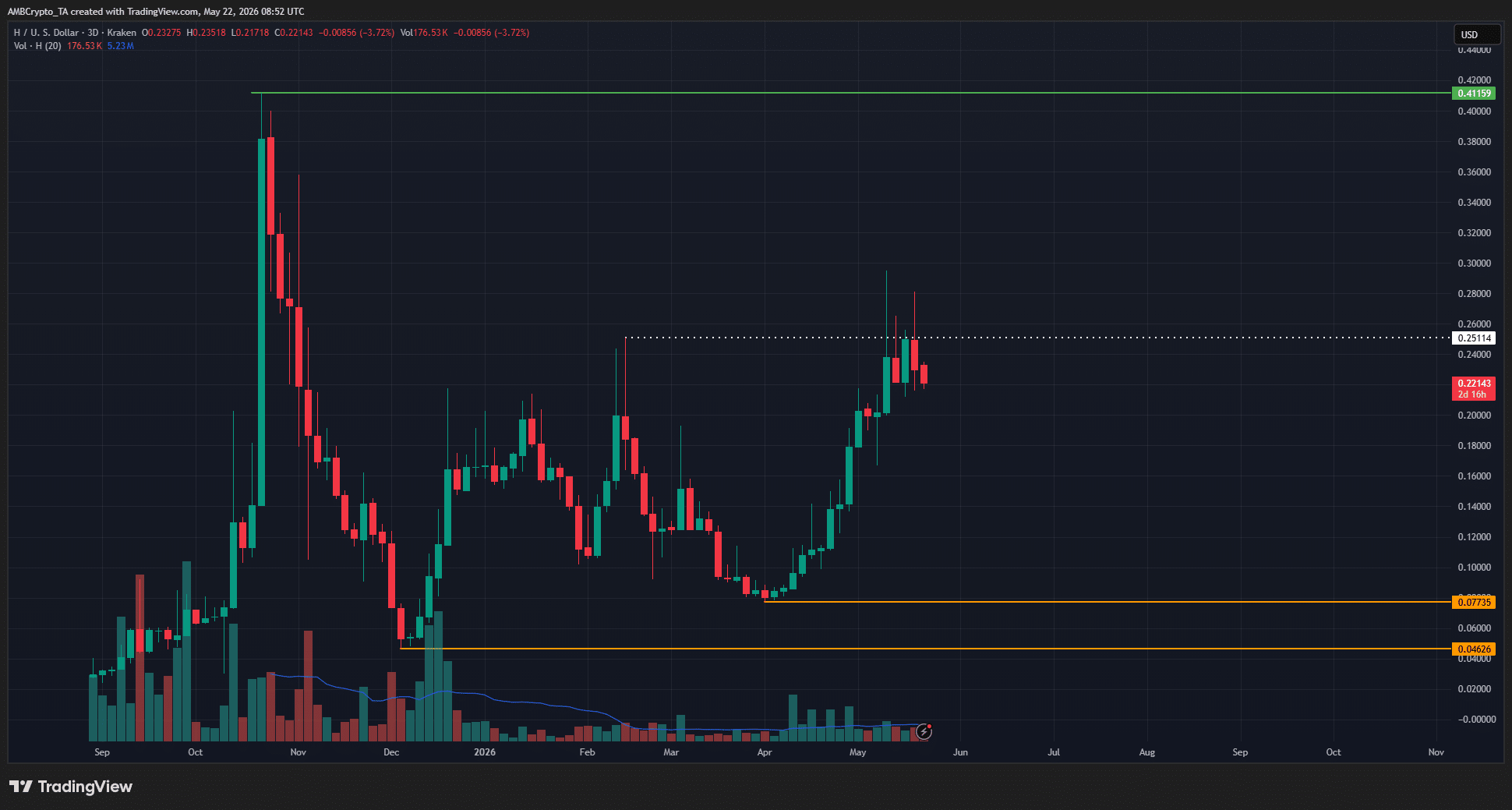
Source: H/USD on TradingView
The higher low at $0.046 kept the long-term uptrend alive. Meanwhile, $0.77 and $0.251 were the key horizontal levels that could decide the direction of the next swing move.
The latter, which marked a high in February, was tested multiple times in May. The bears have refused to budge and, in the previous week of trading, managed to push the buyers backward.
The recent rejection showcased the strength of the sellers at the local resistance zone. Is it enough to bring about a deeper correction, or is it only a matter of time before the Humanity bulls succeed?
The range formation and the H retracement potential
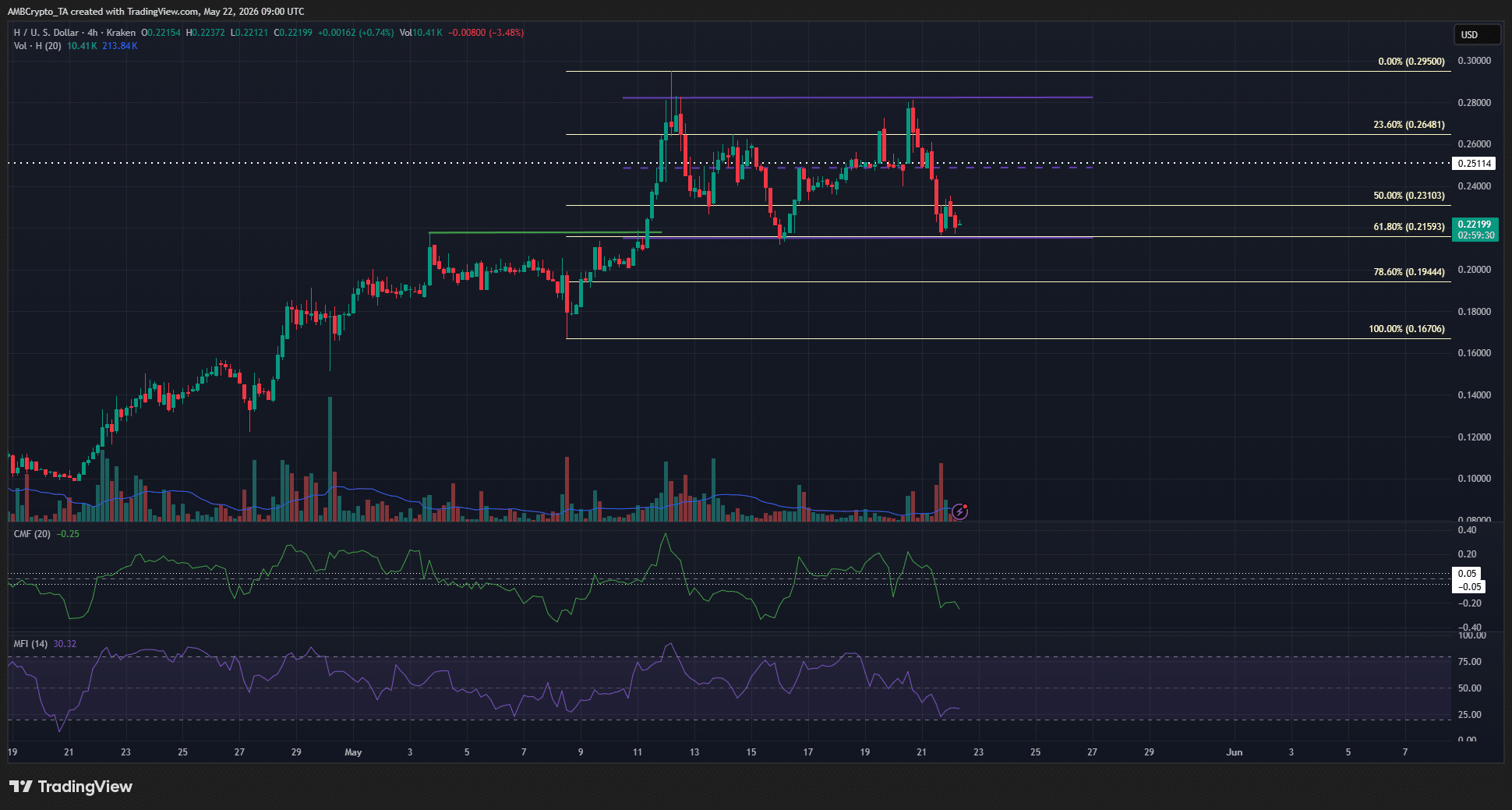
Source: H/USD on TradingView
Can an asset be both rangebound and in a retracement phase? The 4-hour chart of Humanity Protocol showed how this is possible. A structural break (green) earlier in May set up a bullish swing move.
Using this rally from $0.167 to $0.295, a set of Fibonacci retracement levels was plotted. H has retraced to $0.215, the 61.8% retracement level, twice in the past ten days.
The second retest of the same support zone could yield a bullish reaction, since H also appeared to be trading within a range in recent days.
Traders should be cautious of buying at the $0.215 local lows. The CMF was well below the -0.05 threshold, showing hefty capital outflows and intense selling.
The MFI agreed with this finding, indicating both selling pressure and downward momentum with a reading of 30.3.
Despite the short-term range formation, a deeper retracement to $0.194 or even the $0.167 swing low on the 4-hour chart was possible. Traders can maintain a bullish bias but also be prepared for the possibility that the $0.215 support might not hold.
Final Summary
Humanity Protocol shed 13.2% in the past 24 hours after its rejection at the $0.28 local range highs recently.
The higher timeframe trend was bullish. Swing traders can remain confident of a continued uptrend so long as the $0.167 low is defended.
But Carri has already been plying the corridors of Grab’s Singapore headquarters, says chief technology officer Suthen Paradatheth. And Carri’s not alone. “We don’t oblige our business units to just use our robots,” Paradatheth told Fortune during an interview on the sidelines of the Asia Tech (ATx) summit. “If you go to the Grab office now, you’ll see robots from other companies as well. We use a 1+n strategy which keeps us on our toes.”
Paradatheth has been involved with Grab from almost the very beginning, before the company even got its name. He joined the firm, then a Malaysia-based ride-hailing outfit called MyTeksi, as a part-time consultant after a mutual friend introduced him to its founders, Anthony Tan and Tan Hooi Ling.
“Our mission was to make taxis safer in Kuala Lumpur,” Paradatheth explained. “Ling told me a story of starting a call with her mom whenever she rode home at night; even if they didn’t speak, it was a way to make sure the driver knew she was being monitored by someone.” The anecdote hit home for Paradatheth, whose own sister had similarly recounted feeling unsafe while riding taxis. “I saw a very real problem to get involved in,” he said.
Paradatheth joined full-time in 2015 and followed the company to Singapore, where it rebranded to Grab. He then moved through roles including chief of staff and head of engineering for research and development, before being appointed as CTO in 2022.
“A lot of folks have grown with the company, just like me,” he said. “Many of the senior leaders in the company are people who were with me during the 2012 storeroom days; they came as interns and are now heads of engineering.”
Building a Southeast Asian tech empire
Grab, No. 128 on Fortune’s Southeast Asia 500 list, reported $2.8 billion in revenue last year, up from just $469 million in 2020.
Paradatheth credits the global rise of smartphone ownership for Grab’s growth, but he remembers a time when the device wasn’t quite so ubiquitous. “Back in 2012, smartphones were still a thing that only early adopters were buying.”
Grab decided to give its drivers a basic smartphone, a Samsung Galaxy Y, so they could access the app. Drivers could pay for the phone via installments or through a cut of their earnings.
“In Southeast Asia, we’re working under pretty tight economic constraints, with most markets being emerging markets,” Paradatheth said. “And so engineering for that—both in terms of optimizing for what the customer has and what they can use, and making sure we’re constantly able to drive down costs—have been things we’ve invested in from those early days.”
Grab’s app has expanded far beyond ride-hailing to include digital payments, insurance, and delivery. It also developed its own mapping service, GrabMaps, weaning itself off third-party mapping solutions like Google Maps.
“We found that third-party mapping providers just didn’t have the coverage we wanted,” Paradatheth explained. “For example, the small side roads which our two-wheel riders on motorcycle taxis use weren’t really captured in third-party maps.”
‘AI first, with heart’
Grab has embedded over 1,000 AI models into its platforms, and leaders claim they’re guided by the principle “AI first, with heart.”
He points to Grab’s AI-powered translation model, which it built to provide in-app translation for Southeast Asia’s languages, as an example of the firm’s attempts at harnessing the technology. He said the tool is 90% accurate, and can even capture informal contractions and “SMS speak”. (The firm now operates in eight markets across Southeast Asia and entered Taiwan in March, after paying $600 million to acquire Foodpanda’s local business.)
“Southeast Asia, in particular, has layers of locality,” he said. “There are thousands of languages, but also lots of tourists from China, Japan and South Korea who come to visit, and often, English isn’t their primary language.”
Grab is also working to strengthen AI literacy and adoption in the markets it operates in. The platform will launch a program for small- and medium-sized enterprises in its home market of Singapore, hoping to encourage AI adoption across 10,000 food and beverage, e-commerce, and retail firms.
Still, Grab’s push towards AI is worrying some who rely on the platform for their income. The platform is making a big push towards automated driving, investing in several self-driving vehicle startups and launching a robobus in Singapore.
“We are living in a world where humans who don’t embrace AI will very likely be displaced. This is not a dystopian future, folks, it is a reality we must confront today,” said Grab CEO Anthony Tan during the firm’s flagship event in Jakarta in April.
Paradatheth swears that humans will remain at the heart of all Grab’s operations. “We don’t see our autonomous vehicles or delivery robots as substitutes for people,” he said. “We see them as complementary to what our driver partners already do.”
Looking forward, he wants Grab to become a global leader in urban embodied AI. “There’s an opportunity to provide all kinds of optimization—to make journeys smoother, and living in cities more enjoyable and fun.”
Palo Alto Networks (PANW) just picked up another vote of confidence from Wall Street, and it arrived at a busy moment for the stock.
Shares closed at $247.55 on May 18, near a fresh all-time high reached days earlier.
For a stock that fell roughly 20% over the prior year, that swing matters to anyone holding it.
The new call gives investors something concrete to weigh before the company opens its books.
Palo Alto Networks is the largest pure-play cybersecurity firm by market value.SOPA Images / Getty Images
Morgan Stanley raises its PANW price target to $253 on firewall and AI security demand
Morgan Stanley analysts Meta Marshall and Keith Weiss raised their price target on Palo Alto Networks to $253 from $223 on May 20, keeping an Overweight rating, TipRanks reports.
That implies about 2% upside from the May 18 close, modest on its own but notable given how far the stock has already run.
The bank pointed to strong demand across firewall refreshes, Prisma SASE, Cortex XSIAM and AI security as the drivers.
A firewall refresh is the cycle where companies replace aging network security hardware, and that replacement wave is now feeding revenue.
More Tech Stocks:
The firm based the new target on a higher 37x multiple of estimated 2027 free cash flow per share, up from 32x, a sign it now thinks investors will pay more for each dollar Palo Alto generates.
Why the timing of the Palo Alto Networks call points straight at June 2 earnings
The upgrade is not random. Palo Alto Networks reports fiscal third-quarter results on June 2 after the market closes, and analysts are positioning ahead of it.
Morgan Stanley expects the company to beat consensus on remaining performance obligations, a measure of contracted future revenue that hints at demand the income statement has not yet recorded.
The bank sees RPO growing closer to 33% year over year, above the midpoint of management’s own guidance.
It also expects product revenue to land well above the roughly 25% growth management guided to.
Two recent prints set the table: Fortinet grew product revenue 41% in its first quarter and lifted full-year guidance, per sec.gov, while Cisco beat on networking.
Such strong numbers from rivals often signal that the whole firewall market is healthy, which works in Palo Alto’s favor.
How the Idira identity launch reshapes the Palo Alto Networks growth story
The bigger structural change sits in identity security, the work of controlling who and what can access a company’s systems.
That job is getting harder fast.
As AI agents start acting on their own inside companies, the number of things that need permission to log in and move data is exploding, and each one is a target.
Palo Alto is moving to own that problem. As announced in a Palo Alto press release, the company introduced Idira on May 12 as its next-generation identity platform, built to manage access for humans, machines, and AI agents.
The launch makes the company’s $25 billion CyberArk acquisition a built-in part of the platform instead of a separate, standalone product.
Morgan Stanley sees three reasons Idira matters:
It gives a clear answer for why identity belongs inside a security platform, since agentic AI makes privileged access far more common.
It opens a cross-sell path into Palo Alto’s base of more than 70,000 customers.
It lets existing CyberArk customers add zero-trust and machine identity tools over time.
The thesis is that identity becomes a fourth pillar alongside network, cloud, and security operations, widening how much each customer can spend.
What still has to go right for the $253 PANW target to hold
A higher target is not a guarantee, and the setup carries real risk.
The stock trades at a premium valuation, with a forward earnings multiple far above the market, so any growth wobble can hit the shares hard.
Palo Alto fell more than 5% after its last two earnings reports despite beating estimates, a reminder that a strong quarter does not always lift the stock.
Morgan Stanley also flagged possible pressure on hardware gross margins from rising memory costs, though it noted hardware makes up a smaller share of Palo Alto’s revenue than it does for competitors.
For the bull case to work, a few things need to land.
Here are four signals to watch on June 2:
RPO growth at or above the 32% to 33% range that management guided to
Product revenue clearing the 25% growth bar, helped by early firewall ordering
Next-Gen Security ARR holding its roughly 56% growth pace
Early signs that customers are adopting Idira and CyberArk tools
If management reiterates its full-year guides, as Morgan Stanley expects, the durable-demand argument gets stronger.
How PANW stacks up against the broader market and its peers
Context helps here. Palo Alto carries a market value near $176 billion, making it the largest pure-play cybersecurity name.
The stock’s roughly 78% climb off its 52-week low of $139.57 has far outpaced the S&P 500 over the same window, after touching a record high in mid-May.
However, Wall Street is not unanimous on price, even while broadly bullish.
Recent targets range widely.
Here’s where analysts stand ahead of earnings:
Oppenheimer set a Street-high $275 after the CyberArk Impact event, Barchart reports
Truist moved to $275 from $200, and RBC Capital lifted its target to $255
The consensus average sits near $223, with a low of $114 and a high of $285, per Stock Analysis data
That spread reflects a debate over valuation, not the company’s growth.
The takeaway for Palo Alto Networks investors
Morgan Stanley’s move to $253 fits a wider pattern of analysts raising targets ahead of the June 2 report, driven by firewall demand, AI security traction, and a cleaner identity story following CyberArk.
The case rests on Palo Alto beating its RPO and product revenue guides while showing early Idira adoption.
The risk is a stretched valuation that has punished the stock even on good news.
Investors who already own PANW have a clear checklist for earnings day, and those waiting on the sidelines may want to see the quarter before paying near record prices.
Either way, the demand trends Morgan Stanley is betting on get tested in a matter of days.
When a blockchain leans into a stablecoin strategy, it typically signals a more forward-looking shift.
The idea is pretty straightforward. Payments are a trillion-dollar global market, and Layer-1 chains are clearly aiming to position themselves in the middle of it. Stablecoins are becoming the core settlement layer in this shift. As a result, much of the recent market activity is increasingly revolving around this narrative.
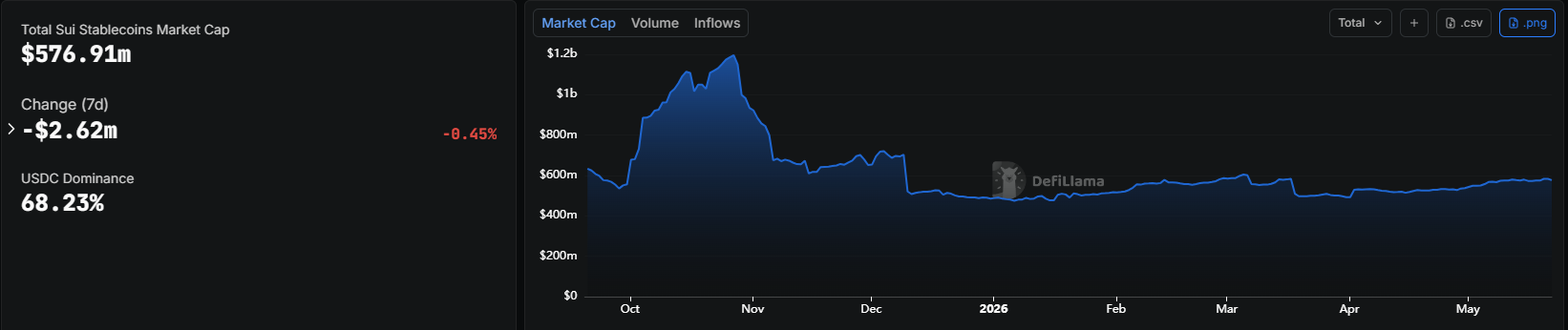
Additionally, Sui has rolled out gasless stablecoin transfers. It is a protocol-level upgrade that lets users and businesses send supported stablecoins peer-to-peer without paying gas fees or needing to hold a separate SUI token balance. In simple terms, stablecoin transfers on Sui are now basically $0 in fees.
Source: DeFiLlama
Notably, the feature has been launched with support for stablecoins including USDsui, SuiUSDe, USDC, and USDY.
From a technical standpoint, this allows institutional users to move across these stablecoins with zero gas fees on supported transfers. With over 68% of Sui’s [SUI] stablecoin supply in USDC, its inclusion makes sense while further strengthening Sui’s overall stablecoin ecosystem. In fact, it is up by 9% in Q2, adding roughly $50 million in net inflows. More importantly, this lines up with SUI’s 25%+ rally too.
Naturally, the question becomes – Is Sui’s technical strength now reflecting stronger on-chain fundamentals, with recent stablecoin developments pushing SUI closer to being “Wall Street ready?”
As noted earlier, SUI’s stablecoin model is centered around global payments infrastructure.
To assess its impact on DeFi positioning, the key focus is whether the network is already seeing meaningful growth in on-chain activity, especially transaction counts, and what that signals for potential shifts in institutional flows and overall ecosystem momentum.
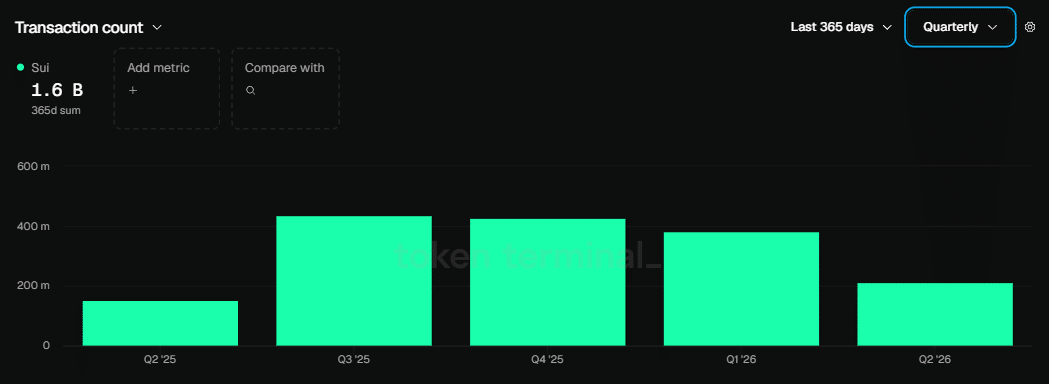
Notably, the impact could be significant. As the chart below shows, SUI’s transaction count has totalled around 1.6 billion since Q2 2025. Although QoQ activity has declined, it is still processing higher transaction volumes than Ethereum [ETH], with SUI’s Q2 2026 count at 215 million versus Ethereum’s 117 million.
Source: Token Terminal
In essence, SUI’s technical strength reflects sustained real usage on-chain.
Against this backdrop, making stablecoin transactions free on the network is clearly strategic. With already strong on-chain activity, fee-free transfers could further amplify this trend, making a 400 million+ transaction quarter on SUI increasingly likely.
More importantly, this could mark the start of a broader trend. With SUI already leading altcoins in both technicals and fundamentals, the stablecoin model may further widen that gap, reinforcing its push towards institutional adoption and strengthening its edge in the growing DeFi competition.
Chun Wang, the Chinese-born Maltese-Kittitian crypto investor who co-founded F2Pool, has been named Mission Commander for SpaceX’s first commercial human spaceflight interplanetary mission to Mars, crucial to Elon Musk’s plans to send one million people to the Red Planet.
Wang, whose mining pool controls roughly 11.3% of the global Bitcoin network hashrate and whose personal bitcoin assets are estimated to exceed $300 million, will take a two-year leave from his current role securing digital ledgers to leading humanity’s next frontier in deep space.
The SpaceX announcement comes as the company owner Elon Musk’s aggressive plans to colonize the Red Planet and establish a multi-planetary civilization continue to accelerate.
A two-year trek into the unknown
The ambitious, multi-phase timeline will take Wang on a a week-long circumlunar fly-by within approximately 125 miles of the moon’s surface alongside Dennis and Akiko Tito before launching on the historic Martian trajectory.
Target launch windows are currently driving technical preparations for a planned 2026 departure. Once launched, the crew will spend two consecutive years in space. The deep-space itinerary includes a full external exploration of the Earth-Moon system, a high-altitude fly-by of Mars, and a complex return trajectory back to Earth.
Navigating deep-space risks
Operating in deep space for 24 months introduces severe operational risks, including severe hardware fatigue and the volatile thermodynamics of managing cryogenic fuel during extended coasts in deep space.
To mitigate these hazards, SpaceX is debuting its next-generation Starship V3 architecture. The upgraded vehicle features vacuum-jacketed header feed lines, high-voltage cryogenic recirculation systems, and 60 integrated custom avionics units capable of handling distributed fault isolation up to 9MW of peak power.
The crew will faces acute biomedical dangers when gathering critical diagnostic telemetry. One of Wang’s team key tasks is performing advanced behavioral health tracking and capturing the first-ever human X-ray images in microgravity to evaluate long-duration physiological deterioration.
The path to a multi-planetary future
Wang’s mission is designed to deliver the crucial operational data required to transition Mars exploration from short-term novelties to permanent, self-sustaining habitats.
The data crew is expected to return to Earth, which will directly stress-test Starship’s autonomous navigation matrix, deep-space radiation shielding, and in-space propellant transfer mechanisms.
The SpaceX team’s findings will be vital to achieving Musk’s ultimate objective: verifying rapid vehicle reuse and validating the logistical baseline required to safely transport millions of tons of cargo and eventually a million citizens to the Martian surface.
The journey to Mars announcement comes as SpaceX, the satellite and space rocket company, confidentially filed for its public offering targeting a valuation upwards of $1.75 trillion, the largest in history. It also comes as Musk’s company officially revealed, for the first time, its bitcoin holdings, totaling 8,285 BTC.
Collins, a Midwest-based lawyer, has been buying Everlane — a quintessential millennial brand — for over a decade. She recently ordered a haul for a trip to Europe, and is a fan of their jackets, pants, and minimalist aesthetic. To her, Shein — which has been dinged for its working conditions and environmental impact — is a very different beast.
“I’ve never had a good impression of them,” Collins told Business Insider on Monday after Puck News first reported the sale. On Friday, the news became official. In a statement to Business Insider, Alfred Chang, Everlane’s CEO, said that the company had reached an acquisition agreement with Shein.
“Everlane will remain an independent brand, staying true to our longstanding brand values, sustainability commitments, and exceptional quality,” said Chang. “We are entering this next phase with expanded global reach, new capabilities, and greater opportunities to bring our mission and products to more customers around the world.”
Current employees told Business Insider that they learned of the initial news via social media and received no information about the sale until Friday’s confirmation. An internal memo seen by Business Insider said that Chang and the leadership team will remain intact and that “this past week has been a hard one.”
Millennial brands like Everlane, characterized by worker- and environmental-friendly practices and a direct-to-consumer model, have faceda reckoning.Lower prices and trendy values have been subsumed by brands’ long-term business needs, forcing them to raise prices when venture capital runs out or to pivot to AI when times get tough.
Silvia Bellezza, an associate professor of marketing at the Columbia Business School, teaches a course on sustainability and business that uses Everlane as the opening case.
“This was like the darling of the direct-to-consumer business model,” she said. “It’s sad because it means that it’s very difficult for brands to really try to put together fashion at reasonable price levels and sustainably.”
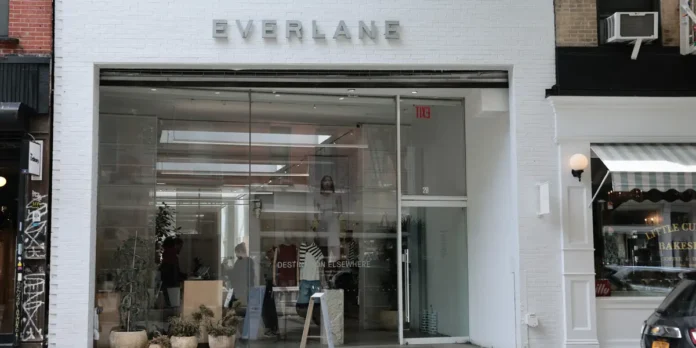
The entrance to the Everlane Soho store.
Michael M. Santiago/Getty Images
As of 2022, Everlane had taken on $90 million in debt — reportedly one of the reasons the brand was looking for a sale. The sale will also offer an interesting new branding opportunity for Shein.
For “Everlane, the target market perhaps is a little older than Shein, which is typically more like teenagers or consumers in their early 20s,” Bellezza said. “I don’t know. I find it puzzling a little bit. It’d be interesting to see if it is to kind of greenwash their name.”
The end of a millennial-coded sustainable fashion era
On Monday,the tranquil glass box of the Everlane store in downtown Manhattan felt far from the news of a sale.Ambiance-setting candles flickered by registers, and minimalist shelves still boasted cotton and linen apparel. A store associate said they learned about the news of the sale with the rest of the world.
Olivia Lobo, a stay-at-home mother and Gen Z/millennial cusper in Florida, is grappling with what she sees asthe loss of her staple brand.
“I care a lot about ethical consumption and the environmental and social impacts of my purchases, but I’m also on a limited budget,” she said.
Lobo, who considers herself a thoughtful consumer, usually ponders most purchases for months and researches clothing companies before pulling the trigger. She loved Everlane because of its ethics and price point. Now, though,she said she won’t be purchasing from them. Instead, she’ll spend more time scouring online resale groups, rather than fast-fashion-filled thrift stores, for higher-quality pieces.
“I don’t love how much time it takes to find items that work for me this way, or the environmental impacts of the shipping involved, but it’s starting to feel like the only way I can realistically get good quality, non-toxic clothes within my budget,” Lobo said.
Shoppers (not pictured) were shocked to learn of the Everlane sale.
Michael M. Santiago/Getty Images
Darcy, a retiree who’s been shopping at Everlane for the past three or four years, had just bought a couple of tops. She learned about the store through her adult children and enjoys the quality and price of the clothing. She hadn’t heard about the sale; she said she would keep an eye on the brand and that the sale might affect her willingness to shop there. She joked that she was glad she bought her shirts that day.
“I should have bought them yesterday!” Darcy said.
Julia Kupiec, a Xillennial lawyer and artist, said she’d been shopping at the store since around the pandemic. She’s a big fan of their t-shirts and chinos, and thinks that their basics are well-priced. As an embroiderer, she’s always on the hunt for pieces she can embellish, and Everlane can be a good fit for that. Kupiec had not heard news of the sale and said it made her not want to shop the brand anymore.
“I would also be very on the alert for their quality going down,” Kupiec said. “I feel like usually when companies like this merge, their quality goes into the toilet.”
Farah Naguib, a Gen Z shopper, was admiring some of the brand’s flats and loafers in the store with her sister. She thought the quality of the shoes seemed nice and liked the shirts she saw. She also hadn’t heard news of the sale; when I informed the sister duo of the sale, they asked if the brand had been offloaded to private equity. At the news that it was reportedly Shein, they gasped.
“I work in climate sustainability,” Naguib said. “I don’t like fast fashion, which is also why I don’t buy a lot of things. Oh my gosh, that’s so sad.”
Worldcoin [WLD] has rallied considerably in recent days. It was up 10.4% in the past 24 hours. Since making a local low of $0.226 on Sunday, the 17th of May, WLD has climbed by 23.95% in five days to trade at $0.281.
Source: Coinalyze
The Open Interest was up 15.4% in 24 hours and has steadily trended higher in the past five days. The Funding Rate had been negative of late, showing that market participants believed prices would continue the higher timeframe downtrend.
Their conviction was misplaced, however, and the recent price bounce has caught many participants off guard. CoinGlass data showed $571k worth of short positions were liquidated on the 21st of May as the funding rate finally shifted into positive territory.
The rising Open Interest and prevailing bearish sentiment have set up a short squeeze, based on the evidence at hand. Is this squeeze over? Here’s how Worldcoin traders can position themselves in the coming days.
The Worldcoin momentum is close to being exhausted
Source: WLD/USDT on TradingView
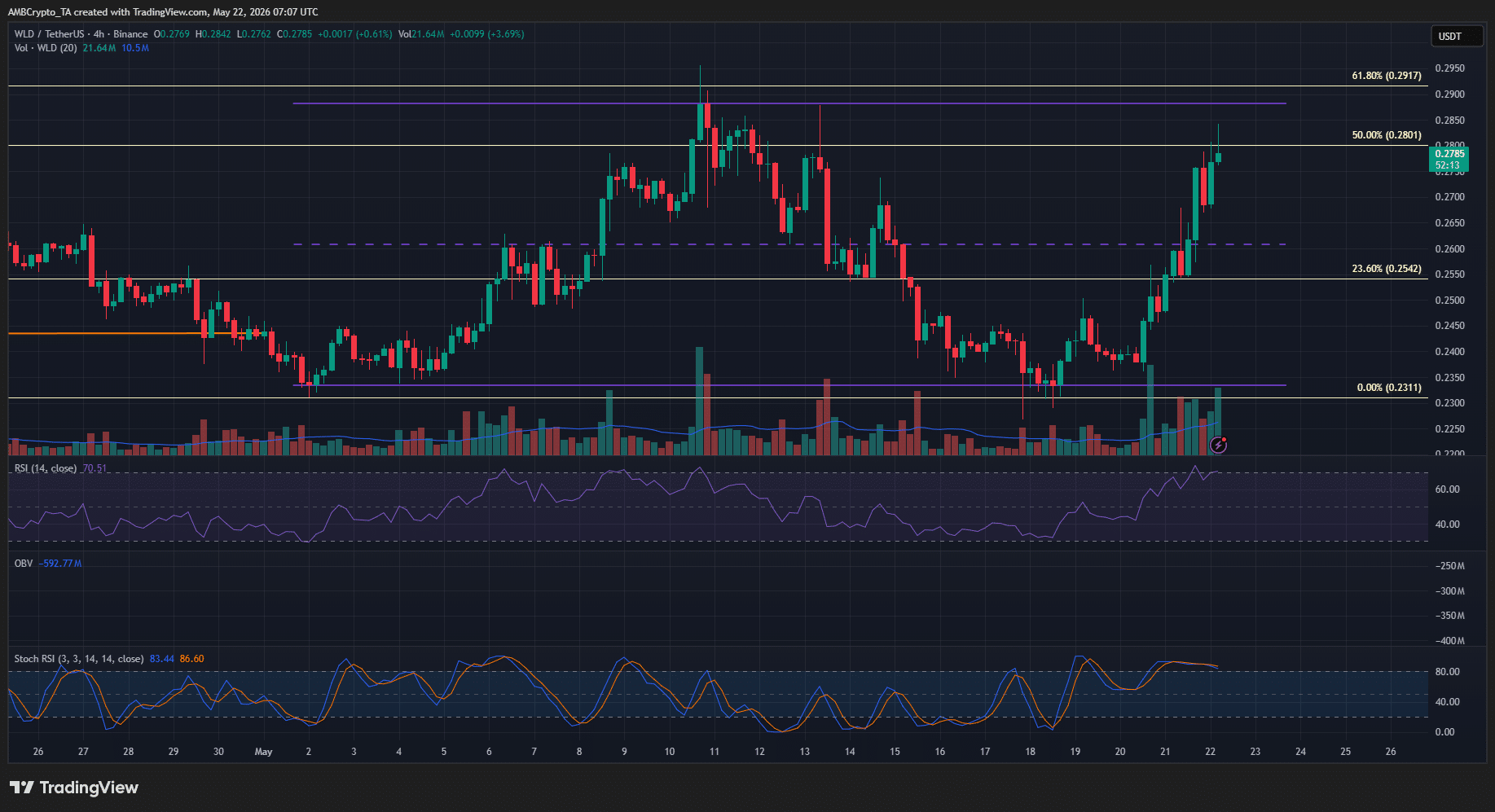
In March and again toward the end of April, WLD made a bearish structure break, signaling a continuation of the downtrend the altcoin has traded within since October 2025. In May, WLD has bounced from the $0.231 support level twice.
Both bounces managed to reach the $0.28 resistance level, which also marked the 50% level of the recent bearish swing move.
At the time of writing, Worldcoin was trading at $0.281. Further north, the $0.291 and $0.308 levels were likely to resolutely oppose any bullish advance.
The OBV was in a steady downtrend, showing sellers have the upper hand. Though the RSI climbed back above neutral 50 and the Stochastic RSI raced higher, the current bounce’s momentum might not be enough to yield a rally beyond the 78.6% retracement level at $0.308.
Source: WLD/USDT on TradingView
Until proven otherwise, traders can treat May’s price action as rangebound. Therefore, a sweep of the $0.288 range highs would offer a selling opportunity.
Based on the higher timeframe trend, even a bullish breakout should be treated with suspicion until the $0.329 swing high is breached.
Final Summary
Worldcoin exhibited strong momentum in the past 24 hours and drew in a sizeable influx of speculative capital.
The altcoin raced toward its $0.288 local highs, but the recent bounce could come to an end soon.