Home Blog Page 427

Ripple sees 4,300 new wallets: Will this fuel XRP’s biggest move yet?

0
Ripple sees 4,300 new wallets: Will this fuel XRP's biggest move yet?


FOMO across assets often acts as a short-term momentum signal. Ripple fits this narrative quite well right now.

From a technical standpoint, XRP has lagged behind most large caps in this Q2 cycle. While liquidity continues to flow heavily into Bitcoin, XRP is still up less than 2% among major altcoins, meaning holders from the past couple of quarters are still largely underwater.

Against this backdrop, the recent spike in new XRP wallets looks like a classic rotational move.

As the data shows, roughly 4,300 new XRP wallets appeared within a 24-hour window, marking the fourth-largest spike of 2026 so far. Such spikes often signal renewed speculative interest in a lagging asset.

XRP
Source: Santiment

Notably, recent derivatives positioning around Ripple [XRP] supports this setup.

According to CoinGlass data, Ripple’s Open Interest (OI) rose by over $20 million over the same 24-hour window, showing that leverage is slowly rotating back into the market.

Given XRP’s technical structure, this buildup in leverage looks relatively high-risk, leaving the asset vulnerable to a breakdown from its 16-week sideways consolidation around the $1.3 level.

That said, this move to new wallets could also point to strengthening retail participation. 

XRP: Macro momentum and on-chain metrics align

In a recent move, U.S. President Donald Trump made another regulatory call. 

From a broader context, he reportedly directed the U.S. government to update regulations to better integrate crypto into traditional finance and payment systems.

With the CLARITY Act still stalled on the regulatory front, this renewed push was enough to trigger a market frenzy, with attention largely centered around XRP.

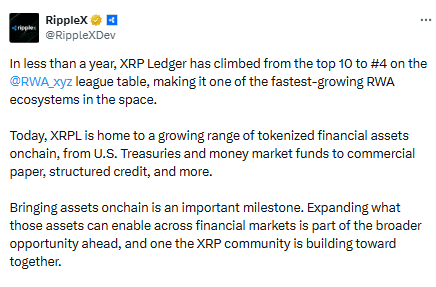
Notably, the underlying metrics support this narrative. As highlighted in the post, in less than a year, XRP Ledger has climbed from the top 10 to 4 on the RWA_xyz league table, making it one of the fastest-growing RWA ecosystems in the space.

Today, XRPL hosts a growing range of tokenized financial assets on-chain, from U.S. Treasuries and money market funds to commercial paper, structured credit, and more.

RippleRipple
Source: X

With tokenization central to crypto regulation, the XRP market frenzy becomes easier to understand.

Supporting this narrative, Ripple’s recent partnerships further reinforce XRP’s growing integration with TradFi markets.

Against that backdrop, rising retail participation in the network doesn’t look like classic short-term FOMO tied to momentum but instead reflects early-stage positioning and broader adoption trends. 

In this context, FOMO may be “evolving” into a key bullish catalyst for XRP this cycle.


Final Summary

  • XRP shows rising wallets and Open Interest, suggesting short-term retail activity and returning leverage.
  • At the same time, regulation and tokenization trends support Ripple’s growth, shifting the story from pure FOMO to early-stage adoption.


Source link

Adding Digital Horsepower To Our Flywheel: Integrated Customer Engagement

0
Adding Digital Horsepower To Our Flywheel: Integrated Customer Engagement


Throughout the first decade of this new century, I (Cliff) became intrigued by how technology and data could be leveraged to learn more about Sonic’s customers and engage with them in ways that would be difficult for others to replicate, creating a competitive advantage.

At the time, the rapid adoption of personal email, internet access, and electronic payment, along with the emergence of e-commerce, had convinced me that technology would become more essential to powering our flywheel and sustaining our momentum and long-term prosperity. It appeared that technology could enable the next wave of innovation for the brand in preparation for the 21st-century customer.

I was convinced that we would need to augment our standard playbook with a series of tech-enabled imperatives that could unlock new opportunities for growth with integrated technology and data – synthesizing the digital and physical to extend our differentiated service model beyond the four walls of our drive-in.

By retrofitting Sonic’s technology infrastructure, expanding digital touchpoints, and enhancing media strategies to meet shifting consumer trends, we built a digital ecosystem that would elevate the brand experience and transform customer engagement in ways that would outstrip all our competitors.

It also occurred to me that this would be a two-way street. By engaging our customers where they were and in a manner that only Sonic could, we would learn such detailed information about them – individually and collectively – as to supercharge our business strategies beyond anything our direct competitors could approach.

Initially dubbed our “Techno-Oval,” we came to refer to it as Sonic’s Integrated Customer Engagement (ICE) ecosystem. It was the combination of technology, digital media, and AI-enabled tools that would completely change how we engaged our customers, both on and off premise.

With our ICE strategy, we:

  1. shifted marketing resources in 2012 from half local to a mostly nationwide-focused fund to prepare ourselves for 21st-century marketing methods (first directed toward national cable, but ultimately aimed toward ICE),
  2. digitally retrofitted 3,500 Sonic stores, enabling the integration of all touchpoints in the customer chain of engagement,
  3. established our own proprietary media and data network for the brand, with over 100k distribution points for targeted and personalized promotional content (interactive, video-enabled drive-in stalls), providing an opportunity to interact one-on-one with every customer who pulled into a stall, and
  4. started to analyze the massive data collection provided by each transaction and utilize it for our AI-enabled customer relationship management (CRM).

The full implementation of ICE in March 2018 had become so intuitive to the customer experience – and so seamlessly embedded in the operating model – that its momentum carried well beyond Inspire Brands’ acquisition in December 2018. With little else materially new in the marketing mix, Sonic’s positive systemwide same-store sales momentum continued to flourish in 2019, while Craig and I watched the brand’s ongoing success from the outside.

In the midst of the COVID-19 pandemic, sales skyrocketed. Shocking? Not at all. With our bold new mobile experience fully deployed in the spring of 2018, the customer could order and pay from the comfort of their own home or car, then pull into a parking stall to pick up their meal. ICE and COVID accelerated a customer-led trajectory already well underway.

The result? FILET! Every customer was “First In Line Every Time.

Turbocharging ICE in the AI Era

We’ve now entered a new phase of business evolution and opportunity for ICE-enabled growth.

Connectivity removed the barriers of time and distance. Mobile unlocked personalization at scale. And now, AI can rapidly accelerate insight into action throughout all levels of the operating model, amplifying execution.

AI doesn’t just accelerate decisions; it predicts demand, automates workflows, creates content, orchestrates operations, and continuously learns. Embedded intelligence will boost organizations to higher levels of performance.

The winners will be those who treat AI as an embedded business capability, integrated into the brand experience not just a set of tools.

Those who connect “algorithmic” intelligence directly to the customer experience, unit economics, innovation velocity, and brand differentiation will succeed.

ICE was designed and built to support AI-enabled strategies by serving as the digital plumbing for embedding data and intelligence anywhere throughout the operating model. But we didn’t chase technology. Instead, we integrated the technology in such a way as to:

  • reduce friction in the customer experience,
  • improve unit economics,
  • extend the brand beyond the four walls,
  • and preserve what made Sonic, Sonic.

ICE wasn’t a side initiative. It was embedded directly into how we operated and engaged with our customers.

The ultimate takeaway is this:

Customers have integrated technology into their lives and daily practices. Brands that effectively integrate technology into their customer experience (in a way that improves that experience) can begin to leverage 21st-century brand-building to keep their strategic flywheel turning.

These same brands will then have the opportunity to learn from their customer engagement so that AI and other current tools can augment their CRM far beyond the reach of traditional marketing methods.

These two layers are the real skyrocketing opportunity of 21st-century brand-building and the highly refined customer engagement that is now possible!

But momentum is never permanent; it must be renewed and re-energized again and again over time.

Stay tuned. In our next blog, we will discuss what happens when the differentiated value proposition that fueled Sonic’s sustained momentum and growth for decades is abandoned.


Source link

Perpetua Resources receives $2.9bn loan from EXIM

0
Perpetua Resources receives $2.9bn loan from EXIM


Perpetua Resources has received a $2.9bn senior secured long-term loan from the Export-Import Bank of the US (EXIM) to develop the Stibnite Gold Project in Idaho.

This funding is part of EXIM’s Make More in America Initiative (MMIA), designed to enhance domestic manufacturing and job creation.

The loan approval from EXIM followed comprehensive technical, financial, environmental and social evaluations, along with a 25-day notice period to Congress.

The Stibnite Project is said to be the only identified domestic reserve of antimony, a crucial mineral for national security and industry.

The loan, alongside Perpetua’s cash reserves, is expected to cover the project’s construction costs.

The project aims to sustainably redevelop the abandoned Stibnite Mining District in Idaho, focusing on gold production and establishing the only reported domestic reserve of antimony.

It involves environmental clean-up, securing antimony for US commercial and defence needs, and creating an average of more than 700 direct jobs annually, contributing significant tax revenue to local communities and Idaho.

The loan includes a $2.4bn upfront facility, with the rest allocated for capitalised interest and EXIM’s exposure fee.

Interest on the loan will align with the long-term US Treasury bond rate, adding 100 basis points, and will be fixed at the initial drawdown. Repayments are expected to begin in 2030.

Perpetua Resources president and CEO Jon Cherry said: “It is time to make more in America and today marks not only a key milestone for Perpetua Resources but a significant step in mineral security for our country.

“When the federal government and private industry work together on a shared national priority, big things are made possible. The $2.9bn loan positions us to bring the Stibnite Gold Project to life and signals a new day in American mineral independence and responsible mining.”

The loan is set to be available in the latter half of 2026, pending completion of final documentation and customary conditions.

Perpetua Resources’ engagement with EXIM began in 2024, leading to this approval after thorough evaluation.

Endeavour Financial is acting as the financial advisor for the loan, with Hunton Andrews Kurth providing legal counsel for the company’s transaction.

In October last year, Perpetua secured $255m through equity investments from Agnico Eagle Mines and JPMorganChase, collectively referred to as the private placement.

“Perpetua Resources receives $2.9bn loan from EXIM” was originally created and published by Mining Technology, a GlobalData owned brand.


Source link

Understanding BEAT’s 2-day rally, driven by whales and an AI narrative

0
Understanding BEAT's 2-day rally, driven by whales and an AI narrative


Audiera [BEAT], an entertainment blockchain token, is among the top rebounding altcoins thanks to the trending AI narrative. BEAT is up more than 13% in the past 24 hours. This rally is an extension of the previous day’s 22% surge, 35% total.

The double-digit rally in two consecutive days was driven by capital rotation into AI-themed tokens and whale activity.

BEAT’s whales positioning

According to Arkham data, 11.423 million BEAT tokens worth $6.58 million were withdrawn from the Gate exchange to 10 fresh addresses. Another 4.9 million BEAT was transferred from Gate but was yet to be distributed.

The distribution left each of these wallets holding 0.1% of the chips to make the top 100 holders less concentrated.

However, a pre-control of more than 16 million BEAT tokens raises concerns unless the team distributes the supply fairly among the community.

AudieraBEAT
Source: Arkham

Additionally, derivative whales were pumping capital into the altcoin. Over the past month, the token delivered about a 75% buyer retention rate on BNB Smart Chain.

Of the 138 whales on Binance, 102 were in profit. Most of the accumulation occurred at around $0.58, with more than $1.129 million in unrealized gains.

BEAT price gaining upward momentum

The price charts showed BEAT was rebounding from the lows of around $0.19, levels the token launched at. The recovery began in late February following a two-month price movement above $0.18.

The rally of March that took BEAT to $0.788 retraced by almost 90%, and bulls have since picked it up again. BEAT is now bouncing off a rising trendline support with the most recent peak at $0.86.

The Money Flow Index (MFI) is in the overbought zone, suggesting bulls are buying. Furthermore, the Stochastic Momentum Index (SMI) indicates the buyers are gaining more momentum.

BEATBEAT
Source: BEAT/USDT on TradingView

Therefore, BEAT could be on a path toward reclaiming the $1 mark. However, the altcoin needs to stay above the trendline that has been in place since April.

Dense liquidity clusters form below

While BEAT was trending higher, it was liquidating shorts, which accelerated the uptrend. However, after hitting $0.86, dense clusters of liquidity are forming below the current level of $0.75.

Using the liquidation heatmap data, the altcoin may drop to $0.65, where dense liquidity is located. The level also aligns with the trendline support. Other notable areas of interest were at $0.72, $0.70, and $0.68.

BEATBEAT
Source: CoinGlass

Still, BEAT may tap into $0.78 and $0.81 levels, which were in close proximity to current prices before correcting.


Final Summary

  • BEAT rallies 13% in 24 hours, extending its double-digit gains for two consecutive days this week. 
  • BEAT was showing signs of uptrend continuation, but dense liquidity clusters were forming below current levels, which suggests a potential correction. 


Source link

Bitcoin (BTC) left behind in the geopolitical melee: Crypto Daily

0
Bitcoin (BTC) left behind in the geopolitical melee: Crypto Daily


The current state of financial markets is best described as macro-geopolitics first, crypto second.

The evidence is clear. Despite recent positive regulatory developments related to the Clarity Act, bitcoin has shown little excitement, trading near $77,200 – largely unchanged over the past 24 hours and for the week.

Meanwhile, oil remains elevated near $100 and speculative capital is pouring into copper amid fears of a sulfur shortage. The connection? Copper production is heavily dependent on sulfuric acid, whose supply has been disrupted through the Strait of Hormuz.

In essence, everything is revolving around Hormuz, driving commodity flows and prices higher, stoking inflation fears, lifting bond yields, which are supposedly weighing over crypto. The U.S. stocks, meanwhile, hover near record highs, driven by AI optimism.

Bitcoin is not at the center of this geo-economic and AI repricing.

It is no surprise, therefore, that U.S. spot bitcoin ETFs continue to bleed, recording $1.15 billion in outflows this week after $1 billion last week, according to SoSoValue. The Coinbase premium, a key gauge of U.S. demand relative to the rest of the world, has hit monthly lows.

Analysts have repeatedly emphasized that these indicators need marked improvement before a sustained rally can take hold. The question is whether that will happen while markets remain fixated on geopolitics and AI.

In the meantime, certain corners of the crypto market, particularly on-chain perpetuals and quantum-resistant tokens, continue to show strength, driven by specific news and narratives, as we discussed Thursday. Layer-1 blockchain Near Protocol’s token (NEAR) is the latest addition to that group, surging over 25% in the past 24 hours following the announcement of a major upgrade focused on automated scaling and quantum resilience.

In traditional markets, Nasdaq futures have surrendered early gains and are trading largely flat. Analysts remain broadly bullish on stocks following the latest earnings season. Stay alert.

Read more: For analysis of today’s activity in altcoins and derivatives, see Crypto Markets Today . For a comprehensive list of events this week, see CoinDesk’s “Crypto Week Ahead.”

What’s trending

Today’s signal

HYPE’s 14-day Relative Strength Index (RSI) has surged above 70. While readings above 70 are widely labeled as “overbought,” this interpretation is often misleading.

The RSI is a momentum oscillator that measures the speed and magnitude of recent price changes. A reading above 70 simply signals strong bullish momentum and suggests that the uptrend may still have room to run. It does not automatically mean the asset is overvalued or due for an imminent reversal, as the popular narrative often implies.

In strong trending markets, RSI can remain elevated for extended periods without triggering a meaningful pullback.


Source link

As Bitcoin miners stay strong, BTC’s next major move depends entirely on…

0
As Bitcoin miners stay strong, BTC's next major move depends entirely on...


Conviction is likely to determine the market’s next major move.

From a technical perspective, Bitcoin’s weekly chart has traded within a consolidation range between $60k and $80k for the past 14 weeks.

With price compressing for this long, the eventual breakout could be significant. At this stage, it mostly comes down to whether the market can continue holding its nerve.

That said, current metrics still don’t clearly point to a market bottom yet. Institutional selling pressure has been rising, with the Coinbase Premium Index moving deeper into negative territory.

Meanwhile, BTC has seen four straight days of ETF outflows, while a $584 million long liquidation flushed out leverage from the market without fully resetting sentiment.

Bitcoin
Source: CryptoQuant

In short, institutional positioning currently seems tilted toward a possible downside move once this consolidation phase breaks.

That said, the latest market reaction also highlights a bigger trend beneath the surface. Nearly $500 billion entered the total crypto market cap after reports of a potential U.S.-Iran peace deal surfaced.

That reaction shows macro headlines still drive recent market flows. In this context, institutions continue to position cautiously around Bitcoin [BTC] rather than signal weak conviction or aggressive long-term selling.

Notably, a recent report from CryptoQuant further supports this view, showing that strong conviction around Bitcoin remains intact. 

Bitcoin miner conviction contrasts on-chain signals 

Miners are often the first to capitulate when they sense a bear phase is starting.

The logic is simple: as Bitcoin declines, miner profitability also drops, forcing them to reduce holdings and protect margins, especially when volatility is driven by macro factors.

In this context, data from Binance Pool shows that miner reserves are still declining, meaning miners continue to reduce holdings. This points to ongoing distribution pressure rather than accumulation.

However, other miner metrics, such as MPI staying negative, suggest selling pressure remains controlled compared to previous cycle tops. In essence, miners remain in a wait-and-see phase.

They are not confident enough to accumulate, but not fearful enough to trigger aggressive selling. This still points to consolidation conditions rather than a confirmed market bottom.

MINERSMINERS
Source: CryptoQuant

The key takeaway? In comparison to previous cycles, Bitcoin miner conviction remains relatively strong.

According to AMBCrypto, this marks a key divergence this cycle. Despite technical weakness, institutional selling, and macro volatility, Bitcoin miners are not aggressively capitulating, which supports a stronger case for continued consolidation rather than a full breakdown.

In this context, the recent $500 billion inflow begins to carry more weight. 

With conviction still holding firm beneath the surface, a shift back into a full risk-on environment could position Bitcoin’s current consolidation phase for a stronger upside response.

As a result, this divergence remains a key signal to monitor when assessing whether Bitcoin is forming a cycle bottom.


Final Summary

  • Bitcoin is still consolidating between $60k and $80k, with institutional selling and weak flows suggesting downside risk if the range breaks.
  • At the same time, strong miner conviction and macro inflows create a key divergence that could signal a possible BTC cycle bottom.


Source link

You wouldn’t put your entire 401(k) in one stock. Why are you doing it with your credit card points?

0
You wouldn't put your entire 401(k) in one stock. Why are you doing it with your credit card points?

When Nick Ewen, editor-in-chief of The Points Guy—a publication which exists entirely on the premise of how to best consume one’s credit card points and miles—found out a friend had just redeemed his Amex Membership Rewards points for a vacuum on Amazon, he had the reaction any points obsessive would.

“I was like, you can’t do that,” Ewen told Fortune. Not because Amex points can’t be used on Amazon (they can) but because using them that way destroys their value. Transferred to the right airline partner, those same points could have covered a round-trip flight. Instead, they bought an appliance at a redemption rate that valued each point at less than a cent.

It’s the kind of mistake that happens when someone collects all their points in one place and never learns what they’re actually worth, or what they can be used for.

Ewen has spent two decades in the points and miles space, and one of the principles he returns to most often is diversification. Not just of cards, but of the currencies they earn.

“It’s just like an investor strategy,” he says. “You don’t want to be all in on one stock, because if that stock tanks, you’re going to be left out in the cold.”

The same logic applies to loyalty programs. If you’ve put every dollar of spend toward Delta SkyMiles and then Delta devalues its award chart, raises redemption prices, or eliminates a route you rely on, you’re stuck. You have a pile of currency that just lost purchasing power and have no backup.

“If you are fully in on Delta SkyMiles and then Delta changes something that you don’t like, that doesn’t give you a ton of flexibility,” Ewen says. “Whereas, if you have some miles with Delta, some with United, some with Chase, that allows you to be protected from some of those changes.”

The points comparison to portfolio management isn’t just a metaphor. Airline loyalty programs are now valued in the tens of billions of dollars—in some cases worth more than the airlines themselves. During the pandemic, United, Delta, and American collectively raised $26 billion in debt backed by their frequent flyer programs. United’s MileagePlus alone was appraised at $22 billion, more than double the airline’s equity value at the time. American’s AAdvantage was valued at up to $30 billion while the airline itself was worth less than $7 billion. When there’s a points program that large that adjusts its pricing, the ripple effects hit millions of point balances simultaneously. That’s why Ewen said diversification is the hedge—but it comes with its own negatives, too.

“There is such a thing as being spread too thinly and being too diversified, especially if you are not spending a ton of money from month to month,” he said. “It’s harder to kind of generate significant balances of points.” The person spending $3,000 a month across four different programs may never accumulate enough in any one of them to book anything meaningful. The person concentrating $3,000 on two well-chosen programs has a better shot at a real redemption.

The right approach is somewhere in the middle, and it starts with matching the card to what you actually spend on, not what an influencer told you to sign up for. “The first thing is, what are you trying to do with this?” Ewen asked. “If someone says, ‘I don’t know, maybe a trip, I only travel about once a year, it’s normally a road trip’—great, a cash back card is going to be the best fit.”

How should I spend my points, then?

For people who do travel enough to justify a travel card, Ewen recommends starting with a flexible points currency (like Chase Ultimate Rewards, Amex Membership Rewards, or Capital One miles) rather than a co-branded airline or hotel card. A flexible currency can transfer to multiple airline and hotel partners, meaning you’re not locked into one program’s pricing.

Take, for example, United credit cards, issued by Chase and popular with loyal United flyers. But the Chase Sapphire Preferred, which has a lower annual fee, actually earns at better rates on dining, general travel, and online groceries. And because Chase points transfer to United at a one-to-one ratio, you can end up with more United miles through the Sapphire Preferred than you would through the United card itself. Plus, you retain the flexibility to send those points to Hyatt, Southwest, or any other Chase transfer partner if United’s pricing doesn’t work for a given trip.

“There are, weirdly, oftentimes much better options than having a co-branded credit card,” Ewen said.

Richard Kerr, GM of Travel at Bilt, sees the same dynamic from the issuer side. The co-branded landscape has become so crowded consumers face decision fatigue before they even start optimizing.

“It’s now an incredibly competitive world,” Kerr says. “Not only a million options between different airlines and hotels, but each airline and hotel has four or five different options for you to take a look at.”

More cards means more annual fees, more interchange revenue, and more opportunities to lock a customer into a single ecosystem. For consumers, the antidote is the same one any financial advisor would give about an investment portfolio: spread your risk, know what you own, and don’t chase performance.

“Start with one. Get comfortable with that,” Ewen said for anyone looking to get into the points game. “And then if you add a second one with maybe a couple different bonus categories, have that for six months or a year. Make it part of your muscle memory.”

His wife is the proof of concept: She went from needing a handwritten cheat sheet to knowing instinctively which card to pull at the grocery store, the gas station, and the restaurant.

“It just became part of her muscle memory,” he said. “It took time to get there, but it’s important to not bite off more than you can chew.”

For everyone else—the person who doesn’t want a cheat sheet, who doesn’t want to track quarterly bonus categories, who just wants to stop leaving money on the table without making it a second job— both Ewen and Kerr arrive at the same place.

“Never a wrong way to go,” Kerr says of a no-annual-fee card with a flat 2% cash back on everything.


Source link