
Home Blog Page 429

Anthropic lands in London as AI-powered coding—and the anxieties around it—go mainstream

0
Anthropic lands in London as AI-powered coding—and the anxieties around it—go mainstream

Welcome to Eye on AI. Beatrice Nolan here, filling in for AI reporter Sharon Goldman. In today’s issue: Anthropic’s Claude comes to London…OpenAI’s imminent IPO…Google DeepMind’s union battle…and worldwide AI spending on track to hit $2.59 trillion this year.

Most of Anthropic’s leadership team has hopped across the pond this week. The AI lab is hosting a series of events around the U.K., kicking off with Code with Claude London on Tuesday.

The company used the event to roll out new features for its Claude Agents, including sandboxes that let companies run agents on their own infrastructure, and ‘MCP tunnels’ that let those agents reach internal systems without touching the public internet. In short, new ways for companies to have more control and more security—a possible attempt to calm C-suite nerves about ungoverned AI. 

The London event, Anthropic’s first dedicated developer gathering in Europe, underscores how central the city has become to the AI ecosystem, with the city gaining even more prominence in recent months. Heavyweights including OpenAI, Anthropic, and Jeff Bezos’s AI lab, Project Prometheus, have all announced plans to build out a substantial presence in the city. Anthropic’s Claude event was heavily oversubscribed, with a mix of enterprise customers, startup workers, and Claude enthusiasts pouring into the riverside venue despite the rain. 

Engineers at startups told me they were using Claude Code and similar tools on a daily basis. Are they concerned about the existential risk this may pose to their jobs? Sure. But better the devil you know, they said. There were a few gripes about Claude’s recent performance issues and Anthropic’s lackluster response, but overall people were pretty happy with the product. (To be expected, perhaps at an Anthropic event.)

Enterprise customers were more complicated. While some were embracing the technology headfirst, others say the rollout has been slower. There’s still some uncertainty about what to automate and when, where a human is needed in the loop, and what can be safely handed off to AI tools. There’s also a certain amount of C-suite hand-holding required. All of these questions get much more pressing when dealing with highly regulated sectors like healthcare or banking. 

Anthropic’s head of engineering, Fiona Fung, had some advice for those wondering where to start when automating with Claude Code: “Pick your noisiest workflow…and ask if it’s still serving its purpose. If it’s something that is really expensive, is it something that Claude can handle?”

The main takeaway from the event: software engineering is undergoing a changing of the guard, with the grunt work of writing code increasingly handled by AI while humans concentrate on higher‑level decisions and keeping the systems on track. Coding everything by hand is starting to look less like a day job and more like a niche craft.

Boris Cherny, Anthropic’s head of Claude Code, told me he’s always cared more about the result of the work than the details of how the code gets written, and now many engineers feel the same way—they’re happy to let AI handle most of the coding as long as the business outcome is better. Some engineers miss the craft, he acknowledged, adding that some team members still write code on weekends by hand just because they miss it. Much like analog film photography, Cherny thinks there will always be a place for that kind of work.

“I buy my veggies at a farmer’s market,” Cherny said. “There’s always room for that.”

AI breakthroughs, existential risk, and AI therapy

Meanwhile, Anthropic co-founder Jack Clark headed to Oxford University to tackle some of the more philosophical questions posed by the technology the company is developing. In a wide-ranging and often frank lecture, Clark touched on subjects from the possibilities of Nobel Prize-winning AI aided discoveries to the use of his company’s tools for mental health. Oh, and the “non-zero chance” of AI killing everyone on the planet. 

He also argued that the pace of progress is accelerating to the point where society may struggle to keep up—warning that geopolitical and commercial competition are making it unlikely that development will slow, even if doing so might be safer.

Clark also revealed he had sought therapy in part because he had been using Claude to talk through some of his personal struggles, and the chatbot prodded him to seek out professional advice. 

AI systems need to be designed to do just that, he argued—prompt people to stop using them and seek out real human contact. However, to do this successfully, AI companies may need to be mindful of how they are designing these tools at a higher level. AI chatbots lean toward sycophancy by default, and several recent studies have shown how that tendency can reinforce harmful thinking or overconfidence if left unchecked.

Later this week, Anthropic leaders, including CEO Dario Amodei, are heading to the English countryside for an exclusive CEO forum for European leaders. The event is aimed at helping enterprises understand how they can adopt the company’s technology. What they may find harder to manage is the inevitable pressure from European executives hungry for access to Mythos—Anthropic’s too-dangerous-to-release model that has so far had a limited international release outside of primarily U.S. partners.

With that, here’s more AI news.

Beatrice Nolan

bea.nolan@fortune.com
@beafreyanolan

FORTUNE ON AI

Microsoft lost its way in the AI race. Can Copilot get it back on course? — Jeremy Kahn

SpaceX finally files IPO prospectus, reveals revenue is up–but losses are too  Allie Garfinkle and Alexei Oreskovic

AI IN THE NEWS

OpenAI’s imminent IPO. OpenAI is reportedly preparing to file confidentially for an IPO within days—potentially as early as Friday. The company is working with Goldman Sachs and Morgan Stanley, the Wall Street Journal first reported, citing people familiar with the matter. The move follows a recent legal victory over co-founder Elon Musk, removing a major obstacle. Internally, CEO Sam Altman has reportedly pushed for the listing while CFO Sarah Friar has urged caution. If it goes ahead, OpenAI’s debut would headline what could be a blockbuster year for tech listings, alongside SpaceX and potentially Anthropic. Read more in the Wall Street Journal. 

Google DeepMind’s union request rumbles on. Google DeepMind has declined a request from staff within a U.K. union for voluntary recognition but agreed to enter formal talks. The AI lab will meet unions including the Communications Workers Union and Unite through the U.K. arbitration service ACAS, a process that could lead to a formal employee vote on union representation in the coming months, employees and union representatives told Fortune. The push to unionize follows mounting internal concern about how DeepMind’s technology is used by the U.S. and Israeli governments for defense and intelligence purposes. DeepMind has said it respects its employees’ rights but prefers direct engagement over collective bargaining. Read more in The Guardian.

Anthropic is paying SpaceX $15 billion per year. In one of the more interesting revelations in SpaceX’s IPO filing, Anthropic is paying SpaceX $1.25 billion per month—$15 billion a year—through May 2029 as part of the compute deal the two companies signed earlier this month. The payments will be reduced for May and June as the deal ramps up, according to Wednesday’s S-1 filing. The financial details weren’t disclosed when the partnership was announced last month, only surfacing Wednesday when SpaceX filed for its IPO. Read more in Fortune.

Trump moves to vet AI models before release. According to a report in The New York Times, President Trump plans to sign an executive order giving the U.S. government new powers to scrutinize advanced AI models before they are released. The order would reportedly give the Office of the National Cyber Director and other agencies two months to design a process for reviewing models that companies share 14 to 90 days before launch. The aim is to catch security flaws before they can be used to attack important infrastructure such as banks or utilities. The move was reportedly sparked by Anthropic’s Mythos model, which officials fear could help adversaries discover software vulnerabilities at scale, intensifying internal debates between national security officials pushing for more oversight and those worried about slowing U.S. firms in the AI race with China. Read more in The New York Times.

EYE ON AI NUMBERS

$2.59 trillion 

That’s how much worldwide spending on AI is forecast to total in 2026, a 47% increase year-over-year, according to new data from Gartner. The surge is being driven largely by AI infrastructure—optimized servers, semiconductors, and cloud capacity—which alone accounts for over 45% of spending, with AI-optimized server spending expected to triple over the next five years.

The bulk of that spending is still coming from tech vendors and hyperscalers rather than enterprises, which Gartner says have yet to really flex their spending potential. Model consumption is forecast to grow 110% this year, adding $6 billion in new spending, as companies expand into agentic workflows and multi-step AI processes. Gartner Distinguished VP Analyst John-David Lovelock noted that most organizations are still favoring tactical, incremental AI initiatives over more disruptive transformation, making it harder for CIOs to prove value and show tangible business outcomes from their AI bets.

AI CALENDAR

June 8-10: Fortune Brainstorm Tech, Aspen, Colo. Apply to attend here.

June 17-20: VivaTech, Paris.

July 6-11: International Conference on Machine Learning (ICML), Seoul, South Korea.

July 7-10: AI for Good Summit, Geneva, Switzerland.

Aug. 4-6: Ai4 2026, Las Vegas.


Source link

Jeff Bezos says some Americans should pay zero federal income tax

0
Jeff Bezos says some Americans should pay zero federal income tax


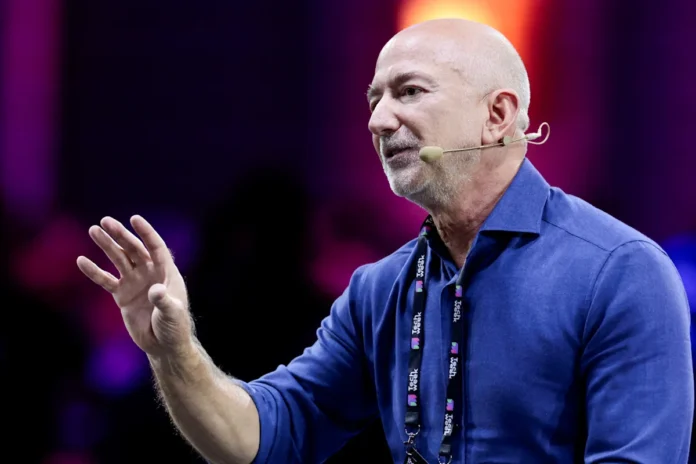
Amazon executive chairman Jeff Bezos, by some estimates the world’s fourth-wealthiest person, has turned the tables on the “tax the rich” effort. He is advocating for eliminating federal income taxes for lower-income Americans.

In an interview on Wednesday with CNBC, Bezos reflected on his upbringing as the son of a Cuban immigrant and a teenage mother, who “brought themselves up” during hard times.

“I want to make sure that the people who are struggling today have a chance to do that, too, to bring themselves up, and maybe they’re going to be the next Steve Jobs,” Bezos said. “Maybe one of their kids will be the next Steve Jobs. I don’t know, but we can give them a better chance by eliminating their tax bill.”

While Bezos also argued that raising taxes on the wealthy will do little to help struggling households, efforts to tax high earners continue to gain traction. New York City mayor Zohran Mamdani launched a “pied-à-terre” tax on luxury second homes of wealthy property owners who don’t live in the city full time. And a half dozen or more states are considering so-called “wealth taxes” as well.

Read more: California billionaire tax moves closer to November ballot: What to know

‘A nurse in Queens should not pay taxes’

Bezos said that the top 1% of earners pay 40% of taxes, while the bottom half of earners pay only 3% of all tax revenue.

“A nurse in Queens who makes $75,000 a year pays more than $12,000 a year in taxes. Does that really make sense? How about we start by having the nurse in Queens not pay taxes? That’s $1,000 a month that could help with rent or groceries or anything. The bottom half of income earners in this country pay only 3% of the taxes. It’s only 3%. We can find 3%,” Bezos said.

Data from the Tax Foundation, a tax research think tank, generally aligns with Bezos’ figures. According to the organization, in 2023, the top 1% of taxpayers paid 38.4% of all federal individual income taxes, while the bottom half of taxpayers, who earn less than $53,801, paid 3.3% of the total.

“When people are starting out and they’re struggling, stop taxing them. We don’t need it. We live in the wealthiest country in the world,” Bezos said.

However, about 76 million households paid no federal income tax in 2025. According to the Tax Policy Center, 70% earned less than $75,000, and 45% earned less than $40,000. Many taxpayers used the standard deduction, as well as other exclusions and credits, such as the earned income tax credit and the child tax credit, to reduce their tax liability, the Tax Policy Center said.

Read next: Get ahead of next year’s taxes: 6 moves to make right now

The ‘Keep Your Pay Act’

There have been congressional bills floating the concept of reducing or eliminating taxes for households of modest means, though none have advanced significantly.

In March, Sen. Cory Booker (D-N.J.) introduced the Keep Your Pay Act, which would make the first $75,000 of income tax-free for households filing jointly.

“This plan can be fully paid for by unrigging our tax system — so that the wealthiest few and the biggest corporations that are getting rich by keeping prices high finally start paying their fair share,” Booker said in a statement announcing the proposal.

The bill was referred to the Senate Finance Committee, where it remains.

A half-million dollars in taxes over a lifetime

While families of modest means surely would applaud a no-federal-income-tax initiative, their tax bills wouldn’t disappear. There are still state and local income taxes, payroll taxes, sales taxes, property taxes, capital gains taxes, and excise, estate, and gift taxes.

An estimate compiled by Paradigm Life Insurance listed 97 different taxes in the U.S. tax code, including:

  • Air Transportation Taxes

  • Biodiesel Fuel Taxes

  • Building Permit Taxes

  • Business Registration Fees

  • Cigarette Taxes

  • Driver’s License Fees

  • Fishing License Taxes

  • Gasoline Taxes

  • Hotel Taxes

  • Hunting License Taxes

  • Inspection Fees

  • Inventory Taxes

  • Library Taxes

  • Liquor Taxes

  • Local School Taxes

  • Professional Licenses And Fees

  • Toll Booth Taxes

  • Self-Employment Taxes

  • Vehicle Registration Taxes

  • Workers Compensation Taxes

And that’s not a complete list.

Self, a financial technology company, estimates that the average American will pay over $520,000 in taxes in their lifetime — a third of all earnings. That includes income taxes, property taxes, and taxes on everything from everyday expenses to the cost of driving the most popular vehicle (a Toyota RAV 4, which costs $38,889 in taxes alone, based on an average of four purchased over a lifetime).

“However, due to local property markets, salaries, and government actions, some states see taxpayers paying even more than the national average,” the analysis said.

New Jersey residents pay the most taxes over their lifetimes ($987,117), while those living in West Virginia pay the least ($358,407), according to the Self report.


Source link

US Special Ops Vets Train Ukrainians to Keep Each Other Alive

0
US Special Ops Vets Train Ukrainians to Keep Each Other Alive


US special ops veterans are training Ukrainian civilians to keep each other alive when ambulances, medics, and rescuers cannot reach them quickly.

In Ukraine, Russia’s drones and missiles hit homes, towns, hospitals, and ambulances, and medics responding to an initial strike may themselves become targets. Civilians close to the fighting might have to treat battlefield-style injuries while waiting hours, or longer, for help.

It is a civilian survival problem in Ukraine, but it echoes a military one. Soldiers in the field often cannot count on the life-saving “golden hour” that Western forces could in recent wars, when quick evacuation and treatment increased the chances of survival.

In Ukraine’s chaotic fight, on and off the front lines, the wounded can end up on their own for long stretches.

Mark Antal, who spent 12 years in the US Army’s 1st Special Forces Operational Detachment-Delta, told Business Insider that “this war is a little different than what we’re used to. We used to control everything.”

In recent wars, Western forces generally fought with air superiority, evacuation networks, and rear areas that were safer than what Ukraine faces now. And Western civilians were far from harm’s way. In Ukraine, by contrast, every part of the country has been struck by missiles and drones, so “no one is safe at any time,” Antal said. And the West worries the same may be true for it in future wars.

Mark and his wife, Christine Quinn Antal, a US veteran and a former Army advisor on security to Ukraine, founded Task Force Antal as a nonprofit organization that has US special operations forces veterans bring life-saving supplies, including medical gear, to conflict zones, including Ukraine, where they train civilians in front-line emergency medicine.

Christine told BI that the purpose is to educate regular people who “never thought that they would be” in a situation where they’re “packing a wound from shrapnel or from an explosion in their neighbor’s apartment.”


A large pile of rubble among damaged buildings with people in high-vis clothing standing on top of it

Russia’s drone and missile attacks are hitting towns and cities, not just military targets. 

Oleksandr Klymenko/Ukrinform/NurPhoto via Getty Images


The goal is to teach civilians to keep each other alive as long as possible, until more help can arrive.

A new type of war

Jeffrey Wells, a US Navy veteran with experience in Afghanistan and Iraq, now working with Task Force Antal in Ukraine, described this war to Business Insider as “very different, first and foremost, than the last 25 years of Western conflict.”

In the wars in the Middle East, the West has had enough control that if someone was injured, “you could get a helicopter there pretty quickly and get them to a hospital.”

Ukraine doesn’t control the sky the way the West did in Iraq and Afghanistan, where US forces still faced serious danger but often had air cover, evacuation routes, and more secure bases behind them. War in Ukraine is a brutal slog, and the same safety nets often are not there for soldiers or civilians.

Wells said that “the airspace is incredibly important to the survivability from a traumatic wound,” but Ukraine shows that control isn’t guaranteed in the future. “I think the last 25 years may be over from commanding the airspace, just from an observation of Ukraine.”

For civilians, that lack of control can result in long waits for help after an attack. “For Ukrainians, especially in the front-line cities, how soon an ambulance might get there, it could be an hour, it could be 12 hours,” Wells said.

Christine said that this war is different from what the West is used to because Russian targets are “just so blatantly civilian.” There are attacks not solely on military targets but also on Ukrainian cities. “Generally speaking, I don’t think we’ve seen such large-scale deliberate targeting of civilian structures or infrastructure,” she said.

In Ukraine, civilians often suffer the same types of injuries as soldiers, often fragmentation injuries from drones and missiles. Task Force Antal initially prepared for gunshots, but that’s no longer the focus. Instead, it’s shrapnel.


Two men in camouflage hold a black and grey drone in a field with white flowers and trees

In Ukraine, most injuries come from drones rather than gunshots. 

Diego Herrera Carcedo/Anadolu via Getty Images


A wait for safety

The West is used to being able to offer quick treatment to soldiers, but in Ukraine, the intense fighting means injured troops can be stuck waiting for days, with only their comrades’ medical skills keeping them alive.

For civilians, the same lesson applies: the first person able to help may be a neighbor, not a medic.

Civilians need to be trained for long wait times and to be patient rescuers, Mark said. Observation, patience, and skill are all necessary. Rushing out into a barrage can be costly. If “you become a victim,” he said, “you can’t help anyone else.”

“We’re seeing more and more of the secondary follow-up attacks,” where Russia targets responders in what are called double-tap strikes.


Two men in dark tracksuits walk over large pieces of rubble

In Ukraine, the regular attacks can delay formal medical help. 

Yan Dobronosov/Global Images Ukraine via Getty Images


Wells said that Russia increasingly launches an attack, “and then kind of waits for emergency services to head on-site and then launch another attack.” Emergency services are having to wait longer before responding, putting more of the first response on civilians already there.

That’s been a learning process for everyone involved in building these skills. “I wouldn’t have realized, even having been in the Army, how important it is to keep your patient warm” through improvisations like pulling curtains down or using bedsheets to pack wounds, Christine said.

She said Ukrainian soldiers and civilians need to know more about medical treatment than what many of their NATO counterparts typically learn. “It’s an anathema in most NATO countries that you would allow or teach laypeople that level of medical care.”

Ukrainian civilians help each other under the threat of secondary attacks, of falling buildings and infrastructure, in the dark and without heat or light sources, and without being able to move with the injured person for long periods, as attacks and targeting continue. To help, Task Force Antal says it distributes items such as battery-operated headlamps, along with medical gear.

Christine said that her organization has “a long waiting list of folks that want us to come to their town or their community.” She said, “These are people like all of us, and their hometowns are under attack.”


Source link

Many retirees don’t know how long their money will last

0
Many retirees don't know how long their money will last


The financial strain from rising costs has become relentless for many retired Americans.

Retirees say everyday expenses are running higher than expected, according to a new survey from investment manager Schroders, and nearly 6 in 10 say they don’t know how long their retirement savings will last.

“The affordability crisis is a daily struggle for many retirees,” Deb Boyden, head of US defined contribution at Schroders, told Yahoo Finance. “With nearly half of retirees reporting their expenses are higher than anticipated, it’s clear many entered retirement without a plan for managing rising costs.”

Read more: How much do you really need to save for retirement?

Healthcare is taking a particularly heavy toll. Retirees report spending an average of 16% of their monthly income on medical expenses such as insurance premiums and prescriptions. Nearly two-thirds said they expected Medicare to cover far more of those bills.

“Many seniors already forgo essentials like medical care because they can’t keep up with rising costs,” The Senior Citizens League executive director Shannon Benton previously told Yahoo Finance.

Retiree Barbara Baratta walks a dog, Duncan, in Short Hills, N.J. on March 17, 2026. (AP Photo/Cathy Bussewitz) · ASSOCIATED PRESS

The survey found retirees’ top financial worries are inflation, healthcare costs, a major market downturn, uncertainty about how to withdraw money from retirement accounts wisely, and the enduring fear of outliving their savings.

The stress is spilling into their daily lives. More than a third worry that financial strain will hurt their overall health. Nearly 3 in 10 say they’ve lost sleep over money and worry about it every day.

Read more: Retirement planning: A step-by-step guide

Asked to describe their current financial situation, just 4% of retirees said they were “living the dream.” Another 37% said they were “comfortable,” while 35% described their situation as “not great, but not bad.”

“It should be a wake-up call for retired Americans who have no idea how long their savings will last,” Boyden said. “Retirement planning doesn’t end once someone stops working. The real challenge begins afterward — creating a strategy for income, inflation, market volatility, and unexpected expenses.”

Kerry Hannon is a Senior Columnist at Yahoo Finance. She is a career and retirement strategist and the author of 14 books, including “Retirement Bites: A Gen X Guide to Securing Your Financial Future,” “In Control at 50+: How to Succeed in the New World of Work,” and “Never Too Old to Get Rich.” Follow her on Bluesky and X.

Sign up for the Mind Your Money newsletter

Click here for the latest personal finance news to help you with investing, paying off debt, buying a home, retirement, and more

Read the latest financial and business news from Yahoo Finance


Source link

Latest AI Behaves More Like Humans By Rudely Interrupting You During Conversational Chats And We Might Relish It

0
Latest AI Behaves More Like Humans By Rudely Interrupting You During Conversational Chats And We Might Relish It


In today’s column, I examine a newly emerging trend that entails how generative AI and large language models (LLMs) are shaped and tuned when it comes to carrying on conversations with humans.

Here’s the backstory. Humans customarily interrupt one another during everyday conversations. We all accept this as a premise of dealing with people. To date, AI hasn’t acted that way. With AI, you take your turn, the AI takes its turn. Very civil and exceedingly polite.

Some AI makers are determined to advance AI and ensure that AI acts more like humans do. As such, the latest AI is devised to interrupt you during conversational chats. You might be telling the AI to explain something to you, but it suddenly cuts you off mid-sentence and starts the explanation. No need to wait until you’ve finished saying what you wanted.

Though this might seem like a blessing, the question is whether humanity is going to feel good about getting interrupted by AI. We are accustomed to not being interrupted by a machine. We expect AI to wait quietly and submissively until we say our peace. This new AI might come as quite a shock to many people, while others might warmly welcome this human-like way of interacting.

Let’s talk about it.

This analysis of AI breakthroughs is part of my ongoing Forbes column coverage on the latest in AI, including identifying and explaining various impactful AI complexities (see the link here).

Taking Turns Is The AI Norm

When using generative AI, the process is as simple as falling off a log. You enter a prompt, and the AI gives you a response. This prompt-response pairing approach is common to nearly all LLMs. Each instance is considered a turn. Humans take their turn during a turn, and the AI takes its turn during a turn.

You might say that this is all perfectly orderly. No one steps on the other’s toes. You tell something to the AI in an easy-going, uninterrupted fashion. The AI responds. On and on this goes. The stopping point is whenever you decide not to enter any more prompts.

Simple and relatively elegant.

Human-AI Dialoguing Is Not Real

Real life is not that way on a human-to-human communication basis. If you think back to any recent conversations that you’ve had with a family member, friend, coworker, or even a stranger, the odds are that they might have interrupted you mid-sentence. Likewise, at some point, you probably interrupted them at mid-sentence. This is a common occurrence. We generally take this in stride.

It can be exasperating at times. A person who continually interrupts you is going to get your dander up. They are acting as though they are superior. They know what you are going to say. They make brash assumptions. Constant interruptions can be belittling, knock you off your stride, cause you to lose your train of thought, and be abundantly irritating.

Humans usually give each other clues when interruptions are getting out of hand. A person might tell the interrupting person that they are being abrasive. Or perhaps the person getting interrupted merely steps away from the conversation. It is conceivable that fistfights might break out, too. You never know what might arise.

Far More Than Interruptions

Getting interrupted is only the tip of the iceberg. A person who interrupts you might opt to unexpectedly change the topic at hand. You were discussing apples, and are suddenly interrupted, so that the other person can bring up the phases of the moon. Another possibility is that the interrupting person goes back to a topic you’ve previously covered. They might say that they just thought of something else on that prior topic and want to put a pin on the present topic.

The overall situation is this:

  • (1) Human-to-human dialogue is messy.
  • (2) Human-to-AI dialogue is neat and clean.

What will happen to humanity if we increasingly use AI?

Some believe that we will all start conversing on a turn-at-a-time basis, akin to human-AI dialogues. Maybe that’s good for humans. No more interruptions. The world will be a better place.

Not so, comes the retort. People will become reliant on human-AI dialogue formats. Once people build that habit, they will fall apart when carrying on real-world human conversations. The moment they get interrupted, they will blow their stack. They will be supremely upset that the other person didn’t wait for their proper turn.

Advancing AI To Be Like Human Conversers

For those who think AI ought to be more like the real world when it comes to being conversational, you’ll be excited to know that the latest AI advances are pushing in that direction. Researchers are crafting LLMs that will interrupt you, change the topic, switch to a prior topic, and otherwise play all the verbalization games that human-to-human dialogues exhibit.

The upside is that people will no longer be faced with those artificial conversations that are based on turn-by-turn stiltedness. Instead, people will get the same meandering and natural interactions that they get with their fellow humans. Perhaps this will be helpful to all.

Could people get better at handling interruptions and the like by having to deal with those moments while conversing with AI?

Some say yes. Others are not going to like this turn of events. There will be people who are going to want to return to an era when AI took its turn, and you took your turn. No worries, since the AI can be prompted to revert to that old style of conversation.

Telling AI To Converse Realistically

If you want to try out the new approach, you can tell an existing AI to go ahead and interrupt you. It won’t work as effectively as the newer AI, but it will give you a semblance of what it is going to be like. Also, please note that the interruption is much more apparent when you are using AI on a verbal basis, speaking to it and getting it to talk to you, than it is via typing in your prompts.

You could use a prompt like this one:

  • User entered prompt: “Act as an experimental conversational AI that behaves more like a real human conversational partner than a conventional chatbot, including occasionally interrupting me naturally, asking questions before I finish a point, revisiting earlier topics, making associative tangents, and reacting spontaneously rather than always waiting politely for my turn to end. Maintain overall coherence and usefulness, but prioritize conversational realism, imperfect timing, and social naturalness over polished customer-service-style dialogue.”

That should get things in gear.

Example Of An Interrupted Conversation

As an example of what the interrupting AI will do, I went ahead and tried to see if the AI would help me diagnose what was wrong with my car. I was going to list all the things I’ve tried, but the AI interrupted me midstream.

  • User entered prompt: “My car won’t start. I turned the key and didn’t hear a sound. I decided to lift the hood and try to see what’s wrong. As I started to –”
  • AI-generated response: “Hold on – are you sure the battery is connected properly?”

You can see that the AI jumped on my attempt to explain what I had already done inside the engine compartment. This might make sense. Might as well stop me from babbling at length when it could be that the battery simply isn’t connected.

Of course, the AI might have jumped the gun. I might have been about to mention that I checked the battery, and it is fully connected and fully charged. By interrupting me, the AI has not allowed me to tell the entire story. The interruption was potentially inefficient rather than being conversationally efficient.

It was tempting to tell the AI that it had rudely interrupted me and that had it waited just a tiny moment longer, I would have gotten to the matter of the battery. If I were talking with a human, I might have told them off. Doing the same to AI might become routine and an everyday habit.

Proper Reasons To Interrupt

AI is going to randomly interrupt you unless you give some explicit stipulations. I could expand the above template and mention these facets:

  • Only interrupt me if there is a valid reason to do so.
  • The types of valid reasons include clarifying ambiguity, preventing misunderstanding, expressing urgency, and accelerating problem-solving, etc.
  • Interrupt me only about 10% of the time.
  • Do not interrupt me during emotionally laden conversations.

Any AI that is not tuned or shaped to interrupt on an intelligent basis is bound to get people into a tizzy. The irony is that many people relish using AI due to the fact that the AI seems to be more attentive, more patient, and less exasperating than talking to a fellow human.

Some believe that AI makers are going to be shooting their own foot by making their AI be more akin to human conversationalists. Civilized turn-taking will become a thing of the past. People won’t realize they can potentially prompt the AI to stop being a continual interrupter. They will assume that this is just the way the world has become.

Latest Efforts In Human-AI Dialoguing

The AI maker Thinking Machines recently made a splash by announcing some of their upcoming advances in human-AI dialoguing. In their recent blog post entitled “Interaction Models: A Scalable Approach to Human-AI Collaboration” by Thinking Machines, May 11, 2026, they made these salient points (excerpts):

  • “Today’s models experience reality in a single thread. Until the user finishes typing or speaking, the model waits with no perception of what the user is doing or how the user is doing it. Until the model finishes generating, its perception freezes, receiving no new information until it finishes or is interrupted.”
  • “We believe we can solve this bandwidth bottleneck by making AI interactive in real time across any modality. This enables AI interfaces to meet humans where they are, rather than forcing humans to contort themselves to AI interfaces.”
  • “Verbal and visual interjections. The model jumps in as needed depending on the context, not only when the user finishes speaking.”
  • “Simultaneous speech. The user and the model can speak concurrently (e.g., live translation).”
  • “In a longer real session, all of this happens continuously, creating an experience that feels more like collaborating and less like prompting.”

I’d like to emphasize that their approach goes far beyond just the interruptions and other human-AI dialogue changes. They have a much more ambitious goal.

Per the points noted above, they are aiming to incorporate multi-modal real-time aspects that occur during conversations. The AI can see you, gauge your facial expressions, listen to the words you say, assess the tone and inflection, and, in total, interact with the robustness that we expect of human interactions.

The World As We Want It

We are at an interesting inflection point.

Should AI carry on conversations in a style that is familiar to us, such as interruptions and topic changing, or should it continue in the existing turn-by-turn approach? Which path is more beneficial to humankind? Are we better off by rejiggering how we communicate with each other using conventional human-AI dialoguing to serve as a respectful habit-forming approach?

Oscar Wilde famously made this remark: “Ultimately, the bond of all companionship, whether in marriage or friendship, is conversation.” AI is giving us a rare and perhaps unique opportunity to redefine how humans communicate. Let’s keep the conversation going on how to sensibly proceed.


Source link

Target sees unexpected shift in customer behavior

0
Target sees unexpected shift in customer behavior


Under its new CEO, Target has been making major changes to its stores in recent months to reconnect with customers after years of declining sales. As the company’s new strategy rolls out, it is seeing an unexpected shift in customer behavior as it works to regain its footing in retail.

In February, Michael Fiddelke became Target’s new CEO. The leadership change came after the company struggled to boost its sales last year amid consumer boycotts over its rollback of diversity, equity, and inclusion policies.

It also faced challenges in attracting price-sensitive consumers into its stores due to economic pressures such as tariffs, inflation, and a slow housing market.

In 2025, Target’s comparable sales decreased by 2.6% year over year, while its operating income declined by roughly 8%, according to its fourth-quarter earnings report for 2025.

Target bets on major store changes to rebuild customer loyalty

Shortly after stepping into the role of CEO, Fiddelke sent a memo to employees, stating that Target has “real work to do” to re-engage customers.

He broke this task down into four main steps: “leading with merchandising authority,” “elevating the guest experience,” “accelerating technology,” and “strengthening our team and communities.”

“We will make clear choices, invest where it matters most and bring this strategy to life through our stores, our digital experiences, and — most importantly — our people,” said Fiddelke in the memo.

Related: Target’s push to end customer boycotts hits major snag

Since launching this new strategy, Target has made several significant in-store changes. In March, it launched a new Baby Boutique department in hundreds of its stores, which features 2,000 new baby items, including premium brands. It also expanded its Baby Concierge service.

Additionally, it added a front-of-department gifting area in almost 1,000 stores. In April, Target introduced viral apparel brand Parke to its stores, with most items priced under $40. It also added a limited-time Pokémon collection to its shelves.

Currently, it is remodeling 130-plus stores, featuring expanded grocery selections, modern décor and fixtures, and updates to self-checkout. Remodels also include updated spaces and expanded services to support order pickup, Drive Up, exchanges, and returns.

Robert V Schwemmer/Shutterstock.com

Target’s turnaround push draws unexpected reaction from shoppers

As Target’s new strategy continues to unfold, the company saw comparable sales increase 5.6% year over year in the first quarter of 2026, according to its latest earnings report.

Foot traffic in Target’s same-store locations also increased by 7.1% in February, 6.5% in March, and 4.8% in April, according to recent Placer.ai data.


Source link

Elon Musk’s pay package reveals what SpaceX really is: a $1 trillion monster built to colonize Mars

0
Elon Musk's pay package reveals what SpaceX really is: a $1 trillion monster built to colonize Mars

Elon Musk’s new pay package at SpaceX, the largest in corporate history, comes with one little catch: He doesn’t get the money until one million people live on Mars.

The SpaceX board granted Musk one billion restricted shares of Class B common stock on top of his existing stake of roughly 5 billion shares, worth roughly $700 billion at the expected IPO valuation of $1.75 trillion.

The new shares, potentially worth an additional $600 billion or more, only vest if SpaceX hits two conditions: its top market capitalization milestone of $7.5 trillion, and the creation of a permanent human colony on Mars with at least one million inhabitants. 

The prospectus answers a question on Wall Street’s mind: why SpaceX is going public this way at all. Three months before filing, Musk merged his AI company xAI and his social media platform X into SpaceX, in a deal that valued the rocket company at $1 trillion and the AI company at $250 billion. That merged company, set to rock public markets next month, seemed Frankenstein-ish, but the filing’s own mission statement shows that the seemingly mismatched parts have a single purpose.

“For the entirety of its existence,” the filing reads, “human civilization has lived on a single celestial body: Earth. The current paradigm, in which human civilization is confined to one planet, exposes humanity to existential threats that are unpredictable and uncontrollable on a planetary scale.”

A few sentences later, it adds:  “We do not want humans to have the same fate as dinosaurs.”

SpaceX is a Mars company, and everything else is built as infrastructure for the trip.

Mars colonization, the goal Musk has chased since he was a boy reading Asimov, requires much more than rockets. It requires robots—to build habitats, carry out agriculture, produce fuel, and build all the infrastructure needed to keep humans alive in an environment that’s trying to kill them. It requires the robots to run on AI that can operate on Mars itself, since there’s a communications lag with Earth. And it requires enormous amounts of capital, since none of this technology exists yet.

The merger gave Musk all three pieces under one roof. xAI on its own, loaded down with debt, could not raise the capital to build the AI infrastructure that such a colony would require. SpaceX on its own had no AI business. The idea,  as the filing shows, is that the new company can use Starlink’s revenue plus SpaceX’s launch business to subsidize the AI buildout, and use xAI’s technology to make Mars actually governable at scale.

Who will pay for the rest of it? That’s what the IPO is for. SpaceX’s launch business doesn’t seem to need public capital, with Starlink alone generating more than $11 billion in revenue last year. But the Mars-supply-stack as a whole needs more money than even a profitable rocket company can produce.

Public capital has to fund this layer: the Starship production scale-up needed to move what would be millions of tons of cargo to Mars and to produce the orbital AI compute satellites SpaceX says it will begin deploying as early as 2028. The S-1 hints at this throughout, including a stated goal of deploying space-based AI data centers powered by the sun starting in 2028.

SpaceX claims that for this suite of technologies, there’s a total addressable market of $28.5 trillion, roughly the current size of the U.S. economy. Of that, $26.5 trillion sits in AI. The space and connectivity businesses most people generally associate with the company account for less than $2 trillion combined.

Whether public market investors have an appetite for funding something this risky is a separate question. The Mars timeline is estimated on a range from multi-decades to never. 

Paul Sutter, a NASA advisor and Johns Hopkins research scientist, wrote in Scientific American that Musk’s Mars timeline doesn’t correspond to a real plan. “It’s like announcing a camping trip on your next available weekend,” Sutter wrote, “without having purchased any camping supplies. And your car is in the shop. And has exploded.”

Plus, the combined company posted a $4.3 billion net loss in the first quarter alone, according to the filing. The drag came almost entirely from xAI, which was folded into SpaceX in the February merger. The AI segment generated $818 million in revenue but lost $2.5 billion on operations, while spending $7.7 billion on capital expenditures—mostly Nvidia GPUs, which the company leased from its own board member. Plus if you add a $1.9 billion accounting charge from paying off xAI’s old debt early, then the bulk of the net loss is SpaceX absorbing xAI’s balance sheet. Starlink and the launch business stayed profitable.

The prospectus opens with an epigraph from Musk himself, set above the corporate mission statement:

“You want to wake up in the morning and think the future is going to be great—and that’s what being a space-faring civilization is all about. It’s about believing in the future and thinking that the future will be better than the past,” he wrote. “And I can’t think of anything more exciting than going out there and being among the stars.”


Source link