Home Blog Page 43

Analyzing what PENGU’s next price target will be after latest 10% gains

0
Analyzing what PENGU's next price target will be after latest 10% gains


PENGU extended its recent bullish trend after the larger crypto market profited from the weakening dollar index. The altcoin’s sustained whale activity and hike in trading volume contributed to its recent gains.

With PENGU trading above all key EMAs, could the memecoin’s buyers provide the required momentum to challenge the resistance level?

PENGU extends its bullish momentum

PENGU’s latest gains strengthened its short-term bullish structure. On the daily chart, the advance pushed the altcoin closer to the $0.012 resistance. This is a level which now represents the next major hurdle for buyers.

At the time of writing, the memecoin was trading above the 20-day, 50-day, 100-day and 200-day key EMAs. Besides, its Bollinger Bands seemed to have widened significantly. This suggested that the volatility for a potentially explosive bullish move was present.
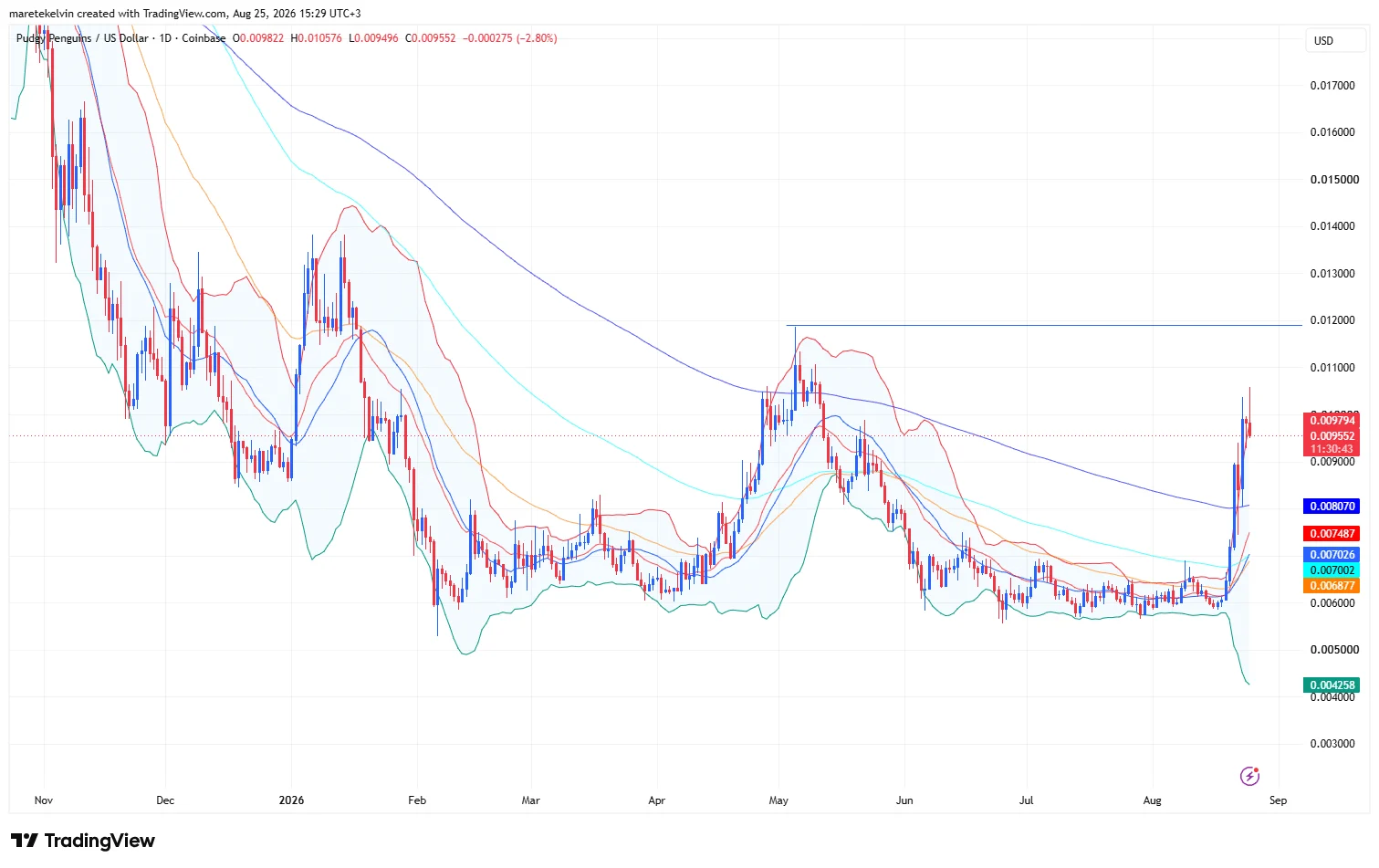
PENGU price analysis
Source: TradingView

What about PENGU’s trading volume?

Alongside the price, the memecoin’s market participation has also increased significantly.

In fact, PENGU’s trading volume has surged by 11% to $453 million over the past 24 hours, indicating stronger activity as the token approaches its resistance level.

If the gains are sustained at elevated levels, it could provide the liquidity needed for buyers to absorb the selling pressure around $0.012.
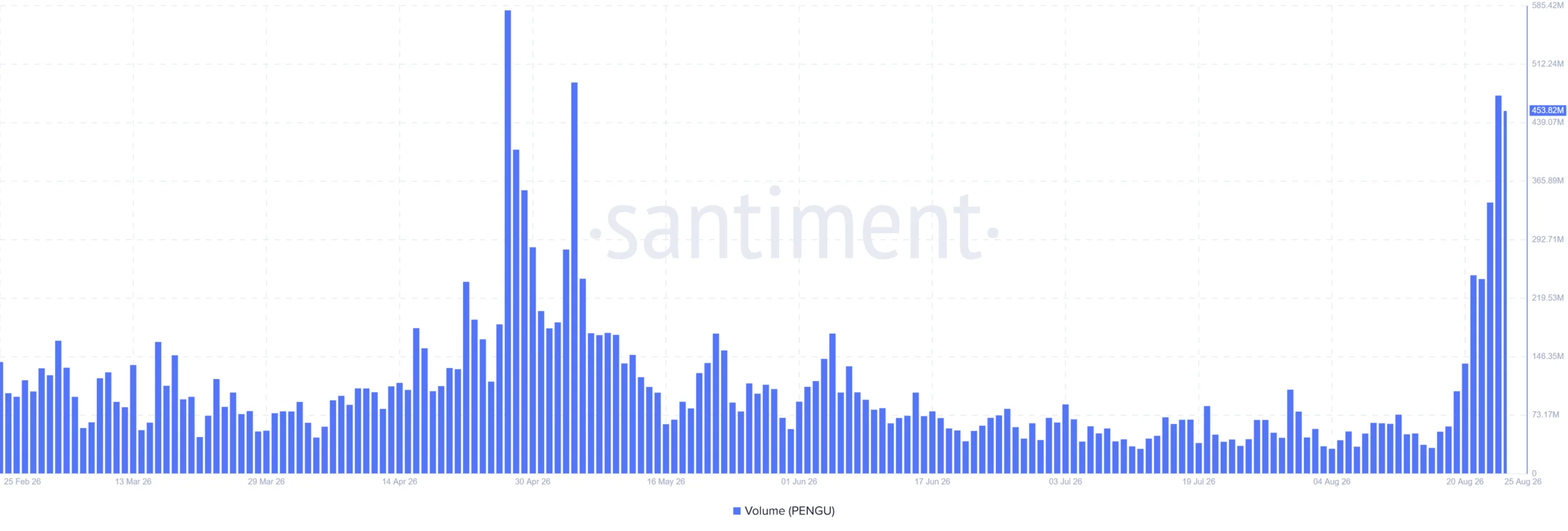
PENGU trading volumePENGU trading volume
Source: TradingView

Are whales continuing to add orders?

At press time, PENGU’s whale activity seemed to be supporting the bullish setup.

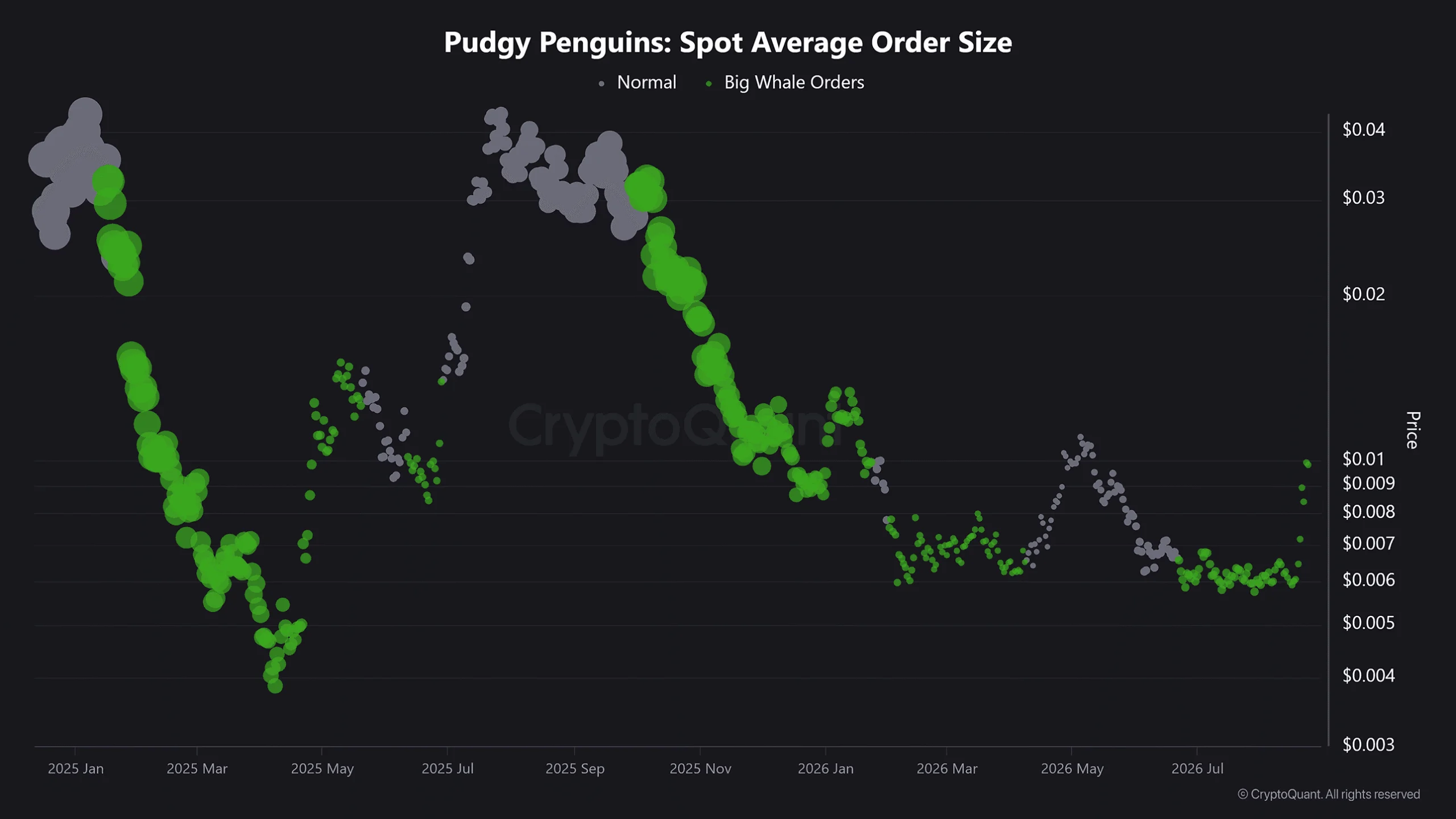
According to CryptoQuant’s Spot Average Order Size data, PENGU whales have been bagging in more orders around its trading price. This may be evidence that larger market participants remain interested in the altcoin.

Sustained whale demand could help absorb supply and improve the chances of a breakout above the $0.012-resistance level.
PENGU Average Order SizePENGU Average Order Size
Source: CryptoQuant

Can PENGU break past $0.0112?

PENGU’s 10% daily gains, hike in trading volumes, and greater whale involvement create a favorable environment for more upside.

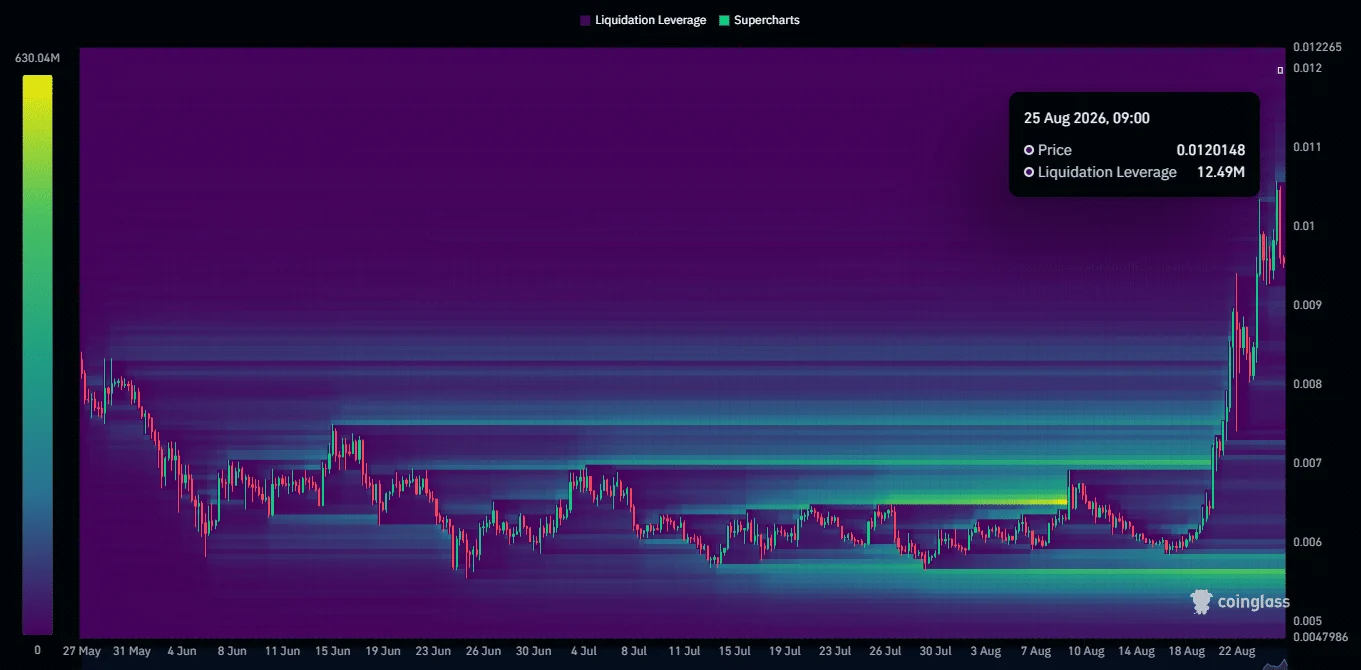
The $0.012-resistance stands out as the next target for the market bulls. The unmitigated liquidity cluster worth $12.49 million around the price level could accelerate the altcoin’s bullish momentum.
PENGU liquidation heat mapsPENGU liquidation heat maps
Source: Coinglass 

Final Summary

  • PENGU maintained its bullish trend after trading volume rose by 11% to $453 million.

  • Whale accumulation and the price being above key EMAs may strengthen the case for a potential breakout above $0.012.



Source link

Stanley Druckenmiller and Cathie Wood agree on 2 tech giant stocks

0
Stanley Druckenmiller and Cathie Wood agree on 2 tech giant stocks


13F season produces a lot of noise. Every quarter, the same headlines about what Buffett bought, what Ackman sold, what Tepper is thinking. Most of it doesn’t mean much.

But occasionally two managers who should not agree on anything turn up in the same place at the same time. That happened in Q2. Cathie Wood and Stanley Druckenmiller both bought Amazon and Alphabet.

Wood manages long-duration disruptive growth funds. Druckenmiller runs concentrated macro bets and moves fast when he changes his mind. They are not supposed to like the same things. They did.

What Cathie Wood and Stanley Druckenmiller bought in Q2 2026

Druckenmiller’s move on Amazon is the one that stands out. A 1,083% increase is not a toe dip. Duquesne ended Q2 with 541,600 shares worth roughly $129 million.

Wood’s ARK was quieter about it but still raised its stake 18%, finishing at about 1.59 million shares worth $379 million and sitting at 2.46% of the portfolio, according to Insider Monkey.

More Google:

ARK’s Q2 2026 13F, filed Aug. 14, showed the firm increased positions in 80 stocks, with Alphabet and Amazon among the largest additions, Seeking Alpha reported.

On Alphabet, Druckenmiller opened a new position of 336,300 shares worth roughly $120 million, equal to 2.31% of his portfolio. Wood increased ARK’s Alphabet stake by 45% to about 1.04 million shares worth approximately $369 million.

The 13F filings reflect portfolio positions at the end of Q2. They do not confirm whether either investor has held, added to, or reduced those positions since then.

Why Amazon AMZN stock is the center of this trade

The bull case for Amazon starts and ends with AWS. Cloud revenue grew 37% year over year in the second quarter, accelerating from 28% the prior quarter. That was the fifth straight quarter of accelerating growth.

AWS backlog hit $496 billion, up $132 billion in a single quarter and growing triple digits year over year. The division now runs at a $169 billion annualized revenue rate. AWS operating margin rose to roughly 39.4%, up 6.5 percentage points year over year, according to Amazon’s official Q2 earnings release.

Faster growth and expanding margins at this scale is not a common combination. Management attributed the improvement to efficiency gains, better capacity management, and fixed-cost control.

Amazon is also building its own silicon through Trainium and Graviton. Every chip sold by Amazon instead of an outside vendor keeps margin inside the company and allows AWS to offer compute at a lower price without sacrificing economics.


Source link

5 Hidden Speed Bumps That Keep Good Companies From Becoming Great

0
5 Hidden Speed Bumps That Keep Good Companies From Becoming Great


Opinions expressed by Entrepreneur contributors are their own.

Key Takeaways

  • Chasing your “fair share” of the market is a comfort trap that guarantees mediocrity — real growth comes from defining your company by the unmet needs of your clients, not the boundaries of your industry.
  • The biggest threats to breakout growth aren’t your competitors but five internal drag factors — complacency, fear of failure, giant intimidation, legacy reflex and the illusion of exhaustive effort — that leaders must actively dismantle.

If you watch a NASCAR race, you’ll see a tight pack of cars traveling at 200 miles per hour, rubbing paint, turning left and fighting over inches of asphalt. To the casual observer, it looks like intense, cutthroat competition. But in the business world, a dangerous parallel occurs when every company mirrors its competitors’ offerings, operates on identical terms and chases the same core customers. Leaders frequently mistake this frantic, localized activity for true market competition — it isn’t. It’s just a high-speed traffic jam where they’re seeking refuge in industry homogeneity, misinterpreting sameness as safety and viewing genuine disruption as an unnecessary risk.

I addressed this corporate complacency during my recent keynote address at CIBC’s Global Corporate and Investment Banking Offsite in Detroit. The summit operated under the banner of “Full Throttle” — the precise mindset required to break free from a crowded field. During the presentation, my goal was to upend a deeply entrenched business concept: the polite, passive pursuit of your “fair share.”

In high-performance environments, fighting for your fair share is a guaranteed recipe for mediocrity. Average leaders comfort themselves by settling for a market slice that matches their historic footprint. Yet, an elite sports team never aims to finish the season with a mediocre record just to remain comfortable in the middle of the standings. Instead, high-performing leaders focus on a dominant season and a definitive spot on the podium.

Moving beyond the homogeneous herd

The underlying problem stems from how organizations view their core identity. Most companies define themselves strictly by the products they sell or the traditional boundaries of their legacy industry. This narrow focus forces them into a baseline where they look and act like everyone else.

The remaining few choose a completely different strategic orientation: they define themselves by an unyielding commitment to solving the unmet needs of their clients. By dedicating themselves entirely to the client’s problem, these market disruptors naturally venture outside traditional industry boxes. They step away from conventional playbooks to deliver solutions that more conservative competitors consider impossible.

Lessons from a billion-dollar growth run

When I assumed leadership at my last CEO role, the company was a regional player sitting at eighth in their industry. The sector was growing at a sleepy 2% a year, but our team wanted to grow at 100% a year. To achieve that, we had to stop running the same race as everyone else. We shifted from being a service provider of last resort to the most innovative brand in the space, transforming the business from a $500 million operation into a $2.7 billion national leader, culminating in a historic billion-dollar-plus exit.

This level of exponential scale requires building a fundamentally different vehicle from the ground up. We crafted a simple, powerful story that aligned everyone from the first-year receptionist to the vice president, anchoring it with three non-negotiable client promises: service, flexibility and innovation.

We executed our commitment to service so intensely that clients openly wished they could replicate our responsiveness within their own organizations. Flexibility meant saying “yes” to a client’s complex request right there in their boardroom, then spending the entire flight home figuring out the operational mechanics of how to deliver. Innovation allowed us to completely modernize an old-world, slow-moving industry that had resisted structural change for decades.

But as any seasoned executive knows, the real challenge lies in the execution. Throughout my career leading organizations through rapid transformation, I’ve found that the greatest obstacles rarely originate from external competitors. Instead, internal drag factors routinely stall championship teams before they even arrive at the standing grid.

The 5 institutional speed bumps

That’s why, in order to get an organization operating at full throttle, leaders must systematically diagnose and eliminate these five institutional speed bumps:

  1. Historic success complacency: Strong financial performance can trick a team into assuming yesterday’s momentum guarantees tomorrow’s survival. A glance at the Fortune 100 list from a decade ago proves how quickly dominant giants vanish when they stop evolving.
  2. Fear of failure: When an environment penalizes missteps, employees instinctively choose safe, homogeneous paths. True disruption requires an ecosystem where calculated failure is embraced as a necessary step toward innovation.
  3. Giant intimidation: Mid-market companies often look at massive competitors and assume the industry hierarchy is permanent. In reality, giants fall regularly because legacy infrastructure makes them slow and rigid.
  4. The legacy reflex: Organizations naturally develop deep muscle memory that fiercely resists change. Overriding this default behavior takes fearless leadership to empower teams to challenge old processes and forge a new path
  5. The illusion of exhaustive effort: When teams claim they have “tried everything,” they have typically only exhausted options within their traditional playbook. Real innovation hinges on looking entirely outside your immediate industry sandbox to discover what the client actually needs.

Recognizing these limitations represents a diagnostic victory, but eliminating them requires a fundamental shift in leadership behavior. Corporate drag is subtle, frequently disguising itself as prudence, tradition or risk mitigation. When leaders actively dismantle these internal barriers, they unlock a latent capacity for speed and agility, allowing the team to stop looking over its shoulder at competitors and focus entirely on the open track ahead.

Play for the podium

In the end, sustaining a full-throttle trajectory is simply an intentional choice to reject a mediocre finish. It means refusing to settle for a comfortable spot inside the pack. Leaders must commit to a clear corporate narrative, fiercely protect their core customer promises and systematically clear the institutional drag holding their people back

Because the grid is crowded, and the stakes are high. So when the green flag drops, remember: average goals yield average results. But true market leaders play for the podium.

Key Takeaways

  • Chasing your “fair share” of the market is a comfort trap that guarantees mediocrity — real growth comes from defining your company by the unmet needs of your clients, not the boundaries of your industry.
  • The biggest threats to breakout growth aren’t your competitors but five internal drag factors — complacency, fear of failure, giant intimidation, legacy reflex and the illusion of exhaustive effort — that leaders must actively dismantle.

If you watch a NASCAR race, you’ll see a tight pack of cars traveling at 200 miles per hour, rubbing paint, turning left and fighting over inches of asphalt. To the casual observer, it looks like intense, cutthroat competition. But in the business world, a dangerous parallel occurs when every company mirrors its competitors’ offerings, operates on identical terms and chases the same core customers. Leaders frequently mistake this frantic, localized activity for true market competition — it isn’t. It’s just a high-speed traffic jam where they’re seeking refuge in industry homogeneity, misinterpreting sameness as safety and viewing genuine disruption as an unnecessary risk.

I addressed this corporate complacency during my recent keynote address at CIBC’s Global Corporate and Investment Banking Offsite in Detroit. The summit operated under the banner of “Full Throttle” — the precise mindset required to break free from a crowded field. During the presentation, my goal was to upend a deeply entrenched business concept: the polite, passive pursuit of your “fair share.”

In high-performance environments, fighting for your fair share is a guaranteed recipe for mediocrity. Average leaders comfort themselves by settling for a market slice that matches their historic footprint. Yet, an elite sports team never aims to finish the season with a mediocre record just to remain comfortable in the middle of the standings. Instead, high-performing leaders focus on a dominant season and a definitive spot on the podium.


Source link

TRUMP holds $2.30 support despite Ceffu’s $9.27M Binance deposit – What’s next?

0
TRUMP holds $2.30 support despite Ceffu's $9.27M Binance deposit - What's next?


TRUMP faced substantial exchange-side pressure as Ceffu transferred $9.27 million to Binance, challenging its accelerating recovery structure again.

The transaction brought possible supply on the exchange side as TRUMP tried to stabilize after its recent volatile price expansion.

This large deposit created distribution risk as Binance offered instant liquidity to any planned token sales. However, the transfer alone did not confirm completed selling, leaving actual market absorption as the critical factor to consider.

Meanwhile, the token’s recovery initiated greater market action that was able to absorb part of the new supply at the existing levels.

Aggressive sellers keep controlling market orders

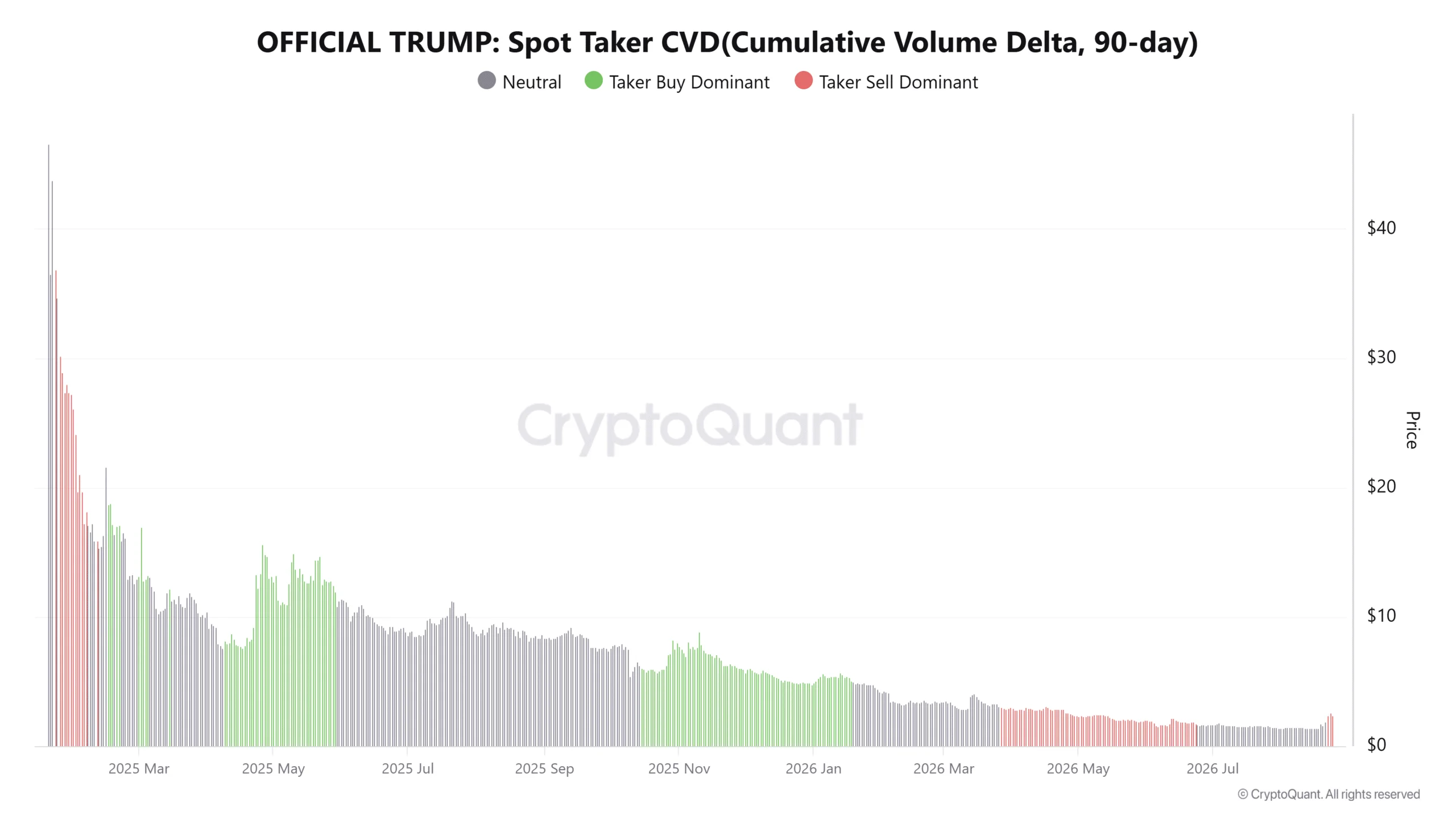
The selling pressure did not end with the Ceffu transaction since the 90-day Spot Taker CVD was still seller-dominant. The indicator recorded a higher aggressive sell volume compared to aggressive buy volume over the measured three-month period.

Therefore, Ceffu Binance deposit entered a market where taker activity had already given preference to sellers as opposed to buyers.

That combination  reinforced distribution concerns despite TRUMP recovering from its August lows.

However, the price rose despite the seller-dominant taker activity, indicating buyers had absorbed substantial aggressive selling during the rebound.

Such resilience provided an important counterweight against the potential supply associated with Ceffu’s 3.706 million TRUMP transfer.

But the taker dominance would tend to undermine that absorption capacity as soon as the Ceffu deposit enters market circulation.

Therefore, the buyers need greater participation to counter the recurring aggressive selling that would drive the recovering price structure to the ground.

Source:CryptoQuant

Reclaimed support reshapes TRUMP’s price structure

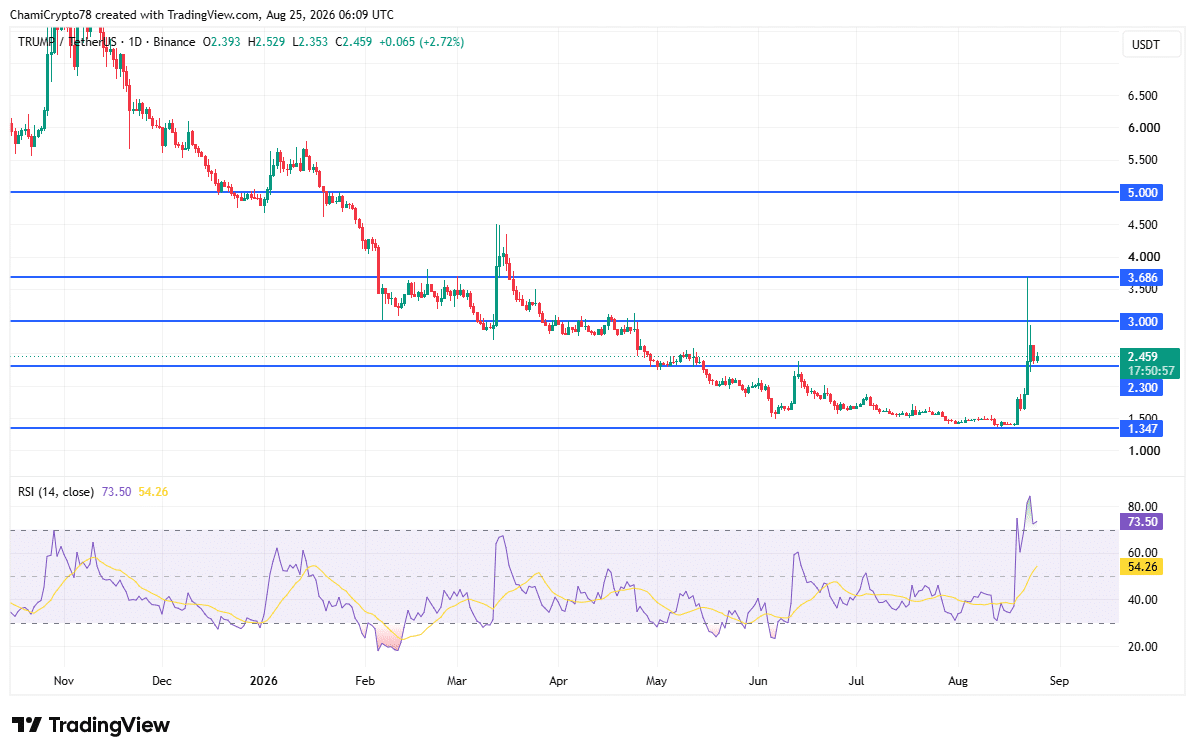
TRUMP rebounded aggressively from the $1.347 support zone before reclaiming $2.30 during its latest upward expansion. Price subsequently spiked to $3.686, but buyers were unable to establish acceptance around that resistance level.

Rather, the rejection pushed TRUMP toward the $2.459 level, with $2.30 being the immediate structural support of the recovery.

Holding above that level would maintain the breakout structure and keep another advance toward the $3.00 level technically viable.

A breakdown of the $2.30 level would weaken the breakout and reopen even further retracement risk of the previous consolidation area.

TRUMP chart outlookTRUMP chart outlook
Source: TradingView

Final Summary

  • Ceffu’s $9.27 million Binance transfer adds supply pressure as aggressive sellers remain dominant.
  • TRUMP holds $2.30, while the $3.00 level is still viable.


Source link

Gold prices today, Tuesday, August 25, 2026: Gold hits 3-month high this morning

0
Gold prices today, Tuesday, August 25, 2026: Gold hits 3-month high this morning


Gold (GC=F) December futures opened at $4,710.10 per troy ounce on Tuesday, August 25, 2026, up 0.3% from Monday’s closing price. The price of gold is down slightly this morning at $4,697.60 per troy ounce as of 7:52 a.m. ET.

Gold prices this morning hit their highest levels in over three months as gold’s rally continues. Gold has pulled back slightly in early trading, but prices remain elevated compared with recent trends.

Investors are closely eyeing this week’s upcoming inflation report, the Personal Consumption Expenditures (PCE) Price Index, and Fed Chair Kevin Warsh’s speech on Friday at Jackson Hole.

Here’s a quick breakdown of what has recently been influencing gold prices:

  1. Continued geopolitical concerns in the Middle East

  2. The U.S. Treasury’s decision to double its long-term bond buyback program

  3. Persistent inflation concerns across the globe

The opening price of gold futures on Tuesday, August 25, 2026, was up 0.3% from Monday’s closing price. Here’s a look at how the opening gold price has changed versus last week, month, and year:  

  • One week ago: +6.7%

  • One month ago: +15.8%

  • One year ago: +39.9%

For context, the one-year gain for gold was 95.6% on Jan. 29.

24/7 gold price tracking: Don’t forget you can monitor the current price of gold on Yahoo Finance 24 hours a day, seven days a week. 

Want to learn more about the current top-performing companies in the gold industry? Explore a list of the top-performing companies in the gold industry using the Yahoo Finance Screener. You can create your own screeners with over 150 different screening criteria.

Learn more: Who decides what gold is worth? How gold prices are determined.

Gold has the same high-level risk as any investment: You could lose money. And, as with other investments, a loss on gold can materialize in different ways. Understanding the potential outcomes is the first step to managing your risk when investing in gold.

According to gold experts, would-be gold investors should understand these four risks:

  1. Price

  2. Speculation

  3. Opportunity cost

  4. Fraud 

Today, we’ll focus on the first two: price and speculation. 

Learn more: How to invest in gold in 7 steps

There is a price risk for investors who buy gold when the metal is nearing record high prices. “Buying high to hope for short-term higher is a tough strategy,” said Darrell Fletcher, managing director, commodities at Bannockburn Capital Markets.

Despite the high prices, there are positive dynamics in play for the precious metal. Fletcher pointed out that gold is recovering from decades of low prices, and it’s an increasingly popular diversification asset for central banks and individual investors. 

The right expectations, a long timeline, and an appropriate allocation can limit your pricing risk. “Gold should not be seen as a driver of supercharged returns — it’s there to act primarily as a stabilizer in a diversified portfolio,” explained Alex Tsepaev, chief strategy officer of B2PRIME Group.

If you are interested in learning more about gold’s historical value, Yahoo Finance has been tracking the historical price of gold since 2000. 

Thomas Winmill, portfolio manager at Midas Funds, encourages investors to view positions in gold bullion, coins, and ETFs as speculative. Gold is a commodity, and “commodity prices are dependent on macroeconomic, political, industrial, and financial factors that are unpredictable, and in some cases, unknowable.” 

Despite its recent performance, gold is an unpredictable asset. Keeping that in mind when making trading decisions could protect you from over-exposure and unrealistic expectations. 

Learn more: Thinking of buying gold? Here’s what investors should watch for.

Whether you’re tracking the price of gold since last month or last year, the price of gold chart below shows the precious metal’s change in value. 


Source link