Walmart set for in-line Q2 as investors eye tariff refund plans, 2H guidance Proactive uses images sourced from Shutterstock
Walmart Inc (NYSE:WMT, XETRA:WMT) is expected to post largely in-line second-quarter results, with investor focus centered on second-half guidance, the treatment of potential tariff refunds, and how much of that money gets reinvested into pricing, according to a note from Jefferies.
Analysts at the firm said management has continued to emphasize a consistent strategy built around price leadership, including plans to funnel potential tariff refunds into lower prices to widen the retailer’s price gaps against competitors and drive market share gains, particularly in consumables.
Jefferies said Walmart remains upbeat on private label growth and e-commerce, pointing to strong marketplace expansion, improving online profitability, and continued investment in automation and fulfillment as key drivers of long-term share gains and margin expansion. Management has acknowledged some volatility in consumer spending, especially among lower-income shoppers, but still expects solid earnings before interest and taxes growth, the note said.
Investor debate centers on the implied back-half guidance and how management characterizes the company’s earnings power beyond an expected solid second-quarter print, Jefferies said. Other investor questions include how tariff refunds would flow through the income statement, how much would be reinvested into price, and whether management adjusts its full-year outlook.
Jefferies flagged a possible modest read-through from the roughly 100 basis point Cyclospora-related headwind expected at Grocery Outlet, noting both retailers have significant grocery exposure and could face similar produce-related demand pressures.
Foot traffic data tracked by Jefferies showed a slight deceleration on a three-month average basis in July, up 1.2% compared with 2.6% in April, though two-year stack trends were steadier at 0.6% versus 0.7%.
Jefferies left its estimates unchanged, forecasting US comparable sales growth of 3.6% and earnings per share of $0.74, broadly in line with consensus.
The firm said it believes investors are underappreciating Walmart’s resilience across macroeconomic environments, along with earnings power building from improving e-commerce margins and advertising revenue, as well as the potential upside from future tariff refunds reinvested into price ahead of the back-to-school and holiday seasons.
Strategy MSTR$93.16 has pushed back against MSCI’s proposed methodology for identifying “non-operating companies,” which could result in the largest bitcoin treasury company being removed from the index provider’s global equity indexes.
Strategy said on X, “Digital assets are assets. Index providers should measure markets, not decide which assets companies are allowed to own,” Strategy said. “MSCI’s proposal puts it out of step with regulators, markets, and its own customers. Bitcoin doesn’t need MSCI. Neither does Strategy.”
The latest consultation replaces an earlier proposal focused specifically on companies with significant digital asset holdings. Applying the new financial-ratio screen using May 2026 data would have resulted in the removal of Strategy, Metaplanet and uranium holder Yellow Cake from the MSCI ACWI IMI.
The response follows Strategy’s formal objection in December 2025 to MSCI’s previous proposal, which would have excluded companies whose digital assets represented at least 50% of total assets.
Strategy argued at the time that it is an operating company, not an investment fund or passive bitcoin vehicle, pointing to its software business, active treasury operations and bitcoin-backed credit instruments. It described the 50% threshold as arbitrary and urged MSCI to maintain neutral index standards.
MSTR is lower by 4.3% on Friday as bitcoin dips to $62,600.
Bitcoin (BTC-USD) opened at $63,418.16 on Friday, August 14, 2026, flat from Thursday’s open. As of 8:14 a.m. ET this morning, bitcoin fell to $62,721.51.
Ethereum (ETH-USD) opened at $1,884.42 on Friday, August 714 2026, up 0.3% from Thursday’s opening price. The price of ethereum also moved lower this morning to $1,872.97 as of 8:14 a.m. ET.
Bitcoin and ethereum prices aren’t responding to the softer inflation data released this week in the same way gold and silver are. While precious metal prices have moved higher and held those positions, crypto prices are slipping.
There are several factors in play limiting crypto growth at the moment, including:
Major interest from investors in AI
ETF outflows
Persistent inflation concerns, despite the July reports
The opening price of bitcoin this morning was flat compared to Thursday’s opening price. Here’s a look at how the opening bitcoin price has changed versus last week, month, and year:
One week ago: -1.3%
One month ago: +1.9%
One year ago: -48.6%
The all-time high for bitcoin was $126,198.07 on Oct. 6, 2025. The all-time low value for bitcoin was $0.04865 on July 14, 2010.
Ethereum
The price of ethereum this morning was 0.3% higher than Thursday’s open. Here’s a look at how the opening ethereum price has changed versus last week, month, and year:
One week ago: -0.9%
One month ago: +6.3%
One year ago: -60.4%
The all-time high for ethereum was $4,953.73 on Aug. 24, 2025. The all-time low value for ethereum was $0.4209 on Oct. 21, 2015.
So, you put a little mad money into bitcoin a few years ago. Now, your crypto-fueled profit means you have a sweet nest egg to put toward a house.
But can you buy a house with crypto rather than using cash or a traditional mortgage loan? What are the roadblocks? And what about taxes?
President Trump wants the United States to be “the crypto capital of the world.” In that spirit, in late June, Director of the Federal Housing Finance Agency (FHFA) William J. Pulte ordered Fannie Mae and Freddie Mac to “prepare their businesses to count cryptocurrency as an asset for a mortgage.”
The FHFA supervises Fannie Mae and Freddie Mac, the government-sponsored companies that fund a major portion of the mortgage industry.
Pulte said the housing system “needs a massive upgrade,” adding, “I want people who own cryptocurrency to be able to buy homes like everyone else. I believe cryptocurrency is an asset. I believe Americans should be able to use their crypto if they want to. It’s time the housing system caught up.”
This signals what could be a fundamental change to how cryptocurrency may be used to qualify for a mortgage.
Whether you’re brand new to tracking the value of bitcoin and ethereum or a more seasoned crypto investor, Yahoo Finance’s price-of-bitcoin chart and price-of-ethereum chart below show a visual history of how the currencies’ value continues to move and evolve.
More information on crypto from the Yahoo Finance team:
Scan the news and there are plenty of reasons for worry: continued U.S.-Iran escalation risks, mounting sovereign debt and rising bond yields among them. Crypto carries its own set of concerns, including regulatory disappointments, weak demand and hack risks.
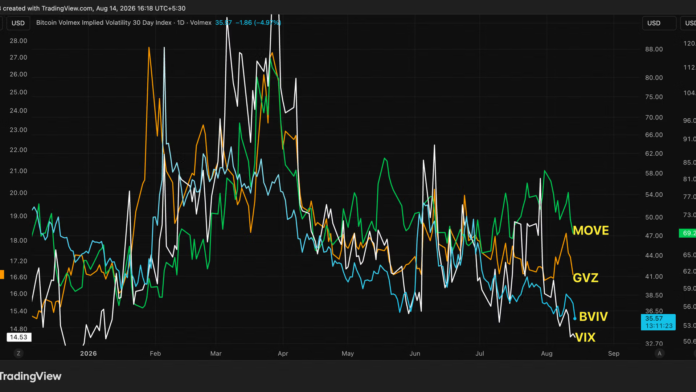
Yet crypto, stocks, bonds and even commodity markets remain sanguine. That is clear from implied-volatility readings across these markets. Implied volatility is a measure of expected price turbulence, and is calculated from the demand for options and other derivatives used to hedge against wild swings and uncertainty.
Bitcoin’s 30-day implied volatility index, BVIV, has dropped back to a 2026-low near 36%, reversing the minor pop to nearly 38% earlier this week, according to data source TradingView. The same is true for ether, the second-largest digital asset market value.
Wall Street’s VIX index, often called a “fear gauge” tracking uncertainty and volatility in the S&P 500, has declined to the lowest level since January. The Treasury market equivalent, MOVE, is also under pressure, hovering near the lower end of its multi-month range of 66% to 84%. Even gold and oil volatility indexes are falling.
A high-stakes crypto player connected to 1win’s Global Crypto Network received a 1.749 million USDC payout following a seven-figure wager on Paris Saint-Germain against Aston Villa in the 2026 UEFA Super Cup.
The payout was received in USDC via the Ethereum network. Both the original deposit and subsequent withdrawal are publicly traceable on-chain, providing independent confirmation of the movement of funds.
The player joined 1win through the network of one of the brand’s Global Crypto Ambassadors, following the recent launch of the 1win Global Crypto Ambassador program. The initiative was designed to build a worldwide network of crypto-native creators, community leaders and active Web3 participants, as well as to connect 1win with established crypto communities.
The latest result also follows another seven-figure bet placed on 1win earlier this summer. In July, Mia Khalifa received a total payout of $1.65 million after placing a $1 million bet on Spain to defeat Argentina in the 2026 FIFA World Cup final.
The two million-dollar wagers within weeks of each other highlight the growing presence of high-stakes players on the platform. The latest case also demonstrates the role of stablecoins in high-value iGaming transactions, with the full cycle from deposit to payout conducted in USDC and recorded on Ethereum.
The win comes as 1win continues expanding its presence among crypto-native audiences, combining its Global Crypto Ambassador program with an increasing focus on digital assets and Web3 communities.
About 1win
Founded in 2016, 1win is a crypto entertainment platform in the global gaming industry. Operating across Asia, Latin America, and Africa, 1win offers a wide range of entertainment products adapted to regional audiences. The brand has active collaborations with international public figures, including football legend Luis Suarez, martial artist Jon Jones, and Olympic champion and UFC fighter Gable Steveson. In 2026, 1win welcomed rapper Tyga, UFC legend Ilia Topuria, and reggaeton star Nicky Jam as members of the 1win VIP community.
Contact
1win Press Office, press@1win.pro
Disclaimer: This is a paid post and should not be treated as news/advice.
According to the Zillow lender marketplace, fixed mortgage rates are rising while ARM rates are falling compared to Thursday.
The average 30-year fixed rate today, Friday, August 14, 2026, is 6.65%, up 7 basis points since yesterday. The 15-year fixed loan is currently at 6.07%, 6 basis points higher than yesterday. The 5/1 ARM is 6.25%, 9 basis points lower than on Thursday.
Here are the current purchase rates, according to the latest Zillow data, for Friday, August 14, 2026:
30-year fixed: 6.65%
20-year fixed: 6.40%
15-year fixed: 6.07%
5/1 ARM: 6.25%
7/1 ARM: 6.18%
30-year VA: 6.09%
15-year VA: 5.63%
5/1 VA: 5.68%
Remember, these are national averages and have been rounded to the nearest hundredth.
Current mortgage refinance rates
These are the latest refinance rates, according to the latest Zillow data, for Friday, August 14, 2026:
30-year fixed: 6.67%
20-year fixed: 6.35%
15-year fixed: 6.03%
5/1 ARM: 6.42%
7/1 ARM: 6.36%
30-year VA: 6.02%
15-year VA: 5.90%
5/1 VA: 5.47%
Again, the numbers provided are national averages rounded to the nearest hundredth. Mortgage refinance rates are often higher than rates when you buy a house, although that’s not always the case.
Your mortgage rate plays a large role in how much your monthly payment will be. Use this mortgage calculator to see how your mortgage amount, rate, and term length will impact your monthly payments:
A mortgage interest rate is a fee for borrowing money from your lender, expressed as a percentage. You can choose from two types of rates: fixed or adjustable.
A fixed-rate mortgage locks in your rate for the entire life of your loan. For example, if you obtain a 30-year mortgage with a 6% interest rate, your rate will remain at 6% for the entire 30-year term unless you refinance or sell.
An adjustable-rate mortgage locks in your rate for a predetermined period and then adjusts it periodically. Let’s say you get a 7/1 ARM with an introductory rate of 6%. Your rate would be 6% for the first seven years, then the rate would increase or decrease once per year for the last 23 years of your term. Whether your rate goes up or down depends on several factors, such as the economy and housing market.
At the beginning of your mortgage term, most of your monthly payment goes toward interest. Your monthly payment toward mortgage principal and interest stays the same throughout the years. However, less and less of your payment goes toward interest, and more goes toward the mortgage principal or the amount you originally borrowed.
A 30-year fixed-rate mortgage is a good choice if you want a lower mortgage payment and the predictability that comes with having a fixed rate. Just know that your rate will be higher than if you choose a shorter term, and you will pay significantly more in interest over the years.
You may want to consider a 15-year fixed-rate mortgage if you aim to pay off your home loan quickly and save money on interest. These shorter terms come with lower interest rates, and since you’re cutting your repayment time in half, you’ll save a lot in interest in the long run. But you’ll need to be sure you can comfortably afford the higher monthly payments that come with 15-year terms.
Typically, an adjustable-rate mortgage might be suitable if you plan to sell before the introductory rate period ends. Adjustable rates usually start lower than fixed rates, and then your rate will change after a predetermined amount of time. However, 5/1 and 7/1 ARM rates have been similar to (or even higher than) 30-year fixed rates recently. Before getting an ARM just for a lower rate, compare your rate options from term to term and lender to lender.
Are mortgage rates decreasing?
Yes, ARM rates are falling. The average 30-year fixed rate today, Friday, August 14, 2026, is 6.65%, up 7 basis points since yesterday. The 15-year fixed loan is currently at 6.07%, 6 basis points higher than yesterday. The 5/1 ARM is 6.25%, 9 basis points lower than on Thursday.
Mortgage interest rates today: FAQs
What are mortgage interest rates doing today?
According to Freddie Mac, the average 30-year mortgage rate was 6.67% through Wednesday, down from 6.69% a week earlier. A year ago, the average 30-year mortgage rate was 6.58%.
How low will mortgage rates go in 2026?
According to the latest forecasts, the MBA expects the 30-year mortgage rate to average 6.5% through 2026. Fannie Mae predicts a 30-year rate of 6.4% through the end of the year.
How low could mortgage rates go by 2027?
Mortgage rates are likely to remain little changed in 2027. The MBA forecasts 30-year fixed rates of 6.5% for all of 2027. However, Fannie Mae is more optimistic, predicting average rates will be between 6.2% and 6.3% throughout 2027.
Stablecoin payments company RedotPay delayed a planned $1 billion U.S. IPO to deal with legal issues, Bloomberg reported Friday, citing people familiar with the decision.
The listing, initially planned for this year, is unlikely to take place before 2027, the people told the financial news organization.
“Our strategy continues to focus on global regulatory compliance and business growth,” a RedotPay spokesperson told CoinDesk via Telegram. “This week we obtained a money transmitter license in the U.S. We are preparing to launch our product in the U.S.”
The spokesperson declined to comment on the IPO plan, which emerged in February. Hong Kong-based RedotPay is said to have tapped JPMorgan, Goldman Sachs and Jeffries for the potential listing.
RedotPay, which describes itself as the world’s largest stablecoin payment card issuer, faces a $470 million lawsuit lodged by Binance in Hong Kong alleging that it poached roughly 470,000 users when both firms had an agreement. Under the accord, the crypto exchange allowed its customers to use Binance Pay funds on RedotPay to convert crypto to fiat currency. Binance filed a parallel case in Singapore.