Home Blog Page 703

Injective surges 14%, hits a 6-month high: Can INJ bulls target $7?

0
Injective surges 14%, hits a 6-month high: Can INJ bulls target $7?


Injective made a strong comeback from a $5.2 slip. The altcoin successfully flipped $6 and jumped to $6.3, levels not seen since November 2025.

As of this writing, Injective traded at $6.1, up 14.4% on the daily charts. Over the same period, its market cap rose 12% to $628 million, a clear sign of steady capital inflow. 

With the price pump, INJ made a clean jump above its short-term moving averages, the 21-day MA reflecting the upside strength. 

What’s driving Injective’s price pump?

Injective [INJ] most likely pumped largely driven by increased speculative demand and short covering. 

As the market suddenly reversed, over $441k worth of short positions were liquidated. The increase in short liquidations prompted some market players to cover their positions, while others opened new ones. 

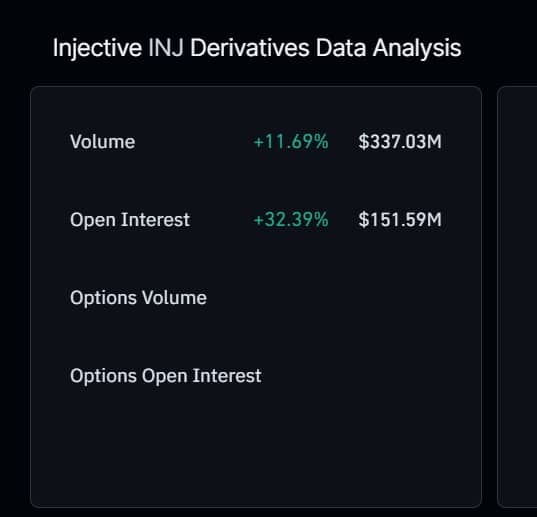
According to CoinGlass data, the altcoin’s Open Interest climbed 32.3% to $151 million, while Derivatives Volume rose 11% to $337 million. 
Injective open interest
Source: Coinglass

With OI and volume rising in tandem, it showed increased market participation and capital inflows into derivatives. This indicated that new positions, both short and long, were opened. 

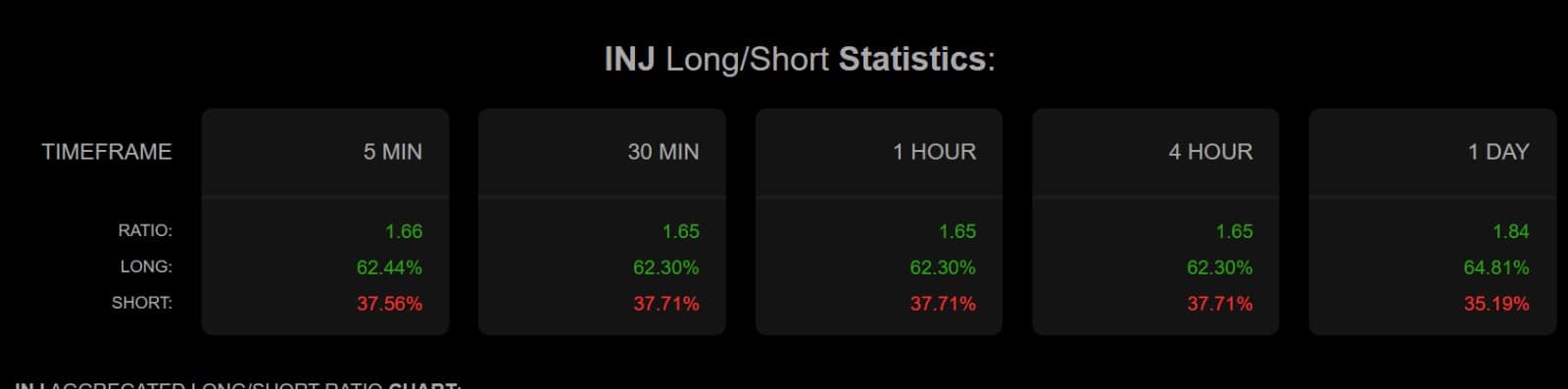
Meanwhile, the Long/Short Ratio rose to 1.8, where longs accounted for 64.8% of the total positions compared to 35% shorts. With longs dominating, it suggested that market participants were mostly bullish and chose to chase the rally. 
Injective long short ratioInjective long short ratio
Source: Coinalyze

As a result, the capital flowing into these positions strengthened the upward momentum, leading to more gains.

Profit taking reaches a record high

As expected, with Injective hitting a 6-month high, investors who have been underwater rushed into the market and cashed out.

As a result, the Spot Netflow turned positive after dropping into the negative zone the previous day. At press time, Netflow was $3.2 million, hitting levels not seen since August 2025,  a massive jump from -$1.28 million recorded earlier.

Injective spot flowInjective spot flow
Source: Coinglass

A positive Netflow indicated that more INJ flowed into exchanges than out of them. Thus, sellers dominated the spot market.

Historically, increased supply on exchanges has reduced scarcity, thus weakening the market structure. Often, such a setup has preceded market pullbacks.

Can the upside momentum hold?

Injective saw increased demand as market participants turned bullish, especially in derivatives. As a result, the upside momentum strengthened.

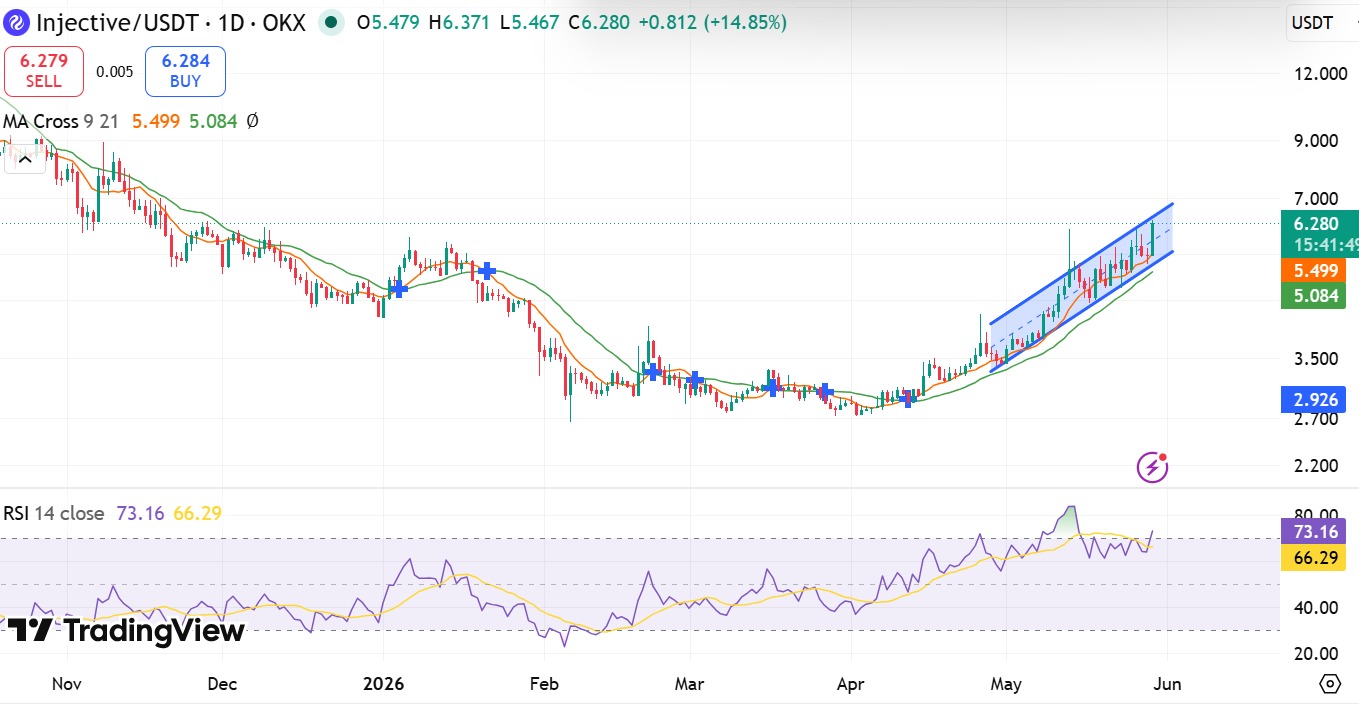
In fact, the altcoins’ Relative Strength Index (RSI) made a bullish crossover and jumped to 73, while the signal dropped to 66.
Injective RSIInjective RSI
Source: Tradingview

At these levels, RSI indicated that buyers have strong control of the market, but with the signal line at 66, the margin is minimal. In essence, while buyers still control, their dominance is not a strong warning of market pressure risks.

Therefore, if demand holds and pushes RSI above 80, Injective could make further gains and flip $7. However, if buyers fail to hold pressure from profit takers, the market correction will follow, with $5.4 as immediate support.


Final Summary

  • INJ rallied 14%, successfully flipped $6, and reached a 6-month high of $6.3.
  • Injective rallied, mainly driven by renewed speculative demand, but profit-taking risks led to another drop towards $5.4. 


Source link

U.S. CFTC opens crypto ‘perp’ door with first approval at regulated firm

0
U.S. CFTC opens crypto 'perp' door with first approval at regulated firm

U.S. crypto firms can offer perpetual futures contracts, or “perps,” without running afoul of the U.S. Commodity Futures Trading Commission, according to the agency’s first approval allowing Kalshi to list and trade U.S. bitcoin perpetuals, the regulator said on Friday.

In a related action, the agency also issued key guidance that allowed Coinbase Financial Markets to put its U.S. clients into global options and perps, tapping the largest current markets.

The perp is a kind of derivative that allows the investor to speculate on future price movements in a crypto asset without putting an expiration date on that contract, allowing it to be held as long as the investor wants. With this first approval on a registered platform, the U.S. derivatives regulator with a long history overseeing traditional crypto futures now opens a U.S. path for the potentially lucrative and popular arena of crypto perps that have previously been pursued more in non-U.S. jurisdictions.

The CFTC announced Kalshi is approved for the first true bitcoin-referenced perp, BTCPERP, and the agency said the approval “requires, among other terms and conditions, that Kalshi list and maintain the BTCPERP Contract in compliance with all applicable provisions of the Commodity Exchange Act.” While Kalshi is best known in the public as a leading prediction markets platform, the registered exchange has been expanding its business footprint.

“This marks Kalshi’s evolution from prediction market leader to next-gen derivatives exchange,” said Tarek Mansour, CEO of Kalshi, in a post on the company’s website that called their event-contract business only the first chapter. “Onshore, safe and regulated perps will improve capital allocation and risk management for countless American businesses.”

In a letter sent to Coinbase on the same day, the CFTC said it would permit certain perpetual futures products that Coinbase intends to list through its CFM subsidiary. These perpetual futures will be routed through Coinbase Bermuda, so they’ll be treated as “foreign futures.” The no-action letter will allow CFM to post customers’ digital assets (including bitcoin, ether and stablecoins) as margin collateral for these products.

Paul Grewal, Coinbase chief legal officer, called it a “massive first for the industry” in a post on social media site X.

The CFTC announcements follow closely on the heels of President Donald Trump’s social-media post this week that cited perpetuals and argued that the previous administration’s regulators “nearly DESTROYED the American Crypto Industry by driving Bitcoin, Crypto Perpetuals, and INNOVATION offshore, but ‘TRUMP’ SAVED IT.”

Trump’s CFTC chairman, Mike Selig, argued that the contracts represent “a foundational risk management and price discovery tool in the global crypto asset markets.”

“Having true perpetual contracts in the United States is a major step forward in delivering on President Trump’s goal of cementing America as the crypto capital of the world,” Selig wrote in an opinion piece published Friday at CoinDesk. He said his agency is now providing “a workable framework for true crypto asset perpetual contracts.”

Perps, typically amplified with leverage, can be a way to cash in big on even minor price movements in assets such as bitcoin and Ethereum’s ether (ETH), but that also means they can go the other direction just as sharply, making them a volatile investment.

Selig had said in March that he has been trying to repair damage from the previous U.S. administration that “drove a lot of these firms and the liquidity offshore.” Some of the other crypto-native exchanges the agency oversees in the U.S. include Bitnomial (just acquired by Kraken) and Gemini, plus Kalshi’s prediction-market rival, Polymarket.

Selig wrote on Friday that his agency’s approach to perps would “limit excessive leverage, volatility and systemic risk.”

There are other dangers associated with perpetuals, too, as witnessed this week with the flash crash in the Hyperliquid SPACEX-USDH, a crypto perpetual contract for SpaceX’s market valuation, catching many investors off-guard and wiping out some $1.5 million in notional value within 30 minutes because of one outsized position that absorbed the market’s thin liquidity.

The CFTC’s new stance doesn’t yet carry the weight of a formal rule. The CFTC and its sister agency, the Securities and Exchange Commission, have been blazing a crypto policy trail with new statements, so-called no-action letters (like the one sent to Coinbase on Friday), approvals and guidance revealing their current stance on various aspects of the industry. But until the policies are set with formal rules or — even more durable — new laws, then they can be easily overturned by future agency leaders.

In March, the two agencies released highly consequential guidance that — for the first time — offered their definitions for classifying various crypto assets. The new taxonomy described a series of buckets the assets could be placed in that would establish how they’d be regulated and by whom, and it also set out standards for how a crypto security may eventually transition out of that classification as its project matures.

The SEC is also poised to release a wide-reaching new crypto policy meant to pave the way for the tokenization of securities by offering temporary exemptions from registration for digital asset innovations. The shift — a marquee project for SEC Chairman Paul Atkins — is planned as an interim measure to foster crypto activity while the industry awaits a more permanent law from Congress.

Read More: CFTC chief Selig to clear path for U.S. perpetual futures in coming weeks

UPDATE (May 29, 2026, 14:17 UTC): Adds identification of the approved firm, Kalshi, and the addition of no-action guidance involving Coinbase.
UPDATE (May 29, 2026, 14:30 UTC): Adds remarks from Kalshi.

UPDATE (May 29, 2026, 14:44 UTC): Adds detail and remarks from Coinbase.


Source link

Best CD rates today, Friday, May 29, 2026: Up to 4% APY return

0
Best CD rates today, Friday, May 29, 2026: Up to 4% APY return


See which banks are currently paying the highest CD rates. If you’re looking for a secure place to store your savings, a certificate of deposit (CD) may be a great choice. These accounts often provide higher interest rates than traditional checking and savings accounts. However, CD rates can vary widely. Learn more about CD rates today and where to find high-yield CDs with the best rates available.

Banks with the best CD rates right now

Today’s CD rates vary quite a bit. In general, however, CD rates have been declining for quite some time due to the Fed’s decision to cut its benchmark rate three times in the latter part of 2024 and three times in 2025. Even so, with the Fed leaving rates unchanged so far in 2026, some banks are still offering competitive CD rates.

For institutions offering competitive rates, top rates reach about 4% APY. This is especially true for shorter terms of one year or less.

Today, the highest CD rate is 4% APY. This rate is offered by Marcus by Goldman Sachs on its 14-month CD.

Here is a look at some of the best CD rates available today from our verified partners:

Compare these rates to the national average as of May 2026 (the most recent data available from the FDIC):

Compared with today’s top CD rates, national averages are much lower. This highlights the importance of shopping around for the best CD rates before opening an account.

Why do online banks have the best CD rates?

Online banks and neobanks are financial institutions that operate solely via the web. That means they have lower overhead costs than traditional brick-and-mortar banks. As a result, they’re able to pass those savings on to their customers in the form of higher interest rates on deposit accounts (including CDs) and lower fees. If you’re looking for the best CD rates available today, an online bank is a great place to start.

However, online banks aren’t the only financial institutions offering competitive CD rates. It’s also worth checking with credit unions. As not-for-profit financial cooperatives, credit unions return their profits to customers, who are also member-owners. Although many credit unions have strict membership requirements that are limited to those who belong to certain associations or work or live in certain areas, there are also several credit unions that just about anyone can join.

Should you open a CD?

Whether or not you should put your money in a CD depends on your savings goals. CDs are considered a safe and stable savings vehicle — they don’t lose money (in most cases), are backed by federal insurance, and allow you to lock in today’s best rates.

However, there are some drawbacks to consider. First, you must keep your money on deposit for the full term, otherwise you’ll be subject to an early withdrawal penalty. If you want flexible access to your funds, a high-yield savings account or money market account might be a better choice.

Additionally, although today’s CD rates are high by historical standards, they don’t match the returns you could achieve by investing your money in the market. If you’re saving for a long-term goal such as retirement, a CD won’t provide the growth you need to reach your savings goal within a reasonable time frame.

Read more: Short- or long-term CD: Which is best for you?


Source link

Bitcoin price news: BTC off the lows on Trump post, but set to close month of May with losses

0
Bitcoin price news: BTC off the lows on Trump post, but set to close month of May with losses

Shares of Robinhood (HOOD) climbed another 10% on Friday, extending a rally that has pushed the stock up more than 20% over the past two trading sessions as investors reacted to a string of developments tied to the company’s crypto, AI and retail investing initiatives.

Part of the momentum came from regulatory news earlier Friday after the U.S. Commodity Futures Trading Commission (CFTC) approved bitcoin (BTC) perpetual futures contracts on a regulated exchange operated by Kalshi, marking the first domestically regulated perpetual futures product in the U.S.

The agency also cleared a path for a Coinbase (COIN) affiliate to connect customers to global options and perpetual futures markets. CFTC Chairman Mike Selig called the decisions a “major step forward” for policies aimed at supporting the U.S. crypto sector. The move could accelerate the development of regulated crypto derivatives products, an area where Robinhood has been expanding following its acquisition of crypto exchange Bitstamp.

Investors were also digesting several company-specific announcements made this week. On Wednesday, Robinhood unveiled Agentic Trading and an Agentic Credit Card, products that allow customers to connect third-party AI agents to their accounts to automate investing and spending decisions. The company said users can set conditions for AI agents to monitor markets, rebalance portfolios, execute trades and make purchases while guardrails such as spending limits, notifications and instant shutdown controls remain in place.

And on Thursday, the Trump Accounts app launched ahead of a broader rollout scheduled for July. Robinhood is serving as the brokerage and clearing partner for the program, which allows families to open investment accounts for children and, for eligible newborns, receive a $1,000 Treasury-funded contribution.


Source link

Ethereum’s ‘deeper problem’ – It’s not just macro risk weighing ETH down

0
Ethereum's 'deeper problem' - It's not just macro risk weighing ETH down


On Thursday, Ethereum’s price briefly dropped below $2000 for the first time since late March. In doing so, the king altcoin effectively erased all its Q2 gains. At the time of writing, it was down 19% from its April peak of nearly $2.5K.

This week alone, the altcoin has shed 6% of its value. 

Should it lose the Q2 support zone of $2K, short sellers could push it lower to $1.8K—the range low of the 2026 sideways structure. 

The pullback mirrored a broader macro-driven correction that also dragged Bitcoin lower. However, according to Nansen, ETH’s weakness showed a “deeper problem.” 

Ethereum ETH
Source: ETH/USDT, TradingView 

Negative ETH catalysts: ETF outflows, low network activity

In an email statement, Nansen Research analyst Nicolai Sondergaard told AMBCrypto, 

Gas fees are sitting below 2 gwei, near cycle lows, which signals that network demand is soft. Fewer people are transacting, fewer contracts are being called, and the burn mechanism that once made ETH structurally deflationary has slowed considerably.

The “store value” proposition is not playing out for the altcoin for now. In fact, Grayscale proposed capping staking rewards to cap the resulting inflation that’s diluting ETH’s value. 

However, part of the problem is structural. Now Layer 2s (L2s) handle most of the transactions and capture revenue away from the mainnet, added Sondergaard. 

For the analyst, the low burn mechanism has turned ETH inflationary, which “removes one of the key narratives that drove conviction in prior cycles.” 

On the institutional demand front, ETH has lagged behind BTC in 2026. Notably, the ETH/BTC ratio has dropped to a year low. The analyst highlighted, 

The ETH/BTC ratio has compressed to 0.027, which is the more telling number. It reflects a cycle dynamic that has been stubborn throughout 2026: Bitcoin continues to capture institutional attention, and ETH has not yet pulled the same weight.

Ethereum ETHEthereum ETH
Source: ETH/BTC ratio, TradingView

Since 11 May, U.S. Spot ETH ETFs have seen consecutive daily outflows. The monthly outflows have hit $522M too—the highest since last December. 

What could trigger ETH’s rebound?

For ETH to recover strongly, it needs renewed Spot ETH ETF inflows and network demand. Nansen’s Sondergaard concluded, 

The macro environment also needs to stop punishing risk appetite. ETH does not need all of these at once, but it needs at least two. Right now, it has none of them.

Even so, whales have piled on to bid on the recent dip. In fact, wallets with over 100K ETH now control 22% of the supply, or 17.4 million ETH, marking a 10-week high. 

Ethereum ETHEthereum ETH
Source: Santiment

However, the whale demand, likely driven by major players like Bitmine, was not enough to taper off the on-chain capital outflows. Notably, ETH’s capital outflow has deepened since last October, as tracked by the Realized Cap.

In fact, in 2026, the altcoin has seen $15B in capital outflows as Realized Cap dropped from $310B to $295B.

It meant that the aggregate demand for ETH was still negative. This further reinforced Nansen’s Sondergaard outlook.

Ethereum ETHEthereum ETH
Source: Glassnode

Will the ETH price retest $1.8K?

If the weak demand and outflows extend, then ETH’s price may fall to $1.8K. Interestingly, the MVRV Pricing Bands also implied such a projection.

After early 2026 price rejection at Realized Price (1.0 RP, green) at $2.3K, ETH could likely retest the next support band at $1.8K (blue). In fact, during the 2022 crypto winter, ETH only marked a true bottom after decisively climbing above the lower bands of the metric.

Ethereum ETHEthereum ETH
Source: Glassnode

Overall, the ETH price could slip lower to $1.8K in the medium term if the weak institutional demand and muted network activity continue in June.


Final Summary

  • According to Nansen, ETH currently has ‘none’ of the catalysts that fueled its rally in the past. 
  • Whales with +100K ETH are aggressively buying the Q2 dip, increasing their aggregate holdings to 17.4M coins.  


Source link

HELOC and home equity loan rates today, May 29, 2026: Rates stay affordable amidst mixed property values

0
HELOC and home equity loan rates today, May 29, 2026: Rates stay affordable amidst mixed property values


If you’re in the market for a home equity loan or line of credit, understanding home price trends is important, since rising property values are one of the main ways homeowners build equity.

According to the latest S&P Cotality Case-Shiller U.S. National Home Price NSA Index, property values posted a 0.7% gain in March. “The geographic divergence remains stark,” said Nicholas Godec, CFA, CAIA, CIPM, Head of Fixed Income Tradables & Commodities at S&P Dow Jones Indices. “Midwest and Northeast markets are sustaining modest growth, while much of the Sun Belt and Western regions are still seeing declines.”

Learn more: Find out how HELOC and home equity loan interest rates work and what you can expect to pay

HELOC and home equity loan rates: Friday, May 29, 2026

The average HELOC rate is 7.21%, according to real estate analytics firm Curinos. The 2026 HELOC low was 7.19% in mid-March. The national average rate on a home equity loan is 7.36%, tied with the 2026 low first seen in mid-March.

Rates are based on applicants with a minimum credit score of 780 and a maximum combined loan-to-value ratio (CLTV) of less than 70%.

Learn more: Here are our picks for the best HELOC lenders

How lenders determine HELOC and HEL interest rates

Home equity interest rates work differently from mortgage rates. Second mortgage rates are based on an index rate plus a margin. That index is often the prime rate, which remains at 6.75%. If a lender added 0.75% as a margin, the HELOC would have a variable rate of 7.50%.

A home equity loan may have a different margin because it is a fixed-interest product.

Lenders have flexibility with pricing on a second mortgage product, such as a HELOC or home equity loan. Your rate will depend on your credit score, the amount of debt you carry, and the amount of your credit line compared to the value of your home. Shop a few lenders to find your best interest rate offer.

Learn about how fixed-rate HELOCs work

Look for low introductory HELOC rate offers

Today, FourLeaf Credit Union is offering a HELOC APR (annual percentage rate) of 5.99% for 12 months on lines up to $500,000. That’s an introductory rate that will convert to a variable rate in one year.

When shopping for lenders, be aware of both rates. And as always, compare fees, repayment terms, and the minimum draw amount. The draw is the amount of money a lender requires you to initially take from your equity.

The best home equity loan lenders may be easier to find because the fixed rate you earn will last the length of the repayment period. That means just one rate to focus on. And you’re getting a lump sum, so no draw minimums to consider.

HELOC and home equity loan rates today: FAQs

What is a good interest rate on a HELOC right now?

Rates vary significantly from one lender to the next. You may see rates from 6% to as much as 18%. It really depends on your creditworthiness and how diligent you are as a shopper. Currently, the national average for an adjustable-rate HELOC is 7.21%, and for a fixed-rate home equity loan, it’s 7.36%. Those are the rates to meet or beat.

Is it a good idea to get a HELOC or a home equity loan right now?

Interest rates fell for most of 2025. They are expected to remain steady for much of 2026. So yes, it’s a good time to get a second mortgage. And with a HELOC or a HEL, you can use the cash drawn from your equity for things like home improvements, repairs, and upgrades. Or just about anything else.

What is the monthly payment on a $50,000 home equity line of credit?

If you withdraw the full $50,000 from a line of credit on your home and pay a 7.25% interest rate, for example, your monthly payment during the 10-year draw period would be about $302. That sounds good, but remember that the rate is usually variable, so it changes periodically, and your payments will increase during the 20-year repayment period. A HELOC essentially becomes a 30-year loan. HELOCs are best if you borrow and repay the balance within a much shorter period of time.


Source link

The Hidden Forces Making Beef Prices Skyrocket

0
The Hidden Forces Making Beef Prices Skyrocket


Ground beef just hit a record $6.89 a pound, up 80% since 2019 — and nobody along the supply chain sees relief coming. Ranchers like Eric Gropper point to years of drought that have shrunk cattle herds to their lowest level in decades. Meanwhile, meatpackers have been hammered by labor shortages and plant closures. And restaurants have had no choice but to keep raising prices.

But how much of this is the market, and how much is manipulation? Since the late 1970s, just four companies — Tyson, JBS, Cargill, and National Beef — have come to control roughly 80% of the American beef market. The Justice Department is now investigating, and McDonald’s and Target are among those suing over alleged price-fixing.

So how much has consolidation driven up prices? And would breaking up these companies actually lead to lower beef prices?


Source link