Home Blog Page 704

‘The banks will not accept it’: JP Morgan’s Dimon escalates battle over stablecoin rewards in CLARITY Act debate

0
‘The banks will not accept it’: JP Morgan's Dimon escalates battle over stablecoin rewards in CLARITY Act debate

JPMorgan Chase CEO Jamie Dimon on Friday yet again sharply criticized Coinbase CEO Brian Armstrong and warned that the latest version of the Clarity Act could ultimately fail if lawmakers do not address concerns from traditional banks over stablecoin regulation.

In an interview with Maria Bartiromo on Fox Business, Dimon appeared frustrated by the direction of the debate around stablecoins and digital asset legislation. Asked whether he was satisfied with the current draft of the Digital Asset Market Clarity Act, the crypto market structure bill that will formalize rules around how federal securities and commodities regulators oversee crypto, Dimon said he was not.

“No, because it allows them to effectively pay interest on deposits, stablecoins or something like that, without protection that they should have,” Dimon said. “The banks will not accept it that way. … I’m not worried about stablecoins but if it happened I’m telling you I will have nothing to do with it and it will eventually blow up.”

The comments come amid a growing divide between the banking industry and crypto firms as lawmakers prepare for a key markup process that will determine whether the Clarity Act can advance through Congress. Lawmakers are expected to continue negotiating provisions governing stablecoin issuers, consumer protections, reserve requirements and whether crypto companies should be permitted to offer yield-bearing products that resemble traditional bank accounts.

For the legislation to ultimately become law, it must clear the full Senate and House of Representatives, and be signed by President Donald Trump. The Senate Banking Committee advanced its version of the bill through a markup earlier this month, and the Senate Agriculture Committee advanced its own version earlier this year. At the moment, representatives from the two committees are merging the bills, a key step before the full Senate can take a look.

At the center of the dispute which dragged out the Banking Committee’s process is the question of stablecoin rewards. Armstrong and Coinbase have argued that traditional banks are pushing lawmakers to curb stablecoin rewards programs, which function similarly to high-yield interest accounts and could threaten banks’ deposit-based business models. Banking executives, meanwhile, contend that firms offering bank-like products should face comparable oversight and regulatory obligations.

The disagreement has become one of the primary reasons the legislation has stalled in Washington and failed to gain sufficient momentum earlier this year, despite broad bipartisan interest in creating a regulatory framework for digital assets.

Tensions between Armstrong and Wall Street executives have been building for months. During meetings at the World Economic Forum in Davos earlier this year, Dimon told Armstrong, “You are full of s—,” according to people familiar with the exchange who spoke with The Wall Street Journal.

Bank of America CEO Brian Moynihan reportedly dismissed Armstrong’s arguments, telling him, “If you want to be a bank, just be a bank.” Wells Fargo CEO Charlie Scharf declined to engage, while Citigroup CEO Jane Fraser spent less than a minute with him, according to that prior reporting.

Coinbase and JPMorgan did not respond to requests for comment in time for publication.



Source link

Mettler-Toledo Stock Outlook: Is Wall Street Bullish or Bearish?

0
Mettler-Toledo Stock Outlook: Is Wall Street Bullish or Bearish?


Mettler-Toledo International Inc. (MTD), headquartered in Columbus, Ohio, manufactures and supplies precision instruments and services for laboratory, industrial, and food retailing applications. Valued at $22.3 billion by market cap, the company also supplies several related analytical and measurement technologies.

Shares of this leading precision instruments supplier have underperformed the broader market over the past year. MTD has declined 5.9% over this time frame, while the broader S&P 500 Index ($SPX) has rallied nearly 27%. In 2026, MTD stock is down 21.5%, compared to the SPX’s 9.9% rise on a YTD basis.

More News from Barchart

Narrowing the focus, MTD’s outperformance is apparent compared to the First Trust Indxx Global Medical Devices ETF (MDEV). The exchange-traded fund has declined about 7.8% over the past year. However, the ETF’s 10.9% losses on a YTD basis outshine MTD’s dip over the same time frame.

www.barchart.com

MTD underperformed as pipette sales slipped on soft demand from academia and biotech. Core industrial sales were flat ex-acquisitions, reflecting cautious spending across most end markets.

On May 7, MTD reported its Q1 results, and its shares tumbled 14.8% in the following trading session. Its adjusted EPS of $8.91 surpassed Wall Street expectations of $8.70. The company’s revenue was $947.1 million, topping Wall Street forecasts of $946.8 million. The company expects full-year adjusted EPS in the range of $46.30 to $46.95.

For the current fiscal year, ending in December, analysts expect MTD’s EPS to grow 9.1% to $46.60 on a diluted basis. The company’s earnings surprise history is impressive. It beat the consensus estimate in each of the last four quarters.

Among the 13 analysts covering MTD stock, the consensus is a “Moderate Buy.” That’s based on six “Strong Buy” ratings, and seven “Holds.”

www.barchart.com
www.barchart.com

This configuration is less bullish than two months ago, with seven analysts suggesting a “Strong Buy.”

On May 18, Stifel Financial Corp. (SF) analyst Daniel Arias kept a “Buy” rating on MTD and lowered the price target to $1,400, implying a potential upside of 28% from current levels.


Source link

Is LAB’s current rally real? Price rises 16% on Futures buying

0
Is LAB's current rally real? Price rises 16% on Futures buying


LAB’s [LAB] price rose by double digits in the past 24 hours, clocking more than 16% in gains.

The rally comes after weeks of scrutiny following a call-out by crypto investigator ZachXBT for an alleged scam. ZachXBT noted irregularities in the supply dynamics of the token, but that seems to have cooled off.

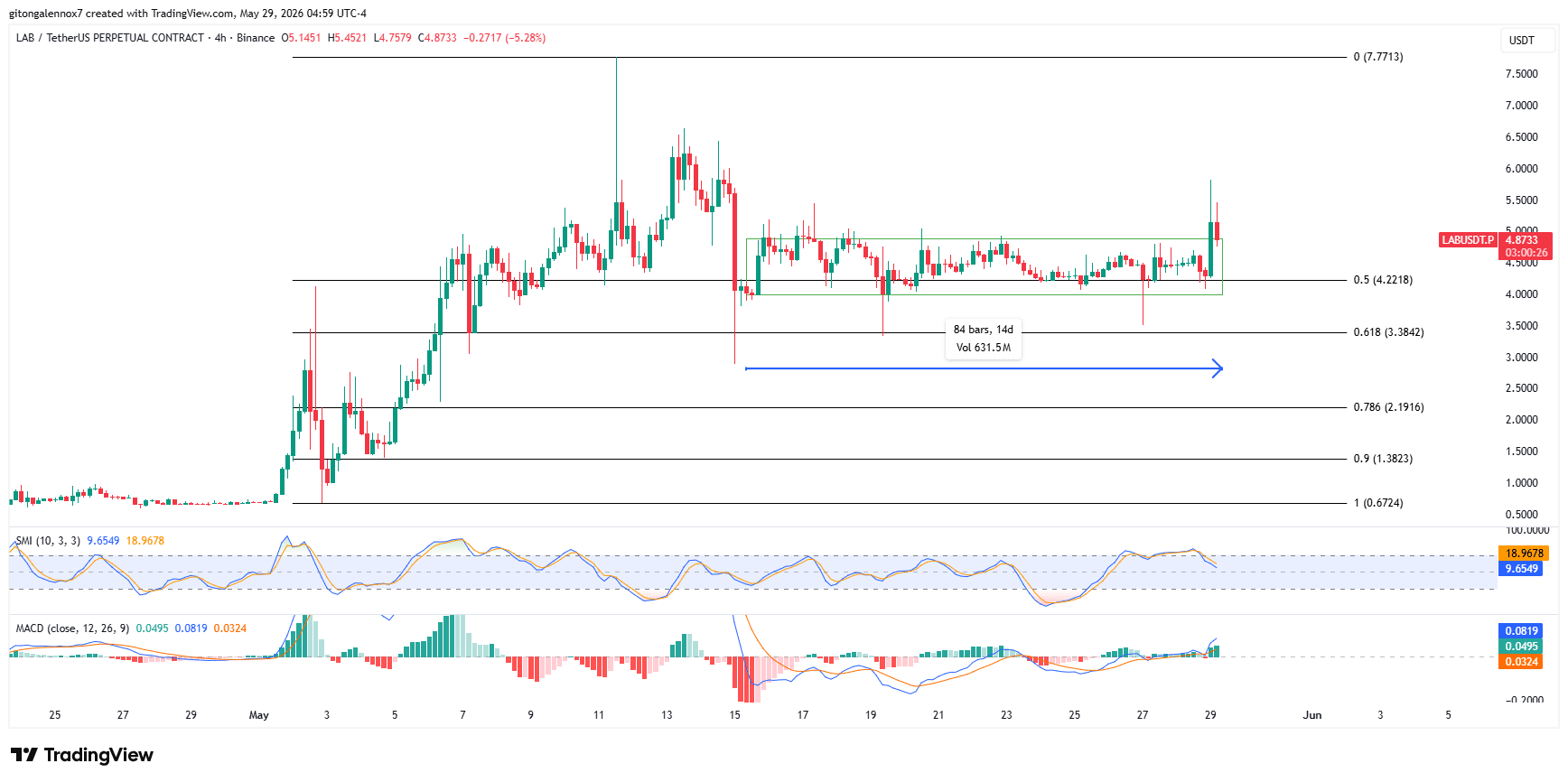
LAB price teases breakout but drops back

The rally came after the altcoin broke out from a sideways consolidation that had lasted for 14 days. Before this consolidation, LAB had made an all-time high (ATH) of $7.77.

While the two-week price range denotes accumulation, these traders were doing so in a premium zone. As per the Fibonacci Retracement tool, LAB was trading above the 50% level, but its price had wicked below that level several times.

The Stochastic Momentum Index (SMI) was still trading above the neutral level while MACD bars indicated buyer strength.

LAB
Source: LAB/USDT on TradingView

However, LAB was struggling to stay above this breakout. The price is slowly returning to the range, though bulls are fighting to keep it above $4.87.

Futures’ positive inflows vs. Spot’s mixed flows

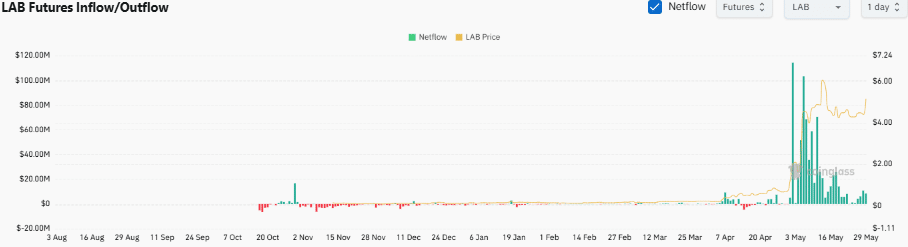
On the Futures market, CoinGlass data shows that capital inflows exceeded outflows. In the past 24 hours alone, derivative traders had pumped more than $8.46 million.

The 14-day price accumulation was evident on the Inflow/Outflow chart. The largest single-day accumulation was worth more than $114 million on the 2nd of May.

In total, over the two weeks, more than $633 million in capital had been leveraged.

LABLAB
Source: CoinGlass

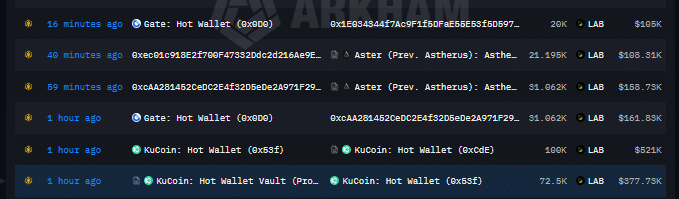
Mixed activity characterized the spot market. As per Arkham, LAB tokens were leaving exchanges, signaling accumulation, and at the same time some were hitting the trading platforms.

For instance, a wallet withdrew thousands of LAB from Gate while almost equal tokens were deposited into KuCoin and AsterDEX exchanges.

Source: Arkham

The spot activity showed no clear direction, but the futures market was outright bullish.

LAB squeezed between liquidity clusters

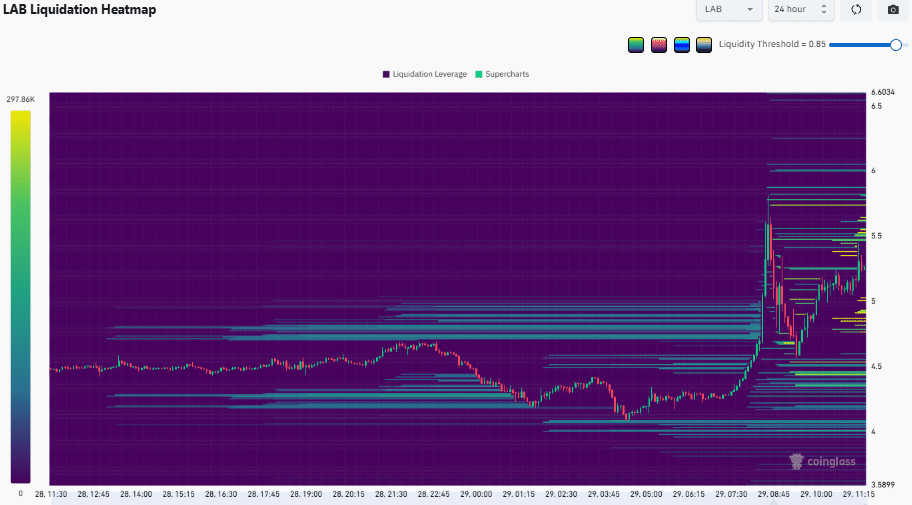
Notably, LAB destroyed short orders, liquidating more than $4 million in the past 24 hours. As a result, LAB rallied to a daily high of $5.82, with more clusters forming between $5.50 and $6.

As such, the price is squeezed between liquidity clusters as more orders have formed between $4 and $5.

LABLAB
Source: CoinGlass

A liquidity sweep on the clusters on either side would amplify price movements in the direction of liquidity. In the case of shorts, LAB may reclaim its peak of $7.77, while for longs below $5, the price may drop to $4.


Final Summary

  • LAB rallied 16% in 24 hours following a price breakout and capital inflows from the Futures market. 
  • The price was squeezed between highly concentrated liquidity clusters, and a sweep on either cluster could define its next move. 


Source link

Clarity Act Risks Regulation Without Oversight, Brookings Fellow Says

0
Clarity Act Risks Regulation Without Oversight, Brookings Fellow Says

Latest developments: Klein argued the Commodity Futures Trading Commission faces a dramatically larger mandate as lawmakers consider expanding its authority over digital assets. Klein recently joined Rebecca Rettig and Renato Mariotti on CoinDesk’s The Policy Protocol.

  • Klein said the CFTC was originally created to oversee commodity futures markets and was not built for the scale of responsibilities envisioned under current crypto legislation.
  • He warned that giving the agency new powers without additional staff, funding and expertise could create the appearance of regulation without meaningful oversight.
  • Klein expressed concern that regulatory capacity has been weakened by personnel departures and structural changes at the agency.

What this means: The debate over the Clarity Act is increasingly becoming a debate over whether the CFTC can effectively police crypto markets.

  • Klein said one lesson from the Dodd-Frank era is that assigning major responsibilities across multiple regulators can create delays and confusion.
  • He argued that fragmented oversight risks repeating past regulatory failures if agencies lack the resources or will to enforce rules.
  • Klein compared those risks to shortcomings he believes contributed to past financial crises.

The controversy: Klein sharply criticized allegations that political influence is affecting financial regulation.

  • Referring to a New York Times report discussed during the interview, Klein said regulators should remain independent from political intervention.
  • He argued that enforcement decisions should not be influenced by relationships with the White House or political figures.
  • Klein described the current environment as unusually permissive toward financial misconduct and called for stronger accountability.

Reading between the lines: Klein sees a longer-term solution in closer coordination between U.S. market regulators.

  • He said the U.S. is unusual in maintaining separate capital markets regulators through the SEC and CFTC.
  • Klein argued that eventually merging the agencies would make sense, though he expressed skepticism that Congress is prepared to pursue that path.
  • In the meantime, he praised reports that SEC and CFTC staff may share office space, saying physical proximity can improve collaboration more than formal agreements.

What comes next: Regulatory structure could become as important as the rules themselves.

  • Klein said memorandums of understanding between agencies often fail to produce meaningful cooperation in practice.
  • He argued that stronger coordination mechanisms and operational integration would better prepare regulators for overseeing crypto and prediction markets.


Source link

U.S. regulator says 24/7 trading is great for crypto, may not be fit for other sectors

0
U.S. regulator says 24/7 trading is great for crypto, may not be fit for other sectors

As global trading trends race toward 24-hour, no-days-off markets, the U.S. Commodity Futures Trading Commission argued that it may be fine for the new blockchain-native players, but that expanded hours might not be appropriate for some of the traditional markets, the derivatives watchdog said in a Friday letter issued to the wide waterfront of firms it regulates.

The advisory — coming on the same day that the agency gave a consequential green light to native crypto platforms offering perpetual futures contracts — marks what may be a growing divide between the traditional firms and the new entrants.

“Because of inherent differences between underlying markets, switching to 24/7 trading and clearing may not currently be suitable for all asset classes,” the agency wrote to its regulated exchanges and clearing operations.

“The ability to engage in, and maintain, markets on a 24/7 basis has been, in part, paralleled by evolutions in market technologies, such as blockchain networks and decentralized infrastructure, alternate forms of collateral, including stablecoins and crypto assets, and market accessibility through smartphones and associated software applications,” the CFTC noted. “With this evolution, an increasing number of platforms, with a growing list of tradeable products, are providing 24/7 access to retail and institutional participants.”However, it said, “other derivatives markets, such as in agricultural products, may be less

suited for 24/7 trading due to their unique customer bases, regional nature, and the specialized

trading and hedging practices in those markets.”

The derivatives watchdog’s primary concern is the potential for market abuse in less-observed, off-peak activity, contending that “extending trading hours to a 24/7 schedule for certain markets or products could potentially result in reduced liquidity, increased volatility, widened bid/ask spreads, and, as a result, create greater opportunities for market manipulation.”

The platforms are responsible for policing themselves as the first line of defense and “should implement additional compliance measures designed to address the unique challenges associated with expanded trading hours.”

The advisory was meant to lay out the considerations for firms looking to expand trading hours, and the CFTC urged them to communicate their plans to the agency.

The current chief of the agency, Chairman Mike Selig, has made it one of his leading priorities to embrace new technologies including crypto and prediction markets. His enthusiasm for the advances — tracking the orders and encouragement from President Donald Trump — has led to a surge in crypto policy work meant to clear a regulatory path for the industry.

One of the crypto-native firms supervised by the CFTC, Coinbase, said in a blog post on its website on Friday that it’s trying to rebuild traditional financial services atop crypto infrastructure.

“Equities, futures, and prediction markets all operate 24/7 on our platform,” the company said, noting the agency’s new allowance of global options and perps through one of its CFTC-regulated affiliates. “Today’s announcement adds the largest and most liquid category of global crypto trading to that lineup.”


Source link

‘There will be no CBDC’ – U.S Treasury rejects Fed’s digital dollar, backs stablecoins

0
'There will be no CBDC' - U.S Treasury rejects Fed’s digital dollar, backs stablecoins


The President Donald Trump administration has ruled out the Federal Reserve’s central bank digital currency (CBDC).

In fact, the Senate recently passed legislation banning CBDC until 2030, citing state surveillance fears. 

In a recent press conference, U.S. Treasury Secretary Scott Bessent reinforced the same sentiment and noted, 

This Administration’s been very clear. There will be no Central Bank Digital Currency, which I think would be the first step toward tracking…so we’ve taken that off the table.

Bessent added that they’ve focused on stablecoin law and the CLARITY Act to bring back crypto investments into the U.S., calling it the “important thing.” 

Status of the global CBDC race

For the unfamiliar, CBDCs are like stablecoins but issued by the state rather than private firms like Circle or Tether.

Supporters argue that this is the best way to ensure monetary sovereignty and ease of controlling money supply, just as they currently do with physical fiat to deal with inflation. 

However, some proposed features like the backdoor freezing and limited expiries to prevent hoarding have raised concerns about state surveillance. 

The debate has now devolved into whether central banks should explore wholesale CBDCs (high-value payments between governments and major financial institutions) or retail CBDCs that compete with stablecoins. 

Given the widespread adoption of stablecoins, wholesale CBDCs for cross-border payments between major banks and governments make more sense.

In fact, most central banks are actively exploring this wholesale payments frontier via Project Agora, which is backed by the Bank for International Settlements (BIS). 

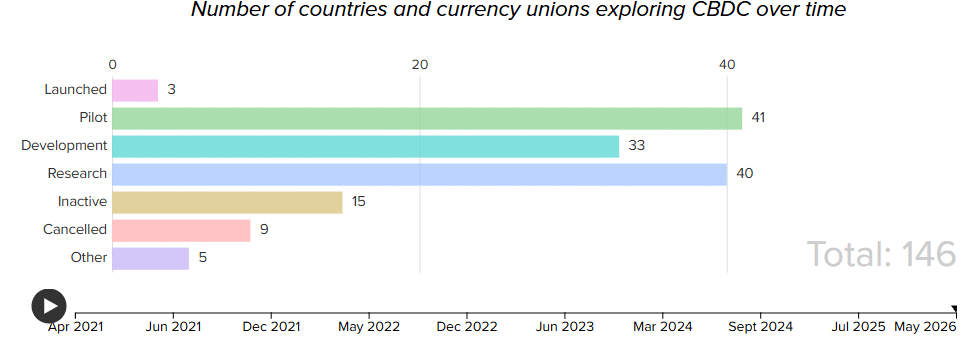
It’s not yet clear whether CBDCs will be involved when the live tests are done. However, as of late 2025, 91% of central banks were exploring CBDCs.  

As of 2026, Kenya, the Philippines, Canada, Denmark, Norway, Finland, and the U.S. have cancelled their CBDC plans. It’s worth pointing out that, however, the U.S. may rethink its CBDC project after 2030. 

CBDC
Source: Atlantic Council 

Only four countries have launched their CBDC, including Nigeria, Kazakhstan, Jamaica, and the Bahamas, according to CBDC Tracker data. The rest are either under research or in the pilot phase (like China’s e-CNY and India’s e-rupee).  


Final Summary

  • U.S. Treasury Secretary Bessent rejected any CBDC plans under the Trump administration, noting that they’ll focus on stablecoin law.  
  • About 100 countries are exploring CBDC either at the research, development, or pilot stage. 


Source link