Home Blog Page 717

Are Wall Street Analysts Predicting Jacobs Solutions’ Stock Will Climb or Sink?

0
Are Wall Street Analysts Predicting Jacobs Solutions’ Stock Will Climb or Sink?


Jacobs Solutions Inc. (J) has grown into one of the world’s largest professional services firms, with a $13.5 billion market cap and operations spanning more than 50 countries. The company provides engineering, technical consulting, and project management services across infrastructure, water, environmental, energy, and defense markets globally.

While the business keeps busy on all fronts, shares of the Dallas, Texas-based company have been telling a very different story in the market. The stock slid 9.6% over the last 52 weeks and bled another 13.4% year-to-date (YTD) in 2026, putting the company on the wrong side of the broader market rally.

More News from Barchart

The S&P 500 Index ($SPX) posted a 27.9% gain over the same 52-week window and has already added 9.2% in 2026, making the gap between Jacobs and the index wider.

The State Street Industrial Select Sector SPDR ETF (XLI) painted an equally unflattering comparison, climbing 21.6% over the last 52 weeks while tacking on another 10.7% YTD, leaving Jacobs trailing its own sector by a wide margin.

www.barchart.com

The stock briefly found its footing on May 5 when Jacobs reported Q2 FY2026 results, jumping 4.4% as investors responded to what looked like a solid quarter on the surface. However, the optimism had a very short shelf life as shares dropped 7.3% in the very next trading session once the full picture came into focus.

Revenue grew 27% year over year to $3.7 billion during the quarter, clearing the analyst estimate of $3.3 billion. The trouble, though, ran deeper in the numbers, as Jacobs posted a GAAP net loss of $43 million that the company attributed to costs tied to its recent acquisition of PA Consulting.

Adjusted EPS came in at $1.75, up 22.4% year over year and comfortably beating the analyst estimate of $1.64 and showing that the underlying business held its ground, but that strength was not enough to hold investor confidence together.

Looking ahead, the picture appears encouraging. FY2026 wraps up in September, and analysts are penciling in an 18% year over year jump in diluted EPS to $7.22, reflecting growing confidence in where the business is heading. The confidence draws further backing from the fact that Jacobs has topped EPS estimates in each of the last four consecutive quarters.


Wall Street has settled on an overall “Moderate Buy” rating for J stock, though the breakdown among analysts reveals a clear lean toward the bullish side. Out of 16 analysts currently covering the company, eight hold a “Strong Buy” rating, two go with “Moderate Buy,” and six remain on the fence with a “Hold.”

www.barchart.com
www.barchart.com

The distribution has not shifted an inch over the last three months, when eight analysts also carried “Strong Buy” ratings on the stock.

The steady conviction only grew louder after the company’s strong second quarter showing. On May 9, RBC Capital analyst Sabahat Khan lifted his price target on J stock to $169 from $160 while maintaining an “Outperform” rating, citing impressive Q2 results and upbeat forward guidance.

J stock’s average price target of $159.14 suggests potential upside of 38.8%. However, the Street-High target of $181 set by Citigroup analyst Andrew Kaplowitz suggests a gain of 57.8% from current levels. Kaplowitz nudged his target price up to $181 from $180 and reiterated a “Buy” rating, making Citigroup the stock’s loudest cheerleader at the moment.

On the date of publication, Aanchal Sugandh did not have (either directly or indirectly) positions in any of the securities mentioned in this article. All information and data in this article is solely for informational purposes. This article was originally published on Barchart.com


Source link

Identifying the 60% Bitcoin dominance problem for Ethereum bulls

0
Identifying the 60% Bitcoin dominance problem for Ethereum bulls


Ethereum [ETH] has had a tough year compared to Bitcoin [BTC].

While Bitcoin continues to attract most of the market’s attention, Ethereum has struggled. The market still looks BTC-led, with investors preferring it over altcoins for now.

BTC has the upper hand in 2026

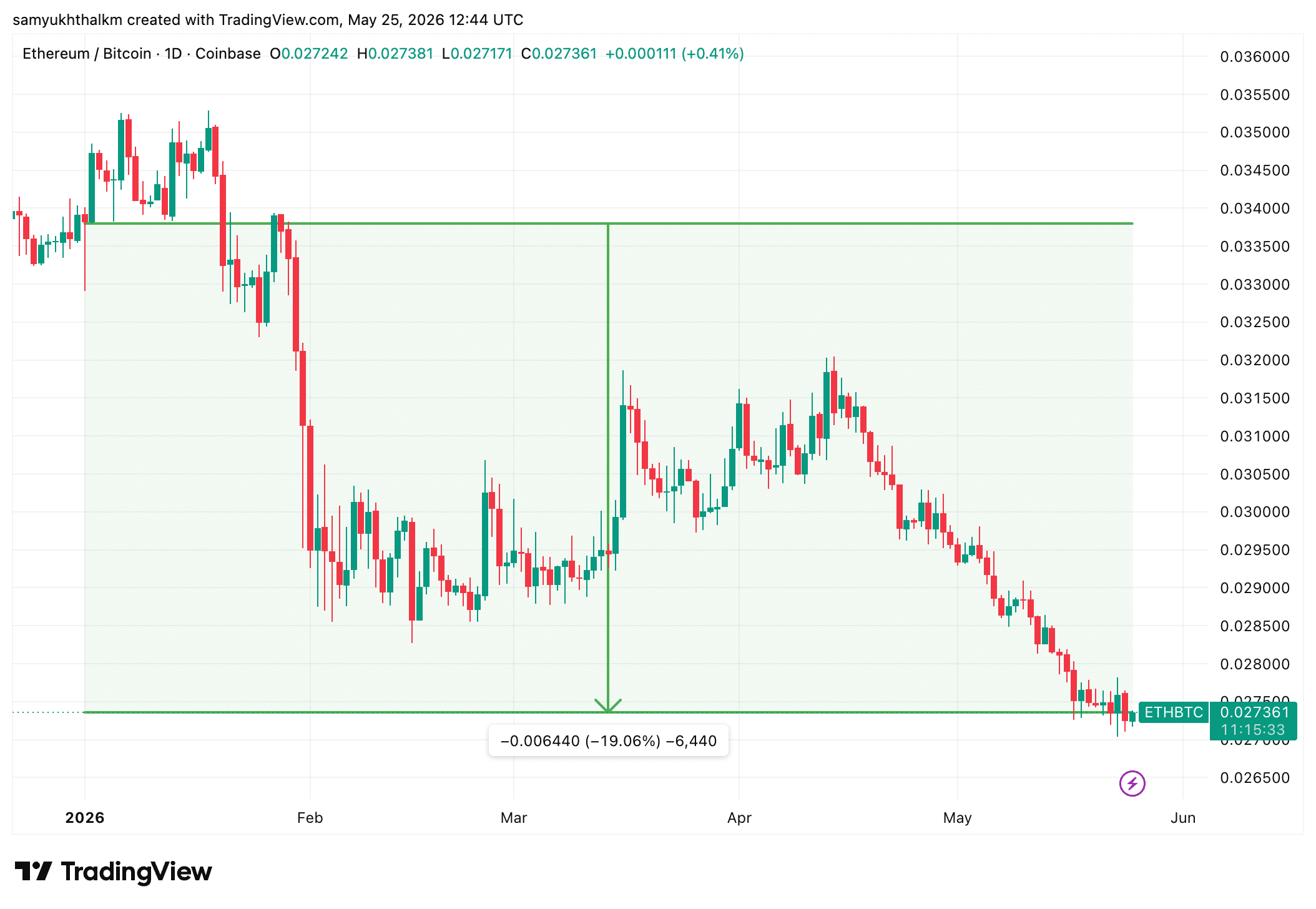
Ethereum has spent most of the year struggling against Bitcoin. The ETH/BTC pair is down close to 20% YTD, which simply means ETH has not kept pace with BTC’s strength.

ethereumethereum
Source: TradingView

This is important. ETH/BTC is often used as a quick way to judge whether the market is moving towards altcoins or staying focused on Bitcoin.

Right now, the indication is fairly clear. Capital is still favouring Bitcoin, and Ethereum has not shown enough momentum to challenge that trend.

Investors are pulling back too!

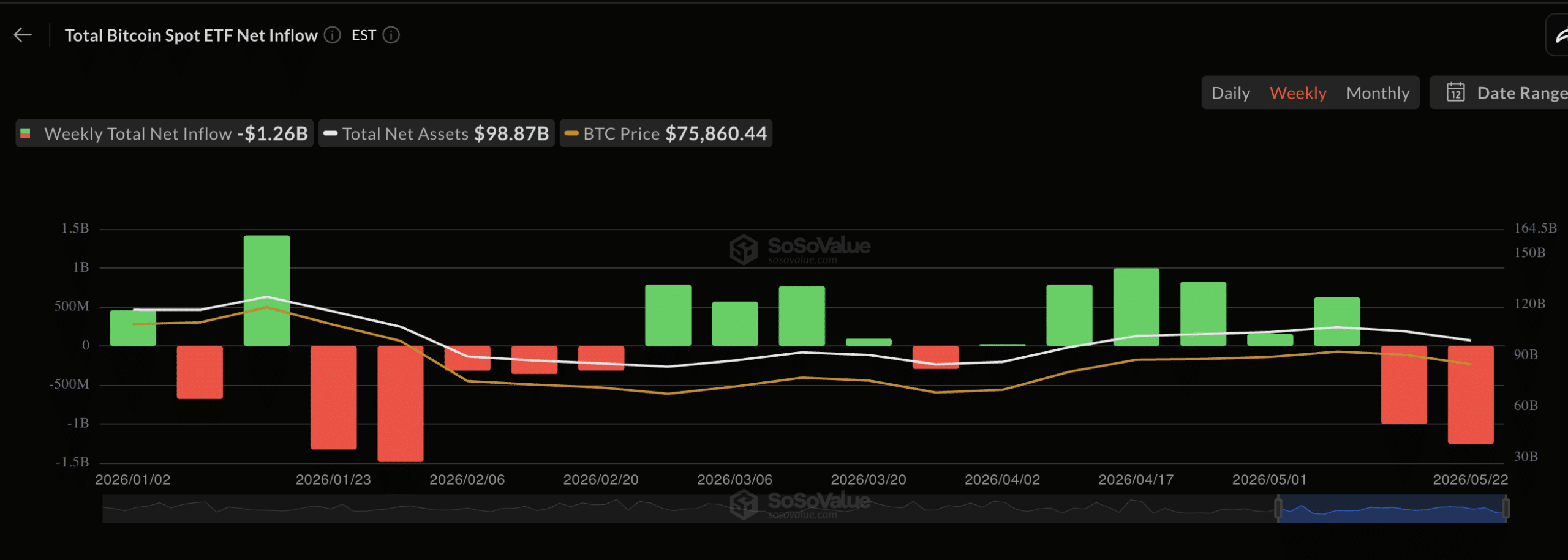
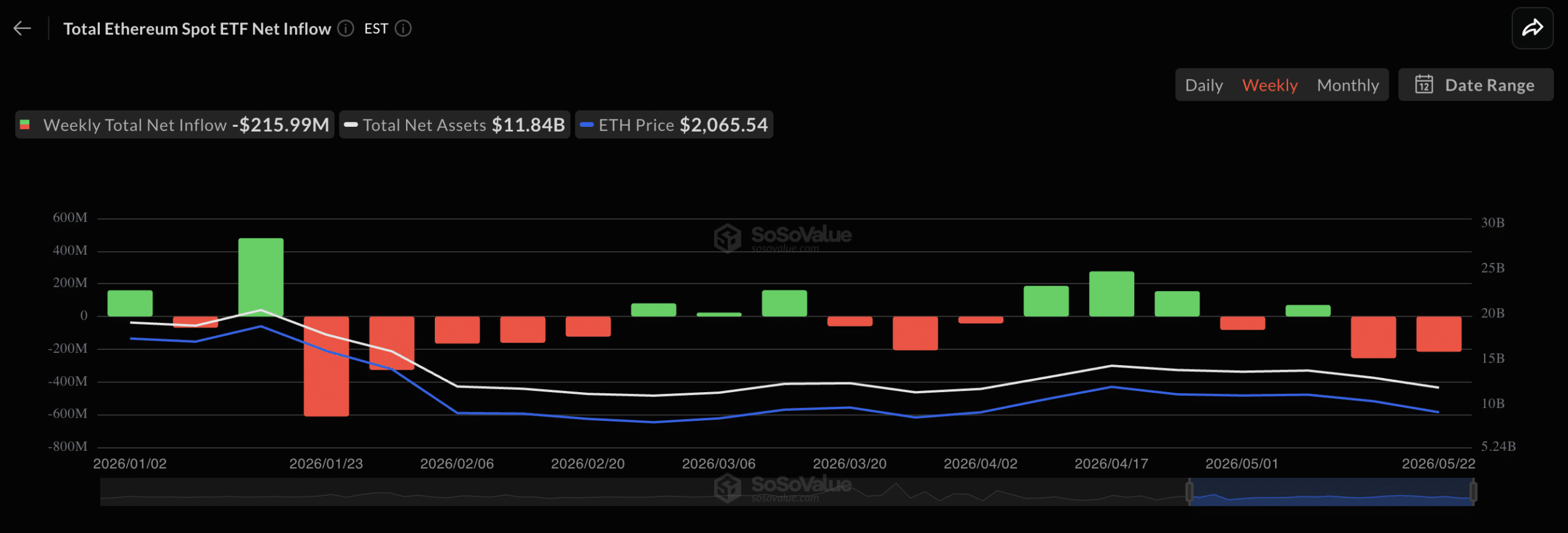
Bitcoin Spot ETFs saw weekly net outflows of about $1.26 billion, while Ethereum Spot ETFs also recorded outflows of around $216 million.

Source: SoSoValue

This tells us two things.

First, risk appetite has slowed down in general, even for Bitcoin. Second, the weakness is not leading investors towards Ethereum or other altcoins.

Source: SoSoValue

Bitcoin still has a much larger ETF asset base. So, even during outflow weeks, it remains the main institutional crypto trade.

Ethereum, on the other hand, has been seeing weaker price action and weaker flows together. That makes it harder to argue on the altcoin’s behalf.

BTC.D keeps altseason on hold


Source link

XRP slips below $1.35 after triangle breakdown puts focus on $1.30 support

0
XRP slips below $1.35 after triangle breakdown puts focus on $1.30 support

XRP spent weeks tightening into a narrow range, but the market finally started leaning lower after another failed push above resistance near $1.36. The move matters because repeated tests of support tend to weaken buyers over time, and XRP is now drifting back toward the same $1.30 area traders have treated as the line between consolidation and broader breakdown risk.

News Background

• Analysts remain split on XRP’s structure, with some calling the latest move a confirmed triangle breakdown while others still frame it as late-stage compression before a larger breakout.

• CME Group is preparing to launch 24/7 XRP-linked futures trading later this month, adding another layer of institutional exposure to the token.

• Whale activity also cooled sharply during the period, with large transaction counts falling more than 57% over nine days.

Price Action Summary

• XRP fell from $1.3457 to $1.3366 during the 24-hour session while trading inside a relatively tight 1.9% range.
• The largest move came after a failed breakout attempt near $1.3620, where elevated volume quickly reversed into selling pressure.
• XRP later broke below the $1.35 level and consolidated near session lows around $1.336 into the close.

Technical Analysis

• The breakdown below $1.35 reinforced short-term bearish momentum after weeks of tightening price action.
• XRP is now trading beneath several key moving averages, while resistance near $1.36 continues to reject upside attempts.
• Some analysts view the recent move as a confirmed symmetrical triangle breakdown with downside risk toward $1.14.
• Others still argue the broader structure resembles compression rather than outright collapse, especially while XRP remains above the critical $1.30 support area.

What traders should watch

• $1.30-$1.31 is now the key support zone. Losing it would likely accelerate downside momentum.
• $1.35 becomes the immediate resistance area XRP needs to reclaim to stabilize near-term structure.
• CME’s upcoming XRP futures launch could increase volatility and improve liquidity once trading begins later this month.


Source link

Why Tether’s Georgia partnership could accelerate sovereign stablecoin adoption

0
Why Tether’s Georgia partnership could accelerate sovereign stablecoin adoption


Tether and the Government of Georgia announced GEL₮, a lari-pegged national stablecoin, on the 25th of May 2026.

The move positioned Georgia among the first countries to place its national currency onto blockchain payment rails through a private issuer instead of a state-run CBDC.

Officials said the initiative targeted faster cross-border payments, lower settlement costs, and stronger digital financial infrastructure.

Georgia had reportedly spent months building a stablecoin framework covering reserve management, redemption rights, issuer oversight, and AML compliance.

However, this was not Tether’s first sovereign-style partnership.

Why does the Lugano deal matter?

Tether began testing this model in 2022 through its partnership with Lugano, Switzerland.

At the time, the city’s Bitcoin and USDT payment integration looked experimental to many observers. That changed in 2026 after Lugano expanded into Plan ₿ Phase II, extending its blockchain infrastructure plans through 2030.

Georgia followed a similar path.

The country signed an MOU with Tether in June 2023 before advancing toward a live national stablecoin in May 2026.

That history suggested governments rarely stopped at symbolic partnerships once infrastructure discussions began.

By embracing blockchain and peer-to-peer technologies, Georgia aims to create a favorable business environment and position itself as a leading hub for digital innovation in the region.

That statement came from the 2023 Government of Georgia and the Tether MOU.

How did Tether build government trust?

Tether’s relationship with U.S. agencies followed a different route. It began with enforcement coordination rather than monetary policy integration.

The company onboarded the Secret Service and the FBI onto its platform. It also froze $435 million across 326 wallets during earlier coordination actions.

In April 2026, another enforcement action froze $344 million tied to two addresses.

That pattern mattered.

Tether first built compliance credibility through enforcement cooperation before expanding into broader institutional partnerships. That move aligned closely with Georgia’s current approach toward stablecoin oversight.

What could GEL₮ adoption look like?

USDT’s market capitalization climbed toward $190 billion, while its daily volumes regularly rivaled Visa and Mastercard activity. Even a moderate adoption curve could carry weight for Georgia because of its reliance on remittances.

In fact, Tether’s infrastructure may appeal to governments for another reason.

Its smart contract system allows token freezes, burns, and reissuance. The company said the framework has already processed up to $2.7 billion in recovered stolen funds.

For governments concerned about sanctions evasion or capital flight, those controls may strengthen the appeal of private stablecoin partnerships.

Tether Trading volume and market cap
Source: Santiment

Are sovereign stablecoins becoming the norm?

GEL₮ arrived during a broader expansion push from Tether. The company launched USAT in January 2026 under the U.S. GENIUS Act through Anchorage Digital.

It also partnered with the United Nations Office on Drugs and Crime to combat illicit financial flows across Africa.

That shift left policymakers focused on a larger trend.

Governments increasingly appeared willing to use private blockchain infrastructure instead of building CBDCs from scratch. Georgia may simply be the latest example, not the last one.


Final Summary

  • Georgia partnered with Tether to launch GEL₮, a lari-pegged stablecoin aimed at faster payments and cheaper settlements.
  • The deal strengthens Tether’s role in sovereign payment systems and expands its policy footprint beyond USDT trading markets.


Source link

Markets rejoice as deal to reopen Hormuz nears, but US forces conduct ‘self-defense strikes’ on Iran

0
Markets rejoice as deal to reopen Hormuz nears, but US forces conduct 'self-defense strikes' on Iran

Stock futures jumped while oil prices and bond yields tumbled Monday evening on reports that a deal to reopen the Strait of Hormuz was coming together, even as the U.S. military conducted new airstrikes on Iran.

Futures tied to the Dow Jones industrial average surged 297 points, or 0.58%. S&P 500 futures were up 0.64%, and Nasdaq futures leapt 0.90%. All three indexes pulled back a bit from earlier highs.

U.S. oil futures sank 5.5% to $91.32 a barrel, but also pared steeper losses. Gold rose 0.48% to $4,545 per ounce.

The U.S. dollar was up 0.07% against the euro and up 0.04% against the yen. The yield on the 10-year Treasury plunged 7.2 basis points to 4.50%.

Reports over the holiday weekend pointed to an emerging agreement that would extend the ceasefire for 60 days. At the same time, Iran would allow ship traffic to flow freely through the Strait of Hormuz, while the U.S. would lift its naval blockade on Iranian ports.

But the thornier issues of Iran’s uranium and nuclear program as well as the U.S. lifting sanctions and unfreezing Iranian assets would be tackled in negotiations during the 60-day window.

While talks haven’t begun yet, President Donald Trump signaled a major concession on the nuclear issue, saying in a social media post that he’s open to allowing Iran’s enriched uranium be destroyed “at another acceptable location” outside the U.S.

Renewed fighting on Monday has already tested the fragile situation as explosions rocked the southern port city of Bandar Abbas near the Strait of Hormuz.

“U.S. forces conducted self-defense strikes in southern Iran today to protect our troops from threats posed by Iranian forces,” a U.S. Central Command spokesman told Fox News. “Targets included missile launch sites and Iranian boats attempting to emplace mines.”

He added that U.S. used restraint “during the ongoing ceasefire,” indicating the attacks do not mean the ceasefire is over.

Sources also told Fox separately that the U.S. military destroyed two Islamic Revolutionary Guard Corps vessels trying to deploy mines and a surface-to-air missile site in Bandar Abbas that was targeting U.S. planes.

Meanwhile, Israeli Prime Minister Benjamin Netanyahu said attacks on Hezbollah would intensify, potentially threatening the talks as Iran has insisted that any deal include the Lebanese militant group.

Despite the current ceasefire starting a month and a half ago, Israel and Hezbollah have been exchanging attacks during that time.

“But we are not removing our foot from the pedal,” Netanyahu said Monday. “On the contrary, I said to press on the pedal even more.”

Even if the Strait of Hormuz opens immediately, the full resumption of the oil trade and traffic flows could take two or three months.

Top oil-consuming countries have been releasing reserves to help offset shortfalls while other countries have enacted strict rationing policies.

But the global economy is running out of time. Veteran commodities analyst Jeff Currie, Carlyle’s chief strategy officer of energy pathways, told CNBC that Asia is already close to minimum operating levels, or “tank bottoms.”

“I would say, Asia, you’re there,” he added. “Europe, give it about another month, and look for July being a problem in the U.S.” 


Source link

BJ’s Wholesale plans major store changes as customers pull back

0
BJ’s Wholesale plans major store changes as customers pull back


BJ’s Wholesale is seeing a ripple effect from economic pressure that has boosted its gas business in recent months.

However, its retail business continues to face challenges as demand grows unevenly. In response, the company is planning significant in-store changes that could affect how customers shop.

In the first quarter of 2026, BJ’s comparable club sales increased by 6.3% year over year, which includes gasoline sales, the company’s latest earnings report revealed. Gas was the main driver of this growth; without it, comparable club sales rose only 1.5% year over year.

Data from a recent Placer.ai report revealed that visits to BJ’s gas stations, which offer discounted fuel, gradually increased over the past two months as gas prices rose. For example, during the week of March 9, BJ’s gas station visits spiked by 17.2% year over year, and for the week of April 6, visits rose by a whopping 21.7%.

Gas prices began to inflate following the U.S. and Israel’s attack on Iran in late February. Currently, gas prices nationwide are averaging about $4.52 per gallon, according to recent data from the American Automobile Association (AAA). A month ago, the average gas price was $4.03 per gallon.

In the report, Placer.ai content writer Ezra Carmel wrote that “competitively priced fuel is a meaningful traffic driver during periods of elevated gas prices – reinforcing the value proposition of warehouse club memberships.”

“If fuel prices remain high, members may be more inclined to consolidate shopping trips around fuel fill-ups, potentially boosting both gas station traffic and in-club spending,” he added.

BJ’s plans significant move as customer base shifts 

During an earnings call on May 22, BJ’s Wholesale CEO Bob Eddy said that in April alone, members spent $143 million more at the company’s gas stations than they did a year ago.

“Gas prices increased dramatically during the quarter, putting additional pressure on member wallets,” said Eddy. “By the end of Q1, retail gas prices were up nearly 50% compared to the start of the quarter. In that environment, our role was clear: to help take care of our members by delivering value.”

Despite this growth in gas sales, Eddy warned that club members are continuing to pull back on spending in discretionary categories, as sales growth in these areas remained flat during the quarter.

Related: BJ’s Wholesale makes bold move to lure more shoppers

“While the consumer in the broadest sense has been resilient in the face of continuing challenges, we continue to see a more pressured environment for the lower-income households,” he said.


Source link

Bitcoin prices tighten amid THESE risks – Is BTC volatility building?

0
Bitcoin prices tighten amid THESE risks - Is BTC volatility building?


Bitcoin’s [BTC] internal structure had already started weakening before institutional demand slowed sharply across broader spot markets recently. Market optimism also became fragile once leveraged retail traders started rebuilding aggressive long exposure again.

Spot Bitcoin ETF outflows later surpassed roughly $1.74 billion, while Coinbase Premium turned deeply negative beneath weakening U.S. demand conditions. Binance BTC netflows also surged nearly 425% as older coins returned toward exchanges beneath defensive positioning behavior.

Such a shift reflected experienced holders becoming more cautious while retail traders continued chasing leveraged upside exposure. However, Funding Rates remained positive despite weakening liquidity and slower stablecoin inflows underneath.

If spot demand weakens further, overcrowded longs may amplify broader Bitcoin liquidation volatility.

Bitcoin’s weakening accumulation strength

Bitcoin’s weakening spot participation started pressuring broader market structure once Apparent Demand collapsed toward yearly lows recently. Apparent Demand measures whether long-term accumulation remains strong enough to absorb newly issued Bitcoin supply across markets.

That metric later fell to nearly -147,000 BTC, its weakest level since December 2025 amid fading capital inflows. Earlier, between June and September 2025, demand stayed mostly positive while Bitcoin traded above the broader $100,000 region.

Source: CryptoQuant

However, newer demand later struggled to absorb fresh supply once long-term holder accumulation slowed across broader markets. Futures activity still continued supporting shorter-term momentum despite weakening spot participation underneath current conditions.

That divergence reflected how leveraged positioning remained stronger than real buyer conviction across Bitcoin markets. Yet, deeply pessimistic demand conditions have historically attracted patient long-term accumulation during later recovery phases.

Binance inflows signal rising defensive positioning

Market caution strengthened across Bitcoin markets once Binance started recording persistent inflows over nearly ten consecutive days recently. Traders also became more defensive as geopolitical uncertainty continued pressuring broader risk appetite conditions globally.

Binance inflows later climbed from roughly 378 BTC on the 16th of May toward nearly 1,190 BTC within less than ten days. The largest single-day inflow also surpassed roughly 3,600 BTC on the 18th of May, reflecting stronger transfer activity into exchange wallets.

Source: CryptoQuant

Meanwhile, Binance Bitcoin reserves rebounded from nearly 616,000 BTC to roughly 632,000 BTC after adding around 16,000 BTC within one month.

This increase signaled rising sell‑side liquidity as holders repositioned more cautiously under weaker market conditions. Bitcoin briefly fell 6.2% while inflows stayed elevated across broader markets.

Still, persistent inflows need further confirmation before indicating heavier distribution pressure.


Final Summary

  • Bitcoin spot demand continues weakening as ETF outflows, rising exchange inflows, and negative apparent demand pressure broader market structure.
  • BTC still faces rising liquidation risk, though deeply pessimistic demand conditions have historically attracted longer-term accumulation during later recovery phases.


Source link