Home Blog Page 718

KelpDAO says rsETH recovery completed as backing returns above 100%

0
KelpDAO says rsETH recovery completed as backing returns above 100%


KelpDAO said it has completed the operational phase of its rsETH recovery plan. This comes after transferring the final tranche of 20,373.72 rsETH into the protocol’s OFT adapter. It marked the latest step in restoring confidence around the liquid restaking asset’s cross-chain backing infrastructure.

In an update published on 25 May, KelpDAO said the transfer finalized a broader refill process that saw approximately 116,000 rsETH replenished into the rsETH OFT adapter over the last two weeks with support from Aave.

The protocol added that minting, redemption, and reward operations have been functioning normally since the system resumed operations following the disruption.

Dashboard shows backing ratio above 100%

KelpDAO also pointed users to its live rsETH dashboard, which currently shows:

  • a 100.01% ETH backing ratio,
  • and full bridge lockbox coverage across both LayerZero and Chainlink infrastructure.

The figures are intended to reinforce the protocol’s claim that rsETH has remained fully backed since the system was unpaused.

KelpDAO rsETH backing
Source: Vercel app

The dashboard update comes as liquid staking and restaking protocols continue facing heightened scrutiny across DeFi following multiple bridge, custody, and infrastructure-related incidents over the past year.

Cross-chain collateral integrity becomes central issue

The recovery process centered around the rsETH OFT adapter, which plays a key role in managing cross-chain liquidity and token movement across supported networks.

By replenishing the adapter and restoring bridge coverage metrics to 100%, KelpDAO appears to be focusing heavily on restoring confidence in the protocol’s solvency and redemption reliability.

Aave’s involvement in the refill process also highlights the increasingly interconnected nature of major DeFi protocols during periods of operational stress.

Recovery efforts move from operations to confidence rebuilding

KelpDAO has described the latest transfer as the end of the operational recovery phase. However, the broader challenge may now shift toward rebuilding user confidence after the disruption.

Recent months have seen investors become increasingly sensitive to:

  • bridge security,
  • backing transparency,
  • and solvency concerns across restaking and liquid staking ecosystems.

Protocols have responded by placing greater emphasis on real-time reserve dashboards, proof-of-backing systems, and publicly trackable recovery wallets.


Final Summary

  • KelpDAO said it completed the operational phase of its rsETH recovery after transferring the final 20,373.72 rsETH tranche into the OFT adapter.
  • The protocol’s dashboard currently shows a 100.01% ETH backing ratio and full bridge lockbox coverage.


Source link

Google and Amazon’s Earliest Backer Calls AI “Underhyped”

0
Google and Amazon's Earliest Backer Calls AI "Underhyped"


Topline

Venture capitalist John Doerr, whose early checks into Amazon and Google helped underwrite the modern internet, called artificial intelligence the “biggest tsunami” of innovation he’s ever tracked in his more than four decades of investing and has actually been “underhyped”—joining a growing group of tech power players making maximalist claims about where the technology is headed.

Key Facts

Doerr, 74, told The Wall Street Journal in an interview published Monday the latest AI wave is the “biggest thing ever. Since everything,” arguing the public still does not grasp how it will reshape education, employment, healthcare and “life as we know it.”

He framed AI as the fourth major “tsunami” in a roughly 13-year cycle he traces back to the 1980 PC and microchip revolution, followed by the internet wave and then the iPhone and cloud computing era.

Doerr cited adoption data to support the case, telling the Journal that “just three years after ChatGPT was launched, 50% of Americans say they use generative AI”—a figure consistent with an April 2026 Ipsos survey finding half of Americans had used an AI service in the past week.

He said his personal investing, now run through his family office after he stepped down as venture capital firm Kleiner Perkins’ chairman, is focused on entrepreneurs using AI to tackle the climate transition and transform healthcare.

On top of early bets in Google and Amazon, Doerr is known for his investments in companies including Twitter, DoorDash, Slack and Intuit.

Key Background

Doerr’s “underhyped” framing slots into an increasingly crowded field of tech billionaires and AI executives making sweeping, civilization-scale predictions about the technology. “We are heading toward a system that will be capable of doing innovation on its own. I don’t think most of the world has internalized what that’s going to mean,” OpenAI CEO Sam Altman told Forbes earlier this year. In late January, Anthropic CEO Dario Amodei warned in a blog post that humanity is entering “a rite of passage…which will test who we are as a species,” calling powerful AI potentially “the single most serious national security threat” of the century. Nvidia CEO Jensen Huang, whose company has ridden the buildout to a roughly $4 trillion market cap, told the World Economic Forum in Davos in January that AI has already triggered “the largest infrastructure build-out in human history” and told Carnegie Mellon graduates during his May commencement speech: “AI is not just creating a new computing industry, it is creating a new industrial era.” Bill Gates wrote in January that “there is no upper limit on how intelligent AIs will get or on how good robots will get,” and told “The Tonight Show” last year that within a decade humans “won’t be needed” for “most things,” with AI replacing doctors and teachers. Last week, the world’s richest man Elon Musk said at the Forbes Innovation 250 celebration dinner, “In five years, digital intelligence will exceed the sum of all human intelligence. In five years, there might be at least 100 million humanoid robots, but maybe a billion.”

Forbes Valuation

Doerr’s net worth sits around $24.4 billion thanks largely to his stake in Alphabet, per Forbes estimates. Doerr famously wrote Kleiner Perkins’ largest-ever check at the time—$12 million for 12% of a $100 million Google—after meeting Larry Page and Sergey Brin in a Menlo Park garage in 1999. Alphabet’s market cap has grown to $4.62 trillion today and shares are up more than 120% since last May thanks to the company’s AI pivot, from the Gemini model and AI overviews in its search function to its custom AI chips.

Tangent

Doerr has also conspicuously skipped investing in crypto, telling the Journal he didn’t see crypto as the kind of founder- and team-driven business that built his career in software, though he said “there is still plenty of time for me to be wrong.” His misses have a track record of their own: He infamously backed the Segway and Fisker Automotive, telling the Journal his partners reminded him “never invest in anything with wheels.” (He missed Tesla.)


Source link

Intel Urges PC Makers to Switch to Its Latest Chips Amid AI Demand. This Could Be the Margin Boost INTC Stock Needs.

0
Intel Urges PC Makers to Switch to Its Latest Chips Amid AI Demand. This Could Be the Margin Boost INTC Stock Needs.


The AI PC story is picking up speed, with global semiconductor revenue expected to top $1 trillion for the first time in 2026. This jump is driven mostly by strong AI demand, with the Computing & Data Storage segment alone forecast to grow 41.4% year-over-year (YOY) and pass $500 billion. On top of that, Gartner expects worldwide AI spending to hit $2.59 trillion in 2026, a 47% increase from the prior year.

Intel (INTC) does not want to be left behind in that kind of market. It is pushing major PC makers in the U.S., China, and Taiwan to move to its most advanced 18A-process chips, including the Panther Lake and Wildcat Lake platforms, as demand for top-tier processors starts to run ahead of supply on the best manufacturing nodes.

More News from Barchart

Wedbush Securities sees this as a smart way for Intel to protect its margins by guiding customers toward higher-value, premium-priced chips.

Will this proactive push into next-generation chips finally deliver the sustainable margin expansion and revenue growth investors are craving, or is it merely a tactical defense in a hyper-competitive market?

Intel’s Messy Earnings Picture

Intel is based in Santa Clara, California, and designs, manufactures, and sells microprocessors, chipsets, and related computing platforms for PCs, data centers, and newer AI-focused devices around the world.

INTC has a year-to-date (YTD) gain of 220.26% and a 52-week return of 471.17%.

www.barchart.com

The company now has an equity value of $598 billion, and its trailing price-to-earnings multiple of 1,846.67 times and trailing price-to-cash-flow multiple of 59.91 times are far above sector medians of 25.06x and 18.35x.

Their latest quarterly report, for the period ended March 26, showed revenue of $13.58 billion versus analyst estimates of $12.39 billion, which worked out to 7.2% YOY growth and a 9.6% beat. It also delivered adjusted earnings per share of $0.17 compared with an estimate of -$0.10, producing a +270.00% surprise.

INTC posted adjusted operating income of $1.67 billion, versus a $397.4 million analyst estimate, and Intel turned that into a 12.3% adjusted operating margin, suggesting the higher-end product mix is already helping.

It is also clear that the underlying numbers are still messy. The operating margin was -23.1% in March 2026, compared with -2.4% in the same quarter last year. The company reported net income of -$3.728 billion, with net income growth at -530.80%.

Intel generated $1.096 billion in operating cash flow, although that was down 88.70%, and its net cash flow came in at $2.983 billion, down 53.85%. This is why Intel’s push to steer PC makers toward its latest chips matters so much, because a better mix and pricing are some of the few levers it can pull quickly to support those stretched financials.

Intel Leans on New Partnerships and Chips

Intel’s push to get PC makers onto its latest chips builds on the recent launch of its Core Series 3 processors, which are meant to bring AI‑ready performance to small businesses, schools, and budget-conscious users. These chips are designed to power AI‑capable PCs with better everyday performance and efficiency, support up to 40 platform TOPS, and deliver clear gains over older machines, gently steering customers toward newer, higher‑value systems.

That same strategy shows up in its long-term work with Alphabet’s (GOOGL) on infrastructure. Under a multi‑year deal, Google continues to use Intel’s Xeon processors while the two companies co‑develop custom infrastructure processing units that fine‑tune networking, storage, and AI workloads at massive scale.

Additionally, Intel has gone from being viewed as a “market reject” to landing a key AI role with Elon Musk’s ventures. Its involvement in Musk’s Terafab project, a huge AI and semiconductor campus meant to support Tesla (TSLA), SpaceX, and xAI with advanced 14A process manufacturing, has helped reposition Intel’s foundry arm as a more credible AI supply‑chain partner.

The brand is getting more visibility in high‑performance settings, too. Intel was recently named the official compute partner of McLaren Racing across Formula 1, IndyCar, and sim racing. Its Xeon and Core Ultra processors will power everything from aerodynamics simulations to race‑day strategy analytics.

These moves all feed into the same story Intel is telling PC manufacturers that the future is on its newest platforms, and that is where the performance, partnerships, and pricing power now live.

Analysts Weigh Intel’s Margin Story

Intel’s next big checkpoint is set for July 23, when it is scheduled to release earnings for the June 2026 quarter. In the upcoming report, the Street is looking for average earnings of $0.10 per share, compared with -$0.26 a year earlier. That works out to an estimated YOY growth rate of 138.46%.

Those higher expectations line up with rising interest from big-money investors. During Q1 2026, Chase Coleman’s Tiger Global Management, one of the most closely watched hedge funds on Wall Street, quietly built a fresh position in Intel. The fund bought 1,638,700 shares, a stake worth roughly $180 million based on its most recent 13F filing.

Even with that kind of backing, the broader analyst crowd is still careful. The stock has a consensus “Hold” rating from 44 analysts, which shows the Street is not ready to call Intel’s margin comeback complete. The average price target is $87.54, well below the current share price and implying roughly 26% downside.

www.barchart.com
www.barchart.com
www.barchart.com
www.barchart.com

Conclusion

Intel’s push to get PC makers onto its newest chips looks like a real, if imperfect, way to support margins rather than just a flashy headline move. The fundamentals still need work, but a better product mix, tighter supply, and more AI-related deals all point to earnings and cash flow slowly improving from here. In that kind of setup, the stock seems more likely to cool off or move sideways than crash, with the next few quarters key to proving the margin story in the actual numbers.

On the date of publication, Ebube Jones did not have (either directly or indirectly) positions in any of the securities mentioned in this article. All information and data in this article is solely for informational purposes. This article was originally published on Barchart.com


Source link

NEAR price rally gains momentum as cross-chain product activity fuels further 15% jump

0
NEAR price rally gains momentum as cross-chain product activity fuels further 15% jump


NEAR Protocol’s token climbed 15% over the past 24 hours to $2.8, extending a month-long rally that has seen the price of NEAR double in the past month.

The move comes amid the success surrounding NEAR Intents, the network’s cross-chain transaction system. The product allows users to request a desired outcome, such as swapping USDC on Ethereum for SOL on Solana, while third-party solvers execute the transaction behind the scenes.

DefiLlama data shows NEAR Intents has processed more than $19 billion in cumulative volume and generated about $32 million in fees. The figures have drawn renewed attention to the protocol after months of limited price movement.

The rally accelerated further after BitMEX co-founder Arthur Hayes described NEAR, Hyperliquid’s HYPE and ZEC as crypto’s “holy trinity” in a post on social media, before suggesting there’s a “long way to go” in its rally.

NEAR gained about 30% as traders rotated back into tokens tied to artificial intelligence and blockchain infrastructure earlier in the month, while institutional demand has been growing. The Bitwise NEAR Staking ETP listed in Europe has grown to roughly $40 million in assets under management, after seeing $7 million in inflows in a single week.

Investors are also watching an upcoming June network upgrade that introduces dynamic resharding. The change is designed to automatically split network shards as demand increases, potentially improving scalability during periods of heavy usage.

Despite the recent surge, NEAR remains well below its 2022 peak near $20.

NEAR is a layer-1 blockchain focused on applications, AI infrastructure and cross-chain transactions. The network uses a proof-of-stake model and markets itself as a platform designed to simplify interactions across blockchains while handling large volumes of activity through sharding.


Source link

Polymarket scrutiny grows as CFTC suspensions raise oversight concerns

0
Polymarket scrutiny grows as CFTC suspensions raise oversight concerns


The Commodity Futures Trading Commission [CFTC] increasingly shifted toward market facilitation as crypto-adjacent trading activity expanded rapidly throughout 2025 and 2026. Regulatory approvals also accelerated once leadership prioritized innovation frameworks and streamlined access pathways across markets.

CFTC enforcement activity later fell below the 58 cases recorded during 2024. Roughly half of the agency’s open matters also closed by mid-2025.

Meanwhile, seventeen new Designated Contract Market applications emerged after early 2025 as approval timelines compressed further beneath acting leadership.


Source link

Pope Leo called AI an ‘instrument of domination, exclusion and death.’ Anthropic was in the room

0
Pope Leo called AI an 'instrument of domination, exclusion and death.' Anthropic was in the room

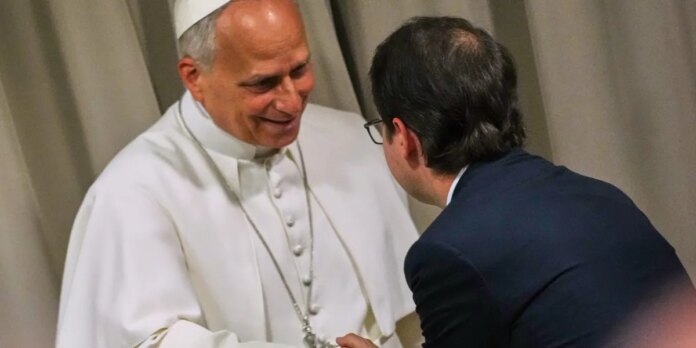
Pope Leo XIV called Monday for robust regulation of artificial intelligence and for its developers to work for the common good rather than profit, issuing a sweeping manifesto on safeguarding humankind as the technology impacts everything from work to war.

“Magnifica Humanitas” (Magnificent Humanity), Leo’s first encyclical, has been eagerly awaited ever since history’s first U.S.-born pope announced days after his election that he considered AI to be the biggest challenge facing humanity today.

In the text, Leo denounced the “culture of power” driving the AI race, especially in developing ever more sophisticated methods of remote warfare. He declared that it was “not permissible” to entrust irreversible, lethal decisions to AI systems, setting up another flash point between the American pope and the Trump administration, which has worked aggressively to deregulate AI development.

“Artificial Intelligence now demands to be disarmed, freed from logics that turn it into an instrument of domination, exclusion and death,″ the pope told a special Vatican presentation of the encyclical, one of the most authoritative types of teaching documents a pope can issue.

Experts in the tech industry, academia and Catholic morality said the document will likely become a benchmark in the debate over AI, a point of reference for policymakers, researchers and ordinary folk alike. It comes as the near-daily developments in the technology trigger concerns over AI replacing human jobs and even human intelligence.

Taylor Black, a Microsoft AI executive and director of Catholic University of America’s AI institute, said the document would prompt people “at the forefront of these tools” to ask questions such as “What does it mean to be human?”

Pope calls out AI companies even as he hosts Anthropic

The Vatican launch also included remarks by the co-founder of Anthropic, which is currently locked in a legal battle with the Trump administration over access to its AI technology. The Vatican decided to involve Anthropic as part of its decade-long effort to engage Silicon Valley in dialogue over the human cost of AI.

And yet in his text, Leo repeatedly blasted the concentration of power and data in the hands of so few people in the private sector as a danger, especially to children and the most vulnerable, and called for external regulation of their work.

“It is not enough to invoke ethics in the abstract; robust legal frameworks, independent oversight, informed users and a political system that does not abdicate its responsibility are required,” he wrote. “A more moral AI is not enough if that morality is determined by a few.”

Leo appealed to AI developers and political leaders responsible for regulating them to slow down and reflect on what they are doing. He urged them to use ethical and spiritual guidelines to make the choice to work not for their own profit or power, but the betterment of humanity.

AI competitors OpenAI and Anthropic are the second- and third-most valuable U.S. private companies, each valued at hundreds of billions of dollars, more than the GDP of many nations. Both companies are heading toward near-trillion dollar IPOs.

Anthropic co-founder Christopher Olah welcomed Leo’s criticism and concern. He said such external checks were fundamental to the technology “going well” for humankind since there is so much at stake — “a real possibility that AI will displace human labor at a very large scale.”

“We need more of the world — religious communities, civil society, scholars, governments — to do what His Holiness has done here: to take this seriously, to look closely, and to push events in a better direction,” Olah said. “We need moral voices that the incentives cannot bend.”

Experts say the text will become a benchmark

In a methodical text, the math major pope traced the history of the Catholic Church’s social teaching and applied its core concepts — justice, solidarity, the dignity of work and the universal destination of resources — to the digital revolution.

“I am convinced that this will prove to be a defining document for our era, a profound and prophetic document,” said Paolo Carozza, law professor at Notre Dame Law School and chair of the Meta Oversight Board.

“Pope Leo is offering a clear, comprehensive, and coherent voice urging us to take responsibility for constructing a world in which technology will serve humans rather than degrade them,” he said.

In its strongest chapters, Leo denounced how AI had helped accelerate the “normalization of war” by desensitizing people to its cost. He didn’t name specific conflicts, but cited “opposing imperialisms, between powers that wish to preserve their supremacy, and those that aspire to seize that supremacy.”

He demanded transparency and accountability by AI developers so that the chain of decision-making command in ordering strikes with AI weaponry is always known. He declared that the Catholic Church’s “just war” theory, which provides specific criteria for when force can be justified, was now “outdated” given the technological advances of warfare.

A text in the church’s social justice tradition

Leo signed the text May 15, the 135th anniversary of the publication of “Rerum Novarum” (Of New Things), the most important teaching document of Leo’s hero and namesake, Pope Leo XIII. That document addressed workers’ rights, the limits of capitalism, and the obligations that states and employers owed workers as the Industrial Revolution was underway.

It became the foundation of modern Catholic social thought, and the current pope cited it at the start of his pontificate in relation to the AI revolution, which he believes poses the same existential questions that the Industrial Revolution posed over a century ago. “Magnifica Humanitas” thus becomes the latest chapter in a century-long history of popes adapting “Rerum Novarum” to the social questions of their times, often dwelling on the dignity of work for human flourishing.

AI is evoking both existential fears and utopian vision amid an intensifying debate on whether it will become a catalyst that enriches humanity or a technological toxin that dulls human intelligence while wiping out millions of high-paying jobs.

“The pursuit of greater profits cannot justify choices that systematically sacrifice jobs, because the human person is an end, not a means, and the economic order must remain subordinate to human dignity and the common good,” Leo wrote.

Leo extended his concern for upholding human dignity in labor to issue the first-ever papal apology for the Holy See’s own role in legitimizing slavery by giving European sovereigns explicit authority to subjugate and enslave “infidels.”

A decade-long dialogue with Silicon Valley

Vatican officials declined to say who contributed to Leo’s encyclical. But Vatican and church officials have been engaged in a dialogue with Silicon Valley tech firms for a decade.

The decision to include Anthropic at the Vatican launch was criticized by some who considered it a papal stamp of approval of the AI firm, which is currently suing the Trump administration after it ordered all U.S. agencies to stop using Anthropic’s technology for its refusal to allow the U.S. military unrestricted use of it.

Brian Boyd, U.S. faith liaison for the nonprofit Future of Life Institute, read the inclusion of Anthropic’s co-founder Olah as a recognition of its prominence in the field and as similar to a papal audience with a head of state: not an endorsement.

Anthropic is an “enormous corporation that is taking onto itself an enormous risk and responsibility,” Boyd said, adding that the company has “demonstrated genuine goodwill and integrity and interest in dialogue.”

___

Winfield reported from Middletown, Connecticut, and Huamani reported from Los Angeles. Associated Press writers Kelvin Chan in London and Colleen Barry in Milan contributed to this report.

___

Associated Press religion coverage receives support through the AP’s collaboration with The Conversation US, with funding from Lilly Endowment Inc. The AP is solely responsible for this content.


Source link

Casey’s (CASY) General Appears To Be A Hidden Jim Cramer Gem

0
Casey’s (CASY) General Appears To Be A Hidden Jim Cramer Gem


We recently published . Casey’s General Stores, Inc. (NASDAQ:CASY) is one of the stocks discussed by Jim Cramer.

Convenience store firm Casey’s General Stores, Inc. (NASDAQ:CASY)’s shares are up by 85% over the past year and by 48% year-to-date. Keybanc discussed the firm on April 24th as it raised the share price target to $860 from $830 and kept an Overweight rating on the stock. Some of the factors that Keybanc discussed in its coverage include fuel margins and industry consolidation. As for Cramer, just as was the case in 2025, he is still a fan of Casey’s General Stores, Inc. (NASDAQ:CASY)’s breakfast pizza. The CNBC TV host recommended the stock in this appearance:

“I’m gonna recommend a stock. Casey General, unbelievable. It’s doing so well. This morning, we’ve got, you know the analysts one by one, today’s Blair. But they have a breakfast pizza, you know I’m a ham egg and cheese guy. I thought the breakfast pizza was a killer. They’re in small towns all over the place. There you go, Casey General.”

Casey’s (CASY) General Appears To Be A Hidden Jim Cramer Gem

marilyn barbone/Shutterstock.com

Carillon Eagle Mid Cap Growth Fund discussed Casey’s General Stores, Inc. (NASDAQ:CASY) in its Q1 2026 investor letter:

“Casey’s General Stores, Inc. (NASDAQ:CASY) operates a chain of convenience stores that sell fuel, groceries, and freshly prepared food, such as pizza, primarily in small-town and rural areas across the Midwest. The stock performed well, driven by strong quarterly results, with continued strength in fuel margins and robust in-store sales, particularly in prepared foods and pizza. It also benefitted from expectations that recent increases in oil prices could further expand fuel margins.”

While we acknowledge the potential of CASY as an investment, we believe certain AI stocks offer greater upside potential and carry less downside risk. If you’re looking for an extremely undervalued AI stock that also stands to benefit significantly from Trump-era tariffs and the onshoring trend, see our free report on the best short-term AI stock.

READ NEXT: 33 Stocks That Should Double in 3 Years and Cathie Wood 2026 Portfolio: 10 Best Stocks to Buy. 

Disclosure: None. Follow Insider Monkey on Google News.


Source link