The $ESPORTS token collapsed more than 92% on 25 May, wiping out over $110m in market value after on-chain analysts flagged large token transfers, exchange deposits, and alleged team-linked wallet activity before the crash.
Data shared by multiple on-chain commentators suggested wallets connected to the project moved tens of millions of tokens through fresh addresses before depositing large amounts onto exchanges and selling through decentralized liquidity pools.
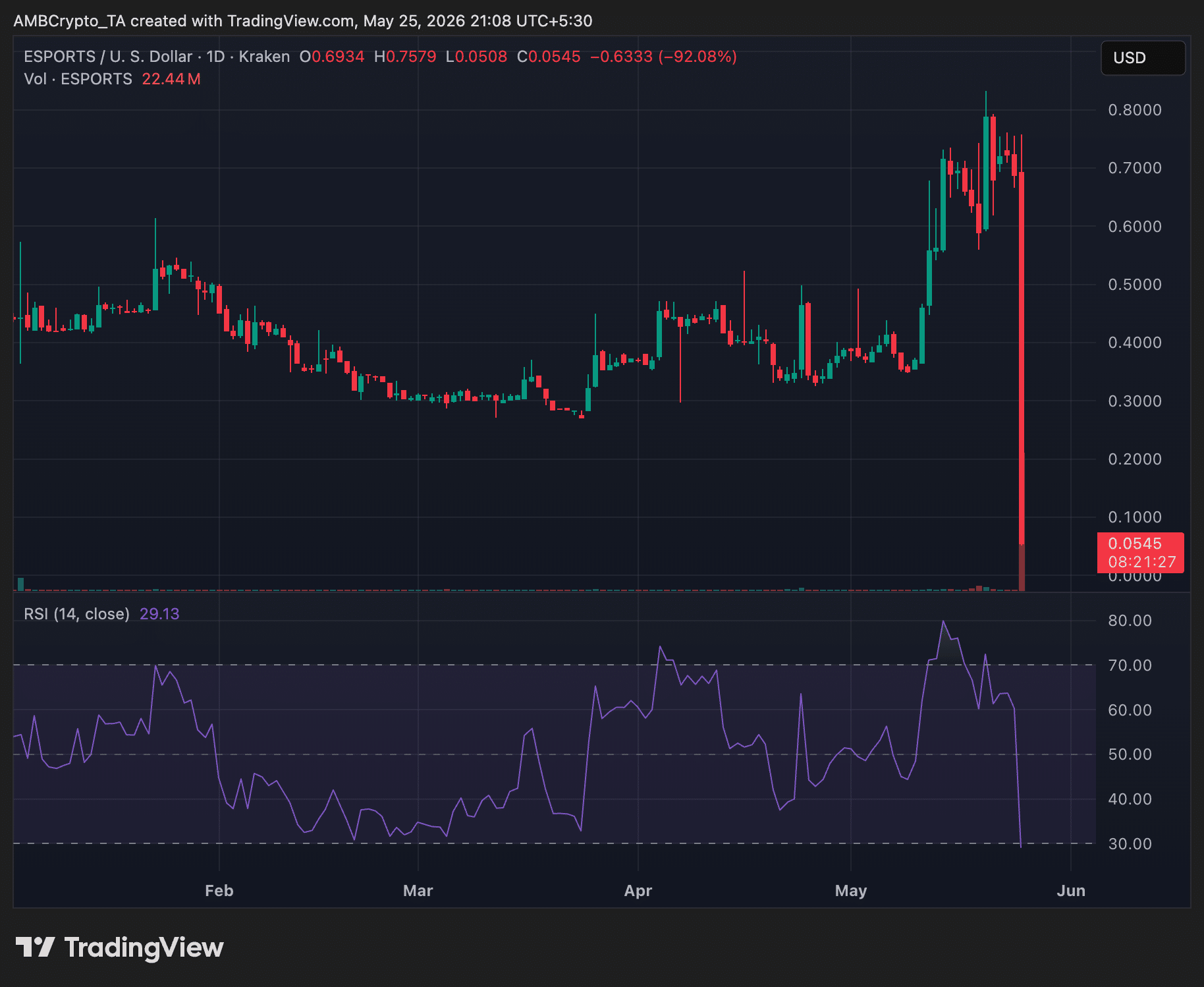
The token fell from around $0.69 to nearly $0.05 within a single daily candle, according to TradingView data. Total liquidation has now exceeded $6m, with long liquidations exceeding $5.2m.
Analysts flagged unusual wallet activity before collapse
On-chain analysts claimed roughly $23m worth of $ESPORTS tokens had moved to KuCoin over the past several days before the collapse.
They also alleged tokens moved from team wallets into clusters of fresh addresses before splitting into additional wallets and flowing toward exchanges.
Separately, onchainschool.pro claimed wallets tied to the project distributed large token balances across dozens of addresses before selling through decentralized exchanges.
Another widely shared post from Ash Crypto alleged that connected wallets dumped between 178m and 197m tokens, representing roughly 43% of the token’s circulating supply.
At the time of writing, the project team had not publicly responded to the allegations.
The collapse followed a sharp rally that pushed $ESPORTS from roughly $0.35 in early May to local highs near $0.75 before momentum abruptly reversed.
Despite the price surge, open interest reportedly remained relatively muted.
TradingView data showed $ESPORTS plunging from an open near $0.69 to a close around $0.054, marking a daily decline of roughly 92%. Volume also spiked sharply during the selloff, signaling aggressive liquidation pressure and collapsing buy-side liquidity.
Source: TradingView
The token’s RSI fell to around 29, entering oversold territory as the breakdown destroyed the previous breakout structure.
Collapse renews scrutiny around token concentration
The incident has renewed attention on token concentration risks across smaller-cap crypto assets, particularly where large wallet holders control substantial portions of circulating supply.
Large unlocks, opaque treasury movements, and low-liquidity market structures have increasingly become major risk factors during volatile market conditions.
While the allegations surrounding insider-linked wallets remain unverified, the scale and speed of the collapse are likely to intensify scrutiny around token transparency and exchange inflow monitoring.
Final Summary
$ESPORTS plunged more than 92% after on-chain analysts flagged major wallet movements and alleged insider-linked token transfers.
The collapse erased over $110m in market value and renewed scrutiny around liquidity depth and token concentration risks.
The coming week appears to be macro-led, with U.S. economic data carrying the main calendar risk. Inflation, growth, jobless claims and housing numbers all land before the open, giving markets insight on whether the Fed has room to cut rates.
Prediction markets and the CME’s FedWatch tool currently point to rates remaining unchanged in June’s meeting.
The data comes amid the ongoing Middle East war, which keeps oil prices and inflation risk in focus. Any move higher in energy costs could make softer inflation harder to sustain and weigh on risk assets.
What to Watch
(All times ET)
Crypto
May 26–June 1: Kevin Warsh officially begins his first week as Federal Reserve Chair following his confirmation.
Macro
May 26, 08:00 a.m.: U.S. S&P/Case-Shiller Home Price YoY for March est. 1.1% (Prev. 0.9%)
May 26, 08:00 a.m.: U.S. House Price Index YoY for March est. 1.8% (Prev. 1.7%)
May 26, 09:00 a.m.: U.S. CB Consumer Confidence for May est. 92 (Prev. 92.8)
May 26, 08:30 p.m.: Australia Consumer Price Index YoY for April est. 4.4% (Prev. 4.6%)
May 27, 08:00 p.m.: Bank of Korea Interest Rate Decision (Prev. 2.5%)
May 28, 04:00 a.m.: Eurozone Economic Sentiment for May est. 92 (Prev. 93)
May 28, 07:30 a.m.: U.S. PCE Price Index YoY for April (Prev. 3.5%); Core PCE (Prev. 3.2%)
May 28, 07:30 a.m.: U.S. Initial Jobless Claims for period ending May 23 est. 212K (Prev. 209K)
May 28, 08:00 a.m.: South Africa Reserve Bank Interest Rate Decision est. 7.0% (Prev. 6.75%)
May 28, 09:00 a.m.: U.S. New Home Sales for April est. 0.67M (Prev. 0.682M)
May 28, 03:30 p.m.: U.S. Fed Balance Sheet for period ending May 27 (Prev. $6.713T)
May 28, 06:30 p.m.: Japan Tokyo Consumer Price Index YoY Prel for May (Prev. 1.5%)
May 29, 07:30 a.m.: Canada GDP Growth Rate Annualized for Q1 (Prev. -0.6%); QoQ (Prev. -0.2%)
May 29, 08:45 a.m.: U.S. Chicago PMI for May est. 49.5 (Prev. 49.2)
May 30, 08:30 p.m.: China NBS Manufacturing PMI for May est. 50.5 (Prev. 50.3)
Earnings
Governance Votes & Calls
Compound DAO is voting on a proposal to update Compound III supply caps for USDC, USDT, and WETH across Optimism, Polygon, and Unichain. Voting ends on May 25.
Aave DAO is voting on a proposal to establish a 3-of-4 rewards operations multisig to manage third-party incentive funding for growth campaigns. Voting ends on May 25.
Instadapp DAO is voting on a proposal to rebalance wstUSR vaults, withdraw 750,000 FLUID to fund rewards, configure PST launch limits, and consolidate InstaConnectorsV2 administrative controls to the Team Multisig. Voting ends on May 26.
Bancor DAO is voting on a proposal to increase the vortex MaxSaleAmount parameter from 100 to 100,000 for the TAC and IOTA EVM blockchains. Voting ends on May 27.
Arbitrum DAO is voting on an amended proposal to transfer 30,765.66 frozen ETH, tied to the rsETH incident, to an Aave LLC-controlled wallet. Voting ends on May 29.
Unlock DAO is voting on a proposal to process the May constant payment roll, compensating contributors David Moderator, Ceci Sakura, and Trigs for their roles. Voting ends on May 30.
Uniswap DAO is voting on proposals to expand protocol fee infrastructure to BNB Chain, Polygon, and Celo, and to recall 12.5M delegated UNI from the Franchiser system to the Governance Timelock. Voting ends on May 30.
Unlocks
May 26: Plasma (XPL) to unlock 3.38% of its circulating supply worth $7.39 million.
May 26: Huma Finance (HUMA) to unlock 20.04% of its circulating supply worth $11.76 million
May 29: Grass (GRASS) to unlock 3.55% of its circulating supply worth $11.29 million.
May 30: Falcon Finance (FF) to unlock 4.06% of its circulating supply worth $8.26 million.
June 1: EigenCloud (EIGEN) to unlock 4.99% of its circulating supply worth $8.48 million.
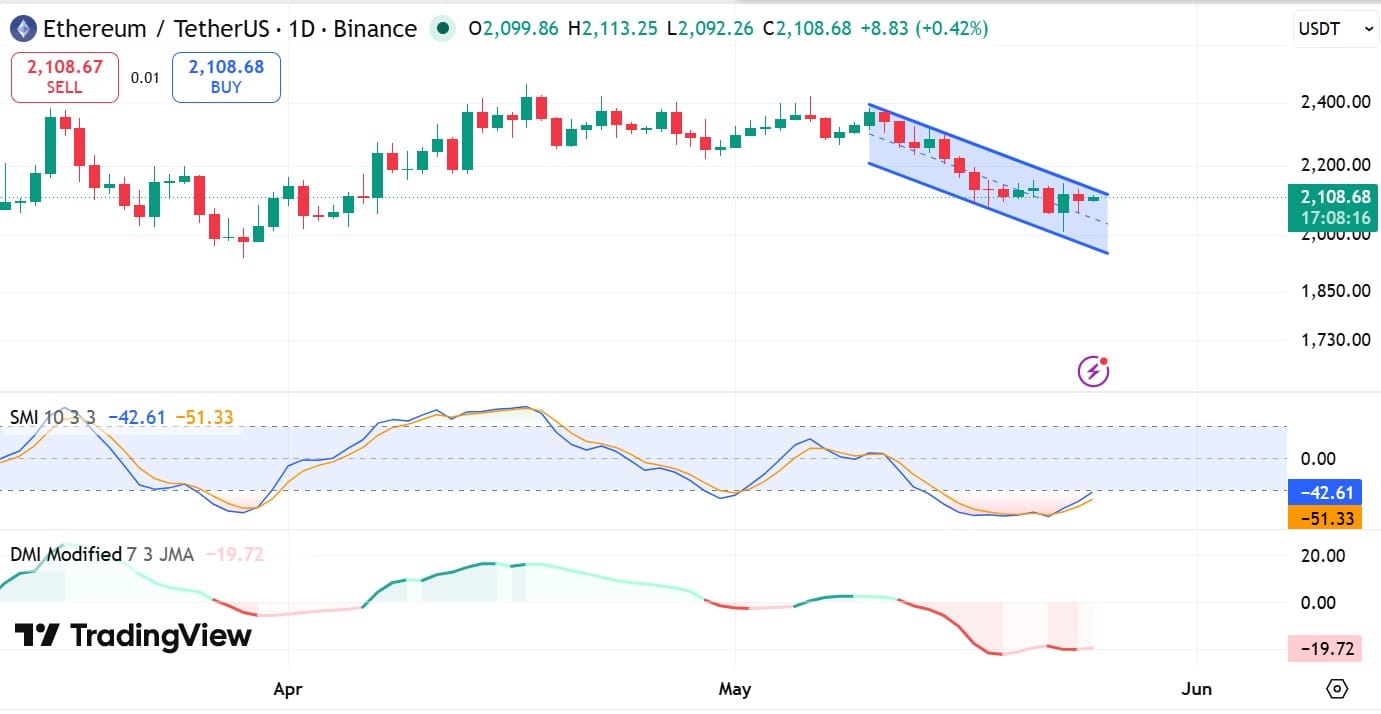
Ethereum traded within a descending channel after its uptrend stalled at $2.3k two weeks ago. During this decline, the altcoin dropped to $2,009 before rebounding slightly.
At press time, Ethereum [ETH] traded at $2,106 after falling 0.62% over the past day. With ETH hovering near $2k, whale activity reflected growing bearish sentiment.
Why are whales turning bearish?
Onchain Lens reported that a whale sold 15,000 ETH for $31.12 million. This whale has been aggressively selling over the past day.
Over this period, the whale has offloaded 35,000 ETH for $72.3 million at an average price of $2,066 per ETH.
When a whale sells during a period of weakness, it signals a lack of confidence in the market, as it anticipates further losses. Usually, when whale selling increases, as assets perform poorly, the downside risk strengthens further.
Interestingly, even those actively entering the market expect prices to drop. As such, whales are aggressively shorting the market.
Source: Lookonchain
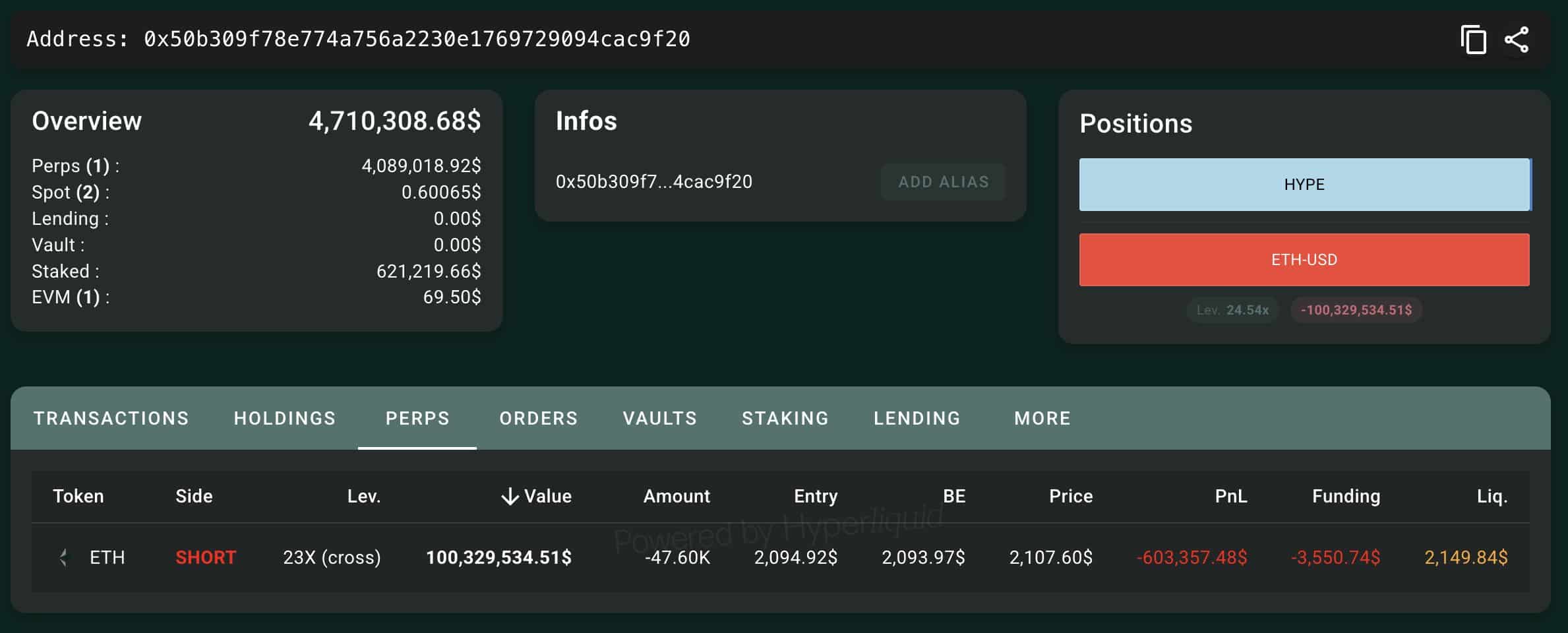
According to Lookonchain, a trader opened a 23x-leveraged short position on 47604 ETH worth $100.3 million, with a $2149 liquidation price. The whale’s taking such a huge bet shows elevated bearish sentiment in the market.
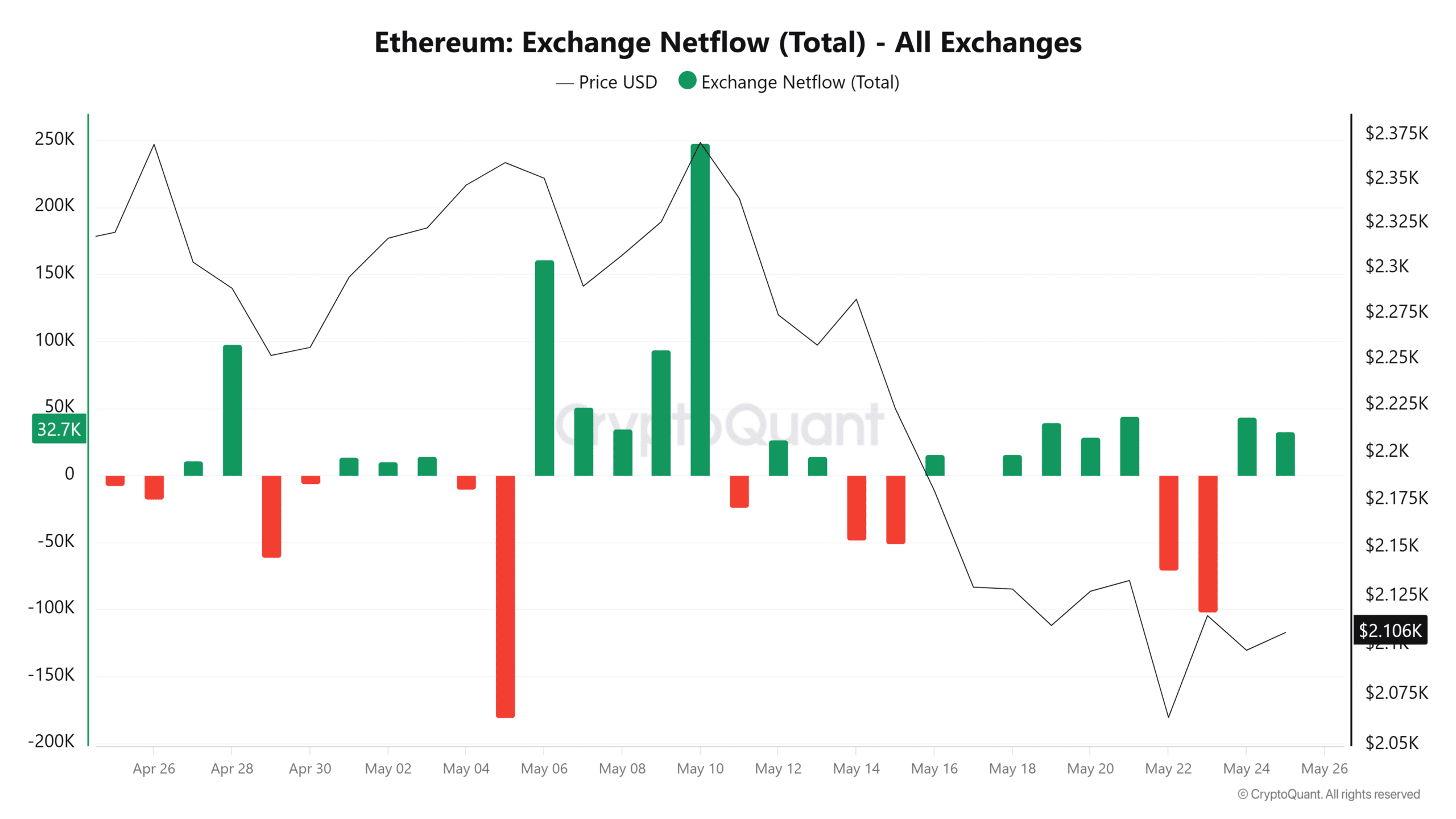
With whales turning bearish, Exchange Inflows also increased sharply over recent days.
Source: CryptoQuant
According to CryptoQuant, Exchange Netflow remained positive for two straight days. At press time, Exchange Netflow stood at 33.4k ETH, down from 43k ETH previously.
Elevated inflows typically indicate growing selling activity as traders move assets onto exchanges. That shift aligned with weakening buyer demand across the market.
Can ETH defend the $2k support?
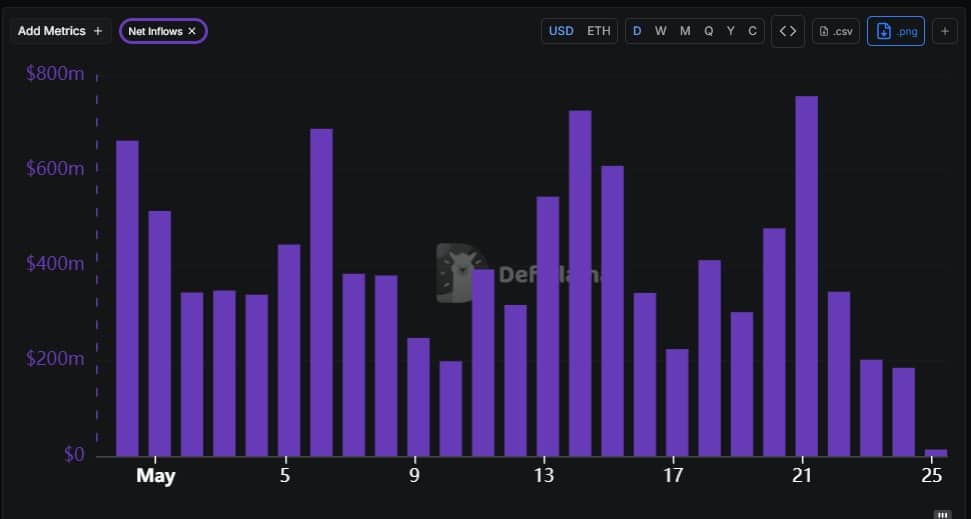
Ethereum’s weakness also reflected declining capital inflows across the ecosystem.
According to DeFiLlama, net inflows dropped sharply from $755 million to just $13 million.
Source: DeFiLlama
Such a steep decline suggested investors largely stayed on the sidelines, reducing momentum further. In fact, momentum indicators also remained bearish.
The Stochastic Momentum Index (SMI) stayed in negative territory for nearly two weeks. Meanwhile, the DMI Modified remained negative for twelve consecutive days.
Source: TradingView
That prolonged weakness suggested sellers still controlled market momentum.
If bearish pressure continues, Ethereum could lose the $2k support level and fall toward $1,930. However, reclaiming $2.3k could invalidate the bearish outlook and weaken selling momentum.
Final Summary
Ethereum whales sold over 35,000 ETH worth $72.3 million as bearish sentiment intensified near the $2k level.
Weak capital inflows and negative momentum indicators suggested Ethereum’s downtrend could continue without stronger demand.
Despite living an active, busy life, Sydney Stoner was plagued by worsening digestive issues.
Around 2019, when she was in her mid-20s, she started cycling between constipation and diarrhea. “I just thought it was just regular stomach issues that people had,” the now 32-year-old told Business Insider.
For a while, Stoner was able to go on living her life in Little Rock, Arkansas, with her husband, two cats, and two dogs. Stoner worked as a professional theater actor, juggling roles with her part-time retail job. In her free time, she loved cycling and CrossFit.
In the meantime, she bounced around from different doctors, including a primary care physician and a holistic doctor, thinking they would diagnose her with IBS. She tried elimination diets, including cutting dairy, gluten, and sugar. Some doctors told her to “watch her weight.”
Nothing worked.
She said she had blood in her stool to get screened sooner
Stoner after her surgery, which also involved removing lymph nodes.
Sydney Stoner
Within a year, the discomfort became more severe. Stoner only felt relief when she used the restroom, which resulted in intense cramping throughout. “I felt like my insides were twisting,” she said.
One day, the pain became too great for Stoner. It hurt to eat, and the cramps wouldn’t stop. “I was like, ‘Someone needs to see inside my body,'” Stoner said.
She called a gastroenterology care center and started listing her symptoms to the woman on the phone. When she was asked for her age and was told she’d need a referral to get screened, Stoner improvised.
From Googling her symptoms, she read that having blood in her stool, one of the most common signs of colon cancer, was typically considered more dire than stomach pain or changes in bowel movements. After she lied and said she had the symptom, she was scheduled for a colonoscopy right away.
Stoner knew something was wrong once she started waking up from the sedation used in a colonoscopy. “I’m pretty sure I heard them say ‘cancer,'” she recalled, adding that the doctors brought her husband into the room with her. “I knew that that wasn’t a good sign.”
She learned that the colonoscope, the long thin medical device used to navigate through the rectum and colon, couldn’t even get a foot inside her colon due to a mass.
Stoner was diagnosed with stage 4 colon cancer at 27. Because she was still coming down from the anesthesia, she didn’t really respond.
“I was just in shock. I didn’t really say anything,” Stoner said. “When I finally ate some foodShe was scheduled for PET and CT scans as well as a tumor removal surgery one month later. after the colonoscopy, the tears just started flowing.”
Almost two years into married life, Stoner struggled to make sense of the diagnosis. “We went on trips often, hung out with a lot of friends, loved going to live shows,” she said. “I just really never thought that cancer would be a part of that.”
Grieving her life before cancer
Stoner has undergone surgery, radiation, and multiple chemotherapy treatments since her diagnosis.
Sydney Stoner
Stoner was scheduled for PET and CT scans as well as a tumor removal surgery one month later. She woke up from her surgery with an ileostomy, a bag attached to her abdomen to collect waste that allows the colon to heal. A year later it’d be reversed.
Initially, she was told by doctors that she had stage 3B cancer, and that it had only spread to a few lymph nodes. But once she moved to St. Louis and started care there, her scans found that the cancer had spread to her liver and lungs, making it stage 4.
Stoner did 12 rounds of chemotherapy, which caused her cold sensitivity. “I had to wear gloves to even get into the refrigerator,” she said. “I had to microwave all of my drinks.” After that, she did three rounds of radiation per lung, which led to no evidence of disease.
Two months later, her blood work showed signs of cancer, so she underwent 12 additional rounds of a different chemo medication, which led to dizziness and nausea, common symptoms. “It’s kind of like being drunk on a cruise ship, but not the fun drunk,” she said.
Since 2023, for over two years, she has been on a lower-dose maintenance chemo pill. But when her recent scans in October showed more progression of disease than her oncologist was comfortable with, she was put on more rounds of the second chemotherapy drug again.
Stoner now works part-time at a cat café, which she said is therapeutic.
Sydney Stoner
The near-never-ending treatments caused both financial and emotional strain. Because Stoner and her husband had just been kicked off their parents’ insurance, Stoner struggled to get scans or treatments approved until she could apply fordisability in 2021. Now, she’s on Medicare.
Stoner, who legally can’t work over a certain number of hours ,also works part-time at a cat café. Her husband is a self-employed barber, and they pay for some of Stoner’s treatment through a GoFundMe.
“You just wake up and just grieve your old life every day, which sounds really depressing,” Stoner said. “But you’re just not the same person after you get news like that.”
She’s advocating for more research funding
Stoner is advocating for increased funding for colon cancer research.
Fight Colorectal Cancer
Stoner said her friends and family have been a great support throughout treatment. So has the colon cancer community she found.
In 2023, Stoner discovered the nonprofit Fight Colorectal Cancer (Fight CRC), which connected her to others diagnosed with colon cancer. She learned about opportunities to present her story to Congress and to advocate for more funding for colon cancer research. It’s timely as colon cancer is now the leading cause of cancer death in people under 50.
For young people with potential colon cancer symptoms, Stoner urged listening to your body.
“Especially young women, we are dismissed a lot, and you have to find a doctor that will do the test that you need, or even try Cologuard,” a stool test that can detect existing cancer and requires a colonoscopy after a positive result, she said. “It’s better to find out early because colon cancer is so preventable.”
Be wary of the speed at which AI is displacing workers throughout the US economy.
“The thing that we need to take more seriously is not just the potential magnitude of the impact [on jobs from AI], but the speed with which it plays out,” BlackRock deputy head of its portfolio management group Mike Pyle said on a new episode of Yahoo Finance’s Power Players with Brian Sozzi podcast (watch above; listen below).
The transition from agriculture to manufacturing services “played out over many decades. And new jobs and new industries rose in the wake of the decline in agricultural employment,” he added.
The speed of AI’s impact on the labor market will be a key determinant of how significant this is from the perspective of workers and the macroeconomy, he explained.
Pyle has spent considerable time in top economic adviser roles in the Biden and Obama eras.
Before rejoining BlackRock in the fall of 2024, Pyle led former President Joe Biden’s international economic policy efforts. He was Biden’s “sherpa,” serving as the lead in key economic negotiations with the G7, G20, and APEC.
His latest warning on AI is well-timed.
The growing impact of AI is showing, from Block (XYZ) canning 40% of its staff to layoffs at Amazon (AMZN), Oracle (ORCL), Coinbase (COIN), Cloudflare (NET), and Meta (META).
With billionaire founder Larry Ellison still pulling the strings, Oracle reportedly laid off up to 30,000 workers across the US, Mexico, and other countries on April 1. Amazon has reportedly slashed 16,000 workers this year as part of its AI efficiency push.
Coinbase is fresh off announcing a 14% reduction in force this month. Cloudflare just cut bait with 20% of its workforce. And Meta is in the process of cutting 10% of its employee count.
Circle (CRCL) co-founder and CEO Jeremy Allaire recently doubled down on his call that we are just at the start of AI agents reshaping the US workforce.
“I think we’re very early in the impact of AI agents on the conduct of work and how that plays out through labor,” Allaire said on Yahoo Finance’s Opening Bid.
Allaire issued an early warning about two months ago at the Economic Club of New York. He said AI-related job losses would soon pick up the pace and perhaps continue into 2027.
Allaire said Circle is aggressively leaning into AI, and it’s yielding results.
Billionaire Block founder Jack Dorsey said he isn’t done removing management layers at the company and changing the job requirements of a modern-day manager.
“So like right now … we’re about five layers deep. I would love to get that down to two to three by the end of the year,” Dorsey said at a JPMorgan conference on Tuesday. He was referencing the number of organizational layers beneath him.
Dorsey said that in the future, managers should be assigned to groups of potentially hundreds of people rather than to a single team. “You’re focused on helping [workers] get to mastery of their discipline and helping them think through their career and like how to think about problems and see around corners … but you don’t have to like tell them what to do. You can show them how to do it.”
As a start, he said, “in engineering last year, we moved from a world of having pure managers to the requirement that every manager must be technical and they must contribute code. And that was just one step, and we need to do that throughout the organization for all of our other disciplines as well.”
What Dorsey is suggesting is a radically lean operating structure for a public company to speed up idea creation and execution. Plus, a completely reinvented role for managers.
Brian Sozzi is Yahoo Finance’s Executive Editor and a member of Yahoo Finance’s editorial leadership team. Follow Sozzi on X @BrianSozzi, Instagram, and LinkedIn. Tips on stories? Email brian.sozzi@yahoofinance.com.
In a recent update aimed at addressing criticism of the Ethereum Foundation (EF), Vitalik Buterin proposed that the foundation will reduce its future Ethereum [ETH] sales.
In a post on X, Buterin pointed out that EF is starting to prioritize “longevity over breadth.”
Buterin added,
The EF focuses *specifically* on those activities critical to the success of ethereum as a censorship/capture-resistant, open, private and secure system, that would not happen otherwise.
This comes after a string of well-known EF departures, which have reignited debate about the foundation’s future. At least eight senior EF contributors have left or announced plans to do so in 2026, including five in May.
Buterin also acknowledged the Ethereum Foundation’s 2025 efforts, which resulted in numerous enhancements and the resolution of various issues.
What is Buterin trying to fix here?
Still, it appears that one piece of this puzzle is missing.
Buterin said,
I would regularly spot people saying things like “vitalik says these beautiful things about ethereum needing to be decentralized, and have privacy, and be a sanctuary technology, but why do the EF’s actions not reflect that?
He emphasized that the Ethereum Foundation is ‘one node with a defined purpose, alongside others,’ rather than the ‘center of Ethereum.’ Given EF’s limited size, resources, and organizational capacity, he reiterated his view that the foundation should remain a supporting node, not the core authority.
This is because, compared to many other individual ETH holders, the EF only holds about 0.16% of all ETH, while a “central foundation” typically holds between 10% and 50%.
Buterin added,
It [Ethereum Foundation] was not designed to be an eternal steward.
This further explains why the Foundation is also focusing on fewer priorities as a result of its redesigned mandate—the CROPS (security, privacy, openness, and resistance to censorship) dimension.
According to him, competitors already have an advantage in high-throughput chains, so Ethereum shouldn’t focus solely on speed.
Buterin’s technical standpoint
From a technical standpoint, he continued, Ethereum should strive to become the world’s most dependable, secure, decentralized, and censorship-resistant blockchain. According to him, new AI-powered tools can help Ethereum become nearly bug-free, and its network should be able to function without relying on centralized control even in the event of attacks or outages.
He says Ethereum’s primary strengths should be trust, resilience, and long-term security rather than just speed, even though it will continue to grow through updates and Layer-2 solutions.
Not a board-wide decision
However, Buterin’s post was his opinion rather than a formal board statement, and he noted that Bastian Aue, the interim co-executive director who succeeded Tomasz Stanczak earlier this year, is primarily responsible for carrying out the transition.
Notably, Buterin concluded it best when he said,
EF will be a smaller ship than in previous years, a more opinionated one.
Final Summary
Buterin’s new proposal is in line with the CROPS (security, privacy, openness, and resistance to censorship) dimension.
As compared to other Ethereum holders, the EF only holds about 0.16% of all ETH.
Crypto trading platform Hyperliquid is beginning to compete with traditional exchanges and prediction market operators as it expands beyond perpetual futures trading, according to a new report from FalconX.
Senior crypto market strategist David Lawant outlined how Hyperliquid’s recent moves into pre-IPO markets, prediction contracts and tokenized real-world assets are broadening the platform’s appeal beyond crypto-native traders.
“Hyperliquid is seeing traction as demand for its HIP-3 markets expands to include pre-IPO markets,” the report said.
Hyperliquid first gained traction through crypto perpetual futures, a type of derivatives contract that dominates offshore digital asset trading. The platform’s native token, HYPE, has skyrocketed 94% over the past three months. But FalconX said newer products could push the platform into more direct competition with firms such as CME Group, Intercontinental Exchange-backed prediction market Kalshi and Polymarket.
The report pointed to growing activity in Hyperliquid’s HIP-3 markets, which allow users to trade assets including equities, commodities, forex and pre-IPO contracts around the clock. FalconX said those markets gained attention after traders used them to speculate on companies such as Cerebras, Anthropic and SpaceX before public listings.
The platform has also begun rolling out HIP-4 outcome markets, which function similarly to prediction markets by allowing traders to bet on binary outcomes tied to politics, economics and crypto events.
FalconX said the ability to trade prediction contracts alongside crypto and real-world asset positions on the same platform could become a major advantage.
“For example you could pair a HIP-3 perps position on NVDA with outcome markets that it could miss or beat earnings,” the report said.
The firm also highlighted strong early interest in newly launched exchange-traded funds tied to Hyperliquid’s HYPE token. Spot HYPE ETFs from 21Shares and Bitwise have attracted a combined $53 million in inflows after only a few trading sessions, according to Bloomberg data cited in the report.
FalconX said those inflows represented a larger percentage of HYPE’s market capitalization than early inflows into spot bitcoin, ether (ETH) and solana (SOL) ETFs at similar stages.
Meanwhile, Hyperliquid’s recent partnership with Coinbase (COIN) and Circle (CRCL) to integrate USDC as an aligned quote asset could significantly increase protocol revenue. FalconX estimated the arrangement could generate as much as $160 million in annualized revenue based on reserve yields tied to USDC balances on the platform.
The report also noted that regulatory developments in Washington could help accelerate adoption of tokenized real-world assets on decentralized trading venues. FalconX cited reports that the SEC is considering an innovation exemption framework for tokenized stocks.
At the same time, the firm warned that growing attention from traditional financial exchanges could bring regulatory scrutiny. CME and ICE have raised concerns with regulators about potential manipulation risks tied to Hyperliquid’s markets.
Even so, FalconX said Hyperliquid continues to lead decentralized perpetual futures markets in trading volumes, revenue and total value locked, positioning it as one of the fastest-growing trading platforms in crypto.