Home Blog Page 720

Berkshire Hathaway’s latest stock purge sends a clear message

0
Berkshire Hathaway’s latest stock purge sends a clear message


For decades, Berkshire Hathaway’s quarterly stock filings have been treated like a roadmap into Warren Buffett’s thinking.

However, the latest one feels very special.

Berkshire Hathaway (BRK.A) (BRK.B) unveiled a wide-ranging portfolio overhaul in its latest 13F filing, adding a big new stake in Delta Air Lines (DAL), increasing its stake in Alphabet (GOOGL) (GOOG), and exiting a handful of household names, including Amazon (AMZN), UnitedHealth (UNH), Visa (V), and Mastercard (MA).

The company bought $15.94 billion in equities but sold $24.09 billion during the first quarter.

This isn’t just ordinary portfolio upkeep.

The filing comes in the first year of Greg Abel’s stint as Berkshire CEO and could provide one of the clearest early indications yet that the company’s investing approach is starting to change.

Buffett remains the heart of Berkshire’s identity. But investors are increasingly asking what Berkshire looks like after Buffett, and the filing offers a glimpse of a response that might involve speedier portfolio reshuffling, bigger technology bets and less loyalty to smaller legacy positions.

The biggest surprise may not have been what Berkshire bought.

It may have been what Berkshire no longer wanted to own.

Berkshire Hathaway makes aggressive moves in key sectors

Wall Street quickly took note of Berkshire’s new interest in Delta Air Lines. Buffett famously soured on airline equities during the Covid epidemic.

Berkshire jettisoned billions of dollars in airline holdings in 2020 after Buffett warned the sector had fundamentally altered. Now Berkshire is back with a stake worth around $2.65 billion in Delta, Reuters said.

That alone would have been remarkable in the filing.

But Berkshire’s pivot into Alphabet may have been even more critical.

Berkshire’s holding in Google’s parent was a lot bigger as the business practically tripled its Alphabet position to roughly 58 million shares. AP pegged the stake at approximately $17 billion, but Barron’s stated it was worth closer to $23 billion, reflecting different valuation timing.

Key Berkshire Hathaway 13F takeaways

  • Berkshire initiated a multibillion-dollar stake in Delta Air Lines.

  • Berkshire nearly tripled its Alphabet position.

  • Berkshire exited Amazon, UnitedHealth, Visa, and Mastercard.

  • Berkshire reduced Chevron by about 35%.

  • The filing is one of the first major portfolio snapshots of Greg Abel’s CEO era.

This is a philosophical shift of significance for a firm that has always been connected with banks, insurers, railroads, and consumer brands.

Buffett notably shunned much of the tech space for years, favoring firms he saw as easier to comprehend and predict. That modified the story somewhat, thanks to Berkshire’s massive investment in Apple (AAPL), but Alphabet looks to be another cornerstone tech holding currently.


Source link

A massive $1 trillion hidden market is waiting to be unlocked in bitcoin, says new report

0
A massive $1 trillion hidden market is waiting to be unlocked in bitcoin, says new report

Crypto lender Ledn says the consumer bitcoin-backed loan market could grow nearly 300-fold to as much as $1 trillion within the next decade, as demand for borrowing against digital assets far outpaces actual usage.

The forecast accompanied new research conducted by consumer insights firm Protocol Theory, which surveyed 1,244 cryptocurrency holders across the U.S. and Australia between February and March this year. The study found that while 88% of respondents said they would consider using a crypto-backed loan or credit product, only 14% currently do so, revealing what Ledn described as a “6-to-1 consideration-to-adoption gap.”

Ledn estimates the bitcoin-backed consumer lending market currently stands at roughly $3 billion. By comparison, Galaxy Research previously estimated the broader crypto lending market reached an all-time high of $73.6 billion in the third quarter of 2025.

The sector, however, still carries the scars of the 2022 crypto credit collapse, when major lenders including Celsius Network, Voyager Digital and BlockFi either filed for bankruptcy or were forced into restructuring after crypto prices plunged and liquidity evaporated. The failures wiped out billions of dollars in customer funds and severely damaged trust in centralized crypto lending models, prompting regulators globally to tighten scrutiny of the sector. Ledn’s report suggests rebuilding that trust remains the industry’s biggest challenge.

“The demand side of the equation is solved,” Ledn co-founder Mauricio Di Bartolomeo said in a statement. “What’s still catching up is the trust infrastructure that gives borrowers the confidence to act.”

The report argues that crypto-backed lending remains underdeveloped relative to the scale of digital asset ownership globally. The global cryptocurrency market capitalization stood at approximately $2.68 trillion as of May 2, according to data cited in the research.

The findings suggest the main obstacles preventing wider adoption are not lack of awareness or understanding, but confidence-related concerns. Among non-borrowers, the most commonly cited barriers were worries about managing crypto price volatility, liquidation risk and regulatory uncertainty surrounding crypto-backed loans.

Respondents also said platform reputation, transparency around loan terms, custody safeguards and risk management practices mattered more than rates or product features when selecting a lending provider.

The report frames crypto-backed borrowing as a digital asset equivalent of securities-backed lending or home equity borrowing in traditional finance: accessing liquidity without selling a long-term asset position.


Source link

Bitcoin whales flip bearish – $74 million Hyperliquid short raises squeeze risk

0
Bitcoin whales flip bearish – $74 million Hyperliquid short raises squeeze risk


Broader crypto momentum had already started weakening before whale positioning abruptly rotated toward aggressive Bitcoin [BTC] downside exposure across Hyperliquid [HYPE] markets.

Traders also became more defensive once larger speculative wallets started reducing altcoin risk beneath softer market continuation.

Trader Evaded later closed HYPE and Zcash [ZEC] longs worth roughly $2.85 million and $2.36 million after holding positions for several days.

However, the wallet also absorbed nearly $591,000 in Ethereum [ETH] losses before shifting aggressively into a 15x leveraged Bitcoin short.

Source: X

That position later expanded toward roughly 990 BTC, worth nearly $74.84 million, while unrealized profits climbed beyond $783,000 beneath weakening market conditions.

The rotation increasingly reflected how smart-money traders are positioning for higher volatility and possible downside continuation across broader crypto markets.

Source: X

Public whale positioning also continues influencing market psychology as leveraged traders increasingly mirror high-risk directional flows.

Bitcoin shorts expand as squeeze pressure quietly builds

Bitcoin’s market structure had already turned increasingly defensive before bearish leverage expanded sharply across major derivatives platforms recently.

Traders also became more cautious once repeated recovery failures weakened broader confidence across crypto markets underneath resistance.

Short exposure later increased steadily while long-short positioning shifted closer toward bearish territory across several major exchanges. That reaction increasingly reflected how larger traders are positioning for continued downside volatility beneath softer spot momentum conditions.

Hyperliquid also attracted heavier speculative activity as transparent whale positions amplified broader market psychology and copy-trading behavior.

Open Interest remained elevated while bearish positioning became increasingly concentrated beneath tightening liquidity conditions.

 If spot demand stabilizes later, aggressive bearish leverage may rapidly reverse into forced covering and sharper Bitcoin recovery volatility.

Bitcoin spot weakness collides with crowded leverage

Bearish positioning had already become heavily crowded before Bitcoin’s broader market structure started showing deeper signs of instability beneath the surface. Traders also grew increasingly uncertain once ETF outflows kept weakening spot demand across already fragile liquidity conditions.

U.S. Spot Bitcoin ETFs later recorded another roughly $105.2 million in daily outflows while weekly selling moved beyond nearly $850 million. Coinbase Premium also remained negative, reflecting softer institutional participation.

Yet derivatives activity continued to stay elevated as Open Interest remained high beneath compressed volatility conditions. That setup increasingly reflected a market driven more by leverage positioning than confident spot convictions.

Some whales still appear positioned for deeper downside continuation, while others increasingly prepare for violent reversal volatility once leverage clears.

Bitcoin now sits between weakening spot demand and overcrowded leverage conditions that could break sharply in either direction.


Final Summary

  • Bitcoin [BTC] whale positioning increasingly reflects growing defensive sentiment as leveraged traders rotate away from weaker altcoin momentum.
  • Bitcoin short exposure continues expanding beneath compressed volatility, though crowded bearish positioning still increases upside squeeze risk.


Source link

Oil drops as U.S. says deal with Iran and Hormuz reopening is near

0
Oil drops as U.S. says deal with Iran and Hormuz reopening is near

Oil dropped as the US and Iran edged toward a deal, although President Donald Trump said that Washington’s blockade of the Strait of Hormuz would remain until an agreement was completed.

Global crude benchmark Brent fell as much as 5.2% to $98.12 a barrel, while West Texas Intermediate was near $92. Trump said in social-media posts he wouldn’t “rush” into a deal, which “isn’t even fully negotiated yet.” Any final approval may take several days, according to senior US officials.

Still, it remains unclear how key differences, including the fate of the Islamic Republic’s nuclear program, will be addressed. Iran’s Tasnim news agency said the draft agreement could still collapse because the US was obstructing some key clauses, including a demand that its assets be unfrozen.

Global energy markets have been upended by the crisis, which began in February when the US and Israel attacked Iran. The conflict spread rapidly across the Persian Gulf region, forcing producers to shut in millions of barrels of daily crude supplies. Hormuz — which links the region to global markets — has been subject to a double blockade by both Tehran and Washington.

A full reopening of the waterway — which in peacetime typically handled around a fifth of the world’s oil and liquefied natural gas supplies — would be a relief for energy importers across Asia, including China, Japan, and South Korea.

“A lot of oil was trading on worst case assumptions for weeks,” said Haris Khurshid, chief investment officer at Chicago-based Karobaar Capital LP. “But once it became clear talks were still alive and escalation wasn’t accelerating, a chunk of that fear premium comes out pretty fast.”

Trump has been facing growing domestic political pressure to end the conflict, particularly ahead of the November midterm elections that will determine control of Congress. The war has boosted the cost of fuels, with average US gasoline prices hitting the highest since 2022 this month.

Kevin Hassett, Trump’s chief economic adviser at the White House, told Fox News on Sunday he expects energy prices to drop once there’s a deal, which could then create space for the Federal Reserve to cut rates. “We expect energy prices, as soon as there’s a deal, to plummet,” Hassett said.

Trading in oil may be lower than usual on Monday, with some traders away from their desks for public holidays in the US and the UK.


Source link

Centrifuge jumps 11% as demand grows – Can CFG reclaim $0.35?

0
Centrifuge jumps 11% as demand grows – Can CFG reclaim $0.35?


Centrifuge [CFG] strengthened its position among the leading tokenized stock platforms. Its Total Value Locked (TVL) still trailed Securitize and Ondo Finance [ONDO].

CFG climbed more than 11% over the past 24 hours despite the SEC delaying tokenized stock trading approvals.

Even so, the token’s daily trading volume dropped 36% to around $25 million, according to CoinMarketCap.

Why is demand rising on Centrifuge?

Data from Centrifuge suggested demand growth continued outpacing capital inflows.

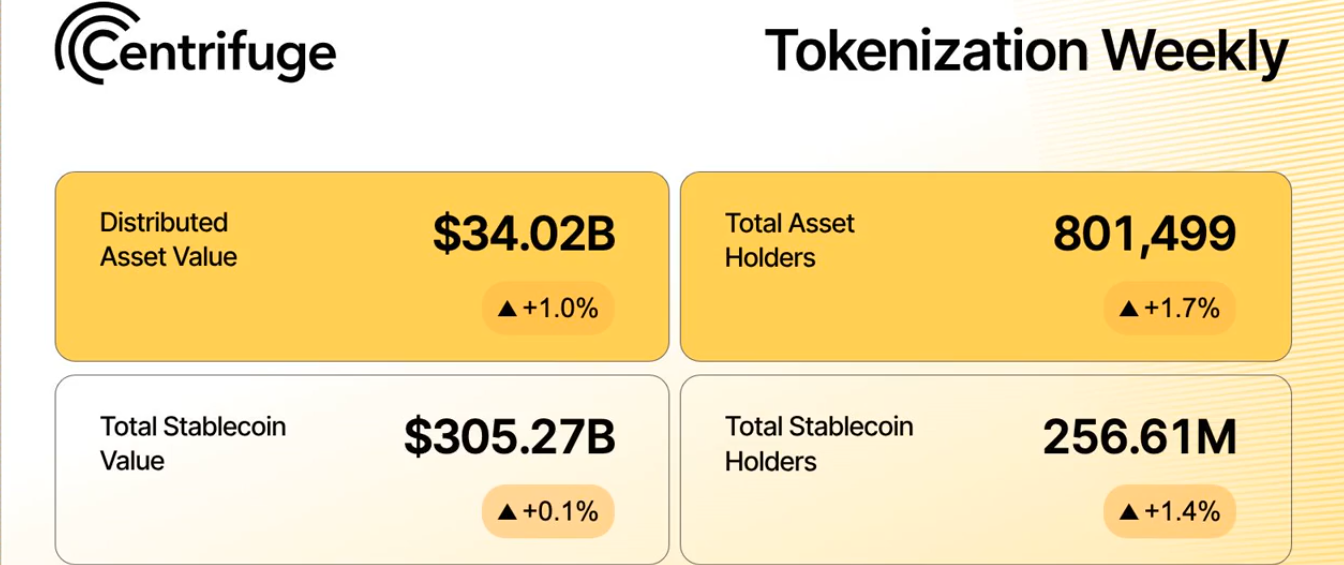
Total Asset Holders rose 1.7% this week to 801,499. At the same time, Total Stablecoin Holders climbed 1.4% to around 256.61 million.

The total number of CFG holders also reached a record 10,150, while Total Unique Addresses stood at 23,008 at press time.

On the other hand, Distributed Asset Value increased only 1% to $34.02 billion. Total Stablecoin Value gained just 0.1% to $305.27 billion.

Source: Centrifuge/X

This gap between holder growth and asset value suggested user demand remained ahead of capital expansion. That trend also hinted that tokenized assets were gradually integrating into platforms that users already transact on.

Why is DEX activity surging?

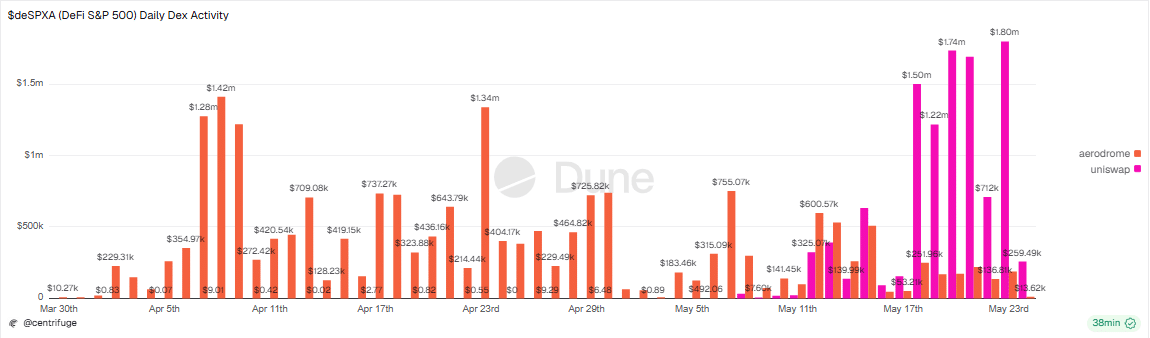
Apart from holder growth, daily DEX activity also reached new all-time highs.

For example, Uniswap’s [UNI] DEX volume for tokenized S&P 500 [deSPXA] climbed to $1.80 million. That was nearly ten times higher than Aerodrome Finance’s [AERO] $189,000 volume.

CentrifugeCFGCentrifugeCFG
Source: Dune Analytics

In total, Centrifuge’s deSPXA DEX volume surpassed $21.22 million despite the SEC delaying its tokenization decision.

Other tokenized assets, including JTRSY, JAAA, and ACDRX, held larger TVL than deSPXA. As a result, they also generated higher DEX volume.

Can CFG reclaim its ATH this week?

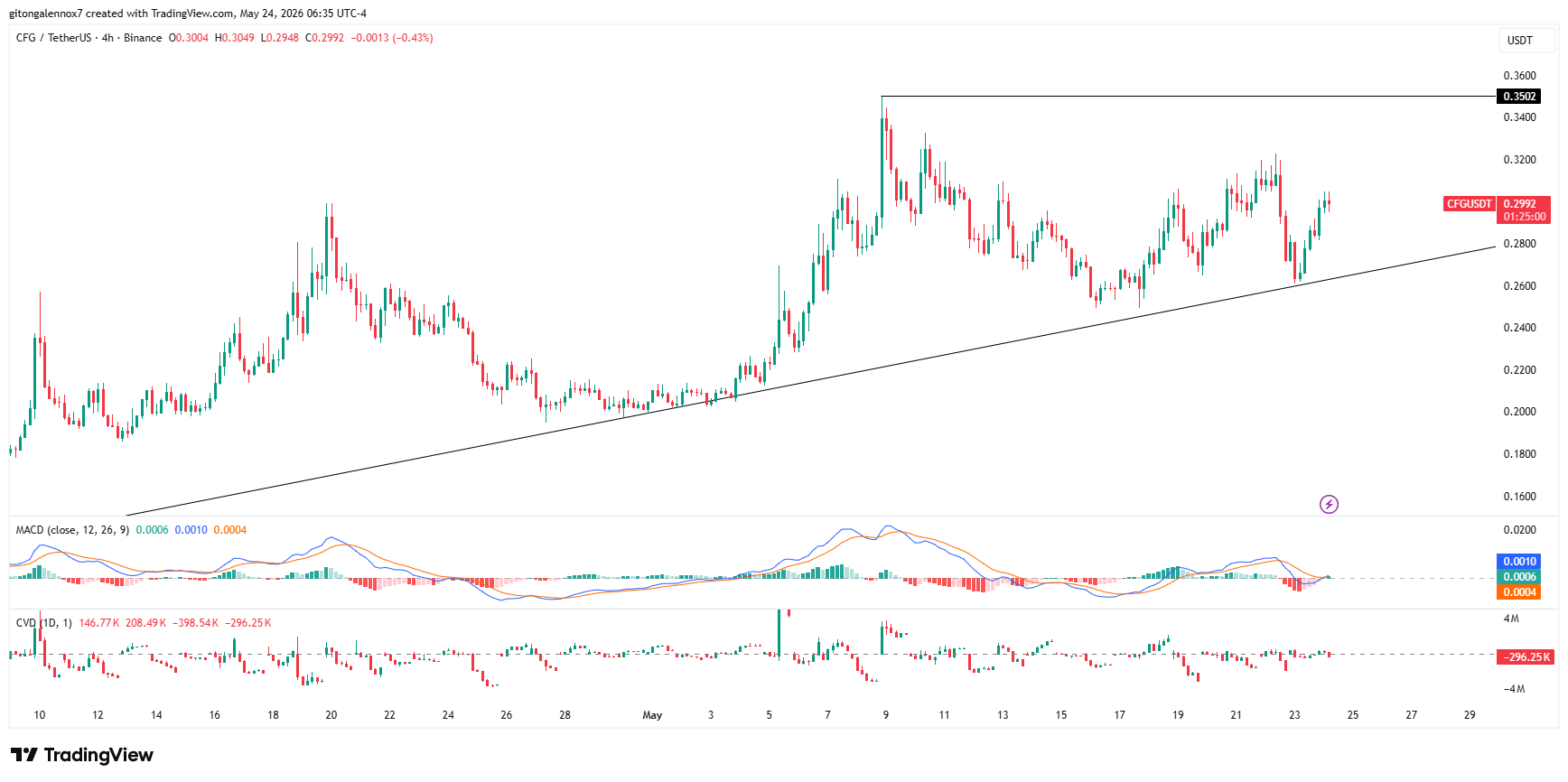
The weekly candle still needed to close near $0.30 to improve the chances of reclaiming CFG’s $0.35 peak. If that happens, Centrifuge could extend its rally next week.

The daily chart showed CFG respecting an ascending trendline support since launch. However, price continued consolidating near recent highs.

CFGCFG
Source: CFG/USDT on TradingView

At the same time, MACD bars just turned green, suggesting buyer momentum started strengthening.

The Cumulative Volume Delta (CVD) remained red, showing sellers still held some control. Even so, weakening sell pressure hinted that bears could be losing momentum.

If bulls reclaim the $0.30-$0.32 range, CFG could retest $0.35. For now, the bullish structure remains intact unless the ascending trendline breaks.


Final Summary

  • Centrifuge rallies by more than 11% as demand surpasses capital inflow from assets and stablecoins. 
  • CFG aims to reclaim its peak value of $0.35 unless the price breaks below the ascending trendline. 


Source link

Coinbase does not fear competition from Wall Street, says exchange executive

0
Coinbase does not fear competition from Wall Street, says exchange executive

Coinbase is not at all concerned with the increasing competition from Wall Street giants or other traditional financial institutions, the crypto exchange’s head of Policy for Europe told CoinDesk on Friday.

“We have always said that a rising tide lifts all ships,” said Katie Harries, adding that Coinbase is “not at all” worried about the increasing involvement of financial institutions in the United States and around the world in crypto.

The company recently posted a loss of $1.49 per share, compared with analyst expectations for a $0.27 profit. Also in the first week of May, Coinbase announced a 14% workforce reduction.

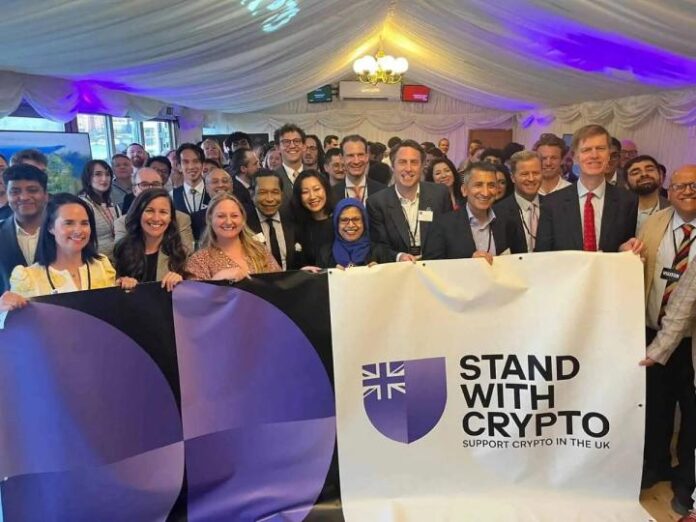
In a brief written interview regarding the Stand With Crypto (SWC) events on Friday, Harries said that the mobilization of people worldwide shows that the established crypto industry has a community behind it that no traditional financial institution can replicate.

“Millions of people around the world chose crypto because they believe in what it represents: open, accessible, peer-to-peer finance,” Harries said. “The people gathered today in London, Paris, New York, Sao Paulo and beyond are not here because a financial institution told them to be. They are here because they believe in this technology and want their governments to support it.”

‘Voters do care about crypto’

Harries also spoke of the American voter. While U.S. citizens do not have crypto top of mind going into the November midterm elections, voters do care about digital assets and have contacted their lawmakers millions of times to let them know, Harries said.

“Voters do care, and the numbers make that clear,” Harries said, refuting recent statements by senators expressing the contrary. “Stand With Crypto has over 3.7 million advocates across six markets. Its members have contacted their lawmakers more than 2.5 million times.”

The Coinbase executive also said that signals “the crypto voter is a permanent fixture in the political landscape, not just in the United States but across the world. Policymakers who have been slow to engage with this community should take note.”

A CoinDesk survey of 1,000 randomly selected U.S. voters across the country showed that just 1% ranked crypto as their top concern. The survey was evenly split between Republican and Democrat respondents (41% of respondents identified with each party to some degree), with a credibility interval of plus or minus 3.53%.

‘Time for sensible regulation is now’

Harries called on regulators worldwide to adopt sensible crypto frameworks, saying the time to do so is now. “The window to shape sensible crypto regulation is open, and the people gathering at the events on Friday are watching.”

SWC is, according to Coinbase, the world’s largest crypto-advocacy organization with over 3.7 million members globally.

Harries’ words come as SWC stages 500 events across four continents and six markets, including the United States, United Kingdom, Canada, Australia, Brazil and the European Union.

The events coincide with Bitcoin Pizza Day, said Coinbase in a statement shared with CoinDesk.

During the global event, a livestream will feature discussions on ecosystem and policy developments worldwide.

Coinbase’s statement notes the event takes place at a critical moment for crypto as market structure legislation advances through the U.S. Congress.

Faryar Shirzad, Chief Policy Officer at Coinbase, a Stand With Crypto partner, said that this Friday, the rally “proves that the crypto voter is a global phenomenon. People around the world want the freedom to exchange value peer-to-peer, and they want their governments to help make that a reality. This hunger for financial progress isn’t confined to any one nation.”

Shirzad also said that “getting crypto regulation right is one of the most critical policy challenges of our generation, and it requires a global effort, not just action in Washington. “

Bitcoin Pizza Day has become a celebrated moment for millions of crypto users, commemorating the first real-world bitcoin transaction. On May 22, 2010, Laszlo Hanyecz paid 10,000 BTC for two pizzas. That bitcoin at current prices is worth roughly over $770 million.


Source link