Every generation of Wall Street workers learns the same lesson the hard way. The bank you joined is rarely the bank you retire from. Roles get reshuffled, divisions get sold off, and the career path that looked rock-solid on day one almost never matches the one that pays out at year 30.
For decades, the safe play inside a giant like JPMorgan Chase (JPM) was simple. Learn the products, build a book of business, climb the ladder. The senior bankers who shepherded clients through deals, financings, and downturns were the ones who got promoted, paid, and protected when the cycle turned.
That model still works. But it is being quietly rewritten in real time, and the man running the rewrite has spent the past few years warning anyone who would listen that the next decade in finance would look nothing like the last.
Now Jamie Dimon has put a sharper edge on what he means. The JPMorgan chief executive told Bloomberg Television that the bank will hire more artificial intelligence specialists and fewer traditional bankers in certain categories as automation accelerates across Wall Street.
Jamie Dimon said JPMorgan plans to reduce headcount, shift hiring
Speaking at JPMorgan’s China Summit in Shanghai on May 21, Dimon was direct about where headcount goes next.
“I think it will reduce our jobs down the road,” he said in the interview, according to Bloomberg.
“There will be all different types of jobs, and I think we will be hiring more AI people and fewer bankers in certain categories, and it will make them more productive,” Dimon added.
More AI:
Dimon’s framing matters. He is not talking about a sudden wave of pink slips. He is talking about a steady reshaping of who gets a job offer in the first place, while existing staff get retrained, redeployed, or pushed toward early retirement.
JPMorgan’s annual attrition runs at roughly 10%, or about 25,000 to 30,000 employees a year, which gives leadership real room to shift the mix without dramatic layoffs, reported Bloomberg.
When I look at what JPMorgan has been quietly building over the past 18 months, the math behind Dimon’s comment becomes obvious. The bank’s tech budget sits near $20 billion, with roughly $2 billion of that earmarked specifically for AI, reported Fast Company. JPMorgan has also started tracking and ranking its engineers on internal dashboards based on how heavily they use AI tools.
That is not a bank trying to manage AI on the side. That is a bank rebuilding its operating model around it.
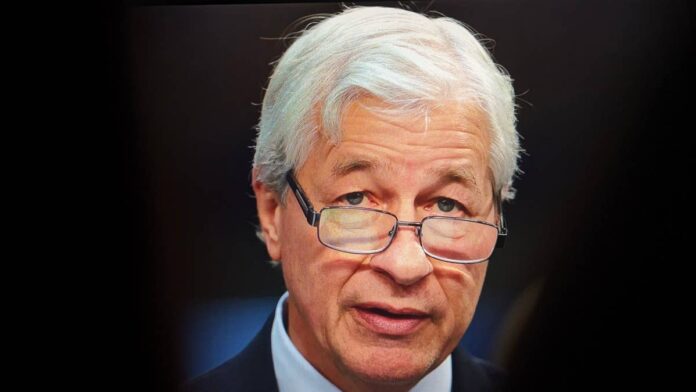
Jamie Dimon tells Bloomberg AI will reduce the firm’s jobs down the road.Photo by Bloomberg on Getty Images
Why JPMorgan is rewiring its hiring around AI
Dimon is not the only Wall Street chief making this call. He is just the loudest.
Wells Fargo (WFC) CEO Charlie Scharf said in December that the bank expected fewer employees in 2026 than 2025, with AI cited as a major reason.
Generative AI tools have already made the bank’s engineering teams “30% to 35% more efficient in terms of writing code today,” Scharf said, according to Reuters.
Across emerging markets, Standard Chartered chief executive Bill Winters has been even more blunt, telling staff the bank is replacing “lower-value human capital” with technology and eliminating 8,000 support roles over the next four years, reported Bloomberg.
A few data points stand out when I run them together:
JPMorgan Chase: 318,153 employees as of September 2025, with annual attrition of about 25,000 to 30,000, Bloomberg noted.
Wells Fargo: 275,000 employees in 2019 down to about 210,000 by Sept. 30, 2025, according to Reuters.
Standard Chartered: 8,000 support roles slated to be cut over the next four years, Bloomberg confirmed.
Six major U.S. banks: Combined $47 billion in a recent quarter, up 18%, while shedding 15,000 employees collectively, Entrepreneur reported.
Global banks: Up to 200,000 jobs at risk over the next three to five years, according to Bloomberg Intelligence.
Tomasz Noetzel, the senior analyst who authored the Bloomberg Intelligence report, told Bloomberg that “any jobs involving routine, repetitive tasks are at risk,” adding that AI “will not eliminate them fully, rather it will lead to workforce transformation.”
That is the polite version of Dimon’s same point.
What the AI hiring shift means for your money
For consumer-investors, the AI banking story has two sides, and they pull in opposite directions.
On the equity side, Bloomberg Intelligence forecasts that AI could lift bank pre-tax profits by 12% to 17% by 2027, adding as much as $180 billion to the sector’s collective bottom line. Eight in 10 surveyed executives expect generative AI to boost productivity and revenue by at least 5% over the next three to five years, according to Bloomberg.
In plain English, that is a strong tailwind for the same megabank stocks held by every major S&P 500index fund and most retirement target-date portfolios. The earnings power inside your 401(k) is quietly being supercharged by what is happening to the people on these banks’ payrolls.
On the household side, the picture is less comforting. Citi previously found that about 54% of banking roles carry a high likelihood of AI displacement, the highest exposure of any sector studied, the Bloomberg Intelligence report noted.
What stood out to me when I lined those numbers up was the speed. Wells Fargo alone has shrunk by roughly 65,000 employees in six years. Six of the country’s largest banks dropped 15,000 jobs in a single recent quarter while booking record profits.
The compression was real before generative AI hit Wall Street’s desks. Now it is accelerating, the kind of shift TheStreet has been tracking inside the broader forever layoffs cycle.
If you bank with one of these giants, expect fewer humans on the phone, more chatbots, more automated underwriting decisions, and faster but less negotiable customer interactions. If you work in financial services, the safest seats look increasingly like the ones tied to client relationships, judgment calls, and direct revenue generation, not the ones tied to repeatable middle-office tasks.
Dimon’s message in Shanghai was not really about layoffs. It was about a hiring filter. Going forward, JPMorgan wants people who can build, deploy, and oversee AI more than it wants people who can simply run the existing process.
For shareholders, that is likely good news for margins. For ambitious junior bankers eyeing the next 10 years inside a Wall Street giant, it is a quieter reminder. The safest career in 2026 may not be the one their predecessors chose. It may be the one that did not exist three years ago.
After crumbling about 4% late Friday into early Saturday, bitcoin BTC$76,382.75 has more than retraced those losses in the past few minutes after President Trump announced a coming agreement with Iran and other Middle Eastern countries.
“An Agreement has been largely negotiated, subject to finalization between the United States of America, the Islamic Republic of Iran, and the various other Countries,” wrote Trump in a Truth Social post.
“In addition to many other elements of the Agreement, the Strait of Hormuz will be opened,” the president continued.
The news sent bitcoin sharply higher to $76,700 after having fallen to nearly $74,000 earlier on Saturday.
Pudgy Penguins [PENGU] is down 14% in the past 24 hours. PENGU had the biggest loss among CoinMarketCap’s top 100 crypto tokens during this period.
A couple of factors influenced this sudden crash, which occurred after a week of positive gains across the crypto sector.
Monthly unlocks fuel selling pressure
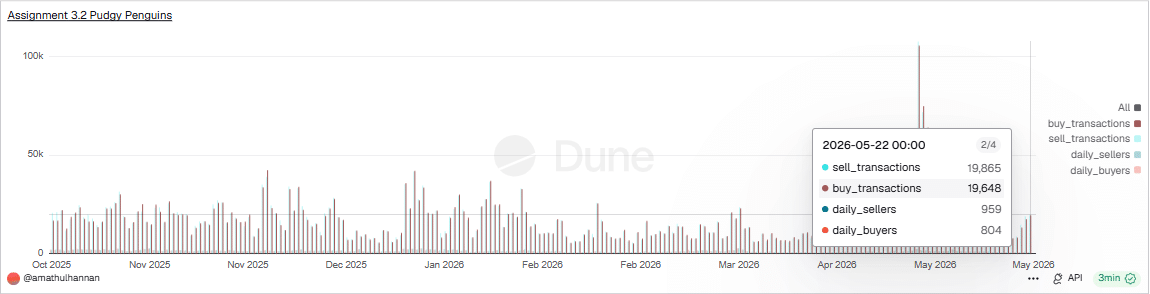
The number of transactions was growing, but sellers dominated them more. According to Dune Analytics, sell transactions were 19,865, while those of buyers were 19,648. However, the difference was not that big.
Additionally, the number of daily sellers was 959, while the number of buyers was 804.
Source: Dune Analytics
This sale came as a result of monthly unlocks of 712.4 million PENGU worth $6.25 million.
Of this amount, 279.3 million PENGU worth $2.45 million was meant for the company, while 433.1 million tokens valued at $3.80 million went to the current and future teams.
Network data from Arkham showed the teams distributed their tokens this week, valued at $3.40 million. Hence, this development potentially sparked sell pressure from on-chain traders.
Source: Arkham
Furthermore, capital was leaving the broader altcoin market, and trending tokens like PENGU were taking the hardest hit. An increase in daily trading volume by 17% to around $181 million affirmed the sell pressure.
Additionally, the decline in collections like Bored Apes spread into PENGU because it is intertwined with the NFT sector. The memecoin is highly sensitive to sentiment shifts away from digital collectibles.
Can PENGU bounce off the 0.618 Fib level?
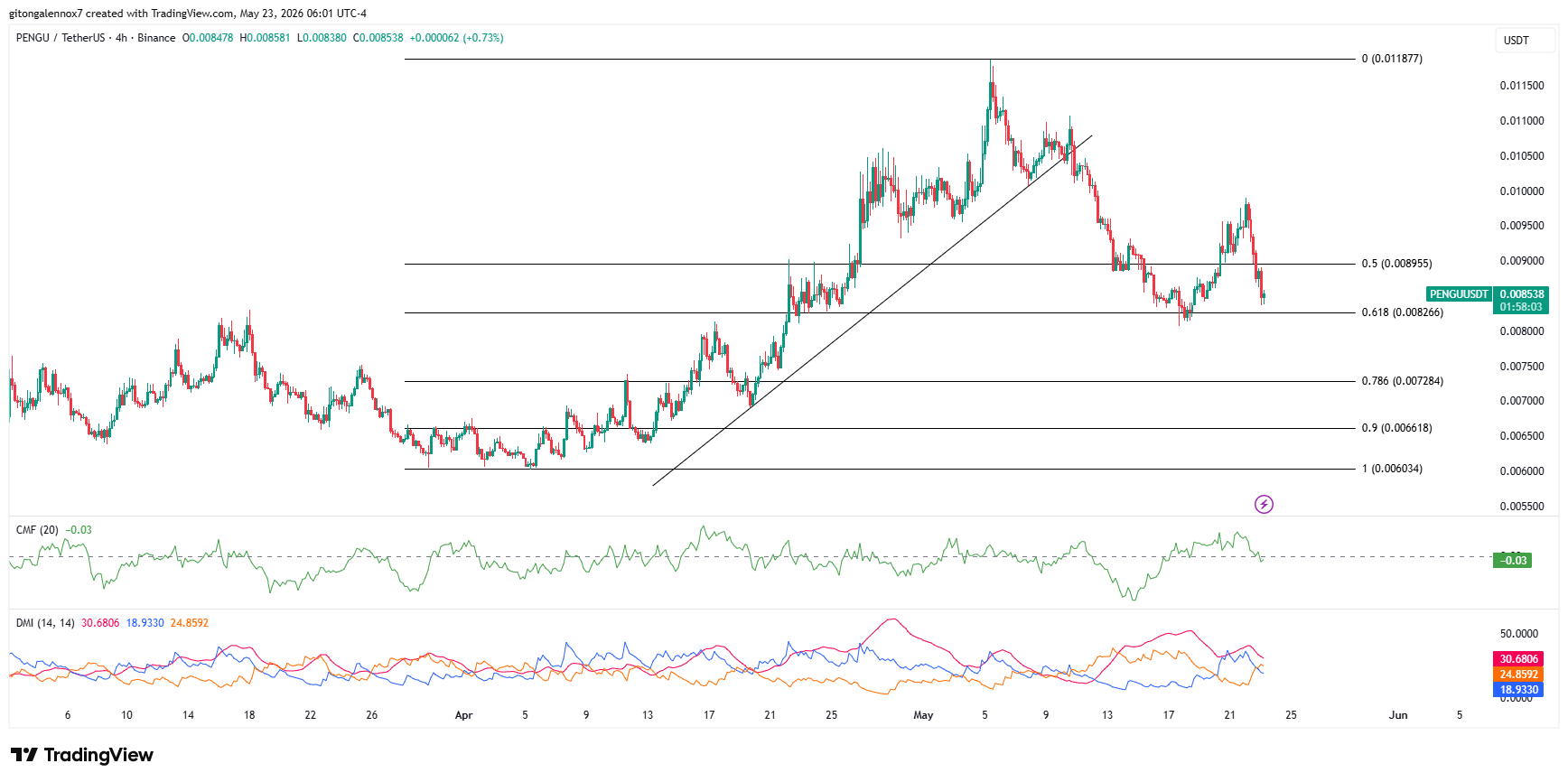
PENGU broke a rising trendline support and dropped to the 0.618 Fibonacci Retracement level. At this level, the memecoin has recovered half of the 31% crash but is approaching the level for the second time.
Bulls are returning at this level even though capital flows are negative. The Chaikin Money Flow is -0.02, as well as a declining Directional Movement Index (DMI). The DMI lines are all pointing downwards.
As price forms a potential turning point at $0.008266, the second touch of the 0.618 Fib level could spark a rebound. This would need PENGU breaking above $0.009846 to confirm an uptrend continuation.
Otherwise, if sellers maintain their momentum, they might break the level down. As a result, the next targets would be at $0.007284 or lower.
Source: PENGU/USDT on TradingView
Therefore, the crash may not last, especially if the market prices in the unlocked tokens of this month.
Final Summary
PENGU loses 14% in the past 24 hours amid broader crypto market correction and massive monthly token unlock.
Price approaches the 0.618 Fib level for the second time, which, if defended, could ignite a reversal.
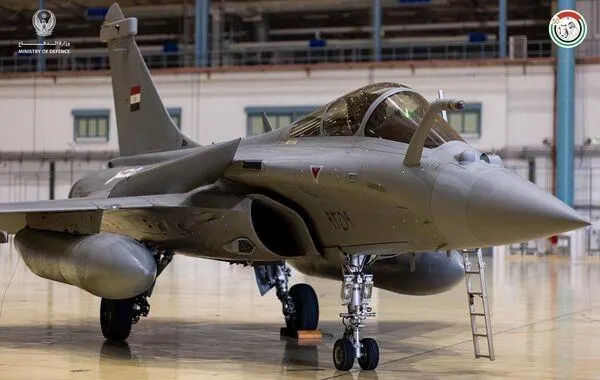
An Egyptian French-made Dassault Rafale fighter jet deployed to the United Arab Emirates. (UAE Ministry of Defense photo)
UAE Ministry of Defense
The U.S.-Israel war against Iran, launched on February 28, saw Tehran take the unprecedented step of repeatedly targeting all six Arab Gulf monarchical member states of the Gulf Cooperation Council with ballistic missile and explosive drones. After the April 8 ceasefire halted hostilities, some in the Gulf states began questioning why larger regional powers like Egypt didn’t do more to help defend them against Iran.
Iran and its regional militia proxies fired missiles and drones at the Gulf states throughout the war, with the United Arab Emirates enduring the brunt of these attacks. The UAE’s world-class air defense found itself under unprecedented strain, and the daily Iranian attacks undermined its carefully cultivated reputation for security and stability that Abu Dhabi strove to uphold for decades.
The Emirates and other GCC states provided grants and investments worth tens of billions of dollars to Egypt to prop up its economy since 2013. The war consequently left some Gulf Arabs wondering aloud why Egypt, which has the largest army of any Arab country, didn’t do more to assist them militarily.
In another unprecedented development of the war, Israel forward-deployed troops to operate Iron Dome anti-rocket and even the new Iron Beam laser defense system to help defend Emirati airspace from these constant attacks.
Tareq al-Otaiba, a former official in the Emirati national security council, wrote a scathing article for the Arab Gulf States Institute, charging that the Iran war exposed “the hollowness of Arab solidarity.”
“In the face of Iranian aggression, several states have stepped up to provide real assistance to the UAE,” he wrote. “Primarily, the United States and Israel have proved to be true allies by offering support through extensive military aid, intelligence sharing, and diplomatic backing.”
“The same support has not come from the Arab world.”
Al-Otaiba also correctly noted that the crisis was the worst the Gulf has seen since August 1990, when Saddam Hussein’s Iraq infamously invaded and annexed the GCC member state of Kuwait. On that occasion, the U.S. responded by assembling a multinational coalition that expelled the Iraqi Army in the ensuing 1991 Persian Gulf War.
Since then, the United States has remained the predominant military backer and arms supplier of the Gulf states, which host various American air and naval forces in large bases throughout the region that Iran bombarded during this latest war.
None of this necessarily means that other regional powers did nothing as the GCC faced its worst crisis since 1990.
Almost a month after the April 8 ceasefire, the UAE Ministry of Defense revealed that Egypt had deployed some of its French-made Dassault Rafale multirole fighter jets to the Gulf state. Egyptian President Abdel Fattah el-Sisi even visited and “conducted an inspection visit to the Egyptian fighter detachment stationed” there with his Emirati counterpart, Mohamed bin Zayed al-Nahyan. How many of these jets, where they are stationed, and whether they played an active role in helping the UAE shoot down drones during the conflict, remains unclear. Nevertheless, their deployment is a symbol of Egypt’s support for its Gulf ally’s defense and certainly isn’t nothing.
France deployed 12 Rafales to the UAE during the war which intercepted several drones. The French fighters expended at least 80 MICA air-to-air missiles, an expensive and unsustainable way of shooting down relatively inexpensive Iranian drones. France has already modified the Rafale’s cannon to intercept such drones more cost-effectively, something the UAE has probably taken note of, given the pending delivery of 80 Rafale F4s Abu Dhabi ordered in December 2021. In the meantime, Egyptian Rafales could conceivably augment their French counterparts if Iranian drone attacks resume in the near future.
The United Kingdom has also armed its Eurofighter Typhoons operating in the Middle East with the cost-effective Advanced Precision Kill Weapon System, which uses relatively inexpensive laser-guided rockets rather than conventional air-to-air missiles to intercept drones. The UAE and several other Gulf states have made large orders of thousands of APKWS rockets after their respective experiences in dealing with unrelenting Iranian drone barrages during the war.
The Wall Street Journal recently reported that Egypt also deployed ground-based air defenses to the UAE and other Gulf states during the war. The systems in question were reportedly the Skyguard Amoun, which integrates anti-aircraft guns and surface-to-air missiles, making it suitable for providing point defense for bases and critical infrastructure. As with the Rafales, it’s unclear if these intercepted anything.
Additionally, Reutersreported that Saudi Arabia’s longtime ally, Pakistan, had deployed 8,000 troops, along with JF-17 Thunder multirole fighter jets and long-range Chinese-made HQ-9 air defense missile systems to the kingdom. Islamabad has stationed troops on Saudi soil during past regional crises, including the Iran-Iraq War and the 1991 Persian Gulf War, to help bolster its defenses. The Iran war was no different. It’s also long been suspected that Pakistan and Saudi Arabia have an understanding in which the former would put its nuclear arsenal at the disposal of the latter if the kingdom faced an existential threat.
Today, Pakistan, Egypt, and Turkey, which also have troops and F-16 fighter jets stationed in GCC member Qatar, are earnestly pushing for negotiations aimed at ending hostilities with Iran. They have a vested interest in doing so: both for regional security and stability and, of course, to mitigate the risk that their troops and military hardware in the Gulf could come under Iranian fire if this regional war resumes.
The war wasn’t the first time the GCC had found its regional allies somewhat lacking in providing an alternative or parallel military support to the U.S. and other Western armed forces.
In the 1980s, leading GCC states supported Saddam Hussein’s Iraq during the Iran-Iraq War with the notable exception of Oman. Muscat has always had the closest ties to Tehran of any GCC state, but that still didn’t spare it from Iranian attacks this year. Back then, Oman shrewdly understood that “only Tehran could potentially act as a balance to an immensely powerful Baghdad,” which Saudi Arabia and Kuwait were financing and helping to become a predominant military power in the region with an enormous army. A mere two years after the Iran-Iraq War ended, Saddam Hussein infamously annexed Kuwait, sending shockwaves throughout the GCC states. In 2019, then-Iranian President Hassan Rouhani even argued that Saudi Arabia and the UAE only survived that crisis because Tehran didn’t cooperate with Saddam Hussein against them.
While the U.S.-led coalition liberated Kuwait and shielded the GCC, these states briefly explored a regional non-American solution for their defense. The subsequent March 1991 Damascus Declaration envisioned the GCC financing a long-term deployment of Egyptian and Syrian troops in Kuwait and Saudi Arabia to defend them against Iraq. Both Arab countries had provided sizable troop detachments to the U.S.-led coalition that fought the Gulf War.
However, grand plans for a permanent force of up to 100,000 Egyptian-Syrian troops were quickly reduced to a much more “symbolic” force of a mere 3,000 to 5,000. Even newly liberated Kuwait expressed its belief that there was “no substitute for Western might.”
Egyptian and Syrian troops left the Gulf by the summer of 1991, and talk of any Egypt-Syria force was abandoned by the end of the year or, in the words of one retrospective analysis, “achieved the status of a footnote in history.”
Whether the current Egyptian and Pakistani deployments will become a similar footnote remains to be seen, though it’s already apparent that, at least as far as some in the GCC states are concerned, they cannot adequately substitute for American military might.
Intel(NASDAQ: INTC) investors are having a phenomenal year so far, as shares of the semiconductor giant have shot up nearly 225% in 2026 as of this writing.
Intel stock has benefited from multiple favorable developments this year. From its improving financial performance to the growing influence in artificial intelligence (AI) chips to the progress that Intel is making in its foundry business, investors have found several reasons to be upbeat about the stock in 2026.
Will AI create the world’s first trillionaire? Our team just released a report on a little-known company, called an “Indispensable Monopoly,” providing the critical technology Nvidia and Intel both need.
But can this semiconductor stock sustain its impressive momentum and deliver more gains over the next two and a half years? Let’s find out.
Image source: Intel.
Intel’s valuation is a sticking point for the stock
Intel’s stunning rally in 2026 explains why the stock is trading at a whopping 904 times trailing earnings. That’s well above its price-to-earnings (P/E) ratio of 615 at the end of 2025. Additionally, the forward earnings multiple of 147 is on the expensive side, given that the tech-focused Nasdaq-100 index has a forward P/E ratio of 26.
The valuation suggests that Intel stock may have gotten ahead of itself. Even the stock’s 12-month median price target of $90 points to a 25% decline. What’s more, only a third of the 51 analysts covering the stock rate it as a buy. So, the Wall Street sentiment suggests that Intel stock may not deliver further upside going forward.
However, the company has displayed a penchant for springing huge earnings surprises over the past three quarters. Its bottom line has significantly exceeded analysts’ expectations, and that’s been key to the massive surge in its stock price. The good news for investors is that there are signs that Intel could continue to outpace consensus expectations.
Booming chip demand, new customers, and improving yields could fuel more upside
Intel released its first-quarter results last month. The company’s revenue grew by a solid 7% year over year to $13.6 billion. More importantly, it reported non-GAAP earnings per share of $0.29, up significantly from $0.13 per share in the year-ago period. Analysts would have settled for just $0.01 in earnings per share.
Intel’s data center and AI (DCAI) segment reported 22% year-over-year growth in Q1 to $5.1 billion. Meanwhile, the Intel Foundry segment saw revenue jump 16% year over year to $5.4 billion. These two segments together produced 77% of its top line during the quarter. The good news for investors is that both businesses could continue to grow at healthy rates.
In the DCAI business, for instance, the demand for Intel’s products is outpacing supply, especially for its server central processing units (CPUs). Not surprisingly, the company is focused on increasing factory output to meet strong demand. That’s the smart thing to do, as the massive investment in AI data center infrastructure is turning out to be a tailwind for nearly all the chipmakers.
It is estimated that the top four hyperscalers in the U.S. could boost their 2026 capital spending by 77% to a whopping $725 billion. These companies are looking to get their hands on all the compute hardware they can, which isn’t surprising as they need a lot of chips to satisfy their huge contractual backlogs, which run into more than $2 trillion.
So, all the major AI chip companies, including Intel, are benefiting from this massive outlay. Market research firm Gartner estimates that overall AI infrastructure spending could grow by another 32% in 2027 to $1.89 trillion. So, the solid growth of Intel’s DCAI business should continue to fuel terrific bottom-line growth for the company.
Meanwhile, Intel’s foundry business is gaining impressive traction among customers. The company is reportedly going to manufacture chips for consumer electronics giant Apple. The iPhone maker has been relying on Taiwan Semiconductor Manufacturing for its chip manufacturing. However, TSMC’s capacity is constrained by strong demand from Nvidia and other AI chip designers, which explains why Apple is looking at Intel to make its chips from next year.
Even better, Intel says that the manufacturing yield of its advanced 18A process is improving at a nice clip of 7% to 8% a month. Manufacturing yield is the percentage of functional chips produced from a silicon wafer. A higher yield means it costs less to produce a functioning chip, suggesting a potential jump in profitability.
Importantly, there is a strong interest in Intel’s 18A process from external customers, suggesting that its foundry business could continue clocking solid growth going forward. Also, the improving yield should be a tailwind for the company’s bottom line. In all, it is easy to see why analysts have substantially increased their growth expectations for Intel for 2027 and 2028.
The chart above suggests that Intel’s revenue will increase in the double digits going forward. Of course, the company could do better than that, given new foundry customers such as Apple and the secular growth opportunity in the AI infrastructure space. But even if it achieves $72 billion in revenue in 2028 and maintains its price-to-sales ratio of 10.4 at that time, its market cap could increase to $749 billion. That suggests potential upside of 24% compared to its current market cap.
However, an acceleration in Intel’s growth could lead the market to reward this AI stock with a higher sales multiple, indicating that stronger upside cannot be ruled out. Also, the company’s ability to grow earnings at a much stronger pace due to new customer additions and improving yields in the foundry business could be another tailwind for the stock, suggesting it makes sense to continue holding Intel in anticipation of more upside.
Should you buy stock in Intel right now?
Before you buy stock in Intel, consider this:
The Motley Fool Stock Advisor analyst team just identified what they believe are the 10 best stocks for investors to buy now… and Intel wasn’t one of them. The 10 stocks that made the cut could produce monster returns in the coming years.
Consider when Netflix made this list on December 17, 2004… if you invested $1,000 at the time of our recommendation, you’d have $477,813!* Or when Nvidia made this list on April 15, 2005… if you invested $1,000 at the time of our recommendation, you’d have $1,320,088!*
Now, it’s worth noting Stock Advisor’s total average return is 986% — a market-crushing outperformance compared to 208% for the S&P 500. Don’t miss the latest top 10 list, available with Stock Advisor, and join an investing community built by individual investors for individual investors.
Harsh Chauhan has no position in any of the stocks mentioned. The Motley Fool has positions in and recommends Apple, Intel, Nvidia, and Taiwan Semiconductor Manufacturing. The Motley Fool recommends Gartner. The Motley Fool has a disclosure policy.
Bitmine Immersion Technologies, the world’s largest Ethereum treasury firm, continues to scale its dip buying amid ETH’s price pullback.
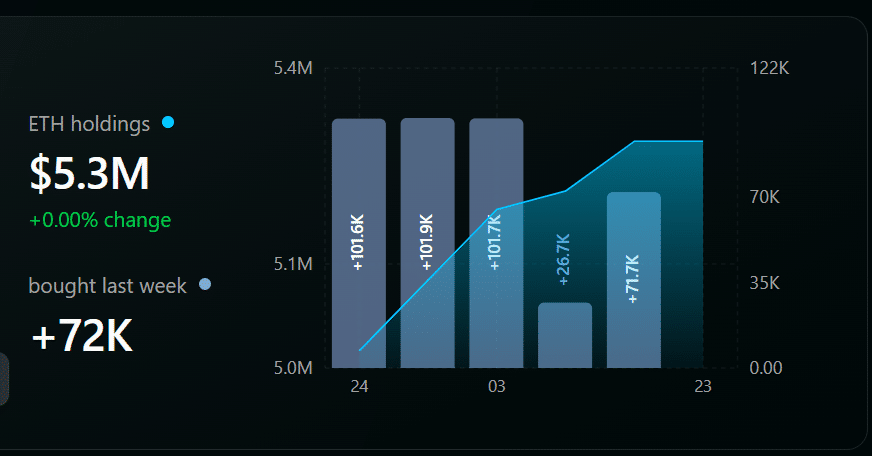
Notably, the Tom Lee-led firm scooped an extra $125.9 million worth of ETH (60K tokens) via Kraken and BitGo.
Source: BMNR.Rocks
Worth pointing out that the 60K ETH haul was still less than the 71K ETH purchase the firm made last week. But it continues to aggressively accumulate during the recent ETH discount window.
ETH’s price has fallen by nearly 15% in May and traded at $2K, partly accelerated by weak market sentiment and renewed U.S.-Iran war fears.
For Tom Lee, however, the pullback has been an ‘attractive’ buying opportunity to aggressively scale to its 6 million ETH holding target.
The firm currently holds 5.3 million ETH. If the recent weekly buying pace of 60K-100K ETH continues, Bitmine may hit its 6 million ETH goal in the next two to three months. Nearly 90% of the 5.3 million ETH is now staked.
Russell 3000 Index to include Bitmine
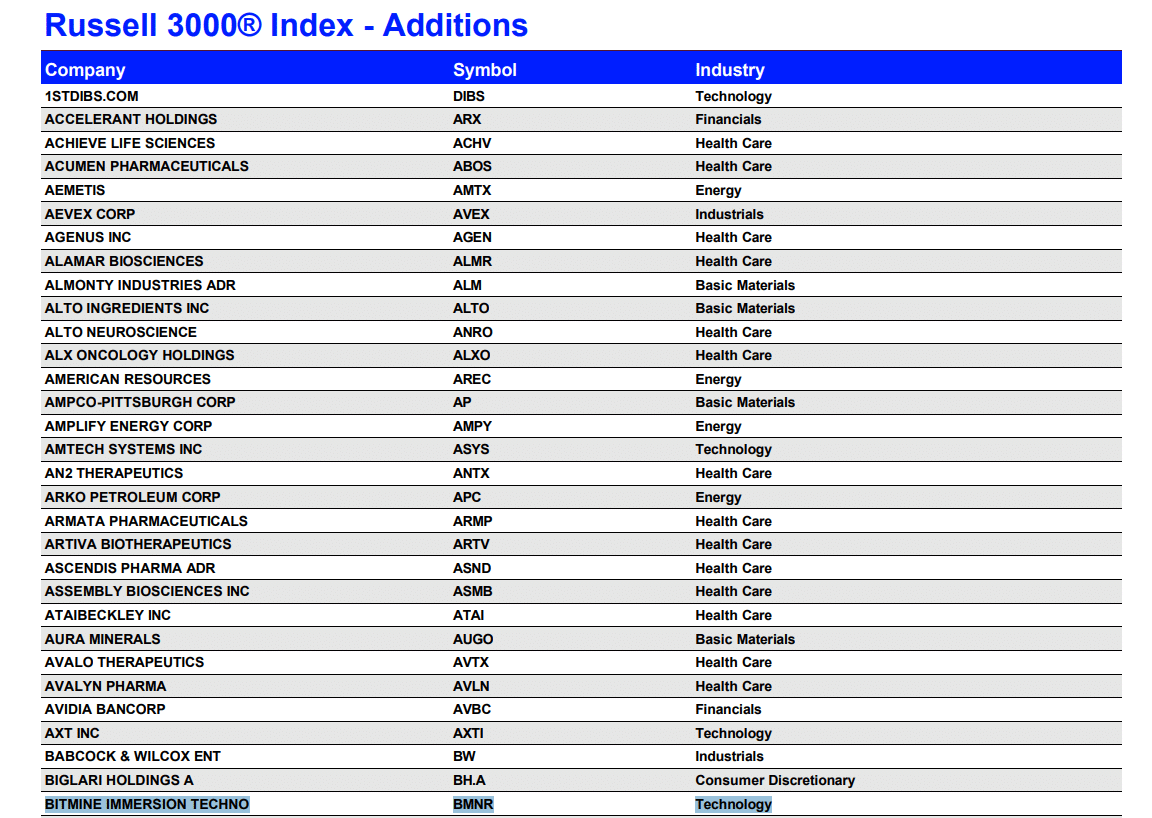
Separately, the world’s largest ETH treasury firm will score another milestone next month. The London Stock Exchange Group (LSEG) confirmed that Bitmine will be included in the preliminary list of its Russell 3000 Index ahead of the June rebalancing.
Source: LSEG
The Russell 3000 Index tracks the top 3000 U.S. companies by market size, with strict requirements that the stock stay above $1 and trade on major exchanges like the Nasdaq or the NYSE.
If finally accepted at the end of June, Bitmine will automatically be included in ETFs tracking the Russell 3000 Index. This would effectively increase its potential inflows, and likely, its uplisting on the Russell 1000 Index in the future.
The Russell 1000 Index tracks the top 1000 largest U.S. public firms by market cap. However, this update was swept away by the broader crypto market pullback amid renewed fears of a U.S.-Iran war.
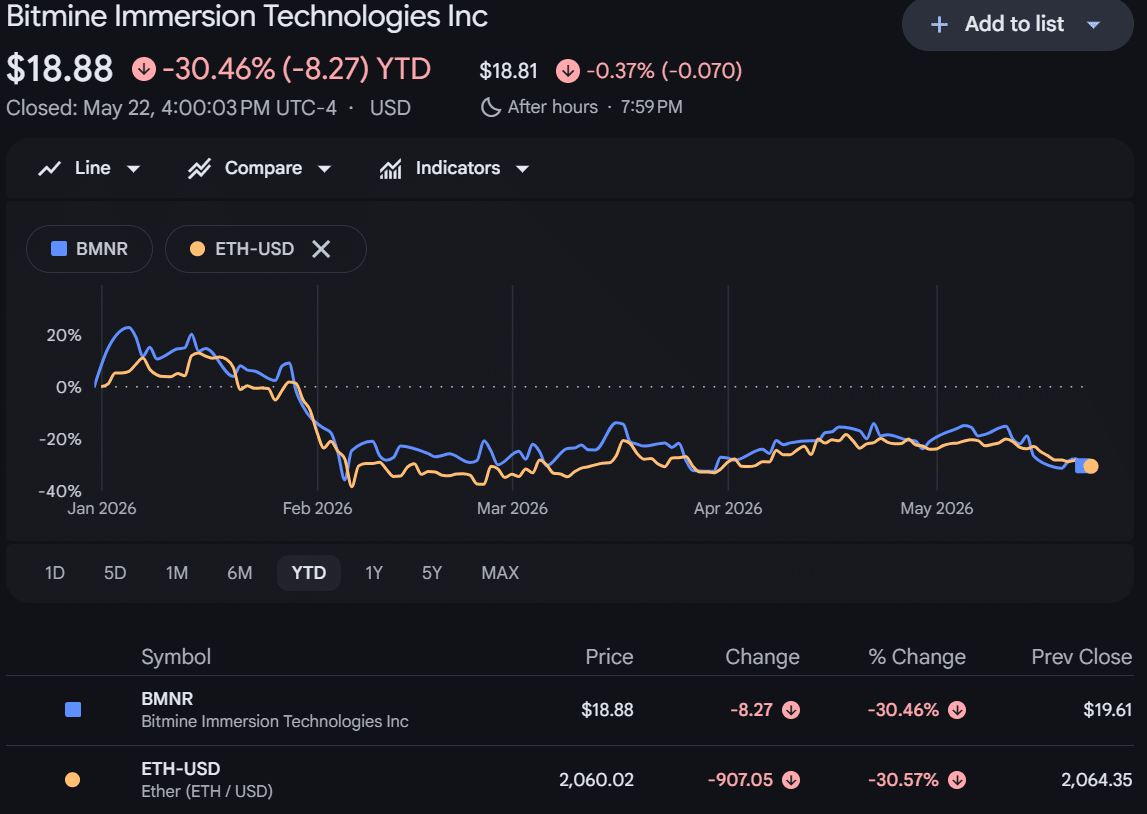
Bitmine stock [BMNR] fell 3.7% to $18.8 on Friday, bringing year-to-date (YTD) losses to 30%. Interestingly, ETH had a similar YTD performance, underscoring the strong correlation between the two.
Source: Google Finance
Final Summary
Bitmine deepened its dip buying with a $126M ETH purchase as the altcoin’s price pullback hit 15%
The firm could easily climb to the Russell 1000 Index, which tracks the largest U.S. firms.
Latest developments: Hyperliquid is outperforming much of the crypto market as traders rotate back into higher-risk assets.
Hyperliquid’s HYPE token hit a new all-time high after two HYPE ETFs launched in the U.S.
Van de Poppe said European traders have increasingly moved to Hyperliquid because perpetual futures trading remains difficult to access on many regulated venues in Europe.
He argued Hyperliquid’s push into tokenized stocks, commodities and pre-IPO assets is accelerating broader tokenization trends across crypto markets.
Van de Poppe said HYPE could rise to $100 or more if crypto market appetite continues to strengthen.
Van de Poppe joined Jennifer Sanasie on CoinDesk’s Markets Outlook.
What this means: Van de Poppe sees Hyperliquid as a short-term winner but Solana as the stronger long-term conviction bet.
He said liquidity in crypto markets is concentrating around a small group of protocols generating strong user growth and revenue.
Van de Poppe said Hyperliquid currently benefits from that concentration but warned competitors will eventually enter the market and pressure its dominance.
He described Solana as successfully transitioning from a “degen” ecosystem into a more institutional blockchain ecosystem.
Van de Poppe said Solana’s long-term positioning as infrastructure makes it more attractive than Hyperliquid over a multi-year horizon.
The AI trade: AI-linked crypto projects remain deeply undervalued relative to traditional AI companies, van de Poppe said.
He pointed to NEAR and Bittensor as two of the strongest infrastructure plays tied to AI adoption in crypto.
Van de Poppe argued valuations for private and public AI companies have become overheated, while crypto AI tokens have fallen sharply despite continued ecosystem growth.
He said NEAR’s projected revenue growth from roughly $10 million in 2025 to as much as $100 million this year supports a significantly higher valuation.
Van de Poppe said Bittensor’s ecosystem expansion and subnet structure could justify prices between $1,000 and $2,000 if adoption continues.
The privacy debate: Privacy remains one of crypto’s biggest long-term themes, but fully anonymous systems face major regulatory risks.
Van de Poppe said institutional and retail users both want more transactional privacy on blockchains.
He argued governments are unlikely to support fully anonymous privacy coins over the long term because regulators want visibility into transactions.
Van de Poppe said funds in Europe already face restrictions interacting with certain privacy-focused assets.
He pointed to zero-knowledge proof systems and permissioned privacy models as more sustainable paths forward for institutional adoption.
Macro outlook: Van de Poppe said bond yields and central bank policy remain the biggest near-term macro drivers for crypto.
He said Japanese bond yields are a key market signal and could heavily influence broader risk appetite.
Falling yields could support equities and crypto markets, while persistent inflation could create headwinds.
Van de Poppe said he does not expect aggressive rate cuts or renewed monetary easing from the Federal Reserve in the near term.
He warned additional rate hikes would likely pressure crypto and broader risk assets.