Home Blog Page 725

Trump was supposed to talk about the economy. Instead he asked why toiletries are locked up in pharmacies

0
Trump was supposed to talk about the economy. Instead he asked why toiletries are locked up in pharmacies

President Donald Trump, from a toss-up congressional district in New York on Friday, began testing his midterm message that was ostensibly on the economy.

But he veered off-topic right from the start, going off on tangents about voter identification, crime in cities, transgender women in sports and “Dumocrats,” his new chosen moniker for the opposition party. He complained that toiletries are locked up in pharmacies, making them harder to buy, and polled the audience on what he should call his predecessor, former President Joe Biden.

Eventually, he landed on the topic of the speech, telling the crowd that he and his party worked to slash taxes and increase take-home pay, while Democrats opposed the effort at every turn.

“I cut your taxes, cut the taxes on workers, families, small business, who are the soul of this state,” Trump said to the audience at Rockland Community College. Listing off the various provisions of the tax law, the president said: “These are all Republican tax cuts. The Democrats voted against every one of these tax cuts.”

Trump traveled to the Hudson Valley area to appear with Republican Rep. Mike Lawler, who is up for reelection in what will be one of the most closely watched House races this November, for an event meant to promote the tax law Trump signed last year, particularly the quadrupling of the deduction for state and local taxes, which is critical in a high-tax state like New York.

Trump called Lawler “fantastic” and mused about how the congressman was a “pain in the ass” as he badgered the administration on expanding the deduction.

He pulled Lawler onstage during the event, and the congressman thanked the president “for working with me to deliver a big win” for the people in his district. He said that more than 90% of the people in his district were able to fully deduct their state and local taxes.

Also appearing with the president at the event Friday was Nassau County Executive Bruce Blakeman, the Trump-backed Republican candidate for New York governor. Trump said, “Guys like Mike Lawler, guys like Bruce Blakeman, you put them in, they’ll turn it around.”

Trying to reverse a slumping approval rating

The White House has been looking for more opportunities to highlight Trump’s economic accomplishments as his approval rating on the economy has slumped. About one-third of U.S. adults approve of how Trump is handling the economy, according to a new AP-NORC poll, down slightly from 40% at the start of Trump’s second term. Trump had promised to bring prices down, but gasoline prices have surged this year due to the war in Iran.

Lawler is just one of three House Republicans who represent a district won by Democratic presidential candidate Kamala Harris in 2024. Unlike the other two — retiring Nebraska Rep. Don Bacon and Pennsylvania Rep. Brian Fitzpatrick, who’s been a critic of Trump policies — Lawler has chosen to embrace the polarizing president in hopes of not alienating Republican voters who support the party’s leader.

“Look, the people who hate the president — and that’s their sole basis for their vote — are likely never voting for me, and you know, obviously, you need to turn out your base, and you need people energized,” Lawler told The Associated Press in an interview on the sidelines of the White House congressional picnic earlier this week. “Moreover, I have a record in my district that is one I’m very proud of, and a record that appeals to a broad middle.”

Lawler, wearing a red ball cap emblazoned with “Mr. SALT,” the acronym for the state and local tax deduction he fought to include in the bill, added, “I am confident that I will be reelected on my own merits and my own record.”

Trump established a SALT cap in 2017 through his Tax Cuts and Jobs Act. Last year’s law expanded the SALT deduction to $40,000 from $10,000 after arduous negotiations with Republicans, including Lawler, whose district has high local taxes. The law also raised the average tax refund for New Yorkers to more than $3,800, according to data provided by the White House.

“My constituents were seeing anywhere from $5,000 to $20,000 refund checks, which is pretty massive,” said Lawler, who said he wanted to give Trump one of his “Mr. SALT” ball caps.

A competitive House race in New York

Trump formally endorsed Lawler for reelection last year, although it came at a time when the congressman was publicly mulling a run for governor of New York. The endorsement was viewed as a way to keep Lawler in a reelection bid rather than opening up a competitive House seat.

Five Democrats are vying for the party’s nomination to compete against Lawler in the general election. The Democratic primary is June 23.

“Nothing says ‘I don’t understand my district’ quite like Mike Lawler bringing Donald Trump to NY-17 to tout a disastrous economy that’s crushing working families at every turn,” said Riya Vashi, a spokesperson for the Democratic Congressional Campaign Committee.

National Republican Congressional Committee chairman Richard Hudson disputed that, arguing that Trump’s Friday appearance will “absolutely” help.

“His poll numbers are pretty good in Lawler’s district,” said Hudson, a North Carolina congressman. The NRCC has been polling in competitive districts and Hudson said the “president’s numbers are good. Democratic numbers are tanking.”

The remarks were an official White House event and not a campaign one, said Lawler, who noted that more than 5,000 people registered to attend in the first 12 hours that a sign-up was available.

___

Kim reported from Washington. Associated Press writers Joey Cappelletti and Michelle L. Price in Washington contributed to this report.



Source link

Should You Buy, Or Sell Fidelity’s MSCI Industrials Index ETF (FIDU) Today?

0
Should You Buy, Or Sell Fidelity’s MSCI Industrials Index ETF (FIDU) Today?


Quick Read

  • Fidelity MSCI Industrials Index ETF (FIDU) delivered 9.13% year-to-date returns as industrial companies benefit from AI infrastructure buildout spending, though the author recommends selling FIDU in favor of more targeted industrial exposure; Nvidia (NVDA) comprises nearly 8% of the S&P 500 with tech at 35% of the index, creating concentration risk that makes industrial stocks relatively safer during potential AI-related selloffs.

  • Hyperscalers’ massive capital expenditures for AI buildout are flowing directly into industrial companies that manufacture construction materials, electrical components, and HVAC systems, positioning industrial stocks to outperform for the next couple of years despite broader market correlation.

  • The analyst who called NVIDIA in 2010 just named his top 10 stocks and Fidelity MSCI Industrials Index ETF wasn’t one of them. Get them here FREE.

The Fidelity MSCI Industrials Index ETF (NYSEARCA:FIDU) is a low-cost ETF that gets you exposure to some of the premier industrial and defense stocks in the market. Most investors view it as a solid play due to surging defense spending and reindustrialization. And while that hasn’t paid off with the S&P 500 still ahead, I’d argue FIDU is worth taking a second look at.

The future could be bright for FIDU for multiple reasons, and some unique characteristics can turn it into a winner.

Industrial stocks are quite hardy in the current environment. Plus, you’re likely underweight on them by a large margin, and you could miss out significantly if the reshoring + reindustrialization plays out as expected in the coming years.

The analyst who called NVIDIA in 2010 just named his top 10 stocks and Fidelity MSCI Industrials Index ETF wasn’t one of them. Get them here FREE.

But even all that might not make it a buy in the end. Let’s first take a look at what’s going on.

FIDU is doing better and better

The past performance might turn off some people just because this ETF underperformed a little, but this is a mistake. In fact, I find it quite impressive that FIDU has managed to almost keep up with the S&P 500 and has actually delivered higher year-to-date returns so far this year at 9.13% vs. 5.8%.

FIDU holds stocks that went through a record-high interest rate hike cycle, plus the tariff drama. The S&P 500 went through the same, but the industrial sector never had Wall Street throwing money at it because of AI.

Things are changing, though. The premium Wall Street is paying for AI is shifting away from software tech companies into hardware and industrial businesses that are on the receiving end of the buildout money.


Source link

How FDIC’s new stablecoin plan can change crypto transfers forever

0
How FDIC’s new stablecoin plan can change crypto transfers forever


The U.S. Federal Deposit Insurance Corporation (FDIC) has proposed a new rule to establish a Bank Secrecy Act and sanctions compliance framework for stablecoin issuers. 

According to the FDIC’s statement on Friday, the new rule will require issuers to have a strict program for anti-money laundering and countering the financing of terrorism (AML/CFT).  

Additionally, the issuers will be used to enforce U.S. economic sanctions and fulfill standard reporting requirements. Besides, other provisions by FinCEN and OFAC, like senders’ and receivers’ IDs of stablecoin transfers, are covered by the new rule. 

It’s worth pointing out that players like Tether recently helped the U.S. Treasury to freeze $344 million of crypto funds allegedly linked to Iran’s government.

Since both USDT and USDC have backdoor freezing features, the new proposal seeks to formalize their use (particularly for U.S.-based issuers) as an economic sanction tool. 

Race to implement GENIUS Act for stablecoin issuers

The GENIUS Act, a stablecoin law passed last year, instructs financial agencies to implement regulations for issuers. The FDIC’s sanctions proposal is the third rule the agency has issued after last December’s license application criteria and April’s prudential framework rules. 

The latest proposal is open for public feedback for the next 60 days, after which the FDIC is expected to issue a formal rule-making. 

The U.S. Treasury, OFAC, OCC, NCUA, and others have also issued proposed rules for GENIUS Act implementations ahead of the July 18th deadline. 

So far, only seven proposed rules for the GENIUS Act have been issued. Out of these, only three have closed public comment windows. However, no proposed rules have been finalized into a formal guideline, with only 55 days left to the deadline. 

FDIC Genius Act
Source: Paradigm

Besides, there have been calls by banks to delay the rulemaking process. The banking lobby raised concerns over the OCC granting crypto firms national trust charter licenses and access to Federal Reserve payment systems. 

On this backdrop, whether the implementation will happen by mid-July remains unclear. However, key players are actively positioning themselves to benefit from the upcoming clear rules for the segment. 

Notably, Fidelity, JPMorgan, U.S. Bancorp, and others are rolling out tokenized money funds specifically targeting stablecoin reserves to ensure instant liquidity while earning yield on the balance. 


Final Summary

  • FDIC has proposed a sanctions compliance standard rule, marking its third proposal aimed at implementing the GENIUS Act.
  • With less than two months left to the GENIUS Act implementation deadline, the banks want the rulemaking process to be slowed. 


Source link

Bitcoin tanks to $74,300 as spot ETFs bleed $2.26 billion in two weeks

0
Bitcoin tanks to $74,300 as spot ETFs bleed $2.26 billion in two weeks

Bitcoin is rapidly losing ground as investors pull out billions of dollars from U.S.-listed spot ETFs.

The world’s largest cryptocurrency fell to $74,305 early Saturday, its lowest level since April 20, according to CoinDesk data. As of writing, BTC was down more than 3% over the past 24 hours and approximately 10% below its recent high of over $82,500 reached on May 6.

The sell-off accompanies a notable upswing in U.S. Treasury yields and parallel increases in government bond yields across developed markets, which are reducing appetite for high-risk, zero-yielding assets like bitcoin.

Investors withdrew $1.26 billion from U.S. spot Bitcoin ETFs this week, the largest single-week outflow since January, following roughly $1 billion in outflows the previous week. In total, the funds have seen more than $2.26 billion in redemptions over the past two weeks.

Meanwhile, commodities such as oil, copper, and sulfur are seeing strong flows of speculative money as markets continue to price in potential supply disruptions through the Strait of Hormuz due to the Iran conflict.

One theory also points to capital being redirected toward SpaceX’s anticipated IPO, with several blockchain-based pre-market derivatives tied to the event already seeing millions in trading volume on blockchain-based platforms.


Source link

KITE plunges 18% amid growing risk-off sentiment: More losses ahead?

0
KITE plunges 18% amid growing risk-off sentiment: More losses ahead?


With the broader crypto market retracing, KITE posted one of the largest declines, ranking among the top losers. The altcoin extended its slip, breaching the $0.2 support and dropping to a low of $0.18 before slightly rebounding. 

As of this writing, KITE traded at $0.19, down 18.2% on the daily charts. Over the same period, its trading volume rose 112%  to $81 million, suggesting increased sell-side activity. 

KITE traders adopt a risk-off stance

As Kite [KITE] extended its decline, exacerbated by market-wide breakdown, investors in the Futures flipped bearish. 

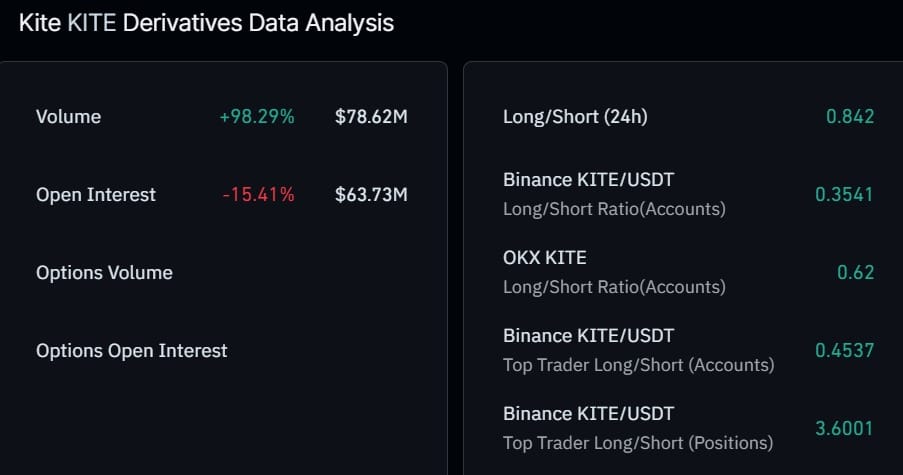
As a result, most market participants either scaled back or closed their positions entirely. CoinGlass data showed that KITE’s Open Interest dropped 15.4% to $63 million, while Derivatives Volume rose 98% to $78 million. 

KITE derivatives data
Source: Coinglass

A drop in OI while volume rose suggested that traders aggressively closed their Futures positions. As such, there was increased market participation, but on the Futures side. 

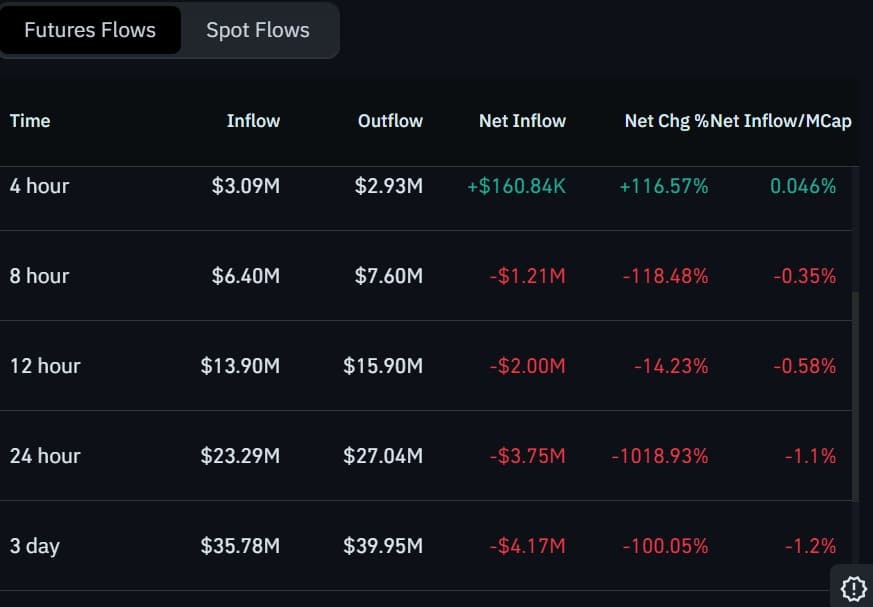
In fact, Futures Outflow rose to $27 million while inflow dropped to $23 million. As a result, Futures Netflow dropped 1018% to -$3.73 million. 

KITE futures inflowsKITE futures inflows
Source: CoinGlass

As the market retraced, speculators panicked and exited, fearing further losses. Traditionally, if the market rallied on increased leverage and those positions closed, the market tended to decline.

Downside momentum strengthens; more losses?

With sentiment flipping bearish in Futures, KITE’s downside momentum strengthened considerably.

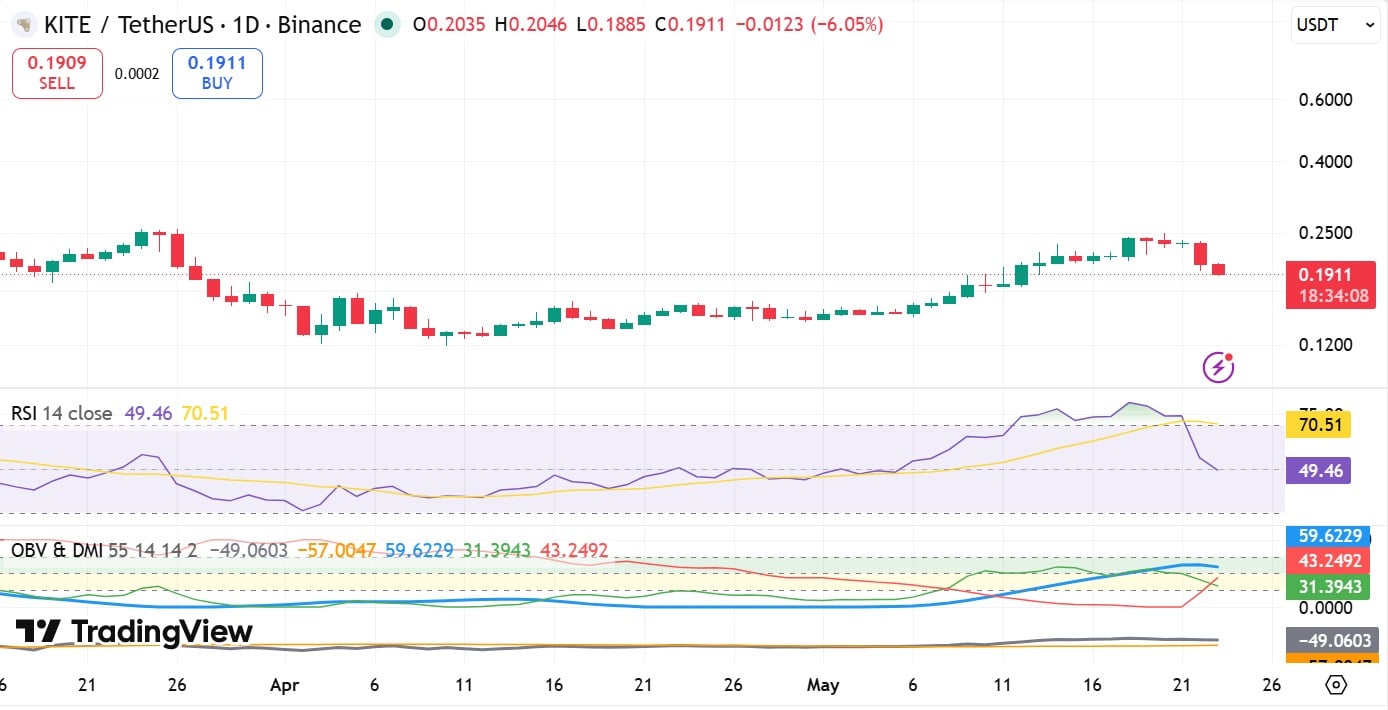
The altcoin’s Relative Strength Index (RSI) fell sharply, dropping from 74 to 49 and entering the bearish zone. Such a drop suggests that KITE faced intense selling pressure.

KITE RSI & DMI ADXKITE RSI & DMI ADX
Source: TradingView

At the same time, the positive index (+DI) of the DMI dropped to 31, while the negative index (-DI) rose to 43. With ADX rising to 59, it indicated a strong downtrend.

With these momentum indicators set this way, it suggests bears have total control of the market, and KITE could drop further. Therefore, if capital continues to flow out, the altcoin could lose its $0.18 support and drop to $0.16.

The Spot remains optimistic

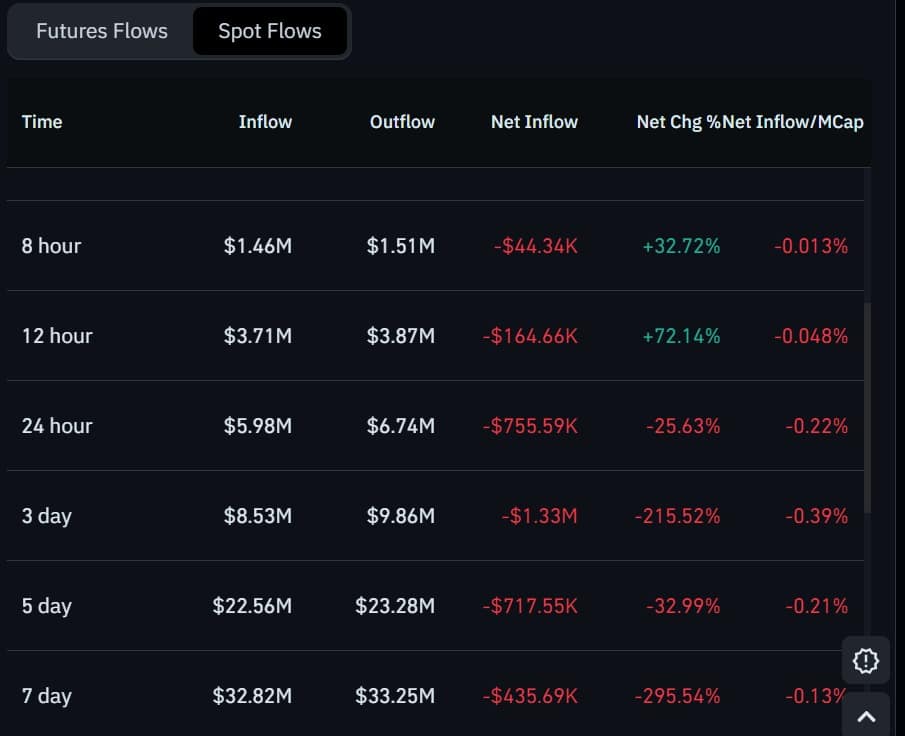
As the altcoin dropped, Spot investors took the opportunity and continued to buy the dip. CoinGlass data showed that $6.74 million worth of KITE flowed out of the exchanges, compared to $5.94 million in flow.

Kite spot netflowKite spot netflow
Source: CoinGlass

As a result, Spot Netflow dropped 25% to -$755k, extending a week-long trend. A negative Netflow suggests buyers remain active in the market.

Their presence gives the market hope for a potential recovery from the slip. If demand holds during this period, the altcoin will reclaim $0.20 and set a path for a significant rebound.


Final Summary

  • KITE dropped 18%, breaching $0.20 support, hitting a low of $01.8. 
  • Futures traders aggressively closed their positions, but Spot demand remains steady, offering the altcoin a chance to rebound. 


Source link

Alaska Bets on Premium Flights As Airlines Absorb 50% of Fuel Costs

0
Alaska Bets on Premium Flights As Airlines Absorb 50% of Fuel Costs


Despite rising fuel costs, Alaska Airlines is pushing ahead with its plan to attract more premium passengers as it celebrated the launch of its newest route atop a London skyscraper on Thursday evening.

The Seattle-to-London service is part of a rapid European expansion, following last month’s launch of Alaska’s first-ever transatlantic route, to Rome. A third service, to Iceland, is set to begin next week.

But it comes at a cautious time for the industry since the Iran war sent jet fuel prices skyrocketing.

“You’ve seen a very significant drive to get airfares up,” Andrew Harrison, Alaska’s chief commercial officer, told Business Insider. “I think on average, most carriers, even what we’re selling today, are still only covering 50, 60, 70% of the increased cost of fuel.”

While most European airlines hedge against fuel costs using financial derivatives, most US carriers do not, leaving them more exposed to the surge in prices. Fuel is typically an airline’s second-highest expenditure, after labor.

United Airlines plans to “fully offset the increase in fuel prices,” but that would require an extra 8.5 percentage points of revenue for each seat it flies, CEO Scott Kirby said in March.

Even with higher airfares and checked bag fees, Harrison’s comments show how fuel costs are still eating into most airlines’ profits.

“What we tell ourselves at Alaska is just control what we can control. We are an industry that faces crises all the time. If it’s not one thing, it’s another,” Harrison told Business Insider.

“So we just feel actually very good about our expansion and what we’re doing here. In fact, it gives us even greater wind in our sails to continue and work hard during these difficult times.”

Jet fuel prices change summer vacation habits


Alaska Airlines staff stand by one of the company's planes to celebrate its new route from Seattle to Rome.

Alaska Airlines staff stand by one of the company’s planes to celebrate its new route from Seattle to Rome. 

Alaska Airlines


Despite rising prices, many people are still keen to fly — especially those rich enough to fly in premium cabins, which are particularly profitable for airlines.

Around 30% of people won’t change their summer travel plans due to rising gas prices, according to a Bank of America survey of 4,000 people conducted in April. Plus, the survey found middle- and higher-income households are seeing stronger travel spending.

Alaska is leaning into the trend with new international business-class suites, including sliding privacy doors and lie-flat beds. By 2028, it also plans to introduce a premium economy cabin on its long-haul widebody aircraft, like the Boeing 787 operating the London route.

Starlink’s high-speed in-flight WiFi also helps attract premium travelers. Alaska has equipped some planes with Starlink, but it isn’t yet certified for the 787. Harrison said the airline expects it to be ready in the fall.

Alaska has expanded to long-haul transatlantic flights thanks to its acquisition of Hawaiian Airlines, which had a fleet and order book of 787s. It’s timely, given the popularity of Europe with American travelers.

The Bank of America survey found Europe remained the most attractive location for vacationers this year. Compared to 2025, it’s become at least 10% more popular with middle- and higher-income households — but less popular with lower-income households, according to the survey.

On the other hand, this means strong competition. British Airways and Delta Air Lines already fly between Seattle and London, although Virgin Atlantic is suspending its route for the winter season.

Harrison pointed to Alaska’s “state-of-the-art aircraft” on the route, manufactured in the last 12 months, as well as its Seattle hub with 105 destinations.

To bypass Heathrow’s capacity constraints, Alaska is leasing its slot at the London airport from American Airlines, a fellow member of the Oneworld alliance.

“Working together with our Oneworld partners has just given us amazing opportunity in what we know is a very highly congested and competitive airport,” Harrison said.

BA is also a Oneworld member, so Alaska customers can connect on its flights to other destinations on the continent.

Surging fuel prices have made it a testing time for aviation, but Alaska isn’t too concerned, backing its international expansion.

It’s going to build a new foundation for growth, long term, for the airline,” Harrison said. “These are large investments, don’t get me wrong, but we’re building the company for the future, we’re building the brand for the future, and this is one area where we’re going to just keep going.”

Alaska is aiming for 12 international destinations out of Seattle by 2030, and plans to announce more later this year.


Source link

Mortgage and refinance interest rates today, May 23, 2026: Rates falling again today

0
Mortgage and refinance interest rates today, May 23, 2026: Rates falling again today


According to rates from the Zillow lender marketplace, compared to yesterday, the current 30-year fixed rate fell 12 basis points to 6.34%, the 15-year fixed rate fell by 7 basis points to 5.90%, and the 5/1 ARM fell by 19 basis points to 6.29%.

READ MORE: Weekly survey of mortgage lenders with the best rates: Another move higher above 6% APR

Today’s mortgage rates

Here are the current mortgage rates, according to the latest Zillow data:

  • 30-year fixed: 6.34%

  • 20-year fixed: 6.26%

  • 15-year fixed: 5.90%

  • 5/1 ARM: 6.29%

  • 7/1 ARM: 6.46%

  • 30-year VA: 5.98%

  • 15-year VA: 5.65%

  • 5/1 VA: 5.68%

Remember, these are the national averages and rounded to the nearest hundredth.

Discover 8 strategies for getting the lowest mortgage rates

Today’s mortgage refinance rates

These are today’s mortgage refinance rates, according to the latest Zillow data:

  • 30-year fixed: 6.38%

  • 20-year fixed: 6.06%

  • 15-year fixed: 5.84%

  • 5/1 ARM: 6.29%

  • 7/1 ARM: 6.22%

  • 30-year VA: 5.89%

  • 15-year VA: 5.58%

  • 5/1 VA: 5.58%

Again, the numbers provided are national averages rounded to the nearest hundredth. Mortgage refinance rates are often higher than rates when you buy a house, although that’s not always the case.

Want to refinance your mortgage in 2026? Here’s what to do.

Free mortgage calculator

Use the mortgage calculator below to see how today’s interest rates would affect your monthly mortgage payments.

You can bookmark the Yahoo Finance mortgage payment calculator and keep it handy for future use, as you shop for homes and the best mortgage lenders. You also have the option to enter costs for private mortgage insurance (PMI) and homeowners’ association dues, if applicable. These details result in a more accurate monthly payment estimate than if you simply calculated your mortgage principal and interest.

30-year fixed mortgage rates: Pros and cons

There are two main advantages to a 30-year fixed mortgage: Your payments are lower, and your monthly payments are predictable.

A 30-year fixed-rate mortgage has relatively low monthly payments because you’re spreading your repayment out over a longer period of time than with, say, a 15-year mortgage. Your payments are predictable because, unlike with an adjustable-rate mortgage (ARM), your rate isn’t going to change from year to year. Most years, the only things that might affect your monthly payment are any changes to your homeowners insurance or property taxes.

The main disadvantage of 30-year fixed mortgage rates is the mortgage interest, both in the short and long term.

A 30-year fixed term comes with a higher rate than a shorter fixed term, and it’s higher than the intro rate to a 30-year ARM. The higher your rate, the higher your monthly payment. You’ll also pay much more in interest over the life of your loan due to both the higher rate and the longer term.

15-year fixed mortgage rates: Pros and cons

The pros and cons of 15-year fixed mortgage rates are basically swapped with those of the 30-year rates. Yes, your monthly payments will still be predictable, but another advantage is that shorter terms come with lower interest rates. Not to mention, you’ll pay off your mortgage 15 years sooner. So you’ll save potentially hundreds of thousands of dollars in interest over the course of your loan.

However, because you’re paying off the same amount in half the time, your monthly payments will be higher than if you choose a 30-year term.

Dig deeper into 15-year vs. 30-year mortgages

Adjustable mortgage rates: Pros and cons

Adjustable-rate mortgages lock in your rate for a predetermined amount of time, then change it periodically. For example, with a 5/1 ARM, your rate stays the same for the first five years and then goes up or down once per year for the remaining 25 years.

The main advantage is that the introductory rate is usually lower than what you’ll get with a 30-year fixed rate, so your monthly payments will be lower. (Current average rates might not necessarily reflect this, though — in some cases, fixed rates are actually lower. Talk to your lender before deciding between a fixed or adjustable rate.)

With an ARM, you have no idea what mortgage rates will be like once the intro-rate period ends, so you risk your rate increasing later. This could ultimately end up costing more, and your monthly payments are unpredictable from year to year.

But if you plan to move before the intro-rate period is over, you could reap the benefits of a low rate without risking a rate increase down the road.

Learn whether now is a good time to get an adjustable-rate mortgage

Is now a good time to buy a house?

First of all, now is a good time to buy a house compared to a couple of years ago. Home prices aren’t spiking like they were during the height of the COVID-19 pandemic. So, if you want or need to buy a house soon, you should feel pretty good about the current housing market.

Plus, despite the recent uptick, mortgage rates are lower than they were this time last year.

The best time to buy is typically whenever it makes sense for your stage of life. Trying to time the real estate market can be as futile as timing the stock market — buy when it’s the right time for you.

Which is more important, your home price or mortgage rate?

Today’s mortgage rates: FAQs

Why do 30-year mortgage rates vary by the source reporting them?

According to Zillow, the national average 30-year mortgage rate is 6.34% right now. Why are Zillow’s rates usually different than those reported by Freddie Mac (which reported 6.51% this week) and elsewhere? Each source compiles rates by different methods, and rates are reported for different time frames. Zillow obtains rates from its lender marketplace and reports them daily, while Freddie Mac pulls information from loan applications submitted to its underwriting system and averages them for the week. However, mortgage rates vary by state and even ZIP code, by lender, loan type, and many other factors. That’s why it’s so important to shop with multiple mortgage lenders.

Are interest rates expected to go down?

According to May forecasts, the MBA expects the 30-year mortgage rate to be between 6.4% and 6.5% through 2026. Fannie Mae predicts a 30-year rate of 6.3% through the end of the year.

Are mortgage rates dropping?

Yes! Compared to yesterday, the 30-year fixed rate fell 12 basis points to 6.34%, the 15-year fixed rate fell by 7 basis points to 5.90%, and the 5/1 ARM fell by 19 basis points to 6.29%.

How do I get the lowest refinance rate?

In many ways, securing a low mortgage refinance rate is similar to when you bought your home. Try to improve your credit score and lower your debt-to-income ratio (DTI). Refinancing into a shorter term will also land you a lower rate, though your monthly mortgage payments will be higher.


Source link