Perpetual-futures volumes still run at a multiple of spot across most major tokens, while funding, positioning and liquidations set the tone intraday, he said
Over the past 12 to 18 months, however, attention has moved from infrastructure toward applications and appchains that fit more familiar fintech and venture-capital frameworks, De Maere said.
Fundamentals are starting to carry more weight in areas including decentralized finance, perpetual-futures exchanges and decentralized physical infrastructure networks.
“Fundamentals set the floor and the shortlist, while flows set the price,” De Maere said. Revenue and usage can determine which tokens survive drawdowns or make it onto allocator shortlists, but they rarely determine the price on a given day, he added.”
Wintermute’s flow data suggests the clearest change is in who is trading. Rather than a wholesale migration from spot to derivatives, institutional counterparties accounted for roughly 72% of its spot over-the-counter flow in the first half of 2026, up from around 59% a year earlier, De Maere revealed.
Those flows have concentrated in major cryptocurrencies and a shortlist of revenue-generating tokens, with tokenized real-world assets emerging as the main new category, he said.
“Part of the outperformance of revenue-generating tokens reflects fundamentals being rewarded, and part reflects the fact that fundamentals are the current narrative, so those tokens attract the flows,” De Maere cautioned. “The two are hard to separate.”
Kaito [KAITO] has been declining over the past few days. The asset has lost roughly 57% of its accumulated gains over the past week, a trend it has continued over the past day as it lost another 11% as of writing.
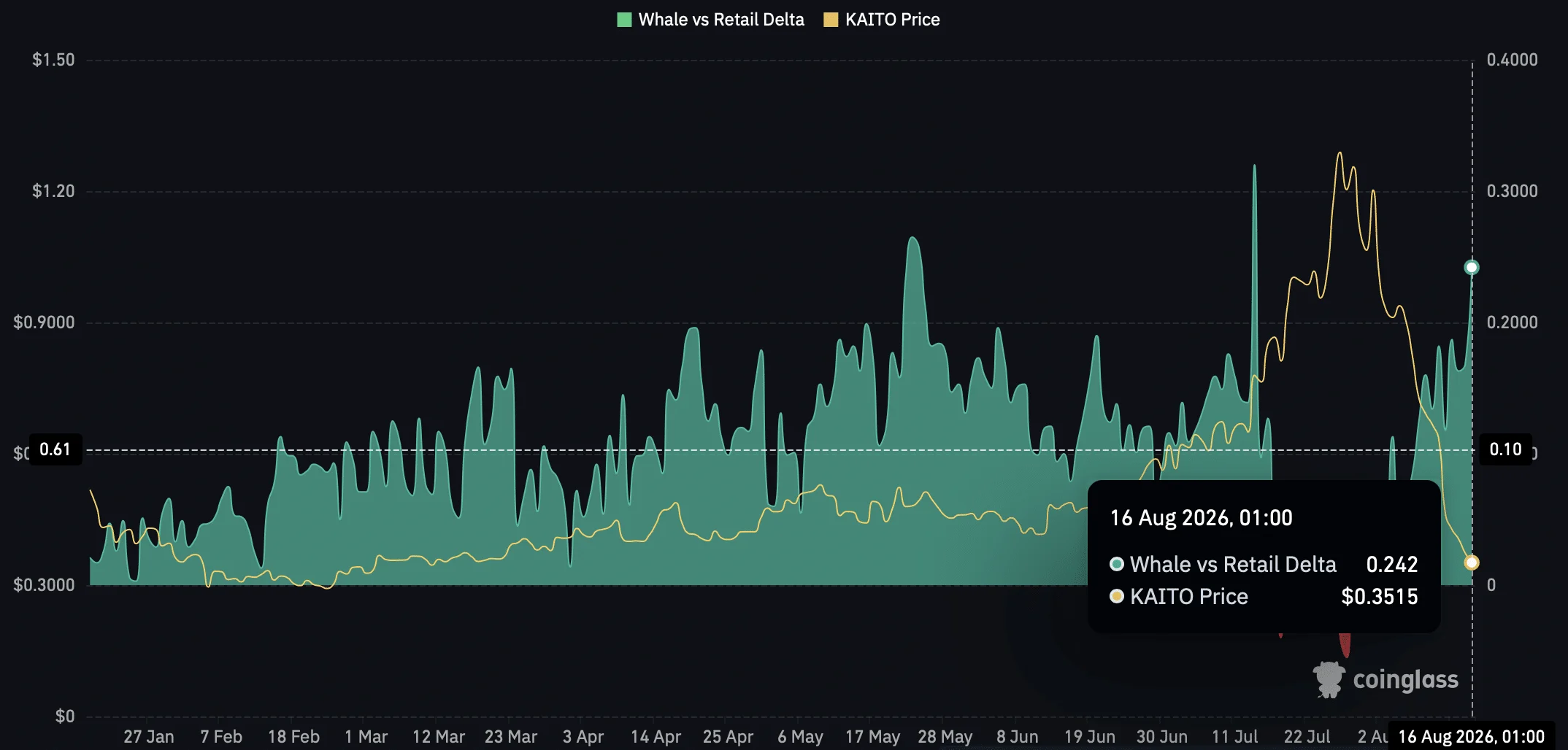
Notably, this downward performance, which has lasted more than a week, has been whale-driven.
Source: CoinGlass
The whale retail delta remained around 0.242 on the chart, as whales possibly consider the asset overvalued and are selling it until it finds fair value.
Token unlock could have incentivized selling
A token unlock, a periodic event where more of an asset’s supply is released to the market to facilitate certain activities, including development and community benefits, is set to happen for Kaito.
The next token unlock is scheduled for the 20th of August, with 32.6 million KAITO tokens set to be released to the market, representing 3.26% of the token’s total supply.
Source: CoinGlass
Usually, when demand remains limited following an asset’s token unlock, its price tends to decline notably. A similar scenario could be the case for KAITO, especially as sentiment across the crypto market remains broadly bearish.
The assumption is that investors are selling their KAITO holdings ahead of the unlock to avoid absorbing larger losses after the unlock. The token holders chart has remained largely flat over the past week, implying that few new holders have entered the market to purchase KAITO.
Likewise, this confirms that whales are not completely selling their KAITO holdings but are instead selling a portion of their wallets, possibly to maintain exposure to the asset.
There’s a warning for KAITO bulls
Perpetual market data shows a clear warning for traders who remain bullish despite the overwhelming bearish dominance in the market: trade with caution.
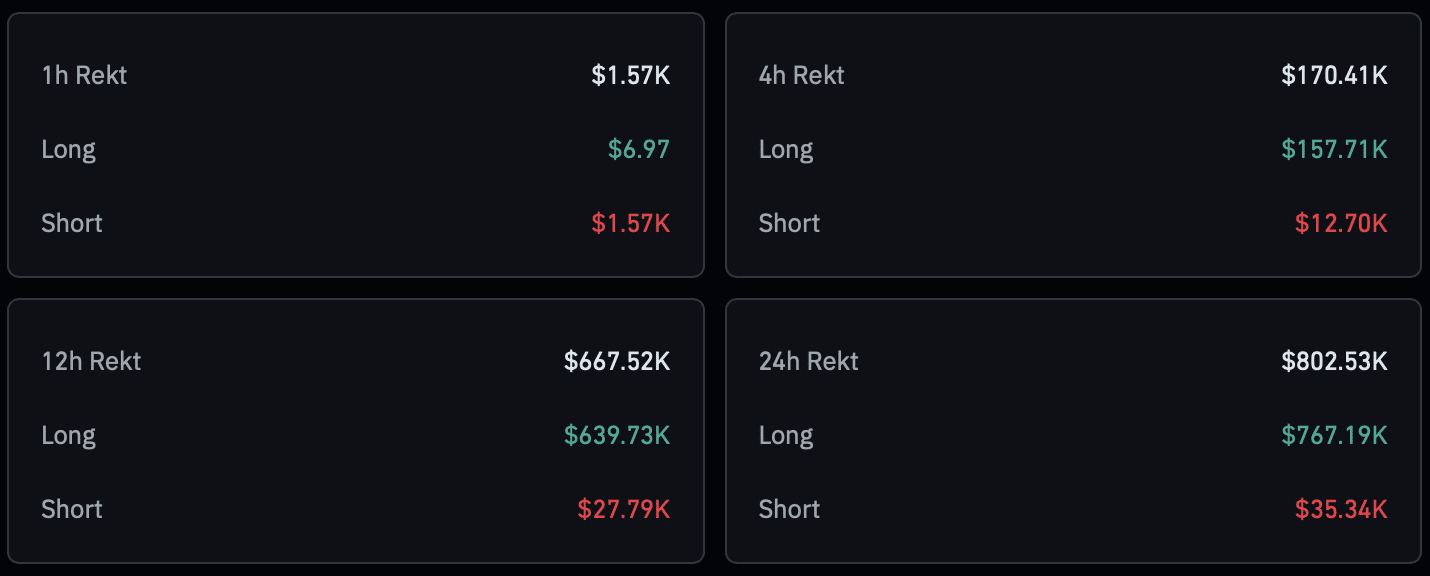
This is based on liquidation data, which points to a growing disparity between short and long positions. At the time of writing, the gap between the losses of these two groups of traders had widened to a 21-fold difference.
Source: CoinGlass
Long positions recorded total liquidations of roughly $767,190, while short positions saw losses of $35,340. A gap of this size suggests that optimistic traders may need to exercise caution before betting long on the asset.
For now, traders should treat the market with caution if they expect to take long positions.
Final Summary
Kaito has lost another 11% in the past day as whale selling continues to weigh on the asset.
The upcoming 32.6M KAITO token unlock could add further selling pressure as market sentiment remains bearish.
Even those of us spending our days writing about personal finance and how the rich spend their money aren’t immune to making money mistakes. From buying the wrong home at the wrong time to racking up credit card debt, financial missteps can happen to anyone.
That’s why we asked Moneywise editors and reporters to share the biggest financial mistakes they’ve ever made — and the lessons they learned from them. Our candid stories prove that even expensive errors can become valuable learning experiences. Bonus: They may help our readers avoid making the same mistakes.
Must Read
1. Ignoring recurring subscriptions
One of the most easily avoidable money mistakes I ever made was unknowingly paying for not one, not two, but three Amazon Prime memberships for seven years. I somehow ended up with three separate accounts tied to three different email addresses. Each one was charging me about $15 a month. Over the course of seven years, that added up to almost $4,000.
I only found out because I succumbed to an Instagram ad for RocketMoney, thinking to myself, “who really has subscriptions that they don’t even know they’re paying for?” Me. I had subscriptions that I didn’t know I was paying for… And I was paying a lot.
As soon as I discovered the triplicate charges, I called Amazon. Since the memberships were legitimate, they weren’t obligated to refund me on the basis of fraud (despite how hard I definitely tried to convince them that I had no recollection of opening three accounts, and it surely couldn’t have been me). Still, after explaining the situation — head down and tail between my legs — they graciously refunded me for a portion of the charges, totaling about $1,200.
The experience taught me three valuable lessons: Regularly audit your subscriptions, actually read your credit card statements (especially for recurring charges) and don’t be afraid to ask for help, even if you don’t think you’re entitled to it. The worst someone can say is no, but sometimes, they’ll surprise (and save) you.
2. Straying too far from your non-negotiables when buying a home
When I set out to purchase my first home, I had a list of musts in my mind: it had to be over 700 square feet, have outdoor space, come with a parking spot, and be within budget with maintenance fees under $500 per month. Unfortunately, after touring dozens of units in a hyper-competitive early-COVID market, some of these quickly fell by the wayside.
While going into a home search with flexibility or even ambivalence isn’t an inherently bad thing, it can have serious consequences. Personally, I ended up settling on a condo that failed to tick some boxes because I got caught up in the fervor of the market.
I convinced myself that shelling out a few hundred more than I’d planned for maintenance fees each month wasn’t such a big deal because the building had an outdoor pool (which wasn’t on my list of must-haves). I thought renting a parking space would be worth it because the sans-parking unit I chose gave me more square footage for my buck than others I saw that came with their own spot, and I’m now spending $300 a month on parking.
These compromises added up. My maintenance fees, already starting higher than I would have liked, have escalated. Add to that my parking, mortgage payments and property taxes, and I feel extremely behind.
I do have an asset to call my own at the end of it. But I may have fared better sticking hard to my criteria, or gradually putting the same amount into a different type of investment altogether.
I used to file my annual return using TurboTax or H&R Block. I’m a big sports fan. And during tax season, seemingly every sporting event on television is sponsored by them.
The appeal is that anyone can file their taxes for free. But the truth is that, once you add certain tax forms or report a specific tax situation, the software automatically bumps you up to a paid tier. Only 37% and 52% of users actually file tax returns for free with TurboTax and H&R Block.
My taxes are by no means complicated, but I would still end up paying anywhere from $85 to $110 to file a federal and one state tax return. I always thought, “I can just pay for it with part of my return.” I wish I could smack that 20-something-year-old version of myself now.
I now use FreeTaxUSA, which allows anyone to file federal taxes for free and a state tax return for $14.99. Cash App Taxes also lets you file your federal and one state income tax return for free, and Jackson Hewitt is great for filing multiple state returns for a flat $25 charge.
Not every online tax prep service will feel as seamless to use as TurboTax and H&R Block. But they’re good enough to file your taxes on the cheap. There’s definitely a few scenarios when using the industry-leading companies’ services makes sense, but don’t just start a return and hope for the best at checkout.
When I was a younger man, I never paid any attention to my credit card statements. I figured I knew everything I was buying, so there was no reason to studiously review my bill every month.
Eventually, I did need to review my statements and noticed a $20 charge I didn’t recognize. It was on the previous month’s bill, as well — and the month before that, and so on for years. It turns out that TransUnion signed me up for a paid credit-monitoring service when I tried to get a free look at my credit score.
Since then, credit bureaus have been fined multiple times for deceptive “dark patterns.”
In 2005, Experian paid $950,000 to settle FTC charges that it signed consumers up for paid credit monitoring without proper notice. Two years later, it had to pay another $300,000 because it kept running misleading ads for the service.
In 2017, the Consumer Financial Protection Bureau ordered TransUnion and Equifax to pay $5.5 million in fines and $17.6 million to consumers for deceptive practices. Five years later, the CFPB sued TransUnion for ignoring its orders, calling it an “out-of-control repeat offender that believes it is above the law.” (That suit was dismissed in 2025.)
It all came too late for me. I was charged about $1,000 for a service I never used, and the company refused to refund the money. My lesson: Even if you’re certain you’re on top of your bills, check them anyway.
In my early 20s I inherited a modest sum of money — not a life-changing amount, but not insignificant either.
At the time, the sum of my financial knowledge encompassed basic bank accounts and retirement savings. But as I was so young, retirement saving didn’t feel like a priority. A financially-savvy friend, however, advised me to invest the inheritance and even offered to help me pick stocks.
Of course, today the youngest Gen Zers eagerly invest via apps. But in the early 2000s, years before Apple even coined the phrase “there’s an app for that,” stocks felt like a game for older and wiser adults.
Intimidated and fearful of losing the inheritance on a bad stock bet, I balked and foolishly kept the money sitting in my plain old bank account. Over time, I chipped away at it for a splurge here and there, eventually using the remainder to pay my college tuition to study creative writing and journalism.
I don’t remember a single thing — beyond an education — that I bought with that money. But I do remember the hard realization, a few years later, when I considered how much that portion of the inheritance that I spent frivolously could have grown if I’d invested it in anything worthwhile.
Paying for an education is never a regret, but I will always wonder how much further ahead I might have been if, back then, I had been more open to a financial education, as well.
As a college graduate, I was determined not to fall into the “move back home and live in your parents’ basement” stereotype. I was also, unfortunately, armed with a collection of high-interest credit cards I’d acquired when the companies came to campus to sign up a bunch of kids who had neither the income nor the knowledge to manage them.
I stayed in my college town, taking on the gigs I could find, including part-time work at Barnes & Noble, while I tried to figure out what to do with my life. My expenses weren’t high, but the student loan income stream was over and decent job opportunities were scarce. I was broke, but I did have that plastic.
Perhaps you can recall the scene from the Gen X classic “Reality Bites” in which Winona Ryder’s character uses her father’s gas card to buy groceries. My situation was similar, only I was using credit to fund my whole life, including paying rent with very convenient (and dangerous) cash advance checks.
I ultimately racked up close to $10,000, and, when I could no longer make even the minimum payments, I admitted defeat and moved home. One year later, after I’d consolidated and paid off my debt with the salary from my first office job, I had an expert-level understanding of personal financial management that remains today. Sometimes youthful mistakes really do pay off — but if you can avoid making this one by never charging what you can’t afford, all the better.
The breach has impacted 39,798 customers who placed orders between March 2, 2025 and April 11, 2026.
SafePal stressed that the core security of its wallets remains intact, adding that users’ seed phrases, private keys, bank passwords, bank account information, payment card numbers, and government-issued IDs were not affected.
However, SafePal said users who have shared their private keys or seed phrases via a phishing email, phone call, or letter should treat their wallet as compromised and transfer their assets to a new wallet.
How SafePal is responding
The company said it had patched the vulnerability and introduced additional security measures in response. SafePal notified all affected customers by email from security@safepal.com on Sunday and hired an independent third-party security firm to audit the fix and review its order-processing systems.
SafePal also said it would retain customers’ personal data in its order-processing system for only 90 days from the date of collection. In addition, the company identified and removed more than 30 fraudulent websites and phishing links associated with the breach.
Customers can use a verification tool on SafePal’s website to check whether their data was affected, the company said.
Nvidia Corporation (NVDA) is once again putting itself at the center of the artificial intelligence (AI) investment boom, but this time the story goes beyond selling high-performance chips. CEO Jensen Huang says AI compute is becoming an “investable asset class,” as the company works together with some of the world’s largest financial institutions to mobilize more than $500 billion in third-party capital for AI infrastructure.
Nvidia is partnering with six major asset managers: Apollo Global Management (APO), Blackstone (BX), BlackRock (BLK), Brookfield Asset Management (BAM), The Goldman Sachs Group (GS), and KKR & Co. (KKR), to mobilize more than $500 billion in financing for AI data centers and Nvidia hardware. The initiative aims to make AI computing infrastructure a financeable, revenue-generating asset similar to commercial real estate or other long-term infrastructure.
More News from Barchart
CEO Jensen Huang argues that Nvidia chips are now productive, long-lived, transferable and increasingly essential to modern infrastructure, challenging the traditional view that GPUs rapidly depreciate. The financing could help hyperscalers, AI labs and enterprises fund massive AI investments without relying entirely on their own balance sheets.
Many experts are now seeing the effort as a potential new asset class and a major development in financial engineering. However, the strategy faces questions over whether GPUs can retain value as newer chip generations emerge and as Big Tech’s huge AI capital expenditures put pressure on cash flows.
About Nvidia Stock
Nvidia is a global leader in accelerated computing and AI, renowned for pioneering the GPU that revolutionized gaming, data centers, and AI-driven computing. Headquartered in Santa Clara, California, Nvidia’s technology now powers everything from high-performance gaming and cloud computing to autonomous vehicles and generative AI applications. With a market cap of $5.4 trillion, Nvidia stands among the world’s most valuable companies, driven by its dominance in AI infrastructure and continued innovation in next-generation chip design.
NVDA has delivered exceptional long-term stock gains, reinforcing its position as one of the biggest beneficiaries of the AI investment boom. Over the past five years, the stock has gained 976.5%, meaning an investor who held the shares through the period would have seen their investment multiply several times.
The more recent performance has been considerably more measured. Over the past 52 weeks, NVDA has gained 23.9%, while its year-to-date (YTD) gain is 20.7%. Nvidia’s long-term trajectory remains extraordinary, but the stock has faced periods of consolidation as investors weigh its elevated valuation, massive AI capital spending and the sustainability of hyperscalers’ demand for GPUs.
More recently, momentum has improved. Nvidia shares gained 3% on Aug. 12, as investors appeared to regain confidence in the company’s AI infrastructure strategy following the recent sell-off. The Aug. 12 gain was particularly notable because Nvidia had fallen 2.9% on Aug. 10 after the $500 billion financing plan was initially reported and marginally on Aug. 11. Some investors had worried that Nvidia financing its customers might not be an effective idea or represent new demand. Nevertheless, the subsequent recovery suggests that investors were becoming more comfortable with the strategic rationale behind the financing push.
www.barchart.com
Nvidia trades at 24.75 times forward price-to-earnings, which is currently a discount compared to industry peers and the historical average.
Q1 Earnings Beat Expectations
Nvidia delivered another exceptional quarter when it reported first-quarter fiscal 2027 results on May 20, further cementing its leadership in the rapidly growing AI infrastructure market.
For the quarter ended Apr. 26, 2026, Nvidia posted record revenue of $81.6 billion, an 85% year-over-year (YOY) increase, while net income jumped 211% YOY to $58.3 billion. On a non-GAAP basis, earnings per share (EPS) rose 140% from the prior-year period to $1.87, beating analyst estimates. Non-GAAP gross margin expanded to 75% from 60.8% a year earlier, underscoring the company’s strong pricing power and favorable AI product mix.
Moreover, the Data Center segment remained Nvidia’s biggest growth driver, with revenue surging 92% YOY to a record $75.2 billion. Data Center networking revenue soared 199% YOY to $14.8 billion, while computing revenue accounted for the remaining $60.4 billion.
Its Edge Computing revenue increased 29% YOY to $6.4 billion, supported by demand across gaming GPUs, autonomous driving, robotics, and AI-enabled edge devices.
Further, management pointed to accelerating adoption of Blackwell systems and highlighted expanding opportunities in agentic AI and enterprise AI infrastructure.
Additionally, Nvidia issued another optimistic outlook for the second quarter of fiscal 2027, forecasting revenue of $91 billion, plus or minus 2%, and a non-GAAP gross margin of about 75%. The guidance assumes no contribution from China Data Center compute revenue due to ongoing U.S. export restrictions.
Street expects Nvidia’s momentum to continue, with analysts forecasting EPS growth of 92.3% YOY to $8.79 in fiscal 2027, followed by another 38% increase to $12.13 in fiscal 2028. The consensus EPS estimate for Q2 (about to be reported on Aug. 26) is $2.01, a rise of 103% YOY.
Wall Street Remains Optimistic About Nvidia’s Prospects
Wells Fargo recently reiterated its “Overweight” rating on Nvidia on Aug. 11, and maintained its $315 price target, signaling continued confidence in the chipmaker’s long-term AI infrastructure opportunity. Analyst Aaron Rakers argued that Nvidia is increasingly positioning itself as more than a semiconductor supplier, expanding its role across the broader AI infrastructure ecosystem through financing platforms and AI factory optimization.
Moreover, Bank of America maintained its “Buy” rating and $350 price objective on Nvidia, continuing to identify the stock as its top semiconductor sector pick. The firm’s bullish stance reflects confidence in Nvidia’s dominant position in AI infrastructure and the continued strength of demand for its data-center products.
Overall, NVDA has a consensus “Strong Buy” rating. Of the 47 analysts covering the stock, 43 advise a “Strong Buy,” three suggest a “Moderate Buy,” and one offers a “Strong Sell” rating.
The average analyst price target for NVDA is $304.32, indicating a potential upside of 35%. Also, the Street-high target price of $500 suggests that the stock could rally as much as 121.9%.
www.barchart.com
www.barchart.com
On the date of publication, Subhasree Kar did not have (either directly or indirectly) positions in any of the securities mentioned in this article. All information and data in this article is solely for informational purposes. This article was originally published on Barchart.com
The battle is likely to be finished one way or another next month, when the Clarity Act gets its final three weeks of Senate action before the midterm elections, and the stakes will test the old-guard strength of bank lobbyists against the high-spending political powers of crypto advocates.
The banks have made an appeal that what they’re doing represents the public good: Their business model requires that people keep their money in deposits, which don’t pay enough interest to compete with what crypto firms would pay in stablecoin yield, if given the chance. People can’t be allowed to make money off their holdings of stablecoins, the banks contend, because if customers abandon low-interest bank deposits, the institutions won’t be able to reuse their money to support bank lending.
One of their standard bearers, JPMorgan Chase & Co. CEO Jamie Dimon, says banks aren’t being treated fairly, contending that stablecoins don’t carry the same government scrutiny, regulations and requirements to track the identity of users.
“It should be fair and equal, period,” Dimon, whose bank is the largest in the U.S., said in a June Fox Business interview, saying the Clarity Act had “almost no legal protections” to prevent money laundering and other illicit finance.
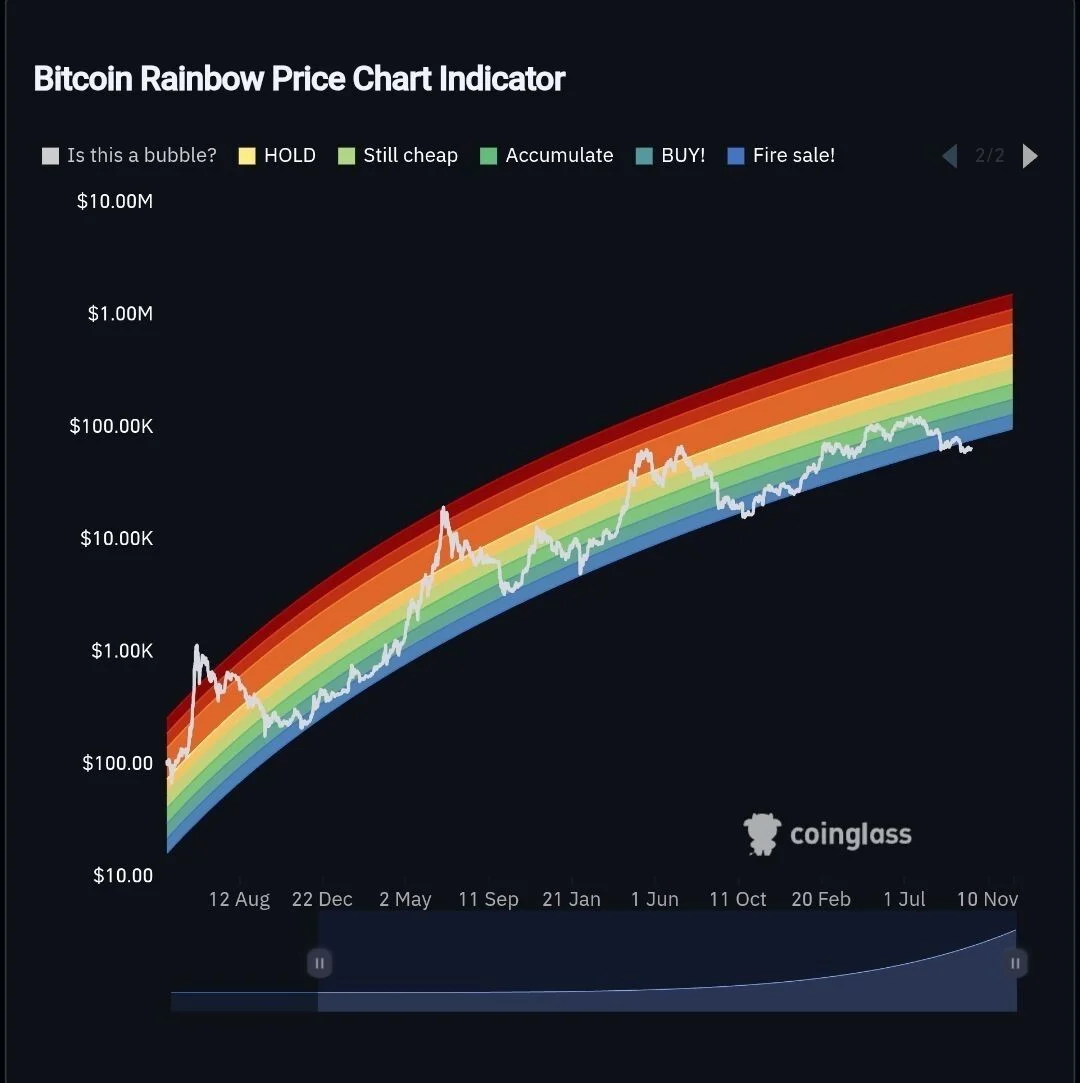
Bitcoin’s [BTC] current valuation sits at the lowest end of the rainbow model, extending a decline that has moved the price below its historical trend. The metric normally categorizes the price of BTC based on valuation bands using the relationship of market price to long-term growth trend.
As the price falls further below that trend, Bitcoin moves through progressively cheaper bands, ending with the “fire sale” zone. At press time, BTC traded 66% below the $186,700 model price, thus placing it beneath that lowest band.
Source: CoinGlass
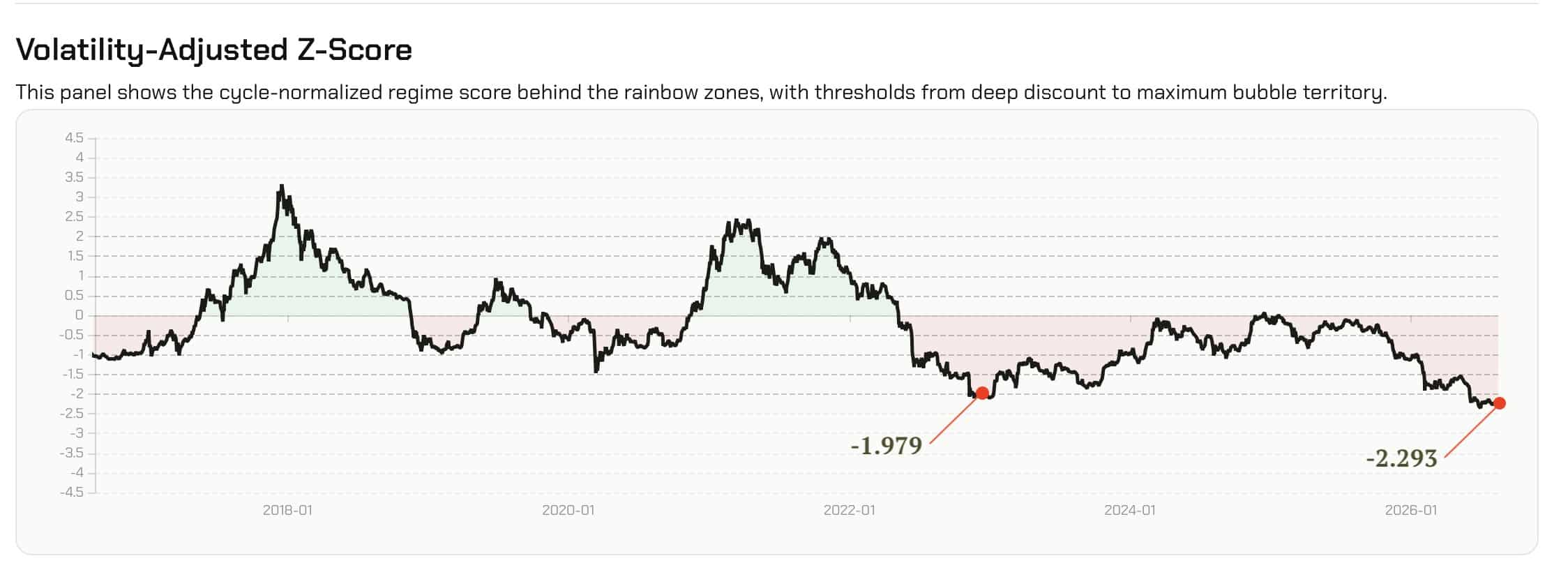
Supporting this deviation, the volatility-adjusted Z-Score has fallen to -2.293, below the 2022 low of -1.979. Simply, this indicates there is a greater chance of discount when considering differences in volatility across cycles.
Source: X
Historically, similar extremes have aligned with accumulation periods. Yet, despite that, they do not technically identify the final bottom. However, a recovery above the lowest band would instead indicate that Bitcoin is beginning to close its valuation gap.
Bitcoin cycle nears previous bottoming windows
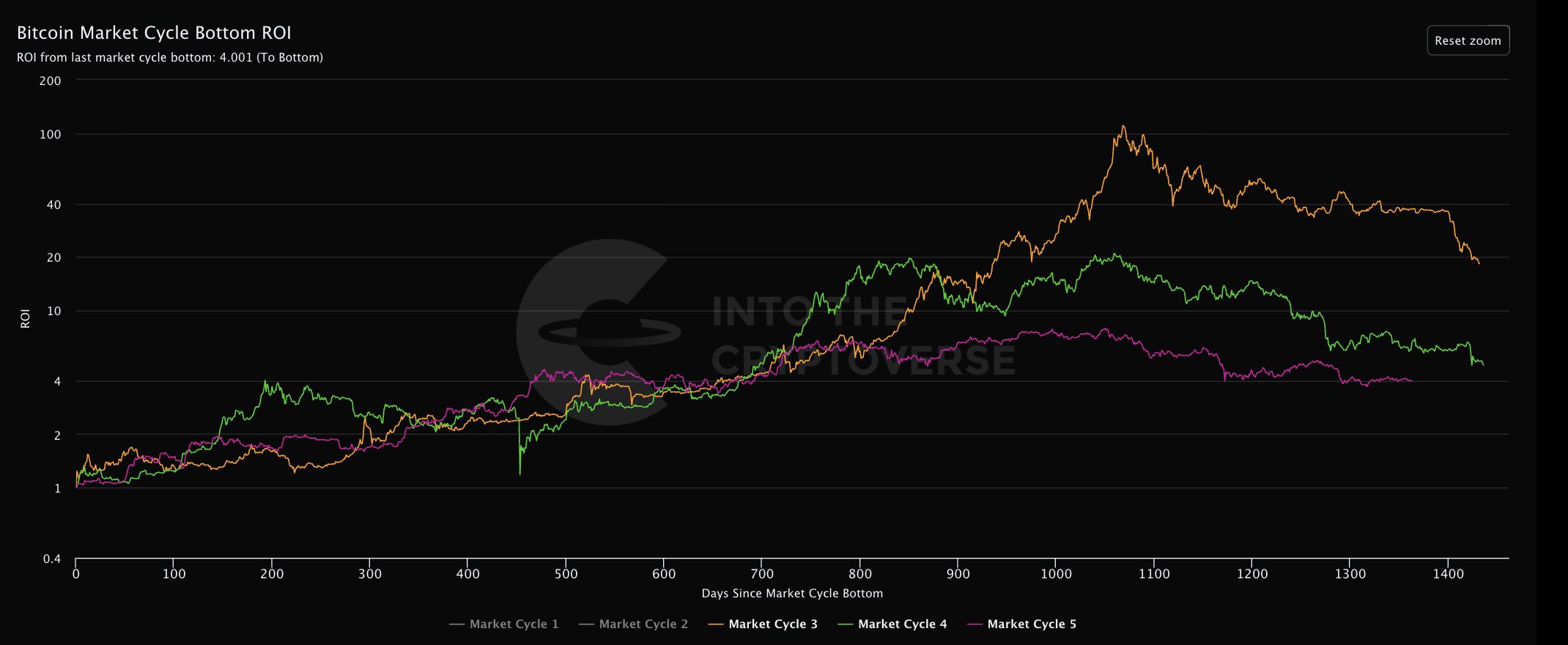
While the Rainbow model shows where Bitcoin sits relative to its long-term valuation trend, cycle duration provides a different perspective. The current cycle has reached day 1,363, while the previous two recorded bottoms around days 1,432 and 1,436.
That said, this places BTC at roughly 69–73 days from matching those cycle lengths even though valuation conditions remain different. Meanwhile, Bitcoin has declined 49–50% from its $126,000 October peak, while Market Value to Realized Value (MVRV) remains near 1.2.
Source: X
That reading stays above the 1.0 level associated with deeper valuation resets. In simple words, this implies that Bitcoin has become cheaper. Yet, MVRV suggests valuations have not fallen as deeply as during some previous major bottoms.
Hence, the timing increasingly resembles previous cycle durations, while valuation and cost-basis measures have yet to reach comparable levels.
Bitcoin decouples from rising global M2
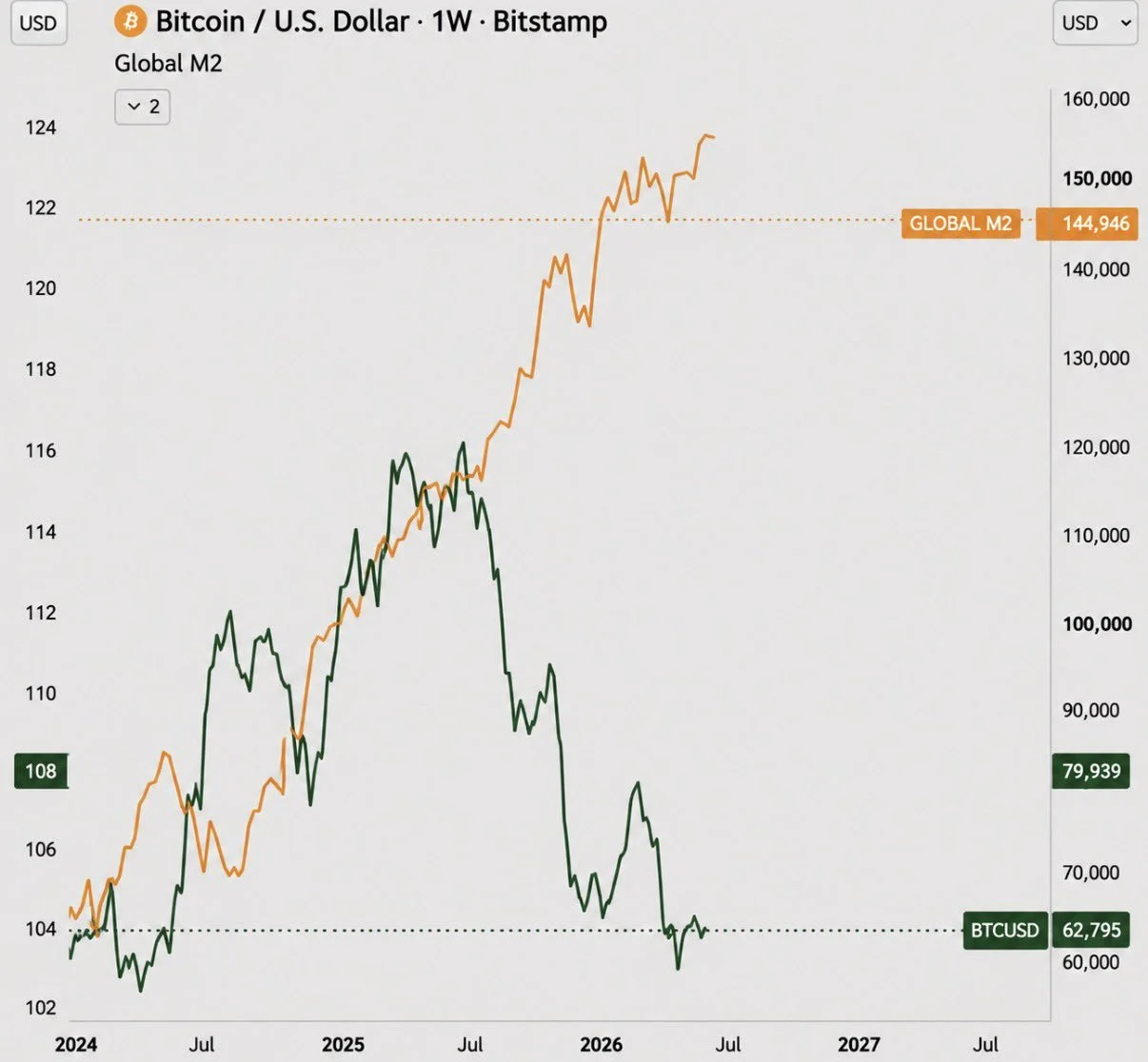
Although cycle duration is moving in line with the previous bottoming period, the broad liquidity signal no longer follows the same historical relationship. Through 2024 and 2025, Bitcoin and global M2 largely moved higher together before separating sharply in 2026.
Global M2 continued rising toward 144,946, while BTC declined toward $62,795, creating a widening divergence. This shift also appears in the 24-month correlation, which has dropped into negative territory, even though the long-term correlation remains at 0.86.
Source: X
Hence, the increase in liquidity provides little or no directional support for the price of Bitcoin compared to the historical trends. Therefore, that shift weakens M2 as confirmation for the cycle-timing comparison.
A renewed positive correlation would strengthen that confirmatory role. Conversely, further divergence would decrease the confirmatory role of cycle timing comparisons.