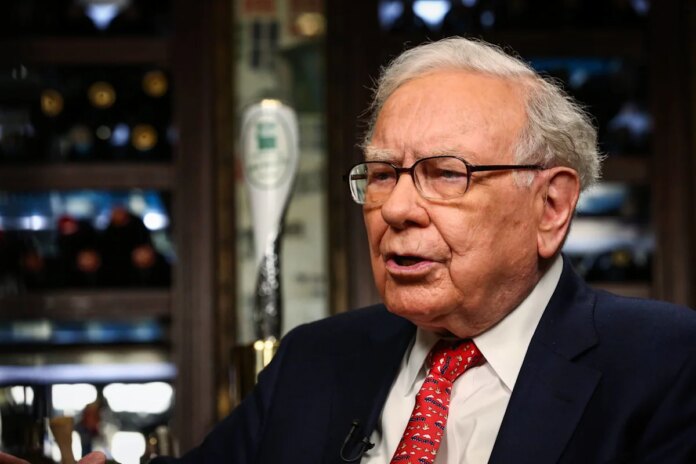
Warren Buffett spent 60 years building one of the greatest investing records in history, not by chasing whatever was popular, but by finding businesses he never wanted to sell.
He said it himself in his 1988 shareholder letter, the year he first bought Coca-Cola: “Our favorite holding period is forever.”
That line was not just about one stock. It was a philosophy that shaped every major decision Berkshire Hathaway made under his leadership.
Three companies sit at the core of that philosophy today. Apple, Coca-Cola, and Alphabet each reflect something different about what Buffett means when he talks about compounders. Each one has earned its place in the portfolio through a different kind of durable advantage, and each one keeps widening that advantage as time passes.
Apple stock and the ecosystem that traps customers in a good way
Apple is Berkshire’s largest holding, accounting for roughly 22% of the portfolio as of the first quarter of 2026. Buffett first bought the stock in 2016, which was unusual for him, given his historical reluctance to invest in technology companies. He has since called it one of the best businesses he has ever seen.
Ask most iPhone users why they won’t switch to Android, and the answer isn’t really about the phone. It’s about everything else. Three years of photos in iCloud. Apps they paid for. A watch that only fully works with an iPhone. Apple Music. Apple Pay habits. At some point, the cost of leaving gets high enough that most people stop thinking about it. That’s when Apple starts making real money, through services that cost almost nothing to deliver and carry margins hardware could never touch.
More Warren Buffett:
Apple’s installed base now exceeds 2.5 billion active devices globally. That is the foundation on which every new product and service launch sits. The company does not need to win new customers to grow. It needs to keep selling more to the ones it already has, and its customers tend to be among the more affluent and brand-loyal in the consumer market.
The risks are real, though. Apple still generates a significant portion of its revenue from iPhone hardware, which makes it vulnerable to cyclical slowdowns in consumer spending.
Regulatory scrutiny over App Store practices is intensifying in Europe and the United States. And the company needs to prove that the AI features being built into its devices will justify continued hardware upgrade cycles.
Coca-Cola stock and what 38 years of never selling actually produces
Buffett bought Coca-Cola in 1988 and has never sold a share. That decision has produced one of the most remarkable compounding outcomes in investing history.
Berkshire completed its purchase of 400 million shares by 1994, spending roughly $1.3 billion in total. Today, those shares generate approximately $848 million in annual dividends, and the effective yield on Berkshire’s original cost basis is now roughly 65%, according to The Motley Fool.
A separate calculation using the full $4.1 billion total cost puts the yield on cost closer to 20%, but either way, the math illustrates what holding a great dividend compounder for 38 years actually produces.
What makes Coca-Cola worth holding for that long is a combination of brand and business model. The brand is one of the most recognized on the planet. The business model is quietly brilliant. Coca-Cola sells syrup and concentrate to independent bottling partners who handle manufacturing, logistics, and much of the capital expenditure. That keeps Coca-Cola’s own capital requirements light while the cash keeps flowing.
The company has also quietly had a strong year. Critics who said soda was a dying category have had to reckon with what actually happened.
Zero Sugar grew 13% across every geographic segment in Q1 2026. Organic revenue was up 10%. EPS up 18%. The stock has climbed roughly 25% this year, comfortably ahead of the S&P 500, as investors looking for something steady started rotating out of AI names, according to FinanceBuzz.
The risks are more gradual than sudden. Health consciousness is a long-term headwind for sugary beverages, even as zero-sugar products offset some of that pressure. Currency fluctuations affect a company doing business in nearly every country on earth. And consumer tastes can shift in ways that are hard to anticipate, as the rise of energy drinks and hydration products has shown.
Apple’s installed base now exceeds 2.5 billion active devices globallyBernard/Getty Images
Alphabet stock and why Berkshire’s Greg Abel made it a top five holding
Alphabet is the newest of the three. Berkshire invested $10 billion in the company, and it has since become one of Berkshire’s top five holdings. Much of the addition happened under new CEO Greg Abel, who has shown more comfort with complex technology platforms than Buffett historically displayed, as long as those platforms exhibit the same wide-moat characteristics Buffett always prized.
Start with Search. When something happens anywhere in the world, billions of people type it into Google. That behavior is so deeply ingrained it barely registers as a choice anymore. Chrome and Android make it even stickier. Google is the default on most of the world’s devices before a user ever opens a browser. That kind of distribution is almost impossible to replicate, and it has been generating advertising revenue through recessions, pandemics, and rate cycles without missing a beat.
Five years ago, Alphabet was essentially a search and advertising business with a cloud unit that hadn’t proven itself yet.
That’s not what it is anymore. Google Cloud is now a real enterprise competitor to AWS and Azure, winning AI and computing contracts from companies that were Microsoft-only customers not long ago.
Alphabet also builds its own chips, Tensor Processing Units designed specifically for AI workloads. Most AI companies have to rent computing power from someone else. Alphabet builds its own. That’s a different kind of business.
The risks are concentrated around regulation. Antitrust cases targeting Google Search and the advertising business have been working through courts in the United States and Europe for years. Generative AI is also raising a genuine question about whether traditional search traffic could eventually decline as users get answers directly from AI assistants rather than clicking through to websites.
What makes a Buffett compounder and why these three qualify
Buffett’s checklist hasn’t really changed in 60 years. Can the business earn high returns without needing to constantly reinvest enormous amounts of capital? Does it have pricing power? Will it still be around and stronger in ten years?
He also needs to actually understand how it makes money, which is why he spent decades avoiding tech. Apple got through because it looked more like a consumer brand than a software company. Alphabet got through because Search is about as simple a business model as you’ll find at that scale.
Apple, Coca-Cola, and Alphabet each qualify in different ways. Apple compounds through its ecosystem and services flywheel. Coca-Cola compounds through its brand and capital-light concentrate model. Alphabet compounds through search, advertising, cloud, and AI.
Their methods are different, but the outcome is the same: each business generates more cash than it needs to maintain its competitive position, and each one uses that surplus to grow.
None of that means buying at any price. Even the best compounders can underperform for extended periods if purchased when valuations are stretched.
The “hold forever” philosophy works when applied to businesses worth that patience in the first place. What Buffett’s track record with these three stocks really demonstrates is not that you should never sell. It is that if you find the right business and pay a reasonable price, the most productive decision is usually to do nothing.
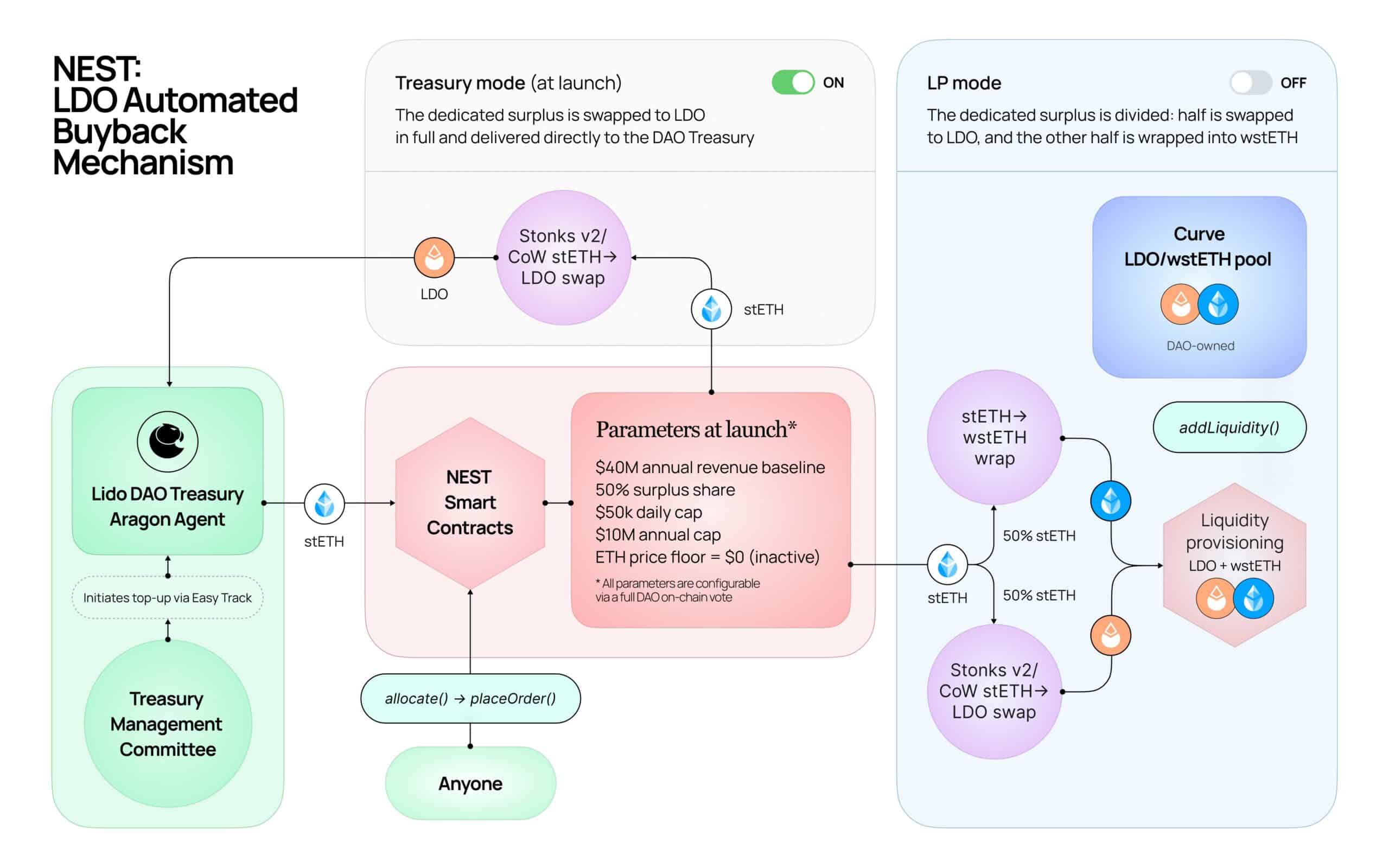
Staking protocol Lido has finally activated its long-awaited automatic LDO token buyback program. The programme, also known as NEST (Network Economic Support Token), was first floated last year.
According to the project, the program is now live on the mainnet with a daily limit set at $50K and annual purchases capped at $10M.
It seeks to ensure automatic, dynamic LDO buybacks, taking into account prevailing market conditions. Under the NEST design, only 50% of the daily staking revenue exceeding $109K will be directed to the buyback program.
That translates to a $40 million annual revenue baseline. Anything below that ($109K daily) means there will be no buyback.
Source: Lido
That said, the bought LDO tokens won’t be burned but will be owned by the DAO treasury. The program was previously criticized for being too low compared to other protocols.
For comparison, Hyperliquid is doing about $100M in annual buyback. Aster and Uniswap run a $40M annual program while PUMP eyes $35M. Compared to LDO’s $10M annual plan, it was 3-10x smaller than other ongoing programs.
Lido’s bumpy buyback start
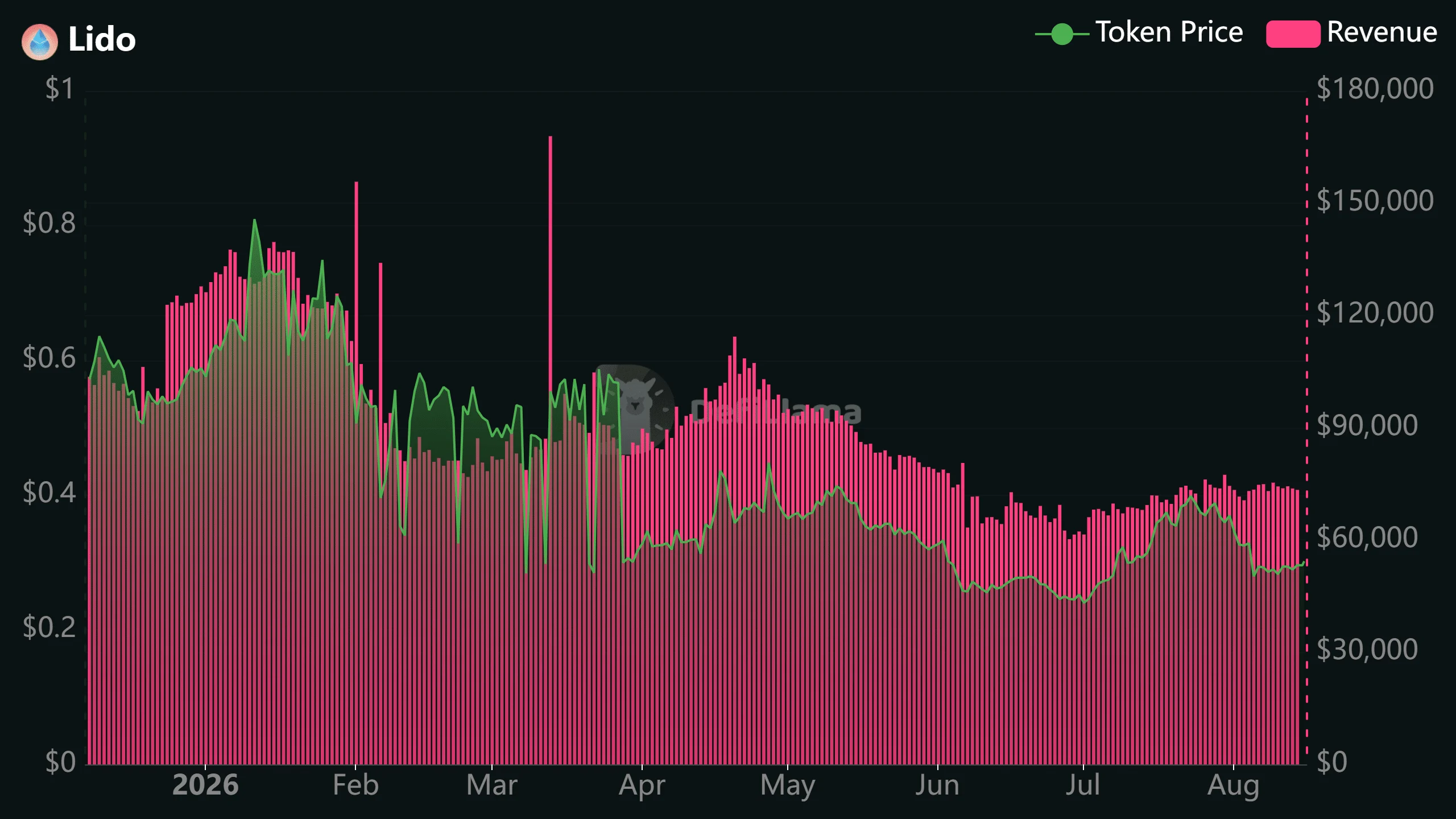
That said, the current staking rewards were still below the daily average of $109K to trigger the buyback program. According to DeFiLlama, the protocol has been making around $75K in daily revenue in August.
Source: DeFiLlama
The last time Lido crossed above $109K in daily revenue was back in April 2026 during broader Q2 recovery across the crypto market.
In other words, NEST will truly kick in if broader market sentiment improves. Even so, most experts hailed the dynamic buyback move. Gabriel Shapiro, a pro-crypto attorney, said,
How buybacks should be.
Worth noting that not everyone supports crypto buybacks in crypto, especially during market downturns.
Critics view it as a waste of funds and propose directing the same to crucial ecosystem development. Some projects, such as Helium, shut down their buyback program.
Lido sees slow recovery above $0.28
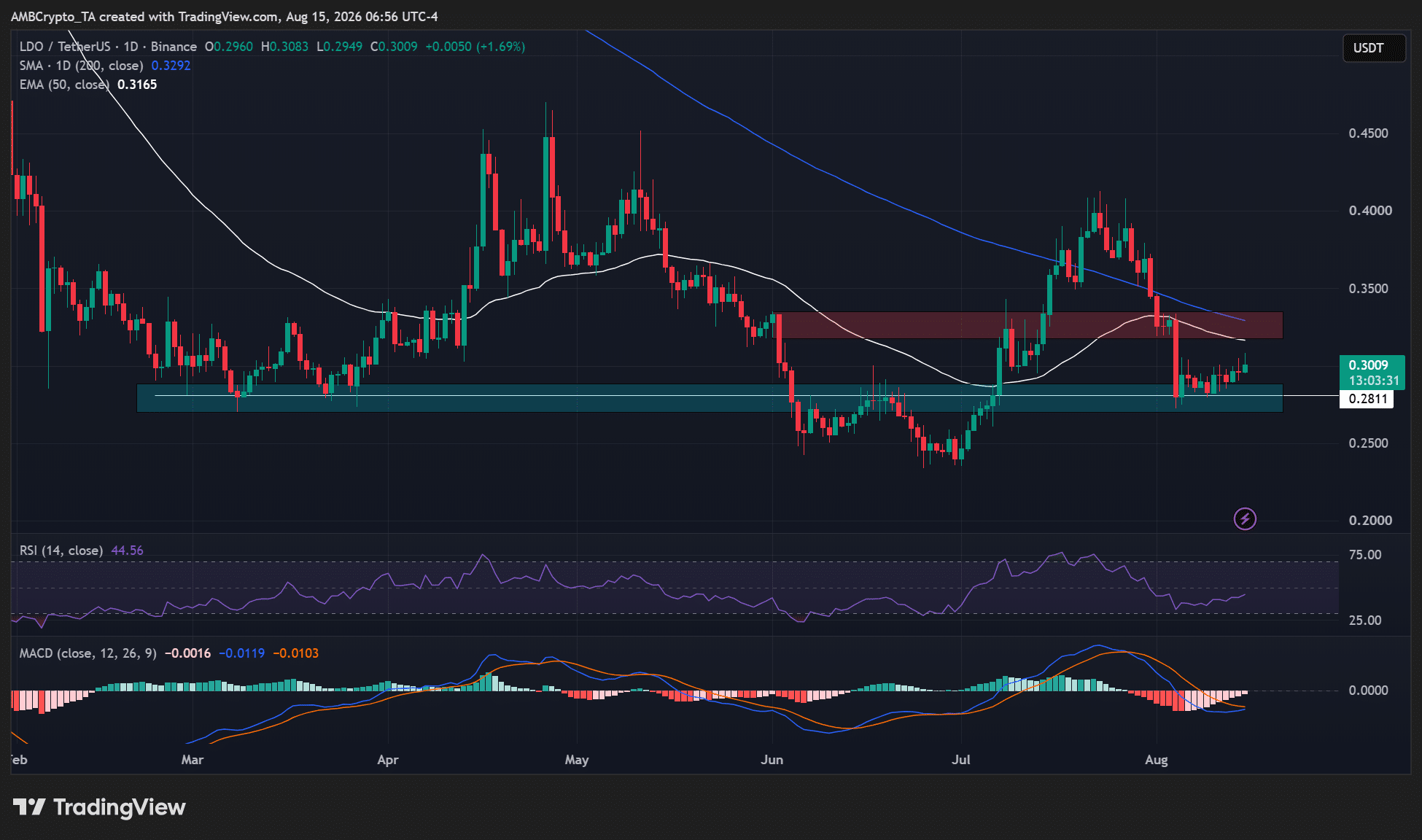
On the price charts, the token has defended $0.28 support in August. This helped stop the July dump, but a strong recovery has been elusive. As of writing, price action was still below key moving averages (50-day EMA and 200-day MA).
Source: Lido/USDT, TradingView
A strong upside potential could be confirmed if the moving averages are decisively reclaimed as support (above $0.33).
Final Summary
Lido activated its automatic buyback program, which is triggered if annual revenue hits $40M, but is limited to $10M in annual purchases.
Daily staking revenue has remained below the automatic buyback trigger level ($109K) since April
Americans spend a lot of money to keep their lawns looking good, but new data reveal some headwinds facing the lawn and garden industry.
“For the first time since 2019, the U.S. gardening audience contracted — and yet total spending hit an all-time high,” according to Garden Research’s 2026 National Gardening Report.
Some key data points from the study showed:
Total market spending in 2025: $79.0B (All-time high, +13.5% YoY)
Spending per household: $740 (Record, +18.3% YoY)
Households left gardening: -4.5 million
“Per-participant spending surged across nearly every major category in 2025. Several categories hit all-time highs, including lawn care, which grew by 26%,” according to the data.
Despite these generally positive numbers, one of the leading wholesale brands in the lawn and gardening space, BFG Supply, is preparing to file for Chapter 11 bankruptcy filing and a possible liquidation.
BFG Supply considers a Chapter 11 bankruptcy
While BFG Supply may not be a household name, since it sells to businesses, not consumers, it’s one of the leading players in the lawn and garden space.
“Our robust national distribution network, including 15 warehouses along with our own fleet, supports customers in all 50 states and regions of Canada. Our extensive partnerships with over 1,000 leading manufacturers allow us to offer 100,000+ SKUs to meet every customer’s needs,” the 53-year-old company shared on its website.
The brand, however, is facing an uncertain future.
BFG Supply is preparing to file for Chapter 11 in the coming weeks, according to sources in a report from Octus.com, which delivers credit news and updates.
“The company is expected to conduct a sales process in court with proceeds used to pay creditors, including lender Ares Management,” the sources said.
The restructuring comes as the company faces mounting financial pressure.
“BFG Supply is working with Goodwin as legal advisor on a restructuring, including a potential liquidation, according to sources,” the Octus report states. “The aforementioned liquidation may be implemented on an out-of-court basis or through a bankruptcy filing,” the sources said.
“Plans are not final and could change, the sources cautioned. The company is said to be laying off employees and declining new orders amid severe financial difficulties,” sources said.
BFG has canceled its annual trade shows.Shutterstock
BFG has canceled all events
BFG normally runs multiple annual trade shows, but has canceled all scheduled events, according to Greenhouse Product News.
An email obtained by the trade organization acknowledges the closures as well as the company’s financial struggles.
“As BFG continues working towards resolutions to our current challenges in conjunction with our Restructuring partners at Reflect Advisors, we have reached the difficult decision to cancel our 2026 Marketplace Expo East and West. If you were planning on attending either event, we recommend cancelling your travel plans as soon as possible,” the email said.
In addition, people who have already paid for the events have not been refunded.
More Bankruptcy:
“There are currently no details on if or when any refunds will be issued for payments made to BFG for Expos. The Reflect Advisors team is working through details and will advise when possible. More details will follow as they become available,” the email said.
In a Chapter 11 filing, people who paid for event tickets would be behind secured creditors, such as the company’s lenders, in line for any payments from an asset sale or liquidation.
BFG does not sell direct to consumers
As a wholesaler, BFG sells to retailers serving the lawn and garden industry. That makes its business dependent upon demand from those customers.
While BFG has not commented on what’s causing its financial woes, and did not immediately answer a request for comment from TheStreet, two of the biggest players in the lawn and garden space, Home Depot and Lowe’s, saw mixed traffic in the second quarter, according to data from Placer.AI.
Home Depot: Year-over-year foot traffic fell 0.3% in Q2, and average visits per location were down 0.6%.
Lowe’s: Year-over-year foot traffic was up 0.4% in Q2, while average visits per location fell 0.4%.
“Lowe’s saw a similar trajectory in traffic growth as The Home Depot, with March showing a significant slowdown. While May and June also saw a decline, the report notes that an ‘accumulation of deferred maintenance, or an easing in prices’ could lead to growth later this year,” according to Placer.AI.
Those aren’t dire numbers, and both Home Depot and Lowe’s sell much more than lawn and gardening supplies, so the data provide only a limited indication of broader consumer demand.
RTM Nexus CEO Dominick Miserandino explained to TheStreet how BFG Supply is having financial problems, despite the overall lawn and garden industry being generally healthy.
“Look, people see gardening spending up and wonder how a company like BFG Supply ends up heading toward Chapter 11. But this isn’t about whether people are buying plants— it’s about where they’re buying them and how BFG got caught in the middle,” he wrote.
“Right now, everyday consumers are being cost-conscious and driving straight to big-box stores like Home Depot and Walmart for their lawn and garden stuff. Those big boxes have massive leverage, so they squeeze the commercial growers on price. When those growers get squeezed, they squeeze BFG,” he added.
Selena Gomez set out to create “the world’s first mental fitness ecosystem.”Instead, the startup is becoming her own personal headache.
A federal lawsuit filed Thursday offers a detailed account of what investors say went wrong at Wondermind — from an app that was never built to major corporate partnerships they allege never existed.
Gomez launched the startup in 2021 alongside her mother, Mandy Teefey, and Daniella Pierson, a business partner. The lawsuit accuses Gomez, her cofounders, and Wondermind of defrauding investors, among other claims.
The investors include Brent Saunders, the CEO of Bausch + Lomb and former CEO of Allergan, and entrepreneur and real-estate investor Marc Roberts.
“The Plaintiffs invested nearly $1.2 million in Wondermind Global Inc. because the Defendants falsely represented that the Company had the infrastructure, leadership, and resources necessary for the Company to launch into a profitable, one-of-its-kind mental health and wellness platform,” the complaint says.
The investors said Wondermind’s cofounders also misrepresented key parts of the company’s business and growth plans. Specifically, that Gomez — a world-famous actor and singer — would play a major role at the company as its head of marketing; that Pierson secured partnerships with firms such as JPMorgan and Fidelity; and that “revenue-generating initiatives” were already underway.
The investors are seeking the return of their investments or damages, as well as costs and attorneys’ fees.
“The partnerships did not exist. The initiatives never materialized. The app was never built. And for three years, while the Company quietly collapsed around them, not one of its founders, officers, or directors said a word to the investors whose money was funding the collapse,” the complaint says.
Wondermind has made some offerings available to users. Its website features articles, interviews, and worksheets about mental health. The startup also sends out a newsletter and has produced two podcasts.
Every time Lauren publishes a story, you’ll get an alert straight to your inbox!
Stay connected to Lauren and get more of their work as it publishes.
Gomez, Teefey, and Pierson did not respond to requests for comment from Business Insider. A lawyer representing Gomez told People that the allegations against her were “completely meritless.”
“The allegations that Selena Gomez engaged in any way whatsoever in any purported ‘fraud’ or other wrongdoing are completely meritless, both factually and legally,” Mathew Rosengart told the outlet on Saturday.
A representative for Pierson told USA Today in a statement that she “categorically denies the allegations against her and welcomes the opportunity to present concrete documentation and financial records that establish the facts.”
“To be clear, she has never used investor funds for personal expenses. Quite the opposite: Daniella invested her own money into the business and did not draw a salary from the company,” the statement said.
Teefey has not responded publicly to the lawsuit.
Selena Gomez cofounded Wondermind with her mother, Mandy Teefey, in 2021.
David Livingston/Getty Images
In the lawsuit, the investors said they were left in the dark about problems plaguing Wondermind, and were unaware of the “utter financial and operational disarray” until The Cut published an article profiling the company in September 2025.
The article detailed allegations of management problems that began soon after the startup’s 2021 launch. At the time, Teefey and Pierson served as co-CEOs, while Gomez was named chief impact officer.
Staffers told The Cut that Teefey, who headed the company’s Los Angeles office, had an erratic leadership style and clashed with Pierson, who led the New York office. Pierson left the startup in 2023 amid the tensions, The Cut reported. Meanwhile, staffers told The Cut that Gomez distanced herself from Wondermind due to a dispute with Teefey.
Business Insider and Forbes earlier published separate investigations into Pierson on the same day in August 2025. Business Insider found discrepancies between subscriber and business figures Pierson had publicly cited for the Newsette Media Group and internal records. The Forbes investigation is cited in the investors’ lawsuit.
Wondermind investors named Daniella Pierson as a defendant in the federal lawsuit.
Astrid Stawiarz/Getty Images
After seeing the Forbes report, the investors contacted Teefey, according to the complaint. Teefey told them that Pierson had “misappropriated investor funds” before her exit and misled the startup’s executives to conceal the alleged misconduct, the complaint says.
After The Cut’s article was published, the investors said they sent the cofounders a notice demanding that Wondermind return their investments.
Teefey exchanged emails with one of the investors after the notice was sent, but never addressed the demands, the complaint says. At one point, according to the complaint, Teefey told the investors that Wondermind had created an escrow account to return their money, but the complaint alleges no such account existed.
“In short, there was no ‘escrow account’ or a plan to return the Plaintiffs’ investments,” the lawsuit says. “Instead, consistent with the yearslong scheme of deceit that the Defendants have perpetrated, it appears that Teefey fabricated this account to further lull the Plaintiffs, and to encourage them to forbear from filing suit.”
Once a destination for some of the world’s most selective luxury shoppers, an iconic retailer is facing one of the biggest turning points in its nearly two-century history.
Years of financial losses and mounting challenges have put the business under serious pressure, with its owner warning that it could not survive much longer without new investment.
Now, after months of uncertainty, the retailer’s future is once again hanging in the balance.
Founded in 1831, Harvey Nichols is a British luxury department store chain known for its upscale designer fashion, beauty products, fine wines, and gourmet food. The company operated 12 stores worldwide.
Harvey Nichols warned it could shut down next year
Harvey Nichols’ financial challenges intensified this year, prompting its owner, Hong Kong luxury goods businessman Dickson Poon, to put the retailer up for sale in June 2026.
Poon acquired Harvey Nichols in 1991 for £53 million from Debenhams and the Burton Group. After 35 years of ownership, he began seeking a buyer or a new investor as the retailer struggled with mounting losses and a lack of profitability.
The retailer had not returned to profit since the Covid pandemic and warned that it could collapse within a year without new investment.
Harvey Nichols reported a £105 million ($142 million) loss after tax for the year ended March 29, 2025, after writing off inter-company loans, according to the company’s annual report and financial statements.
Revenue fell from £204.8 million ($277 million) to £184.8 million ($250 million) in the year, while pre-tax losses widened from £34 million ($46 million) to £49 million ($66 million). The retailer’s accumulated pre-tax losses had reached more than £140 million ($189 million) over five years.
The figures highlight the depth of the retailer’s financial problems as it faced weaker consumer demand, higher operating costs, online competition, and changes in international shopping patterns. The end of tax-free shopping for tourists in the U.K. has also weighed on luxury retailers that rely on international visitors.
Harvey Nichols attracted interest from multiple potential buyers during the sale process, although some prospective bidders withdrew. Frasers Group ultimately emerged as the successful buyer.
Harvey Nichols is acquired by Frasers Group
After months of uncertainty, Harvey Nichols was acquired by Mike Ashley’s Frasers Group on Aug. 13 through a pre-pack administration.
The deal allows Frasers Group to take control of Harvey Nichols’ operating assets, while the retailer’s existing liabilities are addressed through the administration process.
The transaction includes Harvey Nichols’ six U.K. stores in Manchester, Birmingham, Bristol, Leeds, Edinburgh, and the Knightsbridge flagship in London, as well as its online business, existing inventory, and more than 1,000 employees.
International franchise agreements are also included, with those locations continuing to operate under existing licensing arrangements.
The future of the Dublin location remains under discussion, while the OXO Tower restaurant in London was excluded from the transaction.
Frasers Group has not officially disclosed the purchase price. However, multiple reports have put the transaction value at approximately £40 million ($54 million), according to Forbes.
The acquisition marks the end of Poon’s 35-year ownership of Harvey Nichols and gives Frasers Group control of one of Britain’s best-known luxury retail names.
“The turnaround will require tough choices, and we are prepared to make those decisions, even if that means a smaller business in the near term, to create a stronger and more sustainable Harvey Nichols for the long term,” said Frasers Group CEO Michael Murray in a statement.
Harvey Nichols is acquired out of insolvency by Frasers Group.Bloomberg / Getty Images
What the acquisition means for Harvey Nichols’ future
The acquisition does not mean Harvey Nichols’ problems are over.
Frasers Group said it will review and potentially rationalize Harvey Nichols’ store portfolio, organizational structure, operating model, and cost base as it works to create a sustainable business.
That could eventually mean a smaller Harvey Nichols, with Frasers Group warning that significant changes will be necessary to return the retailer to profitability.
The approach is consistent with Frasers Group’s history of acquiring distressed retailers and attempting to restructure them.
Frasers Group previously acquired House of Fraser out of administration, closing at least 28 of its 59 stores as it reorganized its business. According to the BBC, the company also reported a £150 million ($203 million) loss on its investment in Debenhams, which entered administration in 2019.
The group acquired Matches Fashion in December 2023, The Guardian reported, but the online luxury retailer entered administration just three months later.
That history adds an additional layer of uncertainty to the Harvey Nichols acquisition. Frasers Group has experience in restructuring distressed retailers, but Harvey Nichols presents a different challenge because its value is closely tied to its luxury positioning, customer base, and physical stores.
The broader luxury market has also become more challenging. Luxury retailers have faced weaker consumer spending, changing shopping habits, higher costs, and a slowdown in international demand, putting pressure on businesses that once benefited from strong post-pandemic spending.
According to the McKinsey & Company State of Fashion 2026 Report, the global fashion industry is projected to grow at a low single-digit rate in 2026 amid macroeconomic volatility, tariff pressures, and weaker consumer sentiment.
Frasers Group believes its existing luxury portfolio and retail expertise can provide Harvey Nichols with a platform for a turnaround. But the company’s own warning that the business may need to become smaller underscores the scale of the challenges.
For Harvey Nichols, the acquisition marks the end of one era and the beginning of another. The retailer has avoided an immediate shutdown, but its next chapter will likely involve significant changes as Frasers Group decides which stores, operations, and investments can support the business for the long term.
Similar systems, however, have been around the blockchain space for years in one form or another. Early adopters may recall the reams of banks that joined R3’s consortium effort back in 2016, for example, or the many enterprise players that flocked to the Linux-affiliated Hyperledger ecosystem. R3 didn’t make it to the end of the year before the big banks like Goldman Sachs, Morgan Stanley and Santander withdrew from the system.
“It’s like we’re having consortium chain 2.0,” said Raman in an interview. “This is going to end up being a race to the bottom for consortium chains. You’re going to have consortium chains versus consortium chains.”
Raman likened Ethereum’s mainnet to Hypertext Transfer Protocol, or HTTP, the base layer of the internet itself. A more secure, permissioned, privacy-enabled layer, HTTPS, sits on top. An open base layer is necessary, Raman said, because that’s the only way you can have maximum interoperability and maximum liquidity in one place, he said.
“We strongly believe, and always have done, that you need a global, open, permissionless infrastructure as the base layer,” Raman said. “Then you can build all the permissioning on top of it. Whether that’s at the app layer, whether that’s the L2 layer, that’s where you should have the customizability.”
On Friday, 14th August, Open Interest on Shiba Inu [SHIB] positions rose from $46.54 million the day before to $52.79 million. According to Coinglass, this hinted at a 13.4% hike. This speculative volume flood was accompanied by an uptick of 4.03% too.
That’s not all though as Coinalyze’s data revealed that spot demand for Shiba Inu has been steady lately. The weekend tends to see lower trading volume, but SHIB bulls might be able to drive a bigger rally next week if the spot and speculative buying pressure is maintained.
Let’s break down whether swing traders should adopt a bullish or bearish bias.
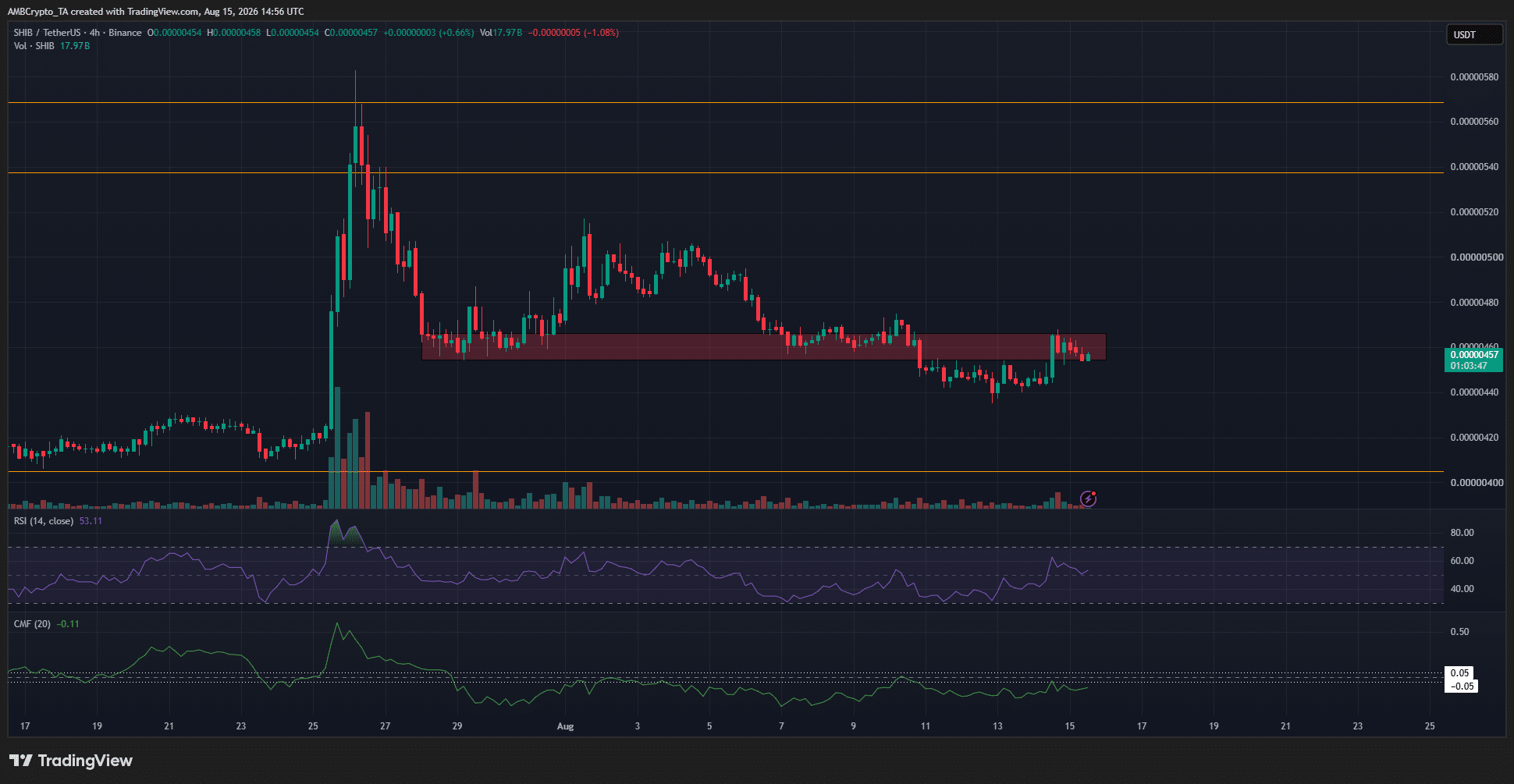
In a recent report, AMBCrypto highlighted the bearish swing structure of Shiba Inu on the 1-day timeframe. The bounce in late July extended to $0.00000583 but only tested an overhead supply zone.
Since that bounce, the memecoin has fallen by 21.4% in three weeks.
Source: SHIB/USDT on TradingView
A local support zone at $0.0000046 was flipped to resistance over the past week. The short-term upward momentum on Friday saw the popular memecoin surge into this overhead supply zone.
The H4 timeframe’s technical indicators showed bears had the upper hand at press time. The RSI was above the neutral 50-level after the recent price bounce, but momentum was not strongly bullish.
Meanwhile, the CMF remained below -0.05 for the majority of August. The capital outflows from the market have been considerable, according to the indicator.
As it stands, the sustained demand needed to break the supply zone is not at hand.
Traders’ call to action – Sell
The retest of the overhead supply zone, on the back of a quick uptick in volume, might be an ideal selling opportunity.
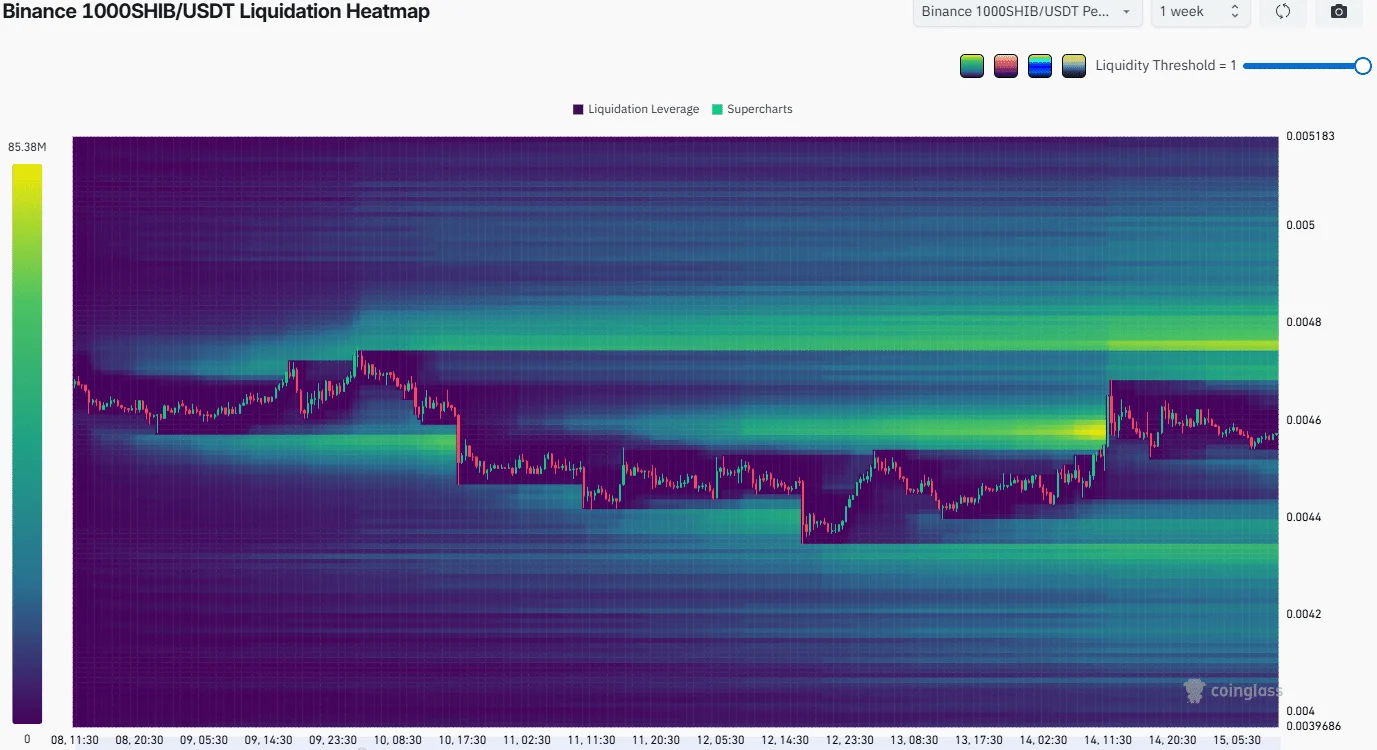
Source: CoinGlass
According to Coinglass’s heatmap, the price has swept the overhead liquidity. There is another cluster of short liquidations just below $0.0000048 that could be targeted over the weekend before a bearish move. A test of this area would also present a selling opportunity.
The evidence at hand strongly alluded to further losses for Shiba Inu.
The less likely scenario is a Bitcoin [BTC] rally bolstering altcoin market sentiment. A SHIB price move past $0.00000518 would shift its short-term bias bullishly again.
Final Summary
Shiba Inu saw strong short-term bullish momentum on Friday.
Bounce appeared to be only a retest of an overhead supply zone.