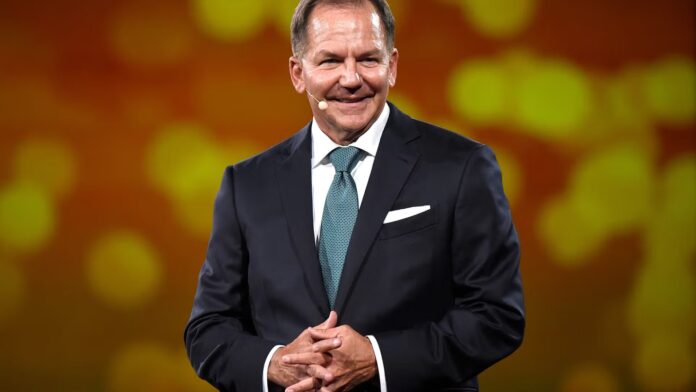
Tudor Investment, founded by billionaire investor Paul Tudor Jones, increased its direct stake in BlackRock’s spot bitcoin ETF in the second quarter while cutting its reported call option position in the fund by 85%.
The firm held 688,529 shares of the iShares Bitcoin Trust ETF (IBIT), valued at $22.9 million as of June 30, according to a 13F filing on Friday.
The share count rose by 109,446, or 18.9%, from 579,083 at the end of March. The holdings are now worth around $24.5 million.
Tudor also reported calls tied to 148,000 underlying IBIT shares, down 85.2% from 998,000 in March. Its put position edged down 1.4% to 715,000 underlying shares from 725,000, according to the filings.
The filing does not disclose the options’ strike prices or expiration dates, so the underlying share counts do not provide a direct measure of Tudor’s directional exposure. And the derivatives positionings are likely a hedging mechanism for its bitcoin bets.
Tudor first disclosed 869,565 IBIT shares in mid-2024 and increased the position to 8.05 million shares, worth $427 million by year-end. It then cut the stake in every quarter of 2025, ending December with 576,523 shares.
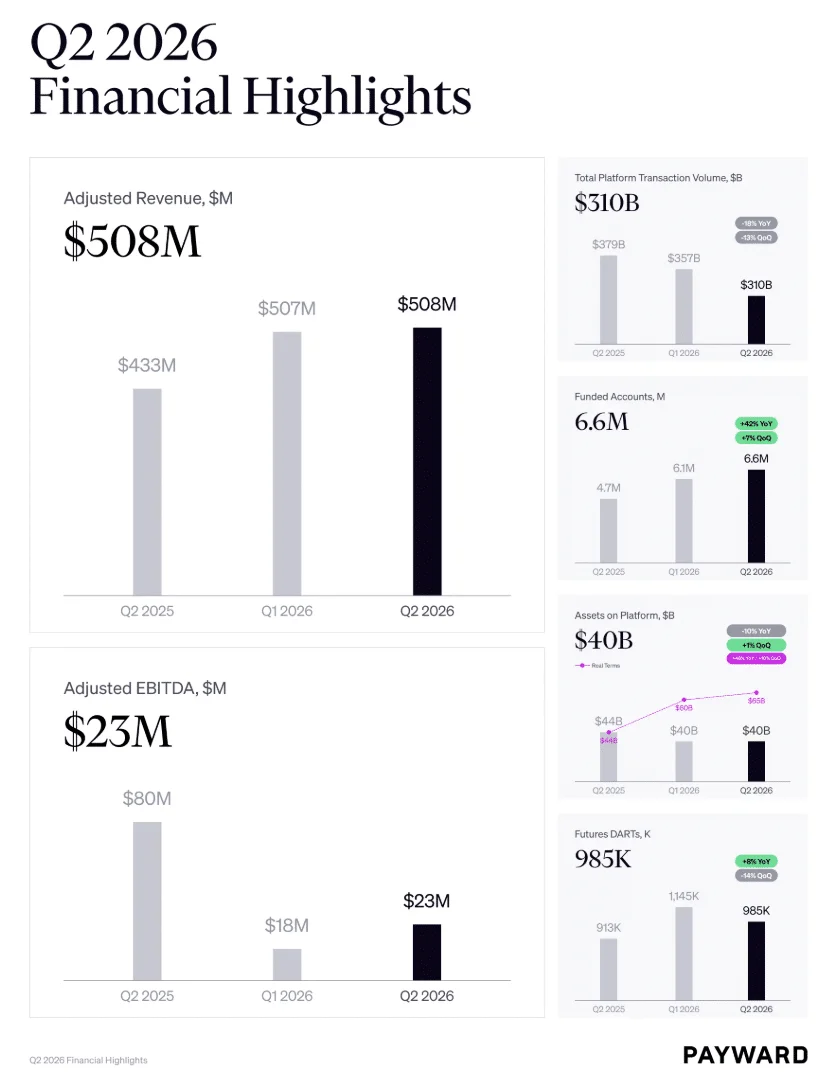
The parent company of Kraken, Payward, reported adjusted revenue of $508 million for the second quarter of 2026. That’s a 17% increase from the previous year.
Additionally, the company reported $23 million in Adjusted EBITDA in its Q2 2026 report, indicating that Adjusted EBITDA remained positive.
The overall volume of platform transactions, however, decreased 18% to $310 billion. This was primarily due to a decline in spot cryptocurrency activity and an increase in stocks and tokenized stocks.
Intriguing enough! Because an exchange that depends significantly on trading fees may experience a decline in revenue if trading volume significantly declines.
But even though there were fewer transactions overall, Payward’s revenue rose. The company says that this is due in part to the fact that it is now doing more than just spot crypto trading.
Was Q2 2026 a healthy quarter for Payward?
That said, the platform’s assets totaled $40 billion, and its real assets climbed 48% year over year to $65 billion.
Source: Payward/Press Release
Strong growth was also seen in funded accounts, which increased 42% to 6.6 million, with Europe seeing the biggest increase after MiCA authorization. From 55% of total revenue in Q2 2025 to 60% in Q2 2026, its asset-based and other revenue grew.
As a result, Payward no longer solely charges trading fees; instead, a greater percentage of its income now comes from assets, services, and other financial products. In other words, Kraken is working to reduce its reliance on cryptocurrency spot trading volumes.
Q1 2026 vs. Q2 2026
If compared to the first quarter of 2026, Payward, the parent company of Kraken, reported adjusted revenue of $507 million. Meanwhile, the total platform transaction volume was $357 billion, and adjusted EBITDA was $18 million.
Funded accounts had climbed 47% year over year to 6.1 million, and as of March 31, platform assets increased 11% to $40 billion. Kraken also grew its spot market share from about 3.5% in mid-2025 to 5.2% in March, indicating that it gained market share despite a decline in overall cryptocurrency trading activity.
Needless to say, comparing the two data points, it’s clear that there has not been much growth from Q1 2026 to Q2 2026.
What’s more?
This comes as Payward’s operations are structured around four key pillars, including services, banking, trading, and asset management. Herein, tokenization is acting as an essential part of Payward’s strategy along with AI.
Additionally, Payward claims to have more than 100 licenses and registrations worldwide, acting as a significant edge over competitors.
At the same time, Kraken announced plans to expand its regulated crypto derivatives offerings by bringing its Bitcoin [BTC] and Ethereum [ETH] options trading platform to qualified European clients later in 2026.
Final Summary
In the Q2 2026 financial results, Payward’s overall volume of platform transactions decreased 18% to $310 billion.
However, the company’s assets totaled $40 billion, and its real assets climbed 48% year over year to $65 billion.
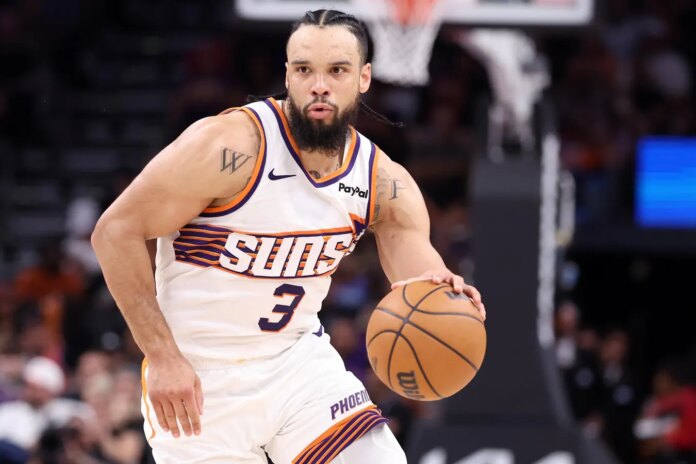
Dillion Brooks proved so valuable to the Phoenix Suns this past season, the extended him for three more seasons. (Photo by Chris Coduto/Getty Images)
Getty Images
HOENIX – Mat Ishbia, the majority owner of the Suns and Mercury, recently found himself in a precarious financial situation because of multi-millions of dollars lost and recouped through his company, United Wholesale Mortgage.
That didn’t stop the Suns from using the NBA’s famous Larry Bird exception to extend forward Dillon Brooks by three years, $73 million, even though the club is well above the league’s salary cap of $165 million. The Suns, according to Spotrac, are at $240.9 million, $80 million above the cap and well beyond what the league calls its second financial apron.
Because the Suns obtained Brooks from Houston last year in the final season of his just-expired contract, they held his Bird rights and could extend him at up to 140% of his previous deal without clearing space under the cap.
Good for Brooks, who became the heart and soul of the team last season because of his on-and-off the court leadership and gritty play. Management responded, pairing him with franchise cornerstone Devin Booker for at least three more seasons.
“It makes you feel comfortable,” Brooks said during a Friday media session after his new deal was announced. “It gives you a sense of trust. From the beginning when the trade happened I felt that trust. That’s why I played so hard. That’s why it was easy to sign this extension and be part of such a great organization.”
Mat Ishbia Has Significant Financial Issues
There always seems to be something going on with Ishbia, who’s embroiled in constant lawsuits, either internally basketball-wise or in his mortgage business. This time UWM suffered a large derivatives loss, losing a bet that interest rates would drop. The company announced a $2.05 billion capital raise to offset the losses.
The obvious question is how this might affect operations of the Suns and Mercury. UWM released a statement to Bloomberg saying not at all, which is well and good until it does. See Mark Walter, under financial scrutiny, just selling the Lakers.
“Trying to use this deal to suggest Mat’s financial situation with UWM or the Phoenix Suns is threatened clearly ignores the facts. Furthermore, Mat is finalizing an agreement to buy out the remaining Suns and Mercury shareholders bringing the Ishbia’s total ownership to almost 99% of the teams.”
Let’s wait for that shoe to drop. Meanwhile, back to the Brooks’ deal.
Because of their penalty situation, on July 6, 2025, the Suns finalized a trade of Kevin Durant to the Rockets for Brooks and Jalen Green, and it had to be a swap for an equal amount of money. Durant was earning $54.7 million from the Suns while Green and Brooks were making a combined $55.5 million.
Brooks was traded with $22.1 million remaining on the final season of a four-year, front-loaded $86 million contract, which made him a perfect candidate for the Bird exception and a cap-less extension.
Bird, the former Celtics’ star, was allowed to remain with Boston after the 1983-84 season when the initial salary cap was negotiated in the NBA collective bargaining agreement. The Celtics were able to re-sign Bird even if his new deal exceeded the cap, which was launched for the 1984-85 season at $3.6 million per team, any of which also had the right to retain their star players for as many as four seasons above the cap.
Thus, the Bird exception, which the Suns and Brooks took full advantage of. Brooks’ cap hit is $22.5 million this season, $24.3 million for 2028-29, and $26.1 million for 2029-30. He’ll be a free agent after that when he’s 35 years of age.
“Dillon’s toughness, competitiveness and work ethic epitomize our Suns’ DNA,” Suns general manager Brian Gregory said after the extension. “He plays with a drive and intensity that sets the tone for our team and raises the level of everyone around him. Dillon was an important part of what we accomplished last season, and we’re excited to see him continue to grow as a player while building on the connection he’s established with our fans and the Phoenix community.”
The Suns Are In The Second Season Of A Rebuild
The Suns won the second of two play-in games defeating the Warriors at the conclusion of this past regular season, but were swept by the then-defending NBA champion Thunder in the first round of the playoffs. They’ve lost eight consecutive postseason games dating back to 2024, and didn’t make the playoffs at the end of the 2024-25 season.
That failure led to Ishbia firing his general manager, James Jones, in lieu of Gregory, and his coach Mike Budenholzer, in favor of Jordan Ott. Gregory and Ott had no previous experience in those jobs.
Gregory then gutted the team, trading Durant and buying out the often-injured Bradley Beal. The Suns still sustain a dead cap hit on the current Clippers guard of $19.4 million per season for the next four seasons.
Still, with a novice head coach and a new lineup, the Suns surprised the pundits, finishing 45-37 and making the playoffs even for just a moment.
“We wanted to get to the playoffs and we did,” said Brooks, despite missing 18 consecutive late season games after he fractured his left hand. “That’s going to help us a lot. Even though we added two new guys, we’re building the second base of this transition. Once we get started, we’ll get that chemistry and camaraderie going.”
The two new guys are forward Miles Bridges and guard Luke Kennard. They came at the cost of Grayson Allen and Royce O’Neale, two good shooting component parts of last season’s team.
“We’ll miss Royce, we’ll miss Grayson,” Brooks said. “Those guys were the building stones of this. We’re going to miss that shooting. We’re going to miss that veteran savvy. We tell them, good luck on the next part of their journeys. And when they play us, we just hope they play their worst games.”
Let’s hope Brooks remains healthy and that Ishbia is able to protect his interest in the teams.
Executive Chairman Scott D. Farmer disposed of 15,923 shares of Cintas Corporation (NASDAQ:CTAS) at $202.71 per share on August 10, according to a recent SEC Form 4 filing.
Transaction summary
Transaction value based on SEC Form 4 weighted average sale price ($202.71); post-transaction value based on the August 10 market close ($202.71).
Key questions
What was the specific nature of this share disposition? The sale was non-discretionary, executed to cover tax obligations associated with the lapse of restrictions on equity awards, and does not reflect the executive’s view on the company stock.
How is the executive’s remaining equity position structured? Scott D. Farmer maintains a primary interest through indirect holdings, including 33.5 million shares held by a limited liability limited partnership and 22.1 million shares held through various limited liability companies.
Which other entities contribute to the indirect ownership total? The reporting person also holds shares through a limited partnership, an Employee Stock Ownership Plan, a spouse, and trusts established for the benefit of himself and his family.
What is the company’s current market valuation context? The transaction occurred with shares priced at $202.71, as the stock has generated a return of -10% over the one-year period ending on the August 10 transaction date.
Company Overview
Company Snapshot
Cintas Corporation provides professional uniform rental and maintenance services, first aid and safety solutions, and facility services, generating revenue primarily through recurring service contracts across the United States, Canada, and Latin America.
The company operates a subscription-based business model in which customers pay recurring fees for uniform rental, cleaning, and maintenance services, supplemented by sales of first-aid and safety products and facility services.
Cintas serves a diverse customer base, including manufacturing facilities, healthcare institutions, hospitality businesses, and other commercial enterprises requiring professional workwear and safety solutions.
Cintas Corporation is a leading specialty business services provider with a market capitalization of $82.1 billion and TTM revenues of $11.3 billion, demonstrating substantial scale and market presence. The company’s diversified service portfolio and recurring revenue model provide stable cash flows and competitive advantages through high customer switching costs and operational efficiency. With 48,100 employees and established operations across North America and Latin America, Cintas maintains a strong market position in the professional services sector.
What this transaction means for investors
Farmer’s stake runs to tens of millions of shares spread across partnerships, family LLCs, trusts, and the employee plan, forming a fortune worth well over $11 billion, so the shares withheld to cover taxes here are almost invisible against it. Ultimately, this is the founding family’s chairman meeting a tax bill on vested stock, and his holdings anchor him to Cintas far more tightly than any single filing could loosen.
Meanwhile, Cintas grew fiscal fourth-quarter revenue 8.9% to $2.9 billion and posted a record 51% gross margin, closing a year of double-digit earnings growth. Despite that growth, the shares have slipped about 10% over the past year, a disconnect that suggests the market had priced Cintas for near-perfection, with even excellent results being measured against an especially high bar. For anyone weighing the stock, the question is not the Farmer family’s commitment, which is enormous and unchanged, but whether a premium valuation can hold while growth stays steady rather than accelerating.
Should you buy stock in Cintas right now?
Before you buy stock in Cintas, consider this:
The Motley Fool Stock Advisor analyst team just identified what they believe are the 10 best stocks for investors to buy now… and Cintas wasn’t one of them. The 10 stocks that made the cut could produce monster returns in the coming years.
Consider when Netflix made this list on December 17, 2004… if you invested $1,000 at the time of our recommendation, you’d have $421,511!* Or when Nvidia made this list on April 15, 2005… if you invested $1,000 at the time of our recommendation, you’d have $1,381,960!*
Now, it’s worth noting Stock Advisor’s total average return is 981% — a market-crushing outperformance compared to 216% for the S&P 500. Don’t miss the latest top 10 list, available with Stock Advisor, and join an investing community built by individual investors for individual investors.
Crypto mining was banned in Moscow, the surrounding Moscow Region and parts of Kursk, with the restrictions set to run through Dec. 31, 2032.
The measure, established under government decree No. 936, also prohibits participation in crypto mining pools. The decree was signed on July 25 and published on July 31, local media reports.
Russia as a whole accounted for an estimated 175 exahashes per second, or 16.4% of Bitcoin’s global computing power, in the first quarter, according to Luxor’s Hashrate Index. That placed it second behind the U.S., although it’s unclear what capacity was located in the newly restricted region.
The country’s Energy Ministry said a year-round restriction was needed to reduce the risk of power-capacity shortages as energy-intensive mining facilities connect to regional grids. Mining currently consumes roughly 1 gigawatt in the Moscow power system, while the region’s data-center capacity could reach 3.6 GW, or 17% of peak demand, by 2032, Interfax reported after the decree was first signed.
Mining is also linked to the country’s Western sanctions.
Russian companies had been using domestically mined bitcoin in international payments after legal changes designed to counter Western restrictions, Finance Minister Anton Siluanov said in December 2024.
Yanjun Wang, CCO and general counsel of Sea Limited (NYSE:SE), sold 3,000 shares of Class A ordinary shares on August 11 and August 12, according to a recent SEC Form 4 filing.
Transaction summary
Transaction value based on SEC Form 4 weighted average sale price ($129.25); post-transaction value based on the August 12 market close ($128.11).
Key questions
What was the nature of this transaction? The sale was executed by a British Virgin Islands entity controlled by Yanjun Wang under a Rule 10b5-1 trading plan adopted on March 26, which allows insiders to set up a predetermined schedule for selling stock to avoid concerns about trading on non-public information.
How does this affect the insider’s total equity exposure? The 3,000 shares sold represent a minor reduction in total holdings, as the insider continues to maintain a substantial position consisting of 1,162,442 directly held shares and 7,000 shares held indirectly, as disclosed in the Form 4.
What is the financial profile of the company at the time of this filing? Sea Limited reported trailing 12-month revenue of $25.2 billion and net income of $1.6 billion, operating across the digital entertainment, e-commerce, and digital financial services sectors.
Company Overview
Company Snapshot
Sea Limited operates a diversified digital ecosystem spanning digital entertainment via its Garena platform, e-commerce, and digital financial services across Southeast Asia, Latin America, and other international markets.
The company generates revenue through multiple business segments, including online gaming and eSports, marketplace and logistics services, and fintech solutions, creating a vertically integrated platform business model.
Sea Limited serves millions of consumers and merchants across emerging markets, targeting digitally native users seeking entertainment, shopping, and financial services in underbanked regions with growing internet penetration.
Sea Limited is a leading digital platform operator in Southeast Asia with TTM revenues of $25.2 billion, demonstrating significant scale across three core business verticals. The company leverages its integrated ecosystem to capture value across the digital entertainment, e-commerce, and fintech sectors, positioning itself as a comprehensive digital services provider for emerging markets. With operations spanning multiple geographies, Sea Limited benefits from network effects and cross-platform synergies that enhance customer acquisition efficiency and lifetime value.
What this transaction means for investors
Once several senior people at a company sell in the same few days, the instinct is to look for a warning, but the pattern at Sea points the other way, since these are preset plans executing into one of its best quarters. Wang, the company’s top lawyer, sold a small block through a holding entity and kept more than 1.1 million shares, which fits that reading rather than cutting against it.
The results behind the selling were broadly strong. Sea grew revenue 48% to $7.8 billion, with e-commerce, fintech, and gaming all expanding, and net income rose to $458 million. CEO Forrest Li called the fintech unit’s progress a sign it can “serve more users, serve them better, and reach further.” One blemish stood out, though, since earnings per share came in below what analysts expected even as revenue sailed past, a reminder that Sea is still spending heavily to grow. That gap between soaring revenue and a per-share profit miss is the tension for shareholders, because the market has rewarded Sea’s return to growth, and it will want to see that growth start converting into bottom-line earnings that keep pace.
Should you buy stock in Sea Limited right now?
Before you buy stock in Sea Limited, consider this:
The Motley Fool Stock Advisor analyst team just identified what they believe are the 10 best stocks for investors to buy now… and Sea Limited wasn’t one of them. The 10 stocks that made the cut could produce monster returns in the coming years.
Consider when Netflix made this list on December 17, 2004… if you invested $1,000 at the time of our recommendation, you’d have $421,511!* Or when Nvidia made this list on April 15, 2005… if you invested $1,000 at the time of our recommendation, you’d have $1,381,960!*
Now, it’s worth noting Stock Advisor’s total average return is 981% — a market-crushing outperformance compared to 216% for the S&P 500. Don’t miss the latest top 10 list, available with Stock Advisor, and join an investing community built by individual investors for individual investors.
Jonathan Ponciano has no position in any of the stocks mentioned. The Motley Fool has positions in and recommends Sea Limited. The Motley Fool has a disclosure policy.
Banking giant UBS, with over $7 trillion in assets under management, has reported a more than 24-fold quarterly increase in call option exposure tied to BlackRock’s iShares Bitcoin Trust (IBIT) in the second quarter.
That increase, which gives it the right to acquire IBIT shares at a later date at a set price, came as its outright IBIT holdings rose about 12%, according to a regulatory filing this week.
The Swiss banking group reported calls representing 1.95 million underlying IBIT shares as of June 30, up from 80,000 three months earlier. UBS separately held 407,890 IBIT shares worth about $13.6 million, compared with 364,371 shares at the end of the first quarter, according to its Q1 filing.
Put option exposure, giving UBS the right but not the obligation to sell IBIT at a set date and price, moved in the opposite direction. UBS reported puts representing 143,300 underlying shares, down about 53% from 303,300 at the end of March.
Its direct IBIT position also remained below the 548,614 shares reported at the end of 2025, according to its fourth-quarter filing.
UBS 13-filing for IBIT. (CoinDesk)
The disclosure also does not include strike prices or expirations, making it difficult to determine UBS’s net directional exposure from the filing alone.