Gold traders have had a hard time getting this year right. The metal has swung from record highs to steep drops and back again. Most of the people who trade it are still trying to figure out which move to trust.
A shift in Federal Reserve expectations, paired with a fresh round of buying, is now pushing the rally question back to the front of the room. Whether it holds depends on a handful of signals that are worth walking through one by one.
Gold’s 2026 swings set up a pivotal week
Gold hit an all-time high of approximately $5,589 an ounce on January 28, then fell more than 18% from that record. Despite the pullback, the metal is still well above its 52-week low.
Gold posted its best week since January, gaining more than 7% as weaker-than-expected jobs data and tamer inflation readings reduced expectations for September’s Federal Reserve rate hike. Gold stocks had already been trading at an elevated level. Both data points accelerated the rally, according to CNBC.
“Gold is the new gold,” Pippa Malmgren, a former Special Assistant to President George W. Bush and member of the National Economic Council, told CNBC.
What draws people into gold hasn’t changed much in her view: worry over U.S. fiscal spending running loose, and weak growth almost everywhere else, which she thinks points toward more inflation.
Central bank buying keeps the floor under prices
Central banks haven’t stopped adding to their gold reserves, and China is leading that charge. Something Malmgren reads as a sign that faith in fiat currency keeps eroding.
“The PBOC added 19.9 tons in July, its largest month since late 2023 and its 21st straight month of accumulation,” said Patrick Kennedy, who founded the Hartford, Connecticut firm AllSource Investment Management, according to Caixin Global. China’s streak has stretched well beyond a year at this point.
John Paulson, the billionaire hedge fund manager who has bet on gold for more than a decade, thinks the metal is still only in the early innings of a longer rally. He points to fading trust in paper currency and government spending that shows no sign of slowing, according to CNBC.
Goldman Sachs is leaning on much the same logic. The bank expects central banks to keep purchasing roughly 60 tonnes of gold monthly through 2026 as reserve managers diversify from the dollar.
That’s a real reversal from earlier this year, when higher rate expectations pushed billions of dollars out of gold ETFs before those outflows finally started to slow.
Gold traders have had a hard time getting this year right.Anadolu/Getty Images
Fed rate expectations are shifting quickly
Odds of a Fed rate hike have dropped fast. Traders are now pricing in about a 40% chance of a September hike, down from a higher level before the newest inflation numbers came out, based on the CME Group’s FedWatch tool, according to CNBC. Lower hike odds, paired with a weaker dollar, usually work in gold’s favor by reducing the opportunity cost of holding non-yielding metal.
Nick Cawley, an analyst who contributes work for the UK bullion dealer Solomon Global, said the odds of a Federal Reserve rate hike were already sliding sharply before the inflation data were released.
Kennedy cautioned against reading too much into that shift. The Fed held rates steady all year, he pointed out. And Wednesday’s CPI print came in roughly where economists expected, with both headline and core inflation running close to forecasts.
New Fed Chair Kevin Warsh is adding his own wrinkle to the picture. Eugenia Mykuliak of B2Prime Group described his early messaging as “cautious and often ambiguous,” saying the uncertainty has pushed some money out of stocks and, in turn, into gold.
At the Fed’s July 29 meeting, policymakers held rates steady even though three officials wanted a hike instead, as CNBC reported. This isn’t the first time precious metals have swung sharply in response to market interpretation of Warsh’s policy stance.
Miners and ETFs give investors more ways to play the trade
Some traders are hunting for value in gold mining stocks rather than the metal itself. Vince Stanzione, an independent trader who wrote “The Millionaire Dropout,” pointed to AngloGold Ashanti and S&P 500 member Newmont as examples trading at single-digit forward earnings multiples while still paying decent dividends.
Retail investors typically reach for equity-focused funds like VanEck Gold Miners and VanEck Junior Gold Miners, or bullion-focused ETFs such as SPDR Gold Shares and iShares Gold Trust when they want more direct exposure to price moves.
Bank of America has favored larger producers in the sector, noting bigger producers like Newmont among its preferred names rather than smaller miners when prices pull back.
Miners also carry more leverage than the metal itself. When gold prices rise while mining costs stay flat, profit margins can grow faster than gold itself. Which is one reason why Kennedy treats miner funds as a satellite bet rather than something to build a portfolio around. Silver has ridden the same wave, just logging its best week since February.
The contracts traded just 1.6% apart on average when both markets were active, and traded near $92 and $94 most recently, translating to a more than 300% upside from the IPO price.
That fourfold premium also means Unitree could have a blockbuster debut and still leave leveraged bulls nursing steep losses.
“Unitree can open at twice its IPO price and still liquidate a third of long exposure,” Allium said.
An opening around $45, double the IPO price, would still be about 52% below the current perp price and could liquidate roughly 33% of long exposure, the analysts said. At the other extreme, a $128 opening price (nearly 6x from the IPO price) could liquidate an estimated 53% of the short positions, the report said. If shares open at around where the perps trade, nothing moves, and neither side is liquidated.
Positioning on Trade.xyz, the bigger market of the two, is almost evenly split, with $6.5 million long and $6.6 million short. However, smaller traders are more bearish: bets below $50,000 are 70% short by value.
“Any open away from today’s price forces one side of this market out,” Allium said.
Selena Gomez launched mental health startup Wondermind in 2021 with the intention of focusing on mindfulness and “mental fitness.”
Now, investors are accusing her of fraud after the startup reportedly faced setbacks last year.
The investors are reportedly seeking to recover nearly $1.2 million, along with damages and legal costs.
Selena Gomez faces allegations of fraud from investors in Wondermind, the mental health startup she co-founded, after the company reportedly faced setbacks last year, including layoffs and missed payrolls.
A group of investors in Wondermind filed a lawsuit this week accusing Gomez of failing to follow through on commitments that persuaded them to back the business. They also name Gomez’s mother, Mandy Teefey, and business partner Daniella Pierson, founder of pop culture newsletter Newsette, as defendants in the case.
According to the complaint, which the investors filed on Thursday in Delaware District Court, the plaintiffs expected that Gomez would use her enormous public profile and social media reach to help market Wondermind. Gomez is the most-followed woman on Instagram, with about 404 million followers. She has an audience of 58.7 million followers on TikTok.
The investors believed that Gomez’s social media platforms would give the young company an immediate marketing advantage and a direct line to a highly engaged audience.
They argue that Gomez’s role was central to Wondermind’s appeal. Investors said they understood that much of the startup’s early value rested on her involvement, particularly her ability to promote its mental-health content and future products to followers who already trusted and paid attention to her.
They also allege that Wondermind positioned itself as a mental wellness platform that was exploring products like a “groundbreaking” mobile app. They allege that the company ultimately failed to deliver the products and revenue it had projected.
“The initiatives never materialized,” the investors allege in the complaint. “The app was never built. And for three years, while the company quietly collapsed around them, not one of its founders, officers, or directors said a word to the investors.”
Pierson said in a statement to NBC News that she denies the allegations against her and “welcomes the opportunity to present concrete documentation and financial records that establish the facts.”
“To be clear, she has never used investor funds for personal expenses,” the statement read. “Quite the opposite: Daniella invested her own money into the business and did not draw a salary from the company.”
Other allegations
Gomez started Wondermind in 2021 with the intention of focusing on mindfulness and “mental fitness.” The company sought to promote routines to maintain mental health, just like people use gyms to stay physically fit.
The startup sought outside funding in 2022 at a reported valuation of $95 million. The suit describes Gomez as the company’s chief impact officer and head of marketing. The investors contend that the venture overstated its prospects, leadership and readiness to build a viable, differentiated mental-health business.
The suit also alleges that Wondermind overstated how far along its business was. Investors claim the company said it had lined up employer partnerships with JPMorgan Chase and Fidelity, while also building revenue through advertising agreements and celebrity-driven cover stories.
According to the investors, they did not learn the extent of Wondermind’s financial and operational problems until a September 2025 investigation by New York magazine’s The Cut. The complaint says the article portrayed Gomez as disengaged from her responsibilities and attempting to distance herself from the company as its condition worsened.
The investors are seeking to recover their investments, which reports put at nearly $1.2 million, along with damages and legal costs.
Key Takeaways
Selena Gomez launched mental health startup Wondermind in 2021 with the intention of focusing on mindfulness and “mental fitness.”
Now, investors are accusing her of fraud after the startup reportedly faced setbacks last year.
The investors are reportedly seeking to recover nearly $1.2 million, along with damages and legal costs.
Selena Gomez faces allegations of fraud from investors in Wondermind, the mental health startup she co-founded, after the company reportedly faced setbacks last year, including layoffs and missed payrolls.
A group of investors in Wondermind filed a lawsuit this week accusing Gomez of failing to follow through on commitments that persuaded them to back the business. They also name Gomez’s mother, Mandy Teefey, and business partner Daniella Pierson, founder of pop culture newsletter Newsette, as defendants in the case.
According to the complaint, which the investors filed on Thursday in Delaware District Court, the plaintiffs expected that Gomez would use her enormous public profile and social media reach to help market Wondermind. Gomez is the most-followed woman on Instagram, with about 404 million followers. She has an audience of 58.7 million followers on TikTok.
United Arab Emirates (UAE) is still doubling down on Bitcoin via its sovereign wealth funds.
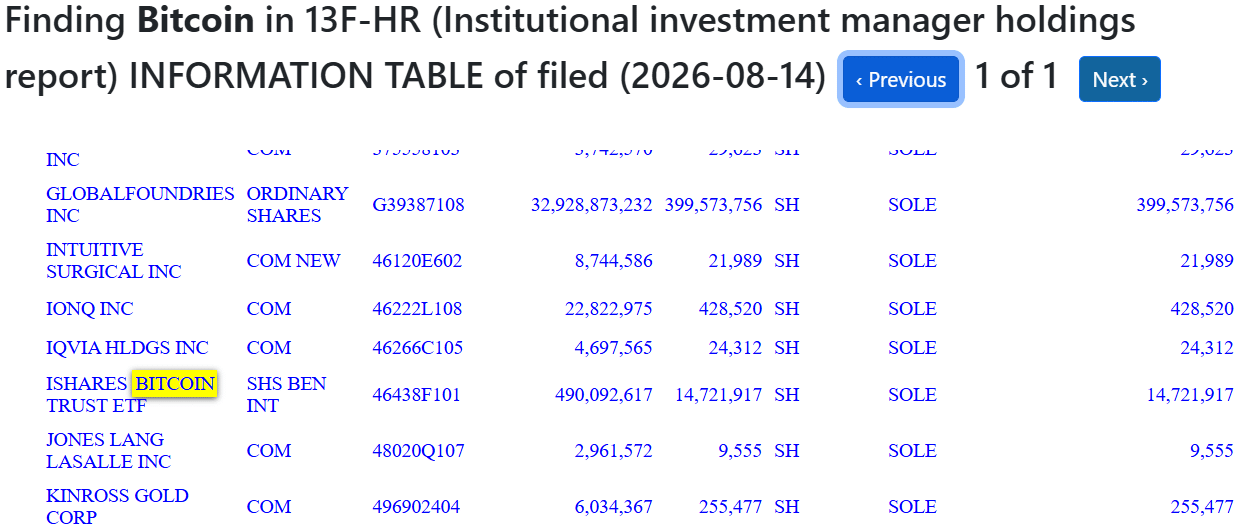
In the latest 13F filings with the U.S SEC, one of its funds, Mubadala, reported owning 14.7 million shares (worth $490M) of BlackRock’s iShares Bitcoin ETF (IBIT).
Source: SEC
A separate fund, Abu Dhabi Investment Council, also reported 8.2 million shares of IBIT (worth $273.6M). Collectively, the two funds own $763.6M worth of BlackRock’s Bitcoin ETF.
Notably, the BTC exposure is the second largest by value in the 13F filings for Mubadala. For Abu Dhabi Investment Council, BTC was the largest holding based on the latest 13F filings.
These holdings have not changed from the Q1 reporting. In fact, at the end of Q4 2025, UAE wealth funds held a cumulative value of over $1B in BTC exposure via BlackRock’s IBIT. This bid came right after BTC’s sharp drop from over $126K to below $100K.
In other words, the UAE is bullish on BTC despite the prolonged crypto winter.
BlackRock’s Bitcoin ETF sees new demand
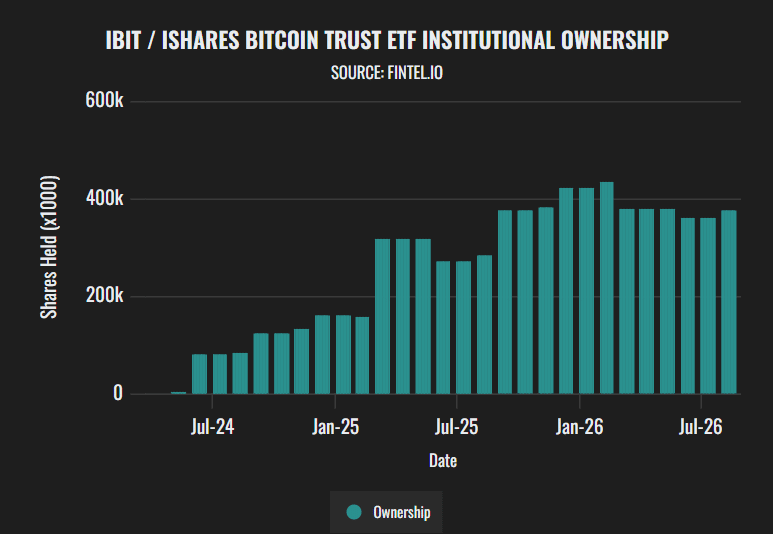
That said, BlackRock’s Bitcoin ETF has seen improved demand in August, breaking the decline trend observed in 2026. According to Fintel, citing the latest 13F filings, IBIT’s institutional ownership increased to 374 million shares in August.
The institutional ownership contracted from its peak of 432 million IBIT shares in February to a low of 361M in July-A 16% decline. The uptick in August meant that there was increased demand from institutional players.
Source: Fintel
The renewed appetite from institutional investors may offer hope to BTC bulls.
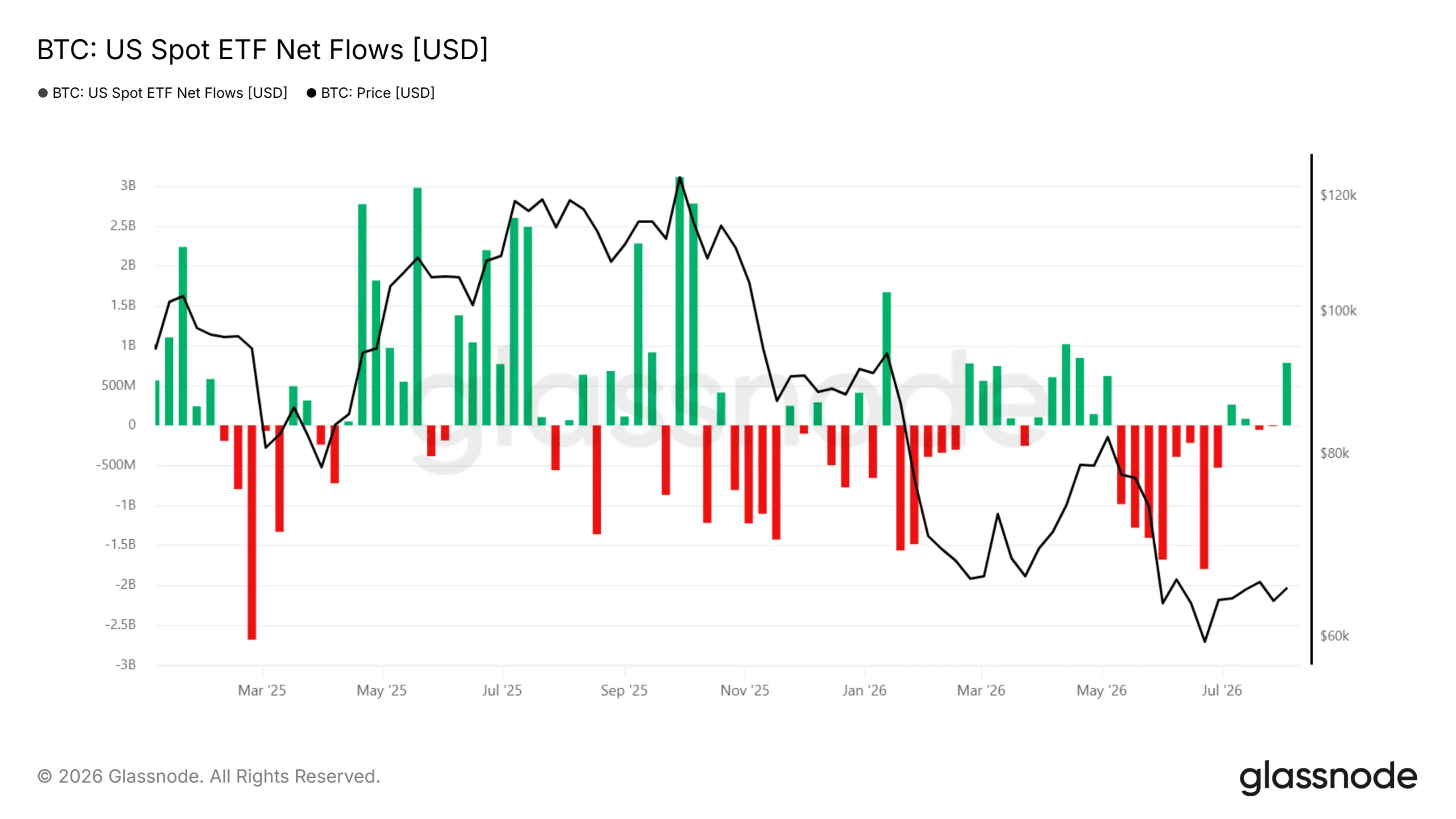
In terms of flows, the broader U.S BTC ETFs have slowed the massive bleed-out seen in May.
Although the products have yet to fully and decisively turn green and positive, the slowing of intense outflows seen in Q2 could offer some stability for BTC’s price.
Source: Glassnode
Overall, the UAE’s BTC exposure was not a surprise, as the country has been bullish since 2025. However, what’s surprising is the UAE’s unwavering faith in the asset despite the sharp decline during the crypto winter.
Final Summary
UAE’s wealth funds reported combined holdings of $763.6M worth of BlackRock’s Bitcoin ETF
Institutional appetite for BlackRock’s improved in August after a 16% decline in 2026
Nvidia’s Spectrum-X Photonics platform is the first CPO Ethernet switch in mass production, delivering 5x lower network power and 64x better signal integrity.
Nvidia’s networking revenue surged 199% to $15 billion as CoreWeave, Lambda, and Oracle adopt the new platform, cementing a rapidly widening competitive moat.
TSM and Lumentum supply the CPO buildout; Lumentum’s revenue doubled to $1 billion with multi-hundred-million-dollar orders already locked in for 2027.
It sounds nuts, but SoFi1 is giving new Active Invest users up to $3,000 in stock for a limited time, and all it takes is a $50 deposit to get started.2 See for yourself (Sponsor)
Every AI story eventually runs into the same wall: power. Data centers can only pull so much electricity from the grid, and chips can only move data so fast before the network becomes the bottleneck instead of the processor.
Shutterstock
Nvidia (NASDAQ:NVDA) posted $81.7 billion in revenue for its fiscal first quarter, up 85% year-over-year, with data center revenue alone hitting $75.2 billion. That kind of growth doesn’t come from selling faster chips alone — it comes from controlling the whole system those chips live in. Now, Nvidia just took its boldest step yet toward owning the wiring, not just the brains, of the AI factory.
The Networking Bottleneck Nvidia Just Solved
Nvidia just announced its Spectrum-X Ethernet Photonics platform entered full mass production, becoming the first co-packaged optics (CPO) Ethernet switch built for 200G-per-lane volume shipping.
Traditional AI data centers link GPUs using pluggable optical transceivers — separate components that convert electrical signals to light and back again. At the scale of a million-GPU cluster, that’s a liability: more lasers to fail, more power draw, more heat.
Nvidia’s fix was to solder the optics directly onto the switch chip. The results are 4 times fewer lasers, 5x lower network power consumption, 10x better resiliency at scale, and a 64x improvement in signal integrity. Optical loss dropped from roughly 22 decibels to about 4. Translation for shareholders: fewer parts breaking down, lower electricity bills for customers, and a network that keeps pace as clusters scale into the millions of GPUs.
CoreWeave (NASDAQ:CRWV), Lambda, and Oracle (NYSE:ORCL) are the first customers, with production having ramped from May through July before reaching full volume. That’s not a science project — that’s revenue.
Nvidia doesn’t manufacture silicon photonics alone, and that’s where the thesis broadens beyond one ticker. Taiwan Semiconductor Manufacturing (NYSE:TSM) handles the advanced silicon photonics fabrication, with packaging capex rising toward 20% of TSM’s planned $52 billion to $56 billion 2026 budget. Advanced packaging made up roughly 8% of TSM’s revenue in 2025, and is expected to top 10% in 2026. TSM trades at a trailing P/E near 30, against a 10-year median closer to 20, so investors are already paying up for this growth.
Lumentum Holdings (NASDAQ:LITE) supplies lasers and optics into the CPO buildout and has secured multi-hundred-million-dollar CPO orders for delivery in the first half of calendar 2027. Its fiscal Q4 revenue hit $1.01 billion, more than doubling year-over-year, with adjusted EPS of $3.23 — also more than double the prior year. Next-quarter guidance of $1.225 billion to $1.275 billion in revenue topped Wall Street’s estimates.
Company
Trailing P/E
Recent Revenue Growth (YoY)
Nvidia
34
85% (Q1 FY2027)
TSM
28
100% (H1 FY2026)
Lumentum Holdings
n/a
83%+ (FY2026)
Why This Deepens Nvidia’s Moat
Owning the switch-to-optics integration doesn’t just make Nvidia’s network faster — it makes the ecosystem stickier. A hyperscaler building around Spectrum-X Photonics buys into Nvidia’s InfiniBand, NVLink, and Ethernet roadmap all at once. Nvidia’s networking revenue nearly tripled to $14.8 billion in fiscal Q2 2026, up 199% year over year — this is becoming its own growth engine, not a side project. Granted, Nvidia’s trailing P/E of roughly 34 sits well below its five-year average near 69, so the market isn’t pricing this as a moonshot.
That said, competition isn’t standing still. Advanced Micro Devices (NASDAQ:AMD) is projecting 64% EPS growth for 2026 with a PEG ratio near 0.4 to 0.5, a cheaper entry for the same AI infrastructure trend. And CPO manufacturing yields remain the swing factor: Yole Group pegs the entire data-center CPO market at roughly $46 million in 2024, growing to $8.1 billion by 2030 — a 137% compound annual growth rate on a market that’s still tiny today.
Key Takeaway
Nvidia isn’t just selling chips anymore — it’s selling the highway those chips talk over, and it’s pulling Taiwan Semiconductor Manufacturing and Lumentum along for the ride.
For investors already holding Nvidia, this reinforces the bull case: a widening moat backed by real revenue. For those wanting exposure without Nvidia’s premium, TSM and Lumentum offer picks-and-shovels entry points — though the latter’s 708% gain over the last year already prices in much of that 2027 CPO ramp.
In any case, the network is no longer an afterthought in the AI story. Nvidia just planted its flag first.
Want Up To $3,000 In Stock? SoFi Is Giving New Active Invest Users Complimentary Stock
Looking to grow your money but unsure where to begin? SoFi Active Invest is offering a limited-time promotion—open a new Active Invest account, fund it with $50 or more, and you could receive up to $3,000 in complimentary stock.
From $0 commission trading3 to fractional shares4 and automated investing, this app is designed to simplify investing for everyone, whether you’re just starting or already experienced. Its easy to sign up and secure your bonus.(Sponsor)
In the first six months of 2026, the crypto industry raised $11.2 billion. Not one dollar of it went to the permissionless, ungoverned experiments that digital assets were supposed to be built on.
“There is an irony at the heart of crypto, and it took an $11.2 billion dataset to make it obvious,” said Dubai-based crypto lawyer Irina Heaver, founder of NeosLegal. “The industry was born on a single promise: permissionless. Money and markets that answer to no gatekeeper.”
Heaver and her team gathered data that might, as he put it, indicate that “crypto’s permissionless era is over.”
NeosLegal tracked every disclosed crypto funding round between January and June 2026. A total of 377 financing rounds took place, Heaver said via Telegram. The top three sectors by capital raised were payments and stablecoins at $3.7 billion, prediction markets at $2 billion and crypto exchanges and trading platforms at $1.7 billion. All three require regulatory approval to operate, she noted.
“The money has stopped chasing permissionless,” Heaver said. “It is chasing regulated businesses now.”
Prediction markets took point
Prediction markets drove the point. Kalshi raised $1 billion in May in a round that included Sequoia Capital, Morgan Stanley, Ark Invest, and Andreessen Horowitz (a16z), among others. Polymarket raised $600 million from Intercontinental Exchange (ICE), the company that owns the New York Stock Exchange (NYSE). Prediction markets pulled in capital in every single month of the first half of 2026 — a total of 34 rounds in six months, she added.
Lip-Bu Tan voluntarily spent $10 million on Intel shares at $95, which was the exact price public investors paid in the company’s concurrent $20 billion secondary offering.
Tan’s beneficial Intel stake now tops 1.3 million shares worth over $130 million, all wagered on a turnaround after a 177% rally in 2026.
Intel’s AI-linked businesses now generate 60% of total revenue, and Q2 sales hit $16 billion, up 25% year over year.
The most widely read finance newsletter on Substack isn’t published by a bank, it’s Doomberg, where 383,000+ readers get the energy and macro analysis the mainstream press misses. 24/7 Wall St. readers save 17% on their first year here.
Insider buying tends to cluster in one of two places: distressed stocks trading for pennies on the dollar, or beaten-down names an executive believes the market has mispriced. It rarely shows up in a stock that has already tripled. Yet last Tuesday, Intel (NASDAQ:INTC) CEO Lip-Bu Tan did exactly that, purchasing shares in the open market after his company’s stock had already run higher for months.
Intel
According to a Form 4 he filed with the Securities and Exchange Commission, Tan bought 105,263 shares at $95.00 apiece — a $10 million bet placed through a family trust, and one that says something specific about how Intel’s own chief executive sees the road ahead.
Why This Purchase Is Different
Executives receive stock constantly through option grants, restricted stock units, and vesting schedules. None of that requires conviction — it’s compensation, not a decision. What Tan did was pull $10 million out of his own pocket and put it into Intel stock at the same $95 price ordinary investors paid in the company’s concurrent $20 billion secondary offering.
From Our Partners
Written by Insiders. Answering to No One.
Before Doomberg published a word, its team spent long careers in heavy industry, private equity, and the hard sciences. They take no advertisers and serve no institution — which is why their lateral-thinking coverage of energy, finance, and geopolitics reads nothing like consensus financial media. Doomberg has set aside a discounted rate exclusively for 24/7 Wall St. readers — it isn’t available on their main page.
That distinction matters. As legendary Fidelity manager Peter Lynch put it, insiders can sell their shares for any number of reasons — a new house, a divorce, diversification, taxes — but they only buy for one: they think the stock is going higher. Tan wasn’t required to participate in this offering at all. He chose to, at full market price, with no discount and no guarantee.
This purchase wasn’t an isolated gesture. Combined with his existing holdings, Tan’s beneficial ownership now stands at roughly 1.3 million shares — 1,314,669 held indirectly through the family trust, another 16,471 held directly, and 500 shares through his 401(k), per the same SEC filing. That’s a personal stake worth well over $130 million at current prices, all riding on Intel’s turnaround succeeding.
The timing adds weight. Intel shares are up approximately 177% in 2026 and roughly 329% over the trailing 12 months. The breakout began in April, when Intel’s Foundry unit announced manufacturing partnerships with Tesla (NASDAQ:TSLA) and Alphabet (NASDAQ:GOOG) for chip manufacturing and processes. Those deals landed alongside a first-quarter earnings report that demolished expectations — revenue of $13.58 billion against a consensus near $12.5 billion, and non-GAAP EPS of $0.29 versus an estimate of roughly a penny. Shares gained 114% that month alone.
Why Tan May Think Intel Isn’t Finished Climbing
The momentum hasn’t faded. Intel’s second-quarter revenue reached $16.13 billion, up 25% year-over-year, and the company guided third-quarter revenue to $15.8 billion to $16.8 billion, ahead of the FactSet consensus near $15.1 billion at the time. Data Center and AI revenue grew 22% year over year in Q1 alone, and management has said AI-linked businesses now make up roughly 60% of total revenue.
Here’s how that growth stacks up against the chip sector’s other momentum names, based on year-to-date performance and trailing P/E ratios as of mid-August:
Intel still isn’t consistently profitable on a GAAP basis, which is exactly why a P/E comparison breaks down and why Tan’s purchase carries more signal than a valuation multiple could. He’s betting on execution — 18A foundry ramp, AI data center demand, and a $20 billion capital raise funding both — not on a chart.
Key Takeaway
Granted, one CEO’s purchase doesn’t guarantee a stock keeps climbing, and Intel remains a turnaround story with real execution risk on foundry yields and AI competition from Nvidia and AMD. That said, a sitting CEO writing a $10 million personal check at the same price the public paid, on top of an already-sizable stake, is the kind of signal Lynch would have flagged immediately.
For investors who believe in the AI-driven data center thesis but have hesitated on Intel specifically, Tan’s own money says he’s not waiting for a pullback.
What $28 a Month Buys a Serious Investor
Through this reader link, 24/7 Wall St. readers get their first year of Doomberg for $332 — 17% off the standard $400, which works out to about $28 a month. That buys six to eight deeply researched articles a month on energy, finance, and geopolitics, the full archive, and one of the most resource-rich comment sections anywhere, where engineers, executives, and fund managers add context under every piece. After the first year it renews at the standard rate, and you can cancel anytime. If today’s article touched energy or the macro picture, odds are the green chicken has already gone three layers deeper — see for yourself at the discounted rate.