Home Blog Page 8

Fintech Company Slash Said Its Employee Burned $80,000 in Tokens

0
Fintech Company Slash Said Its Employee Burned $80,000 in Tokens


Fintech company Slash is touting a new product that doesn’t quite fit in line with its usual offerings — an AI-coded shooter game.

In an X post on Tuesday, the San Francisco-based company wrote that one of its employees racked up a hefty AI coding bill building a video game.

“We encouraged the company last week to start vibe coding more but @nickbruhman burned $80k in credits on the Slash card for a brainrot shooter,” the company wrote.

“Pls play it so we can write this off as a marketing expense,” it added.

Literally called “Brainrot shooter,” it is a bare-bones game set in a Minecraft-esque landscape, where the player has to shoot characters with internet-viral brainrot names like “skibidi toilet” and “tung tung tung sahur.”

Prediction market Polymarket picked up the news, writing in an X post: “Fintech startup Slash reveals it was forced to roll back its AI coding push after an employee burned $80,000 in tokens in the first week.”

The employee, Slash’s head of strategic verticals, Nicolas Brilliante, posted a screenshot that appeared to be a dashboard of his AI usage, showing he had spent $81,267.

“This was a genuine accident, i underestimated my own ability,” Brilliante wrote.

Later, reposting a Polymarket X post, he wrote: “This is actually insane, am I going to become a case study for how AI spend can get out of control.”

Brilliante isn’t the only employee who’s been building things fast and furiously in the era of tokenmaxxing. Still, many companies are now looking at their AI spending with a more critical lens.

Some firms have found that AI costs did not translate into productivity gains, and have cut back on AI budgets.

Companies like Uber, Coinbase, and Walmart have now set caps on how much their employees can spend on AI, with Walmart specifically saying this was done to clamp down on unnecessary, repetitive vibe coding.


Source link

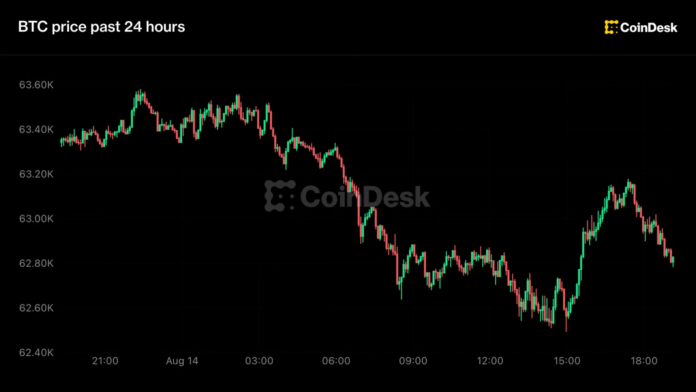
BTC price news: Bitcoin drops to $62,000 as the chip selloff deepens for a second day

0
BTC price news: Bitcoin drops to $62,000 as the chip selloff deepens for a second day

Micron, Marvell and On Semiconductor, each more than doubled in 2026, led the drop. The selloff pulled the S&P 500 down 1.4% and the Nasdaq 100 down 3.3%. An attempted rebound in Asian chip stocks failed to hold on Wednesday, with Taiwan Semiconductor down more than 3%.

Oil kept falling as the other half of the macro picture. Brent crude slipped about 1% toward $76 a barrel as tanker traffic through the Strait of Hormuz became more visible following the US-Iran interim peace deal. A gauge of the dollar climbed to a seven-month high as investors moved toward safer assets.

The crypto-specific signal sits in the fund flows, said Mike McCluskey, co-founder of tx, in an email to CoinDesk. He called bitcoin’s stabilization in the low-to-mid $60,000s a measured response to the Federal Reserve’s hawkish turn, given how hard such shifts usually hit digital assets.

US spot bitcoin ETFs have seen a record 30-day net outflow of more than $6 billion, which McCluskey described as sustained institutional de-risking by the same buyers that drove this cycle. Until those flows clearly reverse, he said, relief rallies are likely to hit a hard ceiling.

McCluskey also flagged Friday’s options expiry on Deribit, with roughly $10.6 billion in notional value set to expire. An option is a contract giving the right to buy or sell at a set price, and notional value is the total value of the assets those contracts cover.


Source link

HELOC and home equity loan rates today, Tuesday, June 23, 2026: Besides rates, how do you choose between a HELOC or HEL?

0
HELOC and home equity loan rates today, Tuesday, June 23, 2026: Besides rates, how do you choose between a HELOC or HEL?


Not willing to move or refinance to a new loan to take advantage of the equity you have built up in your home? If so, you should consider a home equity loan or a home equity line of credit. But how do you know which is right for you? For starters, what you plan to use the funds for and how you want to receive your funding will play a major role in your decision.

According to real estate analytics firm Curinos, the average adjustable-rate HELOC is 7.25%. The 2026 HELOC low was 7.19% in mid-May. The national average rate on a fixed-rate home equity loan is 7.86%, up appreciably from last month, and far from its 2026 low of 7.36% we observed in mid-March and in much of May.

Rates are based on applicants with a minimum credit score of 780 and a maximum combined loan-to-value ratio (CLTV) of less than 70%.

Choosing between a HELOC and a home equity loan is easy when you consider what you’re using it for. A HELOC allows you to draw cash from your approved line of credit, pay it off, then tap it again. A home equity loan gives you a lump sum.

Learn the differences between a HELOC and a home equity loan

With 30-year and 20-year mortgage rates still above 6%, homeowners with home equity and a favorable primary mortgage rate well below that may feel frustrated by not being able to access the growing value in their home. For those who are unwilling to give up their low home loan rate, a second mortgage in the form of a HELOC or HEL can be an appealing solution.

Read more: Learn how to use home equity to build wealth

Home equity interest rates work differently than primary mortgage rates. Second mortgage rates are based on an index rate plus a margin. That index is often the prime rate, which today is down to 6.75%. If a lender added 0.75% as a margin, the HELOC would have a variable rate beginning at 7.50%.

A home equity loan may have a different margin because it is a fixed-interest product. 

Lenders have flexibility with pricing on second mortgage products, such as HELOCs or home equity loans, so it pays to shop around. Your rate will depend on your credit score, the amount of debt you carry, and the amount of your credit you’re drawing compared to the value of your home.

Most importantly, HELOC rates can include below-market “introductory” rates that may only last for six months or one year. After that, your interest rate will become adjustable, likely beginning at a substantially higher rate.

Again, because a home equity loan has a fixed rate, it’s unlikely to have an introductory “teaser” rate. 

Read more: Learn about home equity and how it works

The best HELOC lenders offer:

A HELOC allows you to easily use your home equity in any way and in any amount you choose, up to your credit line limit. Pull some out; pay it back. Repeat.

You should also find and consider a lender offering a below-market introductory rate. For example, FourLeaf Credit Union is currently offering a HELOC APR of 5.99% for 12 months on lines up to $500,000. That introductory rate will convert to a variable rate as low as 6.75% in one year, with a “prime rate for life” thereafter.

Also, pay attention to the minimum draw amount of a HELOC. The draw is the amount of money a lender requires you to immediately take from your equity. Some banks will allow no or small initial draw requirements. Lenders that are not part of a bank with customer deposits are likely to require a large draw at closing. 

The best home equity loan lenders may be easier to find because the fixed rate you earn will last the length of the repayment period. That means just one rate to focus on. And you’re getting a lump sum, so there are no draw minimums to consider.

And as always, compare any annual fees or other charges, and the fine print of repayment terms.

Rates vary significantly from one lender to the next. You may see rates from nearly 6% to as much as 18%. It really depends on your creditworthiness and how diligent you are as a shopper. The national average for a HELOC is 7.25%, and 7.86% for a home equity loan. Those can serve as a guide when shopping rates from second mortgage lenders.

For homeowners with low primary mortgage rates and significant equity in their homes, it’s likely a good idea to consider a HELOC or a home equity loan now. First off, rates are the lowest in years. And you don’t give up that great primary mortgage rate that you earned when you bought your house. 

If you withdraw the full $50,000 from a home equity line of credit and pay a 7.25% interest rate, for example, your monthly payment during the 10-year HELOC draw period would be about $302. That sounds good, but remember that the rate is usually variable, so it changes periodically, and your payments will increase during the 20-year repayment period. A HELOC essentially becomes a 30-year loan. HELOCs and HELs are best if you borrow and repay the balance within a much shorter period.


Source link

Analyzing Dogecoin’s drop below $0.08: What happens next?

0
Analyzing Dogecoin's drop below $0.08: What happens next?


Dogecoin extended its bearish streak, breaching the $0.08 support level. In doing so, the memecoin dropped to a low of $0.079 for the first time in nearly three weeks.

As of this writing, Dogecoin traded at $0.07907, down 5.54% on the daily charts. With the recent price drop, the memecoin fell below the 9- and 21-day moving averages, validating this bearish structure. 

Dogecoin rising liquidation sparks panic selling

After Dogecoin [DOGE] dropped below $0.08, it sparked massive liquidations for leveraged positions. 

According to CoinGlass data, $7.68 million worth of long positions were liquidated. Such high levels of liquidations showed that traders were bullish and expected the price levels to hold. 

Liquidation DOGE
Source: CoinGlass

In addition to the forced exit, the price dip and liquidation caused fear, prompting traders to panic and close their positions. 

Looking at the perpetuals, the Sell Volume surged to 1.3 billion while the Buy Volume dropped to 1.1 billion. 

Dogecoin perpetual volumeDogecoin perpetual volume
Source: Coinalyze

At the same time, the Net buying also remained negative, dropping to  -1.1 billion. With sellers outpacing buyers, it suggests more perps positions closed. 

The same market behavior was observed on the futures side. Over the past 24 hours, $460 million flowed out of futures compared to $413 million in Inflows. 

Dogecoin futures netflowDogecoin futures netflow
Source: CoinGlass

As a result, the memecoin’s Futures Netflow dropped 459% to -$46 million, a clear sign of aggressive futures selling.

Is DOGE at risk of further losses?

Dogecoin is experiencing strong bearish pressure, largely driven by the weakness in the Derivatives market. Examining the memecoin’s Relative Strength Index (RSI), this momentum indicator dropped into the oversold area.

At 28, the RSI shows that bears have total control of the market. Often, such a market setup has preceded extended market weakness.

Dogecoin RSIDogecoin RSI
Source: TradingView

Therefore, if selling activity in the derivatives market continues, Dogecoin is likely to incur further losses and drop towards $0.075.

However, activity in the spot market remains markedly different. Looking at the Spot activity, it seems traders continue to buy the dip.

In fact, the memecoin’s Spot Netflow dropped to -$7.7 million, suggesting higher outflow. The decline in NetFlow suggests that holders lack the incentive to sell.

Dogecoin spot NetflowDogecoin spot Netflow
Source: Coinglass

Thus, with sellers totally exhausted on the spot, even a small buying activity is enough to spark such a shift. Often, such market conditions have worked extremely well for the market and preceded recovery.

Therefore, if the market conditions position DOGE to recover. First, the memecoin must reclaim $0.08 and close above $0.085 in the short term.


Final Summary

  • Dogecoin [DOGE] dropped 5%, breached $0.08 support, and dropped to a three-week low of $0.079 as traders panicked and exited. 
  • DOGE sellers on the spot have been exhausted, with no incentive to sell, leaving the market a chance to recover. 


Source link

Vitalik Buterin says Ethereum Foundation will cut budget 40% in major reset

0
Ethereum's Vitalik Buterin is rethinking how DeFi handles market crashes

The Ethereum Foundation (EF) will slash its budget by roughly 40% this year as part of a shift toward a leaner, endowment-style operating model, Ethereum co-founder Vitalik Buterin said in a blog post published Tuesday.

The reduction comes on the same day the EF confirmed a 20% reduction in headcount and follows the resignation of co-Executive Director Hsiao-Wei Wang. Her departure brings the total number of senior Ethereum Foundation figures to leave since January to nine, underscoring the scale of the organization’s ongoing turmoil.

Buterin said the spending cuts are aimed at transitioning the foundation from spending around 15% of its remaining treasury annually before 2026 to a long-term target of roughly 5% per year after 2030.

“I respect my EF colleagues far too much to pretend that there was not much that is lost,” Buterin wrote, acknowledging that the cuts involve “difficult decisions” and the departure of experienced engineers who have worked on Ethereum for years.


Source link

This Strait of Hormuz Concession Creates a Possible Catalyst for Iamgold Stock. 1 Options Trade to Make Here.

0
This Strait of Hormuz Concession Creates a Possible Catalyst for Iamgold Stock. 1 Options Trade to Make Here.


Investors have greeted the surprising U.S.-Iran peace deal with a sizable move higher, especially for high-powered tech stocks. However, with so many names enjoying blistering upside, there’s a rational case for seeking out less-heralded enterprises. One such example may be gold exploration and mining specialist Iamgold (IAG).

Here’s the quick fundamental case. If we are to take the implications of the peace agreement at face value (and assuming lingering geopolitical tensions don’t roil the relative calm), the Trump administration made some shocking concessions. It’s not just that the U.S. returned to the baseline before the bombs started dropping; rather, the nation fell back into a less favorable circumstance.

More News from Barchart

Basically, the Strait of Hormuz was an international waterway under international law but became a flashpoint during the conflict. Following an agreed-upon interim period, the memorandum of understanding suggests that Iran and Oman may introduce service fees. In essence, the waterway may fall under Iranian jurisdiction.

That has major implications for IAG stock because of the potential paradigm shift in monetary policy. While the dollar may be backed by the good faith and credit of the U.S., in reality, the Navy provides the muscle of the bond market.

The implicit bargain is as follows: the U.S. guarantees freedom of navigation, the world prices commodities in dollars and America gets to run deficits that would bankrupt any other nation. Now, the credibility of this petrodollar is under serious question, which forces nations to store alternative assets, including gold.

With the U.S. giving up a key component of its hegemony, gold should start looking very interesting again. That should make IAG stock quite compelling, especially with shares losing 31% of value since late February of this year.

Volatility Skew Reveals an Intriguing Play for IAG Stock

It’s one thing if I was the lone voice randomly pushing for Iamgold stock; it may be another if options traders also believe that a brewing catalyst is in the works. That’s where the volatility skew provides critical intel for those considering a bullish position.


Source link

AI chipmaker Cerebras down 11% after first public earnings report

0
AI chipmaker Cerebras down 11% after first public earnings report

In its first earnings report since its May IPO, Cerebras Systems (CBRS) is lower by 11% in after-hours trading after guiding to lower profit margins next quarter.

First-quarter revenue nearly doubled from the year-ago level to $193.4 million, and the company’s adjusted net loss of $2.5 million beat analyst forecasts of $36.75 million.

For the second quarter, the company guided to revenue of $194 million, but investors, for now, appear focused on core gross margin — the company expects 36%-38% in the second quarter versus 46.5% in the first.

Cerebras raised $6 billion in a May IPO priced at $185 per share. The stock soared as high as $385 shortly after going public, but has since retreated. It’s down another 11% in after-hours trading at $201.55.


Source link