Cosmos [ATOM] has rallied 8.3% over the past 24 hours, with a 91.9% surge in daily trading volume. The uptick in volume was accompanied by speculative interest, too, but there could be a warning sign in the short-term.
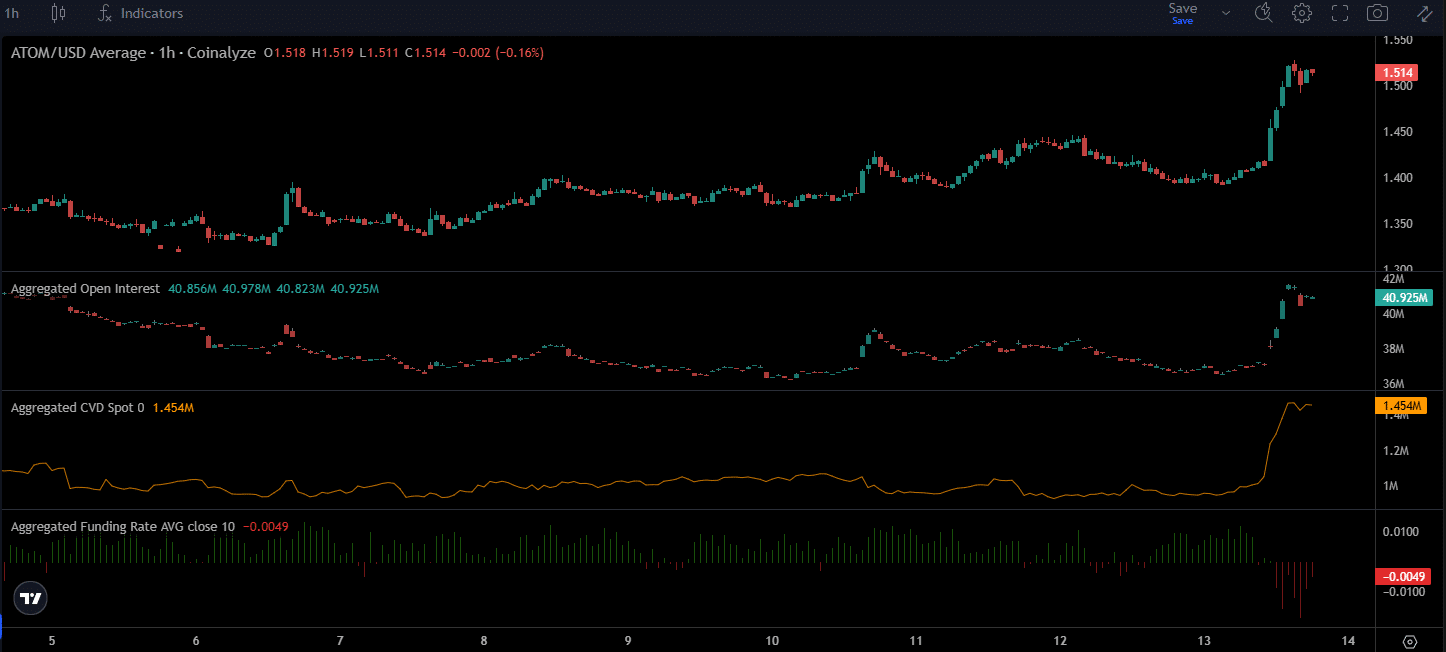
Source: Coinalyze
The Open Interest has climbed 11.3% in the past 24 hours. This signaled heavy speculative activity, and the spot demand was also high, as demonstrated by the uptick in trading volume as well as the spot CVD spike in recent hours.
However, the negative funding rate was a sobering thought for the bulls. The market was betting on a price reversal, and short positions were willing to pay a fee to keep their positions open.
Here’s what the price action has to say about the upcoming ATOM trends.
Bullish moving average crossover foretells bullish ATOM momentum
Source: ATOM/USDT on TradingView
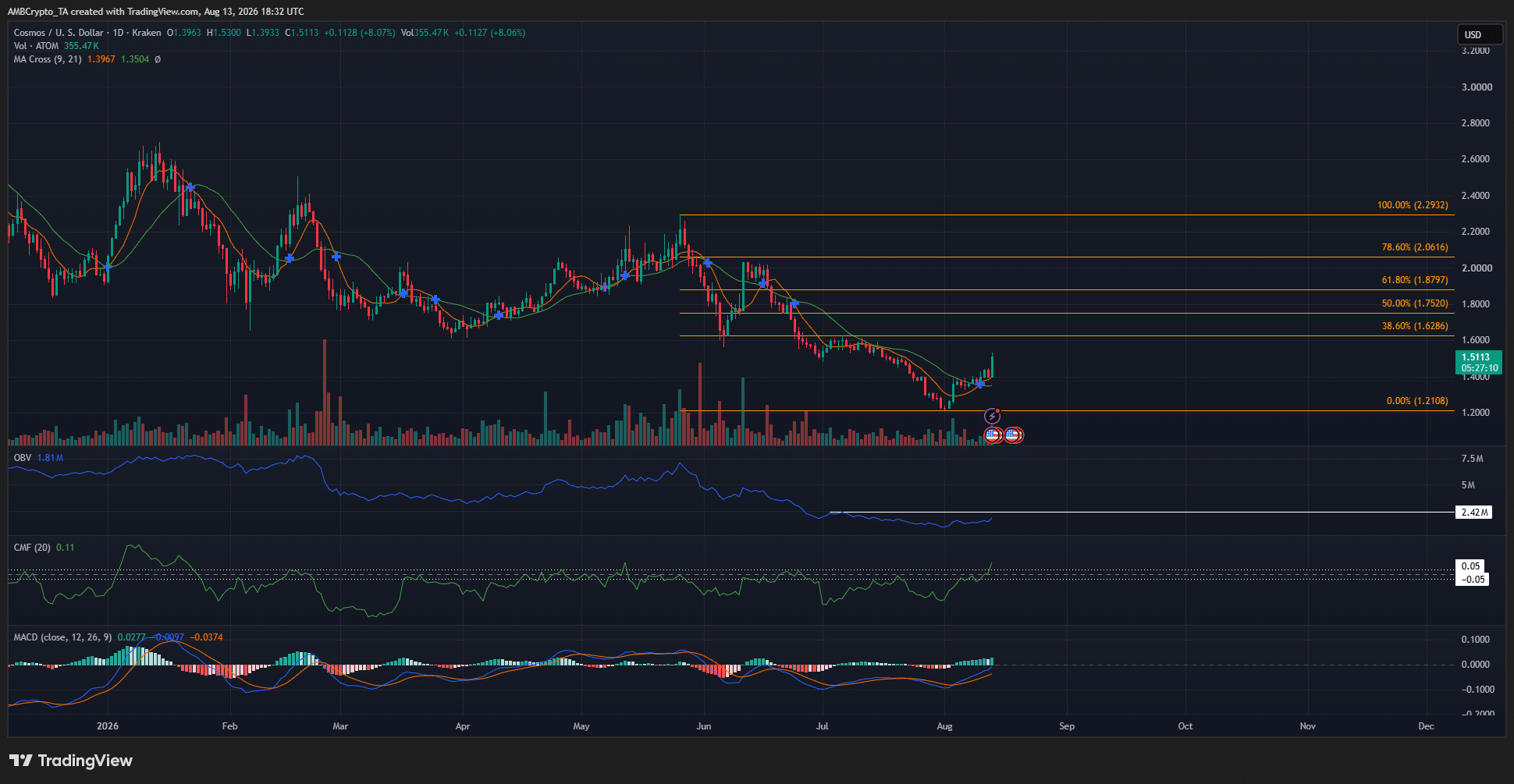
The swing move down from $2.29 to $1.21 began in late May. The structure was clearly bearish, but it does not rule out a short-term bounce.
At the time of writing, the moving averages formed a bullish crossover, and the Cosmos crypto price has also climbed above the averages.
The MACD was also climbing toward the zero line, showing weakening bearish momentum and a potential recovery higher.
While the MACD was unable to climb toward the early July highs, the CMF managed to break out past the +0.05 mark to signal strong capital inflows.
Despite the mixed signals on the daily timeframe, there was one warning sign to watch out for.
Traders’ call to action- Beware of a liquidity sweep
Source: ATOM/USDT on TradingView
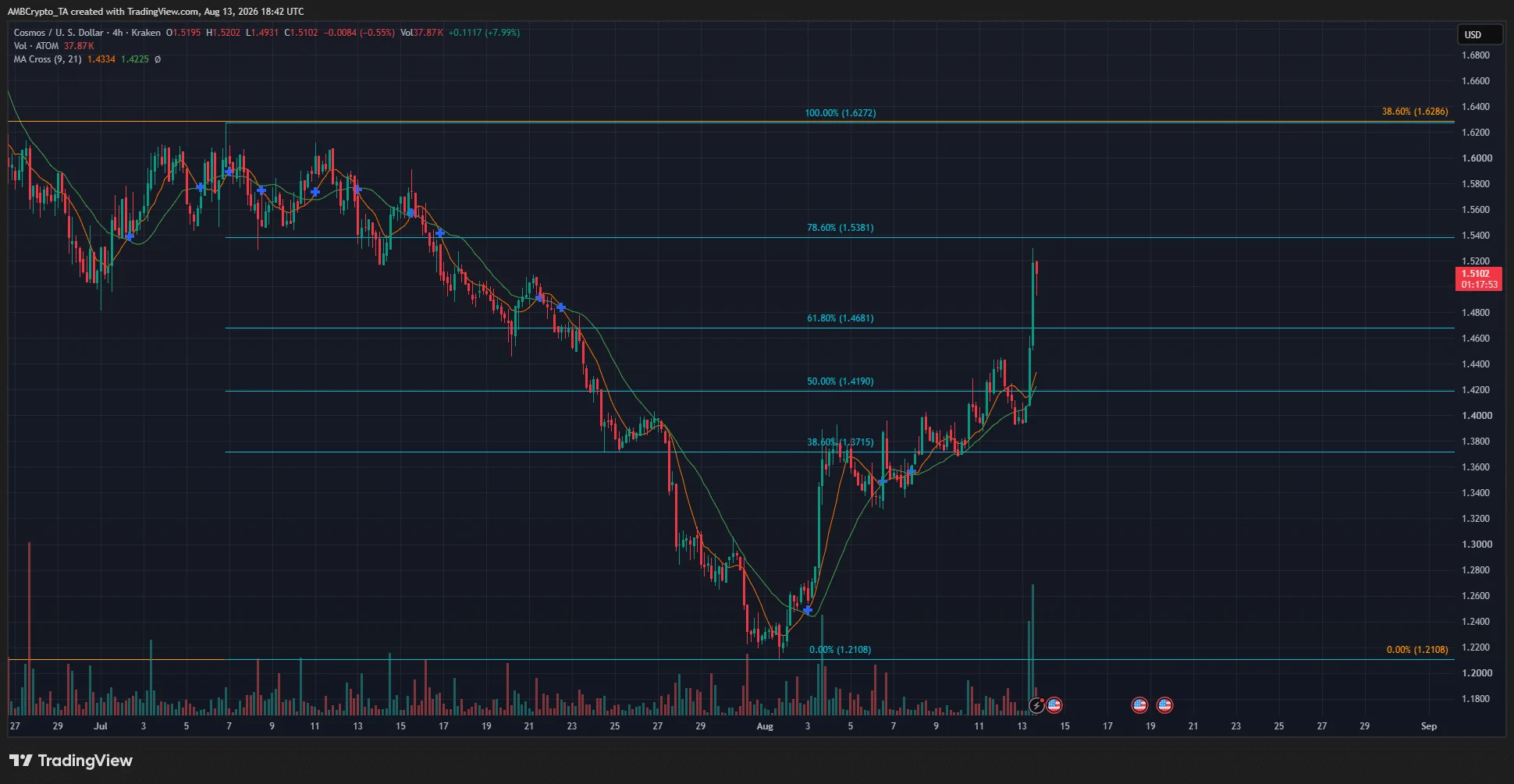
The 4-hour chart’s structure was also bearish. The Fibonacci retracement levels showed that the Cosmos crypto token was trading within the golden pocket between $1.46 and $1.53.
A rejection from the $1.50 resistance zone is expected, based on this structure.
Source: CoinGlass
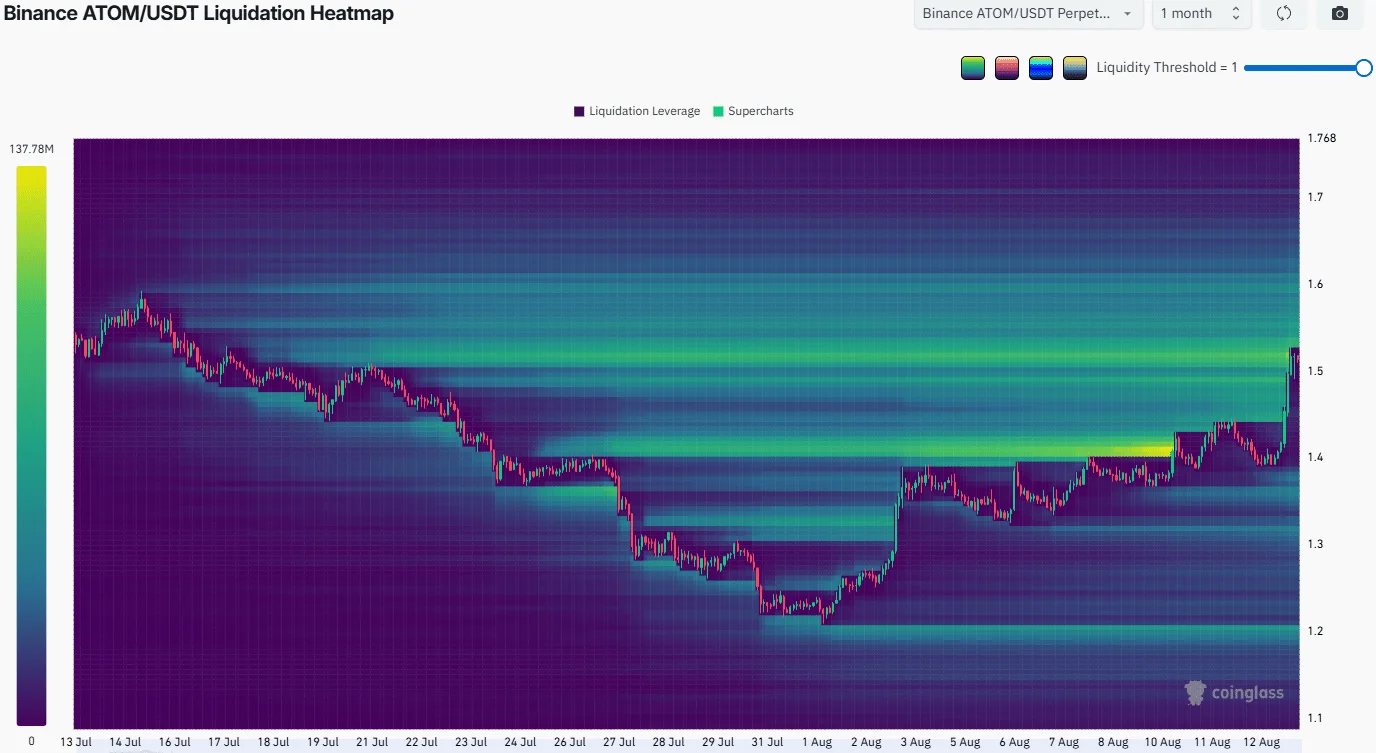
The 1-month liquidation heatmap also highlighted the cluster of short liquidations around the $1.50 area. The recent rally higher has swept this magnetic zone.
Based on the evidence at hand, a bearish trend continuation appeared likely. Sustained buying pressure and a rally past the $1.62 level is needed to signal a potential rally toward the psychological $2 resistance.
Final Summary
The Cosmos crypto token has rallied by just over 8% in 24 hours, with a 91.3% daily trading volume spike and an 11% Open Interest surge.
While the short-term momentum appeared bullish, ATOM would likely struggle to clear the $1.50 supply zone.
Hyperliquid (CRYPTO: $HYPE) is exploring a path into the U.S. perpetual futures market as its policy group presses federal regulators for rules that could bring onchain derivatives under a regulated domestic framework.
With a Senate vote on the CLARITY Act delayed, the decentralized exchange is looking for a route through existing regulatory authority rather than waiting for broader crypto legislation. Hyperliquid does not currently offer its trading platform to U.S. users.
Hyperliquid Policy Center CEO Jake Chervinsky said the goal is for regulators to interpret existing rules favourably or create new ones that would allow regulated firms to offer perpetual futures using markets built on Hyperliquid.
More From Cryptoprowl:
The effort has already reached the Commodity Futures Trading Commission. In July, the Hyperliquid Policy Center and Phantom asked the agency to clarify that developers of onchain software should not automatically face exchange or clearinghouse registration requirements. They also urged regulators to let registered firms use blockchain infrastructure for execution, margining, clearing and settlement.
The groups argued that self-custodial markets do not fit neatly into rules written for traditional intermediaries because users retain control of their own funds. Their filing said the current framework leaves “American users” walled off from onchain derivatives while development continues offshore.
That distinction becomes more complicated as Hyperliquid moves beyond crypto-native contracts. About 32% of the platform’s second-quarter trading volume was linked to stocks and other real-world assets, potentially placing parts of the business across both CFTC and Securities and Exchange Commission jurisdiction.
Real-world asset markets have already become a larger part of Hyperliquid’s trading mix, with contracts tied to stocks and other traditional assets expanding alongside its core crypto derivatives business.
A regulated U.S. route would bring Hyperliquid closer to traditional derivatives infrastructure while preserving the self-custody model behind its onchain markets.
Hyperliquid (CRYPTO: HYPE) is currently trading at $55.80 U.S. per digital token.
The U.S. Securities and Exchange Commission was on the verge of revealing its first major rulemaking effort in the digital assets sphere, having been set to propose its “Regulation Crypto,” but the agency cancelled the Friday meeting in an end-of-day statement on Thursday.
“Due to an unforeseen scheduling issue,” the SEC is moving the meeting to “a later date,” according to a statement from an agency spokesperson.
In the absence of progress in the Senate’s Digital Asset Market Clarity Act, the legislation that would establish a legal foundation for crypto market activity in the U.S., the industry had looked to the SEC to pick up the baton. The so-called Reg Crypto is expected to open a limited framework for issuing crypto securities without triggering agency registration requirements, and also to be able to later transition out of management of the project and, as a result, out of the SEC’s regulatory radar.
The sector will instead have to sit back again and see which branch of the government delivers first: SEC or Congress.
In recent years, online casinos have surged in popularity, offering players the thrill of gambling from the comfort of their homes. However, as a novice, the world of online casinos can be overwhelming and, at times, risky. This guide aims to transform you from a novice to a pro while ensuring safe and responsible play.
Choosing a Reputable Casino
Research Licensing and Regulation
Before signing up, ensure that the online casino is licensed by a reputable authority. Look for casinos that display their license information prominently on their website.
Read Reviews and Ratings
Check out user reviews and ratings on trusted review sites. Feedback from other players can provide insights into the casino’s reliability, game offerings, and payout practices.
Understanding Games and Odds
Types of Casino Games
Familiarize yourself with different types of online casino games, including slots, table games, and live dealer games. Each game has its own rules and odds, which are essential to understand for successful play.
House Edge and RTP
Always check the house edge and return to player (RTP) percentages for different games. Games with lower house edges generally offer better chances of winning over time.
Setting a Budget
Establish a Gambling Budget
Set a clear budget for your gambling activities. Decide how much money you can afford to lose and stick to that limit, ensuring you don’t dip into funds needed for essential expenses.
Use Deposit Limits
Many online casinos allow you to set deposit limits on your account. Take advantage of this feature to control your spending and promote responsible gambling.
Implementing Safe Play Practices
Secure Your Information
Always play on secure sites that use SSL encryption. This protects your personal and financial information from potential threats.
Watch for Signs of Problem Gambling
Be aware of the signs of problem gambling, such as gambling to escape issues, lying about your gambling habits, or chasing losses. If you notice these signs, seek help immediately.
Taking Advantage of Bonuses and Promotions
Welcome Bonuses
Many online casinos offer generous welcome bonuses for new players. Make sure to read the terms and conditions attached, as they often come with wagering requirements.
Loyalty Programs
Join loyalty or VIP programs to earn points for your play, which can be redeemed for bonuses or other perks that enhance your gaming experience.
Conclusion
Transitioning from a novice to a pro in online casino play is achievable with the right knowledge and practices. By choosing reputable casinos, understanding games and odds, setting a budget, implementing safe play practices, and utilizing bonuses wisely, you can enjoy a thrilling yet responsible online gambling experience.
Moneywise and Yahoo Finance LLC may earn commission or revenue through links in the content below.
Nearly two full years since “no tax on Social Security” became a presidential campaign slogan, retirees collecting benefits are still paying taxes.
Despite the passing of President Donald Trump’s signature One Big Beautiful Bill Act in July 2025, it “does not include this provision,” according to the Tax Foundation (1).
Must Read
Instead, the bill includes something much narrower: a special and temporary tax deduction spread across different income bands. And the structure of this deduction has far-reaching impacts for all taxpayers, even those who are years away from retirement or claiming benefits.
Here’s what you need to know.
Implications of the enhanced deduction for retirees
The enhanced deduction for older Americans applies to those beneficiaries above a certain age (65) and can only be claimed between 2025 and 2028, according to the IRS (2). There’s also income thresholds. The deduction phases out for taxpayers with modified adjusted gross income over $75,000, or $150,000 for joint filers.
Because of these narrow parameters, the Tax Policy Center (3) estimates that the tax reduction will “benefit fewer than half of older adults.” And even for those who qualify, they just receive a tax reduction, not elimination.
This reduction also cuts the program’s revenue by roughly $91 billion over its four-year term, according to analysis by the Joint Committee on Taxation, as cited by the Peter G. Peterson Foundation (4). This, along with several other tax cuts implemented by the OBBBA, accelerated the Social Security trust fund’s depletion to 2032, one year earlier than anticipated, according to the Bipartisan Policy Center (5).
Simply put, some beneficiaries will see their taxes reduced temporarily, but all beneficiaries could see their benefits cut over the long term, unless Congress intervenes. The Committee for a Responsible Federal Budget anticipates that retirees could face a 24% benefit reduction (6).
Until then, there are several ways to protect your wealth and retirement.
Since Social Security’s future is highly unpredictable, the best way to prepare might be to make your retirement plan less reliant on benefits in the first place. Diversifying into alternative assets that offer inflation protection, tax advantages or reliable passive income could be the smart money move.
For those worried about the government’s chronic fiscal deficits, gold could be one such safe haven. This environment of sovereign debt concerns favors the yellow metal, according to investment firm Sprott (7).
One way to invest in gold that also provides significant tax advantages is to open a gold IRA with the help of Priority Gold.
Gold IRAs allow investors to hold physical gold or gold-related assets within a retirement account, which combines the tax advantages of an IRA with the protective benefits of investing in gold, making it an attractive option for those looking to potentially hedge their retirement funds against economic uncertainty.
To learn more, you can get a free information guide that includes details on how to get up to $10,000 in free silver on qualifying purchases.
Diversify with your portfolio real estate
For those worried about passive income in retirement, rental property could be a potential solution. For example, platforms like Arrived have democratized this asset class, so you can invest as little as $100 to start collecting rental income from a robust portfolio of vacation homes and apartments.
Another platform that offers fractional ownership in blue-chip rental properties is mogul. Founded by former Goldman Sachs real estate investors, the mogul team handpicks the top 1% of single-family rental homes nationwide for you. Simply put, you can invest in institutional-quality offerings for a fraction of the usual cost.
Each property undergoes a vetting process, requiring a minimum 12% return even in downside scenarios. Across the board, the platform features an average annual IRR of 18.8%. Their cash-on-cash yields, meanwhile, average between 10% to 12% annually. Offerings often sell out in under three hours, with investments typically ranging between $15,000 and $40,000 per property.
Get some professional help
For older Americans with a relatively sizable portfolio of retirement savings, these tax and diversification strategies may need a professional touch. Managing withdrawals, minimizing tax exposure and ensuring long-term sustainability often require greater coordination and strategic planning.
In these cases, working with a financial advisor can help reduce costly mistakes.
Especially if you have a portfolio of $250,000 or more, platforms like WiserAdvisor can connect you with vetted professionals who specialize in this kind of planning.
Simply answer a few questions about your savings, retirement timeline and overall investment portfolio. From there, WiserAdvisor reviews its network to match you — for free — with up to three vetted, reputable advisors aligned with your specific needs.
WiserAdvisor is a matching service and does not provide financial advice directly. All matched advisors are third parties, and specific financial results are not guaranteed.
You May Also Like
Join 250,000+ readers and get Moneywise’s best stories and exclusive interviews first — clear insights curated and delivered weekly. Subscribe now.
Article Sources
We rely only on vetted sources and credible third-party reporting. For details, see ourethics and guidelines.
Tax Foundation (1); Internal Revenue Service (2); Tax Policy Center (3); Peter G. Peterson Foundation (4); Bipartisan Policy Center (5); Committee for a Responsible Federal Budget (6); Sprott (7)
This article provides information only and should not be construed as advice. It is provided without warranty of any kind.
Tesla is making a major bet on demand from urban EV owners by planning an unusually large charging hub in San Francisco.
Plans filed with the city show that Tesla is planning for 124 V4 Supercharger stalls at 75 Waterloo Street, a triangular vehicle storage lot near the intersection of Alemany Boulevard and Bayshore Boulevard, alongside Highway 101.
The proposed station would be among Tesla’s largest globally, and a rare project of that scale inside a major city. By comparison, Tesla’s planned V4 Supercharger at 25 Mason Street, near Market Street in the city, would have 35 stalls. That permit application was submitted on May 18.
Tesla’s 124-stall Supercharger hub plan, as seen in the company’s permit application to the city of San Francisco.
Official Tesla Filings
Tesla’s biggest charging hubs are typically built along heavily traveled interstate corridors, where land is cheaper and demand surges during road-trip season.The hub sits at the crucial location where the 101 meets Interstate 280, which leads to the Peninsula, Silicon Valley, and San Francisco International Airport. It’s also not far from Bernal Heights and the Bayview, which have significant residential populations.
Some of Tesla’s largest charging locations include a 200-stall station in Yeehaw Junction, Florida, and a 164-stall station in Kern County, California. While the latter became fully operational in November 2025, the largest hub in Florida has yet to open.
Based on maps submitted to the city, the 124 stalls would use a conventional parking configuration rather than the pull-through stalls Tesla has introduced at some newer locations.
The plans include a roughly 416-square-foot “micro-amenity” building.
Official Tesla Filings
The plans indicate the station would operate around the clock and include a roughly 416-square-foot “micro-amenity” building. Sketches show that the building contains two gender-neutral, accessible restrooms with diaper-changing stations, water fountains, and vending machines, as well as space for storage, cleaning equipment, and the site’s security and IT systems. The vending area would offer coffee, hot drinks, and snacks.
The plans do not appear to include solar canopies or Tesla Megapack batteries, features used at some of the company’s other large charging hubs. Solar canopies are typically used to lower peak-demand costs and keep chargers operating during some outages.
The latest version of the application was submitted on July 29, but the project still needs to go through the city’s permitting process. No construction or opening date has been announced.
The source also said SEC staff have become increasingly focused on the agency’s legal authority to issue such broad relief, including whether it has completed sufficient economic analysis and followed the procedural steps required to justify an exemption. Industry insiders have been instructed that this effort may need to wait for the outcome of the Clarity Act.
Resistance came from traditional financial institutions as well.
SIFMA, the Wall Street trade group whose members include major broker-dealers and investment banks, has emerged as one of the main groups halting the SEC’s initiative, according to an industry source familiar with the discussions. SIFMA did not immediately respond to a request for comment.
The group’s concerns centered on how blockchain-based trading venues would fit within existing equity-market rules, particularly brokers’ obligations to seek the best execution for customers, the source said.
Under today’s market structure, Regulation NMS links prices across exchanges and generally requires brokers to execute trades at the best available protected quotation. That framework becomes less straightforward if tokenized securities trade through decentralized venues or automated market makers (AMM), where pricing and execution costs may differ from traditional exchanges.
In June, the SEC proposed eliminating Rule 611 of Regulation NMS — the so-called Order Protection Rule — a move widely viewed as removing one of the biggest regulatory obstacles to tokenized securities trading.