The parent company of Kraken, Payward, reported adjusted revenue of $508 million for the second quarter of 2026. That’s a 17% increase from the previous year.
Additionally, the company reported $23 million in Adjusted EBITDA in its Q2 2026 report, indicating that Adjusted EBITDA remained positive.
The overall volume of platform transactions, however, decreased 18% to $310 billion. This was primarily due to a decline in spot cryptocurrency activity and an increase in stocks and tokenized stocks.
Intriguing enough! Because an exchange that depends significantly on trading fees may experience a decline in revenue if trading volume significantly declines.
But even though there were fewer transactions overall, Payward’s revenue rose. The company says that this is due in part to the fact that it is now doing more than just spot crypto trading.
Table of Contents
Was Q2 2026 a healthy quarter for Payward?
That said, the platform’s assets totaled $40 billion, and its real assets climbed 48% year over year to $65 billion.
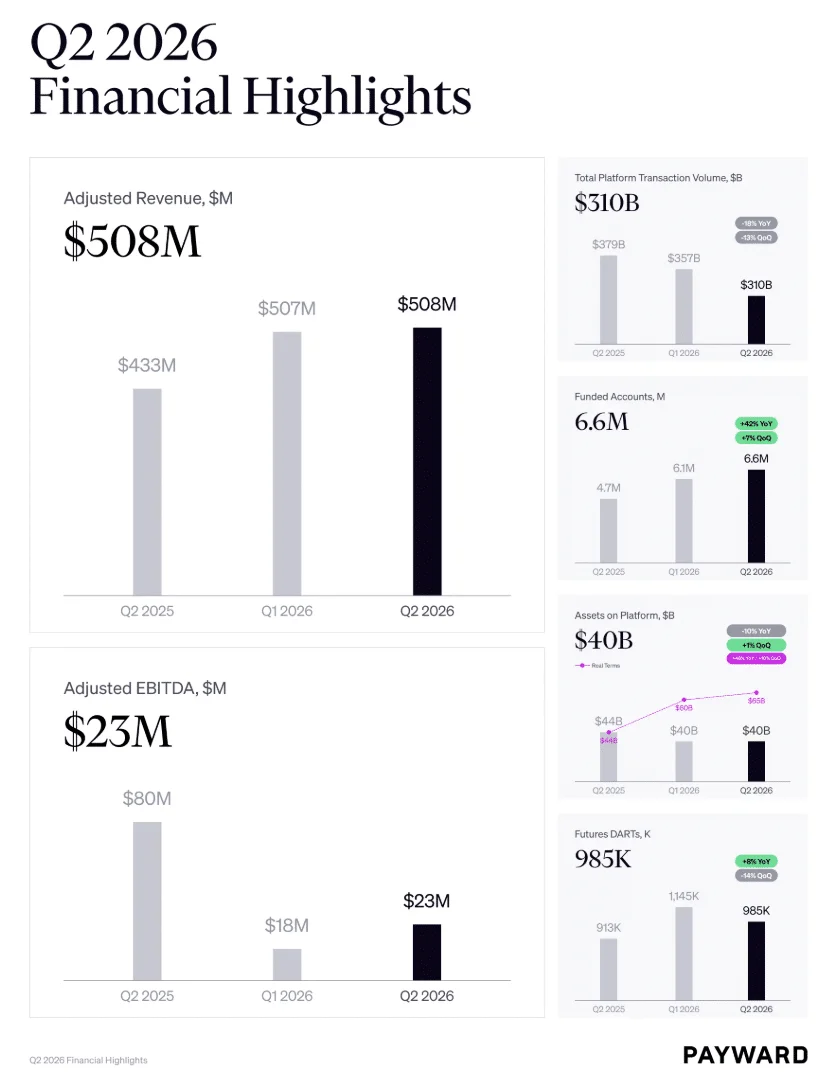
Strong growth was also seen in funded accounts, which increased 42% to 6.6 million, with Europe seeing the biggest increase after MiCA authorization. From 55% of total revenue in Q2 2025 to 60% in Q2 2026, its asset-based and other revenue grew.
As a result, Payward no longer solely charges trading fees; instead, a greater percentage of its income now comes from assets, services, and other financial products. In other words, Kraken is working to reduce its reliance on cryptocurrency spot trading volumes.
Q1 2026 vs. Q2 2026
If compared to the first quarter of 2026, Payward, the parent company of Kraken, reported adjusted revenue of $507 million. Meanwhile, the total platform transaction volume was $357 billion, and adjusted EBITDA was $18 million.
Funded accounts had climbed 47% year over year to 6.1 million, and as of March 31, platform assets increased 11% to $40 billion. Kraken also grew its spot market share from about 3.5% in mid-2025 to 5.2% in March, indicating that it gained market share despite a decline in overall cryptocurrency trading activity.
Needless to say, comparing the two data points, it’s clear that there has not been much growth from Q1 2026 to Q2 2026.
What’s more?
This comes as Payward’s operations are structured around four key pillars, including services, banking, trading, and asset management. Herein, tokenization is acting as an essential part of Payward’s strategy along with AI.
Additionally, Payward claims to have more than 100 licenses and registrations worldwide, acting as a significant edge over competitors.
At the same time, Kraken announced plans to expand its regulated crypto derivatives offerings by bringing its Bitcoin [BTC] and Ethereum [ETH] options trading platform to qualified European clients later in 2026.
Final Summary
- In the Q2 2026 financial results, Payward’s overall volume of platform transactions decreased 18% to $310 billion.
- However, the company’s assets totaled $40 billion, and its real assets climbed 48% year over year to $65 billion.