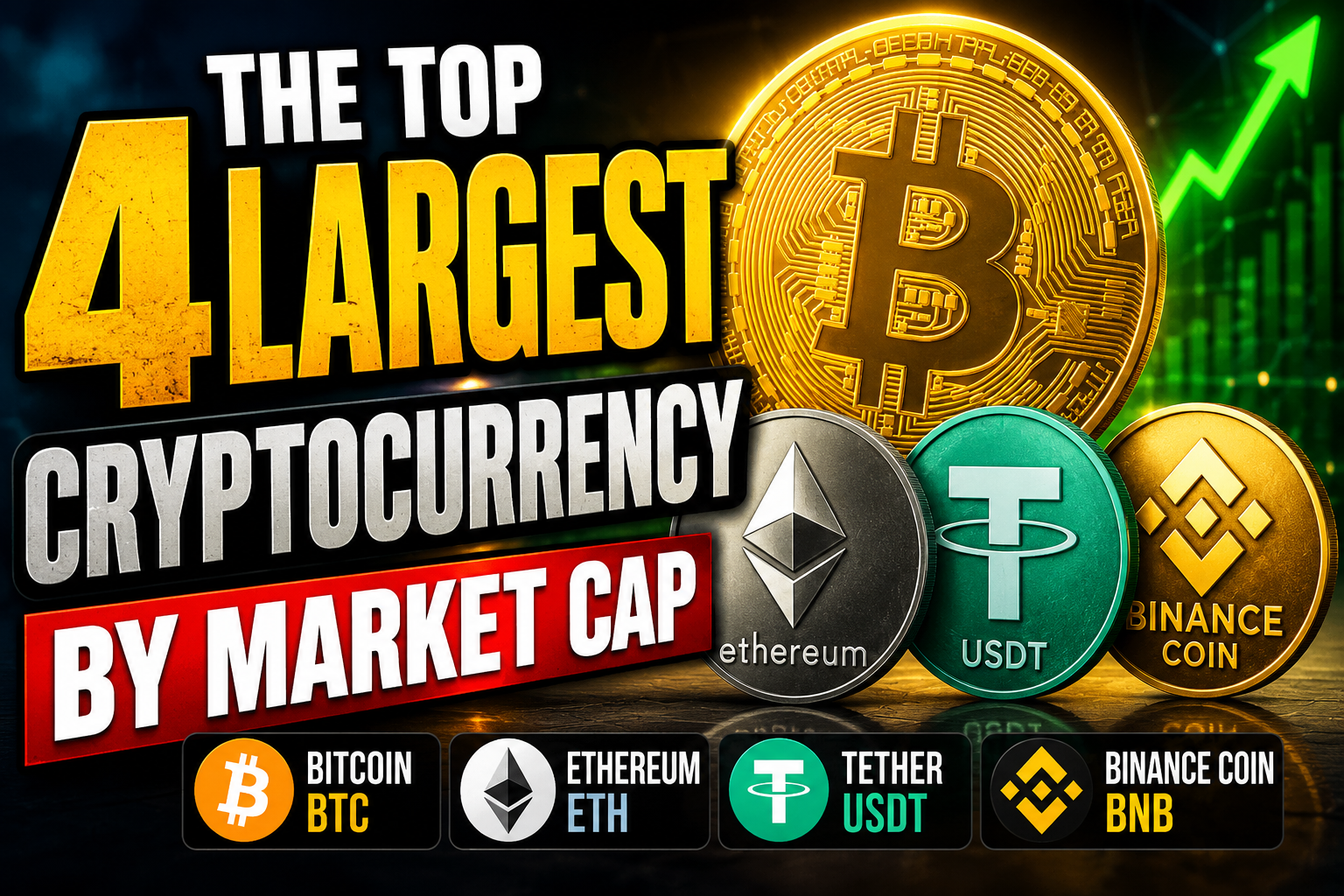
Cryptocurrency has evolved from a niche technology into a multi-trillion-dollar financial ecosystem that is reshaping global finance. While thousands of digital assets exist today, only a handful control the majority of the industry’s value, liquidity, developer activity, and institutional investment.
But here’s what most articles won’t tell you:
Market capitalization alone does not determine whether a cryptocurrency is the best investment.
Many coins have temporarily reached the top 10 during bull markets only to disappear years later. Others have maintained dominance because they continue attracting developers, businesses, institutions, and real-world users.
This guide goes beyond rankings. You’ll discover the hidden strengths, weaknesses, and future potential of the world’s largest cryptocurrencies that many investors overlook.
Table of Contents
What Is Cryptocurrency Market Capitalization?
Market capitalization (Market Cap) is calculated using a simple formula:
Market Cap = Current Price × Circulating Supply
For example:
- Coin Price: $100
- Coins in Circulation: 10 million
Market Cap = $1 Billion
However…
Experienced investors know that market cap tells only part of the story.
Before investing, professionals also examine:
- Daily trading volume
- Liquidity
- Number of active wallet addresses
- Developer activity
- Security of the blockchain
- Token distribution
- Institutional adoption
- Real-world use cases
- Regulatory outlook
These factors often determine whether a cryptocurrency survives for decades—or disappears completely.
Why the Largest Cryptocurrencies Stay on Top
The biggest cryptocurrencies don’t dominate simply because of price.
They stay at the top because they benefit from powerful network effects.
As more people own a cryptocurrency:
- More businesses begin accepting it.
- More developers build applications on it.
- More investors trust it.
- More exchanges list it.
- More financial institutions support it.
This creates a cycle that’s extremely difficult for smaller projects to compete against.
1. Bitcoin (BTC)
The Digital Gold of the Internet
Bitcoin remains the undisputed leader of the cryptocurrency market.
Created in 2009 by the mysterious Satoshi Nakamoto, Bitcoin introduced the world to decentralized digital money that operates without banks or governments.
Today, Bitcoin is viewed by many institutions as a hedge against inflation, similar to gold.
Why Bitcoin Dominates
- First cryptocurrency ever created
- Largest and most secure blockchain network
- Limited supply of only 21 million coins
- Adopted by public companies, hedge funds, ETFs, and governments
- Most recognized cryptocurrency worldwide
Hidden Advantage Most Investors Ignore
Bitcoin has never changed its monetary policy.
Unlike many cryptocurrencies that can increase supply or change token economics, Bitcoin’s scarcity is permanently built into its code.
This predictable supply is one reason many analysts call Bitcoin “Digital Gold.”
2. Ethereum (ETH)
The World’s Largest Smart Contract Platform
Ethereum revolutionized cryptocurrency by introducing programmable blockchain technology.
Instead of simply sending money, developers can build:
- Decentralized Apps (dApps)
- NFT marketplaces
- Lending platforms
- Gaming ecosystems
- Artificial Intelligence integrations
- Tokenized real-world assets
Thousands of blockchain projects rely on Ethereum infrastructure.
Hidden Fact
Every major blockchain ecosystem today has borrowed ideas originally introduced by Ethereum.
Its influence extends far beyond its own network.
3. Tether (USDT)
The Stablecoin That Powers Crypto Trading
Unlike Bitcoin, Tether is designed to remain close to $1 USD.
Its main purpose isn’t investment.
It’s the financial bridge connecting global cryptocurrency markets.
Billions of dollars move through USDT every single day.
Why Traders Love Tether
- Fast settlement
- Lower volatility
- High liquidity
- Widely accepted on exchanges
- Easy transfer between trading platforms
Hidden Insight
Many crypto investors never actually convert back to traditional bank accounts.
Instead, they move profits into USDT while waiting for the next investment opportunity.
4. XRP (XRP)
Built for Global Payments
XRP focuses on solving one of banking’s oldest problems:
Cross-border payments.
Traditional international bank transfers can take several days.
XRP transactions often settle within seconds while costing only fractions of a cent.
Strengths
- Extremely fast transactions
- Very low transaction fees
- High scalability
- Strong partnerships within financial technology
Hidden Advantage
Unlike proof-of-work cryptocurrencies, XRP consumes very little electricity, making it one of the most energy-efficient major blockchain networks.
5. BNB (BNB)
The Utility Token Behind a Massive Ecosystem
BNB began as a simple exchange token.
Today it powers one of the largest blockchain ecosystems in crypto.
Users benefit from:
- Reduced trading fees
- DeFi applications
- NFT platforms
- Blockchain games
- Smart contracts
Its value comes from the size of its growing ecosystem rather than speculation alone.
6. Solana (SOL)
Built for Speed
Solana was created to solve blockchain scalability.
Its network can process thousands of transactions per second while maintaining relatively low fees.
Because of this, many developers choose Solana for:
- Gaming
- NFTs
- Consumer apps
- Payment systems
Interesting Fact
Several high-performance blockchain applications would simply be too expensive to operate on slower networks.
7. USDC (USD Coin)
The Institutional Stablecoin
USDC is another dollar-backed stablecoin trusted by many businesses and financial institutions.
Its transparency and regulatory approach have helped increase institutional adoption.
Businesses frequently use USDC for:
- Payroll
- International settlements
- Treasury management
- Digital commerce
8. Dogecoin (DOGE)
The Meme Coin That Became a Global Brand
Originally created as a joke, Dogecoin became one of the most recognizable cryptocurrencies in history.
Its strong online community helped transform it into a serious digital asset.
Hidden Lesson
Dogecoin proved that community support can sometimes become just as valuable as technology.
9. Cardano (ADA)
Research Before Innovation
Cardano takes a different approach.
Every major update undergoes peer-reviewed academic research before implementation.
Supporters believe this slower development creates a more secure blockchain over the long term.
10. Tron (TRX)
Quietly Powering Billions in Stablecoin Transfers
Although Tron receives less media attention than Bitcoin or Ethereum, it processes an enormous volume of USDT transactions every day.
Its low fees have made it particularly popular for international transfers.
Many users don’t even realize they’re using the Tron blockchain when sending stablecoins.
The Hidden Metrics Smart Investors Watch
Professional investors rarely rely on market cap alone.
Instead, they analyze:
- Daily active users
- Wallet growth
- Developer activity
- Network security
- Institutional ownership
- Transaction fees
- Blockchain revenue
- Token burns
- Inflation rate
- Supply concentration
These indicators often reveal whether a cryptocurrency has genuine long-term value.
Biggest Risks Investors Should Know
Even the world’s largest cryptocurrencies carry significant risks.
These include:
- Government regulations
- Cybersecurity threats
- Exchange failures
- Market volatility
- Smart contract exploits
- Macroeconomic conditions
- Technological competition
Diversification remains one of the most effective ways to manage cryptocurrency risk.
Which Cryptocurrency Could Dominate the Next Decade?
While Bitcoin remains the largest cryptocurrency by market capitalization, the competition beneath it continues to evolve rapidly.
Ethereum continues expanding decentralized finance.
Stablecoins are becoming essential infrastructure for global payments.
High-speed blockchains compete for developers.
Artificial intelligence, tokenized real-world assets, and blockchain interoperability are creating entirely new opportunities that didn’t exist just a few years ago.
Rather than chasing hype, successful investors focus on projects with strong technology, growing adoption, active development, and sustainable ecosystems.
Final Thoughts
The cryptocurrency market changes faster than almost any other financial sector.
Rankings may shift, but the qualities that define long-term winners remain remarkably consistent:
- Strong security
- Real-world utility
- Active development
- Large user communities
- Institutional confidence
- Sustainable token economics
Understanding these fundamentals is far more valuable than simply knowing which cryptocurrency currently ranks number one.
As blockchain technology continues expanding into finance, gaming, artificial intelligence, supply chains, and global commerce, today’s leading cryptocurrencies may become the foundation of tomorrow’s digital economy.
Frequently Asked Questions
Which cryptocurrency has the largest market capitalization?
Bitcoin continues to hold the largest market capitalization and remains the most widely recognized cryptocurrency in the world.
Is market capitalization more important than price?
Yes. A coin’s price alone can be misleading because it doesn’t account for the number of coins in circulation. Market capitalization provides a more meaningful measure of a cryptocurrency’s overall size.
Are stablecoins good investments?
Stablecoins such as USDT and USDC are designed to maintain a stable value rather than appreciate in price. They are commonly used for trading, payments, and preserving value within the crypto ecosystem.
Can a smaller cryptocurrency overtake Bitcoin?
While rankings can change over time, Bitcoin benefits from strong network effects, widespread adoption, and a fixed supply, making it difficult for other cryptocurrencies to surpass its long-term dominance.
How often do cryptocurrency rankings change?
Market capitalization rankings can change daily due to price fluctuations, new token launches, and shifts in investor demand.
References
- CoinMarketCap – Top Cryptocurrencies by Market Capitalization – Live cryptocurrency rankings, market capitalization, trading volume, and circulating supply.
- CoinMarketCap – Market Capitalization Methodology – Explains how cryptocurrency market capitalization is calculated.
- Bitcoin Official Website
- Ethereum Official Website
- Tether Official Website
- BNB Chain Official Website
- XRP Ledger Official Website
- Solana Official Website
- USD Coin (USDC) Official Website
- Cardano Official Website
- Dogecoin Official Website
- TRON Official Website
- CoinGecko – Cryptocurrency Rankings
- Blockchain.com Explorer – Blockchain explorer and network statistics.
- Binance Academy – Blockchain & Cryptocurrency Guides
Academic References
- Song, H., Wei, Y., Qu, Z., & Wang, W. (2024). Unveiling Decentralization: A Comprehensive Review of Technologies, Comparison, Challenges in Bitcoin, Ethereum, and Solana Blockchain.
- Gencer, A. E., Basu, S., Eyal, I., van Renesse, R., & Sirer, E. G. (2018). Decentralization in Bitcoin and Ethereum Networks.