
If you thought Q4 volatility was finally cooling down, you might want to think again.
And yes, the December rate decision priced in by the market is only the tip of the iceberg. Analysts have spent much of the last 24 hours assessing the MSCI report announcing its index review on the 11th of November. Naturally, the focus immediately shifted to Strategy’s MSTR index eligibility as traders began pricing in the risk of its removal from MSIC’s global indexes. Notably, this is exactly how things played out.
In its recent review, MSCI has officially confirmed that Strategy will be removed from its global indexes, effective from the 1st of December. This put MSTR among the companies set to lose their place in these benchmarks, adding another layer of uncertainty around institutional exposure and potential selling pressure.

However, to understand why this decision matters, it is important to first understand what MSCI represents.
MSCI (Morgan Stanley Capital International) creates some of the biggest stock indices in the world. Investment funds that have over $21 trillion in assets track these indices. Many invest in stocks according to these indices. If the fund tracks an MSCI index including MSTR, then the Strategy removal may cause these investment funds to decrease or sell their holdings to match the new index.
It, therefore, comes as little surprise that traders are worried that MSTR’s removal by MSCI will cause a wave of institutional selling. Moreover, given that Strategy is still the largest corporate holder of Bitcoin [BTC] (850,364 BTC on their balance sheet), the importance of this decision cannot be understated. Less institutional exposure to MSTR could cause sentiment to turn more negative towards corporate Bitcoin treasuries.
Traders are now watching whether the removal triggers a broader risk-off move across the crypto market.
MSTR institutional holdings rise 9.62% as MSCI removal looms
Following MSCI’s decision, MSTR’s institutional ownership is becoming an important part of the story.
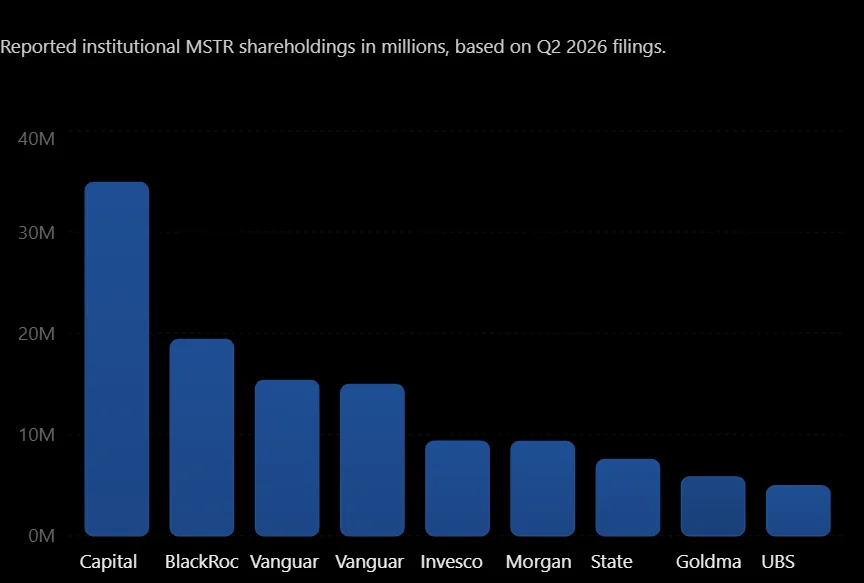
Some of Wall Street’s largest asset management firms also hold large stakes within the company, such as Capital International Investors, BlackRock, Morgan Stanley, Invesco, and Goldman Sachs. Based on the latest institutional filings, it can be seen that Capital International Investors is the largest institutional investor holding around 34.9 million MSTR shares. This is followed by BlackRock with 19.39 million shares.
Interestingly, institutional investment increased within Q2. Invesco increased their shareholding by around 7.21 million shares. Meanwhile, Goldman Sachs increased theirs by 4.02 million shares, Capital International Investors increased theirs by 3.46 million shares and BlackRock increased their shareholding by around 1.64 million shares. Overall, there were around 209.52 million MSTR shares owned by institutional investors at the end of Q2, an increase of 9.62% compared to the previous quarter.
However, not every major institution was accumulating.
The move by Capital Research Global Investors, who shed around 4.62 million shares, and Bank of America, who sold 2.79 million, demonstrates that it was already a slightly negative time for institutions. The primary concern therefore will be whether MSCI’s decision to exclude MSTR may speed up institutional selling.
In this context, MSCI’s latest decision could become a turning point for Bitcoin’s late Q4 rally. If the funds tracking MSCI’s indices are forced to sell their MSTR stake, it will add more downward pressure. It may also damage institutional confidence in Strategy’s “high-risk, Bitcoin-focused” investment strategy. In turn, creating further uncertainty in the crypto markets.
Final Summary
-
MSCI’s removal could force index-tracking funds to sell MSTR shares, adding further selling pressure.
-
Despite rising institutional holdings in Q2, the decision could hurt confidence in Strategy and other corporate Bitcoin holders.