
Although the CLARTIY Act failed to pass the Senate this year, the Commodity Futures Trading Commission (CFTC) is working hard to develop new crypto market advisories.
On the 23rd of November, the agency issued a new advisory allowing certain crypto assets to be counted towards the financial resource requirements of regulated derivatives trading and clearing platforms. This includes Bitcoin [BTC], Ethereum [ETH], and payment stablecoins.
So now, Swap Execution Facilities (SEFs), Designated Contract Markets (DCMs), and Derivatives Clearing Organizations (DCOs) can use these digital assets to confirm that they have sufficient financial resources to cover at least 12 months of operating expenses.
These requirements are designed to ensure that such platforms have enough funds to continue operating and meet their financial obligations, even during times of financial stress.
Table of Contents
Important limitations on the new advisory
However, the approval comes with an important limitation. While eligible crypto assets can contribute towards the 12-month financial resources requirement, they cannot be counted towards the separate liquidity requirement. This is because, under Generally Accepted Accounting Principles (GAAP), cryptocurrencies are not classified as cash or highly liquid securities.
In simple terms, holding Bitcoin or Ethereum may help a platform prove its financial strength, but it cannot replace the cash or highly liquid assets it needs to meet immediate payment obligations.
The advisory also requires appropriate haircuts. In other words, the platforms must discount the value of crypto assets when calculating how much they can count towards their financial resources. This would be done to account for the price volatility and risks associated with digital assets.
Expressing their opinion on the matter, CFTC’s Chairman Mike Selig said,
Pleased to see @CFTC staff continue to provide important clarity around crypto assets in US derivatives markets through today’s staff advisory.
Additional rules for a regulated crypto market
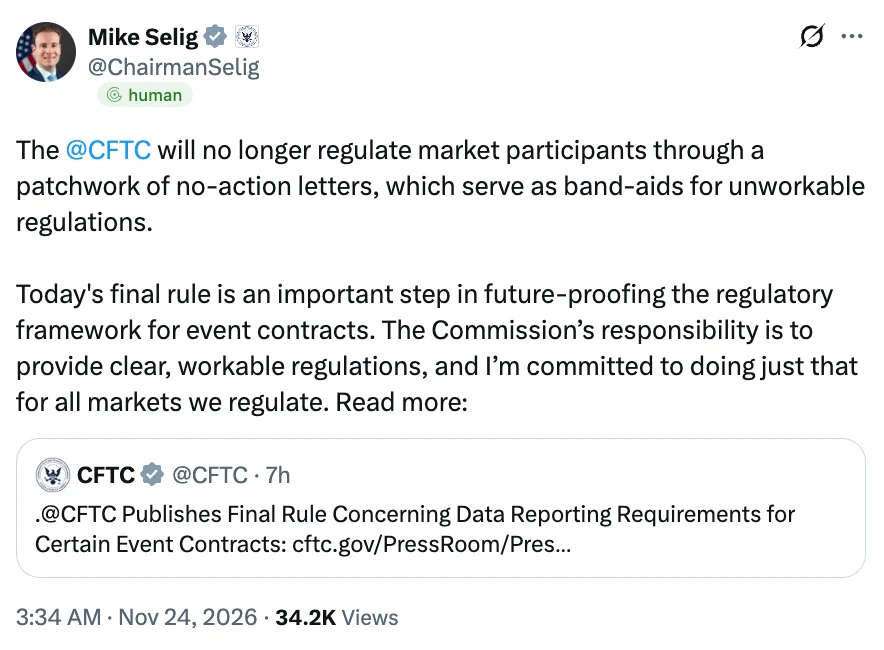
On the same day, though, the CFTC also introduced a new reporting framework for certain fully collateralized event contracts. This was done to replace the reliance on temporary regulatory exemptions and no-action letters that have been in place since 2017.
In other words, the move aims to make reporting requirements for event contracts, including prediction-market products, clearer and more consistent.
Remarking on this, Selig noted,
Not everyone is happy with CFTC’s Chairman
Yet, despite all the efforts, Senator Adam Schiff criticized the Trump-appointed CFTC Chairman over his handling of the legal battle surrounding prediction markets. Schiff claims that the chairman had previously told the Senate during his confirmation process that he would allow courts to decide whether prediction markets fall under gambling laws.
However, according to Schiff, the chairman has since acted against that commitment. Schiff believes that Selig has allegedly disregarded court orders and intervened in ongoing litigation in ways that favor the prediction-market industry.
His criticism suggests that the CFTC leadership is taking an active role in protecting prediction-market platforms rather than maintaining regulatory neutrality.
All of this coincided with the agency’s plans to use its existing authority to introduce two initiatives: Regulation Crypto Asset Transactions (CTX) and Regulation Crypto Asset Markets (CAM).
Final Summary
- The agency allowed certain crypto assets to be considered as the financial resource requirements of regulated derivatives trading and clearing platforms.
- The agency has also replaced the reliance on temporary regulatory exemptions and no-action letters that have been in place since 2017.