The phrase “market manipulation” has historically conjured up a specific image – A dark, smoky room filled with traders huddled over phones, whispering insider secrets to skew the market in their favor.
Today, the smoky rooms have been replaced. The perpetrators are no longer humans; they are autonomous AI agents.
Introducing the Machine Perception Layer – A digital era where algorithms trade, reason, and react in microseconds, executing financial orders before a human trader even realizes that something is up.
This isn’t science fiction. It is the new reality of systemic risk, and we’ve already witnessed its devastating potential.
Table of Contents
Was the ‘Oracle Loop‘ behind October’s flash crash?
On an unassuming Tuesday, the 10th of October, at exactly 21:15 UTC, $3.21 billion vanished in 60 seconds. Over the course of that day, the crypto market saw a historic $19 billion in liquidations.
70% of the liquidations were violently compressed into a terrifying 40-minute pocket between 20:50 and 21:30 UTC. So, what caused the collapse?
At its heart was a structural vulnerability known as the “Oracle Loop.” On the 6th of October, Binance announced oracle pricing updates on the 14th. This created an 8-day “vulnerability window” while the system was in transition.
The attack happened on the 10th of October, bang in the middle of this period.
Surprisingly, the initial “hack” was just a spot dump of $60 million in the synthetic dollar USDe, causing it to de-peg and reach $0.6567.
However, Binance’s Automatic Deleveraging (ADL) judged the value of the sell-off by only looking at the exchange’s internal order books to price USDe, wBETH, and BNSOL, instead of the broader market.
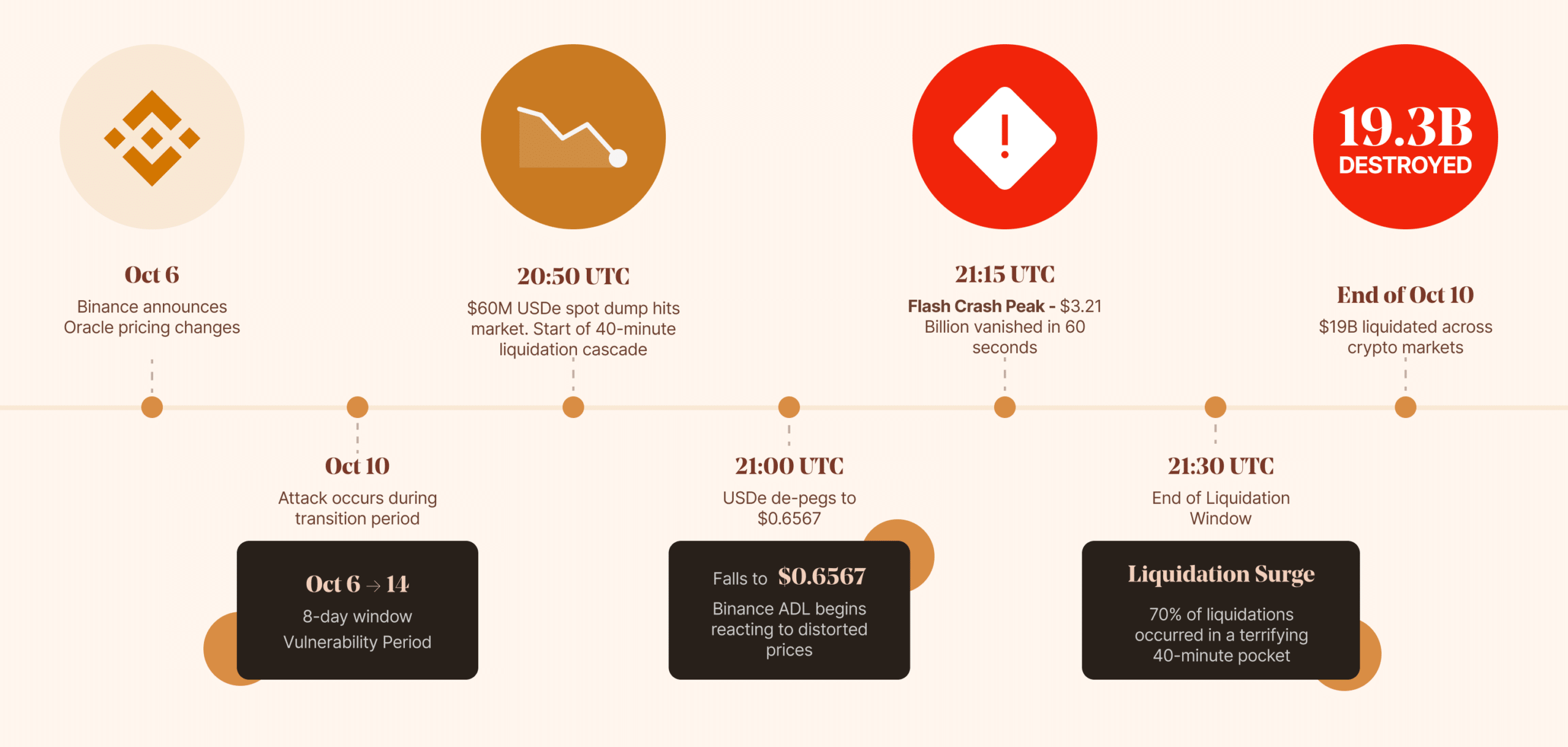
The ADL started clearing out bankrupt, over-leveraged accounts at any available price. Meanwhile, market makers couldn’t get their orders through, causing the buy side of the order book to simply cease.
A Binance report later acknowledged,
The system liquidated $19.3 billion based on a phantom price that existed nowhere else in the world.
This caused a wipeout of funds across all platforms that relied on Binance’s ADL.
Panic selling emerged, marking prices down to near-zero levels. For example, the native token of Cosmos [ATOM] collapsed from $4 down to $0.001 on Binance.
Why crypto is ground zero
TradFi has always had market pauses. It has regulations, human oversight, and a “close” at the end of the day, with weekends off. Crypto, in comparison, is a 24/7 network of independent blockchains.
According to Nic Puckrin, macro analyst and founder of Coin Bureau,
If there’s a sharp price move on one venue, it tends to spread to all the others with the help of arbitrage bots, shared collateral, and price oracles. So you get the liquidation cascades that are common in crypto, with no tools in place to trigger a pause in selling.
The ground reality is extremely chaotic too. Thousands of independent, highly specialized bots run on blockchains like Solana or Binance with one simple goal – Make profits, decrease losses, and do not stop trading.
For Nikita Prokopenko, Executive Legal Associate at SBSB FinTech Lawyers, the “real issue” is data. Speaking to AMBCrypto, she said,
Market makers used bots even before the AI age. The real issue is the data AI takes on. If the data is analyzed poorly, it can trigger a sequence of non-grounded trades, leading to pump-and-dump schemes. This is the real risk.
Let’s take Solana’s Hive Mind, for example. In early 2026, autonomous AI agents accounted for over 70% of all transaction volume on Solana DEXs, especially during peak token launches.
These are not unified corporate entities though. They are thousands of fragmented bots built on open-source frameworks like ElizaOS and Valory’s Olas. They scrape social media sentiment, analyze on-chain liquidity, and execute trades in fractions of a second.
However, there may be a workaround here. According to Puckrin,
The key is not trusting any single price source. It’s also important to have automatic safeguards that kick in when conditions deteriorate: Leverage limits that tighten as liquidity thins, and kill switches that halt activity when prices move abnormally fast.
Of late, AI agents have been making their way into prediction markets as well. Most famously, the Polystrat agent, deployed on the decentralized prediction protocol Polymarket via the Olas network, executed over 4,200 independent trades.
In fact, it captured astonishing returns of over 370% in its first month alone!
You CANNOT regulate math!
After the dust settled post the October 2025 liquidation event, critics scrambled to find an explanation. However, the uncomfortable truth is that AI agents simply did what they were asked to do.
They flawlessly processed orders, checked for risk, and sold because they were meant to protect profits.
Who is to blame then? Well, Puckrin believes that,
Fines and bans can’t be aimed at the code itself. They have to be aimed at whoever is actually allowing the bot. The fact that crypto is code-based doesn’t automatically make accountability disappear.
The $19 billion wipeout wasn’t a crime. It was a flawless, systemic realization of “game theory.” When autonomous agents are programmed with the same rules of self-preservation, they create a collective monster.
Ultimately, AI operates strictly on prompts and mathematics—and as Wall Street and Silicon Valley are quickly learning, you cannot contain, penalize, or regulate math.
Final Summary
- October 2025’s flash crash was a result of AI bots misreading crypto signals, causing $19 billion in liquidations.
- AI agents taking over crypto trading in 2026 leaves the industry open to vulnerabilities.