
Thailand has made a bold move to boost cryptocurrency adoption.
With a five-year tax exemption plan, Thailand’s Cabinet has encouraged investors to trade through regulated channels rather than unlicensed or offshore platforms.
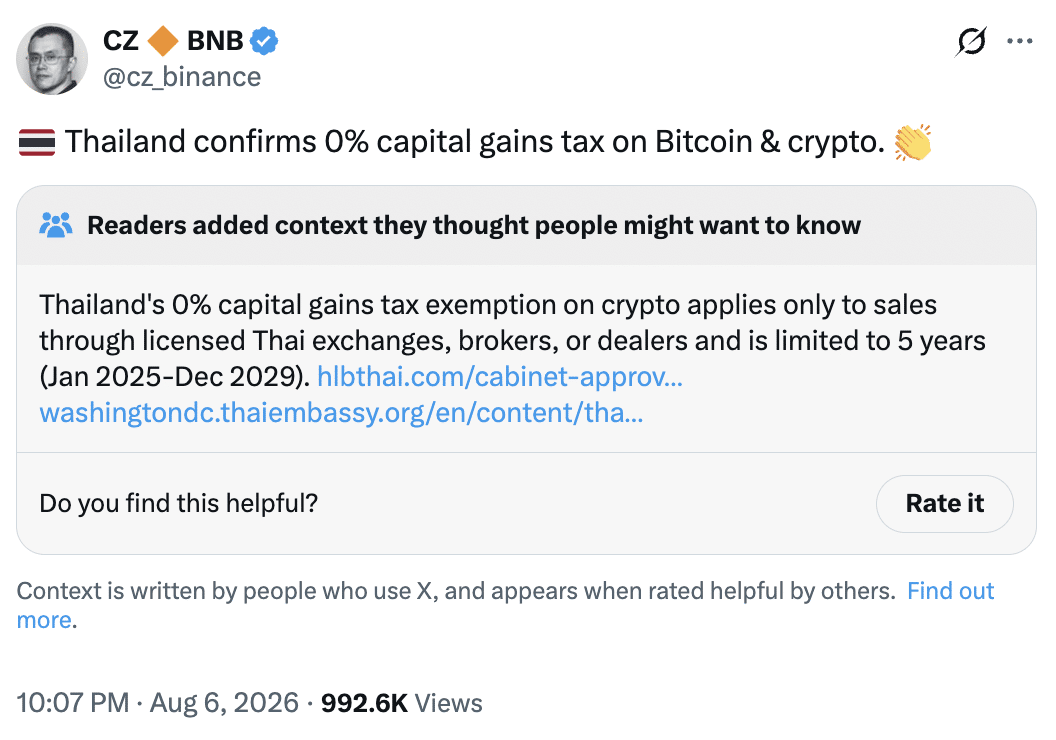
According to the proposal, between the 1st of January 2025 and the 31st of December 2029, people who purchase and sell cryptocurrencies like Bitcoin, Ethereum, or other digital assets on Thai exchanges licensed by the SEC will not be required to pay personal income tax on their capital gains.
This would in turn enable them to keep a larger portion of their investment in profits.
Table of Contents
Not universal
However, trades made on unlicensed exchanges, profits from specific foreign cryptocurrency ventures, or transactions that don’t adhere to Thailand’s regulatory standards are still subject to the standard progressive personal income tax rates, which can go up to 35%.
By tying the tax benefit to authorized exchanges, the government is enhancing oversight of the domestic cryptocurrency market. Additionally, they are also promoting adherence to investor protection, anti-money laundering, and know-your-customer (KYC) regulations.
Back in July, Deputy Finance Minister Julapun Amornvivat had applauded this move when he said,
This is a key step in boosting Thailand’s economic potential and a major opportunity for Thai entrepreneurs to thrive on the global stage.
At present, Changpeng Zhao, former CEO of Binance, also appreciated this move and noted,
Is this good news for Thailand’s crypto ecosystem?
Because capital gains from cryptocurrency investments are already exempt from personal income tax, they are essentially placed on the same tax footing as stocks listed on the Stock Exchange of Thailand.
Simply put, the exemption aims to increase trading activity on regulated platforms, enhance market transparency, and fortify investor protection.
Additionally, this is an add-on to Thailand’s previous crypto-friendly reforms. For those unaware, the latter included removing the 7% VAT on the sale of cryptocurrencies and capping personal income tax at 15% for some profits from holding digital tokens.
That said, investors should keep in mind that the incentive is only meant to last until the end of 2029, unless the government decides to replace or extend it.
Thailand’s crypto adoption rate
This comes as Thailand accounts for widespread retail adoption, with approximately 6.2 million Thai people, or 9.3% of the total population, being cryptocurrency owners as per 2024’s TripleA report.
However, with Thailand’s Bitkub recently facing a criminal complaint over a 1.7B-baht hack, which took place back in May 2021, concerns remain.
This coincided with South Korea also proposing a 22% crypto capital gains tax, which is set to go live in early 2027 but currently remains under strong opposition.
Final Summary
- Between 2025 and 2029, people who trade crypto on Thai exchanges licensed by the SEC will not be required to pay personal income tax on their capital gains.
- This tax exemption plan complements Thailand’s previous crypto-friendly reforms.