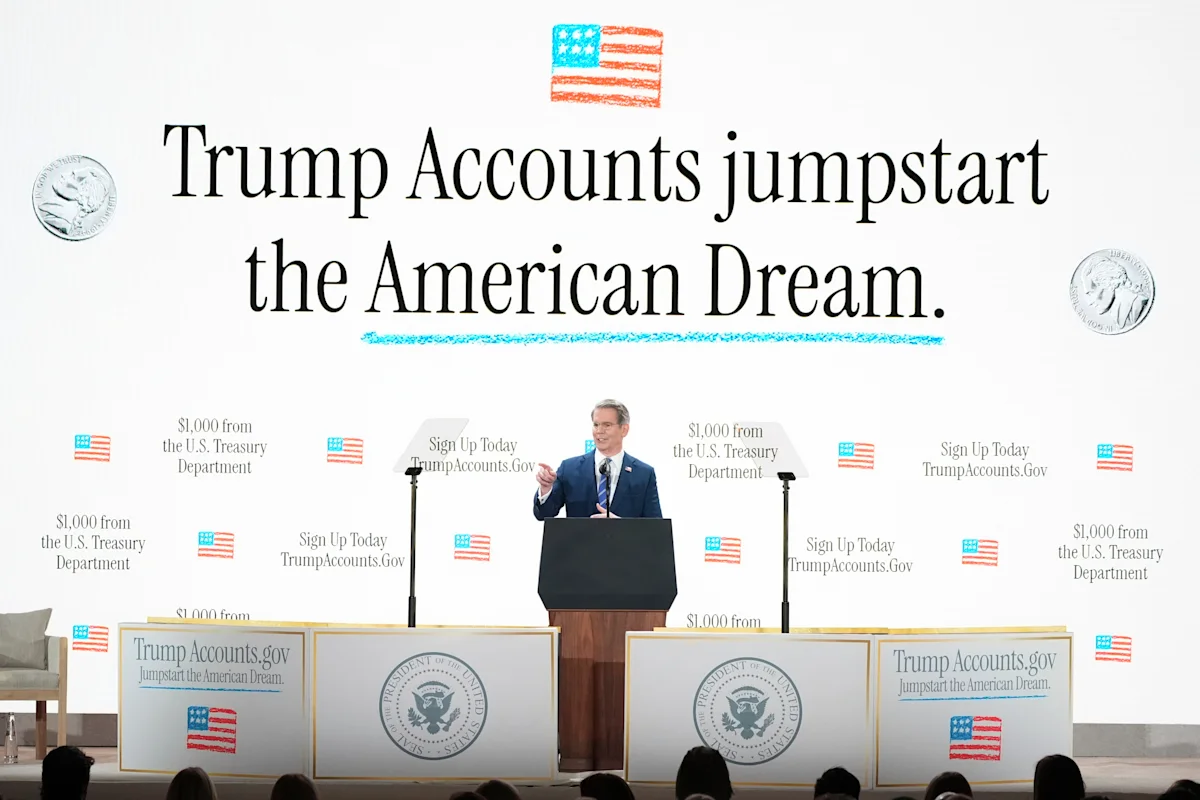
Trump Accounts, created under the One Big Beautiful Bill Act, were designed to help families build wealth by helping kids invest early. But so far, many of the families who could benefit most are not participating, according to one recent study.
Just 5% of low- to moderate-income families eligible for a 530A Trump Account have actually opened one, according to a study by the national nonprofit Commonwealth. The organization surveyed over 1,000 eligible parents living on low or moderate incomes following the program’s July 4 launch.
The Trump administration has said these accounts will “afford a generation of children the chance to experience the miracle of compounded growth and set them on a course for prosperity from the very beginning.”
However, the survey indicates that many parents are still unsure how the accounts work, keeping them from taking advantage of them — and, for some, leaving a $1,000 starting deposit on the table.
Read more: Trump Accounts just added another perk for working parents
Table of Contents
Why some parents haven’t opened Trump Accounts
According to the Commonwealth survey, awareness of Trump Accounts isn’t necessarily the biggest obstacle among low- to moderate-income families. Fifty-five percent of eligible parents surveyed said they were aware of the program. That share rose to 65% among parents also eligible for the $1,000 federal contribution.
Still, 36% said they are simply undecided about whether to sign up.
“Families often lack clear information about how the 530A/Trump accounts work logistically, how they fit alongside other investment accounts, and whether the accounts would continue into the future through administration changes,” Timothy Flacke, CEO and co-founder of Commonwealth, told Yahoo Finance.
“Information gaps, misconceptions, and unclear guidance can create barriers. Many of us hesitate to act or follow through when we feel uncertain or have unanswered questions.”
Many parents’ uncertainties are financial. Of those surveyed, 27% of eligible parents were concerned about how the account could affect their tax responsibility or eligibility for benefits. About a quarter (25%) also say they cannot afford to contribute to the account.
“For many families, early investing opportunities can feel complex or inaccessible,” Flacke said.
A lack of trust in the Trump administration was another barrier, cited by 25% of eligible parents.
Flacke said the findings point to a need for clear communication about the account benefits and long-term wealth-building potential, in “neutral, transparent language — including both ‘530A’ and’Trump’ together to be clear about the accounts’ name and their basis in the federal tax code, through legislation passed and funded by Congress.”
Read more: These are all the companies pledging matching funds to Trump Accounts
Top questions about Trump Accounts, answered
Some financial experts say Trump Accounts have drawbacks compared to other tax-advantaged accounts for kids. And given how new the program is, details involving additional contributions from nonprofits and investment options are still evolving.
Nevertheless, education and information for families across income thresholds is an important part of helping those eligible make the choice that’s right for them.
Here are some of the top questions eligible parents had concerning Trump Accounts — along with the answers we know so far:
How do Trump Accounts grow over time?
A Trump Account is a form of IRA (individual retirement account) and can grow over time via investments. However, Trump Account funds may only be put in select eligible investments during the “growth period” before a child turns 18.
These eligible investments, according to the law, include “mutual funds or exchange traded funds, which must track either the Standard and Poor’s 500 (S&P 500) stock market index or another index tracking the returns of equity investments in ‘primarily United States companies.'” Eligible investments also cannot charge more than 0.1% in annual fees.
To start, Trump Account funds will be invested in the State Street SPDR Portfolio S&P 500 ETF (SPYM) by default. Other eligible investments that parents can later choose include iShares Core S&P 500 ETF (IVV), Vanguard Total Stock Market ETF (VTI), and State Street SPDR Portfolio S&P 1500 Composite Stock Market ETF (SPTM).
Parents and children can view investments within the Trump Account app or online account to see how they’re performing. Over time, the funds in the account will grow in the market, whether parents are able to contribute annually or rely on the opening deposit.
Also read: Trump Accounts app: How to sign up and get started
Which Trump Accounts are eligible for free deposits?
Young children and newborns may be eligible for a one-time, $1,000 “government seed contribution” when opening a Trump Account. This applies to children born between Jan. 1, 2025, and Dec. 31, 2028. This is a one-time contribution, and it doesn’t count against the $5,000 annual contribution limit.
Some accounts may also be eligible for additional contributions from employers, philanthropists, and corporations. According to Flacke, these government and private donor contributions are available to millions of eligible children.
“Parents do not have to deposit a dime in these accounts in order for their kids to receive these funds — but they must open accounts for their kids,” Flacke said.
Even if parents can’t afford to make additional contributions, the opening deposit can help the account grow over time.
What can the money in a Trump Account be used for?
Trump Account funds can be especially useful for qualified expenses, such as college expenses or first-time home purchase.. That’s because of the taxes that can apply for withdrawals.
Families generally won’t be able to withdraw funds from their Trump Account before a child turns 18. At age 18, the Trump Account can be used like any other traditional IRA — which means that certain restrictions apply.
Also read: How Trump Accounts could impact your child’s student aid
Account holders can continue making contributions annually, but any withdrawals made before age 59½ will be charged a 10% penalty, except for certain exceptions. These are a few instances in which Trump Account funds can be used by account holders without any early withdrawal penalty:
-
Higher education expenses
-
Buying a first home ($10,000 limit)
-
Child birth or adoption ($5,000 limit)
-
Personal emergency expenses ($1,000 annual limit)
-
Qualifying medical expenses
-
Health insurance premiums during unemployment
When account holders make these qualified withdrawals, contributions typically aren’t taxed. However, any earnings from the IRA are taxable.