
From a technical standpoint, SOL has been the worst performer in the Q4 rally. It’s currently trading at just a few points above $50 and has recently fallen below $70 once again, resulting in another wave of weak hands taking profits. $50 is back on the radar.
In this light, the focus shifts to Fidelity’s latest report, in which the firm called Solana,
An emerging piece of financial market infrastructure.
According to the report, Solana’s trading volume was about 15% of the big five U.S. stock exchanges combined this year. Meanwhile, its trade count has also grown nearly 100x since 2022, compared with just 1.76x growth across major U.S. stock exchanges.
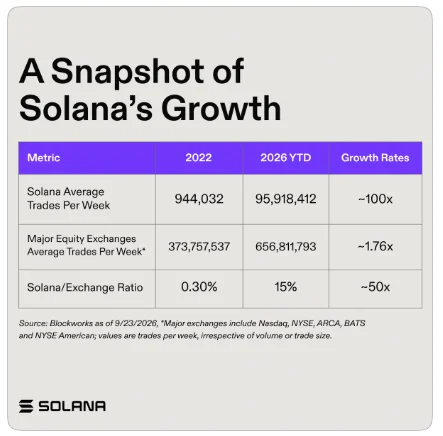
In essence, Solana’s competitive edge is becoming increasingly tied to on-chain trading activity.
From a structural perspective, this provides more weight to Solana’s DeFi growth. Increased trade will drive higher transaction fees and overall revenue within the Solana ecosystem. This provides a clearer utility story for SOL.
As a result, SOL’s long-term value may be more dictated by on-chain demand.
If this proves true, SOL may have strong fundamentals underlying the price weakness. An increase of network activity will help maintain the long-term outlook, therefore creating a potential longer-term investment.
So the bigger question now will be whether increased macro liquidity can cause the on-chain growth to filter through to Solana’s [SOL] price.
Solana’s on-chain activity meets rising macro liquidity
Liquidity and capital flows into risk assets tend to move together.
This is evident in the stablecoin market, where total market cap has slipped below $300 billion following a 1.7% weekly decline. This marks the first drop below this level since the market rallied toward $320 billion ahead of last October’s crash.
The result? Solana breaking below the $50 level.
There is still not enough liquidity in the stablecoin market to create strong bullish momentum, although there are some positive signs that liquidity is increasing.
Circle has just created $250 million more USDC on the Solana blockchain, and the U.S. M2 money supply has gone up $113 billion to record levels of $23.41 trillion.
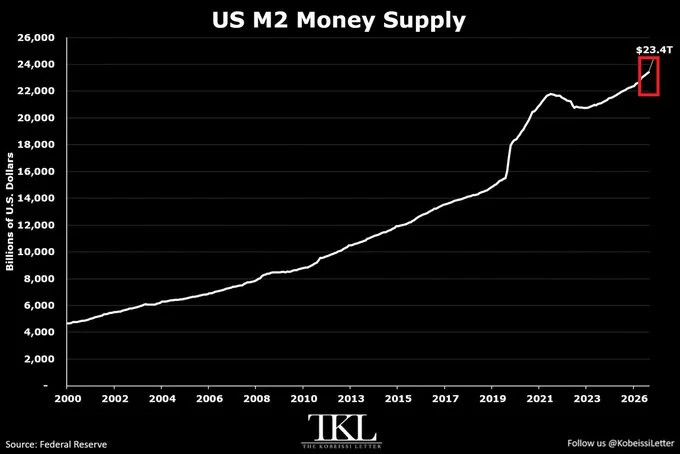
In essence, macro liquidity is expanding, potentially setting the stage for capital to flow back into crypto.
This places Solana in an interesting position. Whilst price movement has been poor, on-chain activity and liquidity overall are showing signs of improvement.
Should capital flow back into the market, SOL’s increasing on-chain activity could be a major factor in driving the next rally.
In this context, Solana’s 15% share of trading volume could be just the start. Increased macro liquidity can increase on-chain activity, which will increase the fees on the network, thus improving revenue.
An increase in capital flowing into the crypto market will put Solana in a great position to turn this growing adoption into its next major growth phase.
Final Summary
-
Fidelity highlights Solana’s growing adoption, with trading volume reaching 15% of the five major U.S. stock exchanges combined.
-
Rising USDC supply and record U.S. liquidity could bring fresh capital into crypto, boosting Solana’s network activity and supporting SOL’s next rally.