
A key divergence might be taking shape within XRP’s current market structure.
On the macro level, the asset is following the general market weakness. Down more than 7% this week, XRP has broken below $1.5. However, this is in line with the broader risk-off move that saw the total crypto market value drop more than 4%, pushing high-caps below crucial support levels.
But what happens when the market reverts to risk-on? Given XRP’s current positioning, it wouldn’t be surprising to see it lead the charge in the next wave of risk-on flows. To begin with, Evernorth has completed its SPAC merger with Armada II, bringing approximately 473 million XRP and $300 million in gross cash proceeds into the public markets.
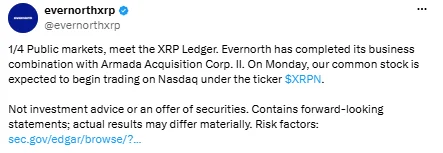
For context, the 473 million XRP figure represents the amount of XRP that Evernorth holds in its treasury. Thus, by embarking on this merger with Armada II, Evernorth is enabling the firm to enter the public markets and provide investors with an alternate avenue for gaining exposure to Ripple [XRP].
According to AMBCrypto, this is where the divergence gets interesting.
Data from SoSoValue shows XRP ETFs continuing to see net inflows, despite BTC and ETH ETFs recording outflows. XRP ETFs also clocked $67 million in daily trading volume.
The key takeaway? Franklin Templeton is beginning to close the gap with Bitwise, in terms of daily volume. Bitwise previously led by a large margin, but Franklin is now beginning to catch up, pointing to growing activity across XRP ETF products.
XRP ETF inflows defy BTC and ETH as strategic positioning builds
Notably, Evernorth’s merger and upcoming XRPN trading can be a beginning of a more significant trend.
On the fundamental side, the XRP Ledger is also seeing progress. The latest upgrade introduces delegated key controls for banks, stablecoin issuers, and tokenized funds. In essence, businesses can grant permission to a particular account to approve customers on separate accounts while keeping their primary wallet keys offline.
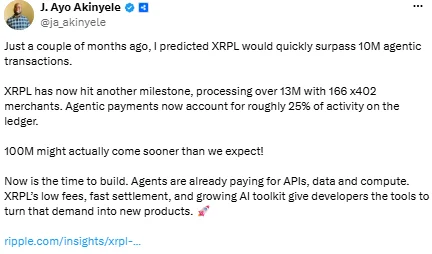
Such a feature might make the XRPL much more attractive to institutional players that want to exercise greater control and security over digital assets. In addition to this, XRPL’s emerging agentic economy is another indicator of increased activity on the ledger. As the post below shows, it has already achieved a record 13 million with 166 x402 merchants.
Agentic payments are currently representing approximately 25% of its ledger activity. If this trend continues, it is likely to cross the 100 million milestone in roughly 12 months.
Together, these signals suggest that XRP’s recent divergence may be more than a random capital rotation.
With Evernorth’s merger, upcoming XRPN trading and increased XRPL activity, XRP’s ETF inflows reflect a more “strategic” capital rotation, even as the broader market faces weakness. Should this development persist and the market turn risk-on, XRP could be well-positioned to lead the next leg of capital rotation.
Final Summary
-
XRP ETFs are seeing inflows despite BTC and ETH ETF outflows, while Evernorth’s merger adds to growing institutional interest.
-
With XRPL activity rising and new upgrades rolling out, XRP could lead the next market recovery if sentiment turns bullish.