During CNBC’s Mad Money episode aired on August 5, Jim Cramer addressed investor concerns surrounding Space Exploration Technologies Corp. (NASDAQ:SPCX) and its immense capital requirements. Explaining why he remains bullish on SpaceX’s long-term trajectory despite the massive expenditures involved, Cramer stated:
I want to take this moment to explain why the stock might be valuable years down the road. Again, with the caveat that I don’t know how many years or even which road, but you know what? It doesn’t matter. I’m not being facetious here. This is Elon Musk we’re talking about, quite possibly the greatest business person of our time. Because of his success with Tesla, he’s been able to raise all the money he needs to get the job done. So even as skeptics may blanch about the long-term viability of a company with so much mammoth ambitions that need so much cash, I want to tack the other way and say that Musk will never have trouble raising money. He easily raised $44 billion to buy the money-losing Twitter, for heaven’s sake. So I bet he’ll have no problem raising a couple hundred billion dollars here or maybe a few hundred billion dollars there, or possibly much more once SpaceX has a line of sight to profitability. He has that many acolytes, that many true believers, many of whom have enough money to help his cause. As long as he’s there, I think this one’s good to go, which is one of the reasons I like the story.
Jim Cramer Is Telling Investors to Accumulate SpaceX for the Long Term
Orbital Computing and Starlink
Cramer also highlighted the Space Exploration Technologies Corp.’s (NASDAQ:SPCX) dominance in launch capacity, as he noted that its Falcon class delivers roughly 2,500 tons to orbit annually, representing 80% to 90% of Earth’s total payload volume. He pointed to Musk’s plans for Starship to scale capacity to millions of tons, enabling long-range initiatives like orbital data centers powered by solar energy and natural space cooling, which is an idea conceptually endorsed by NVIDIA CEO Jensen Huang.
In the near term, Cramer emphasized Starlink as the commercial engine funding these long-range projects. Operating in 167 global markets, Starlink added 1.7 million subscribers in a single quarter, with President and COO Gwynne Shotwell anticipating continued market share gains from legacy telecom carriers. Cramer compared SpaceX to a 100-year railroad bond, and framed it as a generational holding for patient investors looking past short-term lockup expirations toward multi-decade upside.
Unmatched Access to Private Capital
The development of Starship launch systems and satellite networks requires tens of billions in recurring investment. While heavy capital needs strain traditional aerospace balance sheets, Cramer noted that Musk’s track record gives SpaceX an unprecedented capital runway. With the company’s public market valuation hovering around $1.7 trillion, its history of strong private-market backing, and Musk’s ability to mobilize market liquidity, SpaceX ensures funding channels remain wide open as the enterprise scales.
While we acknowledge the potential of SPCX as an investment, we believe certain AI stocks offer greater upside potential and carry less downside risk. If you’re looking for an extremely undervalued AI stock that also stands to benefit significantly from Trump-era tariffs and the onshoring trend, see our free report on thebest short-term AI stock.
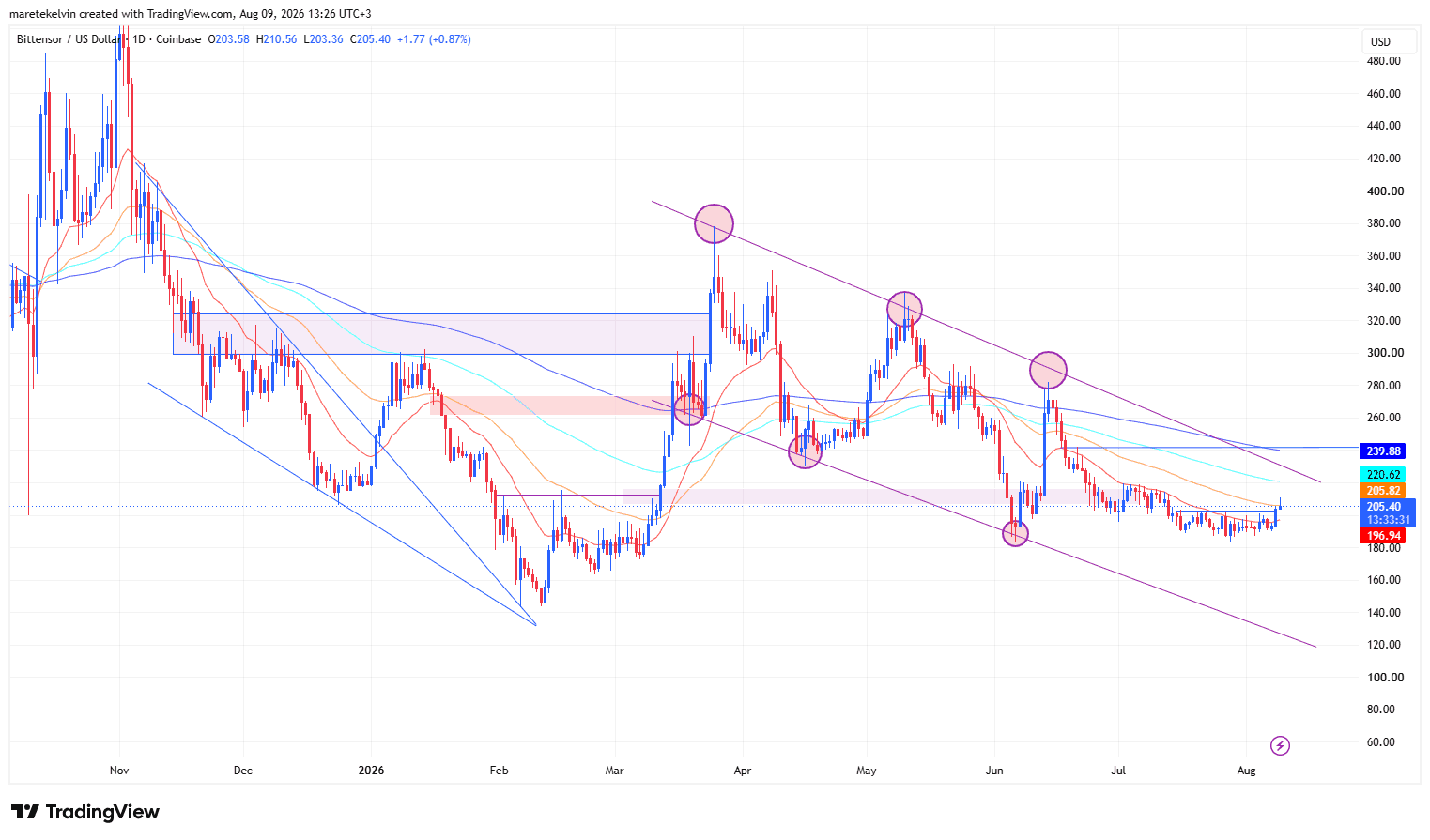
Bittensor [TAO] has recorded a three-day bullish run, with yesterday’s aggressive surge pushing the token above the 20-day and 50-day EMAs while clearing the $202.50 resistance that had held for weeks.
However, TAO remains within a bullish flag pattern that has held since March. With whale activity increasing, spot buyers dominating, and Open Interest climbing, could TAO extend its recovery toward $240?
TAO breaks above key resistance
TAO surged above the $202.50 resistance and the 20-day EMA before briefly testing the 50-day EMA around $205.82.
The move strengthens the bullish setup, although the token remains inside its broader bullish flag, making the $205-$220 zone the next key zone for buyers.
A sustained break above the 50-day EMA could expose TAO to the 100-day EMA at $220.62, while a successful move beyond this level would put the $240 resistance in focus.
Source: TradingView
Could the positive on-chain metrics accelerate the bullish run?
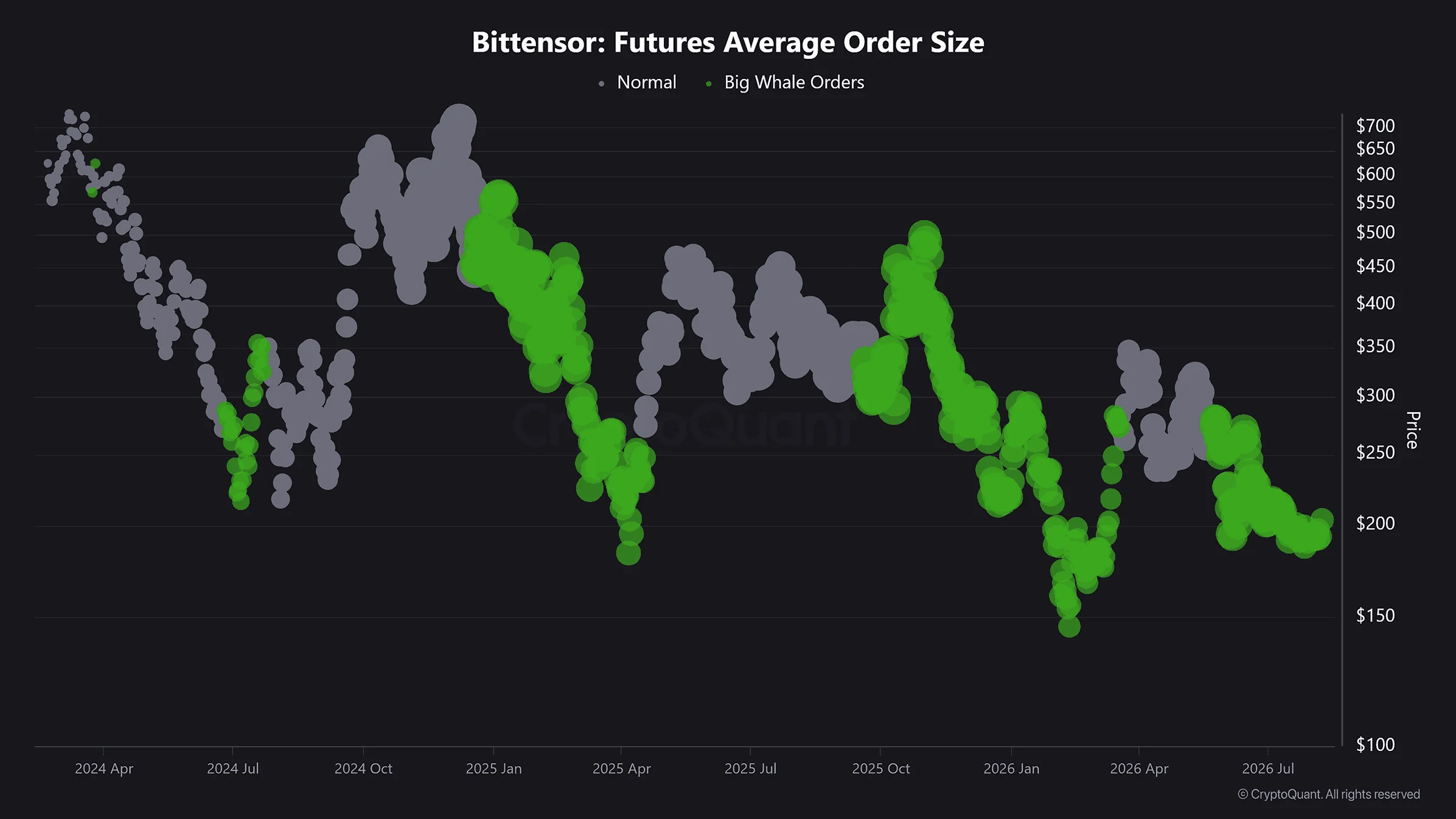
Recent Futures Average Order Size data shows that large whale orders are increasing around TAO’s current trading price, signaling greater participation from larger market players.
Bitternsor’s continued accumulation near $200 could provide additional demand and help buyers defend the recent bullish gains.
Source: CryptoQuant
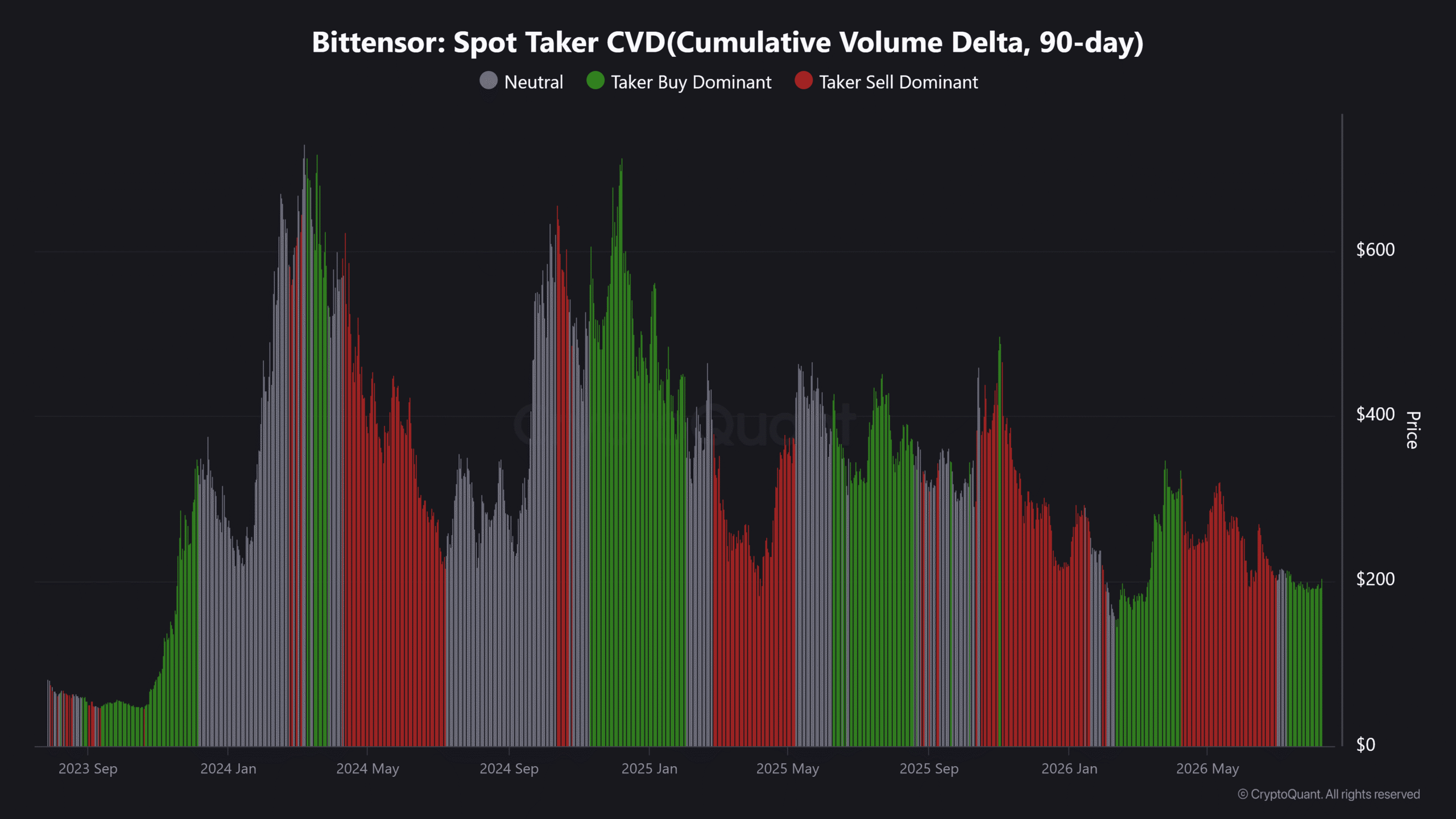
Moreover, TAO’s Spot Taker CVD data also indicates a stronger buyer dominance, suggesting that aggressive buyers are increasingly absorbing available sell-side liquidity.
If this buying pressure persists, it could provide the spot-market confirmation needed for TAO to maintain its bullish momentum and challenge higher resistance.
Source: CryptoQuant
Moreover, TAO’s Open Interest has surged 12% to $140.2 million, highlighting a sharp increase in capital entering the derivatives market during the latest price recovery.
Usually, rising Open Interest alongside price gains suggests traders are positioning for a further bullish rally. The increasing open positions in the market could provide the required volatility to keep the momentum running toward $220.62 and eventually $240.
Source: Coinalyze
Volume strengthens the move
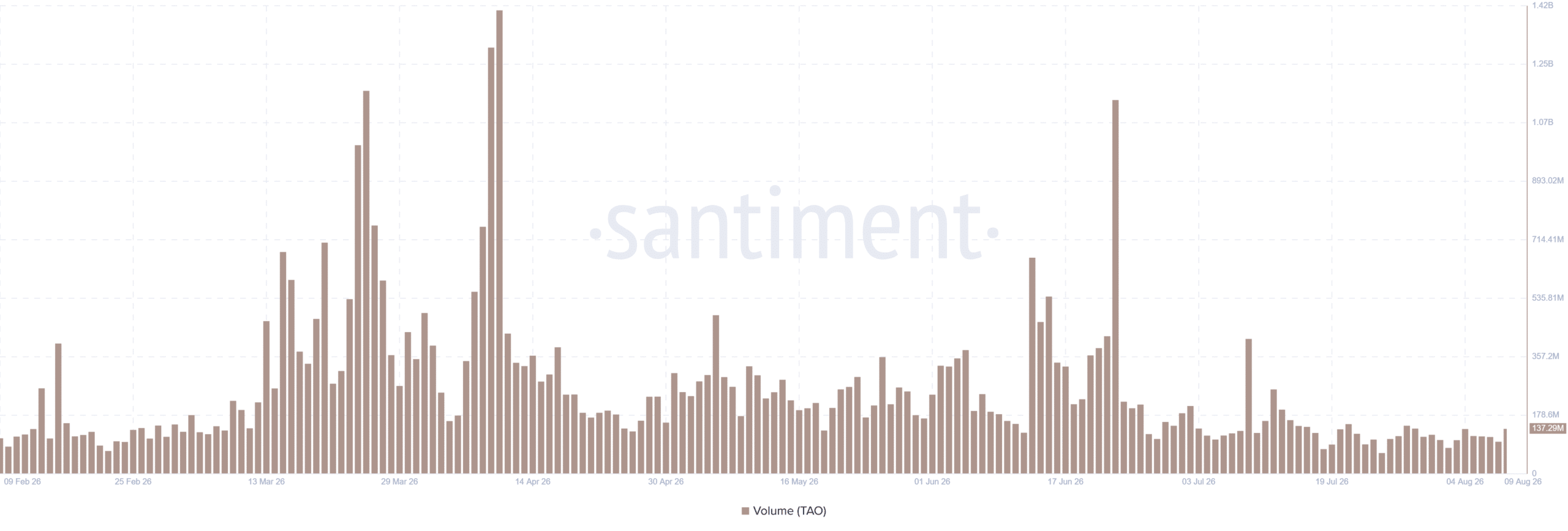
TAO’s trading volume has climbed to $128 million, confirming stronger market participation behind the recent three-day rally.
The altcoin’s sustained volume at elevated levels could help validate the breakout and give buyers enough momentum to challenge the upper boundary of the bullish flag.
With TAO holding above $202.50, rising whale activity, buyer-dominated spot flows, and growing OIcould keep the bullish setup intact. A break above the 100-day EMA at $220.62 could open the path toward $240.
Source: Santiment
Final Summary
TAO clears $202.5 resistance as bullish momentum accelerates toward the $240 target.
Rising whale orders, Spot CVD, Open Interest, and volume strengthen TAO’s breakout setup.
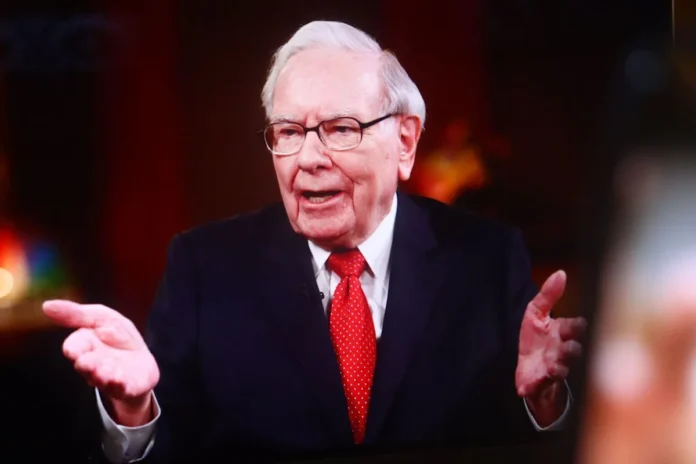
Image of Warren Buffett by Photo Agency via Shutterstock
Legendary investor and former Berkshire Hathaway (BRK.A) (BRK.B) Warren Buffett once famously described his Dexter Shoe acquisition as a “gruesome mistake,” though not necessarily for the reason most investors might assume.
But for modern CEOs, and the investors who watch their maneuvers, the decision now stands as one of the most instructive lessons in corporate finance history. At its core, the Dexter Shoe acquisition illustrates the catastrophic cost of using an appreciating currency—Berkshire Hathaway stock—to purchase a depreciating asset.
More News from Barchart
In 1993, Berkshire acquired Dexter Shoe Company for approximately $433 million, which it paid entirely in stock, roughly 25,203 Class A equivalent shares at the time. The business itself ultimately proved worthless, as cheap foreign imports decimated Dexter’s competitive position, rendering the company’s domestic manufacturing model obsolete within a decade.
The true magnitude of the error, however, extends far beyond the initial purchase price. Because Buffett paid with Berkshire stock rather than cash, the real cost of the deal compounded relentlessly as Berkshire’s share price appreciated over the following decades.
Those shares given to Dexter’s sellers would be worth tens of billions of dollars today, given that Berkshire Hathaway Class A shares now trade above $780,000 each. The lesson is that when you use an undervalued or appreciating stock as acquisition currency, any misjudgment about the target’s value is amplified exponentially over time.
Buffett himself has repeatedly acknowledged this mistake in his annual letters to shareholders, noting that he gave away a piece of a wonderful business to acquire something that turned out to be worthless.
“I have made plenty of mistakes,” Buffett wrote in his 2014 letter to Berkshire shareholders. “…The most gruesome was Dexter Shoe. When we purchased the company in 1993, it had a terrific record and in no way looked to me like a cigar butt. Its competitive strengths, however, were soon to evaporate because of foreign competition. And I simply didn’t see that coming.”
Buffett continued on, writing that the $433 million cost of the acquisition “doesn’t come close to recording the magnitude of my error”:
The fact is that I gave Berkshire stock to the sellers of Dexter rather than cash, and the shares I used for the purchase are now worth about $5.7 billion. As a financial disaster, this one deserves a spot in the Guinness Book of World Records.
Several of my subsequent errors also involved the use of Berkshire shares to purchase businesses whose earnings were destined to simply limp along. Mistakes of that kind are deadly. Trading shares of a wonderful business– which Berkshire most certainly is– for ownership of a so-so business irreparably destroys value.
We’ve also suffered financially when this mistake has been committed by companies whose shares Berkshire has owned (with the errors sometimes occurring while I was serving as a director). Too often CEOs seem blind to an elementary reality: The intrinsic value of the shares you give in an acquisition must not be greater than the intrinsic value of the business you receive.
This experience reinforced a principle that has guided Berkshire’s capital allocation philosophy ever since: the immense importance of being disciplined about the form of payment in acquisitions.
Greg Abel, Buffett’s successor who took over as Berkshire Hathaway CEO at the start of 2026, appears to have internalized this lesson thoroughly, as evidenced by the recent $6.8 billion cash acquisition of Taylor Morrison Home and the preference for deploying Berkshire’s massive cash reserves rather than issuing equity.
The Dexter mistake also highlights a broader truth about competitive moats that Buffett frequently discusses. Namely, what appeared to be a solid business with reliable earnings lacked a durable competitive advantage, and when low-cost international competition arrived, the entire enterprise was destroyed.
Buffett has since emphasized that understanding the permanence of a company’s competitive position is paramount before committing capital.
The combination of misjudging the business quality and compounding the error through the use of stock makes Dexter perhaps the single most expensive mistake in Berkshire’s history on a per-share basis, as well as a cautionary tale about the irreversible nature of equity dilution when the acquired business fails to deliver lasting value.
This article was created with the support of automated content tools from our partners at Sigma.AI. Together, our financial data and AI solutions help us to deliver more informed market headline analysis to readers faster than ever.
On the date of publication, Sarah Holzmann did not have (either directly or indirectly) positions in any of the securities mentioned in this article. All information and data in this article is solely for informational purposes. This article was originally published on Barchart.com
In the midst of the CALRITY Act’s approval, Zach Pandl, Head of Research at Grayscale, contends that the US crypto industry can still expand even if the Act is not passed into law in 2026.
He bases this on the idea that significant portions of the crypto ecosystem are already operating without extensive market-structure legislation.
In practice, CLARITY’s failure ‘won’t have an immediate impact’ on the crypto market. This is because stablecoins would still have the ability to be used as payment methods, and Bitcoin would continue to function as a store of value.
He said,
The legislation would have provided a more comprehensive rulebook for digital assets in the US, but the industry has moved forward for almost 17 years without it.
Does Pandl believe that the CLARITY Act is unnecessary?
The greater worry, though, is about upcoming innovation and investment in the US. Needless to say, the CLARITY Act was created to give digital assets a clear regulatory framework.
But, without that framework, investors and businesses might be left in the dark about what securities laws apply, how tokenized assets can be issued, and what regulations crypto companies need to abide by.
On this note, Pandl thinks the SEC and other regulatory rulemaking can help close this gap. Especially since the current administration has already made strides in areas like institutional crypto custody, banking access, staking, and crypto exchange-traded products.
He added,
Crypto will move forward without CLARITY, supported by expected rulemaking by the SEC and other regulators. However, without comprehensive market structure rules, a greater share of new investment may occur overseas, in our view.
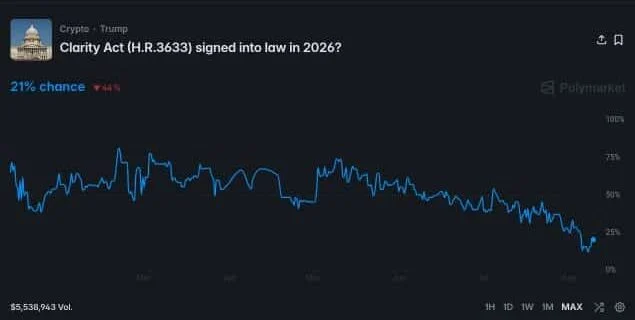
This comes as the Polymarket odds of CLARITY Act approval in 2026 stand low at 21%—a drop of 44%.
Source: Polymarket
New deadline and Senators push
But according to Patrick Witt, Executive Director of the President’s Council of Advisors for Digital Assets, Congress had more than enough time to come to an agreement on the CLARITY Act.
Hence, he argues that further delays are turning this into a political issue rather than a drafting one.
The latest blow was when pro-crypto Democrats, including Senate Minority Leader Chuck Schumer, pushed for more time to negotiate rather than proceed with a procedural vote before the August recess.
Patrick reiterates that lawmakers should go past political differences and take action before the legislative window closes.
At last, he put it best when he said,
If they can’t get there by September 15, they never will.
Final Summary
Zach Pandl believes that the CLARITY Act is not that important for the U.S. crypto market.
Senators are waiting for the 15th September deadline as the Polymarket odds drop to 21%.
Opinions expressed by Entrepreneur contributors are their own.
Key Takeaways
The 15-minute, no-code setup that turns one Google Sheet and one set of instructions into your own AI chief of staff.
The daily system that reads your sales, traffic and leads, chooses the highest-value move and keeps you focused until it is done.
How your agent catches distraction, fatigue or falling sales, then rearranges your calendar and dispatches specialist help
Most million-dollar goals do not fail because the founder lacks ambition. They fail at 10:17 on an ordinary Tuesday, when the founder opens a laptop to work on revenue and gets swallowed by messages, dashboards, administration and other people’s priorities.
By lunchtime, you have been busy for three hours. But the one action capable of moving you closer to the number has not been touched.
The usual response is another productivity app, a more detailed calendar or a smarter ChatGPT prompt. None of those can tell you that sales are slipping, your lead pipeline is thinning and the task occupying your morning is no longer the most important thing in the business.
That is what makes an AI agent different —and you do not need technical experience to build one.
In the video above, I show you how to create your own AI chief of staff in approximately 15 minutes using one Google Sheet, one copyable set of instructions and no code. You enter the business goal, give it the numbers that matter and define what it may change when you begin drifting off course.
This is not an AI agent that waits for you to think of the right question. It proactively reads your sales, traffic and lead data, compares your progress with the million-dollar target and identifies the highest-value action for that day.
It can ask what you are working on, notice when you have wandered into low-value work and gently pull you back. If sales fall behind, it can recommend a recovery plan. If your energy collapses, it can reduce the scope without abandoning the goal. If your week changes, it can rearrange approved calendar blocks so the work most likely to generate revenue remains protected.
You stay in control. The agent handles the watching, calculating, prioritizing and preparation; decisions involving money, customers, publishing or major commitments still come back to you.
That distinction matters.
A June 2026 U.S. Chamber Foundation study found that only 6% of small-business workers using AI employ it to automate workflows with minimal human involvement. Most people are still using AI to complete isolated tasks. The larger opportunity is giving it an ongoing role in how the business operates.
As the system grows, your chief of staff can also call on specialist agents. When the content pipeline runs dry, it can request researched video ideas. When website traffic declines, it can prepare an investigation. When the calendar becomes overloaded, it can rebuild the week around the work most closely connected to leads and sales.
In Rule #7, “Find Your Frequency,” from The Wolf Is at The Door, I explain how too many choices create a cognitive bottleneck that can lead to decision paralysis. This system reverses that problem. Instead of giving you another list of possibilities, it reduces the noise and shows you what deserves your attention now.
An AI agent cannot guarantee that you will build a million-dollar business. But it can make it considerably harder to lose another week doing work that was never going to get you there.
The video includes the exact beginner setup, the five-part operating loop and the copyable instruction you can use to build your first AI chief of staff today.
The 15-minute, no-code setup that turns one Google Sheet and one set of instructions into your own AI chief of staff.
The daily system that reads your sales, traffic and leads, chooses the highest-value move and keeps you focused until it is done.
How your agent catches distraction, fatigue or falling sales, then rearranges your calendar and dispatches specialist help
Most million-dollar goals do not fail because the founder lacks ambition. They fail at 10:17 on an ordinary Tuesday, when the founder opens a laptop to work on revenue and gets swallowed by messages, dashboards, administration and other people’s priorities.
By lunchtime, you have been busy for three hours. But the one action capable of moving you closer to the number has not been touched.
Eli Lilly (LLY) posted a second-quarter result strong enough to shift the debate around its stock.
For months, the debate centered on one worry: a slow start for its new obesity pill. That worry did not disappear in the second quarter, but it stopped driving the conversation.
Bank of America came out of the earnings call pointing to a different number.
The bank thinks the obesity market outside the United States could eventually surpass U.S. sales of the same drugs.
For anyone holding LLY or considering it, that international call is worth a closer look.
Why Bank of America raised its Eli Lilly price target after the quarter
Bank of America lifted its price objective on Eli Lilly (LLY) to $1,344 from $1,334, according to a BofA Global Research report shared with me.
The bank kept its math simple, applying an unchanged 28.5 times multiple to its updated 2027 underlying earnings estimate, which removes one-time research charges.
More Health Care Stocks:
That multiple sits above what BofA uses for other large drugmakers. Lilly is expanding faster than its peers, so the bank pays more for each dollar of future profit.
The raise followed a second quarter that beat expectations.
Lilly reported revenue of $23.0 billion, up 48% from a year earlier, and adjusted earnings of $8.38 a share against a $6.01 consensus, CNBC reported.
Lilly also raised its full-year revenue forecast to $85 billion to $87 billion, up from $82 billion to $85 billion, according to a press release.
The international obesity market that could outgrow the U.S.
For years, the U.S. drove almost all of Lilly’s obesity sales. That is changing quickly, and it is the shift BofA flagged for investors.
The bank noted that GLP-1 sales in international obesity markets are now approaching parity with the U.S.
GLP-1 drugs are a class of medicines, sold as injections and now pills, that treat diabetes and obesity by curbing appetite, BioPharma Dive reported.
Mounjaro, Lilly’s diabetes injection, grew 55% in Europe, 30%in Japan, and 93% in China last quarter.
That growth is why BofA believes the non-U.S. opportunity could eventually surpass the home market, since most large countries have far more untreated patients than the U.S. does.
Bank of America sees Eli Lilly’s obesity franchise expanding faster overseas than at home.JHVEPhoto / Getty Images
What the Foundayo launch abroad means for Lilly’s next leg
The clearest catalyst BofA cited is Foundayo, Lilly’s oral GLP-1 pill.
Foundayo matters because it’s a pill, not a shot. That opens the drug to patients who won’t take a weekly injection, a group Lilly’s other treatments have never reached.
Its U.S. debut was modest. Foundayo brought in $98 million, slightly below the roughly $103 million analysts expected, CNBC reported.
BofA is looking past that number and expects the international launch to matter more, estimating roughly 60% of Foundayo’s peak sales to come from outside the U.S.
That launch is close. Lilly has filed for approval in more than 40 countries and plans an overseas rollout in early 2027, BioPharma Dive reported.
Both Lilly and rival Novo Nordisk (NVO) described strong pent-up demand for an oral option abroad, where injectables have faced supply limits, Fierce Pharma reported.
Lilly’s launch has trailed Novo’s oral Wegovy so far, Pharmaphorum noted.
How the Medicare Bridge program feeds U.S. demand
On July 1, Medicare’s GLP-1 Bridge program went live, opening obesity-drug coverage to about 20 million eligible beneficiaries.
BofA said early feedback from Lilly and Novo points to smooth access, with most early adoption coming from patients new to GLP-1 treatment.
Millions of older Americans who could not previously get these drugs now can, widening the paying customer base.
Lilly told analysts that Bridge patients can get both oral and injectable GLP-1s, though injectables remain the early preference.
The pricing trade-off investors keep watching
U.S. GLP-1 prices keep falling as more patients come in through cash-pay channels and programs like Bridge.
BofA pegged second-quarter U.S. net sales at about $580 per prescription, down 15% from a year earlier but flat from the prior quarter.
That drop was milder than the bank had modeled. Still, BofA expects the blended U.S. price to keep falling through the second half of 2026 as cheaper channels grow.
Lilly’s management calls the trade-off worth it, because volume is rising faster than price is falling. That same pattern carried the stock through the first quarter.
Investors should watch this closely, because the call depends on demand outrunning prices. If volume ever stalls while prices fall, the case turns quickly.
Where Lilly’s pipeline keeps it ahead of rivals
The bank said Lilly remains a step ahead of competitors, pointing to late-stage assets that could extend its lead past today’s drugs.
Two names anchor that view:
Retatrutide, a next-generation triple-hormone shot that posted weight loss approaching bariatric-surgery levels in Phase 3 trials, according to a press release. Its U.S. filing is planned for the first quarter of 2027.
Eloralintide, an amylin-based drug BofA just added to its Lilly model, reflecting how much depth the pipeline now carries.
The takeaway for investors is that Lilly does not rely on just one product. Even if Foundayo’s U.S. sales remain slow, the company has several ways to extend its franchise.
What LLY investors should do with this
Lilly closed at $1,192.52 on Aug. 6, up 1.94% on the day and up 3.83% over the prior five sessions. That’s also near its 52-week high of $1,249.45.
At that level, BofA’s $1,344 target implies about a 13% increase over the next year.
A few things to keep in mind before acting:
The stock trades at a price-to-earnings ratioaround 40, so a lot of future growth is already priced in.
One weak quarter on volume or pricing could hit the shares hard at this valuation.
The international launch is the real swing factor, and it does not begin in earnest until early 2027.
The case for owning Lilly rests on demand growing faster than prices fall, at home and abroad. The second quarter showed that pattern still holds, which is why BofA raised its target.
Anyone considering LLY should size a position to their own risk tolerance, and remember that even a dominant company can see a sharp pullback when expectations run this high.
Dow Jones futures fell slightly Sunday evening, along with S&P 500 futures, while Nasdaq futures were little changed. Iran news is in focus. Warren Buffett’s Berkshire Hathaway reported earnings on Saturday, with Cisco, Lumentum and Applied Materials among the notable companies on tap this coming week. A stock market rally is back in full force, with the S&P 500 and…