“They came to us highly recommended by an alumni CEO that we had already backed,” Rist told CoinDesk in an interview. “So, there was a lot of trust there, and this CEO said, ‘You got to meet these guys’. They were serial entrepreneurs coming out of South Africa. They’d never built businesses outside of South Africa, but they were hungry. They were relentless.”
Despite enjoying a sturdy exit, Rist said he feels mixed emotions toward the Mastercard acquisition, having been part of the whole BVNK journey. “It’s actually sad to sign the papers, almost like sending your son off to boarding school,” he said.
Chris Harmse, co-founder and chief business officer at BVNK echoed this: “It’s been an incredible journey,” he said in an email. “Concentric has been a valued partner throughout that journey.”
Stablecoins, one of the busiest areas of crypto, have become a focal point for the large card networks and payments players. The total stablecoin market cap is about $300 billion, according to CoinGecko data.
The proverbial cat was set loose among the pigeons when Stripe acquired stablecoin infrastructure firm Bridge in late 2024 for $1.1 billion. This probably put pressure on the likes of Visa and Mastercard to start kicking the tires of other stablecoin shops so as not to be outflanked by Stripe’s aggressive approach.
The U.S. energy system has helped mitigate the shock loss of oil and LNG supply from the Middle East when the Strait of Hormuz closed to traffic and sent refiners and gas importers worldwide scrambling for alternative supply.
The record American crude oil production and huge natural gas production and rising LNG exports were decades in the making, during which companies invested billions of dollars every year to increase oil, natural gas, and fuel supply, the American Petroleum Institute (API) said in an analysis this week.
But the role of “the world’s energy stabilizer”, as API put it in its article, comes at a cost for the U.S. energy system. America’s inventories of crude oil and petroleum products have slumped below the five-year average for this time of year, leaving narrow margins of error in the production, refining, and export systems.
The disruption caused by the Iran war hasn’t gone away, but the record U.S. oil output and fuel exports have kept crude oil prices in check for most of the past five months, alongside perpetual market hopes that a resolution of the conflict is imminent.
“Markets remain tight, inventories are low and uncertainty around the Strait of Hormuz and other key shipping lanes persists. Yet, America’s energy system has helped cushion what could have been a much more severe shock,” API said.
Since the shale revolution began, the U.S. oil and natural gas industry has invested about $150 billion every year in oil and natural gas upstream production alone, according to API’s estimates. Those investments, adding to billions more poured in pipelines, export terminals, and other critical infrastructure, fundamentally changed America’s role in global energy markets, the oil lobby says.
The U.S. role has indeed changed, with record crude oil production and exports, and record exports of fuels in recent months as the world is reeling from the crisis triggered by the war in Iran and the closure of the Strait of Hormuz.
The record-high exports are naturally depleting U.S. inventories even as refineries run at very high utilization rates. This tightens the domestic market, leaving it vulnerable to a sudden supply disruption from a hurricane or a refinery stoppage. Middle distillate inventories in the United States are now 12% below the five-year average, according to the latest EIA petroleum status report.
Domestic gasoline and diesel prices are much higher than they were before the war. Due to the crude price surge on international markets, the national average gasoline price is now $4 per gallon, about $1 higher than at the end of February before the U.S. and Israel started bombing Iran and nearly $0.90 higher than at this time last year.
The path to a permanent de-escalation in the Middle East remains unclear, and the U.S. crude oil and fuel producing system will continue to offset some – but not all – supply from the Middle East that’s not making it to buyers these days.
The role of U.S. oil and gas production in helping stabilize global energy supply has been decades in the making, with continued investments in supply and infrastructure to bring this supply to markets.
According to API, energy security needs continued investment in supply through the cycles.
“Today’s disruption is a reminder that energy security is built through investments made over many years and across changing market conditions,” the biggest oil lobby in America said.
“Today’s record production, world-class refining and America’s role in global markets are, in many ways, the result of those long-term investment decisions — and have helped cushion consumers during today’s disruption.”
Going forward, supportive policies and continued investment would make the U.S. – and the world – more resilient to supply shocks, API notes.
“Preserving that advantage means continuing to create the conditions for long-term investment, infrastructure and domestic energy development so America is prepared for whatever comes next.”
By Tsvetana Paraskova for Oilprice.com
More Top Reads From Oilprice.com
Oilprice Intelligence brings you the signals before they become front-page news. This is the same expert analysis read by veteran traders and political advisors. Get it free, twice a week, and you’ll always know why the market is moving before everyone else.
You get the geopolitical intelligence, the hidden inventory data, and the market whispers that move billions – and we’ll send you $389 in premium energy intelligence, on us, just for subscribing. Join 400,000+ readers today. Get access immediately by clicking here.
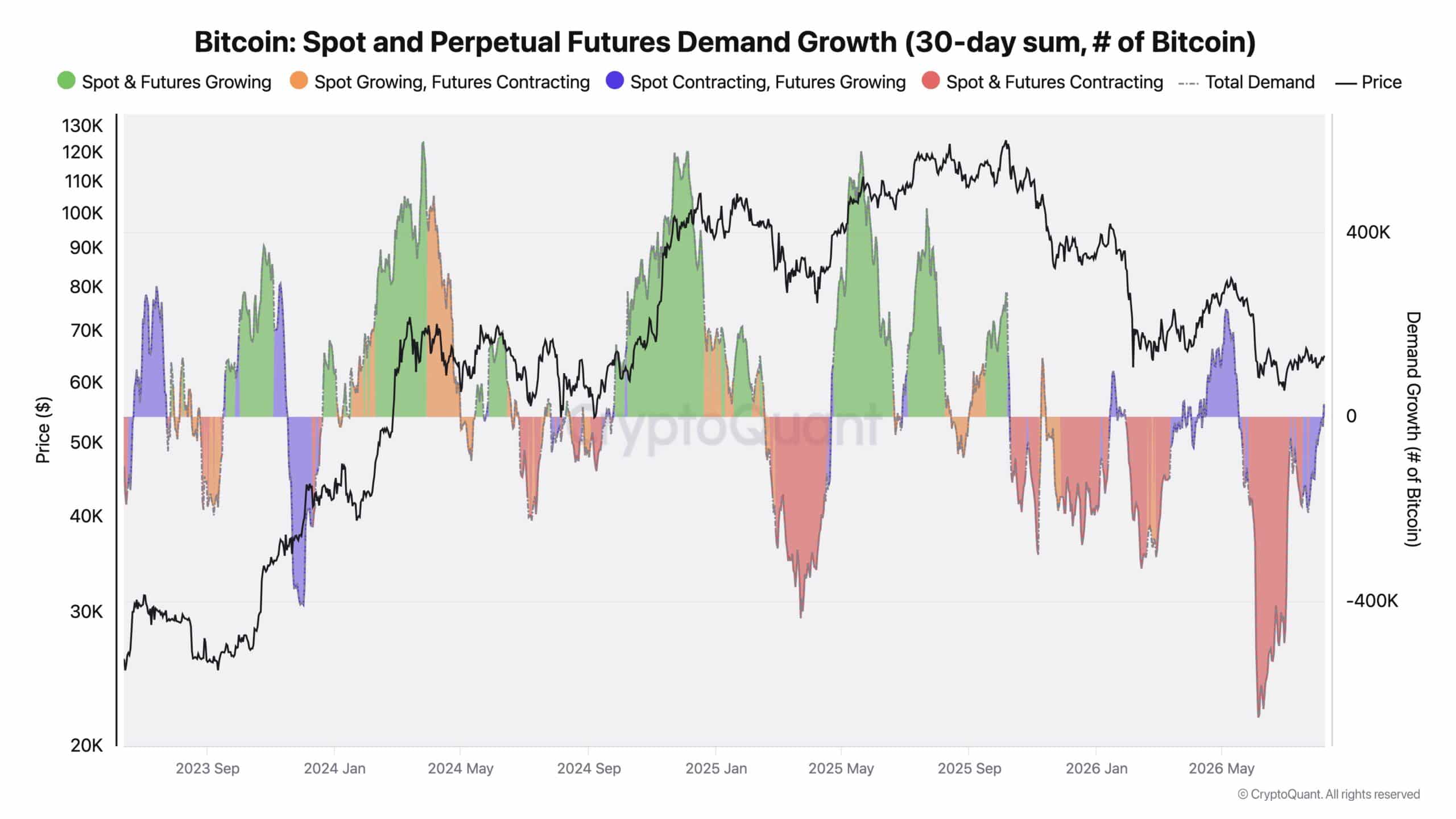
The 30-day demand for Bitcoin [BTC] is on the way back up after the extreme drop in demand it experienced due to its recent price decline. The metric has now turned positive near 25,000 BTC, reversing from deeply negative levels recorded around June.
That trend indicates that capital is returning, even if demand still isn’t as high as we’ve seen during prior recovery periods. More importantly, it appears derivatives are doing most of the heavy lifting currently.
Still, there may be an environment developing where we could see something like what occurred in May’s move to $82,000.
Source: CryptoQuant
Normally, Futures demand provides initial momentum as traders rebuild leveraged exposure and respond to improving prices. Yet previous rallies became more sustainable when spot buying expanded alongside Futures activity.
Thus, unless both Spot and Futures increase in demand, derivatives will likely continue to artificially inflate prices upward and then just as quickly reverse downward.
Bitcoin now needs stronger spot participation to turn this early rebound into sustained buying pressure.
DATUM moves that decision back to the individual miner. An operator can build its own block using its own bitcoin software while still contributing computing power to Ocean and sharing in the pool’s payouts.
Simple Mining used that control to leave the BIP-110 signal out of block 961,634.
“We chose not to signal and the chain extended on our block,” the company said.
That also explains why Ocean has appeared on both sides of the weekend split.
A miner using Ocean produced the first block accepted by the BIP-110 branch on Saturday, according to fork tracker Mempool. Simple Mining then used the same pool and made the opposite choice, producing a block for the dominant bitcoin chain.
Computers running BIP-110 software began rejecting blocks that did not carry its signal at block 961,632, after miner support peaked at about 2.6%, far below the 55% the proposal needed.
The minority branch has struggled since. It produced blocks 961,632 and 961,633 before stalling, while bitcoin kept producing blocks roughly every ten minutes.
By Monday a live monitor showed the main chain at 961,725, putting the BIP-110 branch more than 200 blocks behind.
The ‘Magnificent Seven’ stocks spent years convincing investors that their tremendous AI spending would translate into sustainable growth, powerful cash flows, and fatter valuations.
That assumption is now up against a major test.
Wall Street has largely treated hyperscaler spending as a powerful long-term growth engine, but Bank of America strategist Michael Hartnett just flagged a major risk that could test how much investors are willing to pay for the AI trade.
The contrast is becoming incredibly tough to ignore.
Stock markets remain somewhat resilient, but parts of the credit market are flashing more caution around AI spending.
That said, BofA now sees one major market signal as critical to the Mag 7’s ability to shrug off that threat.
Bank of America warns cheaper Chinese compute could challenge Magnificent Seven stocksAnnabelle Chih/Bloomberg via Getty Images
Why BofA sees a critical test for the Magnificent Seven
According to Seeking Alpha reporting, Hartnett just identified what needs to keep working for the AI trade to remain credible.
More AI:
He zeroes-in on the Roundhill Magnificent Seven ETF (MAGS), holding around $70, turning the ETF into a confidence gauge.
If the group can maintain pricing strength despite concerns about cheaper Chinese compute, it suggests investors are still buying into the long-term AI CapEx story.
For now, though, it seems markets are becoming a lot less comfortable with that assumption.
Credit spreads and credit-default swaps linked to AI hyperscalers are moving in a far more cautious direction.
He pointed to two major signs, including rising U.S. investment-grade tech credit spreads and Oracle’s (ORCL) five-year CDS, as evidence that credit investors are growing increasingly cautious about the AI infrastructure trade.
Though stocks are still rewarding the AI story, credit markets are beginning to question its cost.
Cheap Chinese computers add a major dynamic to that layer.
If increasingly capable AI can be developed and operated at significantly lower costs, U.S. hyperscalers will need to justify why hundreds of billions of dollars in annual capital spending is necessary.
For investors, the biggest risk might therefore be valuation compression instead of an immediate earnings collapse.
If we see confidence in the CapEx cycle weaken, investors might demand lower multiples before sales or earnings materially deteriorate.
The key signals to watch are MAGS price strength, hyperscaler cash flow and buybacks, and credit spreads.
If stocks are depressed while credit stress continues rising, the market could be starting to question the economics behind the AI boom, not merely its near-term growth rate.
Why is cheap Chinese compute a threat to the AI capex boom?
Chinese AI developers are showing they can deliver highly capable models using cheaper hardware, more efficient architectures, and dramatically lower inference costs.
The issue is that it runs counter to one of the assumptions underpinning the U.S. AI boom, which entails that better AI will require ever-larger amounts of expensive computing infrastructure.
DeepSeek first exposed that flaw in early 2025.
CNBC reported that its V3 model was developed using less-advanced Nvidia H800 chips, citing training costs of under $6 million.
The reaction was immediate, with investors questioning whether U.S. companies really needed to shell out billions in building the AI ecosystem.
Consequently, according to CNBC, Nvidia dropped nearly 17% on Jan. 27, 2025, wiping $593 billion from its market value in a single session.
That threat has only gotten more tangible over time.
DeepSeek’s new V4-Flash costs just $0.14 per million input tokens and $0.28 per million output tokens, according to Artificial Analysis data reported by Reuters.
Even though it was remarkably cheap, the model was much more competitive than more expensive systems, including Alibaba, Z.ai, Moonshot, and ByteDance.
So if businesses can achieve similar AI performance with far fewer GPUs or cheaper models, the economic return on those billions of dollars becomes much less certain.
There’s clearly a ton of financial pressure involved already.
Big Tech’s AI buildout is now up against a major cash-flow problem, while Microsoft, Meta, Oracle, Amazon, and Alphabet have collectively written down nearly $1.09 trillion in future lease payments, much of it tied to data centers, according to Reuters.
Moreover, credit markets are noticeably more cautious, with Oracle’s five-year credit-default swaps trading around 200 basis points, compared with nearly 53 basis points for a broader investment-grade CDS index, according to Reuters.
There’s the counterargument, too, though, which entails that cheaper AI could raise compute demand.
Yahoo Finance reports that Microsoft CEO Satya Nadella made that argument following the original DeepSeek shock, arguing that greater AI efficiency will drive significantly more demand.
So far, we haven’t seen the U.S. hyperscalers respond by slashing spending.
Case in point: Amazon recently raised its 2026 capex forecast to $220 billion, citing healthy AWS demand and ongoing capacity constraints, according to the Financial Times.
What are the Magnificent Seven stocks?
The “Magnificent Seven” refers to seven of the most powerful U.S.-listed companies that have become the most prolific stocks in the S&P 500.
Their influence is down to their sheer size, top- and bottom-line strength, and exposure to trends such as AI, cloud computing, and digital advertising.
According to Reuters, the term was coined by Hartnett in May 2023, a nod to the 1960 Western The Magnificent Seven.
These seven stocks have created tremendous wealth in the stock market.
According to NYU finance professor Aswath Damodaran, their combined market capitalization jumped by $5.1 trillion in 2023 alone. That accounted for over 50% of the increase in the value of the entire U.S. stock market that year.
Moreover, a separate FTSE Russell report showed their combined market value jumping another 43.5%, from $9.2 trillion to $13.2 trillion, over the year through April 30, 2024.
Tesla (TSLA) — $1.297 trillion. Source for market caps: CompaniesMarketCap, as of Aug. 7, 2026.
How does MAGS’ performance stack up against its risk?
The Roundhill Magnificent Seven ETF has slowed significantly compared to its lofty year-over-year gains, according to Seeking Alpha.
The ETF has gained 4.82% over the past week and 4.38% over one month, outperforming the S&P 500’s 3.57% and 3.38%, respectively.
However, things look a lot shakier over a six-month period, with the ETF posting a 9.55% gain compared to the broader market’s 12%.
Longer-term, however, Roundhill has been a massive money spinner, surging 121% over three years compared to 71.7% for the S&P 500, according to Seeking Alpha data.
It’s important to note, though, that the MAGS carries a higher-than-average risk profile, with its holdings heavily concentrated in a small group of stocks.
Nearly 96% of its assets sit in its top 10 holdings, double the typical ETF level of 45%. Its annualized volatility of 22.2% is also well above the ETF median of 14.1%, underscoring larger price swings.
Moreover, its standard deviation is elevated at 24, compared to the ETF median of 13, reinforcing that MAGS can move much more sharply than the average ETF.
Kevin O’Leary says he could have done a better job selling his plan for a hyperscale data center to the people of Utah.
In an interview with MS NOW, released on Thursday, the “Shark Tank” investor talked about how he and his team did not properly communicate plans for the Stratos data center project in Box Elder County with residents, and “really screwed this up.”
“I have no interest in causing an environmental disaster on my legacy,” he said. “That’s never going to happen. There’s zero probability that’s going to happen.”
O’Leary added that he and his team were planning to be more transparent, sharing plans for a one-gigawatt facility and what the heat, noise, and water impact of this facility would look like. Critics can extrapolate the impact of his fully built data center from those plans, he said.
The original plan for his data center was gargantuan — occupying a full 40,000 acres of land. This would require up to nine gigawatts of energy, O’Leary said in an April interview with The Wall Street Journal.
However, the plan drew strong criticism from residents in the region, environmental activists, and local lawmakers. Utah Senate President J. Stuart Adams posted an open letter that he sent to O’Leary in June, calling for a 75% reduction in the proposed data center’s size.
Following the uproar, O’Leary pledged to reduce the size of the development and to offer greater transparency regarding the project’s construction.
He said in the MS NOW interview that he has a lot of work to do and apologized to the residents of Box Elder.
“If I’ve said anything that offends you, yes, I apologize. If I’ve done anything that you think has been unfair, I apologize. But I also, with that, would say I want you to lend an open ear to what I’m going to show you in the months ahead,” he said.
However, O’Leary has stood firm on his decision to build a data center in Utah, saying in the MS NOW interview that although some people may view him as a “bad shark,” he plans to become a “major contributor” to the local economy.
O’Leary has also been posting on social media about the data center and his plans for the area.
In a post on LinkedIn last week, the investor wrote: “Data center developers have to earn the trust of the communities where we build, and that starts with complete transparency.”
“That’s exactly what we intend to do in Box Elder. We have work to do to earn the community’s support, but the facts will be public, from water and power to jobs and tax revenue,” he wrote. “If you want to build in a community for decades, you have a responsibility to become an asset to it.”
As of the end of 2025, there were 1,416 data centers built or approved for construction in45 US states and Washington, DC, according to Business Insider’s data center tracker.
Representatives for O’Leary’s venture capital firm, O’Leary Ventures, did not respond to a request for comment from Business Insider.
Bitcoin rose above $65,000 on Monday, up nearly 3% over the week, with July inflation data due Wednesday at 8:30 a.m. ET after Friday’s weak jobs report eased worries the Federal Reserve would need to raise rates.
Ether traded near $1,919 and is also up almost 3% on the week. BNB gained 0.3% to $603 and matched that weekly move. Solana was the strongest major, up 1% on the day to nearly $77 and almost 5% over seven days. Tron held at 33 cents.
XRP was the only major in the red on both views, slipping 0.4% to $1.03 and down 4% on the week. Hyperliquid’s HYPE fell over 1% to $54 but remains up over 3% on the week, and dogecoin eased to under 7 cents.
Equities set the tone. The MSCI All Country World Index rose 0.1%, its seventh gain in eight sessions, with the Asian gauge up 0.6% after Friday’s soft jobs report sent the S&P 500 to a record.
Chipmakers led, with a regional semiconductor gauge rallying more than 1.5% on gains at Taiwan Semiconductor and SK Hynix.