The extra yield exists only if traders actually swap through those pools, which means Jupiter not only runs Solana’s largest swap router, the software most wallets and apps use to find the best price across venues, but it also owns pools that need that flow to arrive.
The company told CoinDesk the router does not favor its own vaults and sends swaps wherever the price is best.
The risk of pairing assets falls unevenly, however. Jupiter said margin is valued using primary market oracles, or data providers, so a temporary price wobble on an exchange does not trigger anything, and a position liquidates as normal once its loan-to-value ratio passes the threshold.
A genuine depeg is different. On the debt side the borrower is protected — someone borrowing $100 split between USDC and USDT would see the pool rebalance into whichever asset held its value and still owe $100. On the collateral side there is no such protection, and a supplier carries the loss on both assets if either breaks.
That is why the design is confined to correlated pairs, stablecoins against each other and SOL against its staked versions, rather than volatile assets.
“There’s been a wall between the two primary ways people earn APY onchain, lending and LPing,” said Kash Dhanda, Jupiter’s chief operating officer, referring to lending and supplying liquidity to exchanges.
Ceva (CEVA), a provider of silicon and software intellectual property for network edge applications, on Monday beat Wall Street’s targets for the second quarter. But Ceva stock fell after the report. The Rockville, Md.-based company earned an adjusted 8 cents a share on sales of $29 million in the June quarter. Analysts surveyed by FactSet had expected earnings of 7…
UKey is positioning UKey Wallet and UKey Core 26 as two parts of the same self-custody workflow. UKey Wallet is the company’s multi-platform wallet application for supported account management, asset transfers, and Web3 access. UKey Core 26 is a touchscreen hardware wallet that can take over the final signing step. Used together, the app prepares a transaction while Core 26 displays the request and signs it on the device.
That gives users a straightforward choice. UKey Wallet can be used on its own for regular activity. Users who want a separate device for private-key operations and transaction approval can pair it with Core 26.
From Web3 access to hardware signing
In software-only mode, UKey Wallet lets users create accounts, send and receive supported assets, and interact with supported Web3 applications without hardware. Private keys are managed locally on the user’s phone rather than by UKey servers, so the user remains responsible for device security and the recovery phrase.
That setup may suit frequent transactions, exploratory use, or a limited day-to-day balance. It also calls for basic discipline: download the app from official sources, keep the phone and app updated, protect the device lock, and store the recovery phrase offline, not in screenshots, cloud storage, email or chat.
When paired with a UKey hardware wallet, the app becomes the operational interface. It can show accounts, prepare transactions and connect to Web3 services, while the hardware device handles private-key signing. UKey states that its servers do not hold users’ private keys or recovery phrases.
Core 26: The hardware signing layer
UKey Core 26 is a hardware wallet with a 3.5-inch color touchscreen. Its published specifications describe a four-chip security architecture and list an EAL6+ secure-chip level. Depending on the client and workflow, it supports Bluetooth, USB and QR-based connections.
For users, the practical point is simple: key handling and approval can take place on a dedicated device instead of relying entirely on the connected phone or computer.
A phone or computer can assemble a transaction request, but Core 26 presents the details for review before signing. Once approved, the signed transaction is returned to the software client and broadcast to the relevant blockchain network.
That does not remove the need for judgment. Users should still check the recipient address, amount, network and authorization details on the device screen. A hardware wallet can strengthen the boundary around private-key operations, but it cannot protect a recovery phrase that has already been exposed or undo an approval given to a malicious request.
One stack, different roles for your assets
UKey presents the app and device as complementary tools, not competing products. Some users may keep a limited day-to-day balance in a software wallet while reserving Core 26 for longer-term holdings or transactions where an additional confirmation step is preferred.
Use case
UKey Wallet on its own
UKey Wallet paired with Core 26
Primary role
Mobile-first access to supported assets and Web3 services
Software interface plus device-side signing
Key and signing model
Software-wallet workflow on the local phone
Private-key operations and signing performed on Core 26
Typical consideration
Convenience for regular activity
Added separation for accounts needing stronger transaction isolation
What the user must protect
Phone security and recovery phrase
Hardware device, recovery phrase and transaction-review process
The app handles connectivity and account access. The device provides a separate point for reviewing and approving a transaction.
Self-custody still starts with recovery hygiene
A hardware wallet does not make an exposed recovery phrase safe again. If a phrase was created or entered on an internet-connected device, importing that same phrase into a hardware wallet does not remove the earlier exposure.
Users who want a separate hardware-protected account should create and back up a new recovery phrase on the device, then carefully verify destination addresses before transferring assets.
Recovery phrases should never be shared with support personnel, entered on unverified websites, or sent through email or messaging services. Anyone who obtains the phrase may be able to control the associated assets.
Explore UKey Wallet and Core 26
UKey Wallet is available through the company’s official download page, which links to supported desktop and mobile versions. UKey advises users to verify the platform, publisher and version before installation or upgrade.
Current Core 26 specifications, supported workflows and availability are available on the UKey Core 26 product page. Purchasing options, delivery, taxes, warranty and after-sales support may vary by region. Readers should consult UKey’s official channels for information applicable to their location.
For current product details, supported-asset information or setup guidance, visit ukey.com for the latest updates.
About UKey
UKey is the crypto-asset hardware wallet and seed phrase backup product line associated with UKey Wallet. UKey Wallet and UKey are trademarks held by UKEY LIMITED.
Disclaimer: This is a paid post and should not be treated as news/advice.
Bitcoin treasury firm Strategy (MSTR) had raised $108.6 million last week through the sale of 1,690 bitcoin and an additional $653.1 million from the sale of 6.59 million shares of common stock, according to a Monday filing.
The company used the bitcoin sale proceeds to repurchase 1,152,020 shares of its variable-rate preferred stock, STRC, for $108.6 million.
The bitcoin sales reduced Strategy’s holdings to 840,447 BTC, acquired for $63.36 billion at an average price of $75,385. The 1,690 bitcoin were sold at an average price of $64,262, net of fees and expenses.
Strategy directed $650 million of the proceeds from its common-stock sales to its USD reserve, lifting the balance to $4.65 billion as of Aug. 9. The remaining $3.1 million was added to the company’s cash balance.
Following the latest transactions, Strategy has $785.2 million remaining under its preferred-stock repurchase program and $1 billion available under its MSTR common-stock repurchase program.
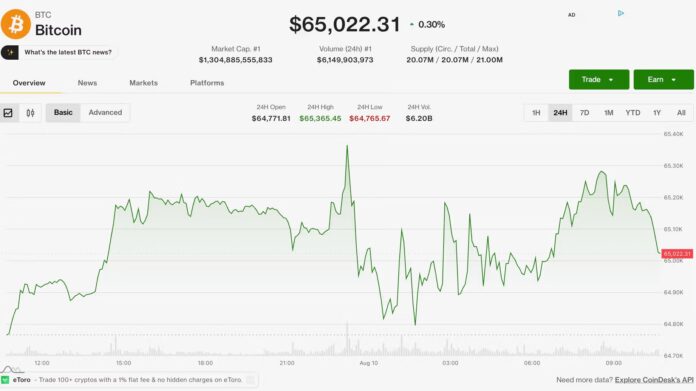
MSTR and STRC are both up 0.5% in Monday pre-market trading, with bitcoin changing hands near $65,000.
With CPI hitting 3.8% and 30-year Treasury yields at their highest since 2007, a September 25-basis-point Fed rate hike looks virtually certain.
Energy Transfer (ET) pays a 6.58% distribution yield while Prudential Financial (PRU) offers 4.64%, both positioned to profit as rates climb higher.
It sounds nuts, but SoFi1 is giving new Active Invest users up to $3,000 in stock for a limited time, and all it takes is a $50 deposit to get started.2 See for yourself (Sponsor)
Converging forces are pushing rates higher in 2026. The Iran conflict closed the Strait of Hormuz, spiking crude oil prices and raising production and transport costs. This energy shock drove inflation higher, with the CPI rising earlier this summer to 3.8%, which was the sharpest increase in three years and well above the Federal Reserve’s 2% target. This, in turn, has prompted lenders to demand higher rates to protect returns. Meanwhile, investors sold bonds amid rising inflation and concerns about U.S. debt, lifting Treasury yields to the highest levels for the 30-year bond since 2007. Since mortgage rates are based on the 10-year Treasury yield plus a risk premium, they rose in tandem and are at their highest levels since the summer of 2025.
On the fiscal side, federal interest payments on government T-bills, notes, and bonds now exceed spending on Medicaid, national defense, and all nondefense discretionary programs combined, adding further upward pressure on long-term borrowing costs. Experts say rates will only fall if geopolitical tensions ease, oil prices stabilize, and inflation remains under control, outcomes that remain highly uncertain. One thing is for sure: if the July consumer and producer price index numbers come in above expectations this week, a 25-basis-point September increase is still on the table.
The dreadful jobs data on Friday gave some relief to the rate-hike narrative, but the reality remains the same: If inflation jumps in the reports this week, you can bet it will be there in the August report in early September. Plus, the August jobs report will be released in early September, before the Fed meeting, and jobs are likely to bounce back from the negative print last Friday.
Typically, when interest rates go higher, these four sectors tend to win:
Financials and Insurance Companies
Financials and insurance companies are the biggest winners. Banks earn a wider spread between what they pay depositors and what they charge borrowers. Insurers earn more on their investment portfolios because they hold large amounts of cash to pay incurred insurance claims. The sector almost mechanically benefits from rising rates, as net interest income rises.
U.S. Bancorp
Based in Minneapolis, this super-regional financial giant is an outstanding choice for growth and income investors now, offering a hefty 3.24% dividend. U.S. Bancorp (NYSE: USB) is a financial services holding company.
The bank’s segments are:
Wealth
Corporate
Commercial and Institutional Banking
Consumer and Business Banking
Payment Services
Treasury and Corporate Support
It offers a comprehensive range of financial services, including lending and deposit services, cash management, capital markets, and trust and investment management services. It also engages in credit card services, merchant and ATM processing, mortgage banking, insurance, brokerage, and leasing.
The company’s banking subsidiary, U.S. Bank National Association (USBNA), is engaged in the banking business, principally in domestic markets. USBNA provides a range of products and services to individuals, businesses, institutional organizations, governmental entities, and other financial institutions.
The non-banking subsidiaries offer investment and insurance products to customers primarily within their domestic markets, as well as fund administration services to a range of mutual and other funds.
Oppenheimer has an Outperform rating with a target price of $77.
USB Analyst Ratings — 24/7 Wall St.
USB Price Target — 24/7 Wall St.
Prudential Financial
Prudential Financial (NYSE: PRU) offers a range of insurance, investment management, and other financial products and services. With a rich 4.64% dividend yield, this insurance and investment giant is a safe option for conservative investors. Prudential provides insurance, investment management, and other financial products and services in the United States and internationally.
It operates through five segments:
PGIM
Retirement Strategies
Group Insurance
Individual Life
International Business
The PGIM segment offers investment management services and solutions related to public fixed income, public equity, real estate debt and equity, private credit, and other alternatives, as well as multi-asset class strategies, to institutional and retail clients and its general account.
The Retirement Strategies segment provides a range of retirement investment and income products and services to retirement plan sponsors in the public, private, and not-for-profit sectors. It develops and distributes individual variable and fixed annuity products.
The Group Insurance segment offers:
Various group life plans
Long-term and short-term group disability
Group corporate, bank, and trust-owned life insurance in the United States, primarily for institutional clients, for use in connection with employee and membership benefits plans
Accidental death and dismemberment, and other supplemental health solutions
Plan administration services in connection with its insurance coverages
The Individual Life segment develops and distributes variable life, universal life, and term life insurance products.
The International Businesses segment develops and distributes life insurance, retirement products, investment products, specific accident and health products, and advisory services. The company provides its products and services to individual and institutional customers through its proprietary and third-party distribution networks.
J.P. Morgan has a Neutral rating with a $129 target price.
PRU Analyst Ratings — 24/7 Wall St.
PRU Price Target — 24/7 Wall St.
Energy
Energy benefits because rate hikes typically coincide with inflation, and oil and gas prices are a primary driver of inflation. Higher commodity prices translate to higher revenues. It’s the inflation-hedge play, and it’s been one of the strongest-performing S&P sectors so far in 2026.
Energy Transfer
Energy Transfer (NYSE: ET) is one of North America’s largest and most diversified midstream energy companies. This top master limited partnership is a safe option for investors seeking energy exposure and income, as the company pays a 6.58% distribution yield. Energy Transfer owns and operates one of the largest and most diversified portfolios of energy assets in the United States, with a strategic footprint across all major domestic production basins. The company blew out second-quarter earnings and looks poised to move to new highs.
The company is a publicly traded limited partnership with core operations that include:
Complementary natural gas midstream, intrastate, and interstate transportation and storage assets
Crude oil, natural gas liquids (NGL), and refined product transportation and terminalling assets
NGL fractionation
Various acquisition and marketing assets
Following the acquisition of Enable Partners in December 2021, Energy Transfer owns and operates over 114,000 miles of pipelines and related assets in 41 states, spanning all major U.S. producing regions and markets. This further solidifies its leadership position in the midstream sector.
Through its ownership of Energy Transfer Operating, formerly known as Energy Transfer Partners, the company also owns Lake Charles LNG Company; the general partner interests, the incentive distribution rights, and 28.5 million standard units of Sunoco (NYSE: SUN); and the public partner interests and 39.7 million standard units of USA Compression Partners (NYSE: USAC).
TD Cowen has a Buy rating on the shares, with a $24 target price.
ET Analyst Ratings — 24/7 Wall St.
ET Price Target — 24/7 Wall St.
Healthcare
Pricing power and steady demand insulate the top healthcare names. They don’t directly benefit from higher rates, but they tend to hold up well because their earnings don’t erode as much as those of interest-sensitive sectors.
Bristol-Myers Squibb
Bristol Myers Squibb (NYSE: BMY) is a global biopharmaceutical company committed to discovering, developing, and delivering transformative medicines for patients with serious diseases across oncology, hematology, immunology, cardiovascular disease, neuroscience, and other therapeutic areas. It remains a solid pharmaceutical stock to own in the long term, offering an outstanding entry point with a reliable 3.81% dividend.
Its platforms comprise chemically synthesized or small-molecule drugs, including protein degraders, as well as biologics produced through biological processes. These platforms also encompass ADCs, CAR-T cell therapies, and radiopharmaceutical therapeutics.
Small-molecule drugs are typically administered orally in tablet or capsule form, although other drug-delivery mechanisms are also used. Biologics are usually administered by injection or intravenous infusion. CAR-T cell therapies are administered by intravenous infusion.
Its growth portfolio includes:
Opdivo
Opdivo Qvantig
Orencia
Yervoy
Reblozyl
Opdualag
The legacy portfolio includes:
Eliquis
Revlimid
Pomalyst/Imnovid
Sprycel
Abraxane
Argus has a Buy rating with a $75 price objective.
BMY Analyst Ratings — 24/7 Wall St.
BMY Price Target — 24/7 Wall St.
Industrials
Industrial stocks often perform well in rising-rate environments because rate hikes can signal a strengthening and expanding economy. As businesses ramp up activity, demand for heavy equipment, machinery, and manufacturing capacity increases. This allows these cyclical companies to secure stronger order books and exercise greater pricing power, more than enough to offset their higher cost of capital.
Stanley Black & Decker
Stanley Black & Decker (NYSE: SWK) is the world’s largest tool company, with 50 manufacturing facilities in the United States and more than 100 worldwide. Shares trade at 17.7 times forward earnings estimates. With the potential for the economy to slow somewhat, do-it-yourself consumers are likely to repair rather than replace, making this legendary stock a solid idea now while yielding a dependable 3.24% dividend.
Stanley Black & Decker provides hand tools, power tools, outdoor products, and related accessories in North and South America, Europe, and Asia. Its Tools & Outdoor segment offers professional-grade corded and cordless electric power tools and equipment, including:
Drills
Impact wrenches and drivers
Grinders, saws, routers, and sanders
Pneumatic tools and fasteners, such as nail guns, nails, staplers and staples, and concrete and masonry anchors; corded and cordless electric power tools
Hand-held vacuums, paint tools, and cleaning appliances
Leveling and layout tools, planes, hammers, demolition tools, clamps, vises, knives, saws, chisels, and industrial and automotive tools
Drill and screwdriver bits, router bits, abrasives, saw blades, and threading products
Toolboxes, sawhorses, medical cabinets, and engineered storage solutions
Electric and gas-powered lawn and garden products
This segment sells its products under such brand names as:
DeWalt
Craftsman
Black+Decker
Stanley
Flex Volt
Irwin
Lenox
The Industrial segment provides:
Threaded fasteners, blind rivets and tools, blind inserts and tools
Drawn arc weld studs and systems
Engineered plastic and mechanical fasteners
Self-piercing riveting systems
Precision nut running systems
Micro fasteners
High-strength structural fasteners
Axle swage, latches, heat shields, pins, couplings, fittings, and other engineered products
Attachments used on excavators and handheld tools
The segment sells its products through a direct sales force and third-party distributors to various industries, including automotive, manufacturing, electronics, construction, aerospace, and others.
Citigroup has a Buy rating on the shares and a $107 target.
SWK Analyst Ratings — 24/7 Wall St.
SWK Price Target — 24/7 Wall St.
Want Up To $3,000 In Stock? SoFi Is Giving New Active Invest Users Complimentary Stock
Looking to grow your money but unsure where to begin? SoFi Active Invest is offering a limited-time promotion—open a new Active Invest account, fund it with $50 or more, and you could receive up to $3,000 in complimentary stock.
From $0 commission trading3 to fractional shares4 and automated investing, this app is designed to simplify investing for everyone, whether you’re just starting or already experienced. Its easy to sign up and secure your bonus.(Sponsor)
➡️ Did someone forward you this email? If you would like to receive this information directly, every morning before the markets open in New York,sign up here.
ONE BIG THING
At Google’s DeepMind, absence did not make the heart grow fonder
There’s an extraordinary quote in Bea Nolan’s account for Fortune of how Demis Hassabis lost his role as CEO of DeepMind, the London-based lab that created Google’s Gemini AI product. Apparently, Hassabis was largely absent from company offices: “I can’t say that I’ve ever seen Demis walk around the office in the Gemini area,” one DeepMind engineer said. (To be fair, he made plenty of media appearances.)
DeepMind had also seen a recent exodus of talent—in June, Google lost Gemini co-lead Noam Shazeer to OpenAI and Nobel laureate and AlphaFold co-inventor John Jumper to Anthropic. And the product had fallen behind its competitors in terms of capabilities. So it is perhaps not surprising that parent company Alphabet, based 6,000 miles away in Mountain View, California, wants more direct control. Hassabis, who will now become the company’s chairman, will be replaced by DeepMind’s chief technology officer, Koray Kavukcuoglu, who is based in Mountain View and will report directly to CEO Sundar Pichai at Alphabet.
THE MARKETS
The price of oil ticks up again
S&P 500 futures were up 0.14% this morning. The index closed up 0.62% in its last session.
In Europe, the Stoxx 600 was down 0.02% in early trading and the U.K.’s FTSE 100 was down 0.3% before lunch.
Asia: South Korea’s KOSPI was up 0.65%. Japan’s Nikkei 225 was up 2.08%. India’s Nifty 50 was down 0.05%. China’s CSI 300 was up 0.16%.
Brent crude was back over $84 per barrel this morning.
Bitcoin was at $65.1K.
‘Sell America’ never happened—at least in stocks
As this chart from Wells Fargo’s Ohsung Kwon shows, foreigners never really stopped buying U.S. equities:
OpenAI’s revenues are plateauing, Bank of America says
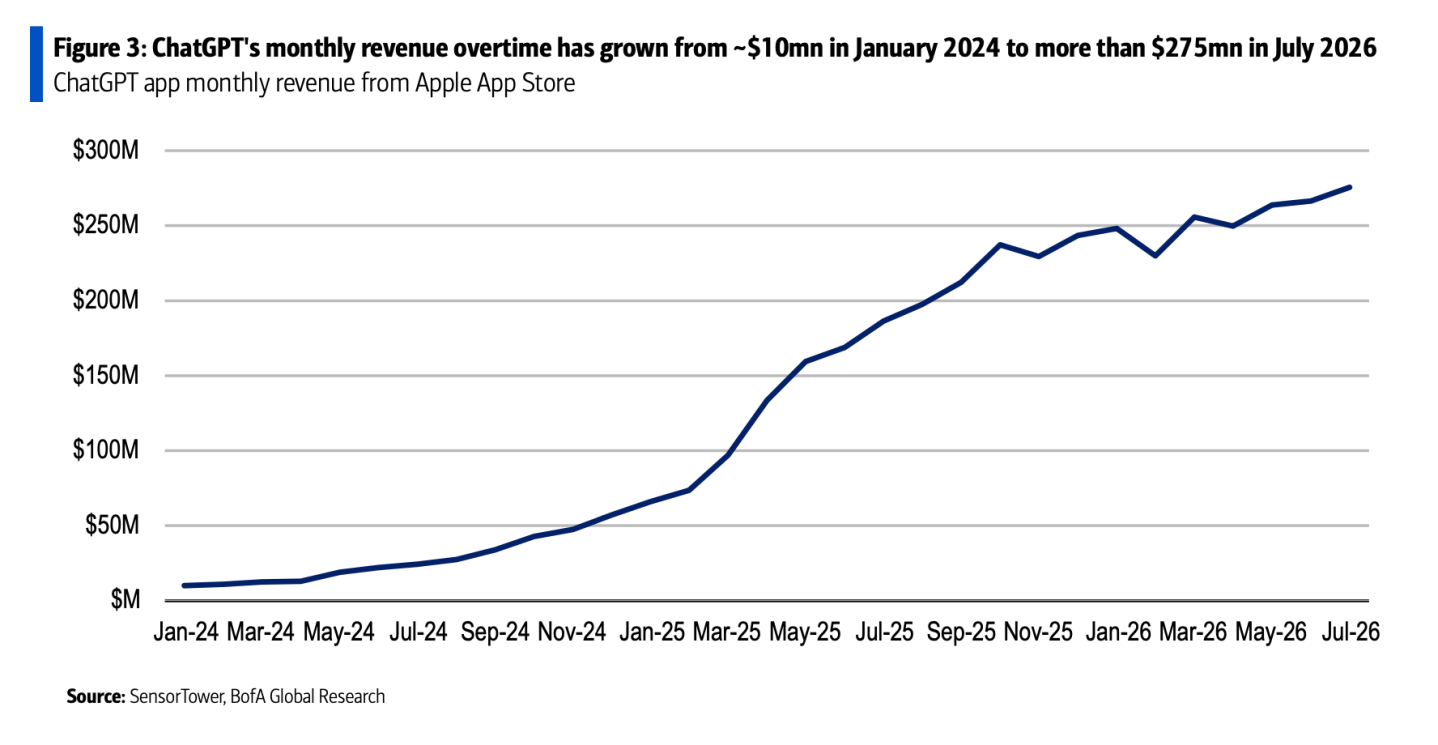
ChatGPT’s monthly revenue from Apple’s App Store has flattened over time, according to this Sensor Tower data published by Bank of America’s Wamsi Mohan. It hit $265 million per month in July:
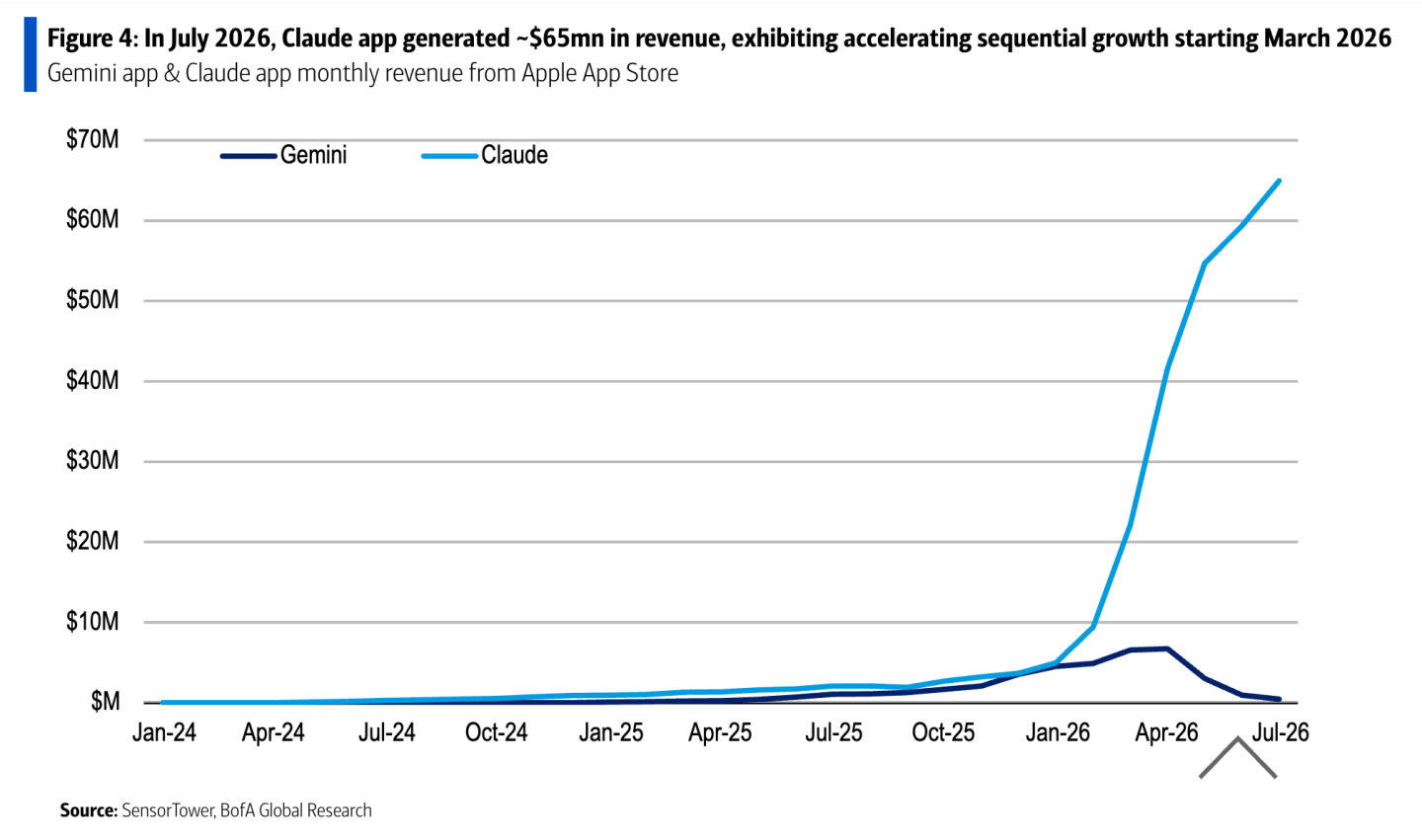
By amazing coincidence, app store revenue for Anthropic’s Claude went through the roof this year, as this next chart shows. (Ignore the flatline for Google’s Gemini—that’s likely an artifact of Google pulling its billing mechanism in-house so it doesn’t have to pay fees to Apple.)
CHART OF THE DAY
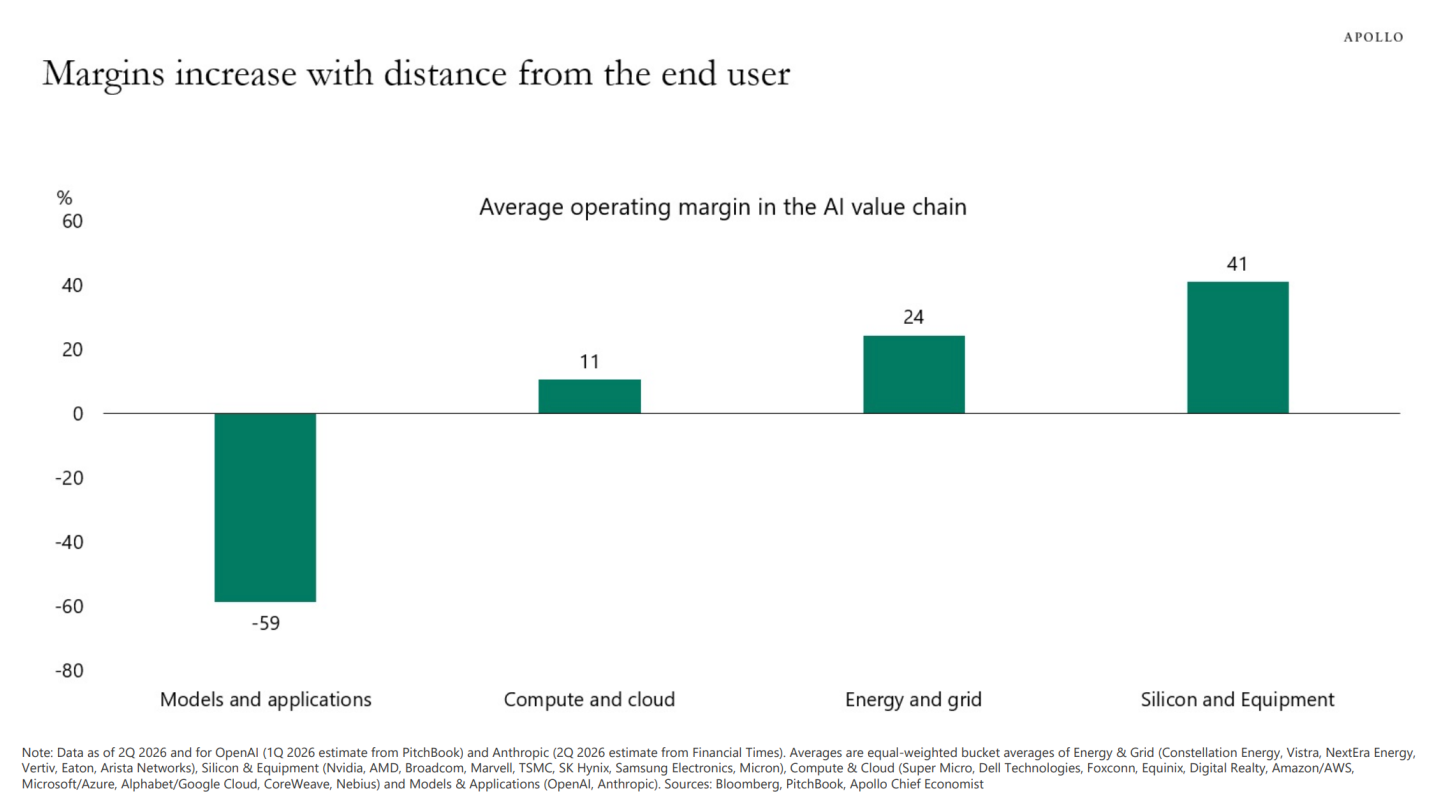
Everyone is profiting off AI except the people who make AI
“Is AI a bubble?” This is the best, simplest explanation we’ve seen so far. It comes from Torsten Sløk of Apollo Global Management. He broke out the various sectors of AI into four buckets: the models themselves (OpenAI, Anthropic, etc.) and then their non-AI suppliers of things like cloud services, chips, and energy. Lo and behold, everyone in the sector whose primary business is not building an AI model is profitable. Only the model-makers are money losers—which implies that they are running on investment capital, not their own revenues. “Will the ROI show up for AI’s end customers fast enough to sustain the spending that is generating those upstream margins?” Sløk asks.
IRAN
Iran and the U.S. test who can bear most pain over the closure of the Strait of Hormuz
The war between Iran and the U.S. appears to have entered a stalemate as Iran refuses to reopen the Strait of Hormuz and the U.S. watches Iran’s economy crumble.
“We are low-keying it,” President Trump said to Axios over the weekend. “We are only semi-negotiating with them. We are just watching Iran with its huge inflation and the fact they have no money.” Centcom said it had turned away 55 ships that attempted to sail to Iranian ports in recent days.
Iran appears to be willing to see how much political damage it can inflict on Trump by keeping oil prices high and continuing a war that is unpopular with voters. In turn, the U.S. appears to be content to see if a break in hostilities will focus Tehran’s attention on its precarious economic position.
Iran on Saturday published a list of demands including a complete end to hostilities, the removal of U.S. forces from the Strait, and the lifting of sanctions and the payment of war reparations.
Those demands are similar to what Trump had previously agreed to in the “memorandum of understanding” back in June, with the exception of reparations, the NYT notes. But Trump is unlikely to agree to any pact that leaves Iran with even partial control of the Strait.
JOBS, AND THE LACK THEREOF
U.S. unemployment would be 5% if it weren’t for ghost workers leaving the market
As you no doubt know by now, the U.S. reported a decline of 23,000 jobs in July—a depressingly weak report. Counterintuitively, unemployment went down, to 4.1% from 4.2%.
Government jobs were cut by 53,000 as schools and other services shut for the summer. But the numbers also revealed that unemployment only declined because many unemployed workers simply gave up trying to find a job, or retired.
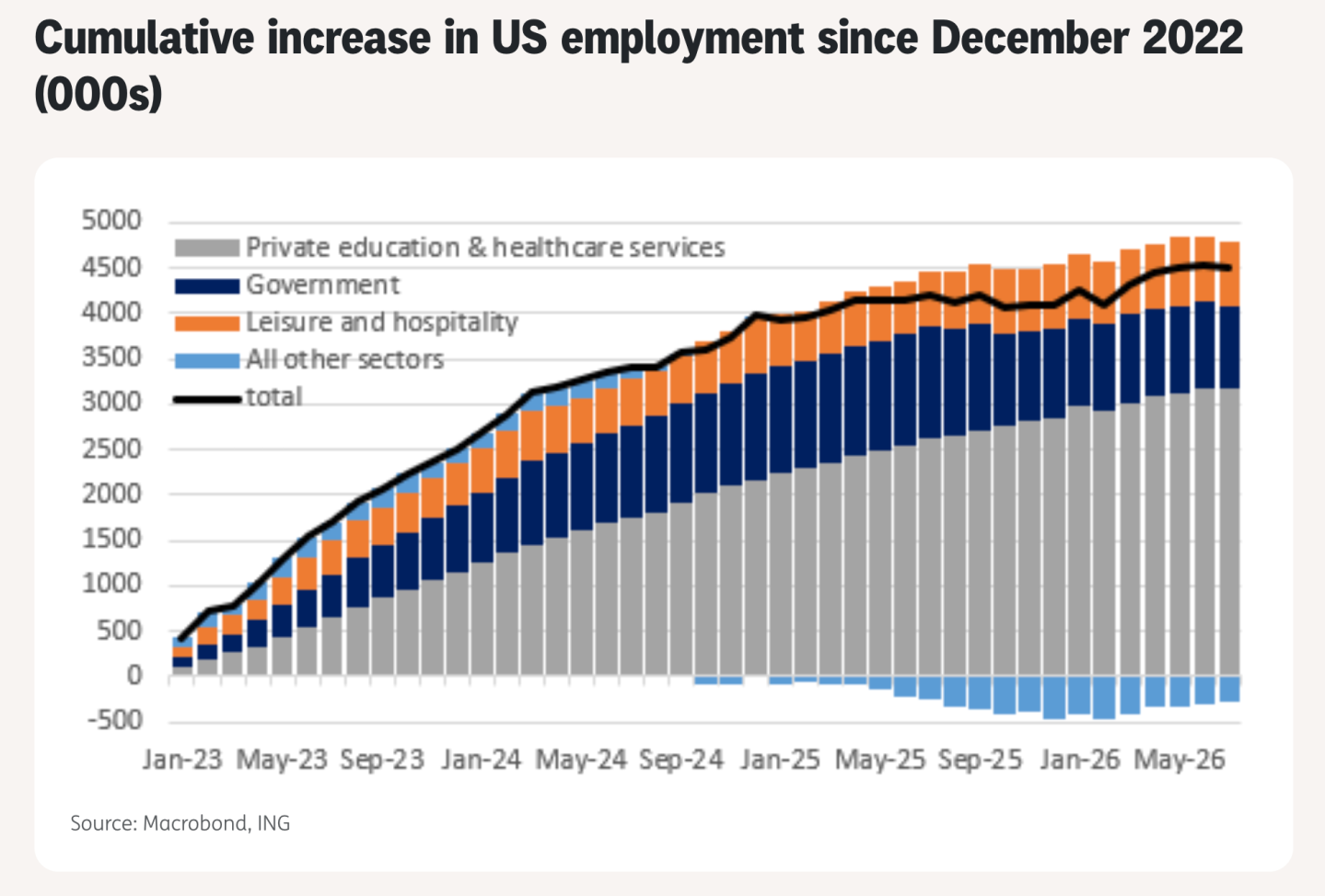
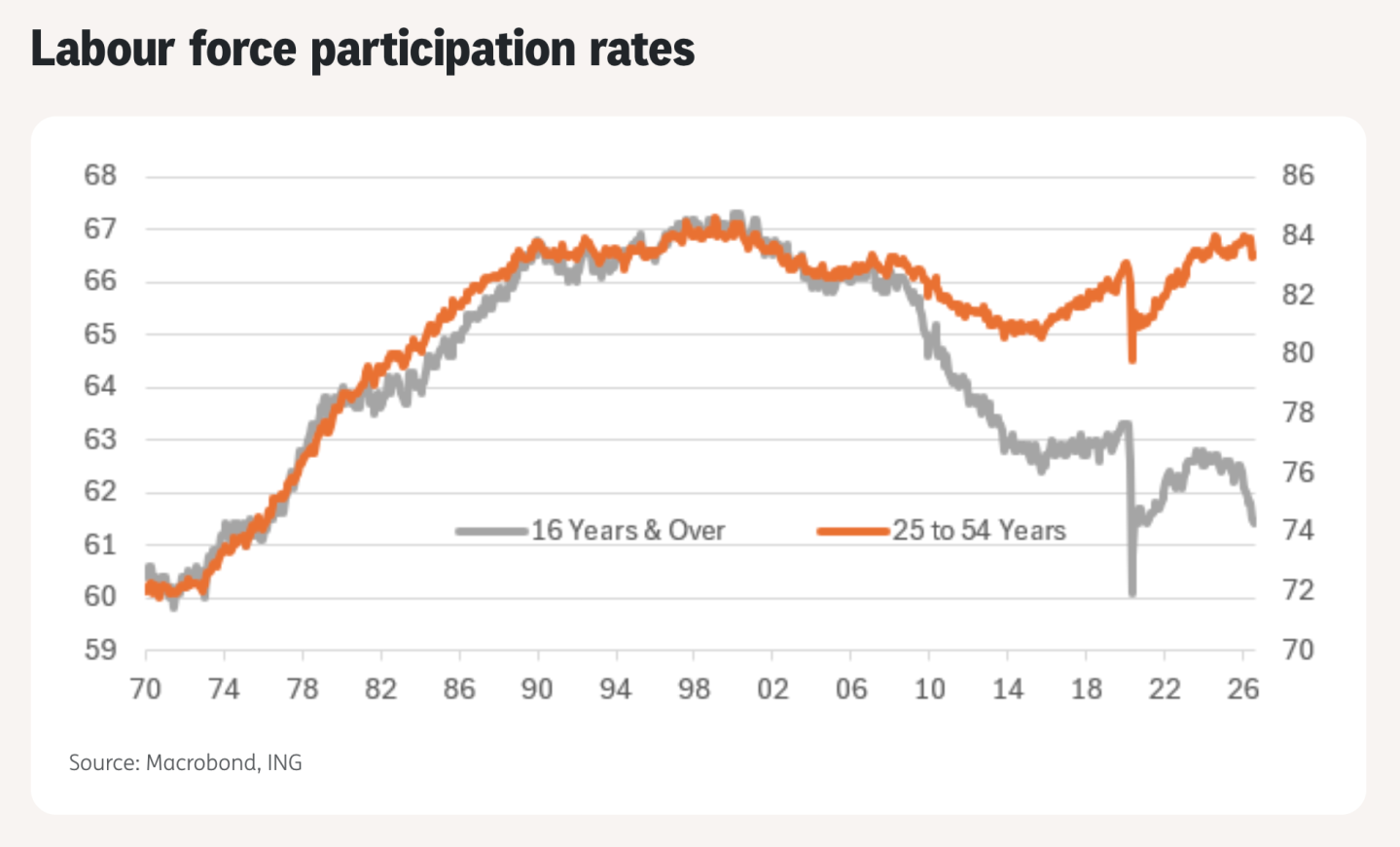
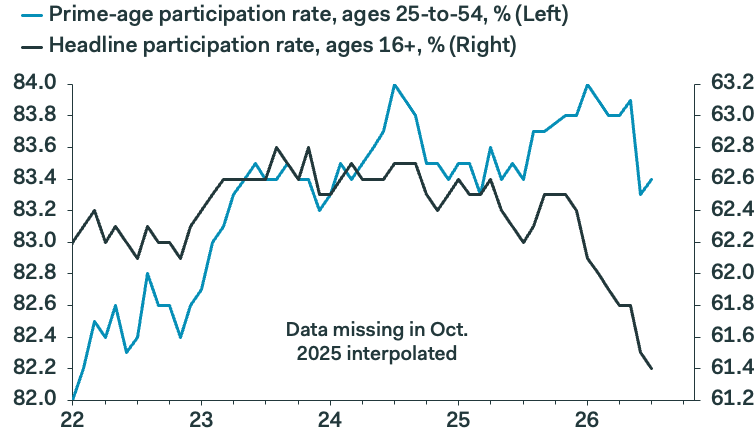
The best explanation of this new, bad trend came from James Knightley at ING. “We have to look at the participation rate. It fell to 61.4%, which, outside the pandemic, we must go all the way back to the mid to late 1970s to find a lower reading. A quarter of a million people left the labour force last month. Within that, the number of people classifying themselves as employed fell 87k while the number of people classifying themselves as unemployed fell 178k. Therefore, the fall in the unemployment rate was caused by disengagement rather than for any positive reason,” he told clients.
If the participation rate had held steady, “we would have a U.S. unemployment rate in excess of 5%,” he wrote. These charts show the trend:
Young people aren’t working
It’s young people who are losing out on the jobs, according to Bill Adams, chief U.S. economist at Fifth Third Commercial Bank. “Unemployment among workers aged 20-24 without prior work experience, a good proxy for the Class of 2026, was 242,000, down slightly from 253,000 in July of 2025. The last two years have seen the highest unemployment for recent grads since 2016,” he said in an email.
This chart from Pantheon Macroeconomics shows how employment among younger people is dropping off a statistical cliff:
Did the Fed’s Warsh just get his credibility back?
Some analysts on Wall Street have been mean about new Fed chairman Kevin Warsh recently, saying he lacks “credibility” because he won’t give forward guidance and he hasn’t raised interest rates even though inflation has been above 2% for five years. But the weak jobs number shows that raising interest rates at the last FOMC meeting would have been the wrong call, given that the labor market needs all the cheap money it can get.
“The loss of 23,000 jobs is another reason the Fed was right to hold off on raising rates in July,” said Jamie Cox, a managing partner at Harris Financial Group.
Charlie Ripley, a senior investment strategist at Allianz Investment Management, agreed: “If anything, it raises the bar for any Fed rate increases heading into the fall.”
The U.S. will report a new consumer price inflation (CPI) number on Wednesday—the nightmare scenario for the Fed is if inflation is up while the job market is down. That would make its next interest rate decision an impossible call.
NUMBER OF THE DAY: AI’s contribution to GDP growth
0.2 percentage points
The contribution to GDP growth of the AI industry, as calculated by Pantheon Macroeconomics’ Samuel Tombs and Oliver Allen. That’s surprisingly small. Why? “The sums pouring into AI infrastructure are enormous, and a naïve reading of the national accounts implies that this capex wave now is the source of about half of overall GDP growth,” they said in a recent note. However, “most AI equipment is imported,” meaning U.S. dollars leaving the country—and that is counted as negative for GDP. “Spending on AI hardware—semiconductors, computers, and telecoms equipment—subtracted 0.8pp from year-over-year GDP growth in Q2,” they say.
All told, Trump mentioned grass—its quality, whether it should be paved over or not—in at least 45 public events or interviews over the past 18 months, The AP reported. That’s once every 12 days. And that doesn’t include the numerous social media posts that Trump has also made on the topic.
He’s already far outpaced the 26 times he mentioned grass during the entirety of his first four-year term.
That’s not all. Trump recently hosted Matt Koch, the lawns research fellow for Scotts Miracle-Gro Company, in the Oval Office to discuss planting new grass on the White House’s South Lawn. “An amazing dialogue, talking grass for half an hour,” Koch said. “Going back and forth about grass.”
The White House declined to comment. But Trump has made clear where his interest in—and knowledge of—grass comes from. “I know a lot about grass because I own a lot of golf courses,” he said while announcing the recipients of the Kennedy Center Honors last August. “And, if you don’t have good grass, you’re not in business very long.”
The crypto market opened the week on a positive note, with bitcoin BTC$64,978.83 up 0.54% since midnight UTC at $65,209 and ether ETH$1,916.58 gaining 0.86% to $1,925 as sentiment stabilized following a turbulent July.
The move was correlated with Nasdaq 100 index futures, which rose by 0.45% since midnight, buoyed by speculation from the Middle East that Iran is ready to strike a deal with Oman to open the Strait of Hormuz.
The altcoin market is delicately poised, waiting to see if bitcoin can drive higher into the $68,000 to $72,000 range before benefiting from capital rotation.
Derivatives positioning
Long-short ratio flips bullish: The long-short ratio for taker volume in crypto futures has flipped bullish, with longs accounting for 52% of the flow. A taker is an entity that removes liquidity from the order book by trading at available prices.
BTC OI growth remains elusive: Bitcoin futures market activity remains subdued as BTC attempts to hold above $65,000 amid cooling bets on Federal Reserve rate increases. Open interest (OI) slipped back below 750K BTC. However, annualized funding rates and 24-hour OI-adjusted CVD remain positive, indicating that the limited interest present in the market is leaning bullish.
ETH OI slides: De-risking continues in ETH futures, with open interest falling to 13.35 million tokens, the lowest level since May 3, and a significant drop from the late-May peak of 15.98 million tokens.
Activity picks up in SOL futures: Renewed activity is appearing in SOL futures, as open interest rebounds to 64.60 million tokens from a recent low of around 60 million. This points to fresh capital inflows, coinciding with the token’s price recovery from nearly $70 to over $76 and a break above the widely tracked Ichimoku cloud, signaling a potential short-term bullish trend reversal.
Monero leads OI growth: Privacy-focused coin Monero (XMR) has surged 5% over the past 24 hours, briefly topping $400 for the first time since June 12. The rally appears to have staying power, with futures open interest jumping 6% alongside the price gains. The 24-hour CVD is the most positive among major cryptocurrencies, indicating that buyers are acting more aggressively through market orders rather than passive limit orders. In addition, annualized funding rates stand at the highest level among majors at 28%, underscoring growing demand for upside exposure.
BVIV hits 2026 lows: Bitcoin’s 30-day implied volatility index, BVIV, fell to a year-to-date low of 35.59% over the weekend. The drop shows expectations for market calm, although some traders warn that put options offering protection from price losses in BTC are still trading at a premium to calls.
Calls dominate volume: The 24-hour volume ranking in options shows increased investor bias for bitcoin calls at strikes $68,000 and $70,000. Ether options show a similar profile.
Token talk
Pump.fun PUMP$0.002740 led the altcoin market with a 5.39% gain since midnight UTC, extending a 24-hour run that has pushed its market cap above $1.1 billion.
Ethena (ENA) rose 4.84% to $0.0907, continuing a steady recovery that has seen it gain ground in most sessions over the past two weeks. Still, it remains more than 90% below its all-time high.
NEAR protocol gained 3.79% as AI tokens broadly recovered, with FET adding 2.10% after weeks of underperformance against the wider market.
Lighter (LIT) slipped 0.94%, one of the only notable altcoins in the red as its slide following July’s 200%-plus rally continues to grind lower.
Woldcoin WLD$0.3398 posted a 13% gain over the past 24 hours but remains in a deep downtrend, down 91% from its record high one year ago.
CoinMarketCap’s “altcoin season” indicator is at 37/100, down significantly from last week’s peak of 51/100 as investors focus on bitcoin’s potential move higher.