Moneywise and Yahoo Finance LLC may earn commission or revenue through links in the content below.
Owning a home, contributing to a retirement account, or maintaining an emergency fund may not be enough to achieve lasting financial security.
A new report from the Aspen Institute’s Financial Security Program (1) argues that Americans need a combination of liquid savings and appreciating assets to build what it calls “essential wealth” — the financial foundation needed to weather emergencies, invest for the future and retire comfortably.
Must Read
JPMorgan still sees gold hitting $5,000/oz by Q4 — and savvy investors are protecting their wealth with a tax-advantaged Gold IRA. Learn more with a free guide from Priority Gold
But according to the report, only 26% of U.S. households have reached that benchmark, leaving nearly three in four without enough wealth to fully achieve those goals.
“The headline finding is stark: The vast majority of American households — three out of four — do not have essential wealth,” the researchers wrote.
Worse still, this isn’t just a look at in-progress wealth building.
“Most households do not reach essential wealth at any age,” the report found, noting that even many Americans approaching or in retirement still fall short of the benchmark despite decades of saving.
‘Wealth is not just for the wealthy’
The report defines essential wealth as having both sufficient liquid savings to absorb financial shocks and enough net worth invested in appreciating assets — retirement accounts, home equity or businesses — to build long-term financial security.
Researchers argue that income alone isn’t enough because wages pay today’s bills, while wealth creates future opportunities and financial flexibility.
“Families cannot afford to wait for wealth until every other financial need has been met,” the report states. “Wealth is not just for the wealthy. It is necessary for everyone.”
To reach the benchmark, households must clear both a savings threshold and a net worth threshold, which vary by age.
For example, the report says a typical household in its 20s would need roughly $40,000 in net worth and six weeks’ worth of take-home pay in liquid savings to qualify as having essential wealth. For households in their 30s, that illustrative benchmark rises to roughly $120,000 in net worth plus six weeks of income in cash savings.
Importantly, essential wealth is just the final destination in a three-step journey. The report also details earlier, more manageable brackets — underscoring the fact that essential wealth is a developing goal, not an ultimatum.
One way to start building wealth is by investing consistently, even if you’re starting with small amounts. Micro-investing apps such as Acorns can help automate the process by rounding up purchases and investing the spare change into diversified portfolios.
For instance, if you buy a donut for $3.25, Acorns will round up the purchase to $4 and invest the change in a smart investment portfolio. So a $3.25 purchase automatically becomes a 75-cent investment in your future. Once you’re comfortable with your investments, Acorns can also help you make regular monthly contributions to speed up building out your nest egg.
Perhaps the most concerning finding is that reaching essential wealth remains difficult regardless of age.
While wealth generally increases over a lifetime, the report found that most households never accumulate enough to meet the benchmark.
Even among Americans 65 and older, those who have had the longest to save and invest, still fall short. Households in their 50s and early 60s reach essential wealth at roughly the same rate as people decades younger, suggesting many Americans are approaching retirement without the financial cushion researchers believe is necessary.
The report argues this is simply the result of “the sheer consistency of the gap across age groups points to structural barriers that inhibit wealth building beyond individual saving behavior.”
They did not cite poor spending habits as a reason.
The report also challenges the idea that owning a home automatically puts households on solid financial footing.
Many families who own homes remain below the report’s “emergent wealth” threshold because they lack sufficient liquid savings. While home equity is an important asset, researchers note that households can still be “house poor” if most of their wealth is tied up in property and they don’t have enough cash to handle unexpected expenses.
Likewise, some households have accumulated meaningful assets but still fall short because they haven’t built an accessible emergency fund. Fidelity (2) notes that many investors should maintain emergency savings separate from long-term investments.
The report concludes that reaching essential wealth “typically requires a diverse portfolio of appreciating assets — home equity, retirement savings, and other investments working together — rather than outsized reliance on any one vehicle.”
Lasting financial security comes from owning multiple appreciating assets rather than relying on a single source of wealth. For investors who want exposure to real estate without purchasing another property, platforms such as Arrived allow individuals to invest in shares of rental homes.
Backed by world-class investors, including Jeff Bezos, Arrived allows you to invest in shares of rental properties and earn a passive income stream without the extra work that comes with being a landlord.
If you’re behind on building wealth, the report suggests thinking beyond a single retirement account or emergency fund.
Financial professionals at CFP Board (3) generally recommend building wealth through a diversified mix of assets while maintaining enough liquid savings to handle unexpected expenses without taking on debt. Some investors also choose to diversify a portion of their retirement savings with alternative assets such as precious metals.
If you’re curious about adding precious metals to your broader inflation-hedging strategy, a gold IRA from Goldco lets you hold physical gold and other metals while still getting the tax advantages of an IRA.
They also offer a guaranteed buyback program, meaning they’ll repurchase your metals at the “highest price” according to market value if you ever decide to sell.
If you want to explore whether precious metals could be a helpful hedge for your portfolio, you can download Goldco’s free gold and silver guide to see if it’s a good fit for you. Just keep in mind that gold is typically best deployed as one part of an otherwise well-diversified portfolio.
Get a second opinion
If you’re unsure whether your savings strategy aligns with your retirement timeline or broader financial goals, speaking with a qualified financial advisor can help you evaluate your options and create a personalized plan.
If you have a portfolio of $250,000 or more, platforms like WiserAdvisor can connect you with vetted professionals who specialize in this kind of planning.
Simply answer a few questions about your savings, retirement timeline and overall investment portfolio.
From there, WiserAdvisor reviews its network to match you — for free — with up to three vetted, reputable advisors aligned with your specific needs.
WiserAdvisor is a matching service and does not provide financial advice directly. All matched advisors are third parties, and specific financial results are not guaranteed.
You May Also Like
Join 250,000+ readers and get Moneywise’s best stories and exclusive interviews first — clear insights curated and delivered weekly. Subscribe now.
Article Sources
We rely only on vetted sources and credible third-party reporting. For details, see ourethics and guidelines.
Aspen Institute (1); Fidelity (2); Certified Financial Planner Board of Standards (3)
This article provides information only and should not be construed as advice. It is provided without warranty of any kind.
Ethereum [ETH] has been cheap since February, as it was trading below its overall cost basis at $2.3k. More holders were at a loss, and the recent rally to $1,920 and subsequent reset lower meant sellers still have the upper hand in the market.
AMBCrypto reported that the realized price bands meant a price drop to $1.15k is possible if the 2022 bear market cycle plays out once more.
Though it can be considered cheap, spot ETF outflows of $70.7 million on Friday, the 24th of July, broke a five-trading-day streak of inflows that began on the 16th of July. Stalled momentum could be a warning of a bearish trend continuation, AMBCrypto warned.
Some on-chain metrics suggested organic growth and reduced speculative froth.
THESE signals point to reduced Ethereum downside risk
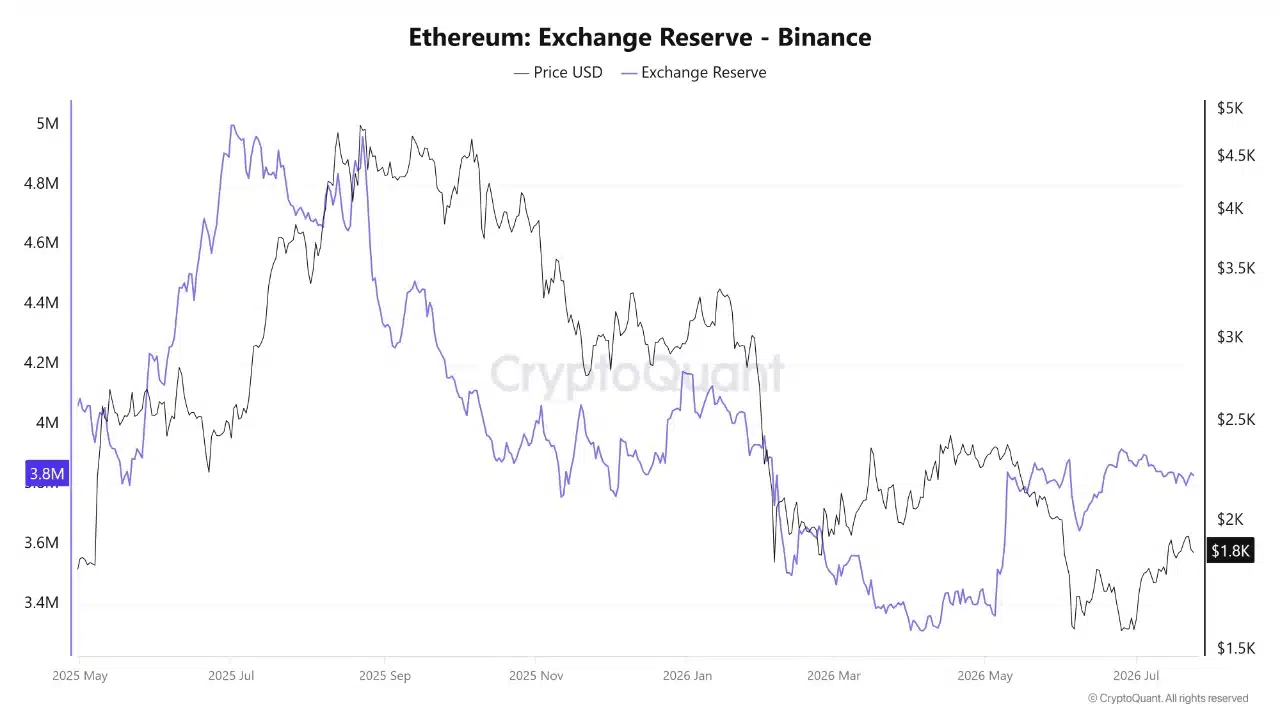
Source: CryptoQuant
XWIN Japan observed that Exchange Reserves fell from 5 million ETH in mid-2025 to 3.8 million at the time of writing. This signals both accumulation from holders and easing selling pressure in the market.
Additionally, the market price is below the realized price, setting up favorable conditions for long-term investors to buy the leading altcoin on the cheap.
However, XWIN Japan noted that falling Exchange Reserves, by themselves, do not confirm a final market bottom.
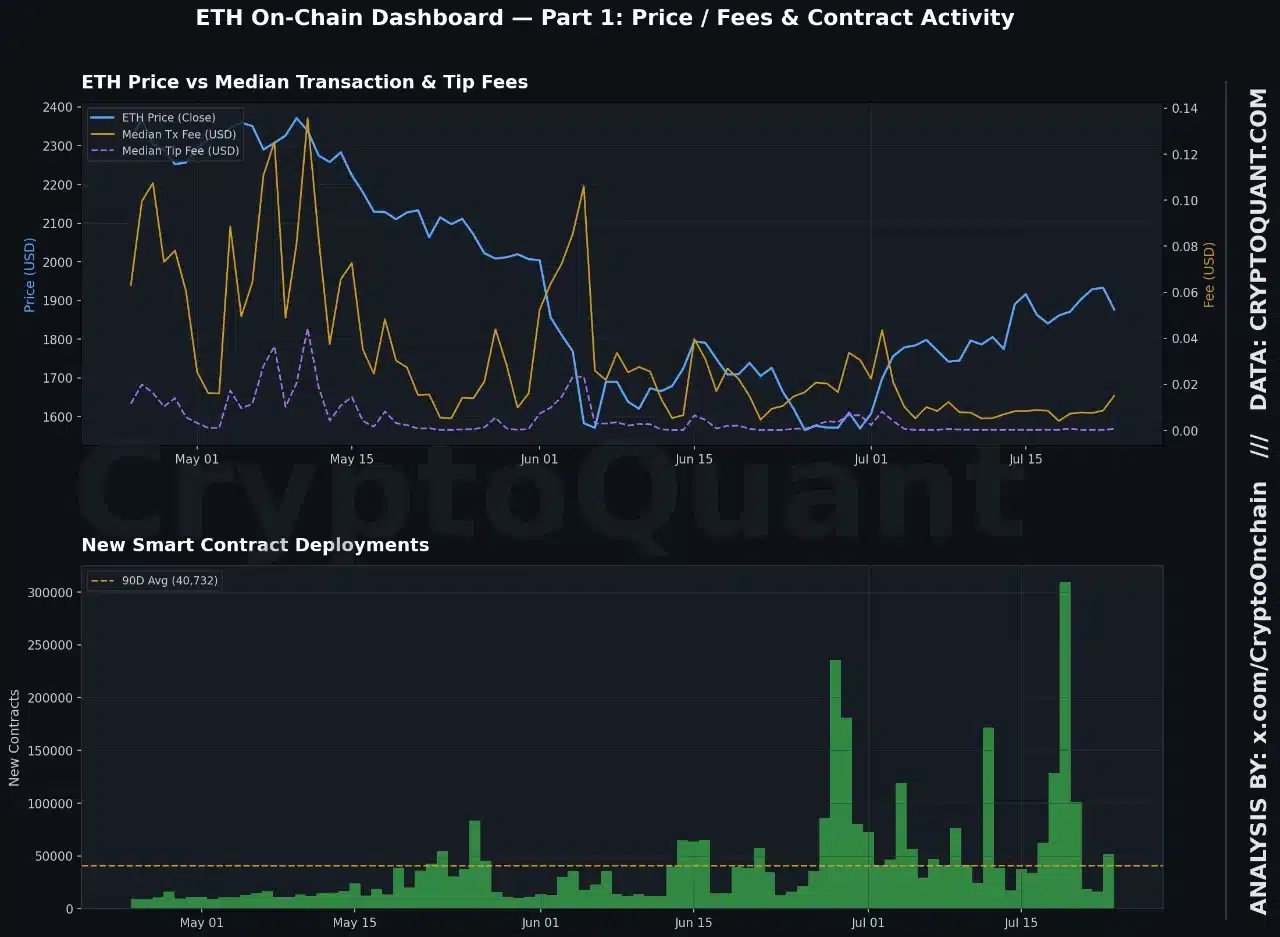
Source: CryptoQuant
Over the past quarter, Ethereum has been quiet, wrote crypto analyst Crypto Onchain. Median transaction fees were 92% below the 90-day average, for example. Yet, over the past week, these fees rose by 16%.
New smart contract deployment surged 190% compared to the 90-day baseline. Median tip fees also rose 86%. The increased contract deployment and tips pointed to genuine short-term on-chain demand and activity.
Leverage remained subdued. Funding rates were cooling on Binance, and Open Interest has dropped from $15.06 billion at the start of June to $11.85 billion at press time.
If the short-term uptick in activity is sustained, while leverage is under control, a price uptick driven by organic demand could be viable.
Final Summary
Compared to its realized price, Ethereum remains cheap, and falling exchange reserves pointed to steady accumulation.
Uptick in smart contract deployment and median tips over the past week, alongside subdued leverage, was something investors can keep an eye on.
Shiba Inu rose 36% to about $0.0000057 on Sunday, adding roughly a billion dollars to its market value in a day, with no announcement or development to account for it.
The token now carries a market cap near $3.4 billion on almost $380 million of daily volume, its highest turnover ranking in months.
SHIB prices are up 35% in the past 24 hours. (CoinDesk Data)
Nothing has emerged from Shibarium, the network’s layer-2, and the wider dog-token complex has lagged. Dogecoin gained 6% over the same stretch, and smaller-cap tokens moved as much as 10%, which pointed to something specific to SHIB rather than a rotation into memecoins.
South Korean buying stands out. Upbit’s SHIB/KRW pair is the single largest market at about $62 million, over a tenth of global volume, and it prints a slight premium to Binance and the other dollar venues.
The country’s traders are known to drive exuberant rallies in high-volatility tokens, and the token’s climb fits that pattern, with a first push late Saturday, nine flat hours, then a second move through the Asian morning.
Dave Nadig, Eric Balchunas, Tony Dong, and Sumit Roy share a laugh on ETF Zoo
The leveraged frenzy has hit fever pitch, with the ETF category notching substantial gains and equally eyebrow raising losses in the first half. ETF.com hosts Dave Nadig, President & Director of Research, and Sumit Roy, Senior ETF Analyst are joined this week by Eric Balchunas, Senior ETF Analyst at Bloomberg Intelligence, and Tony Dong, CETF, Lead ETF Analyst at ETF Central. The group catches up on flows, including the sizable amount of money going into and out of leveraged ETFs, what’s trending and what’s faded this year, and much more.
ETF inflows recently have been completely swallowed by a flat-to-down market, while the boring stuff keeps winning. Eric Balchunas pointed out that even amid all the buzz around AI and semiconductor plays, nearly $200 billion year-to-date has quietly piled into plain-vanilla giants like VOO, SPY, IVV, and VTI. The flip side of this trade is that nobody’s touching commodities, crypto, or private credit as diversifiers anymore, and even factor investing appears to be languishing. Cautious investing is back as investors park their safe money in boring beta and cash (thanks to 4% money-market yields). That said, having secure money tucked away also frees them up to gamble on whatever’s hot without panicking when it tanks.
The Roundhill DRAM memory-chip ETF became the poster child for 2026 speculation, breaking iShares Bitcoin ETF IBIT‘s inflow record before taking a 40% price hit, yet assets barely budged from their $25 billion peak because money kept pouring in anyway. Sumit Roy noted the real debate is whether the memory/AI chip cycle is genuinely different this time or just another boom headed for a bust. Meanwhile, Tony Dong called out the sillier end of the spectrum: a wave of leveraged and inverse single-stock ETFs launched around the SpaceX IPO, one of which cratered nearly 30% in a week. However, despite the wild swings in leveraged strategies, Balchunas makes the case that products like TQQQ have actually generated tens of billions in real investor gains.
The Zoo crew also dug into the longer-term impacts of Trump accounts for kids, with Balchunas predicting wealthy donors will eventually use them to pass down stock tax-free.t. On crypto, Roy and Balchunas agreed the current quiet stretch simply tracks Bitcoin’s roughly 50% drawdown but could it also be because true crypto believers are having an identity crisis now that Wall Street and the government have made it mainstream? Rounding things out, the crew was also skeptical of a real rotation into China despite hype around the Kimi AI announcement, given the larger geopolitical framing. And on small caps and international stocks, the consensus was: promising numbers, but nobody’s ready to call it a real regime change until large caps tumblee for more than a few months.
Find out how much you could earn by locking in a high CD rate today. The Federal Reserve cut its federal funds rate three times in 2025. So far in 2026, the Fed has left interest rates alone, and so now could be your last chance to lock in a competitive CD rate before rates move further. CD rates vary widely across financial institutions, so it’s important to ensure you’re getting the best rate possible when shopping around for a CD.
The following is a breakdown of CD rates today and where to find the best offers.
CD rates today, Saturday, July 25, 2026
Generally, the best CD rates today are offered on shorter terms of around one year or less. Online banks and credit unions, in particular, offer the top CD rates.
Today, the highest CD rate is 4.20% APY. This rate is offered by Sallie Maeon its 2-year CD.
Here is a look at some of the best CD rates available today:
How much interest can I earn with a CD?
The amount of interest you can earn from a CD depends on the annual percentage rate (APY). This is a measure of your total earnings after one year, taking into account the base interest rate and how often interest compounds (CD interest typically compounds daily or monthly).
Say you invest $1,000 in a one-year CD with 1.52% APY, and interest compounds monthly. At the end of that year, your balance would grow to $1,015.20 — your initial $1,000 deposit, plus $15.20 in interest.
Now let’s say you choose a one-year CD that offers 4% APY instead. In this case, your balance would grow to $1,040.74 over the same period, which includes $40.74 in interest.
The more you deposit in a CD, the more you stand to earn. If we used the same example of a one-year CD at 4% APY but deposited $10,000, your total balance when the CD matures would be $10,407.42, meaning you’d earn $407.42 in interest.
When choosing a CD, the interest rate is usually top of mind. However, the rate isn’t the only factor you should consider. There are several types of CDs that offer different benefits, though you may need to accept a slightly lower interest rate in exchange for more flexibility. Here’s a look at some of the common types of CDs you can consider beyond traditional CDs:
Bump-up CD: This type of CD allows you to request a higher interest rate if your bank’s rates go up during the account’s term. However, you’re usually allowed to “bump up” your rate just once.
No-penalty CD: Also known as a liquid CD, this type of CD allows you to withdraw funds before maturity without penalty.
Jumbo CD: These CDs require a higher minimum deposit (usually $100,000 or more), and often offer a higher interest rate in return. In today’s CD rate environment, however, the difference between traditional and jumbo CD rates may not be much.
Brokered CD: As the name suggests, these CDs are purchased through a brokerage rather than directly from a bank. Brokered CDs can sometimes offer higher rates or more flexible terms, but they also carry more risk and might not be FDIC-insured.
On the 25th of July, Stacks [STX] experienced strong bearish pressure. After a long period of consolidation, bears finally took over the market, with STX losing the $0.16 support level.
As a result, the altcoin crashed to $0.13. STX has not dropped to such levels since mid-2020, marking a 6-year low. As of this writing, Stacks was trading around $0.138, after dropping by 6.2% on the daily charts.
Why is Stacks declining, though?
STX dropped to a six-year low driven by market concerns over the token’s tag on Binance. The Stacks Endowmentacknowledged the concern and said it was in contact with Binance to resolve the issue.
Importantly, the team posited that the change in tag on Binance was likely due to the upcoming PoX-5 hardfork. For that reason, the Stacks team informed other major CEX partners in time, who have since moved forward in support.
According to Reubs, the tag will be removed once consensus-level changes on Binance are completed. Although the team assured the community, the market did not receive the assurance positively, and sentiment flipped.
What about the PoX-5 hardfork?
The Stacks PoX-5 hardfork is scheduled for the 29th of July. This follows a successful vote and overwhelming community support of SP 044 and SP 045.
The highly anticipated upgrade brings about trustless, self-custodial Bitcoin staking. Thus, the upgrade will allow users to earn BTC-dominated yield while still keeping their holdings under their own key.
Three days ago, the public PoX-5 testnet went live for builders to test their protocols ahead of the mainnet.
On-chain usage remains extremely weak
Despite the rollout of the public testnet and market anticipation, Stacks’ on-chain activity has failed to keep up. In fact, the network’s on-chain activity has continued to decline.
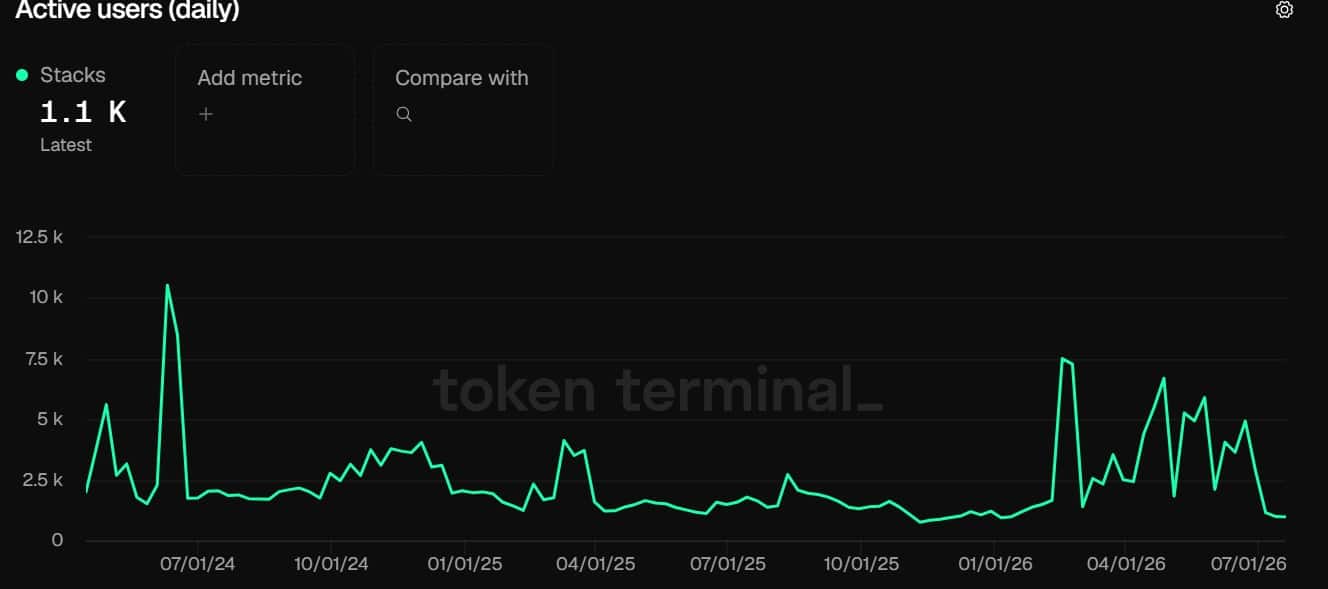
According to Token Terminal data, daily active users plunged to 1.1k. The network recorded such a low user count in January 2026.
Source: Token Terminal
The declining usage shows that the upcoming upgrade has not incentivized users to stay or attracted new users. Reduced network activity usually translates to lower demand for the native token and could lead to extended weakness for STX.
Can STX hold the pressure?
The recent market concerns prompted traders to reduce exposure. As a result, the market structure weakened, thus further strengthening the downward momentum.
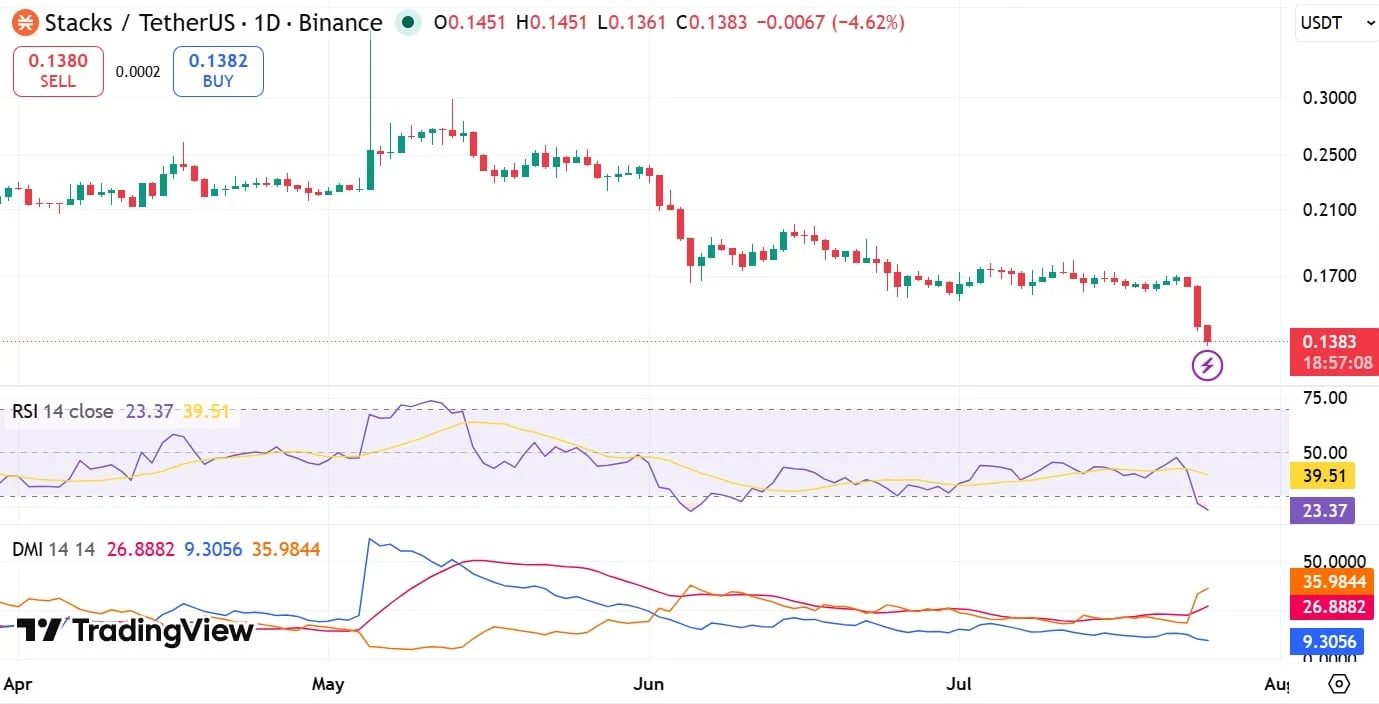
In fact, STX’s Relative Strength Index (RSI) formed a bearish crossover and plummeted into oversold territory.
Source: TradingView
At 23, RSI indicated sellers had fully retaken control. Furthermore, the Spot Buy Sell Volume metric confirms this bearish flip.
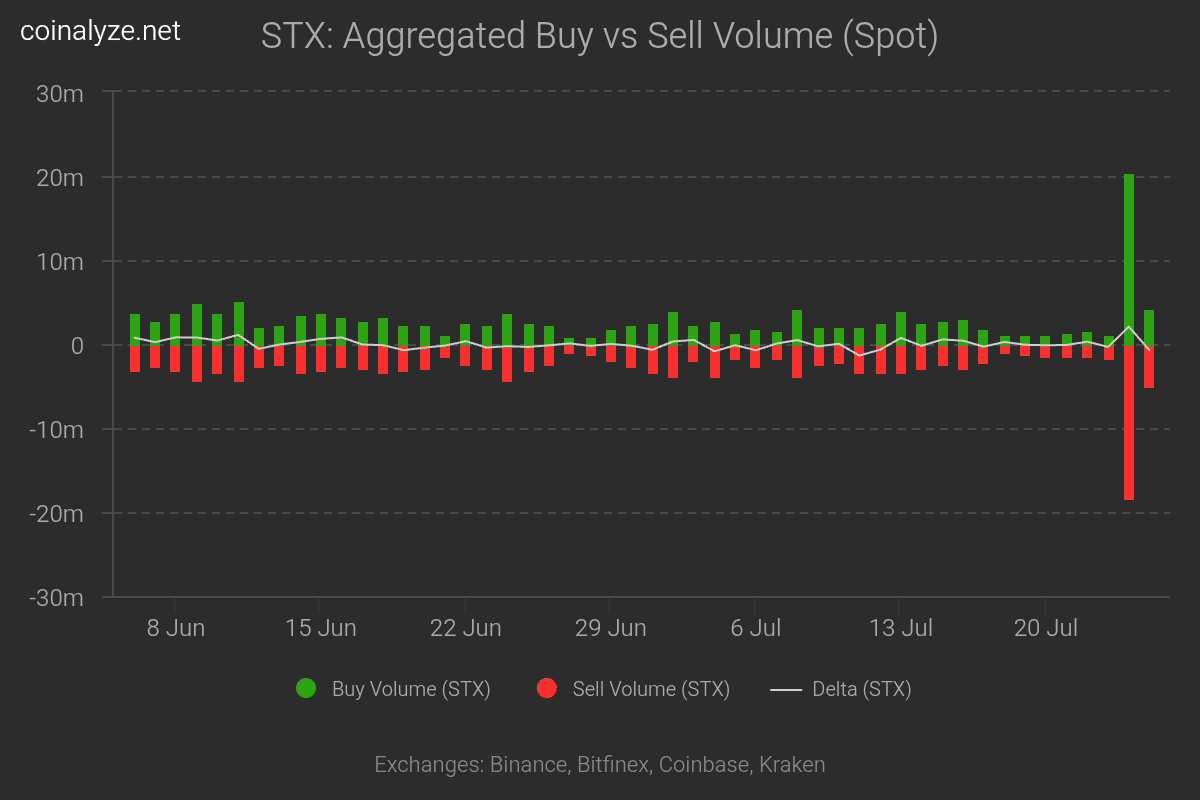
The sell volume rose to 4.98 million while the buy volume dropped to 4.24 million. Previously, buyers had shown relative strength, pushing buy volume to 20.4 million.
Source: Coinalyze
With sellers dominating the market, it warns of potentially extended weakness. Therefore, if sellers continue to dominate while network demand is weak, Stacks could drop below $0.13, with $0.1 as a critical support level.
However, if the concerns over the Binance tag are addressed, easing pressure, the altcoin could seek to reclaim $0.16.
Final Summary
STX plunged to a 6-year low of $0.13 amid market concerns over the Binance tag.
Stacks’ market structure remains bearish, with weak on-chain activity and seller dominance.
PARIS, FRANCE – AUGUST 08: LeBron James #6 and Stephen Curry #4 of Team United States celebrate after their team’s win against Team Serbia during a Men’s basketball semifinals match between Team United States and Team Serbia on day thirteen of the Olympic Games Paris 2024 at Bercy Arena on August 08, 2024 in Paris, France. (Photo by Gregory Shamus/Getty Images)
Getty Images
It was all a dream.
That LeBron James would join the Golden State Warriors after once facing them in four epic NBA Finals (2015-18). That James would play with Stephen Curry for something as memorable as the 2024 Paris Olympics gold-medal run. That James would also partner with Draymond Green, a former adversary, current friend and ally that delayed his free agency to give the Warriors additional cap space to secure James. That Steve Kerr’s bravado to a Warriors fan that they signed James was more than just the Warriors’ coach trolling playfully while sitting in traffic.
Instead, the Warriors struck out on their main free-agency target. After once causing league-wide envy for their dynastic run filled with four NBA championships, generational talent and strong organizational depth, the Warriors currently seem light years behind. That’s because their Plan B likely involves retaining their main roster that couldn’t advance past last season’s Play-In tournament. That’s because there aren’t many game-changing free agents available. That’s because they don’t have many assets beyond draft picks to make many significant moves.
Hence, the Warriors’ next pivot will likely entail the following scenarios. Hope that Curry will still provide elite shooting, playmaking and leadership. Retain Green, trust that he will still defend at an All-NBA level and that public trash talking with rookie Yaxel Lendeborg won’t lead into any serious tension. Lean on Kristaps Porzingis’ stellar passing, scoring versatility and spacing. Stay competitive until Jimmy Butler returns possibly midway through the season after rehabbing his right ACL since January. Foster Lendeborg’s intriguing upside with his two-way versatility. Try to acquire some decent talent through free agency (DeMar DeRozan) or trades (Trey Murphy). All while holding onto their draft capital for future deals. All while banking that their veteran-laden team can stay reasonably healthy.
It all seems like a flimsy house of cards.
The Warriors had a 25-19 record and the fourth-highest defensive rating (112.2) before Butler’s season-ending injury. That has convinced the Warriors they actually have a title-contending roster. But it seems foolish to bank on a 36-year-old Butler remaining just as effective after returning from an injury that has altered numerous NBA players’ careers, including former Warriors guard Klay Thompson. Porzingis has become a dependable plug-and-play complementary piece around star players, including his 2024 NBA title run with the Boston Celtics. But it seems naïve to think Porzingis can stay healthy consistently even when accounting for the Warriors’ strong medical staff and his own progress in recent years to improve his postural stability.
Lendeborg won’t face the same limitations as the Warriors’ failed draft picks in James Wiseman and Jonathan Kuminga. But even if Lendeborg makes a significant impact his rookie season, it’s unfair to expect he will become the main factor in elevating the Warriors’ season. Lastly, bank on Curry and Green’s enduring play, chemistry and relationship equity. But though both players have proven they can still keep the Warriors in the mix, they have not shown that’s enough to make a serious playoff push since last winning an NBA title four years ago.
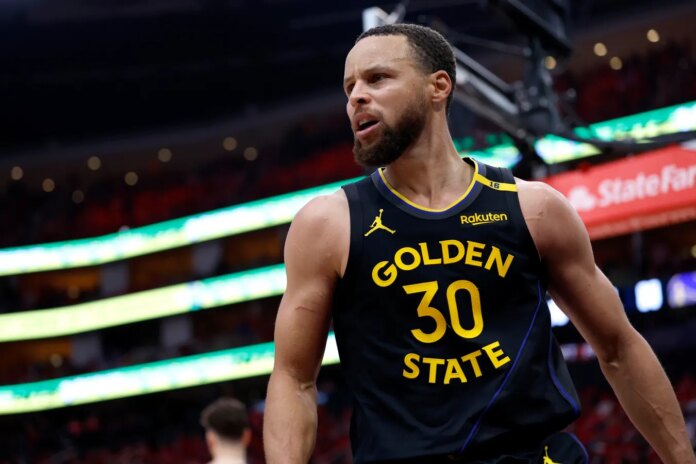
HOUSTON, TEXAS – MAY 04: Stephen Curry #30 of the Golden State Warriors reacts against the Houston Rockets after making a shot during the fourth quarter in Game Seven of the Western Conference First Round NBA Playoffs at Toyota Center on May 04, 2025 in Houston, Texas. NOTE TO USER: User expressly acknowledges and agrees that, by downloading and or using this photograph, User is consenting to the terms and conditions of the Getty Images License Agreement. (Photo by Tim Warner/Getty Images)
Getty Images
Will the Warriors do enough to help Steph Curry?
Because of this backdrop, Warriors fans have become increasingly frustrated that the franchise has needlessly squandered Curry’s title window. Some believe Warriors majority owner Joe Lacob cares more about maximizing their long-term future following Curry’s eventual retirement than maximizing their current present with Curry still playing at an All-Star caliber level. It doesn’t help that the Sixers acquired both James and Jaylen Brown this offseason because of a familiar person. That would be Bob Myers, the president of the Sixers’ ownership group (Harris Blitzer Sports & Entertainment) after previously serving as the Warriors’ longtime general manager (2012-23).
It’s not clear to what extent the Warriors tried to acquire Brown when the Celtics dangled him in trade talks. But it seems doubtful the Celtics would have interest in Green or Butler along a handful of draft picks. Green has played a key role in the Warriors’ four NBA titles, but his value means more to the Warriors considering how well he complements Curry. Butler wouldn’t be available for at least half the season, and he likely wouldn’t be the best version of himself anyway. Thought the Celtics questionably banked on a 36-year-old Paul George to become consistent with his play and health, that move seems less risky than inheriting anything the Warriors could realistically offer.
As for James, he certainly found it enticing to play with Curry and Green out of respect for their basketball IQ and championship experience. James had initially floated that he hoped to be able to spend more time with his wife (Savannah) and daughter (Zuri), making it theoretically possible for James to stay in nearby Los Angeles during the team’s offdays. James would have loved to team up again with Anthony Davis, but the Wizards have not made him available in trade talks. The Warriors also didn’t consider it worth it to deal their first-round picks to Davis considering his injury history.
Therefore, it’s not about beating up on the Warriors for missing out on potential moves this summer with either Brown, James or both. This illustrates, though that the Warriors seem boxed in with their current circumstances. Three years after Kevin Durant left the Warriors as a free agent, the Warriors won an NBA title partly because they made the best of Durant’s departure. Myers oversaw the Warriors dealing Durant to Brooklyn in a sign-and-trade for D’Angelo Russell, which they flipped a season later to Minnesota for Andrew Wiggins and a first-round pick. The Warriors smartly drafted and groomed Jordan Poole. Myers oversaw the Warriors misfiring with their No. 2 pick in 2020 (Wiseman) and No. 7 pick in Kuminga (2022). But the Warriors still had enough with Curry and Green’s enduring excellence, Wiggins’ complementary role, Poole’s growth and Thompson’s somewhat promising return from injury.
The Warriors couldn’t sustain that championship play. Green’s pre-season punch toward Poole certainly didn’t help chemistry. But the Warriors eventually invested more in Green for his enduring defense and soured on Poole for his inconsistent play and team-oriented habits. Thompson no longer looked like the elite two-way player before his two season-ending injuries. Wiggins struggled to play as effectively both because of health and inconsistent play. Following a second-round exit to the Los Angeles in 2023, the Warriors dealt Poole to the Washington Wizards for Chris Paul and Thompson to the Dallas Mavericks in a sign-and-trade for Josh Green and two second-round picks. None of those moves materialized into anything. But the Warriors finally felt like they were back in the title mix after acquiring Butler from Miami with Wiggins as the centerpiece leading into 2025 trade deadline.
That helped the Warriors go 23-7 with Butler and sneak into the Play-In tournament as a seventh seed. They survived a seven-game first-round series against the second-seeded Houston Rockets. But they lost to the Wolves in five games mostly because Curry suffered a Grade 1 left hamstring strain in Game 1. The Warriors appeared ready to contend again last season up until Butler’s season-ending injury. That unraveled everything. They couldn’t entice the Bucks to listen to any trade offers for Antetokounmpo. The Warriors settled on acquiring Porzingis from the Atlanta Hawks for Kuminga and Buddy Hield. But without Butler, the Warriors could only win one Play-In game.
Two months later, the Warriors appear only slightly better simply because their main core has had time to heal this offseason. But what about when the season actually starts? The Warriors simply hope to stay competitive enough before finding a better market leading into the trade deadline. Then and now, the Warriors’ front office need to become more aggressive and creative out of respect for Curry, his enduring play and his graceful loyalty.






![Stacks [STX] crashes to $0.13 even as PoX-5 testnet goes live – Why?](https://moneyvests.com/wp-content/uploads/2026/07/Stacks-STX-crashes-to-013-even-as-PoX-5-testnet-goes-696x391.jpg "Stacks-STX-crashes-to-013-even-as-PoX-5-testnet-goes.jpg")