Alphabet (Google) Image by Markus Mainka via Shutterstock
The artificial intelligence (AI) boom continues to fuel one of the biggest spending cycles the technology sector has ever seen, and Alphabet (GOOGL) is showing no signs of easing off the accelerator.
The Google parent has once again increased its 2026 capital spending forecast to $195 billion to $205 billion, up from its earlier outlook of $180 billion to $190 billion, with most of that investment directed toward expanding AI infrastructure.
More News from Barchart
While investors became cautious after free cash flow turned negative last quarter, the higher spending reinforced that demand for AI computing power continues to outpace supply. This news is expected to benefit Google suppliers Lumentum Holdings (LITE) and Celestica (CLS).
Lumentum is benefiting from rising demand for the optical networking components that move massive volumes of data across AI data centers. Meanwhile, Celestica supplies the advanced electronics manufacturing and networking infrastructure that hyperscale customers need to support their expanding AI deployments.
Not every AI supplier shared in the optimism. Broadcom (AVGO) holds concerns that it could lose some tensor processing unit business to MediaTek, even though Morgan Stanley (MS) recently described Broadcom as a “core AI winner.”
The market’s reaction shows investors are becoming more selective. As Google commits even more capital to AI, Lumentum and Celestica appear especially well positioned to benefit from the company’s next phase of infrastructure expansion.
Stock #1: Lumentum Holdings
Based in San Jose, California, Lumentum develops advanced optical and photonic technologies that power communications networks and a wide range of industrial applications.
With a market cap of $64.9 billion, Lumentum’s portfolio spans high-performance laser systems used in semiconductor manufacturing, solar production, display technologies, electric vehicles (EVs), and battery manufacturing, giving it exposure to multiple long-term growth themes.
If AI has become the market’s favorite story, Lumentum has been one of its biggest beneficiaries. LITE stock has skyrocketed 665.7% over the past 52 weeks and gained 113.7% year-to-date (YTD), driven by surging demand for its optical networking components.
As hyperscale data center operators increasingly swap copper connections for faster optical links, Lumentum has found itself in the sweet spot of the AI infrastructure buildout.
www.barchart.com
Naturally, that kind of performance has come with a lofty valuation. LITE stock is currently trading at 101.26 times forward adjusted price-to-earnings. The figure sits well above the industry average and its own five-year historical multiple, showing that investors are willing to pay up.
The company’s latest quarterly results only reinforced the bullish narrative. On Tuesday, May 5, shares gained 1.88% after Lumentum reported Q3 FY2026 earnings that exceeded analyst expectations. Revenue increased 90.1% year-over-year (YOY) to $808.4 million, topping the $805.4 million analyst estimate.
Robust demand across the Components and Systems business drove the growth, while laser chips and products such as pump lasers continued to benefit from AI-related spending and improving scale.
Delving deeper, gross margin expanded by 540 basis points, while operating margin improved by 700 basis points. Better execution, disciplined pricing, and a richer product mix boosted bottom-line growth. Adjusted EPS came in at $2.37, representing 315.8% YOY growth and surpassing analysts’ estimate of $2.24.
Wall Street expects the momentum to carry into the next quarter and beyond. Analysts project Q4 FY2026 EPS of $2.62, representing 718.8% YOY growth. For the full-year FY2026, EPS is estimated to rise significantly to $6.42, followed by another 159.7% jump to $16.67 in FY2027.
Analyst sentiment is overwhelmingly positive, with Lumentum carrying an overall “Strong Buy” rating. Of the 22 analysts covering the name, 15 rate it a “Strong Buy,” two recommend a “Moderate Buy,” and five maintain “Hold” ratings.
The average price target of $1,098.45 represents potential upside of 31.8%, while the Street-High target of $1,400 signals a possible surge of 67.9% from current levels.
www.barchart.com
www.barchart.com
Stock #2: Celestica
Headquartered in Toronto, Canada, Celestica delivers end-to-end design, engineering, manufacturing, and supply chain solutions for many of the world’s largest technology companies.
With a market cap of $38.5 billion, it offers product design and development, new‑product introduction, engineering services, component sourcing, electronics manufacturing and assembly, testing, systems integration, and comprehensive supply‑chain management to customers worldwide.
The positioning has translated into exceptional shareholder returns. CLS stock has surged 92.3% over the past 52 weeks and gained 6.7% YTD, fueled by the relentless expansion of AI infrastructure.
Demand for the company’s high-speed data center networking solutions, particularly its 800G products and next-generation 1.6T platforms, has accelerated sharply. Moreover, a streak of earnings beats and multiple upward revisions to full-year guidance make it clear why the stock has remained firmly in the market’s good graces.
www.barchart.com
Of course, quality rarely comes cheap. CLS stock is trading at 32.50 times forward adjusted price-to-earnings, a valuation that sits comfortably above both the industry average and the company’s own five-year average multiple. Investors have shown little hesitation because the company’s earnings have continued to justify the premium.
O Monday, April 27, Celestica reported its Q1 FY2026 results, and its shares climbed 2.93% as the company delivered another standout quarter, driven by robust AI-related demand in its Connectivity & Cloud Solutions (CCS) segment.
First-quarter revenue climbed 52.8% YOY to $4.05 billion, topping the $4 billion analyst estimate. Adjusted EPS came in at $2.16, while adjusted net earnings rose 78.1% to $249.5 million, underscoring the company’s ability to convert booming demand into meaningful profitability.
For Q2 FY2026, Celestica projects revenue between $4.15 billion and $4.45 billion alongside adjusted EPS of $2.14 to $2.34. Looking further ahead, the company also lifted its full-year FY2026 outlook, now expecting $19 billion in revenue and adjusted EPS of $10.15.
Investors won’t have to wait long for the next update, as Celestica is scheduled to report Q2 FY2026 results before the market opens on Tuesday, July 28. Analysts anticipate Q2 FY2026 EPS to grow 68.3% YOY to $2.12. For full-year FY2026, EPS is forecasted to rise 71.8% to $9.57, followed by a 49% growth to $14.26 in FY2027.
CLS stock has earned an overall “Strong Buy” rating. Out of 19 analysts covering the name, 17 have backed it with a “Strong Buy,” one maintains a “Moderate Buy,” while one carries a “Hold” rating.
The average price target of $446.53 represents potential upside of 43.4%. For the more bullish among them, the Street-High target of $510 points to a possible rally of 63.8% from current levels.
www.barchart.com
www.barchart.com
On the date of publication, Aanchal Sugandh did not have (either directly or indirectly) positions in any of the securities mentioned in this article. All information and data in this article is solely for informational purposes. This article was originally published on Barchart.com
“As it uses existing rules, it’s going to be much less like a standalone framework,” Lightstone said. “A crypto firm will be treated like any normal traditional financial institution,” adding that “it will still be hard to get FCA authorization.”
For established banks and investment firms already operating under those rules, adapting to crypto may be relatively straightforward. For newer crypto businesses, however, the cost of building governance, capital and custody systems from scratch could prove considerably more burdensome.
That challenge is particularly evident in the FCA’s proposed client asset regime, applying the Clients Asset Sourcebook (CASS) framework, which would require firms to segregate customer crypto assets from company funds under trust arrangements while introducing crypto-specific operational safeguards around private keys and reconciliations.
“The CASS requirements are very onerous,” Lightstone said. “That could encourage those newcomers to merge [with], be acquired by, a traditional firm that’s already subject to CASS and has those controls in place.”
Banking adoption
The prospect of consolidation comes as banks themselves appear more willing to enter digital assets now that regulatory uncertainty is beginning to lift.
“As of today, there is less than 20% of all the banks in Europe [that] offer today any type of crypto services, so it’s heavily underserved,” said Simon Schneider, CEO of Sygnum Europe.
Find out how much you could earn by locking in a high CD rate today. A certificate of deposit (CD) allows you to lock in a competitive rate on your savings and helps your balance grow. However, rates vary widely across financial institutions, so it’s important to ensure you’re getting the best rate possible when shopping around for a CD. The following is a breakdown of CD rates today and where to find the best offers.
Overview of CD rates today
Historically, longer-term CDs offered higher interest rates than shorter-term CDs. Generally, this is because banks would pay better rates to encourage savers to keep their money on deposit longer. However, in today’s economic climate, the opposite is true.
Today, Sunday, July 26, 2026, the highest CD rate is 4.20% APY. This rate is offered by Sallie Maeon its 2-year CD.
How much interest can I earn with a CD?
The amount of interest you can earn from a CD depends on the annual percentage rate (APY). This is a measure of your total earnings after one year, taking into account the base interest rate and how often interest compounds (CD interest typically compounds daily or monthly).
Say you invest $1,000 in a one-year CD with 1.52% APY, and interest compounds monthly. At the end of that year, your balance would grow to $1,015.20 — your initial $1,000 deposit, plus $15.20 in interest.
Now let’s say you choose a one-year CD that offers 4% APY instead. In this case, your balance would grow to $1,040.74 over the same period, which includes $40.74 in interest.
The more you deposit in a CD, the more you stand to earn. If we used the same example of a one-year CD at 4% APY but deposited $10,000, your total balance when the CD matures would be $10,407.42, meaning you’d earn $407.42 in interest.
When choosing a CD, the interest rate is usually top of mind. However, the rate isn’t the only factor you should consider. There are several types of CDs that offer different benefits, though you may need to accept a slightly lower interest rate in exchange for more flexibility. Here’s a look at some of the common types of CDs you can consider beyond traditional CDs:
Bump-up CD: This type of CD allows you to request a higher interest rate if your bank’s rates go up during the account’s term. However, you’re usually allowed to “bump up” your rate just once.
No-penalty CD: Also known as a liquid CD, this type of CD allows you to withdraw funds before maturity without penalty.
Jumbo CD: These CDs require a higher minimum deposit (usually $100,000 or more), and often offer a higher interest rate in return. In today’s CD rate environment, however, the difference between traditional and jumbo CD rates may not be much.
Brokered CD: As the name suggests, these CDs are purchased through a brokerage rather than directly from a bank. Brokered CDs can sometimes offer higher rates or more flexible terms, but they also carry more risk and might not be FDIC-insured.
Hyperliquid [HYPE] has historically deployed deflationary mechanisms to control supply and absorb market pressure. The project has mostly used the protocol’s revenue for token buybacks and burns to achieve these goals.
Hyperliquid burns $1.2 million worth of HYPE
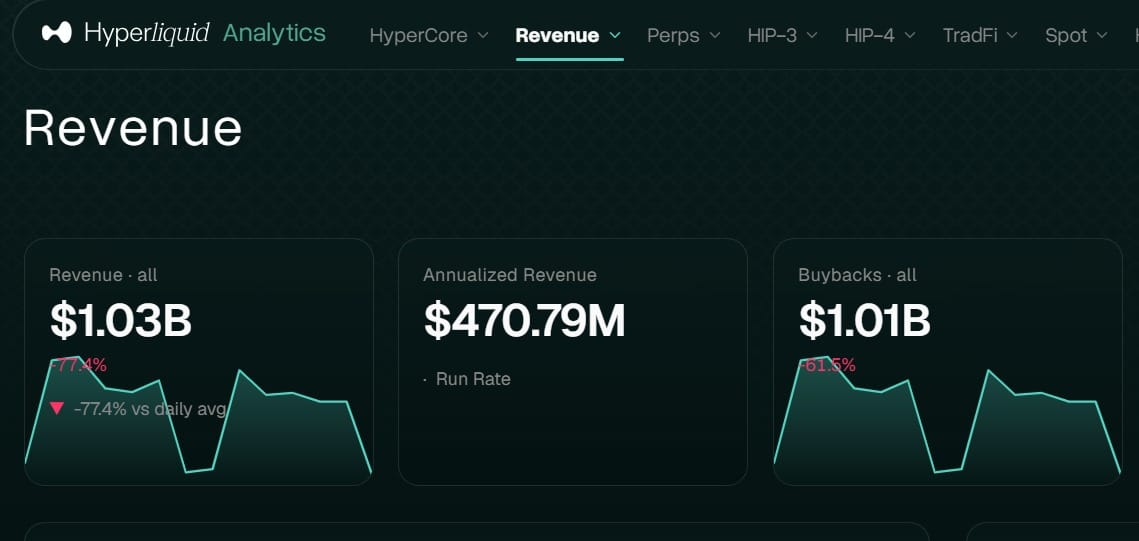
With HYPE prolonging its stay below $60, the project once again used its revenue to reduce inflation. Since August 2025, the Hyperliquid network has generated $800 million in net income, with HyperCore accounting for 95% of the income.
Interestingly, most of the funds generated have been spent on token buybacks. Out of the $1.03 billion generated, $1.01 billion has been used for buybacks and burns.
Source: Hyperscreener
Over the past day, for example, Hyperliquid generated $1.4 million in fees and burned 20.64K HYPE worth $1.2 million. However, despite the buyback and burns, the capital spent here has plummeted significantly, falling 61%.
With the recent burn, Hyperliquid has burned 4.73% of the token’s supply according to Onchain Lens. This also marks over 15% of the currently circulating supply.
The sustained capital deployment toward deflationary measures has gone a long way toward stabilizing the HYPE token. As a result, HYPE has remained strong even during a prolonged period of broader market weakness.
Is actual demand incentivized, though?
Sustained capital deployment to ease pressure has significantly played a major role in boosting investor confidence. As a result, buyers have continued to pile in even during pullbacks.
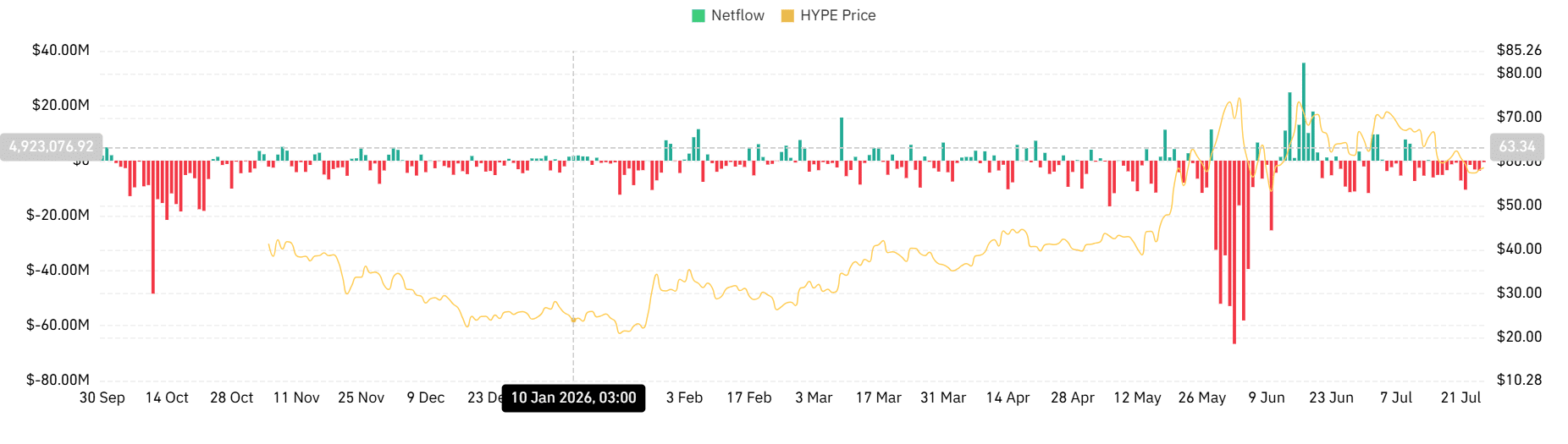
On the Spot side, for example, the Netflow has remained positive for two consecutive weeks. As of this writing, Netflow was -$598k, a significant drop from -$3.2 million the previous day, reflecting strong buying pressure.
Source: CoinGlass
Historically, sustained exchange outflows have preceded major price moves, especially to the upside.
The momentum remains weak
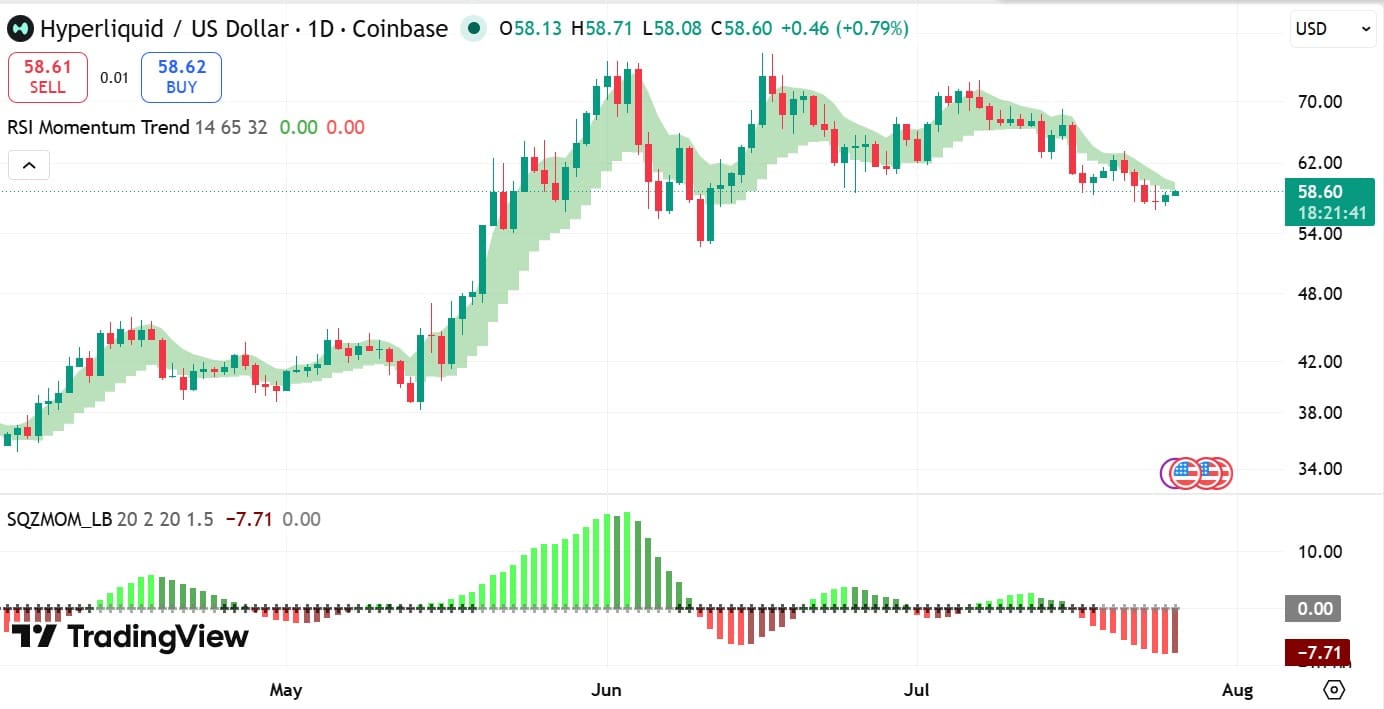
Although the demand currently holds strong, it remains insufficient to flip the trend bullish. In fact, when we look at the RSI Momentum Trend, this indicator sits above the market price.
Such a setup usually suggests that sellers still have significant control of the market. As such, the indicator now acts as dynamic resistance.
Source: TradingView
The Squeeze Momentum Indicator also currently sits below zero, at around -7.69, further confirming the trend’s weakness. However, the price remains on an upward trajectory; it must flip the RSI Momentum Trend to signal a reversal.
This means Hyperliquid needs a daily close above $60 to strengthen the uptrend. Failure to do so will increase downside risk, and HYPE will pull back toward $56 again.
Final Summary
Hyperliquid generated $1.4 million in fees and burned 20.64K HYPE worth $1.2 million.
HYPE’s momentum remains strong despite recovering demand, but a daily close above $60 will signal a trend reversal.
After interviewing dozens of financially independent investors over the past five years, I’m convinced that one of the fastest ways to buy yourself more freedom — whether that means retiring early or simply gaining the option to stop working — is not to skimp out on coffee while meticulously tracking every dollar.
It is to make more money.
Laurie-Anne King, cofounder of the financial-literacy company Dow Janes, told me in 2022 that “earning money is one of the secret skills of people who are achieving financial freedom fast.”
Rather than thinking, “Spend less so you can save more,” King and her cofounder, Britt Baker, challenge their audience to think: “Earn more so you can invest more.”
Grant Sabatier, author of the bestselling book “Financial Freedom,” offers similar advice: “If you want to reach financial independence as quickly as possible, you’re going to need to up your side-hustle game.”
Between 2010 and 2015, when Sabatier grew his net worth from $3 to more than $1 million, he did everything from pet-sitting and selling concert tickets to flipping vintage mopeds.
“No job was too small,” he writes in his book.
The math checks out: If you earn more without significantly increasing your spending, you’ll have more money to save and invest — and that’s how you accelerate your financial goals.
Putting that idea into practice, however, is harder than it sounds.
That business is now entering its third year. My cofounder and I spent about $10,000 getting it off the ground, mostly on inventory, and it has yet to turn a profit.
Peak Pickleball, one of the author’s side hustles, has yet to turn a profit.
Katie Monds
Bringing our product — pickleball paddles — to life took months of back-and-forth with manufacturers in China and long waits for prototypes to cross the Pacific. Amazon fees ate into our limited revenue and eventually prompted us to remove much of our inventory, which came with additional costs. We also learned that online advertising is a complicated, pay-to-play system that can consume money without producing sales.
Building something that actually makes money is easier said than done.
The easiest side hustle to start is the most time-consuming
The side hustle I keep returning to is one I started as a teen, before I’d even heard the term “side hustle”: teaching tennis.
It’s a natural choice for someone who’s played the sport for three decades and whose most-played YouTube video is the 2008 Wimbledon Final. It aligns with Baker’s advice to start with skills you already have.
“There’s this Venn diagram way of thinking about it,” she said, “which is: What’s a skillset that you have that other people need that they’re willing to pay for? If you can find something that fits those three circles, you can make money.”
It is also a true hustle. Teaching is a customer-facing job that requires energy and a lot of time on foot. It’s the opposite of passive income.
The author started playing tennis at age three and now earns extra income teaching the sport.
Courtesy of Kathleen Elkins
Cody Berman, author of “Retire by 30” and a longtime side hustler, calls this a “type one” side hustle: Trading time for money.
That category can include online freelance work such as writing, editing videos or podcasts, building websites, or compiling email newsletters. It can also include in-person work such as landscaping, driving for Uber, delivering groceries through Instacart, or completing jobs through other gig-economy platforms.
In my case, I earn $100 for every hour I spend on court. The arrangement is simple and predictable — I teach a lesson, get paid — but it is not scalable, at least not in its current form. The income stops when the lesson ends, and there are only so many hours I can teach in a week.
I’ve repeatedly stepped away from teaching (only to return to it) because the thing I ultimately want is more time — time to build something that could eventually earn money without requiring my presence every hour.
Berman calls that a “type two” side hustle: a scalable income stream that can continue generating revenue after much of the initial work is complete.
Examples include digital products, which generate the bulk of Berman’s income, as well as podcasts, YouTube channels, online courses, and other forms of content. A creator might spend hours producing something once and then continue earning through sales, sponsorships, affiliate links, advertising, or other forms of monetization.
The appeal of a type-two side hustle is that income is not strictly tied to hours worked. For Berman, those ventures have also been the most lucrative.
The trade-off is that they can take months or years to produce meaningful income — and some never do.
“You’re not going to start a YouTube channel or create a digital product today and make money with either of those things tomorrow,” he said. “But in six months’ time, those things might start making serious income.”
Peak Pickleball may eventually become that kind of business for me. For now, however, it is still consuming money rather than producing it.
Until the paddles pay me, the tennis lessons will.
BMX, the platform’s token, fell to about 8 cents, down 58% over 24 hours, cutting its market value to roughly $27 million. The token was already down about 70% over the past year, so Sunday’s drop extended a long decline rather than starting one.
The exchange’s trading figures are significant, despite the closure. BitMart reported about $1.6 billion in 24-hour volume, up 51% from the previous period, with bitcoin accounting for nearly half of it. That jump more plausibly reflects users unwinding positions and moving funds out than any fresh demand, but it leaves open why a platform still clearing that kind of flow is closing.
Meanwhile, the withdrawal terms carry more friction than a routine exit. BitMart said requests may face additional review covering identity verification, device and IP checks, withdrawal-address screening, source-of-funds questions and sanctions checks, and warned that processing could stretch if request volumes spike.
BitMart lost about $196 million to a hot-wallet breach in December 2021, one of the larger exchange hacks of that cycle, and covered customer losses at the time.
Moneywise and Yahoo Finance LLC may earn commission or revenue through links in the content below.
Owning a home, contributing to a retirement account, or maintaining an emergency fund may not be enough to achieve lasting financial security.
A new report from the Aspen Institute’s Financial Security Program (1) argues that Americans need a combination of liquid savings and appreciating assets to build what it calls “essential wealth” — the financial foundation needed to weather emergencies, invest for the future and retire comfortably.
Must Read
JPMorgan still sees gold hitting $5,000/oz by Q4 — and savvy investors are protecting their wealth with a tax-advantaged Gold IRA. Learn more with a free guide from Priority Gold
But according to the report, only 26% of U.S. households have reached that benchmark, leaving nearly three in four without enough wealth to fully achieve those goals.
“The headline finding is stark: The vast majority of American households — three out of four — do not have essential wealth,” the researchers wrote.
Worse still, this isn’t just a look at in-progress wealth building.
“Most households do not reach essential wealth at any age,” the report found, noting that even many Americans approaching or in retirement still fall short of the benchmark despite decades of saving.
‘Wealth is not just for the wealthy’
The report defines essential wealth as having both sufficient liquid savings to absorb financial shocks and enough net worth invested in appreciating assets — retirement accounts, home equity or businesses — to build long-term financial security.
Researchers argue that income alone isn’t enough because wages pay today’s bills, while wealth creates future opportunities and financial flexibility.
“Families cannot afford to wait for wealth until every other financial need has been met,” the report states. “Wealth is not just for the wealthy. It is necessary for everyone.”
To reach the benchmark, households must clear both a savings threshold and a net worth threshold, which vary by age.
For example, the report says a typical household in its 20s would need roughly $40,000 in net worth and six weeks’ worth of take-home pay in liquid savings to qualify as having essential wealth. For households in their 30s, that illustrative benchmark rises to roughly $120,000 in net worth plus six weeks of income in cash savings.
Importantly, essential wealth is just the final destination in a three-step journey. The report also details earlier, more manageable brackets — underscoring the fact that essential wealth is a developing goal, not an ultimatum.
One way to start building wealth is by investing consistently, even if you’re starting with small amounts. Micro-investing apps such as Acorns can help automate the process by rounding up purchases and investing the spare change into diversified portfolios.
For instance, if you buy a donut for $3.25, Acorns will round up the purchase to $4 and invest the change in a smart investment portfolio. So a $3.25 purchase automatically becomes a 75-cent investment in your future. Once you’re comfortable with your investments, Acorns can also help you make regular monthly contributions to speed up building out your nest egg.
Perhaps the most concerning finding is that reaching essential wealth remains difficult regardless of age.
While wealth generally increases over a lifetime, the report found that most households never accumulate enough to meet the benchmark.
Even among Americans 65 and older, those who have had the longest to save and invest, still fall short. Households in their 50s and early 60s reach essential wealth at roughly the same rate as people decades younger, suggesting many Americans are approaching retirement without the financial cushion researchers believe is necessary.
The report argues this is simply the result of “the sheer consistency of the gap across age groups points to structural barriers that inhibit wealth building beyond individual saving behavior.”
They did not cite poor spending habits as a reason.
The report also challenges the idea that owning a home automatically puts households on solid financial footing.
Many families who own homes remain below the report’s “emergent wealth” threshold because they lack sufficient liquid savings. While home equity is an important asset, researchers note that households can still be “house poor” if most of their wealth is tied up in property and they don’t have enough cash to handle unexpected expenses.
Likewise, some households have accumulated meaningful assets but still fall short because they haven’t built an accessible emergency fund. Fidelity (2) notes that many investors should maintain emergency savings separate from long-term investments.
The report concludes that reaching essential wealth “typically requires a diverse portfolio of appreciating assets — home equity, retirement savings, and other investments working together — rather than outsized reliance on any one vehicle.”
Lasting financial security comes from owning multiple appreciating assets rather than relying on a single source of wealth. For investors who want exposure to real estate without purchasing another property, platforms such as Arrived allow individuals to invest in shares of rental homes.
Backed by world-class investors, including Jeff Bezos, Arrived allows you to invest in shares of rental properties and earn a passive income stream without the extra work that comes with being a landlord.
If you’re behind on building wealth, the report suggests thinking beyond a single retirement account or emergency fund.
Financial professionals at CFP Board (3) generally recommend building wealth through a diversified mix of assets while maintaining enough liquid savings to handle unexpected expenses without taking on debt. Some investors also choose to diversify a portion of their retirement savings with alternative assets such as precious metals.
If you’re curious about adding precious metals to your broader inflation-hedging strategy, a gold IRA from Goldco lets you hold physical gold and other metals while still getting the tax advantages of an IRA.
They also offer a guaranteed buyback program, meaning they’ll repurchase your metals at the “highest price” according to market value if you ever decide to sell.
If you want to explore whether precious metals could be a helpful hedge for your portfolio, you can download Goldco’s free gold and silver guide to see if it’s a good fit for you. Just keep in mind that gold is typically best deployed as one part of an otherwise well-diversified portfolio.
Get a second opinion
If you’re unsure whether your savings strategy aligns with your retirement timeline or broader financial goals, speaking with a qualified financial advisor can help you evaluate your options and create a personalized plan.
If you have a portfolio of $250,000 or more, platforms like WiserAdvisor can connect you with vetted professionals who specialize in this kind of planning.
Simply answer a few questions about your savings, retirement timeline and overall investment portfolio.
From there, WiserAdvisor reviews its network to match you — for free — with up to three vetted, reputable advisors aligned with your specific needs.
WiserAdvisor is a matching service and does not provide financial advice directly. All matched advisors are third parties, and specific financial results are not guaranteed.
You May Also Like
Join 250,000+ readers and get Moneywise’s best stories and exclusive interviews first — clear insights curated and delivered weekly. Subscribe now.
Article Sources
We rely only on vetted sources and credible third-party reporting. For details, see ourethics and guidelines.
Aspen Institute (1); Fidelity (2); Certified Financial Planner Board of Standards (3)
This article provides information only and should not be construed as advice. It is provided without warranty of any kind.