Bitcoin BTC$65,120.13 exchange-traded funds (ETFs) pulled in $853.54 million in net inflows for the week ended Aug. 7, the largest weekly total since mid-April, according to data from SoSoValue.
BlackRock’s IBIT accounted for the bulk of the activity, attracting $693 million on its own.
This surge in inflows offers a tentative sign that institutions are dipping back in after the heavy selling earlier this year.
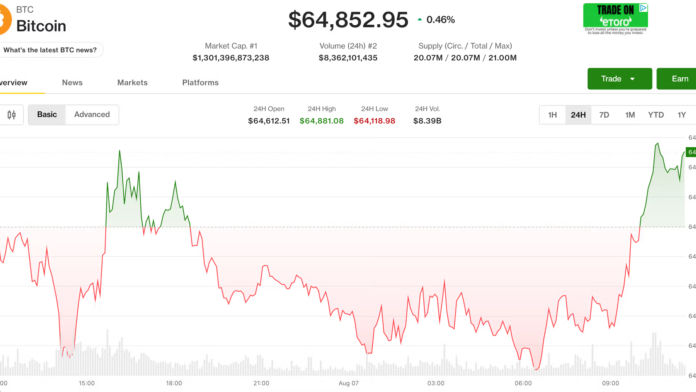
Recent bitcoin price action has looked more constructive. Negative headlines, including a multi-million-dollar Coldcard hack and rising government bond yields, have failed to dent the spot market. Bitcoin held steady at around $64,000 early this week and traded at around $65,100 as of this writing.
Friday’s unexpectedly weak U.S. jobs report for July has cooled bets on further Federal Reserve rate hikes for now, potentially clearing the path for continued institutional buying in ETFs.
What next?
The latest spike in inflows represents only one week of data. On a year-to-date basis, the ETFs remain roughly $4.5 billion in the red due to net outflows. This helps explain the heavy selling pressure seen during the first six months of the year, when Bitcoin fell 33% to below $60,000 by the end of June.
Do you remember past financial contagions? Those periods of time that tend to occur just when “things can’t get any better than this.” 1987, 2000, 2008, and 2022 are the U.S. versions of those.
And, with the summer froth having convinced the broad market that nothing can go wrong, my risk-manager brain goes into overdrive. Because when fundamentals leave the building, as they have recently, it allows a lot of bugs to creep in. Such as leverage-induced selloffs. Like that we just saw unfolding in South Korea.
More News from Barchart
South Korea’s benchmark KOSPI index cratered 44% from its June peak — a collapse worse than the 2020 pandemic crash — before staging a record-breaking 18% single-day rebound on Friday. Is all well? Not likely.
www.barchart.com
The primary catalyst wasn’t just fear over AI capital expenditure or tech debt. It was a hyper-leveraged feedback loop that trapped over a million retail investors and forced the government to issue a public apology.
At the center of the storm sit two tech giants—Samsung Electronics and SK hynix, which account for over half of the KOSPI’s weighting. When single-stock leveraged ETFs launched in South Korea this past May, retail investors jumped in aggressively. By July, these leveraged products and their underlying stocks represented 70% of total daily trading volume on the local exchange.
As we see here, South Korea’s stock market is no stranger to volatility. This table shows the iShares MSCI South Korea ETF (EWY), the main tracker ETF for the country’s stock market. That beta of nearly 1.5 over the past five years implies that this market is 50% more volatile than the S&P 500 Index.
www.barchart.com
Recently, when AI sentiment cooled, the unwinding for the Kospi was mechanical and merciless. Of course it was! Because leverage is a double-edged sword: it amplifies daily upside, but aggressively compounds downside risk. Because leveraged ETFs must rebalance their exposure daily, a declining stock forces the ETF issuer to sell more shares into a falling market.
Retail traders held 92% of these leveraged ETF positions, suffering an estimated $38 billion in cumulative losses. Incredibly, margin calls were delivered on more than 1.2 million South Koreans. That’s 3.4% of the adult population! By comparison, only 1% to 5% of U.S. retail accounts hit margin triggers during the entire 2008 global financial crisis. This seed was sowed in just a few weeks’ time, given the SK hynix (SKHY) IPO.
Outside Seoul’s National Assembly, funeral wreaths line the streets bearing protest signs. Regulators urgently established a debt-counseling hotline, suspended new single-stock leveraged ETF listings, and raised deposit minimums to 30 million won. National Assembly member Lee Jong-wook captured the public outrage during parliamentary hearings: “The country has turned into a casino.”
This crisis was created not only by greed, but by South Korea’s acute economic crisis. With real estate out of reach for young adults saving on average wages, high-leverage bets on Samsung and SK hynix became viewed as one of the few remaining tickets to social mobility. Sound familiar, U.S. investors?
American counterparts shouldn’t view this as a distant anomaly. In the U.S., leveraged ETF assets under management have surged 60% since March to a record $218 billion. While they make up just 1% of total ETF assets, they now generate 40% of all U.S. ETF trading volume.
As Charlie Munger famously warned, leverage strips away an investor’s most important asset: time. Unleveraged investors can comfortably ride out cyclical downturns; leveraged traders get liquidated at the absolute bottom, right before the recovery takes off.
www.barchart.com
Finally, to show how “not surprised” I was by this event, look at that monthly chart of EWY above. The percentage price oscillator (PPO) indicator at bottom is way above where it has ever been. Just like many U.S. stocks look right now. Translation: overvalued, primed for a bruising. But as Mr. Munger said, time is the factor. I don’t know when the U.S. will suffer a similar fate. I just know we have reached the point where incorporating that possibility into your investment process and risk management approach is no longer an option. It’s a must.
Rob Isbitts is a semi-retired CIO, former fiduciary investment advisor, and Barchart columnist. Check out his other work at ETFYourself.com (featuring the Fresh Charts weekly trading post), and ROAR.PiTrade.com, helping investors to better-manage their own portfolios.
On the date of publication, Rob Isbitts did not have (either directly or indirectly) positions in any of the securities mentioned in this article. All information and data in this article is solely for informational purposes. This article was originally published on Barchart.com
RaveDAO [RAVE] completed a breakout from a prolonged consolidation range after bouncing to a monthly high of $0.369.
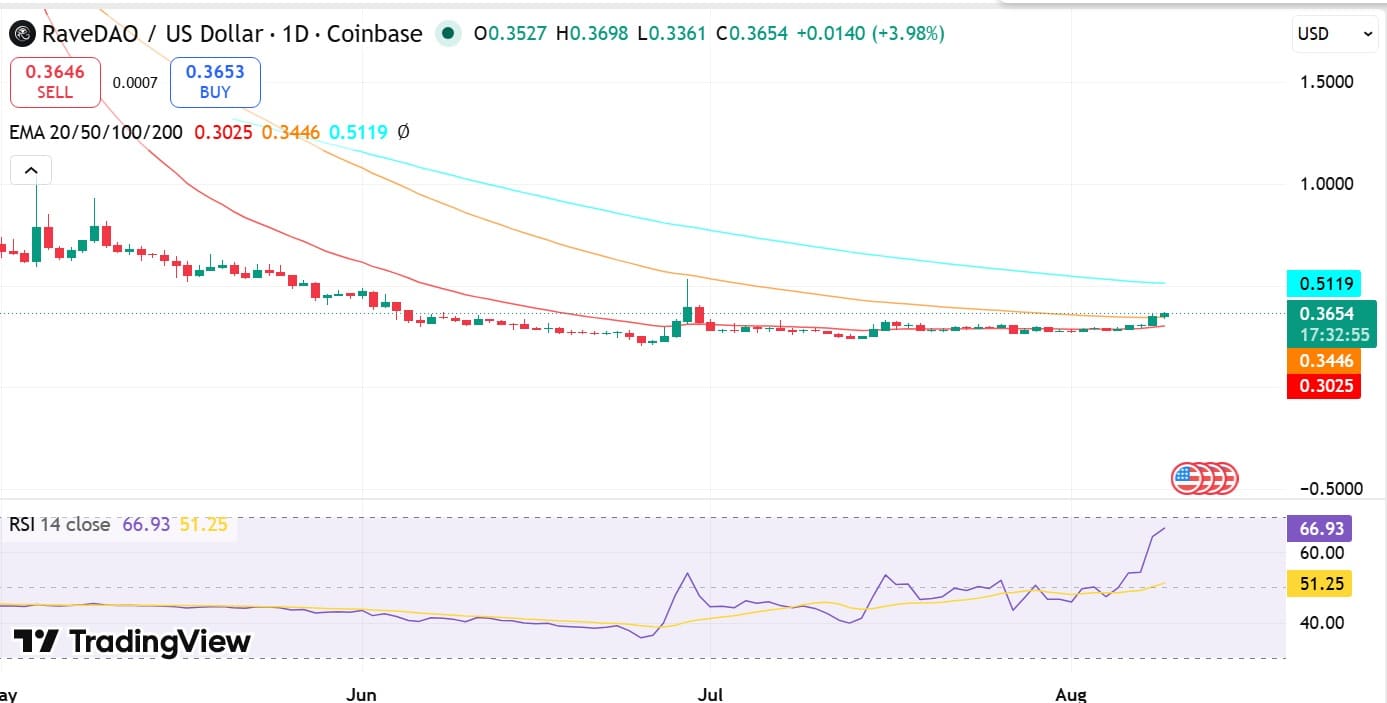
At press time, RAVE was trading around $0.363, marking a 16.25% increase on the daily charts. With the price hike, altcoin flipped both the 20 and 50-day EMAs, indicating strong upside pressure.
Over the same period, the altcoin’s trading volume climbed 147% to $13.7 million, reflecting strong market activity and capital circulation.
What’s driving RaveDAO’s rally?
Notably, RAVE’s rebound was largely driven by speculators. RAVE saw explosive speculative demand over the past day.
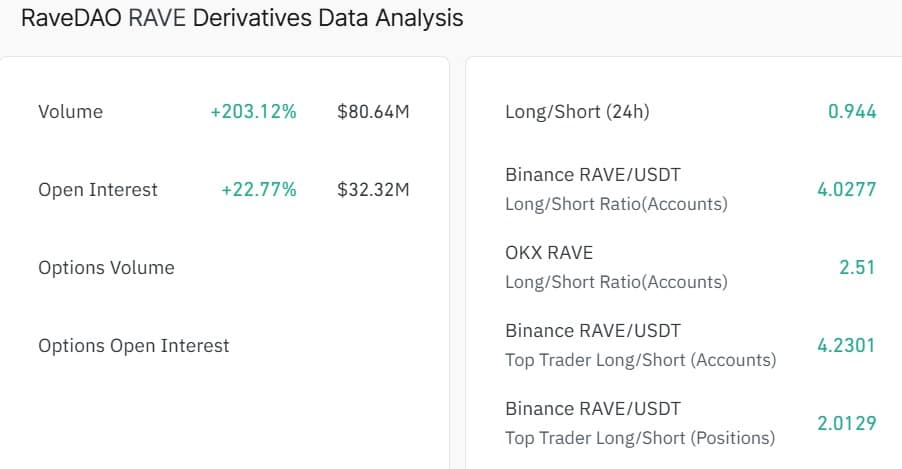
In fact, according to CoinGlass data, the derivatives volume rose by over 211% to $83 million while Open interest (OI) surged 21% to $32 million as of writing.
Source: CoinGlass
The rising OI and volume indicated increased market participation and steady capital inflow. As such, these funds flowed into opening new positions.
Notably, the Long/Short Ratio jumped above four on Binance. When traders open mostly long positions, it implies they are bullish and anticipate continued uptrend. Historically, strong speculative activity has preceded strong price moves to the upside in the short term.
Spot sentiment also flips
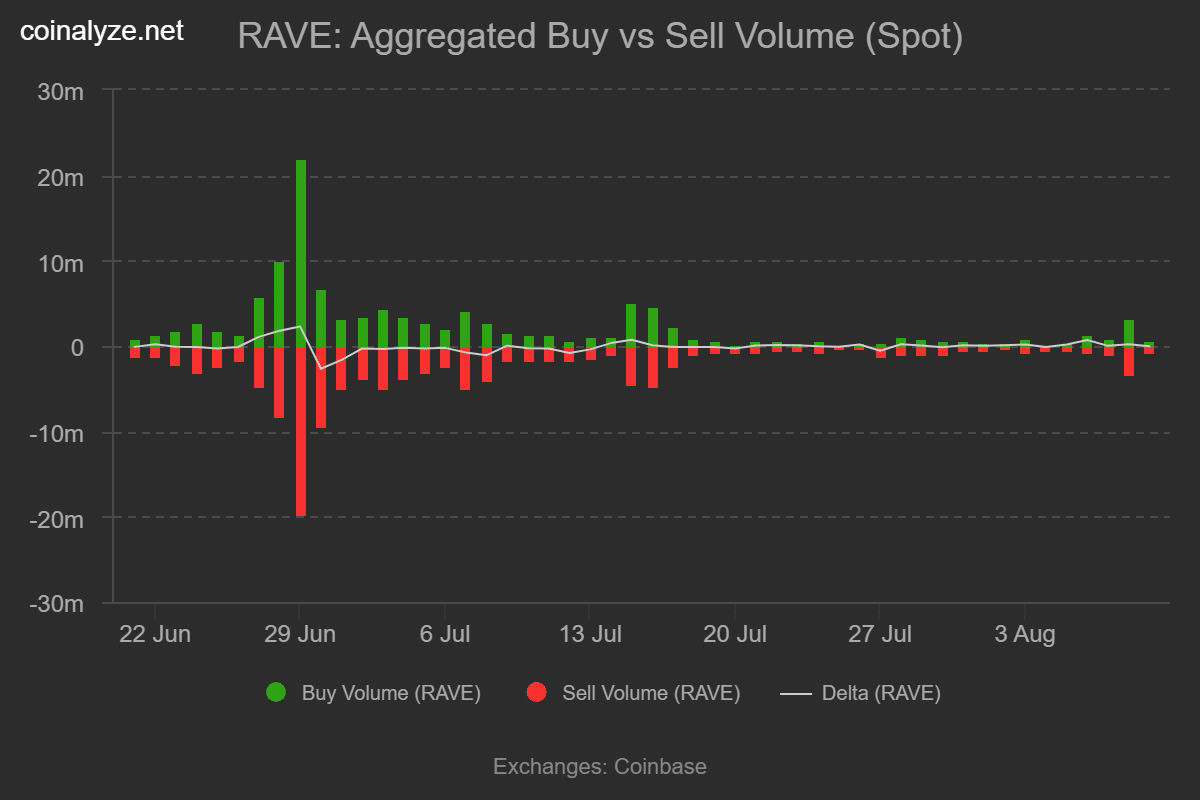
On the spot side, buyers are also re-entering the market. As RaveDAO jumped to $0.36 on the 8th of August, buyers on the spot returned with strength.
As a result, the Buy vs Sell Volume rose to 3.4 million while the buy volume rose to 2.3 million, with the delta rising to 200k.
Source: Coinalyze
This trend has held on August 9th, as buyers continued to displace sellers. The altcoin’s buy volume rose to 773k m while the sell volume dropped to 714k, leaving a positive delta of 58k.
Can the upside momentum hold?
With RaveDAO seeing renewed demand, the altcoin’s upside momentum has strengthened substantially. In fact, the altcoin’s Relative Strength Index (RSI) has held on an upward trajectory, hiking to 64 at press time.
Source: TradingView
The rising RSI validates our earlier observation regarding rising demand, with buyers retaking the market. Often, such a market setup has preceded some more gains.
If demand can hold, RAVE will breach the $0.40 resistance, with $0.48 as the next level. However, if the speculation fades, which mostly happens, the altcoin will drop again towards $0.28.
Final Summary
RaveDAO surged 16%, breaking out of a prolonged consolidation range, hitting a six-week high of $0.369.
RAVE showed strong upside momentum, largely driven by speculative demand, but if this fades, a drop below $0.3 will follow.
Moneywise and Yahoo Finance LLC may earn commission or revenue through links in the content below.
First-time homebuyers have their fair share of ups and downs to deal with, but one downside many don’t expect can decimate the most carefully planned of household budgets.
That budget-buster is home maintenance and repair bills, which rarely makes it into the “expected expense” column, according to a new study from Jobber (1), a provider of home service software. While 93% of Americans say they’re pleased with own a new home, 58% discovered unanticipated repair needs right after move-in day. What’s more, 72% of newly minted homeowners say they spent about $10,000 on those unexpected fixes within two years of buying the property.
Must Read
“The biggest mistake first-time buyers make is assuming that if they can afford the mortgage payment, they can afford homeownership,” Daniel Amodeo, president of Boston-based Amo Realty, told Moneywise.
The first two years of home ownership often bring expenses people never planned for, from replacing a water heater or HVAC system to higher insurance premiums, property taxes, landscaping, and routine maintenance.
“I always tell buyers to leave the closing table with a healthy emergency fund because it’s usually not a question of if something will break, but when,” Amodeo said. To Amodeo’s point, 45% of those surveyed in Jobber’s study said they’d warn future buyers to pad the household repair budget with more cash than they think they’ll need.
Buyers too often focus on the initial costs of a home like the listing price and mortgage but fail to account for additional expenses. “First-time homebuyers often lack the experience to understand the surprise expenses,” Wyatt Simon, founder at Omaha Home Advisors, told Moneywise.
Here’s where the biggest early home repair bills originate
New homeowners can do themselves a big favor by focusing on the critical infrastructure of a home, which holds it together, ensuring it operates efficiently and safely. It’s more important than decor or cabinet space.
“Most surprises are seldom cosmetic,” Alexei Morgado, a Florida-based real estate agent and founder at Lexawise, a digital real estate exam preparation platform, told Moneywise.
“They’re related to the age of roofing systems, heating and air conditioning units, water heaters, plumbing or electrical systems, and insurance deductibles.”
Those cost headaches tend to surface at the same time, since the systems may well be close in age. Additionally, most buyers aren’t adequately prepared for these costs since qualification for a mortgage focuses more on affording the monthly payment than on the maintenance.
“Home inspection represents just a snapshot and is no guarantee of the life left in the equipment,” Morgado said. “Most of the buyers may use all of their available funds to pay for a down payment, closing costs, moving, and furniture.”
Insurance and property taxes are changing homeownership economics
Many new homebuyers also discover too late that a fixed-rate mortgage is not a fixed total housing payment.
According to Cotality (2), non-mortgage housing costs soared by 30% in 2025. Meanwhile, ATTOM (3) finds that the national average on property taxes was $4,427 in 2025, representing a 3% annual increase.
New buyers must factor in insurance costs and taxes when purchasing the house because they are just as as mortgage rates and payments
“The buyer must be aware that it may cost more to buy a cheaper house in a high-risk insurance area, one that needs to have additional wind and flood insurance, which has a large deductible or a potential reassessment of the property following its purchase,” Morgado said.
Here’s how to keep on top of surprise home repair bills
As the old saying goes, a little bit of preparation goes a long way, and that goes double for accounting for home repairs.
Home experts say that while due diligence on maintenance may dent the budget, it’s a whole lot better than the cash you’ll spend addressing big repairs. “Save at least 1% of your home’s value each year for maintenance, Melanie Musson, insurance analyst at Clearsurance.com (4), told Moneywise. “If your home is older, you should save at least 3%.”
That budget target means if you bought your home for $400,000, plan to spend $4,000 a year maintaining it, which breaks down to about $333 a month.
If you’re about to buy your first home, avoid steering every dollar you have into the down payment. Instead, reserve $5,000 for home maintenance if you can.
“Then, when issues arise, and you’re getting used to how your lifestyle changes from the financial impact of homeownership, focus on function,” Musson noted. “Fix the problem without going overboard.”
For example, if your dishwasher breaks, look for a scratch-and-dent model to get you through to next year. Eventually, when things settle down, you can splurge for the incredible high-end dishwasher you always wanted.
“Just don’t do that right away, and instead, save money during those first two years of ownership,” Musson said.
Build a robust emergency fund
A house doesn’t care about your budget. Appliances fail, pipes burst and HVAC systems seem to quit at the worst possible time.
That’s one reason why many financial experts generally recommend keeping three to six months’ worth of living expenses in an emergency fund. Having cash set aside can help you cover unexpected repair bills, giving you a financial cushion so you aren’t forced to borrow at steep interest rates just to keep your home in good shape.
Or, even worse, tap into your investments to fix a leaky roof.
A high-yield account like a Wealthfront Cash Account can be a great place to grow your uninvested cash, offering both competitive interest rates and easy access to your money when you need it.
A Wealthfront Cash Account currently offers a base APY of 3.30% through program banks, and new clients can get an extra 0.75% boost during their first three months on up to $150,000 for a total variable APY of 4.05%.
That’s 10 times the national deposit savings rate, according to the FDIC’s July report.
Additionally, Wealthfront is offering new clients who enable direct deposit ($1,000/mo minimum) to their Cash Account and open and fund a new investment account an additional 0.25% APY increase with no expiration date or balance limit, meaning your APY could be as high as 4.30%.
Once you’ve budgeted for your mortgage, property taxes and utilities, it’s easy to assume you’ve accounted for the biggest housing expenses. But insurance is one bill that’s been climbing fast — and many homeowners don’t notice until renewal time.
Average homeowners insurance premiums climbed faster than inflation across all major regions in the U.S. between 2018 and 2024, and they’ve risen another 7% since the start of 2025 (5). The National Association of Realtors estimates that home affordability is roughly 10% lower than it would have been had insurance costs remained stable since the late 1990s.
Rather than automatically renewing your policy, it may be worth comparing rates. Insurify lets you compare accurate, real-time quotes from 100+ top insurance companies in minutes, helping you see whether a better deal is available in your area.
Even better, the process is 100% free, and there is zero obligation to switch unless you find a better rate. Plus, you could also save up to 20% by bundling your car insurance and home insurance together.
Consider tapping into your home’s equity
Even the best emergency fund has its limits. The repair bill can simply be too large to cover out of pocket — even if you’ve done everything right. Rather than financing the expense on a credit card with double-digit interest, it may be worth looking at the equity you’ve already built in your home.
A HELOC lets you borrow against that equity as needed, meaning you pay interest only on the funds you use. It can be a practical solution for major repairs, renovations or upgrades that help you stay comfortably in your home for years to come.
You can tap into your home equity with a HELOC from AmeriSave and access your full funds right at closing.
You can choose a draw period that fits your life — three, five, or 10 years — along with 20- or 30-year terms to suit your budget. And with a 10-year interest-only option, you can keep monthly payments manageable while you plan ahead.
It’s essentially a flexible credit line secured by your home, delivered through a mostly online application process. Just make sure you understand the repayment terms before committing.
Invest fractionally in real estate with as little as $100
The financial reality of owning a home often looks very different from the American dream. While real estate can be a lucrative investment, it isn’t always a cheap one — especially when it comes to down payments.
In fact, among homeowners who regret something about purchasing their current home, 42% complain that maintenance and hidden costs turned out to be far more expensive than expected (6).
Fortunately, buying an entire property isn’t the only way to gain exposure to real estate. Crowdfunding platforms like Arrived allow you to invest in shares of rental properties across the country with as little as $100.
Arrived handles the day-to-day responsibilities of managing the property — so you can sit back and relax without any headaches.
Arrived also distributes any rental income generated by properties to investors monthly, allowing you to potentially set up a passive income stream without the extra work that comes with being a landlord of your own rental property.
Bitcoin is holding near $64,700 Friday, barely changed over the last 24-hour period, while the broader CoinDesk 20 (CD20) index is down 0.2% over the period.
Brent crude has meanwhile moved to over $83 a barrel after Yemen’s Iran-linked Houthis attacked Saudi Arabia, further escalating tensions in the Middle East.
Treasury yields have seen a slight correction, but remain at 4.67% for the 10-year note, a level Fidelity’s Director of Global Macro Jurrien Timmer said “history suggests that nothing good happens.”
Higher oil could add to inflation pressure if sustained, while elevated Treasury yields tighten financial conditions. Together, they could limit expectations for near-term rate cuts and weigh on bitcoin and other risk assets.
Gold has meanwhile maintained its recovery, moving up 1.5% to now trade at $4,300 per ounce as investors move toward safety in the face of uncertainty.
Derivatives positioning
Long-short taker ratio: The crypto futures market’s long-short taker ratio has returned to neutral after leaning bullish on Thursday, suggesting traders may be adopting a more cautious stance ahead of the U.S. payrolls report.
CC token leads OI growth: Canton Network’s CC token is down 13% in 24 hours, yet its futures open interest (OI) has surged over 5%. The combination is said to validate the downtrend, especially as the 24-hour OI-adjusted cumulative volume delta remains negative, indicating sellers are more aggressive by shorting futures via market orders rather than passive limit orders.
Open Interest Movers: DOGE, XRP, and SUI are open interest gainers, while SHIB has seen a drop.
CVD Indicator: The CVD indicator paints a bearish picture for the market, as most majors (excluding ADA, HBAR, and ETH) show negative CVD readings.
Volatility Indexes: The BVIV index, representing BTC’s annualized 30-day implied volatility, remains near a long-held floor of 36%, showing little signs of stress despite the Clarity Act delay and the impending U.S. jobs report. The same holds true for ether’s volatility index (EVIV).
Options Activity: In Deribit-listed options, puts (bearish bets) at the $60,000 and $62,000 strikes dominate the 24-hour volume rankings for BTC, while the $2,000 call is the most popular for ETH.
Token Talk
Sui is adding quantum-resistant security to its accounts, integrating two post-quantum signature schemes approved by the U.S. standards body NIST, per The Block. The upgrade lets users optionally adopt quantum-safe keys derived from their existing recovery phrases, so nobody has to generate a new seed or move funds to a new address to be protected.
The threat it’s guarding against is specific to crypto. In most systems an attacker has to break in before they can go after a key. Onchain, the public key is exposed permanently the moment an account transacts, which opens the door to “harvest-now, forge-later,” where attackers collect exposed keys today and crack them once quantum computers are capable enough to run Shor’s algorithm, the technique that could break the elliptic-curve cryptography securing most wallets. No quantum hardware is needed to start collecting.
Sui is using two schemes for two risk levels. ML-DSA-65 covers everyday accounts at the protocol level, and the hash-based SLH-DSA-SHA2-128s runs inside Move smart contracts for high-value vaults. The two rest on different math, so a weakness in one doesn’t compromise the other. Sui went with a higher security tier after a July incident where an AI model halved the effective strength of a different post-quantum candidate, a reason to carry margin rather than pick the cheapest option.
It’s a feature add, not a rebuild. Sui says it was built for “cryptographic agility,” meaning new signature schemes slot in without touching consensus or existing balances, so this ships as a routine protocol update. That contrasts with bitcoin and ethereum, where quantum-proofing is a heavier lift, and lands the same month Strategy and BlackRock formed a consortium to prepare bitcoin for the same threat. SUI traded around [X], per CoinDesk data.
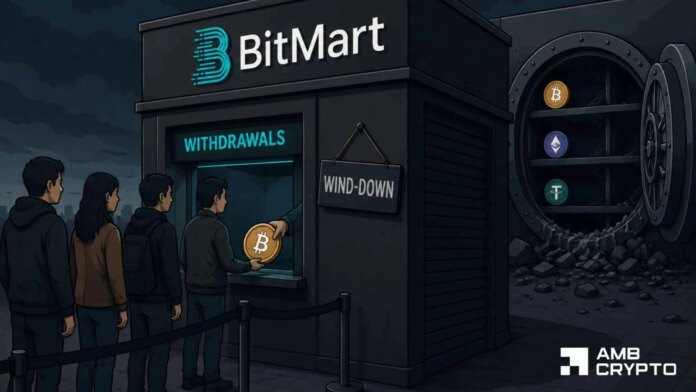
Nearly three weeks after BitMart announced its shutdown, concerns have grown over delayed withdrawals.
BitMart founder Sheldon Xia responded to increasing speculation surrounding the issue. He denied allegations of misappropriating customer deposits or removing them before announcing the shutdown.
In his defense, Xia claimed he did not abandon his duties in relation to the exchanges.
Source: X
He also urged users to rely on verified information posted through official channels rather than unsubstantiated claims allegedly made by either current or former employees. However, withdrawals will continue to be the most reliable indicator that these assurances are valid.
Shortly after the 26th of July announcement, Lookonchain recorded 58 wallets withdrawing about $805,000, including an eight-hour period with no withdrawals. Meanwhile, BitMart-linked holdings fell from roughly $102 million to $69–71 million, though internal movements complicate that decline.
Therefore, Xia’s consideration of court involvement and independent third-party auditors becomes important. Verified asset disclosures and improving withdrawal throughput would provide stronger evidence that customer funds remain accounted for.
BitMart withdrawal processing accelerates
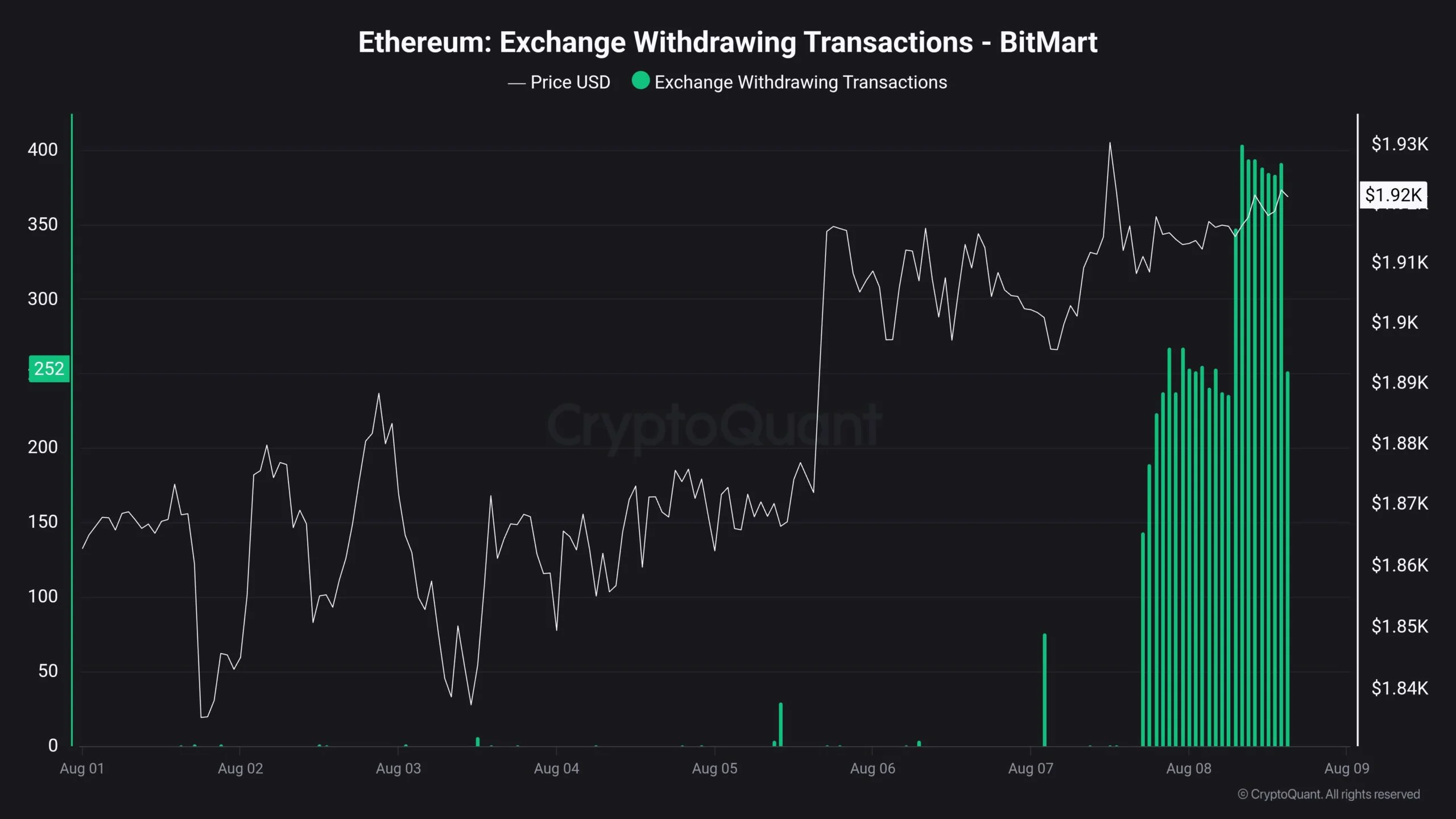
More importantly, the acceleration in withdrawals offers evidence against the earlier stagnation that had fueled concerns around BitMart’s remaining assets. While ETH withdrawals were limited in early August, activity surged to over 200 per hour starting on the 7th of August.
Activity then exceeded 200 transactions per hour, while several periods approached 400, with the latest pace averaging roughly 300 hourly. This rate of processing indicates that BitMart has progressed from merely reviewing its assets to actively satisfying withdrawal requests.
Source: CryptoQuant
Moreover, sustained processing could gradually reduce the backlog and ease pressure from customers awaiting funds. However, the exchange has not disclosed total outstanding liabilities, making the scale of progress difficult to measure.
Therefore, sustaining an average rate of 300 hourly or higher for both ETH and all other assets remains necessary. Higher levels of withdrawals would support Xia’s claims. Conversely, if withdrawals again slow down, liquidity concerns could rise once again.
Unpaid obligations test BitMart’s wind-down
Yet clearing customer withdrawals addresses only one side of BitMart’s financial obligations. Reports of unpaid wages create competing claims against remaining assets. As funds leave, BitMart must balance customer repayments with employee and operating liabilities.
Moreover, asset quality matters because less-liquid holdings may provide weaker coverage. Without disclosed liabilities or independent reconciliation, the exchange’s financial position remains unclear.
Ultimately, an orderly wind-down requires enough resources to settle customers, employees, and other creditors without leaving unresolved obligations behind.
Final Summary
BitMart founder Sheldon Xia addressed withdrawal concerns, denying asset misuse as the exchange continues its wind-down.
BitMart’s faster withdrawals signal progress, but unpaid obligations and undisclosed liabilities leave the wind-down’s outcome uncertain.
Find out how much you could earn by locking in a high CD rate today. A certificate of deposit (CD) allows you to lock in a competitive rate on your savings and helps your balance grow. However, rates vary widely across financial institutions, so it’s important to ensure you’re getting the best rate possible when shopping around for a CD. The following is a breakdown of CD rates today and where to find the best offers.
Overview of CD rates today
Historically, longer-term CDs offered higher interest rates than shorter-term CDs. Generally, this is because banks would pay better rates to encourage savers to keep their money on deposit longer. However, in today’s economic climate, the opposite is true.
Today, Sunday, August 9, 2026, the highest CD rate is 4.35%. This rate is offered by United Bank on its 18-month CD.
How much interest can I earn with a CD?
The amount of interest you can earn from a CD depends on the annual percentage rate (APY). This is a measure of your total earnings after one year, taking into account the base interest rate and how often interest compounds (CD interest typically compounds daily or monthly).
Say you invest $1,000 in a one-year CD with 1.52% APY, and interest compounds monthly. At the end of that year, your balance would grow to $1,015.20 — your initial $1,000 deposit, plus $15.20 in interest.
Now let’s say you choose a one-year CD that offers 4% APY instead. In this case, your balance would grow to $1,040.74 over the same period, which includes $40.74 in interest.
The more you deposit in a CD, the more you stand to earn. If we used the same example of a one-year CD at 4% APY but deposited $10,000, your total balance when the CD matures would be $10,407.42, meaning you’d earn $407.42 in interest.
When choosing a CD, the interest rate is usually top of mind. However, the rate isn’t the only factor you should consider. There are several types of CDs that offer different benefits, though you may need to accept a slightly lower interest rate in exchange for more flexibility. Here’s a look at some of the common types of CDs you can consider beyond traditional CDs:
Bump-up CD: This type of CD allows you to request a higher interest rate if your bank’s rates go up during the account’s term. However, you’re usually allowed to “bump up” your rate just once.
No-penalty CD: Also known as a liquid CD, this type of CD allows you to withdraw funds before maturity without penalty.
Jumbo CD: These CDs require a higher minimum deposit (usually $100,000 or more), and often offer a higher interest rate in return. In today’s CD rate environment, however, the difference between traditional and jumbo CD rates may not be much.
Brokered CD: As the name suggests, these CDs are purchased through a brokerage rather than directly from a bank. Brokered CDs can sometimes offer higher rates or more flexible terms, but they also carry more risk and might not be FDIC-insured.