Spot bitcoin ETFs are yet to see outflows this month, bringing in $754 million in the first week of August. Yet, bitcoin remains steady at $64,700, while options flow favors protection at $62,000 and $63,000.
The opposing signals point to a market with a spot bid but limited conviction. ETF demand has seemingly returned, but derivatives traders are guarding against a retreat ahead of today’s U.S. jobs report.
The options market adds another layer. Put options, giving holders the right but not the obligation to sell, accounted for 53.8% of bitcoin options volume over the past 24 hours, and three of the four most-traded contracts were puts at $62,000 or $63,000 expiring Aug. 10, Aug. 14 and Aug. 28, CoinGlass data shows.
Calls still represent 60.7% of total open interest, showing that the broader options market remains tilted toward calls even as recent trading focuses on downside puts.
Protection is also cheap. Deribit’s DVOL index, which tracks bitcoin’s expected 30-day volatility, is near 35, down from a high of 90 earlier this year. That implied volatility tracks the market’s pricing of future movements, implying not much is expected to happen in the near future.
China Yuchai International Limited Q2 2026 Earnings Call Summary – Moby
Strategic Performance Drivers
Our analysts just identified a stock with the potential to be the next Nvidia. Tell us how you invest and we’ll show you why it’s our #1 pick. Tap here.
Revenue growth of 13.9% was primarily driven by a 10.9% increase in engine unit sales, with heavy-duty truck engines leading the segment with 47.3% growth.
Gross profit margin expanded to 17.1% from 14.3%, attributed to a favorable shift toward larger, high-margin engines and enhanced operational efficiency.
The MTU Yuchai joint venture saw a 56.2% profit increase, fueled by robust demand for high-horsepower engines in the marine and power generation sectors.
Management successfully mitigated rising precious metal costs through cost rationalization and improved sales mix in the heavy-duty segment.
The acquisition of a 27.97% stake in Nanyue Fuel Injection Systems (NYDK) was executed to strengthen supply chain resilience and access advanced powertrain technologies.
Strategic focus on the AI data center (AIDC) market resulted in approximately 1,800 units sold in the first half of 2026, reflecting strong sector tailwinds.
Outlook and Strategic Initiatives
Management expects full-year 2026 AI data center engine sales to reach approximately 3,500 units or more, indicating significant year-over-year growth.
Production capacity for high-horsepower engines has been expanded to 5,000 units through a combination of internal process optimization and external subcontracting.
The company is pursuing an IPO for its genset power subsidiary on the Hong Kong Stock Exchange to unlock resources for accelerated growth while maintaining control.
R&D efforts are focused on alternative fuels, including a breakthrough high-pressure direct injection engine capable of operating entirely on ammonia.
Future capacity expansion for 2027 is under evaluation, involving a dual strategy of further outsourcing and internal investment in fine-machining equipment.
Operational and Financial Context
Consolidation of NYDK financial results began on April 1, 2026, following the acquisition of control on March 31, 2026.
Other operating income decreased by 32.2% due to lower government grants and the absence of one-time technology licensing fees received in the prior year.
The effective income tax rate rose to 20.4% from 17.8%, primarily due to higher taxable profits and the utilization of deferred tax assets.
Cash and bank balances reached approximately USD 1.2 billion, supporting a dividend increase to USD 0.87 per share for 2025.
Q&A Session Highlights
AI data center volume guidance and second half outlook
One stock. Nvidia-level potential. 30M+ investors trust Moby to find it first. Get the pick. Tap here.
Management confirmed 1,800 units were sold in H1 and adjusted the full-year target to 3,500 units or more.
The growth represents a significant increase over 2025 levels, supported by adjusted production schedules.
Gross margin expansion drivers and MTU JV profitability
Margin improvement was driven by product mix shifts toward high-power engines and operational efficiency, offsetting higher precious metal prices.
The MTU JV maintains a gross profit margin over 30%, though net profit growth lagged revenue due to pricing pressure and OEM discounts.
High-horsepower engine capacity and outsourcing strategy
Capacity increased from 3,000 to 5,000 units by subcontracting initial machining processes to external partners.
Management plans to continue this dual approach of outsourcing and internal equipment upgrades to meet 2027 demand.
Alternative fuel progress and North American market entry
Gas engines are currently undergoing certification for the North American market; timing remains dependent on testing completion.
Fuel cell development is ongoing for mobile applications, but management clarified there is no short-term plan for fuel-cell-based power generation.
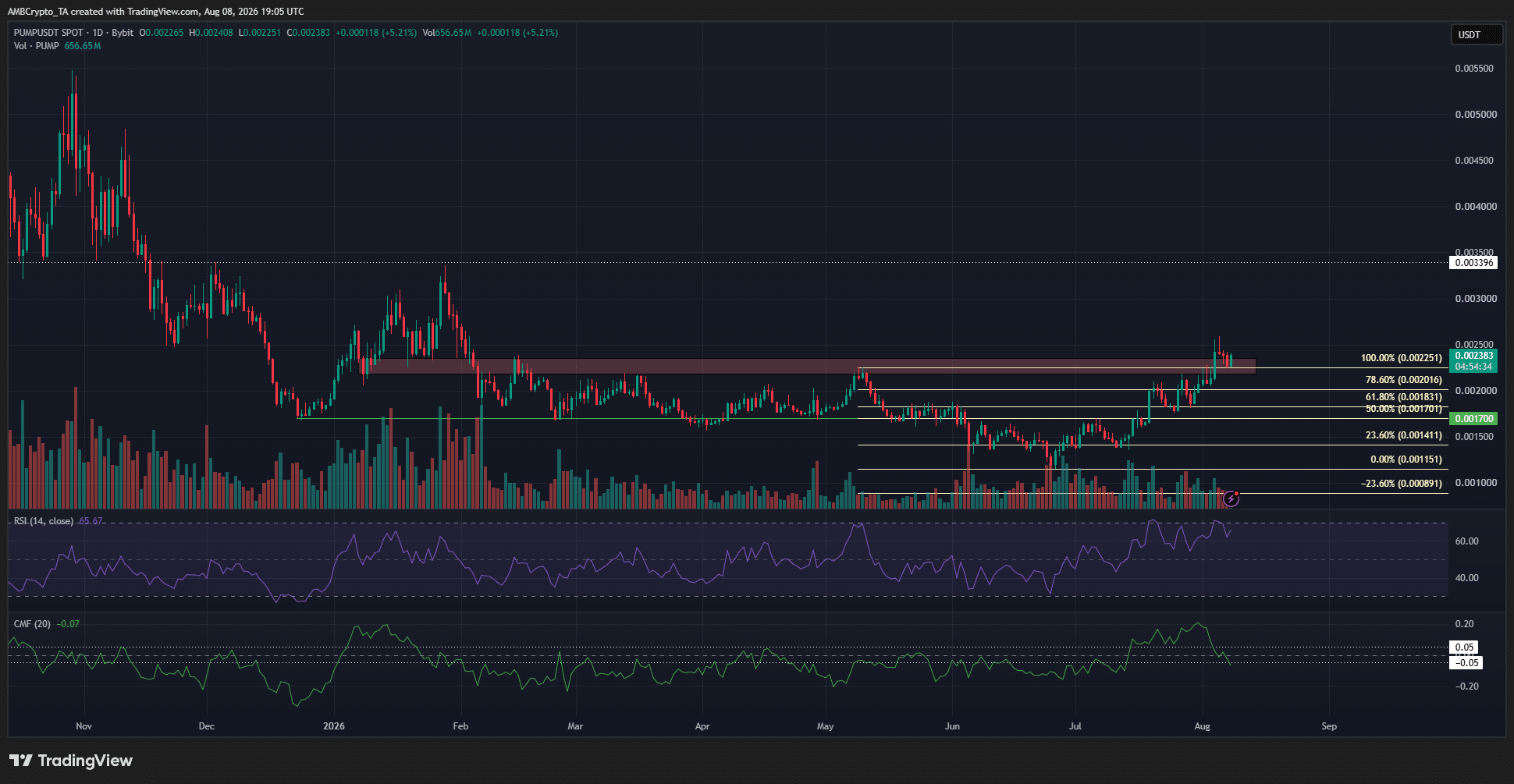
Pump.fun [PUMP] prices have managed to clamber back above a six-month supply zone, price charts showed. The memecoin launchpad platform’s utility token is up 106.5% from the $0.00115 low made on the 26th of June.
These steady gains not only flipped a resilient resistance zone to support but also enforced a bullish structural shift.
Here are the next price targets and why one analyst expects the next upward move to be another 90% from current market prices.
The importance of PUMP’s structure flip
Source: PUMP/USDT on TradingView
The $0.00225 swing high from early May was the source from which a bearish structure break (a drop below $0.00157) occurred. This drop reached a low of $0.00115.
This move represented the bearish swing structure, and this is the structure that was flipped bullishly once the $0.00225 high was breached.
The RSI was firmly above 60 to show strong upward momentum. However, the selling of the past three days and the slowdown in trading volume at the start of the month saw the CMF slump below -0.07.
Despite this slump, the swing trader bias can remain bullish due to the structural shift. The next price target would be $0.00336-$0.00340, the highs made in December 2025 and January 2026.
If the $0.00232 support is defended, $0.0046 would be the next target, analyst Ali Martinez showed in a post on X. This target is 90% higher than the current PUMP market price.
Traders’ call to action- Buy
Source: PUMP/USDT on TradingView
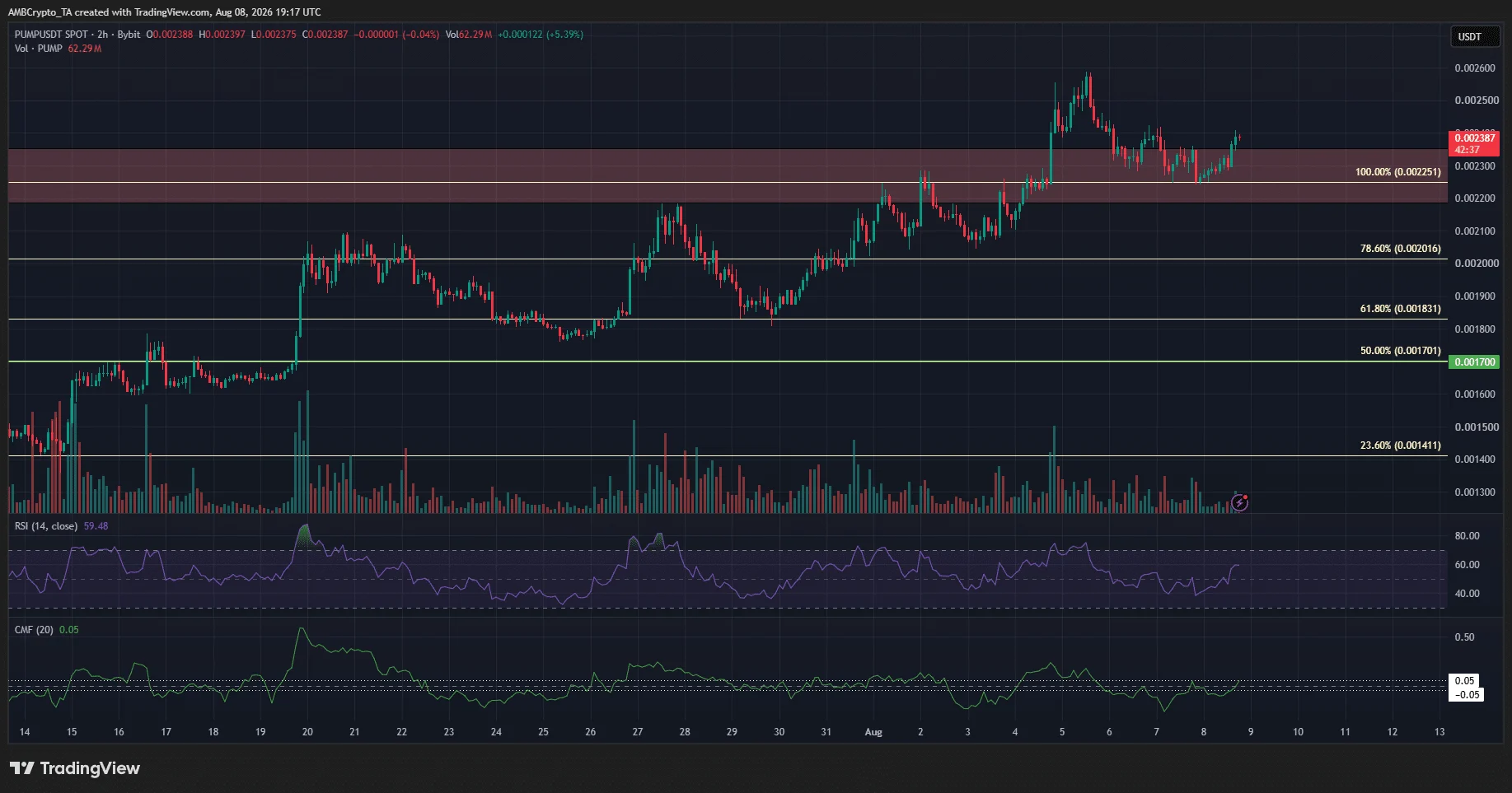
In the near term, the $0.00205 level would be key. A drop below this local support would signal flagging bullish strength in the lower timeframes and could set up a pullback.
Another factor swing traders and investors will want to see is sustained buying pressure. Strong demand in spot and speculative markets would reinforce the bullish bias and showcase buyer strength.
Final Summary
PUMP has broken above a resistance zone that has been in place for six months.
Sustained buying pressure is needed to defend the $0.0020 area and keep the upward momentum going.
Bitcoin mining firm AntPool mined the first non-signaling block, which the rest of the network accepted and BIP-110 nodes rejected, and a miner using Ocean produced the alternative that the breakaway chain followed instead. (A miner is an entity that uses massive computing resources to maintain bitcoin and process its transactions, earning newly issued bitcoin and fees for the work.)
AntPool and Ocean are mining pools, where many operators combine their machines and share the rewards.
The stall has a mechanical cause that is hard to escape. Bitcoin recalculates how difficult mining is every 2,016 blocks, aiming to keep blocks arriving roughly every ten minutes.
The breakaway chain inherited bitcoin’s current setting but has a tiny share of the machines, so its blocks arrive at long intervals. It cannot make mining easier until it completes 2,016 blocks at that pace. The monitor puts that at 350 days away, against 14 days for bitcoin.
BIP-110 Situation Monitor. (Bip110.orange.surf)
Support was never there. Only 2.53% of blocks signaled for BIP-110 over the past two weeks, against the 55% needed to activate it without a split.
That leaves the fork coin in an awkward position for anyone hoping to sell it. Both chains still accept identical transactions, so a signed transaction sending fork coins also works on bitcoin, and a buyer can rebroadcast it there and collect real BTC from the same seller — opening up the chances of a novel attack method that users should keep track of.
An Intel sign out front of a corporate office by wolterke via Adobe Stock
Dividend tech stocks are a rare breed. I mean, technically NVIDIA (NASDAQ: NVDA) and Apple (NASDAQ: AAPL) pay dividends, but the yields barely reach 1%. That’s why finding a decent tech company that pays reasonable yields while offering ample room for capital growth is like finding a golden needle in a haystack.
And a few short years ago, Intel (NASDAQ: INTC) fit that description to a T. The company paid yields that averaged around 2% for more than three decades and increased payouts for eight straight years. Even better, it was at the very top of the semiconductor industry. In fact, back then, AMD (NASDAQ: AMD) and NVIDIA – yes, that NVIDIA – were playing catch-up to Intel for decades.
More News from Barchart
But now, that’s all in the past as a series of unfortunate events cast doubt on the company’s future.
After pouring money into its foundry business, losing market share to AMD, watching NVIDIA dominate the AI revolution, and ultimately cutting its dividend altogether in 2024, Intel went from being the undisputed king of semiconductors and a tech dividend darling to one of Wall Street’s biggest disappointments.
But now, things are looking up. Foundry is starting to contribute, the company is clawing its way back into generating meaningful revenue, and Wall Street is warming up to Intel’s potential turnaround story.
So that begs the question: Can Intel reclaim its glory days from the past? Does its current trajectory open up the possibility of paying dividends again?
Let’s pop the hood and have a look.
Intel’s 2026 So Far: Record AI Growth, Estimate Beats, and a Turnaround Taking Shape
www.barchart.com
So far, Intel seems to be on a genuine path to a comeback. The stock’s up 170% year-to-date and 389% in the last 52 weeks.
Meanwhile, Q2 FY’26’s reported earnings reached $0.30 per share. That is a full 200% above Wall Street’s expectations.
www.barchart.com
Revenue also grew 25% year over year to $16.1 billion – the company’s strongest quarterly growth in more than 15 years.
But the headline numbers hide even better news. Its Data Center and AI segment grew 59%, while Foundry grew 31%. Both of these numbers are hinting at the same thing: Intel’s AI and Foundry bet is starting to pay off. Better late than never.
www.intc.com
In other news, management highlighted improved factory yields and faster cycle times, progress toward risk production on the 18A-P node, and a plan for high-volume 14A manufacturing by 2028. It also doesn’t hurt that the company’s deepening its ties with Alphabet via a strategic partnership through Google Cloud.
With all that good news, it’s no surprise that many investors are expecting a new dividend announcement to hit the company pressroom.
But, like with everything else in life, it’s not that simple.
What the Cash Flow Says About Intel’s Potential Dividend
If you’re a dividend investor, you know that top- and bottom-line numbers don’t tell the whole story when it comes to dividend payments. You’d need to look at free cash flow (FCF) to see whether a company can pay its shareholders.
Now, on paper, Q2 looked encouraging. Intel generated operating cash flow of roughly $7.0 billion for the quarter, with an estimated $4.45 billion in free cash flow. That’s the kind of number that gets dividend investors like me excited.
But remember, Intel had been posting negative free cash flow over the past few years. So, yeah, it’s good news that FCF is now positive, but the company’s got a lot to make up for.
This is particularly true since capital expenditure is still going up – not as much as last year, but it doesn’t seem like it’s going to slow down anytime soon as Intel continues to expand its foundry business and invest in next-gen silicon production.
And, even more damning to all our dividend hopes, Intel has not announced a payout yet. Back when it announced the dividend suspension in Q2 FY’24, the company reiterated its “long-term commitment to a competitive dividend as cash flows improve to sustainably higher levels.”
After that… crickets on the dividend front.
That said, Wall Street analysts’ revenue and FCF forecasts have been rising alongside investor confidence. Intel’s top line is now expected to reach $70 billion by the end of 2027, while FCF is projected to grow to $6 billion.
So there’s definite improvement. It’s just not at a level where the company can comfortably pay its shareholders like it did in the past.
Bottom Line: What This Means for Intel “Dividend” Investors
So, can Intel bring back its dividend?
The short answer is yes. And I fully stand by it.
But all signs point to the fact that right now is not the time for a comeback. A couple of green marks on the scorecard don’t change the narrative – at least not yet.
We need to see all the growth and these improvements continue in the following quarters and years. Management needs to prove that its foundry bet is well worth the wait and that it can catch up to NVIDIA and AMD.
Still, I take the good news where I can get it. Intel no longer looks like a company in free fall. It’s starting to look like a company rebuilding itself.
If the current trajectory continues and free cash flow improves over the next couple of years, I wouldn’t be surprised to see management revisit its dividend policy. But until then, investors should view any future payout as a bonus, not an expectation.
On the date of publication, Rick Orford did not have (either directly or indirectly) positions in any of the securities mentioned in this article. All information and data in this article is solely for informational purposes. This article was originally published on Barchart.com
Two drivers of Mercedes AMG cars have filed a class action lawsuit against the luxury car company, claiming that the AMG logo on their driver’s seat gets so hot that it literally brands them and causes burns.
Gabriel Lahijani and Karendeep “Karina” Bath allege the front seats of certain Mercedes AMG vehicles have a design defect where the raised metallic AMG logo is “reasonably expected to contact an occupant’s upper back, neck, or shoulder,” according to the court document filed earlier this week in the U.S. District Court of California’s Western division.
The plaintiffs want Mercedes to compensate them for any medical expenses, as well as any pain, suffering and emotional distress they can prove at trial. They also want Mercedes to pay for other owners to have the logo removed from their cars.
Mercedes-Benz couldn’t be reached immediately for comment.
Lahigani, a Los Angeles resident, had leased a new 2026 Mercedes-AMG E-Class vehicle from an authorized Mercedes-Benz dealership in Los Angeles, according to the suit. He reported receiving second-degree burns on his back on May 31, after entering his vehicle wearing a tank top. A board-certified dermatologist subsequently documented first- and second-degree burns, describing the injury as “AMG inscribed.”
Roughly six weeks later, Bath, a Chatsworth, California resident, received similar burns allegedly from the logo design while wearing a sleeveless top. After parking her Mercedes-AMG vehicle in Los Angeles, Bath returned to the vehicle and entered the driver’s seat, the suit said. Her shoulder immediately touched the logo, causing a burning sensation. In the following days, a mark in the shape of the AMG logo “darkened and became visible on her skin, consistent with a thermal contact burn,” the lawsuit said.
In December, Mercedes-Benz USA and parent company Daimer AG agreed to pay $149.6 million to settle allegations that the automaker secretly installed devices in hundreds of thousands of vehicles to pass emission tests, according to an announcement by a coalition of attorneys general.
According to the coalition, between 2008 and 2016 the German automaker equipped more than 211,000 diesel passenger cars and vans with software devices that optimized emission controls during tests but reduced the controls during normal operations.
Dathon Ohm, the proposal’s pseudonymous author, declared, “Bitcoiners are about to show the world, once again, what happens when the plebs stand up against large, corrupt institutions who are telling us Bitcoin isn’t money and our nodes belong to them,” in a thread on X on Thursday.
Rhetoric aside, the thread gave instructions to miners planning on enforcing the BIP-110 rulebook, advising them to upgrade to Bitcoin Knots (the primary software carrying and enforcing BIP-110), warning that Bitcoin Core (the network’s principal software that represents the current implementation of Bitcoin’s rules) should not be run as it would become “insecure.”
BIP-110 is a movement by the plebs, for the plebs, standing up and arming themselves with software to tell these institutions in one resounding, unified voice:
BITCOIN IS MONEY, OUR NODES BELONG TO US, AND WE WILL NEVER GIVE UP.
11:21 PM · Aug 6, 2026
BIP-110 is designed to temporarily tighten Bitcoin’s consensus rules to make inscription techniques used by Ordinals and Runes impractical. Its supports argue that use of the network for non-financial data consume block spacer, make it more expensive to run and undermine Bitcoin’s purpose of digital money.
Critics have pointed to the lack of miner support as evidence that the proposal is effectively dead. Its supporters reject that premise.
BIP-110’s proponents argue that miners do not govern Bitcoin – they merely produce the blocks. Nodes decide whether those blocks comply with rules. User-activates soft forks (UASFs) are designed around that principle, allowing node operators to begin enforcing new rules from a predetermined block height regardless of miner support.