Treasuries rallied across the curve as the oil move eased inflation worries, taking the 10-year yield down four basis points to 4.69% after it hit its highest since January 2025 last week. Nasdaq 100 futures and European share futures both gained 0.8%. Gold added 0.3% to about $4,060 an ounce.
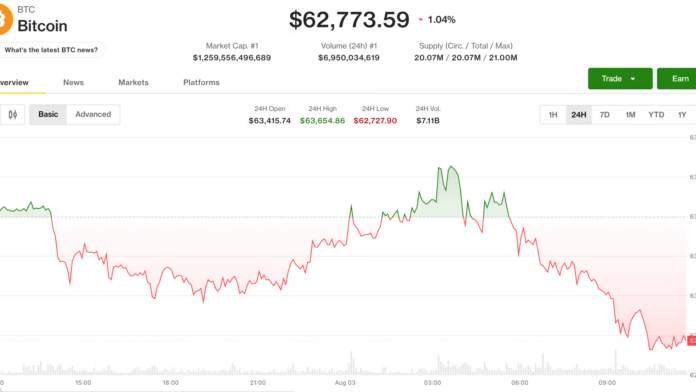
Falling oil, falling yields and rising stock futures usually give crypto a lift. This time bitcoin ignored all three — because the pressure on it is coming from a broken hardware wallet rather than from the macro.
As CoinDesk reported Sunday, a third wave of sweeps against Coldcard-generated addresses were found over the weekend, bringing observed losses to 1,367 bitcoin, nearly $89 million, across 4,585 addresses.
The average haul per address has fallen with each wave, which suggests the attacker has worked through the large balances, and later moved to emptying wallets worth a few thousand dollars.
Wave one took 1,083 bitcoin from 1,196 addresses on July 30, but wave three took 208 BTC from 1,912 wallets, which is more wallets for a fifth of the money.
Meanwhile, ether funds took small inflows on Friday while bitcoin funds saw an outflow, an unusual split for a market where bitcoin normally sets the direction and ether follows.
Moneywise and Yahoo Finance LLC may earn commission or revenue through links in the content below.
Almost half of Americans are holding onto medical debt, according to a 2022 poll (1) from the Kaiser Family Foundation (KFF).
And many of them reported struggling to keep up with those bills, letting them slip past due or into collections. Others said they’d gone to family and friends, or even used credit cards, to foot the bill for medical expenses.
Must Read
What about medical insurance? Having insurance doesn’t guarantee protection from medical expenses when you factor in premiums, deductibles, copays and uncovered expenses.
Imagine Sam and Alison, a couple struggling to pay their bills after a sudden illness in their family left them with $50,000 in medical bills that they put on credit cards. Now, five years later, they feel like they’ve barely made a dent in that debt, and they’re barely able to make minimum payments.
Even if they manage to keep up with the $2,000 monthly minimum payments, it will take them more than 20 years to pay down their debt.
And they will end up paying nearly $40,000 in interest.
Since only one of them is able to work, they’re starting to wonder if they’ll ever manage to dig themselves out of this hole. At this point, they’re not sure whether they should try a debt settlement program, work with a credit counselor or file for bankruptcy.
Here’s what they might want to consider for each option.
Using a debt settlement program
Debt settlement programs, which are offered by for-profit companies, can be risky, the FTC warns (2). These companies will negotiate on your behalf with your creditors, offering a lump sum that you will agree to pay and is less than your debt.
But it comes with a risk.
“Meanwhile, you have to set aside a specific amount of money every month in a designated account until you have enough savings to pay off the amount in your settlement agreement,” the FTC says.
In other words, the programs typically “encourage you to stop making any monthly payments to your creditors.”
But if Sam and Alison choose this option and stop making payments, but then the debt settlement company fails to reach a settlement agreement with their creditors, they’ll be in a worse position than before — as they’ll owe even more in late fees and interest.
Plus, with debt settlement programs, they still have to be able to make all the payments on time to pay off their debt.
That’s why the FTC warns consumers should be incredibly careful when exploring this option: “Some debt settlement companies are dishonest and make promises they can’t keep, charge you a lot of money, and then do little or nothing to help you.”
Another option to manage debt is working with a credit counselor to make a debt management plan, which is different from a debt settlement program.
A debt management plan is typically a payment schedule for you and your creditors, possibly with lower interest rates or waived fees, that is put together with the help of a credit counselor (2). Then, once you’ve negotiated a payment plan, you deposit money with the credit counseling organization every month, and your counselor pays your creditors according to the plan.
Finding a credit counselor is also straightforward. You can search for credit counselors through credit unions, universities, U.S. Cooperative Extension Service branches and military personal financial managers.
But again, you might want to be careful with this option.
It’s a good idea to be wary of credit counselors who don’t offer any free information, the FTC warns. You’ll also want to avoid those who’ll charge you a lot of money before they do anything, say they can fix all your problems or don’t take the time to carefully review your finances. Finally, the FTC cautions against working with a credit counselor who’ll tell you a debt management plan is your only option.
However, if you’re unsure about a credit counselor, you can always check them out with your state attorney general or local consumer protection agency.
Declaring bankruptcy
For some individuals, the best course of action when it comes to unmanageable debt might be bankruptcy. But because of its long-term impact on your credit, bankruptcy is often viewed as a last resort. If you’re working with a reputable credit counselor, they can help you decide whether filing for bankruptcy makes sense.
For Sam and Alison, or anyone else struggling to make their minimum payment, bankruptcy may be the right choice if the debt is too overwhelming, it isn’t possible to make repayments while managing to pay for basic necessities, it will take many years to pay down the debt (some experts say more than five years) or the debt is having an impact on a relationship.
Also remember that if you do file for bankruptcy, you’ll have to pay filing fees, which can be several hundred dollars, plus attorney fees, the FTC says (2). Before filing, you’ll be required to undergo pre-bankruptcy credit counseling as well.
Additionally, for Chapter 7 bankruptcy, you’ll need to pass a means test to show that you qualify. With Chapter 7 bankruptcy, you must liquidate all your assets that aren’t exempt — such as cars, work-related tools and basic household furnishings — while for Chapter 13 bankruptcy, “the court approves a repayment plan that lets you pay off some of your debts in three to five years, rather than give up any property,” the FTC says.
Finally, it’s worth noting that bankruptcy doesn’t get rid of debt related to child support, alimony, fines, taxes or most student loans.
Making a plan to get out of major debt can be a big challenge. For a couple like Sam and Alison, talking to a non-profit credit counselor can be a good first step to help decide which option makes sense for them and their family.
In addition to these measures, however, there are other, smaller strategies that can be used to alleviate money problems.
Consolidate your debt
Like it did for Sam and Alison, medical debt has become a financial reality for millions of Americans.
While roughly 100 million people carry some form of medical debt, about 7.4% of U.S. residents face “catastrophic” healthcare expenses each year — more than double the rate seen in any other developed nation, according to Forbes (3).
If you’re trying to recover from a costly medical bill while also juggling credit cards, personal loans or other high-interest balances, the burden can feel overwhelming. That’s why simplifying your finances can be an important first step toward debt relief.
For instance, rather than keeping track of multiple due dates and interest rates, consolidating your debt into a single personal loan can make repayment more manageable, and it may even lower your overall borrowing costs.
Finding the best debt consolidation loans
If you’re looking for the debt consolidation loan that’s best for you, platforms like Credible let you comparison-shop for the lowest interest rates for free with just a few clicks. In minutes, you’ll see all the lenders willing to help pay off your credit cards or other debts with a single personal loan.
For those who owe a substantial amount, you may also want to see if you qualify for a debt relief program to help clear a significant portion of your debt. With Freedom Debt Relief, you can speak with a certified debt relief consultant for free, who can show you how much you can save by partnering with them.
If you’re eligible, they can negotiate settlements with your creditors until all of your enrolled debt is resolved.
Budget your monthly payments
Consolidating your balances is only part of the equation. The next step could be creating enough room in your monthly cash flow to consistently make those payments.
A detailed budget helps ensure your spending aligns with your income while creating room to aggressively tackle high-interest debt. It can also reveal expenses that quietly drain your finances each month — whether it’s subscription services you’ve forgotten about, frequent takeout meals or recurring bills that could be negotiated for a better rate.
Those small savings may not seem significant on their own, but over time they can free up hundreds or even thousands of dollars to put toward debt repayment and long-term financial goals.
Start tracking your expenses
But budgeting on your own isn’t always easy. That’s where apps like Monarch Money can help you out.
Monarch Money’s expense tracking system makes managing your finances easier. The platform seamlessly connects all your accounts in one place, giving you a clear view of where you’re overspending.
By linking your credit card accounts, you can monitor your payment progress in real time and set specific goals to get out of credit card debt faster.
Even after you’ve paid down debt, one unexpected expense can threaten all the progress you’ve made. A medical emergency, home repair or sudden job loss can quickly force people back to relying on high-interest credit cards if they don’t have cash set aside.
That’s why financial experts consistently stress the importance of maintaining an emergency fund.
“You do need oxygen, and if you’re ever without it for four or five minutes, you will learn,” legendary investor Warren Buffett once said (4). “And cash is that way. So you always need to have it available, because you do not know what will happen.”
In simple terms, saving three to six months of essential living expenses can provide valuable peace of mind.
Finding the right place to put your emergency fund
If you’re looking for a place to park that emergency fund, a high-yield account like a Wealthfront Cash Account can be a great place to grow your uninvested cash, offering both competitive interest rates and easy access to your money when you need it.
A Wealthfront Cash Account currently offers a base APY of 3.30% through program banks, and new clients can get an extra 0.75% boost during their first three months on up to $150,000 for a total variable APY of 4.05%.
That’s 10 times the national deposit savings rate, according to the FDIC’s June report.
Additionally, Wealthfront is offering new clients who enable direct deposit ($1,000/mo minimum) to their Cash Account and open and fund a new investment account an additional 0.25% APY increase with no expiration date or balance limit, meaning your APY could be as high as 4.30%.
The habits that help you get out of debt can also help you build wealth — especially if you continue putting money aside once your balances are paid off.
One important thing to keep in mind is that you don’t need to wait until you have thousands of dollars to begin investing. Starting small and contributing consistently can be just as powerful over the long run thanks to compound growth.
For instance, investing $20 each week for 30 years can help you save over $179,000, assuming it compounds at 10% annually (5).
Start planting the investment seeds
Apps like Acorns allow users to invest spare change from everyday purchases automatically — helping them steadily build wealth without having to think about every market move.
All you have to do is link your cards, and Acorns will round up each purchase to the nearest dollar, investing the difference — your spare change — into a diversified portfolio of ETFs managed by experts at leading investment firms like Vanguard and BlackRock.
Over a lifetime, a little bit of consistency can go a long way.
With Acorns, you can invest in an ETF built and managed by experts with as little as $5 — and, if you sign up today, Acorns will add a $20 bonus to help you begin your investment journey.
— With files from Rebecca Payne
You May Also Like
Join 250,000+ readers and get Moneywise’s best stories and exclusive interviews first — clear insights curated and delivered weekly. Subscribe now.
BNB Chain linked the ASTEROID meme token to a former employee after uncovering unauthorized access to a tutorial wallet. The company said the employee created the wallet while producing a tutorial video.
After leaving BNB Chain, the individual allegedly kept the wallet’s seed phrase and generated a new private key. That access allowed the former employee to control the wallet independently and launch the token without authorization.
Source: X
On X, BNB Chain denied creating, approving, or promoting ASTEROID and has started legal action alongside authorities. The disclosure shifts attention from a routine meme token collapse toward alleged insider misconduct.
It also highlights how weak offboarding procedures can expose crypto projects to long-term security and governance risks.
ASTEROID supply shifts into focus
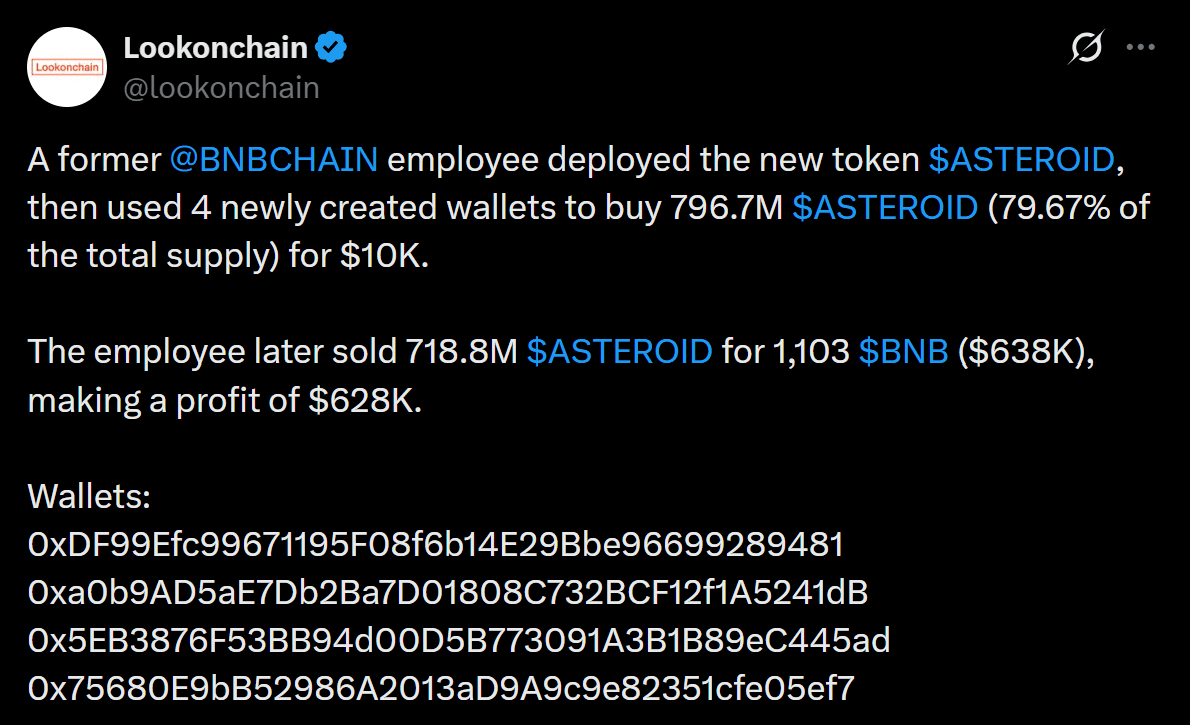
That alleged insider access also becomes clearer when examining the token’s early distribution. Blockchain records show the former BNB Chain employee allegedly used four linked wallets to acquire 796.7 million ASTEROID, accounting for 79.67% of the total supply, for roughly $10,000.
Source: X
The same wallets later sold 718.8 million ASTEROID for 1,103 BNB, worth about $638,000, producing an estimated $628,000 profit. This concentration placed most of the token supply under a single participant during the earliest trading phase.
Source: X
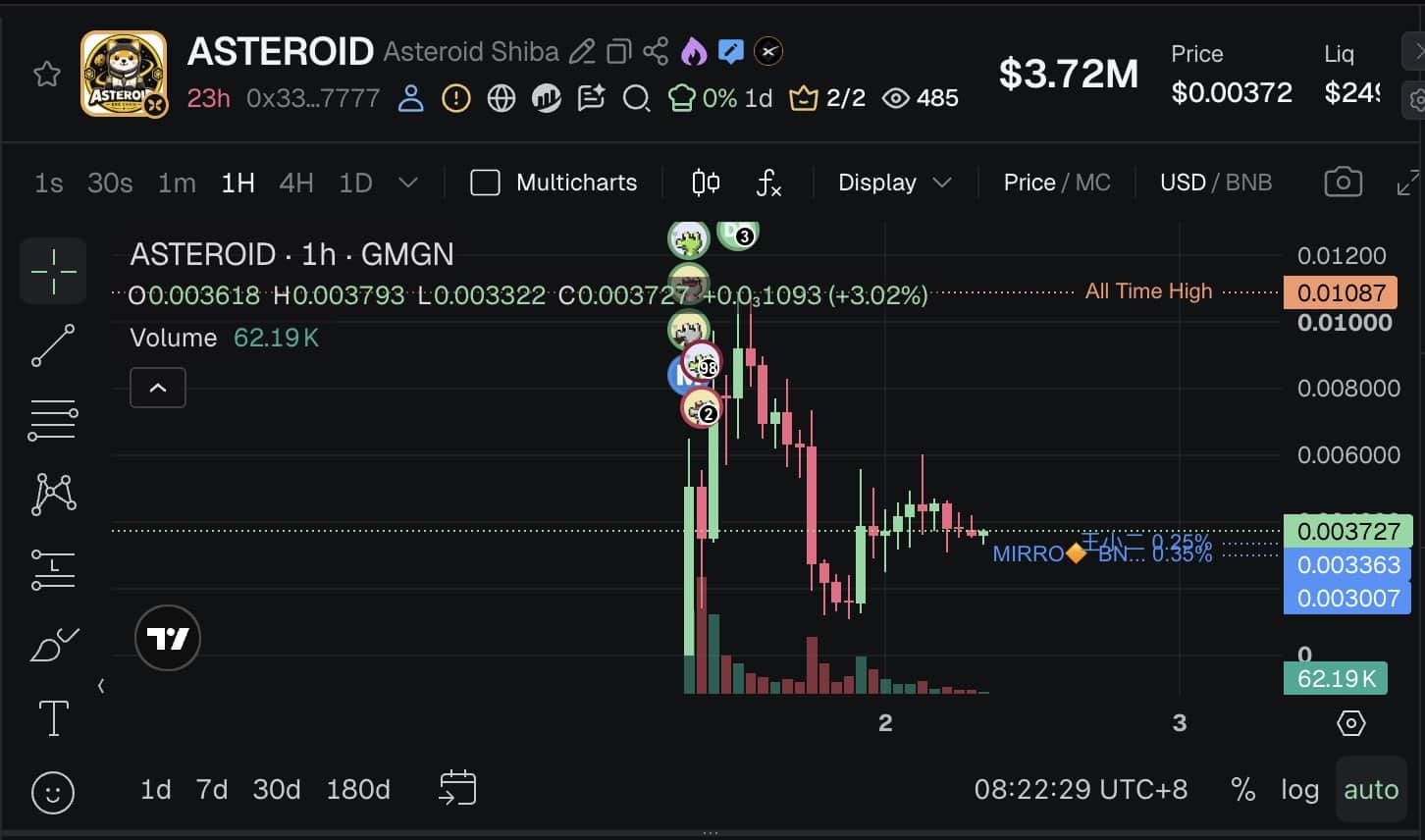
As those holdings entered the market, liquidity struggled to absorb the sales, accelerating downside pressure. This led to the token crashing by over 40%.
The trading pattern therefore supports BNB Chain’s allegations and highlights how concentrated ownership can rapidly distort price discovery.
Governance now faces a key test
Now attention turns to whether this incident points to a governance challenge beyond isolated security slips. Alleged misuse of a retained tutorial seed phrase highlights that residual access can persist long after someone leaves the company.
That shifts scrutiny toward offboarding procedures, key management, and controls around demonstration wallets. Future security updates will therefore matter as much as the legal investigation itself.
Stronger access controls would indicate the incident exposed a correctable operational weakness. However, limited procedural changes could raise broader concerns about governance standards across crypto ecosystems.
Ultimately the long-term impact will depend on whether measurable improvements result rather than just continuing with enforcement actions alone.
Final Summary
BNB Chain linked the ASTEROID token to alleged insider misconduct and concentrated early token ownership.
ASTEROID’s lasting impact now depends on whether BNB Chain strengthens governance and access controls.
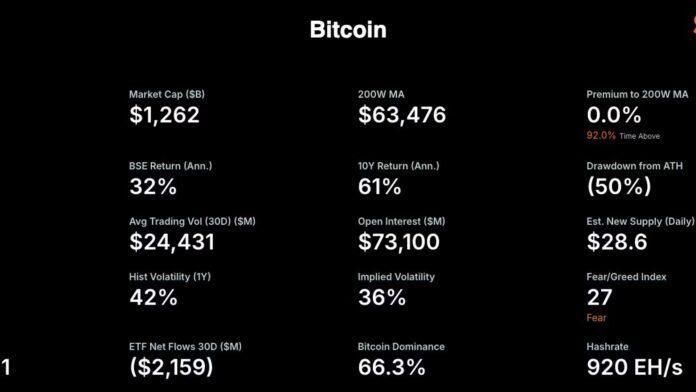
If you’ve been tracking crypto markets, you’ve likely seen analysts flag bitcoin’s BTC$62,778.56 200-week moving average (200W MA) as a key inflection line where the broader trend can turn decisively higher. This line represents bitcoin’s average closing price over roughly four years.
Strategy is now tracking the same indicator, along with bitcoin’s premium (or discount) to that average. The firm’s Founder, Michael Saylor, announced it on X on Sunday, reinforcing the long-term average as a pivotal level for traders and investors alike.
“We’re now tracking Bitcoin’s 200-week moving average and its premium to that level on http://Strategy.com. Since the 200W MA became available, Bitcoin has traded above it 92% of the time. Today, it sits almost exactly on the line,” Saylor said Sunday on X.
However, in the hours since the post, prices have come under pressure, likely over concerns about a delay in the passage of the long-awaited Clarity Act, which is expected to unlock a significant institutional bid for digital assets. According to reports, the Senate did not list the Clarity Act in Monday’s agenda.
You thought gasoline prices have gone up? That’s nothing compared with the soaring cost of memory chips, which have become not only incredibly expensive but also increasingly scarce relative to demand because of the AI buildout.
To see why, you only need to understand two things.
The first is compute, the most famous component of the AI buildout. In short, it’s the hardware that provides the processing power to speed up AI and machine learning. As Big Tech hyperscalers and the major AI labs have raced to obtain as much processing power as possible for their more and more sophisticated advanced models, high-end hardware like Nvidia’s graphics processing units (GPUs) has become one of the world’s most coveted resources. The demand transformed the semiconductor designer into one of the most profitable and valuable companies on earth.
It has also led to a dramatic GPU shortage, enabling the valuations of rival GPU makers AMD and Intel to take off, too. Other competitors have emerged, like Google’s Tensor Processing Units (TPUs), which the Mountain View, California, company offers to select outside firms including Meta, with which it announced a multibillion-dollar pact in February.
The second thing, of course, is memory. It’s impossible for companies to scale on compute power alone, because compute hardware can only handle data processing. Memory hardware stores the vast amounts of data advanced AI models require to do all kinds of things.
It’s needed to generate responses to user queries, which requires sifting through troves of information for an answer. In AI agents, it’s needed to remember a user’s preferences and past interactions so they can offer consistent support. In complex coding and software engineering, it requires not just knowing a massive codebase, but also remembering all the debugging and troubleshooting that went into development so that it can fix problems. Basically, AI doesn’t advance from here without more and more powerful memory.
So, just as AI has created a gold rush for state-of-the-art compute, it has created a gold rush for state-of-the-art memory. And the top of the line when it comes to that is high bandwidth memory (HBM), a specialized form of dynamic random-access memory (DRAM).
Basically, the old-fashioned DRAM on your laptop is much too slow for the vast compute power of AI. So advanced HBM stacks layers of DRAM (in some cases a dozen or more layers) on an AI GPU.
Without enough memory, AI can hit what’s called a “memory wall.” Computing power increases but memory bandwidth doesn’t follow, resulting in a high-powered computing setup that’s frequently left idle while it waits for memory access speeds to catch up. At a certain point, it hinders the benefit of the compute itself. You can’t scale advanced AI without both: They are the two core needs of larger models.
AI hyperscalers are set to spend $750 billion this year and $1 trillion in 2027, according to Goldman Sachs. Much of that is going to be directed toward HBM and DRAM, which is currently creating both dreams and nightmares. Which one depends on who you ask.
Taking Stock and Trading Stocks
The global DRAM market is dominated by three companies, Samsung Electronics, SK Hynix and Micron Technology. The massive uptick in demand for their products is a dream scenario.
Money has poured in. Samsung Electronics, to take one example, reported record earnings for the third quarter in a row last week, with second-quarter revenue roughly doubling year-over-year to $117 billion and net profit multiplying 14-fold.
So, too, have investors. Shares in Samsung are up 267% in the past 12 months. SK Hynix is up 528%, and Micron Technology is up 690%.
The fact that this skyrocketing rally is powered almost solely by the AI trade, however, has summoned nightmares for others.
The memory market is now attached at the hip to investor sentiment regarding AI, which means when investors sour, things can get very bumpy. Early last week, chip stocks had at one point lost $1 trillion in market value in just a handful of days as investors fretted about the resilience of AI infrastructure spending.
Swept up in those concerns was the $24 billion, AI-focused hedge fund Situational Awareness, which sold most of its public equities portfolio to rival Citadel after its highly leveraged bets on volatile memory stocks brought it to the brink of collapse.
Another nightmare sufferer has been South Korea’s stock market, where SK Hynix and Samsung are heavily weighted, which has swung from meltdown to rebound depending on the current, oft capricious mood about AI. After last week’s selloff, the country’s financial regulators intervened to rein in excessive retail bets on the chipmakers by limiting access to highly leveraged (and wildly popular) ETFs.
Naturally, in keeping with the theme of volatility, South Korean chipmakers staged their biggest-ever rally on Friday, fueled by assurances in the latest quarterly reports by Google, Amazon, Microsoft and Meta that made clear the hyperscalers have no plans to dial down capital spending.
The demand those hyperscalers are creating, however, is also pushing Samsung Electronics, SK Hynix and Micron to their limits. Simply put, there’s not enough memory to go around and not enough manufacturing capacity to make up for it.
“We are continuing to increase production, but demand is growing even faster,” Samsung Vice President Kim Jaejune said on an earnings call last week. “Next year’s supply shortage will deepen further than this year’s, widening the gap between supply and demand.”
Paying the AI Tax
Of all the nightmares arising from the memory crunch, the one that’s most disturbing is the one that belongs directly to you.
Because AI has become so lucrative, the three major RAM manufacturers have shifted from mostly producing conventional DRAM to focusing more of their capacity on HBM, which is what AI data centers need.
DRAM, unfortunately for you, is what consumer electronics use for their computational memory needs. This has created a brutal shortage that has been not-so-lovingly dubbed RAMageddon or the DRAMpocalypse by observers.
The shortage means the price of memory is going up. DRAM contract prices rose as much as 89% in the second quarter of 2026 alone. Consumer electronics manufacturers can’t absorb cost increases of that magnitude, which means the costs are increasingly being passed on to consumers.
Last month, Apple hiked laptop and iPad prices by 15% to 25%. On an earnings call Thursday, CEO Tim Cook warned memory prices will only go up from here. Microsoft also hiked the price of its Xbox game console yesterday, asking $100 more for the starter model, citing the cost of memory chips.
Some have started to nickname this phenomenon an “AI tax.”
MacBooks and Xboxes, however, tend to have loyal customer bases with disposable income to spare. For consumer electronics companies that cater to the middle of the market, RAMageddon has been even more stark.
Take the smartphone industry. Counterpoint Research estimates global smartphone shipments fell 11% year-over-year in the second quarter to the lowest level in 13 years. Price increases resulting from the memory crisis were the main contributor.
While shipments rose from the big guns in the sector, like Samsung and Apple, mid-market competitors Xiaomi, OPPO and vivo each recorded double-digit percentage declines.
Further reflecting these dynamics, Counterpoint found that smartphone revenue rose 7% year over year to $109 billion in the quarter, despite falling shipments, reflecting the fact that more is being paid by fewer consumers.
The stress won’t be limited to the smartphone industry, either. When digital camera maker Canon reported last week, the company said it will “seek to mitigate the negative impact [of the memory crunch] as much as possible through price increases and additional cost reductions.”
Priced Out
According to Taiwan’s Economic Daily News, Hsiang Hsu, the chairman of computer hardware designer Micro-Star International, said the visibility of memory supply is only about a month. He expects consumer product shipments will fall 10% to 20% this year as prices increase.
MSI makes gaming laptops and gear, computer and gaming accessories, vehicle infotainment systems, computers for industrial use and motherboards, giving it a high-res view into the consumer electronics market.
Sharp, the Japanese consumer appliance firm that makes home electronics, appliances, smartphones and computers and thus also has a good view of the market, said it plans to focus on higher-margin offerings to offset rising memory costs. At a June business meeting, co-Chief Operating Officer Shigeru Kobayashi said the company “will accelerate the shift toward high-priced, high-value-added products to secure profits amid the rising price of memory chips.”
Research firm Gartner estimated earlier this year that DRAM and solid-state drive (SSD) prices would rise 130% by the end of 2026, in turn increasing PC prices by 17% and smartphone prices by 13%.
Apple shares fell 10% on Friday after it issued a disappointing sales forecast. The company noted it is proving difficult to acquire enough components, including memory chips, as the AI capex boom strains supplies.
In other words, your “AI tax” is probably going up. Look for those smartphone deals now.
This post first appeared on The Daily Upside. To receive razor sharp analysis and perspective on all things finance, economics, and markets, subscribe to our free The Daily Upside newsletter.
Don’t use Swiss Army knives for surgically precise work; use scalpels.
That’s what Manos Koukoumidis and other players in the AI cost-saving business say is the biggest problem with how companies use AI. They’re using the most powerful, versatile, and expensive AI models — from frontier labs like Anthropic, OpenAI, and Google — to handle niche tasks within their organizations.
Koukoumidis, the CEO of the Washington-based AI company Oumi AI, called this practice “widely irrational and inefficient,” resulting in staggering AI bills.
Founded in 2024, Oumi lets individuals vibe-code their own niche AI models within minutes, tailored to their tasks and goals. It raised $10 million in its 2024 seed round.
Oumi is one of the many companies that have sprung up in the last two years to solve the biggest enterprise problem of the day: reducing highly inflated enterprise AI spending and increasing its returns on investment.As companies move away from the tokenmaxxing trend — where employees were encouraged to burn as many AI tokens as they could — these cost-saving services are becoming increasingly sought after.
Some of these companies are consulting firms and measurement platforms that advise clients on integrating AI into their workflows in a smart way. Others, like Oumi, are building new products, such as model builders and inference platforms, to tackle the problem from the source.
The coaches
The first category is the coaches: the consultants and advisors lighting up the path to AI success.
Sydney-based business consultancy Adaptovate has been operating for more than eight years, with over 100 consultants across offices around the world. But over the past three years, the company has zeroed in on helping others get the most bang for their AI spending buck.
Michael Murphy, a partner in the company, said Adaptovate works with clients at all stages of their AI adoption journey — from a snacks manufacturer that’s just figuring out how to use AI in its supply chain, to a 30,000-employee-strong professional services company that wants to restructure all its teams around GenAI products.
“It always starts with the strategy,” Murphy said. “Figuring out how decision-making changes. How does your talent model change? How does your organization’s structure change when you’re beginning to scale AI across the full organization?
The measurers
Then there are the measurers, who use software tools to help companies pinpoint where AI is working for them and where it isn’t.
One example is the San Francisco-based Larridin. CTO Ameya Kanitkar told Business Insider that the company acts as a measurement layer across its clients’ AI tools, employees, agents, and spending.
One of Larridin’s products is a data analysis tool that shows how employee productivity varies with token spend, helping companies identify the sweet spot for the token budget they allocate to their staff.
Kanitkar, who has worked at LinkedIn, Coinbase, and Groupon, said Larridingot off to a slow start because companies weren’t particularly concerned about AI spending in the early days of adoption. But that has shifted after they started pouring millions into the resource, and he’s seeing Larridin’s traction double every quarter since the start of the year.
“It just makes sense that you need a measurement layer to make sure that all those hundreds of millions of dollars you’re spending are actually justified and are properly spent,” he said.
Larridin raised $17 million in seed funding from Andreessen Horowitz, Bloomberg Beta, Google Ventures, and other investors and launched the platform in 2025. It now serves clients from data center construction companies to biosciences and financial services firms.
The builders
The third category is the builders: the startups like Oumi that are creating products to directly help companies slash AI costs.
Another example is Runware, a company cofounded by serial entrepreneur Ioana Hreninciuc. Runware provides the inference infrastructure companies need to run AI models quickly, cost-effectively, and at scale. This makes it much easier for companies to scale up their AI products without worrying about AI outages.
For those buying their own GPUs, there’s Tensormesh. The startup focuses on Key-Value Cache, cofounder Junchen Jiang said, something that “never appears in people’s token bills” but certainly affects their costs.
Tensormesh’s caching system helps businesses “accept more queries on fewer GPUs,” Jiang said. The company raised $20 million from big-hitters in hardware like AMD and NVentures, Nvidia’s venture capital arm.
And even more are gestating, ready to hit the market. Conifer is still participating in Y Combinator’s summer 2026 batch. Its cofounder, Charles Muehlberger, said the company had already raised $1.3 million, about 20% of its desired raise, before Demo Day. The company’s product will synthesize queries, break them into pieces, and feed the pieces to different models (including local ones).
“We think the main customer is one who is focused on cost,” said Michael Jeffords, Conifer’s other cofounder.
Bottom line
While the coaches, measurers, and builders are cutting the AI-cost-saving pie in different ways, their advice is largely the same: stop using frontier AI models for every menial task, start using lighter, open-source models, and build your own models to reduce costs and reliance on the big AI labs.
They’re also proposing new ways to think of ROI. Kanitkar from Larridin said AI costs should be treated as capital expenditures, not operating expenses, and companies shouldn’t expect to see gains immediately, but rather over a period of a year or two.
They’re all united on one belief — that companies jumped on the AI hype train without proper planning, and most don’t really know what they’re doing.
“Everybody’s pretending their AI spending is paying off,” Hreninciuc from Runware said.
“The incentive right now is for people to say it is paying off and to find a way to justify it, and because of this, we don’t have an accurate view of the market, as nobody wants to be the canary in the coal mine,” she said.
Chainlink [LINK] has been stagnant over the past week with the market cap around $6.25 billion. Its daily trading activity is around $215 million with a volume-to-market-cap ratio at 3.36%.
The data shows normal trading activity and fair liquidity, probably influenced by retailers and whales. However, institutional capital is still sidelined. Can whales and retailers drive Chainlink’s price action on their own?
Whales accumulate
Over the past month, a whale has been accumulating Chainlink tokens from the Binance exchange. These buys constituted orders worth hundreds of thousands.
The last buy was made three weeks ago, with 18.748K LINK tokens worth $151.486K. This brought the entire stack to 266.4144K LINK, now worth $2.153 million.
Source: Onchain Lens
The entire balance was moved to the Gnosis Safe multisig wallet, indicating a long-term accumulation.
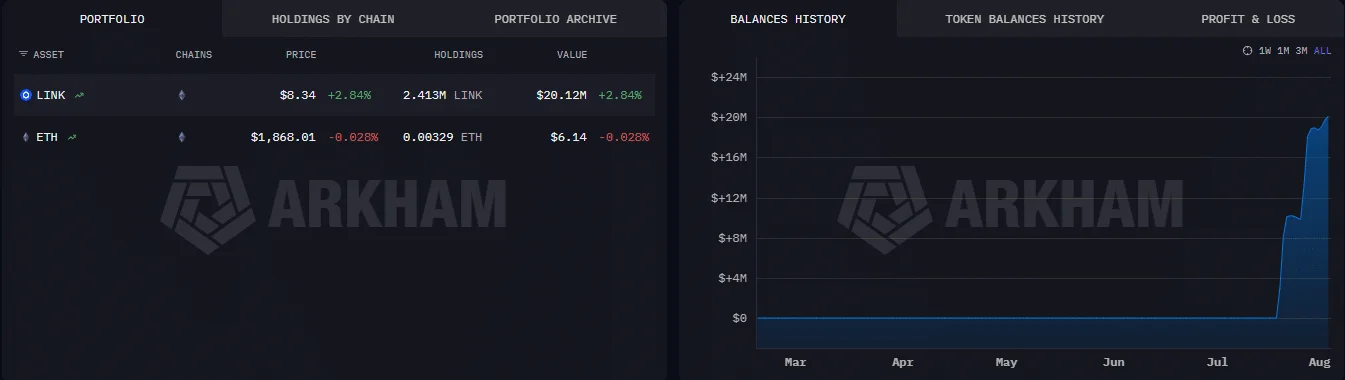
Another whale was purchasing LINK. Recently, they bought 163.494K tokens valued at $1.37 million from Coinbase. Its holdings are now 2.413 million LINK, costing $20.15 million.
Source: Arkham
The whales continue to hunt for more of the circulating supply, indicating serious conviction. They reinforce the demand created by Chainlink Reserve, which added 706K LINK in July.
However, there was zero activity from the spot Chainlink ETFs, as well as those of Dogecoin [DOGE] and Avalanche [AVAX]. This activity was happening despite renewed interest in altcoins and memecoins.
LINK revisits 4-year low – What’s coming?
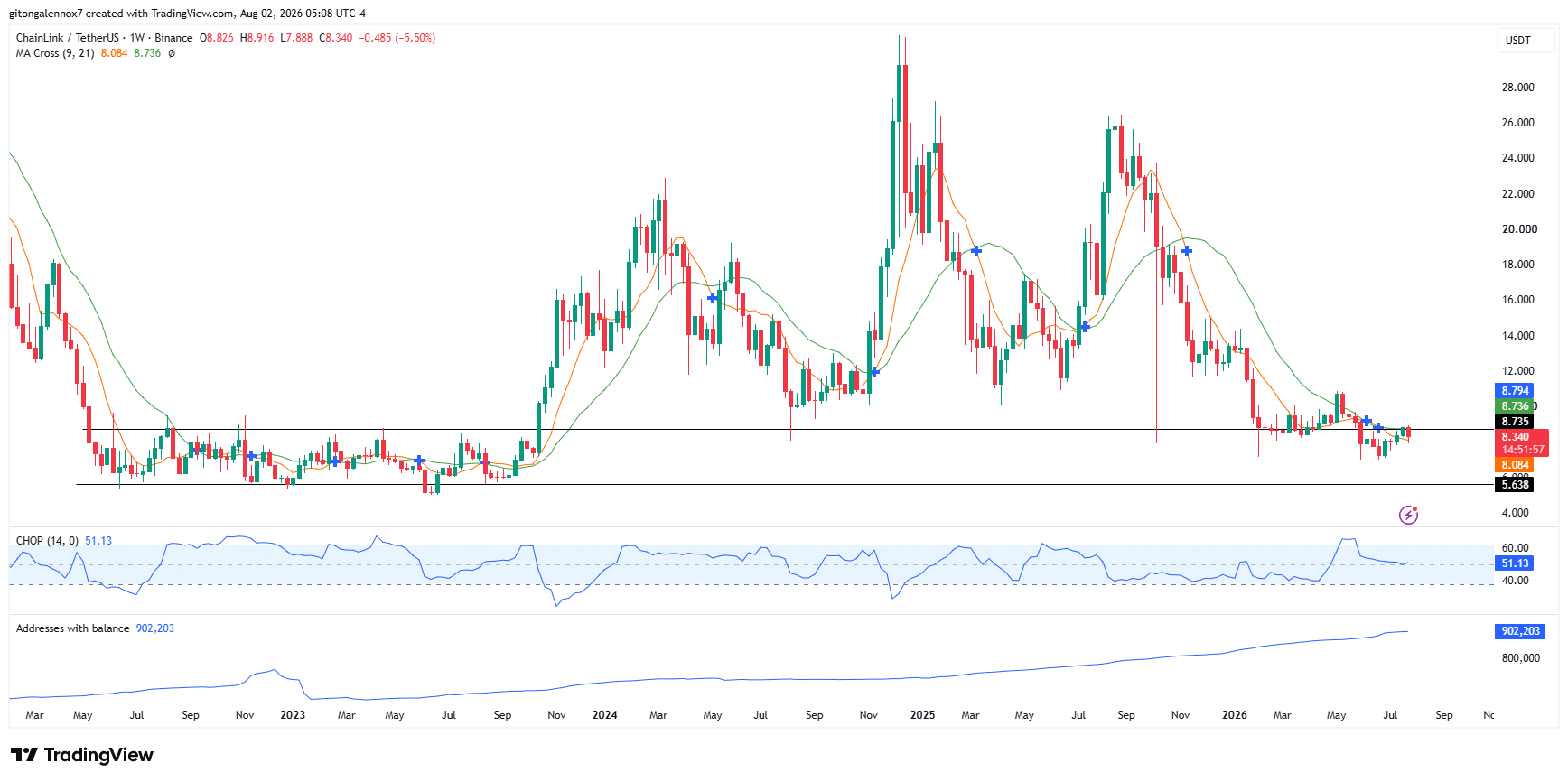
On the charts, LINK was trading at a demand zone between $5.638 and $8.727 that had formed four years ago. This demand zone lasted more than a year and a half, from May 2022 to mid-October 2023.
Three rallies to $22, $29, and $27 all started from this demand zone. The altcoin continues to consolidate around this level, hinting at potential bottoming.
The Choppiness Index was at 51, reinforcing the sideways movement around the $8 zone. It was also between the 9-week and 21-week moving averages.
However, the current retest of the zone has been deeper than in the previous three rallies. That could result in a more explosive rally as traders up their accumulation.
Source: LINK/USDT on TradingView
In fact, addresses with balance have been in an uptrend since early 2023. This figure stands at 902,203, indicating traders across different divides were buying LINK tokens and could move the price with minimal institutional capital.
Therefore, if the demand zone holds, the price might trade to levels above $20. Again, the odds of a decline to the demand zone low at $4.85 cannot be overlooked.
Final Summary
Chainlink whales continue to withdraw LINK tokens from exchanges, while spot Chainlink ETFs have seen no weekly activity.
LINK traded above a demand zone that formed four years ago and has defended its price since then.