Cathie Wood, head of Ark Investment Management, likes to lock in gains when her tech darlings rally.
That’s exactly what she’s doing with Snowflake, trimming her position after the cloud software stock surged nearly 10% over the past five trading days ahead of earnings.
In 2025, the flagship Ark Innovation ETF gained 35.49%, far outpacing the S&P 500’s return of 17.88% in the same period. But so far this year, Wood’s flagship Ark Innovation ETF (ARKK) is down 8.51% as of July 31, while the S&P 500 surged 9.41%, Yahoo Finance data shows.
Wood gained a reputation after the Ark Innovation ETF delivered a 153% return in 2020. But her style also brings painful losses in bearish markets, as seen in 2022, when the Ark Innovation ETF tumbled more than 60%.
Those swings have weighed on Wood’s long-term gains. As of July 31, her Ark Innovation ETF has delivered a five-year annualized return of -9.75%, while the S&P 500 has an annualized return of 11.25% over the same period, according to data from Morningstar.
Over the past 12 months through July 30, the Ark Innovation ETF saw roughly $1.49 billion in net outflows.Getty Images
Cathie Wood flags “the deflationary impact” of tech innovation
Wood usually focuses on high-tech companies across artificial intelligence, blockchain, biomedical technology, and robotics. She believes these businesses have strong growth potential, though their volatility often causes fluctuations in the Ark’s funds.
Over the decade ended 2025, the Ark Innovation ETF wiped out nearly $5 billion in investor wealth, according to an analysis by Morningstar’s analyst Amy Arnott. That made it the fourth-biggest wealth destroyer among mutual funds and ETFs in the ranking.
Wood believes investors have been focusing on the wrong signals as they assess the outlook for inflation, interest rates, and stocks.
In a June post on X, Wood said the bond market is increasingly reflecting the deflationary impact of technological innovation, particularly artificial intelligence, rather than the inflation risks many investors still fear.
Wood pointed to the continued flattening of the Treasury yield curve despite a sharp rise in oil prices over the past year. In previous cycles, she noted, an energy shock of that magnitude would have pushed long-term yields higher.
Wood believes the bond market is “discounting something much more powerful: the deflationary impact of technological innovation, particularly artificial intelligence, which is beginning to increase productivity across broad swaths of the economy. ”
She also said easing tensions with Iran and a decline in oil prices could push inflation even lower.
“The next phase of this cycle could be characterized by accelerating growth, declining inflation, falling interest rates, and a strengthening U.S. dollar,” Wood said. “That combination would create a remarkably supportive backdrop for innovation-led equities and the technologies driving the next productivity boom.”
Not all investors agree with Wood’s optimism. Over the past 12 months through July 30, the Ark Innovation ETF saw roughly $1.49 billion in net outflows, according to data from ETF research firm VettaFi.
Cathie Wood sells $5.5 million of Snowflake stock
On July 31, Wood’s Ark Innovation ETF sold 18,855 shares of Snowflake Inc (SNOW), according to its daily trading information. Based on the latest closing price of $293.28, these stocks were worth about $5.5 million.
Snowflake is a software company that helps businesses handle large amounts of data. Earlier this year, investors worried that AI could disrupt the software-as-a-service (SaaS) business model, which charges customers based on the number of users.
But that’s not the story for Snowflake.
Shares of Snowflake have surged 9.41% over the past five trading days, largely due to a bullish call from Wells Fargo. On July 29, the bank raised its price target on the stock to $500 from $320 while maintaining its Overweight rating, saying “the game has changed,” according to The Fly.
That is the highest target on Wall Street, implying roughly 70% upside from the July 31 close of $293.28.
Wells Fargo believes AI agents are accelerating customer spending on Snowflake, while investors are underestimating the company’s AI-driven growth potential.
The analyst sees Snowflake as a near-term AI beneficiary “without capex requirements or model dependence.” That means the company can profit without having to spend heavily on infrastructure.
Year-to-date, Snowflake stock is up 33.7%, including a 36.48% jump on May 28 after the company delivered stronger-than-expected earnings and announced plans to spend $6 billion on Amazon Web Services infrastructure over the next five years. That was Snowflake’s biggest single-day gain on record.
For its fiscal first quarter, Snowflake reported adjusted earnings of 39 cents per share and revenue of $1.39 billion, which was up 33% from a year earlier. Analysts were expecting earnings of 32 cents per share and revenue of $1.32 billion, CNBC reported.
Snowflake also issued upbeat guidance. It forecast fiscal second-quarter product revenue of $1.415 billion to $1.420 billion and an adjusted operating margin of 12.5%. Wall Street was looking for product revenue of $1.37 billion and an adjusted operating margin of 11.9%.
Snowflake is estimated to report its fiscal Q2 earnings on August 26.
“AI continues to be a powerful tailwind for Snowflake, and Q1 marks a clear inflection point in that journey. With Cortex Code and Snowflake Intelligence, we are extending from the trusted foundation for enterprise data and context to become the control plane for the Agentic Enterprise,” Snowflake’s CEO Sridhar Ramaswamy said in a statement.
“We are seeing strong momentum from both AI-driven acceleration of our core platform and growing adoption of our first-party AI products, positioning Snowflake to lead in this new era.”
Wood significantly increased her Snowflake position on June 18, purchasing 223,690 shares valued at roughly $52 million at the time. More recently, her funds began trimming the stake, selling another 14,684 shares on July 20. This was likely a profit-taking move before earnings.
Snowflake is not in Ark Innovation ETF’s top 10 holdings.
Top 10 Holdings in the Ark Innovation ETF by Portfolio Weight as of July 31, 2026:
Tesla (TSLA) – 9.42%
SpaceX (SPCX) – 4.92%
Tempus AI (TEM) – 4.81%
CRISPR Therapeutics (CRSP) – 4.66%
Coinbase (COIN) – 4.54%
Shopify (SHOP) – 4.54%
Advanced Micro Devices (AMD) – 3.96%
Circle Internet Group (CRCL) – 3.82%
Robinhood Markets (HOOD) – 3.54%
10x Genomics (TXG) – 3.43%
Other than selling Snowflake shares, Wood’s latest trades included buying CoreWeave (CRWV), Circle Internet Group (CRCL), Pony AI (PONY), and a small amount of Kodiak AI (KDK).
She also trimmed positions in Shopify (SHOP), 10x Genomics (TXG), Brera Holdings (SLMT), Figma (FIG), Strata Critical Medical (SRTA), and Iridium Communications (IRDM).
As the crypto market rallied in 2025 amid positive sentiment around policy changes, ALT5 Sigma jumped at the opportunity to acquire World Liberty Financial [WLFI]. In August, the firm announced plans to raise $750 million to purchase WLFI.
Later, ALT5 Sigma expanded its strategy to $1.5 billion, becoming the primary Treasury reserve asset. Now, with the market on edge, it captured market share with major token movement.
Trump-linked Treasury moves $99.7 million WLFI
According to Onchain Lens, ALT5 Sigma transferred 1.815 billion WLFI worth $99.77 million to a new address. After the transfer, the ALT5 Sigma wallet still holds 5.09 billion WFI worth $283.5 million.
Since the transfer was not made to exchanges, it remains an external transfer. Thus, the token transfer could be an internal reorganization.
Since the transfers did not have an immediate impact on the market, the ALT5 Sigma still holds 7.28 billion and has not sold any.
However, these holdings are sitting on massive unrealized losses. Two wallets hold 6.9 billion WLFI worth $384 million.
With a cost basis of $1.24 billion, these tokens sit on $853.24 million in unrealized losses. To remain afloat, ALT5 Sigma has reportedly borrowed funds from World Liberty Financial.
How did the World Liberty Financial market react?
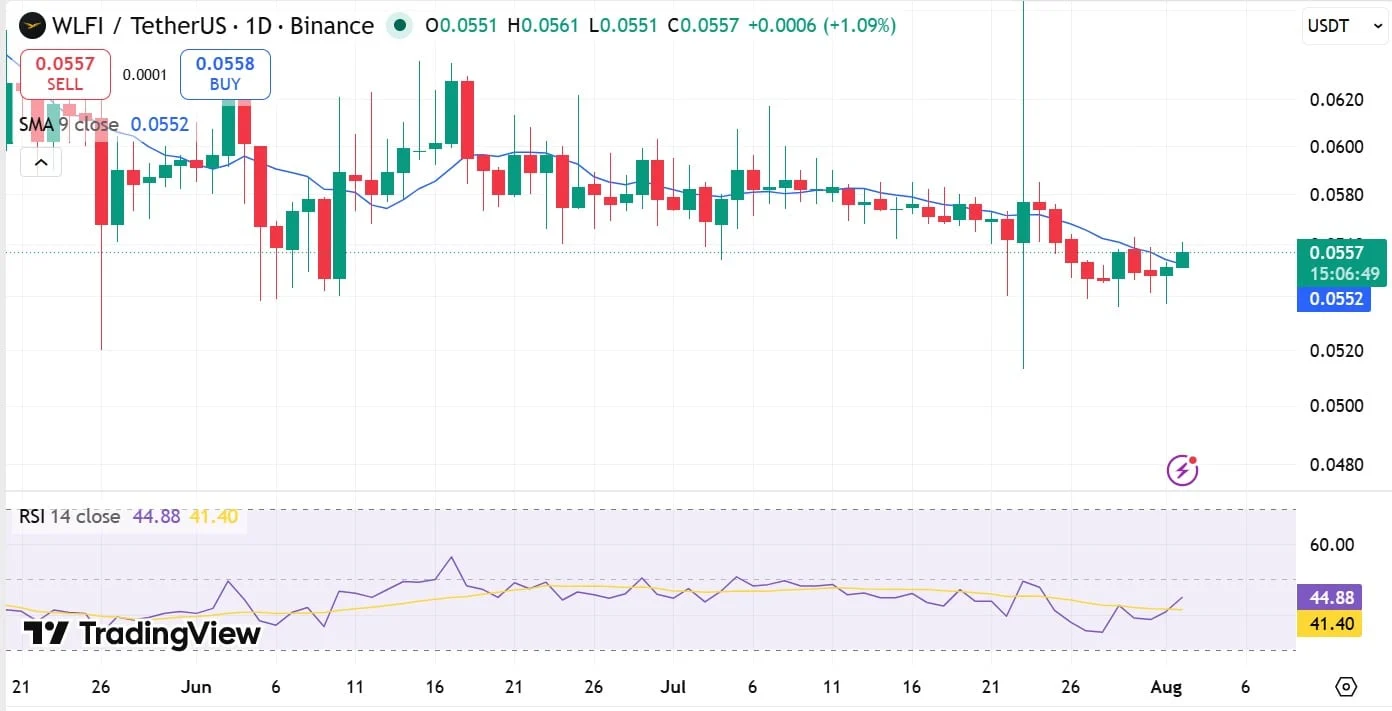
Despite the transfer, WLFI has continued with the rebound from a $0.053 slip. The altcoin jumped to a high of $0.056 before slightly retracing.
As of this writing, World Liberty Financial was trading around $0.0557 after rising by 2.85% on the daily charts.
With the price hike, the altcoin flipped the Simple Moving Average at $0.0559, indicating strong short-term upside strength.
Source: TradingView
Furthermore, the altcoin’s native Strength Index (RSI) formed a bullish crossover, rising to 46. The rising RSI suggested that buyers are currently attempting to retake the market.
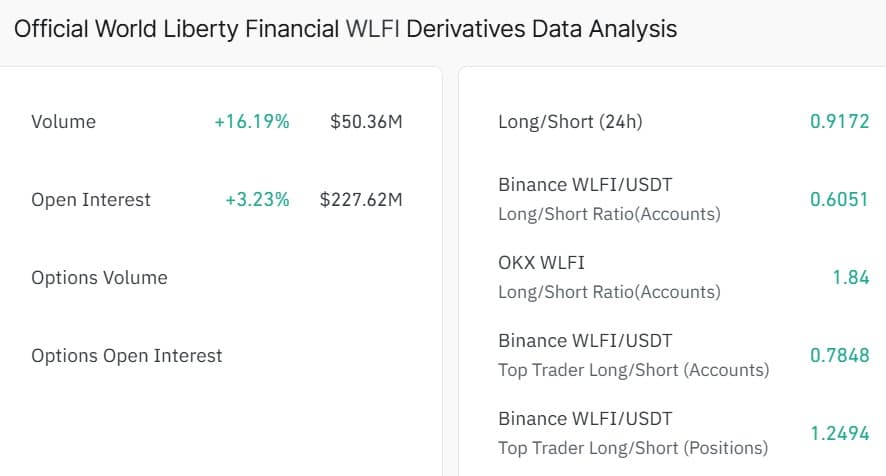
These buyers were mostly speculative traders, as participation in derivatives increased. According to Coinglass data, Derivatives Volume rose 16% to $50.36 million, while the Open Interest climbed 3.2% to $227.6 million.
Source: CoinGlass
Speculative activity has often resulted in short-term price hikes. If the activity holds, the altcoin will flip 50, validating the trend shift.
In doing so, it will validate the strength of the trend, paving the way towards $0.06. However, holding below 50 suggests sellers remain stronger and buyers have yet to take over fully.
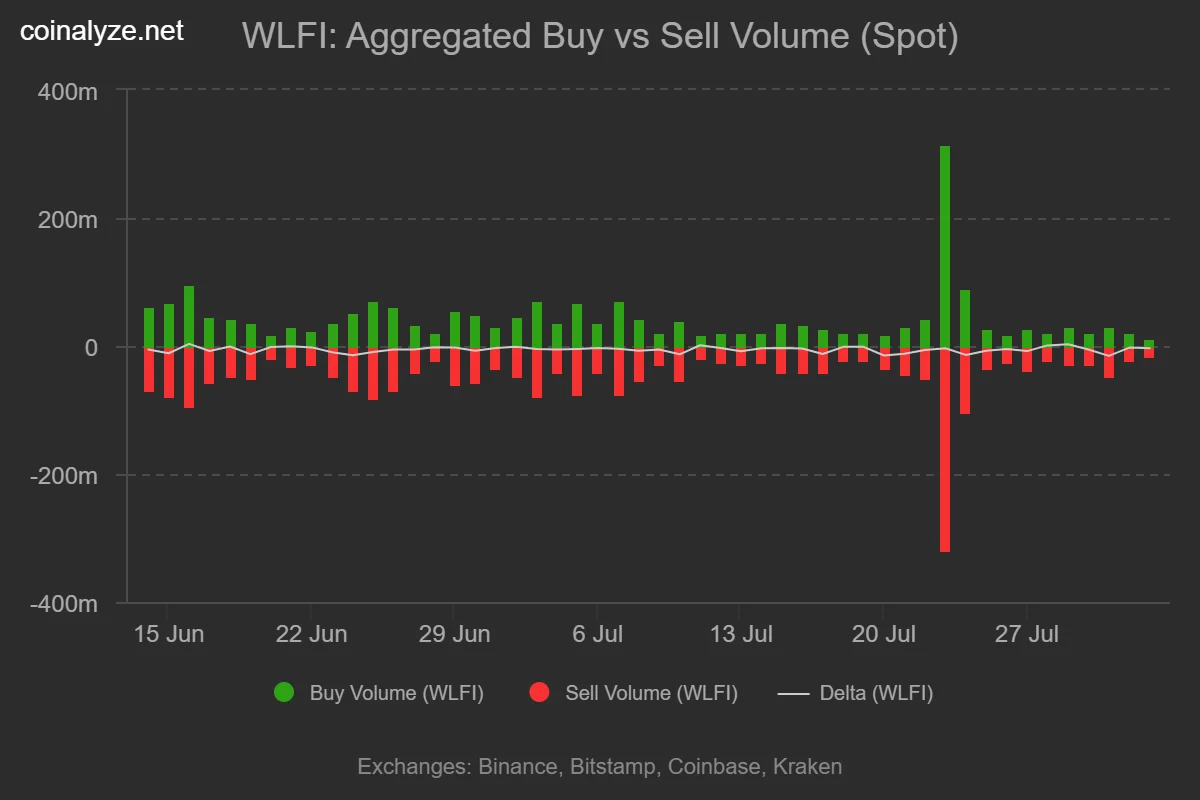
In fact, on the Spot market, sellers have dominated over the past five days. In fact, the market delta has remained largely negative.
Source: Coinalyze
Over the past day, for example, the selling volume rose to 15.98 million compared to 12.6 million in buy volume. As a result, the Buy Sell Delta dropped to -3.38 million, a clear sign of aggressive spot selling.
With sellers still dominating the spot, the risk of another pullback remains. If the selling persists, WLFI will breach SMA and fall to $0.053.
Final Summary
ALT5 Sigma transferred 1.815 billion WLFI worth $99.77 million to a new address as unrealized losses hit $853.24 million.
WLFI rebounded from a $0.053 slip to $0.056 amid renewed demand in the derivatives, but the spot market remains bearish.
The geopolitical conflict in the Middle East has the world on edge. The daily news flow from the region can lead to wide swings in oil and natural gas prices. But the truth is that the energy sector has long been volatile, and today’s events aren’t all that unusual. Which is why long-term investors should probably focus on reliable dividend-paying energy stocks.
ExxonMobil (NYSE: XOM) has one of the most impressive dividend histories in the energy industry. Close behind is Chevron (NYSE: CVX). For those looking to avoid direct commodity exposure, two of the most reliable high-yield stocks are Enbridge (NYSE: ENB) and Enterprise Products Partners (NYSE: EPD). With yields of up to 5.7%, this group of stocks could be your entry point into energy in August.
Missed Nvidia in 2009? This Rare Signal Is Flashing Again. In 2009, a “Double Down” signal flashed for a little-known chipmaker called Nvidia. For the first time in years, that same “Total Conviction” signal is flashing for a company 1/100th the size of Nvidia. Continue »
Image source: Getty Images.
Get integrated and focus on the dividend checks
It actually gets easier to find energy stocks if you start with the premise that the energy sector is volatile. Income-focused investors can immediately look for the strongest companies with the best dividend histories. That very quickly leads to Exxon and Chevron.
From a business model perspective, they are both globally dominant integrated energy companies. They have exposure to the entire energy value chain, including the upstream (production), midstream (pipelines), and the downstream (chemicals and refining). Geographically, they can invest where management believes it can find the highest returns. And, the broad portfolio diversification helps to soften the energy market’s normal swings.
Meanwhile, both companies have the lowest leverage among their integrated energy peers. Exxon’s debt-to-equity ratio is around 0.2x, while Chevron’s is roughly 0.25x. That gives them the leeway to take on debt during industry downturns to support their businesses and dividends.
The proof of the model here, however, is the reliable, growing dividends Exxon and Chevron have paid. Exxon’s 2.6% yield is backed by 43 annual dividend increases. Chevron’s 3.7% yield is backed by 38 annual increases. The combination of positives here makes Exxon and Chevron the go-to options for dividend investors seeking direct energy exposure.
Sidesteping the commodity exposure
If the swings in oil and natural gas prices are something you want to avoid, however, you can still find attractive dividend stocks in the energy industry. All you need to do is refine your search to focus on the midstream sector.
These businesses own the energy infrastructure, such as pipelines, that help to move oil and natural gas around the world. They charge fees for the use of their assets, so the volume moving through their systems is more important than the price of the commodities being moved. Two of the best options are Enterprise and Enbridge, which are both industry-leading North American midstream giants.
Enterprise is more focused on the energy sector. Enbridge also owns regulated natural gas utilities and clean energy investments. However, both businesses are designed to produce reliable cash flows to support large dividend payments. Enterprise’s distribution yield is a lofty 5.7%, while Enbridge’s dividend yield is roughly 5%. Enterprise has increased its distribution annually for 27 years, and Enbridge has increased its dividend for 31 years.
The one large drawback here is that Enterprise and Enbridge are both slow-growth businesses, so the yield will likely make up the lion’s share of your return over time. However, if you are trying to maximize the income your portfolio generates, that probably won’t be a problem.
August is as good a month as any
The global impact of the Middle East conflict has clearly highlighted how important oil and natural gas are to the world’s economy. Every investor should probably have some energy exposure. That includes dividend investors. But if you are a dividend lover, you need to shift your focus from oil prices to dividend reliability. Exxon, Chevron, Enterprise, and Enbridge have proven that they know how to survive through the entire energy cycle while continuing to reward investors well for sticking around. Take a close look, and it’s likely that one of these four high-yield energy stocks will fit your needs as August gets underway.
Should you buy stock in ExxonMobil right now?
Before you buy stock in ExxonMobil, consider this:
The Motley Fool Stock Advisor analyst team just identified what they believe are the 10 best stocks for investors to buy now… and ExxonMobil wasn’t one of them. The 10 stocks that made the cut could produce monster returns in the coming years.
Consider when Netflix made this list on December 17, 2004… if you invested $1,000 at the time of our recommendation, you’d have $386,727!* Or when Nvidia made this list on April 15, 2005… if you invested $1,000 at the time of our recommendation, you’d have $1,232,139!*
Now, it’s worth noting Stock Advisor’s total average return is 906% — a market-crushing outperformance compared to 208% for the S&P 500. Don’t miss the latest top 10 list, available with Stock Advisor, and join an investing community built by individual investors for individual investors.
Reuben Gregg Brewer has positions in Enbridge. The Motley Fool has positions in and recommends Chevron and Enbridge. The Motley Fool recommends Enterprise Products Partners. The Motley Fool has a disclosure policy.
NEW YORK: Freddy Peralta of the New York Mets throws a pitch during the third inning of the game against the Los Angeles Dodgers at Citi Field on July 26, 2026 in New York City. (Photo by Dustin Satloff/Getty Images)
Getty Images
In acquiring Freddy Peralta from the Mets, the Rays tapped into their deep farm system without giving up a prospect rated higher than No. 15.
In return for the 30-year-old righthander, Tampa Bay parted with a trio of minor leaguers: 22-year-old outfielder Aidan Smith (Rays’ No. 15 prospect), 21-year-old righthanded pitcher Gary Gill Hill (No. 26) and 23-year-old second baseman Emilien Pitre (No. 27).
“We’re excited to welcome Freddy Peralta to the Tampa Bay Rays,” said Rays president and head of baseball operations, Erik Neander, in a statement. “Freddy is a proven major league starter with high-stakes experience and a strong track record. Adding a pitcher and competitor of his caliber strengthens our team as we push forward.”
Peralta, who was acquired by the Mets in January from Milwaukee, joins an already-strong Tampa Bay rotation. Drew Rasmussen and Nick Martinez, both all-stars, have been among MLB’s best starters all season. Shane McClanahan has rebounded nicely from missing the past two seasons and Griffin Jax, who began this season in the bullpen, has been effective in a starting role for the first time since his rookie season of 2021 when he was with the Twins.
Though desirable to begin with, a need for a starter was heightened when McClanahan exited a July 30 start against Texas due to back tightness. He was placed on the 15-day injured list with the hope he will miss no more than a couple of starts. The lefty missed the 2024 and 2025 seasons due to Tommy John surgery and a triceps injury, respectively.
The Rays have also utilized Ian Seymour as a starter and bulk reliever behind an opener.
“I am very excited, certainly given that (McClanahan) is down, to be able to slot him in,” said manager Kevin Cash, of Peralta, following a 9-1 loss to the White Sox on Sunday that was as unsightly as the final score.
Peralta, a teammate of Rasmussen’s in Milwaukee, is a two-time all-star who spent eight seasons with the Brewers. His best showing was last year (17-6, 2.70 ERA) when he led the National League in wins and was fourth in ERA. He went 70-42, with 3.59 ERA as a Brewer.
Ozzie Timmons was the Brewers’ hitting coach in Milwaukee for three seasons (2022-24) before returning for a second stint on Cash’s staff with the Rays. He has plenty of good things to say about the acquisition, including a comparison to a well-liked shortstop who was with Timmons in Tampa Bay and Milwaukee.
“He’s a great teammate, a competitor and he works hard,” said Tampa Bay’s assistant hitting coach. “He’s a good person, a family man, has a lot of energy. He reminds me of Willy Adames.”
Peralta, a free agent after this season, struggled in Queens in going 5-9, 4.99. He is making $8 million this season with Rays will responsible for a prorated $2.4 million, which should allow them to make other moves to strengthen the lineup. The middle of the infield, in particular, has struggled offensively and with precious little power.
After allowing four runs in five innings to pick the win on Opening Day in Pittsburgh, Peralta was winless (0-3) in six April starts despite an ERA of 2.97. Beginning with a May 29 start against Miami and through his final outing with New York on July 26 against the Dodgers, Peralta had a 6.71 ERA in 11 starts. Alas, that is yesterday’s news as Peralta can look forward to joining a stellar rotation and coaching staff that includes pitching guru Kyle Snyder.
“He’s going to love this place,” said Jax. “We call him “Fastball Freddy” and anytime anybody with a good heater steps on this mound (at Tropicana Field), it’s generally pretty favorable.”
The Rays begin a nine-game road trip in Colorado on Monday night.
The crypto market has stayed under pressure as capital steadily drains out of the space, and total market capitalization for digital assets now hovers near $2.17 trillion while valuations struggle to find a floor.
Fragile economic conditions and the prospect of fresh action from the Federal Reserve remain a key threat to the outlook, and either one could weigh further on price performance across the board.
Rate hike could be next
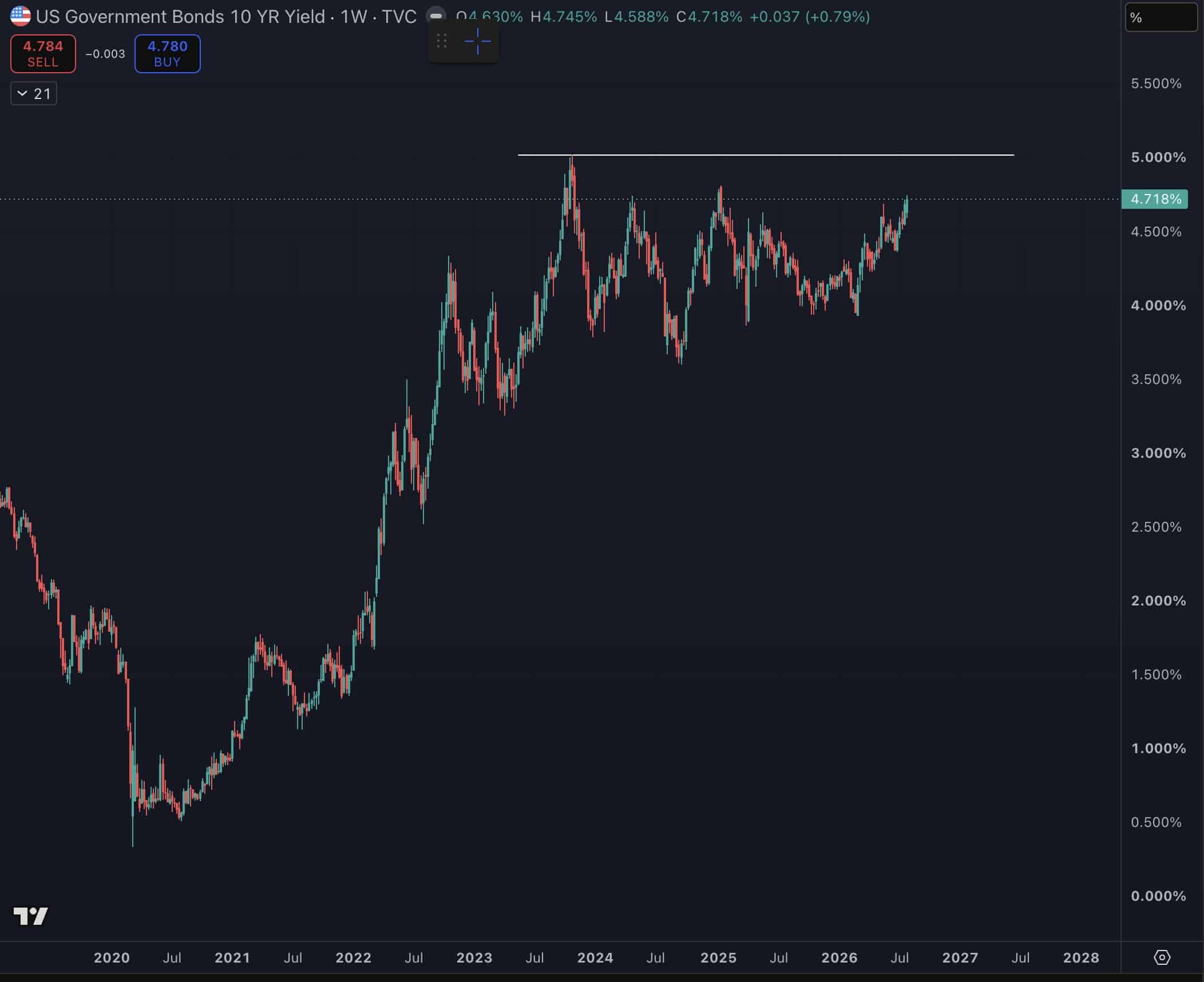
Crypto analyst Benjamin Cowen expects the U.S. 10-year Treasury yield to keep gaining strength and sees a high chance of it reclaiming the 5% mark in the near term.
A rising yield reflects instability in an economy, particularly around inflation, and Cowen’s prediction lands as the U.S. 30-year bond yield crossed 5.28% on the 31st of July, one of its highest levels since 2007.
Source: TradingView/ Benjamin Cowen
The climb has been building for weeks, drawing investors toward lower-risk assets and steadily pulling capital away from bets like Bitcoin [BTC]. Cowen noted lowering rates does not automatically translate into lower yields, and he pointed to 2024-2025 as his case study.
The Fed cut rates from 5.5% to 3.75% from 2024-2025 and yet the 30 year yield is higher today than when interest rates were 5.5%!
He ties the expected move to the Federal Open Market Committee cutting rates too early, and he expects the pressure on the long end to keep building. A yield holding above 5% would eventually force the Fed to raise rates and tighten the flow of capital into risk assets.
Impact of a rising yield
A rising yield carries a clear knock-on effect once the Fed lifts interest rates. A hike tends to restrict capital flow because borrowing grows more expensive, and it pushes investors toward stable assets over riskier bets.
Cryptocurrencies are broadly considered risk assets, so tighter conditions consistently leave less capital coming from the US side, which can feed a gradual slowdown across the market.
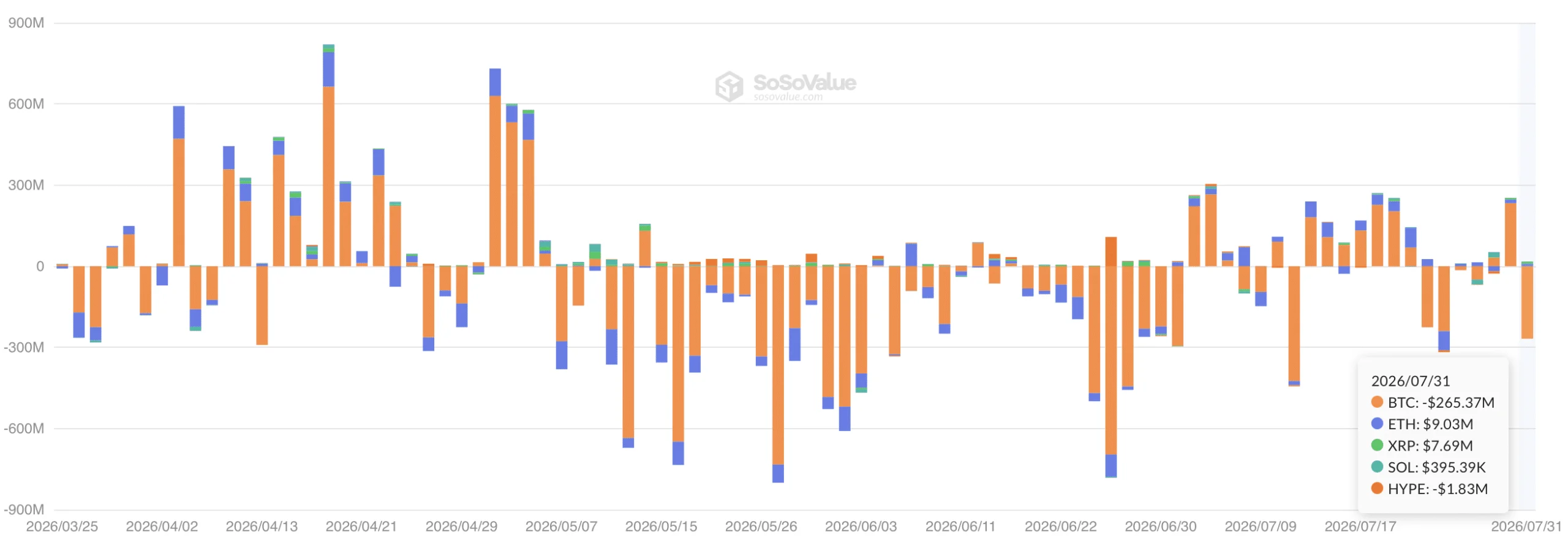
That rotation toward safety already surfaced on Friday, when U.S.-listed products recorded a sharp spike in outflows and a visible drop in capital as the 30-year yield pushed to fresh highs.
Source: SosoValue
BTC and Hyperliquid [HYPE] sat on the losing side, with $265.37 million and $1.83 million pulled from the two assets, while other funds, including Ethereum [ETH] and Ripple [XRP], saw thinner flows of $9.03 million and $7.69 million, respectively.
A steeper rate hike would raise the odds of the bear market stretching on even longer.
Capital flow in the market
Capital across the market has thinned over the past few weeks, and the drain feeds directly into current conditions.
Stablecoins have seen heavy redemptions, with total supply down from $321.82 billion on the 22nd of May and roughly $14.27 billion pulled from the market since.
Most of the remaining stablecoin balance now sits idle instead of flowing into crypto, a sign investors are holding back from fresh bets on digital assets.
Final Summary
Cowen expects the U.S. 10-year Treasury yield to keep climbing and reclaim the 5% mark, a move he believes would eventually push the Fed toward raising rates.
Higher yields are already steering money into safer assets, and the resulting pullback in capital leaves Bitcoin and the wider crypto market exposed to a longer slowdown.
While those applications have become increasingly visible, the infrastructure that enables deposits, withdrawals and settlement has largely remained behind the scenes.
Fun is one of the companies building that infrastructure. The firm said it powers 100% of deposits and withdrawals on Polymarket and deposit flows into Aave’s largest vaults, while processing more than $3 billion in monthly transaction volume.
The company has raised more than $75 million to date.
From payment rails to funding flows
Fine said today’s crypto payments ecosystem remains unnecessarily fragmented, with developers forced to stitch together different card processors, banking partners, crypto assets, blockchains and bridges to create funding experiences.
Instead of relying on individual payment rails, platforms should optimize around the end goal of getting users funded as quickly and seamlessly as possible, he says.
“In Web2, payments are highly fungible,” Fine said. “In Web3, they’re much more complex because every payment method behaves differently. Teams keep rebuilding the same infrastructure over and over again instead of building unified optimized funding flows.”
That shift means many existing crypto payment businesses risk becoming obsolete, according to Fine. Companies built around converting fiat into crypto or moving assets between blockchains are solving an intermediary step that users never cared about in the first place, he argued.
Investors who had hopes that Novo Nordisk (NVO) could succeed outside of weight-loss drugs were disappointed on Friday, July 31.
The Danish drugmaker said its experimental heart drug Ziltivekimab failed the main goal of a large late-stage trial, and the stock fell fast.
Novo has spent 2026 trying to prove it can grow beyond Wegovy and Ozempic, and this was one of the clearest tests of that plan.
For anyone holding the stock or watching the dip, the reaction says a lot about how much the market had riding on this trial.
Novo Nordisk stock falls after its ZEUS heart drug trial misses
Novo Nordisk started July 31 with one of its worst trading sessions in months.
The company said its heart drug Ziltivekimab failed the main goal of the ZEUS trial, and investors sold the stock fast.
Novo Nordisk’s Danish shares fell about 7.5% on the day, while the company’s U.S.-listed shares dropped 8.6% in early trading, CNBC reported.
The drop shows how much investors were counting on Ziltivekimab to become a second growth engine next to Novo’s weight-loss and diabetes drugs.
That hope is now on hold, and the stock reaction reflects it.
What the ZEUS trial tested and why it failed
ZEUS was a late-stage trial that followed more than 6,300 people, according to Novo Nordisk’s press release.
The patients had atherosclerotic cardiovascular disease, chronic kidney disease, and ongoing inflammation. That last group matters because inflammation is linked to heart attacks and strokes.
Ziltivekimab is a once-monthly injection that blocks a protein called IL-6, which drives inflammation in the body.
More Healthcare Stocks:
Novo wanted to show that lowering inflammation would also lower the rate of major adverse cardiovascular events, like heart attack, stroke, or cardiovascular death.
The drug did lower inflammation markers as designed, but that biological effect did not turn into fewer heart events.
The trial posted a hazard ratio of 0.99, which means patients on the drug had almost the same risk as patients on a placebo.
One safety detail stood out. Patients on Ziltivekimab had more serious infections than those on placebo, though overall death rates were similar between the two groups.
Novo Nordisk’s cardiovascular ambitions took a hit after its ZEUS trial missed its main goal.Cheng Xin / Getty Images
Why the failure hit Novo Nordisk stock so hard
Novo has spent 2026 trying to prove it can grow beyond Wegovy and Ozempic.
Analysts widely expected Ziltivekimab to deliver at least some heart benefit and eventually reach billions in annual sales.
Without that win, Novo’s cardiovascular pipeline outside of weight-loss drugs now looks weaker, and investors sold the stock to reflect that.
Novo Nordisk said the setback will cost it money on paper. The company expects to take a non-cash impairment charge in the third quarter of 2026 tied to this trial failure.
An impairment charge is an accounting write-down that lowers the recorded value of an asset. It does not drain cash, but it signals that a project is worth less than expected.
Novo also confirmed the failure will not change its 2026 adjusted operating profit outlook, so the near-term earnings outlook stays intact.
How this fits Novo Nordisk’s rough stretch in 2026
Novo shares have fallen sharply from their 2024 highs as Eli Lilly (LLY) has taken GLP-1 market share with Mounjaro and Zepbound.
The failure also arrives days after a U.S. judge ruled Novo must face part of a shareholder lawsuit tied to its CagriSema weight-loss trial, CNBC reported.
That case centers on what Novo told investors about the design of the REDEFINE-1 trial before disappointing results in December 2024, Pharmaphorum reported.
The concern for some investors is repetition. Novo keeps building expectations for pipeline drugs, then falling short of the biggest targets.
What could still go right for Novo’s heart drug
The heart program still has two chances left to prove itself.
Novo Chief Scientific Officer Martin Holst Lange said the ZEUS result does not change the company’s commitment to cardiovascular disease, CNBC noted.
Ziltivekimab is still being tested in two other late-stage trials with different patient groups:
HERMES, which studies patients with heart failure
ARTEMIS, which studies patients recovering from an acute heart attack
Both trials continue, and Novo expects results in the first half of 2027.
A positive result in either trial would reopen the cardiovascular opportunity that ZEUS just closed, though there is no guarantee the drug performs better in those patients.
What Novo Nordisk investors should watch next
The clearest early signal comes at Novo’s next earnings report, when its management is expected to disclose the size of the impairment charge and update its pipeline plans.
Here are three things worth tracking:
The impairment charge. The dollar figure in the Q3 2026 report will show how much value Novo assigned to the ZEUS program.
Wegovy pill momentum. U.S. prescription trends for the oral version will indicate whether the core business can keep funding new bets.
The CagriSema lawsuit. Any movement in the shareholder case could affect sentiment separate from the drug pipeline.
Novo also plans to present the full ZEUS data at a medical meeting later in 2026, which may reveal whether any patient subgroup saw a benefit.
Until then, the core diabetes and obesity business remains the main reason to own the stock, and the heart pipeline remains an open question.
The failure does not threaten Novo’s current revenue, but it removes one path the company was counting on to widen its lead over Lilly.
The bigger question for investors is whether Novo’s stock price already accounts for this setback. Shares have traded lower for months as Eli Lilly gains ground in the weight-loss drug market, so some of this bad news may already be priced in.
Anyone taking a position should size it to their own risk tolerance, since a single trial result or court ruling can still move this stock sharply.