Home Blog Page 167

Blackstone credit arm nears deal for HSBC’s Australian loan book – report

0
Blackstone credit arm nears deal for HSBC’s Australian loan book – report


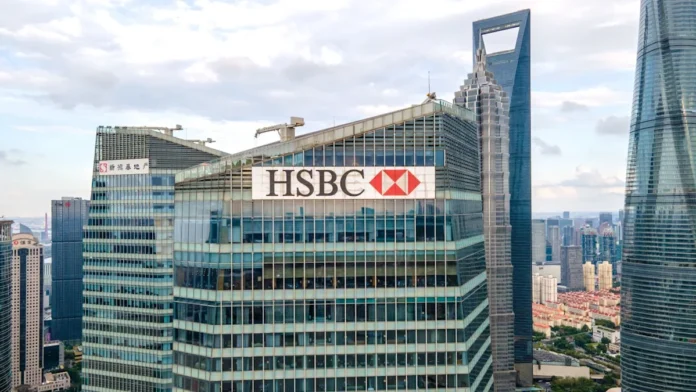
HSBC is expected to sell its Australian loan portfolio, which is worth more than A$30bn, to the Blackstone’s private credit unit, reported Australian Financial Review (AFR).

Sources said the discussions are being handled by the same Blackstone credit team that has provided lending to Firmus, although with a different group of dealmakers.

King & Wood Mallesons is acting for Blackstone. HSBC is being advised by Citi and Allens.

Westpac’s disposal of its RAMS home loan portfolio last year drew interest from KKR, Apollo Global Management and Cerberus. KKR also holds stakes in non-bank lenders Pepper Money and Latitude Financial.

The same names have also featured in the process for HSBC’s portfolio, as previously reported by this column.

Earlier this year, Citi began a new auction for HSBC Australia’s loan book after the bank’s London headquarters opted to narrow the scope of the sale.

Previous efforts to sell the full Australian business, including both loans and deposits, to National Australia Bank or Macquarie did not proceed.

HSBC is carrying out a broad global reorganisation under chief executive Georges Elhedery, who took the role last September.

In Australia, that has led to three significant steps: the retail bank was put up for sale, corporate lending was reduced, and the local management structure was changed by combining the chief executive and head of banking positions.

The bank’s Australian lending operations are now divided into three areas: debt capital markets under Andrew Duncan; structured finance under Visweswara; and leveraged and acquisition finance under Michael Rossiter.

In June, Bloomberg, citing sources, reported that Emirates NBD is in talks to buy HSBC’s operations in Türkiye.

In May this year, OCBC Indonesia signed a deal with PT Bank HSBC Indonesia to assume the assets and liabilities connected to HSBC Indonesia’s retail banking and wealth management operations there, known as International Wealth and Premier Banking (IWPB Indonesia).

HSBC’s Sri Lanka branch signed a binding agreement in September 2025, to transfer its retail banking operations to Nations Trust Bank (NTB).

In July 2025, HSBC disclosed its plan to withdraw from its International Wealth and Premier Banking (Retail Banking) operations in Bangladesh.

“Blackstone credit arm nears deal for HSBC’s Australian loan book – report” was originally created and published by Retail Banker International, a GlobalData owned brand.


Source link

Internet Computer: Traders accumulate 503M ICP as breakout pattern forms – $2.50 next?

0
Internet Computer: Traders accumulate 503M ICP as breakout pattern forms - $2.50 next?


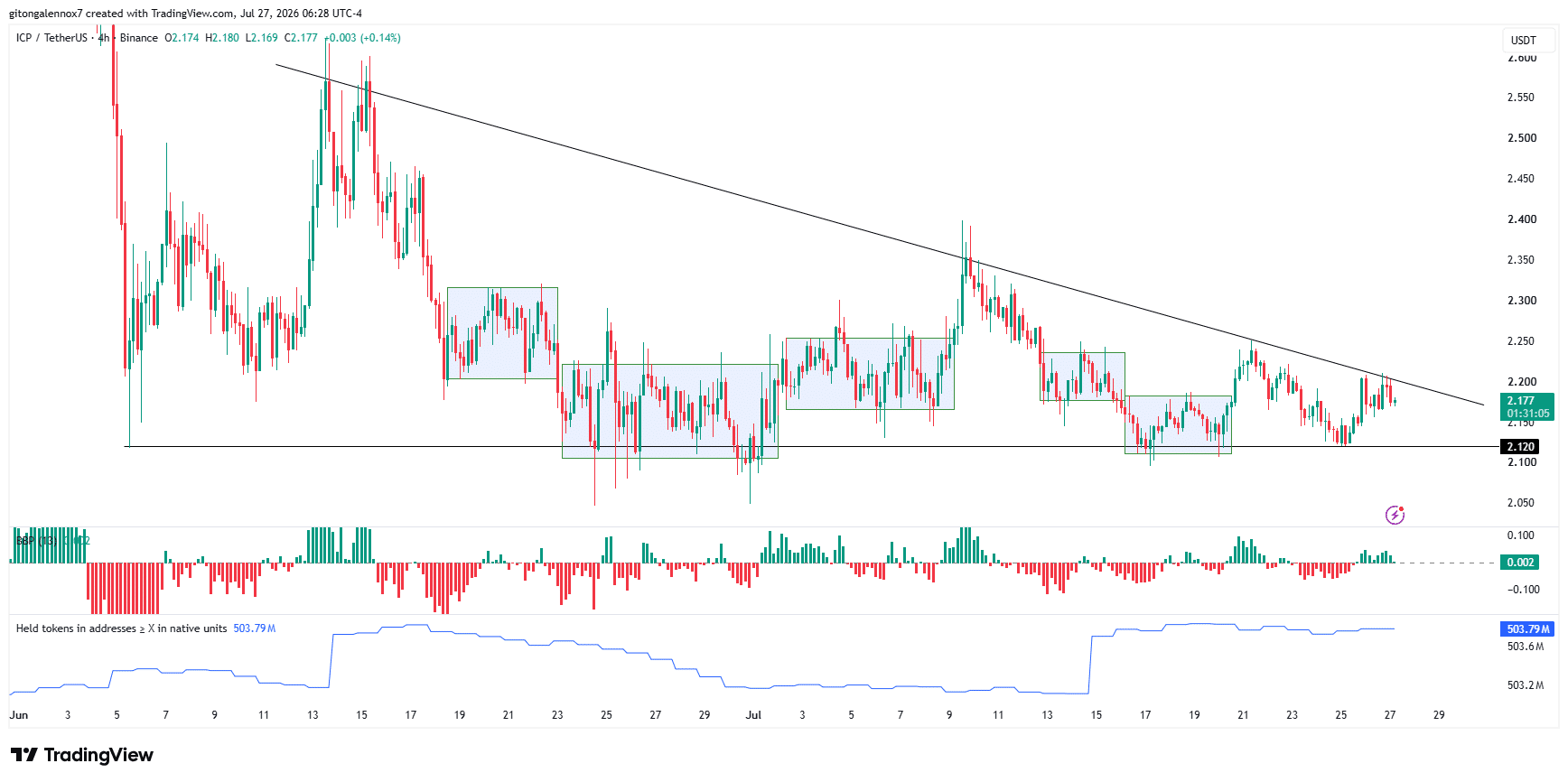
Internet Computer [ICP] has been stagnant since mid-June with the price action trading around $2.17. The 9-day and 26-day moving averages are flat, reinforcing this quiet price action with an insignificant daily change.

Interestingly, the price action of ICP is hinting at a potential breakout that could determine the altcoin’s direction.

ICP crypto nears triangle pattern breakout

Looking at the price of ICP, the altcoin was trading at the apex of a triangle consolidation pattern. The pattern is characterized by a horizontal support at $2.12 and a slanting resistance running from $2.50 to $2.20. It has lasted for about two months.

The price contraction to the apex indicates volatility is low. Usually, low volatility precedes high volatility, which hints at a potential pattern breakout.

For now, ICP is trading in a consolidation. However, breaking and staying above the slanting resistance would expose a rally toward $2.50 or higher.

This was backed by Bull Bear Power (BBP) turning bullish. Additionally, transactions of more than 10K ICP on the Binance spot market have been increasing since the 15th of July.

Collectively, over 503 million ICP tokens had been aggressively accumulated in these two weeks. But from a broader perspective, ICP’s buying activity started in the second half of June.

ICP
Source: ICP/USDT on TradingView

On the other hand, if ICP breaks below the support at $2.12, more price decline may be expected. That is, the next key demand level is at $2, while the extreme bear target is at the $1-$1.16 zone, which was created on the 10th of October.

Why is network activity showing divergence?

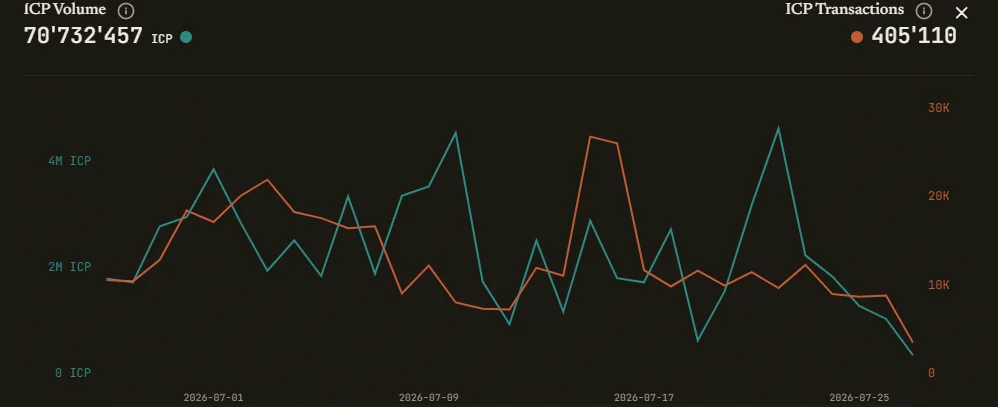
While ICP was bullish on the technical outlook, its chain activity was bearish. For instance, overall transactions fell from 9,612 per day to about 3,680, the lowest level this month. These figures represented about a 62% drop in network usage.

However, ICP topped blockchains by monthly transaction count with 9.40 billion, as Solana [SOL] followed with 8.60 billion.

Similarly, volume was tanking further, creating this month’s low. It tumbled from 2.869 million ICP to 362.7K ICP tokens, further reinforcing the low network activity.

ICPICP
Source: ICP Dashboard

Final Summary

  • Internet Computer was trading at the apex of a consolidation pattern as the accumulation trend gained pace. 
  • ICP’s on-chain activity was diverging from the bullish technical outlook, reinforcing that a potential breakout was looming. 


Source link

Why Do Enterprise Brands Avoid Testing Bold Ideas in Public?

0
Why Do Enterprise Brands Avoid Testing Bold Ideas in Public?


Opinions expressed by Entrepreneur contributors are their own.

Key Takeaways

  • Challenger brands test messaging publicly. They co-create with communities. They adjust based on audience response. They learn while moving. Enterprise brands, meanwhile, are often trapped inside planning structures built around certainty.
  • The most effective organizations won’t replace planning with improvisation. They’ll build feedback loops into planning itself.

A new report surveying more than 300 enterprise FMCG marketers revealed a statistic that should concern every major brand leader: Only 1% of campaign ideas originate through testing-and-learning in public. Meanwhile, 41% still come from quarterly or annual planning cycles, and just 11% are driven by social or cultural insights.

That statistic helps explain why challenger brands continue to outperform incumbents in today’s attention economy. While enterprise organizations are still planning for culture, challenger brands are learning from culture in real time.

Increasingly, that difference is determining who wins.

Enterprise was built for control; culture wasn’t

For decades, enterprise marketing rewarded scale, consistency and risk management. Big brands controlled shelf space, dominated media buying and shaped consumer perception through carefully orchestrated campaigns.

Unfortunately, the way demand is created has fundamentally changed.

Today, discovery happens publicly. According to data from Socially Powerful, more than a third of enterprise FMCG marketers say social media and creators now drive more product discovery in their category than TV or search. At the same time, 86% say brand loyalty is weaker today than it was five years ago.

Consumers are increasingly less loyal by default. They’re influenced continuously by creators, communities, algorithms and online conversations happening at a pace traditional organizations simply weren’t designed to match.

That’s why challenger brands have become so dangerous — 7 in 10 enterprise marketers believe challengers outperform them on speed to market, from faster approvals to quicker creative production and publishing. But speed itself isn’t the real advantage. The real advantage is learning velocity.

Challenger brands test messaging publicly. They co-create with communities. They adjust based on audience response. They learn while moving.

Enterprise brands, meanwhile, are often trapped inside planning structures built around certainty. By the time a campaign survives approvals, legal reviews, stakeholder alignment and production timelines, the cultural moment it was designed for may already be over.

Culture ships daily. Most enterprises still operate quarterly.

Why most enterprise influence keeps resetting

One of the sharpest insights in the report is that enterprise influence still behaves like a burst. A campaign launches, attention spikes, engagement rises — and then everything resets once the spend stops.

That creates a costly cycle where brands repeatedly buy attention instead of building momentum.

The irony is that enterprise marketers already know where cultural understanding lives. According to the research, 81% agree that influencers understand culture and trends better than internal teams. Yet 62% still believe they can remain culturally relevant without fundamentally changing how they work with creators.

That contradiction explains why so much enterprise creator marketing still feels transactional.

Creators are often brought in late, after strategy is finalized, and used primarily for distribution. Challenger brands do the opposite.

They involve creators upstream as real-time intelligence networks that help shape positioning, messaging and product narratives while culture is still forming, allowing for a much quicker change of course should it be needed.

The incentive problem nobody wants to address

The challenge isn’t simply that enterprise organizations move slowly. It’s that most enterprise marketing systems were designed to reward predictability rather than learning.

When a brand manager presents a quarterly plan, success is often measured by how accurately results align with forecasts. Deviating from that plan can create operational complexity, even when the deviation is driven by genuine market insight. As a result, experimentation frequently becomes a side project rather than a core operating principle.

This creates a subtle but important asymmetry between incumbents and challengers.

Challenger brands are rarely expected to be right the first time. They are expected to discover what works through iteration. Enterprise brands, by contrast, often feel pressure to justify decisions before they reach the market. The consequence is that learning happens internally, while challenger brands learn externally.

The irony is that modern consumer behavior increasingly rewards the latter approach. According to Edelman’s Trust Barometer research, people place greater trust in peers, creators and individuals they perceive as authentic than they do in institutional messaging. At the same time, studies from McKinsey have consistently shown that consumers are more willing than ever to switch brands when presented with better value, convenience or relevance.

In other words, the market itself is becoming more dynamic while many enterprise operating models remain relatively static.

This is why the future competitive advantage may not be creative excellence alone, media scale alone or even data alone. It may be organizational learning speed: the ability to observe shifts in consumer behavior, test responses quickly and incorporate those learnings into decision-making before competitors do.

Ideally, brands should seek to combine the advantages of both systems. The proactive side handles traditional enterprise marketing launches, seasonal campaigns, retail moments and long-term brand planning. The reactive side operates continuously through creator partnerships, rapid experimentation, community feedback and ongoing cultural sensing.

The most effective organizations won’t replace planning with improvisation. They’ll build feedback loops into planning itself. Rather than treating strategy as a document that is reviewed quarterly, they’ll treat it as a living framework that evolves alongside consumer behavior. In practice, that means giving local teams more autonomy, shortening approval cycles, embedding creators earlier in the decision-making process and creating mechanisms for small-scale experiments to influence larger strategic decisions.

While allowing a reactive expansion of your brand may lead to some loss of autonomy, as trends are not always congruent with brand identity, it’s difficult to argue that either extreme is a sustainable model.

Acting like a challenger brand at enterprise scale can lead to inconsistency and an unreliable customer experience. Abandoning the challenger mindset entirely, however, is akin to rolling out the red carpet for emerging competitors.

The brands that win the next decade won’t necessarily be the loudest or the biggest spenders. They’ll be the ones capable of learning publicly while everyone else is still waiting for approval.

Right now, only 1% are built to do that.

Key Takeaways

  • Challenger brands test messaging publicly. They co-create with communities. They adjust based on audience response. They learn while moving. Enterprise brands, meanwhile, are often trapped inside planning structures built around certainty.
  • The most effective organizations won’t replace planning with improvisation. They’ll build feedback loops into planning itself.

A new report surveying more than 300 enterprise FMCG marketers revealed a statistic that should concern every major brand leader: Only 1% of campaign ideas originate through testing-and-learning in public. Meanwhile, 41% still come from quarterly or annual planning cycles, and just 11% are driven by social or cultural insights.

That statistic helps explain why challenger brands continue to outperform incumbents in today’s attention economy. While enterprise organizations are still planning for culture, challenger brands are learning from culture in real time.

Increasingly, that difference is determining who wins.


Source link

Crypto Week Ahead

0
Crypto Week Ahead

Interest rates could set the direction for crypto this week, with the Federal Reserve, Bank of England and Bank of Japan all expected to hold while markets look for signs that higher energy prices have brought further tightening closer.

CME’s FedWatch shows a 33% chance of a U.S. rate increase, while prediction markets odds are at 19%, up from next to nothing earlier in the month. Gregory Daco, the chief economist for EY-Parthenon, said September could be the first meaningful test of the Fed’s stance, CBS News reported.

More immediate tests come Thursday, with U.S. second-quarter GDP and June Personal Consumption Expenditure (PCE) due. Strong growth alongside persistent inflation would reinforce higher-for-longer interest-rate expectations and pressure crypto prices through higher yields and a stronger dollar, while softer readings could unwind that trade.

All 70 economists in a Reuters poll expected the BOE to hold at 3.75%, while the BOJ is forecast to remain at 1% before potentially raising rates again later this year.


Source link

CS PowerTech opens first phase of solar cell facility in Indiana, US

0
CS PowerTech opens first phase of solar cell facility in Indiana, US


CS PowerTech, a US-based manufacturing subsidiary of Canadian Solar, has opened the first phase of its photovoltaic cell manufacturing plant at the River Ridge Commerce Center in Jeffersonville, Indiana.

This facility is reported to be the first in the US designed to produce heterojunction (HJT) bifacial N-type solar cells, according to the company.

It is expected to play a key role in developing a domestic supply chain for solar technology.

The company states that this initiative aims to strengthen energy infrastructure and support the resourcing of advanced manufacturing within the US.

At full capacity, the Jeffersonville plant could produce more than 6GW-peak (GWp) of solar cells each year and create more than 1,200 skilled jobs in southern Indiana.

The total local investment for the project is projected by the company to be nearly $1bn.

The new site will operate alongside CS PowerTech’s module manufacturing plant in Mesquite, Texas, as part of an integrated supply strategy aimed at serving US customers.

CS PowerTech president Rusty Schmit said: “This facility will produce next-generation HJT solar cells, support domestic manufacturing and ultimately strengthen grid reliability as our customers deploy the products.

“We are proud to invest in Indiana’s workforce and work with regional partners to build a long-term centre of excellence for solar technology and advanced manufacturing.”

Canadian Solar CEO Colin Parkin said: “HJT technology is critical for the next generation of high-efficiency, high-performance solar modules, and this plant gives CS PowerTech the ability to deliver leading technology, improved energy yield and long-term value for customers while strengthening domestic advanced manufacturing.”

CS PowerTech plans to ramp up production to full capacity for the initial phase over the coming months and begin work on a second phase of expansion before the end of the year.

In April 2025, e-STORAGE, a subsidiary of Canadian Solar, was awarded a contract by the Chilean energy company Colbún to deliver a battery energy storage system with a capacity of 228MW/912MW-hours for the Diego de Almagro Sur project.

“CS PowerTech opens first phase of solar cell facility in Indiana, US” was originally created and published by Power Technology, a GlobalData owned brand.


Source link

ONDO crypto traders are betting big on leverage – Is $0.45 or $0.35 next?

0
ONDO crypto traders are betting big on leverage - Is $0.45 or $0.35 next?


Ondo Finance [ONDO] is on the verge of clearing all July losses. The altcoin rebounded from a $0.37 slip, successfully held $0.4, and touched a local high of $0.41.

As of this writing, ONDO was trading around $0.406, after slightly rising by 5.6% on the daily charts. Over the same period, the altcoin’s trading volume surged by 55% to $123 million, indicating growing market participation. 

ONDO Futures outpaces Spot amid high-risk appetite

ONDO’s  price hike, although triggered by a shift in the broader market sentiment, has also seen traders show greater demand for leveraged bets. Trader Sarosh noted that ONDO’s Futures activity remains larger than zSpot. This suggests that traders are willing to take leveraged exposure.

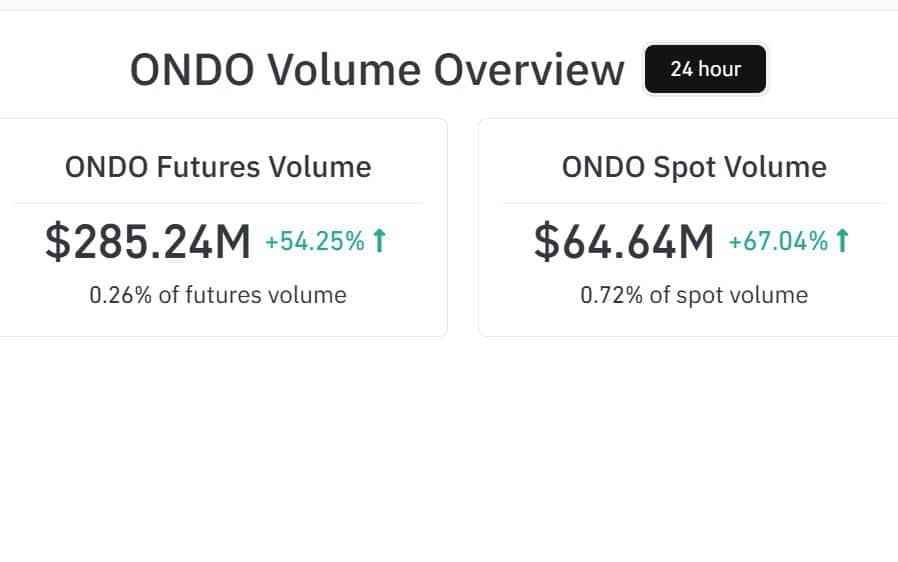
CoinGlass data shows this gap in the market. The altcoin’s ONDO Futures Volume climbed 54% to $285 million, while the Spot volume rose by 67% to $64.6 million.

Ondo futures v spot volume
Source: CoinGlass

This marks a $218 million gap between Futures and Spot, indicating that the ONDO market is experiencing a high-risk appetite.

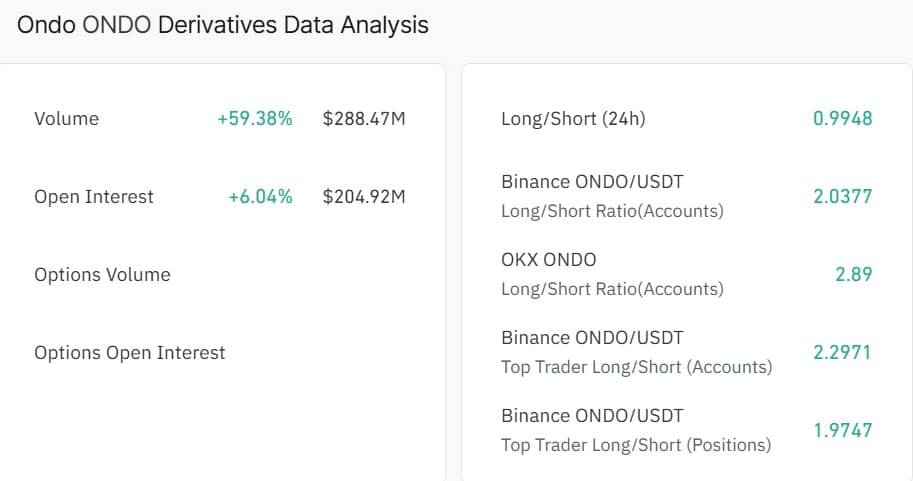
In this light, traders have deployed significant capital into opening new positions. In fact,  the altcoin’s derivatives volume surged 59% to $288 million while Open Interest rose 6% to $204 million. 

ONDO Derivatives volumeONDO Derivatives volume
Source: CoinGlass

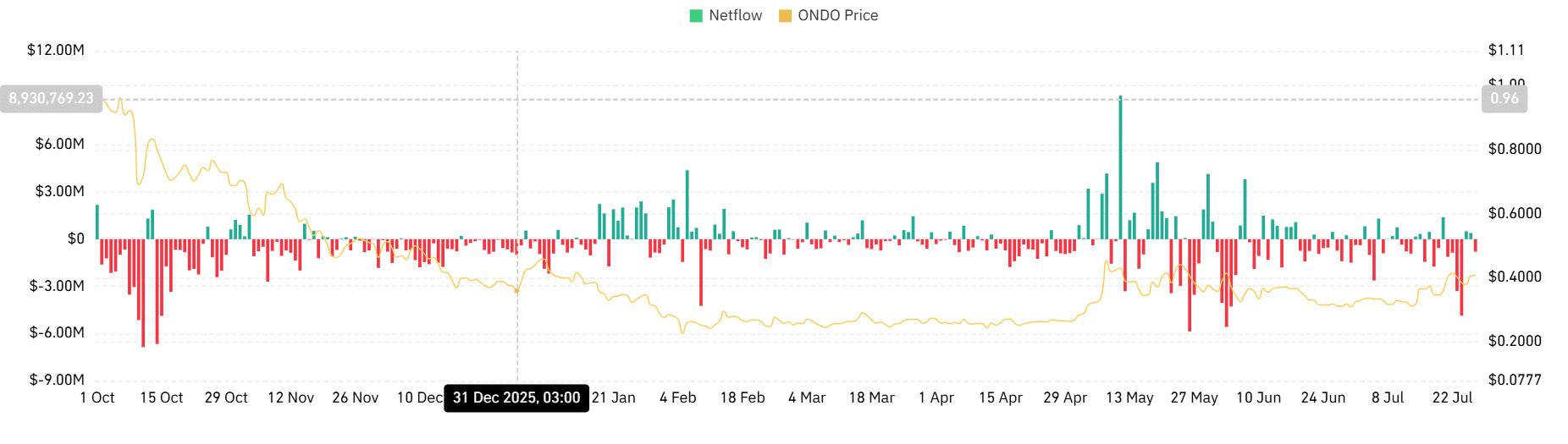
The rising volume and OI validate our earlier observations of intense demand for leveraged positions. Over the past day, for example, the altcoin’s Spot volume dropped into the negative zone after holding positive for two days.

ONDO spot netflowONDO spot netflow
Source: CoinGlass

At press time, Spot netflow dropped to -$929k, implying that volume is mostly buyer-dominated.

What’s next for the altcoin?

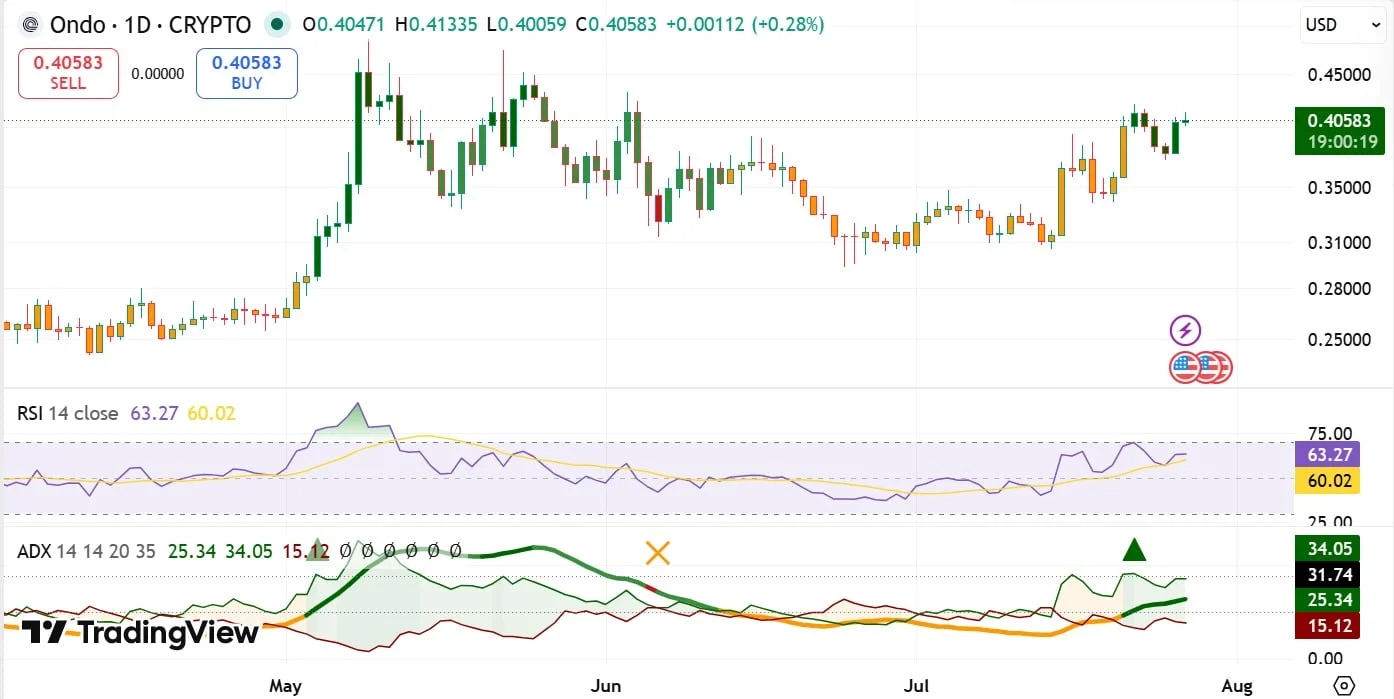
ONDO is currently experiencing strong market demand, with traders exhibiting high-risk appetite. As a result, the altcoin’s Relative Strength Index (RSI) jumped to 63, suggesting strong buying pressure. 

The ADX-DI indicator further validates these market conditions. The positive index rose to 34 while the ADX climbed to 25. 

ONDO RSI & ADXONDO RSI & ADX
Source: TradingView

With ADX and +DI rising in tandem, it showed stronger upward momentum and the likelihood of the trend’s continuation.

Therefore, if demand, especially on the Futures, continues to rise while Spot also rises to keep up, ONDO will make more gains. 

In doing so, the altcoin will target to flip the $0.45 resistance. To keep this bullish outlook, ONDO needs a daily close above $0.4, and failure to do so will see another retest of the $0.35 support.


Final Summary

  • ONDO rebounded from a $0.37 slip, successfully held $0.4, and touched a local high of $0.41.
  • Traders have shown a high-risk appetite, with Futures volume at $285 million, while the Spot volume lags at $64 million.  


Source link

Live updates: Ether leads crypto higher as bitcoin trades around $65,500

0
Live updates: Ether leads crypto higher as bitcoin trades around $65,500

Bitcoin is likely to stay range-bound, said Jeff Ko, chief analyst at CoinEx, and he points to three reasons the backdrop has calmed.

Oil has retreated from last week’s highs after another pause in U.S.-Iran hostilities. The 10-year Treasury yield, approaching 4.7%, is doing part of the Fed’s tightening work on its own. And the Fed may want to keep its options open ahead of this week’s PCE inflation and second-quarter GDP data.

The bigger swing factor is corporate. Apple, Microsoft, Meta and Amazon all report this week, and Ko said their free cash flow and AI-spending guidance could move Treasury yields and the Nasdaq, indirectly shaping the liquidity that flows into crypto.

Ko added that the composition of ETF flows will matter as much as the headline numbers.


Source link