Home Blog Page 166

WestBridge begins process to exit Star Health stake – report

0
WestBridge begins process to exit Star Health stake – report


WestBridge Capital has started a process to exit its investment in Star Health and Allied Insurance, Moneycontrol reported, citing unnamed sources.

The report said the private equity firm has asked investment banks to present proposals for a mandate to oversee the sale of its stake, with JPMorgan identified as the preferred adviser.

Based on the June quarter shareholding pattern, WestBridge holds around 40% of Star Health through Safecrop Investments India, a consortium set up by WestBridge, late investor Rakesh Jhunjhunwala and Madison Capital.

WestBridge requested expressions of interest from investment bankers a few weeks ago to run a sale process for its Star Health shares.

The source said that the size, structure and timing of any deal have yet to be decided and will depend on market conditions and investor interest.

“Given that the quantum of share held is huge, the idea is to explore multiple options for an exit,” the person said.

“It is too early to say what would be the preferred route given that a large volume of shares is involved, but a combination of many options such as finding a strategic buyer, a set of financial investors and some bit of secondary market sale is likely,” the person added.

Moneycontrol said one possible reason for the planned exit is WestBridge’s role in Kiwi General Insurance, a general insurance company it launched with industry veterans Neelesh Garg and Saurav Jaiswal in November 2024.

Kiwi General Insurance recently received approval from the Insurance Regulatory and Development Authority of India (IRDAI) to start operations.

WestBridge is currently recognised as a promoter in both Star Health Insurance and Kiwi General Insurance.

According to the report, IRDAI licensing norms allow a promoter to hold only one insurance licence, which could require WestBridge to exit Star Health after Kiwi General Insurance began operations.

In response to Moneycontrol, Star Health Insurance said: “We do not comment on market speculation. Any decision relating to a shareholder’s investment is entirely a matter for the shareholder. The company continues to remain focused on executing its business strategy and creating long-term value for all stakeholders.”

The report also referred to Prudential relinquishing its promoter status in ICICI Prudential after acquiring a 75% stake in Bharti Life Insurance.

According to its website, Star Health was established in 2006 and offers health, personal accident, overseas and local travel insurance.

WestBridge first invested in Star Health in 2018, when it and consortium partners Madison Capital and the late Rakesh Jhunjhunwala bought a significant majority stake of possibly more than 90%.

Source link

Litecoin network activity triples – Can LTC finally reclaim $50?

0
Litecoin network activity triples - Can LTC finally reclaim $50?


Litecoin [LTC] is gradually gaining momentum but remains stuck in a bearish market structure. Meanwhile, LTC’s network activity continues to grow steadily, yet the altcoin’s price is lagging on a broader scale.

What’s behind Litecoin’s network activity growth?

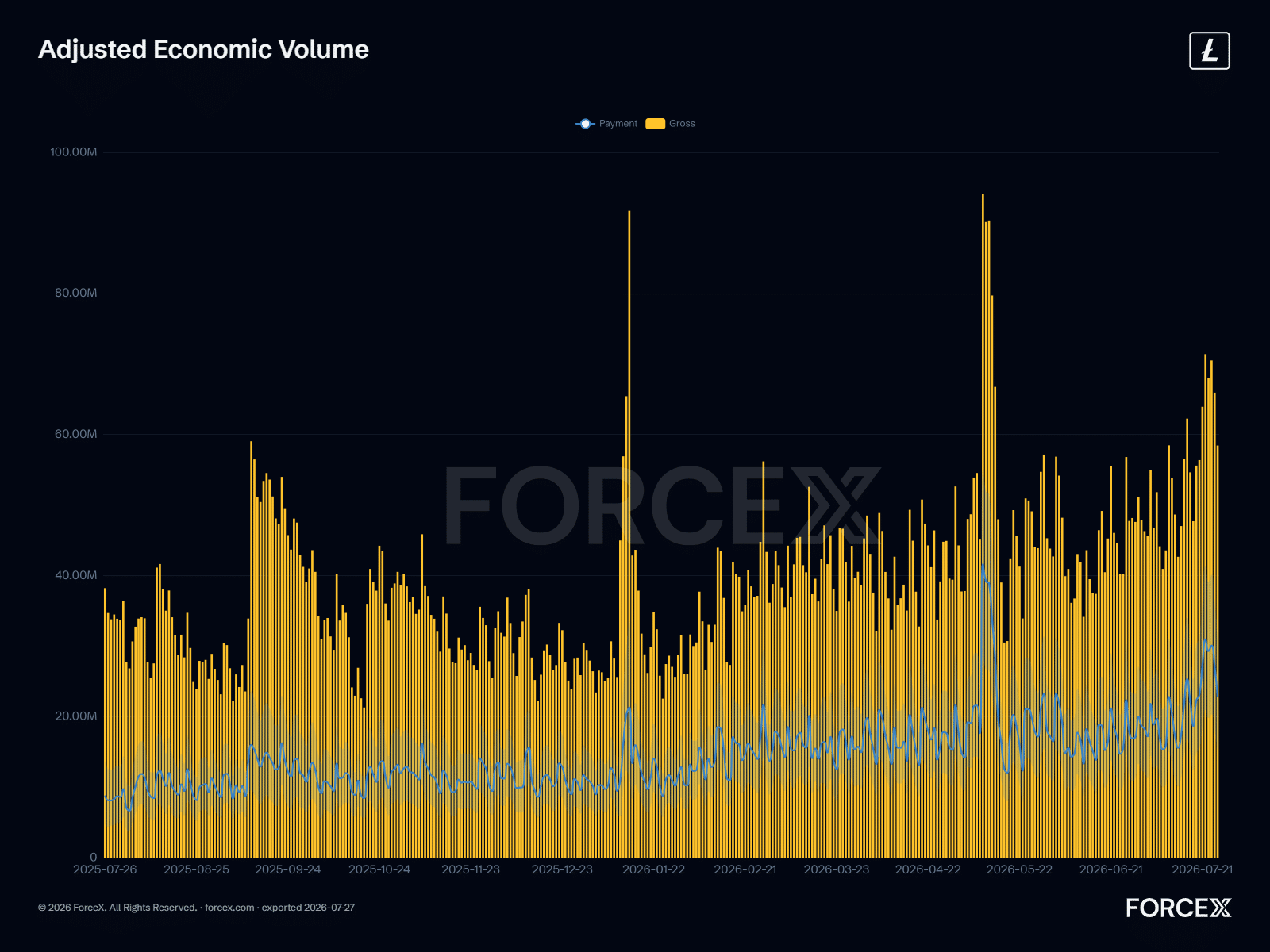
Litecoin’s Adjusted Economic Value (AEV) has more than tripled over the last year and continues to grow steadily. According to data from FORCEX, payments rose from 8.81 million LTC to 30.95 million LTC in the same period.

The AEV shows the actual amount of LTC tokens sent, excluding the unspent transaction output (UTXO). As such, it shows there is real ledger usage growth, which is bullish for the whole ecosystem.

Litecoin LTC
Source: FORCEX

The gross value moved, including UTXO, has almost doubled from 38.21 million LTC to 58.43 million LTC tokens. This shows the AEV is growing more than the entire transaction volume, indicating usage is up.

However, some users have criticized the metric, arguing SegWit transactions send the entire balance of LTC even for small transactions. The thing is, AEV addresses that issue and hence becomes a true measure of network activity.

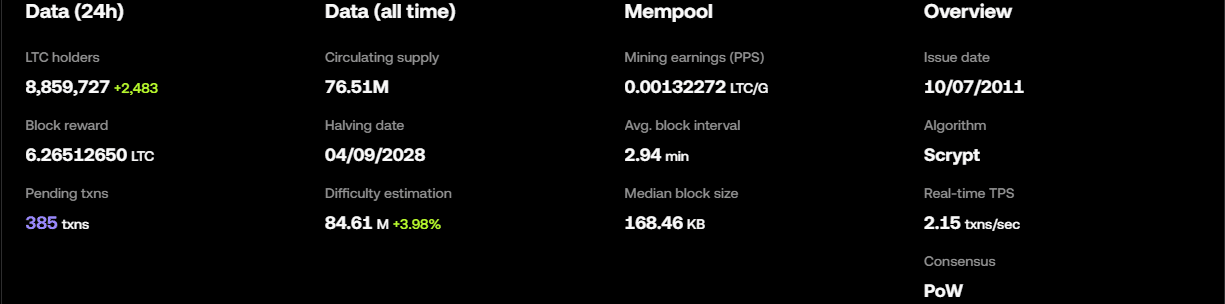
Additionally, the number of LTC holders has grown by 2,483% in 24 hours and stood at 8.86 million as of press time. This reinforces network activity growth.

LitecoinLitecoin
Source: Litecoin Explorer

One factor driving this network’s growth is exposure to traditional institutional capital. For example, Swiss bank BancaStato now allows customers to buy, sell, and hold LTC directly within their normal accounts.

Can LTC price recover?

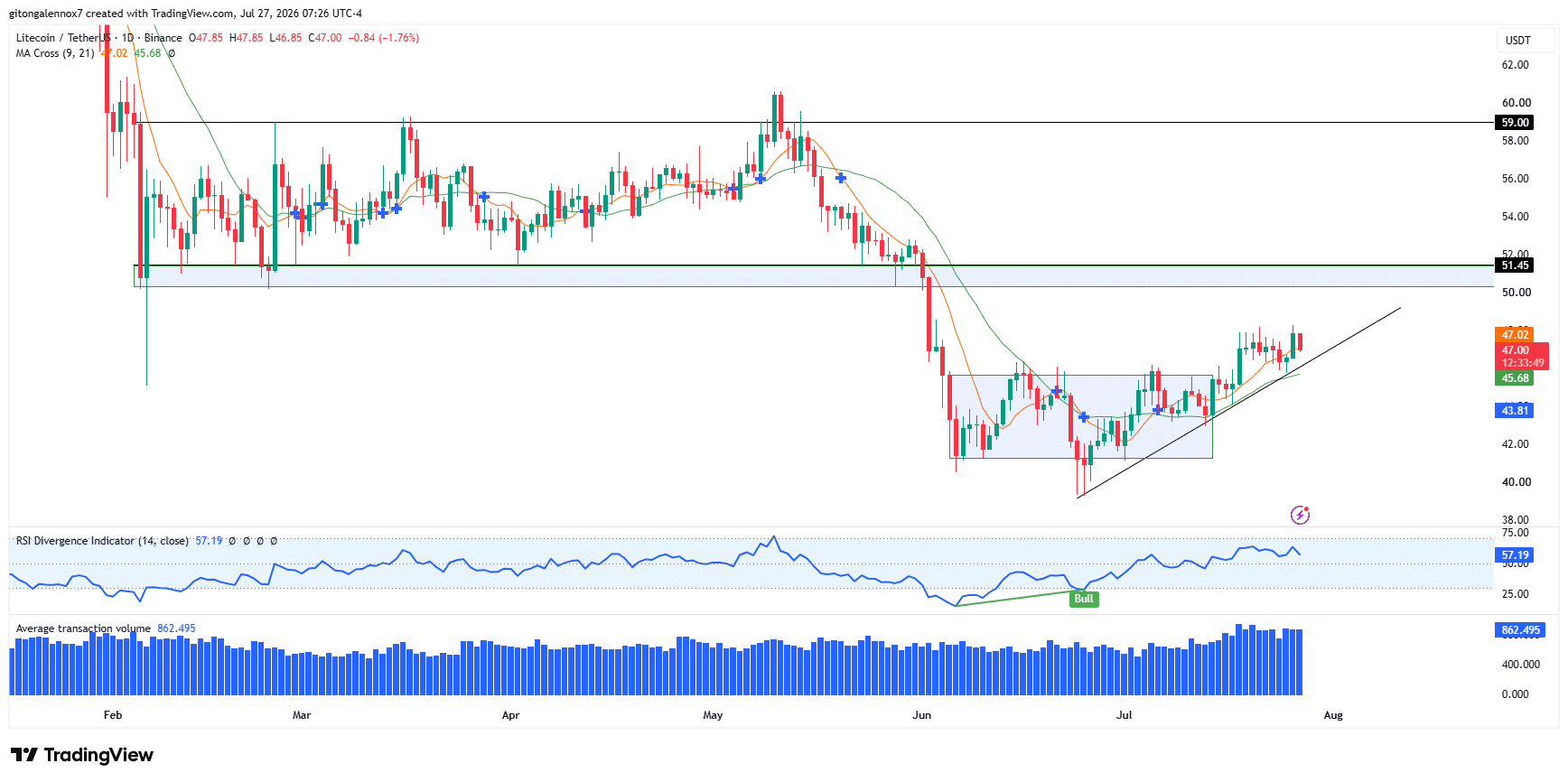
On the charts, Litecoin was attempting a recovery as the price moved above a slanting support after the 9-day SMA crossed above the 21-day SMA.

This followed six weeks of consolidation between $41 and $45, beneath the $50 resistance. However, LTC has now broken out of that consolidation and appears headed toward $50, a former support zone that has turned into resistance.

LitecoinLTCLitecoinLTC
Source: LTC/USDT on TradingView

On the contrary, failure to reclaim $50 as support might extend the bearish market structure.

Moreover, the altcoin is slowing down after retesting the slanting support level. This bearish trend persists despite a commendable average transaction volume of 862.5K LTC per day.


Final Summary

  • Litecoin’s AEV spikes by 3x in just a year, confirming sustained growth in network activity. 
  • LTC’s price is rising and respecting a slanting support, but it faces a key test at the $50 zone. 


Source link

Lido starts historic $16 billion migration to optimize Ethereum performance

0
Lido starts historic $16 billion migration to optimize Ethereum performance

“This is the biggest change to how Lido Core staking works since Lido V2,” said Isidoros Passadis, chief of staking at Lido Labs Foundation. “The node operators securing the majority of ETH staked via Lido are consolidating onto far fewer validators, and for the first time, they’re backing that stake with their own capital, leaving the validator set underpinning Lido Core much leaner and better secured.”

Ecosystem builders had questioned whether enforcing capital bonds would drive away established node operators. Lido confirmed that all 34 of its existing curated operators are expected to transition to CMv2, with none planning to leave because of the bond requirement.

“Rather than replacing the existing reputation-based model, the bonds complement it with real economic accountability,” Will Shannon, head of node operator mechanisms at Lido Labs Foundation, said in an interview with CoinDesk.

He also said the migration will use a separate consensus-layer consolidation queue rather than Ethereum’s deposit and activation queue. Lido estimates that the transition will reduce annual staking rewards across the protocol by about 0.28%. Validators will continue earning rewards until they exit, with any missed rewards limited to the period before their balances reach the new validators.


Source link

SiTime Corporation (SITM) Rose on AI Infrastructure Demand and Margin Expansion

0
SiTime Corporation (SITM) Rose on AI Infrastructure Demand and Margin Expansion


Artisan Partners, an investment management company, released its second-quarter 2026 investor letter for its “Artisan Small Cap Fund”. A copy of the letter can be downloaded here. The fund reported strong absolute returns and modestly outperformed the Russell 2000® Growth Index, which gained 25.7%. Global equities rebounded as resilient US growth, moderating inflation, strong earnings and continued AI investment outweighed delayed rate cuts, rising bond yields and geopolitical uncertainty. Investor Class: ARTSX, Advisor Class: APDSX, and Institutional Class: APHSX returned 26.02%, 26.05%, and 26.11%, respectively, in the second quarter, compared to a 25.71% return for the index. Market leadership favored loss-making, highly leveraged companies, creating a difficult environment for quality-focused active managers. Health care was the strongest relative contributor, while energy, materials, financials and real estate also helped. Technology, industrials and consumer discretionary detracted, partly because the fund did not own oversized index contributors. Software holdings also weakened despite strong fundamentals. The fund remains positive on small-cap opportunities, AI infrastructure and health care, but has reduced software exposure and is staying selective as valuations rise and competitive risks increase.  In addition, please check the Fund’s top five holdings to know its best picks in 2026.

In its second-quarter 2026 investor letter, Artisan Small Cap Fund highlighted SiTime Corporation (NASDAQ:SITM) as a newly added position. SiTime Corporation (NASDAQ:SITM) engages in the design, development, and sale of silicon timing systems solutions. On July 24, 2026, SiTime Corporation (NASDAQ:SITM) closed at $554.46 per share. One-month return of SiTime Corporation (NASDAQ:SITM) was -21.96% and its shares gained 184.69% over the past 52 weeks. SiTime Corporation (NASDAQ:SITM) has a market capitalization of $14.64 billion with a 52-week trading range between $186.49 – $901.81.

Artisan Small Cap Fund stated the following regarding SiTime Corporation (NASDAQ:SITM) in its Q2 2026 investor letter:

“SiTime Corporation (NASDAQ:SITM) develops silicon-based timing solutions used across communications, data center and industrial applications. We believe the company is well positioned to benefit from the ongoing transition from legacy quartz timing solutions to higher performance microelectromechanical systems (MEMS) timing devices, with AI infrastructure supporting sustained growth. Recent results significantly exceeded expectations, driven by accelerating demand for AI infrastructure and higher timing content per system, which fueled strong revenue growth and margin expansion. We continue to see multiple catalysts, including higher speed networking, expanding inference workloads and increasing product content. We added to the position during the quarter as our research strengthened our conviction that timing orchestration will become increasingly important in optimizing AI data center performance, while semiconductor-based timing solutions continue to replace legacy quartz technology.”

SiTime Corporation (NASDAQ:SITM) is not on our list of the 40 Most Popular Stocks Among Hedge Funds. As per our database, 54 hedge fund portfolios held SiTime Corporation (NASDAQ:SITM) at the end of the first quarter which was 41 in the previous quarter. While we acknowledge the potential of SiTime Corporation (NASDAQ:SITM) as an investment, we believe certain AI stocks offer greater upside potential and carry less downside risk. If you’re looking for an extremely undervalued AI stock that also stands to benefit significantly from Trump-era tariffs and the onshoring trend, see our free report on the best short-term AI stock.

In another article, we covered SiTime Corporation (NASDAQ:SITM) and shared a list of best performing semiconductor stocks to invest in. In addition, please check out our hedge fund investor letters Q2 2026 page for more investor letters from hedge funds and other leading investors.

READ NEXT: 33 Stocks That Should Double in 3 Years and 15 Stocks That Will Make You Rich in 10 Years.

Disclosure: None. This article is originally published at Insider Monkey.


Source link

Bitcoin options traders are dropping their hedges going into the Fed meeting

0
Bitcoin options traders are dropping their hedges going into the Fed meeting


Bitcoin’s options market has turned notably less defensive over the past month, unwinding the downside protection traders built up in June just as the Federal Reserve prepares to meet.

The put/call ratio on open interest, which measures how much of the market is positioned in puts, contracts that pay off when the price falls, against calls, which pay off when it rises, has dropped to roughly 0.52 from about 0.76 in late June, according to Glassnode.

Calls are gaining share, the pattern of traders stepping back from hedging rather than adding to it. Recently, large traders have been accumulating $70,000 strike calls and bull call spreads, signaling expectations of upside in the spot price.

The 25-delta skew, the premium traders pay for downside protection relative to equivalent upside exposure, has fallen to around 4% at the one-week tenor while three- and six-month contracts hold at 11% to 12%. That indicates traders are still paying for insurance against something going wrong later this year, but have largely stopped paying for it this week.


Source link

Blackstone credit arm nears deal for HSBC’s Australian loan book – report

0
Blackstone credit arm nears deal for HSBC’s Australian loan book – report


HSBC is expected to sell its Australian loan portfolio, which is worth more than A$30bn, to the Blackstone’s private credit unit, reported Australian Financial Review (AFR).

Sources said the discussions are being handled by the same Blackstone credit team that has provided lending to Firmus, although with a different group of dealmakers.

King & Wood Mallesons is acting for Blackstone. HSBC is being advised by Citi and Allens.

Westpac’s disposal of its RAMS home loan portfolio last year drew interest from KKR, Apollo Global Management and Cerberus. KKR also holds stakes in non-bank lenders Pepper Money and Latitude Financial.

The same names have also featured in the process for HSBC’s portfolio, as previously reported by this column.

Earlier this year, Citi began a new auction for HSBC Australia’s loan book after the bank’s London headquarters opted to narrow the scope of the sale.

Previous efforts to sell the full Australian business, including both loans and deposits, to National Australia Bank or Macquarie did not proceed.

HSBC is carrying out a broad global reorganisation under chief executive Georges Elhedery, who took the role last September.

In Australia, that has led to three significant steps: the retail bank was put up for sale, corporate lending was reduced, and the local management structure was changed by combining the chief executive and head of banking positions.

The bank’s Australian lending operations are now divided into three areas: debt capital markets under Andrew Duncan; structured finance under Visweswara; and leveraged and acquisition finance under Michael Rossiter.

In June, Bloomberg, citing sources, reported that Emirates NBD is in talks to buy HSBC’s operations in Türkiye.

In May this year, OCBC Indonesia signed a deal with PT Bank HSBC Indonesia to assume the assets and liabilities connected to HSBC Indonesia’s retail banking and wealth management operations there, known as International Wealth and Premier Banking (IWPB Indonesia).

HSBC’s Sri Lanka branch signed a binding agreement in September 2025, to transfer its retail banking operations to Nations Trust Bank (NTB).

In July 2025, HSBC disclosed its plan to withdraw from its International Wealth and Premier Banking (Retail Banking) operations in Bangladesh.

“Blackstone credit arm nears deal for HSBC’s Australian loan book – report” was originally created and published by Retail Banker International, a GlobalData owned brand.


Source link

Internet Computer: Traders accumulate 503M ICP as breakout pattern forms – $2.50 next?

0
Internet Computer: Traders accumulate 503M ICP as breakout pattern forms - $2.50 next?


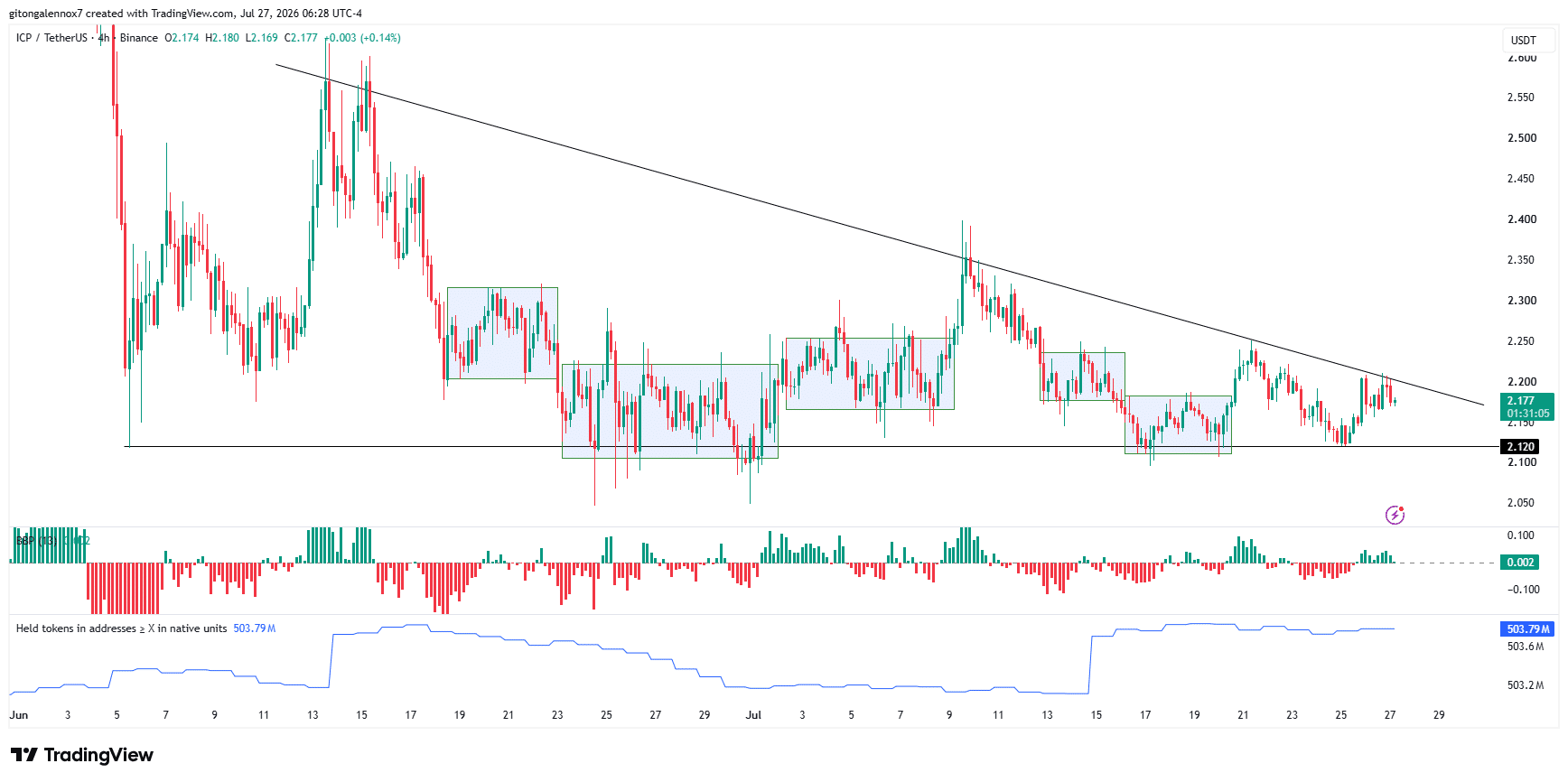
Internet Computer [ICP] has been stagnant since mid-June with the price action trading around $2.17. The 9-day and 26-day moving averages are flat, reinforcing this quiet price action with an insignificant daily change.

Interestingly, the price action of ICP is hinting at a potential breakout that could determine the altcoin’s direction.

ICP crypto nears triangle pattern breakout

Looking at the price of ICP, the altcoin was trading at the apex of a triangle consolidation pattern. The pattern is characterized by a horizontal support at $2.12 and a slanting resistance running from $2.50 to $2.20. It has lasted for about two months.

The price contraction to the apex indicates volatility is low. Usually, low volatility precedes high volatility, which hints at a potential pattern breakout.

For now, ICP is trading in a consolidation. However, breaking and staying above the slanting resistance would expose a rally toward $2.50 or higher.

This was backed by Bull Bear Power (BBP) turning bullish. Additionally, transactions of more than 10K ICP on the Binance spot market have been increasing since the 15th of July.

Collectively, over 503 million ICP tokens had been aggressively accumulated in these two weeks. But from a broader perspective, ICP’s buying activity started in the second half of June.

ICP
Source: ICP/USDT on TradingView

On the other hand, if ICP breaks below the support at $2.12, more price decline may be expected. That is, the next key demand level is at $2, while the extreme bear target is at the $1-$1.16 zone, which was created on the 10th of October.

Why is network activity showing divergence?

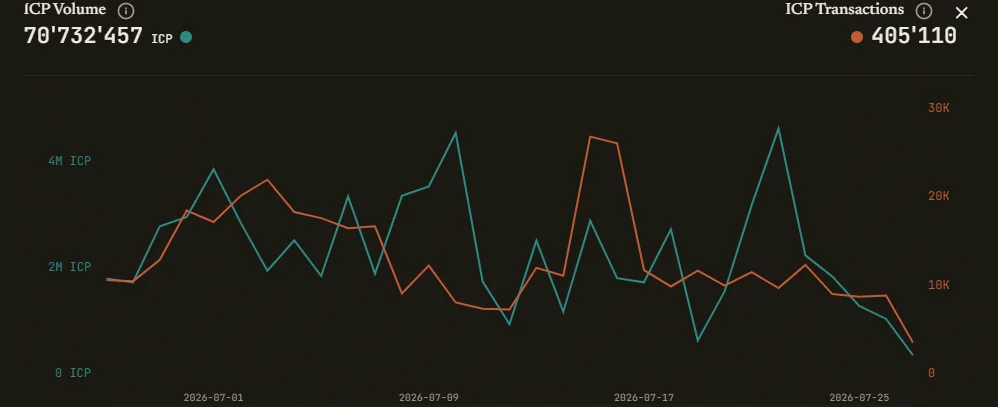
While ICP was bullish on the technical outlook, its chain activity was bearish. For instance, overall transactions fell from 9,612 per day to about 3,680, the lowest level this month. These figures represented about a 62% drop in network usage.

However, ICP topped blockchains by monthly transaction count with 9.40 billion, as Solana [SOL] followed with 8.60 billion.

Similarly, volume was tanking further, creating this month’s low. It tumbled from 2.869 million ICP to 362.7K ICP tokens, further reinforcing the low network activity.

ICPICP
Source: ICP Dashboard

Final Summary

  • Internet Computer was trading at the apex of a consolidation pattern as the accumulation trend gained pace. 
  • ICP’s on-chain activity was diverging from the bullish technical outlook, reinforcing that a potential breakout was looming. 


Source link