Home Blog Page 133

Strategy’s Michael Saylor believes THESE 5 factors are holding Bitcoin back – Details 

0
Strategy's Michael Saylor believes THESE 5 factors are holding Bitcoin back - Details 


Strategy Founder and Executive Chairman Michael Saylor believes Bitcoin is at a key inflection point right now, one that could mark its bottoming phase. 

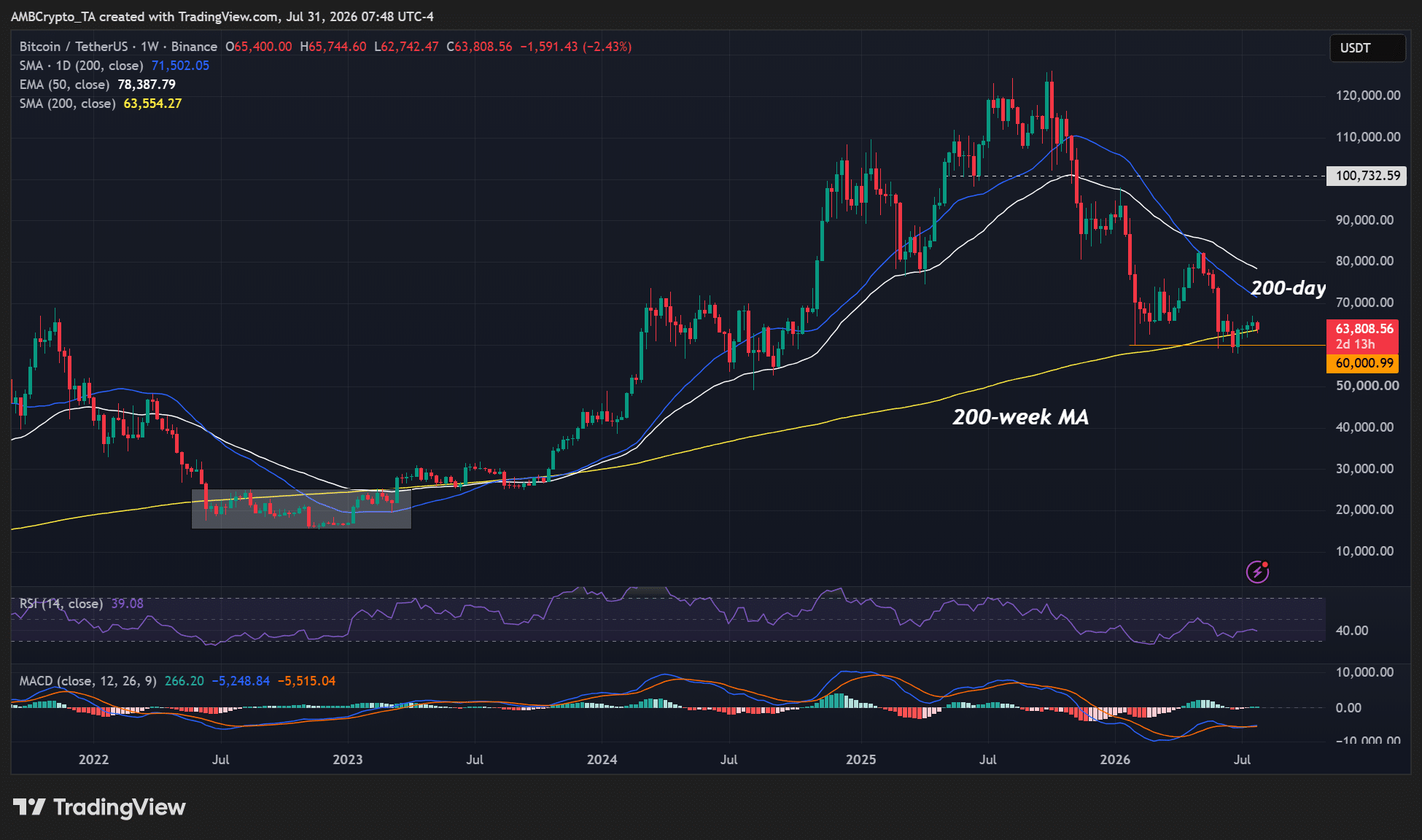
During Strategy’s Q2 earnings call on Thursday, Saylor claimed that BTC had dropped to its 200-week Moving Average (MA). In saying so, he urged investors to take advantage of the signal to add positions. 

He added,

The right price signal to look at is the 200-week MA, and you see it’s a pretty up and to the right message and signal. You can see the periods of exuberance around late 2021; there was a massive premium.

Michael Saylor Bitcoin
Source: BTC/USDT, TradingView 

Indeed, the 200-week MA marked Bitcoin’s bottoming phase in 2022. However, it stayed below the level for a while before recovering above it.

At the time of wrting, several on-chain signals did suggest that the crypto was indeed close to bottoming out. 

What’s derailing Bitcoin’s recovery?

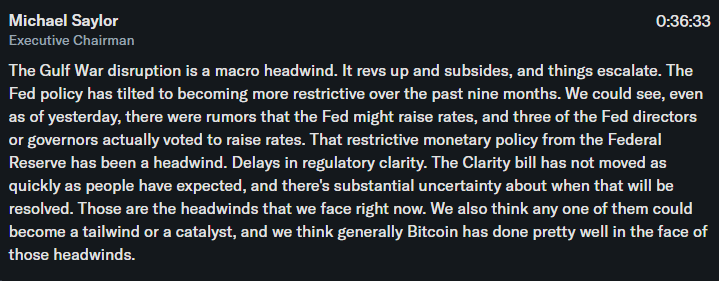
Here, it’s worth pointing out that Saylor added that there are only five key factors still keeping BTC from a strong rebound. According to him, the first headwind is artificial intelligence (AI) capital expansion. Investors opted for AI build-outs, and Bitcoin miners joined the race. 

With capital flowing to AI build-outs, crypto has been left to dry. On when the headwind will be resolved, Saylor noted, 

We think at some point we’ll get through the biggest phase of that build-out, and we’ll settle into an equilibrium, and that headwind will become neutral, a tacking wind, or it’ll subside.

Trade tensions and the ongoing Middle East crisis have been some of the macro headwinds derailing Bitcoin too. 

Finally, the Fed rate policy and CLARITY Act delay have also blocked the crypto from seeing sustainable relief. 

Michael Saylor BitcoinMichael Saylor Bitcoin
Source: Yahoo (Strategy earnings call) 

The exec added that these headwinds could also become tailwinds if they improve. 

As we get good news in any of those areas, I think that’ll be very positive for the entire Bitcoin market.

Now, the impact of the last two factors could be felt soon. Notably, the CLARITY Act has until next week to make any meaningful progress this year. As far as the Fed rate policy is concerned, another hike is expected in September. However, some traders have already shrugged off its potential bearish impact. 

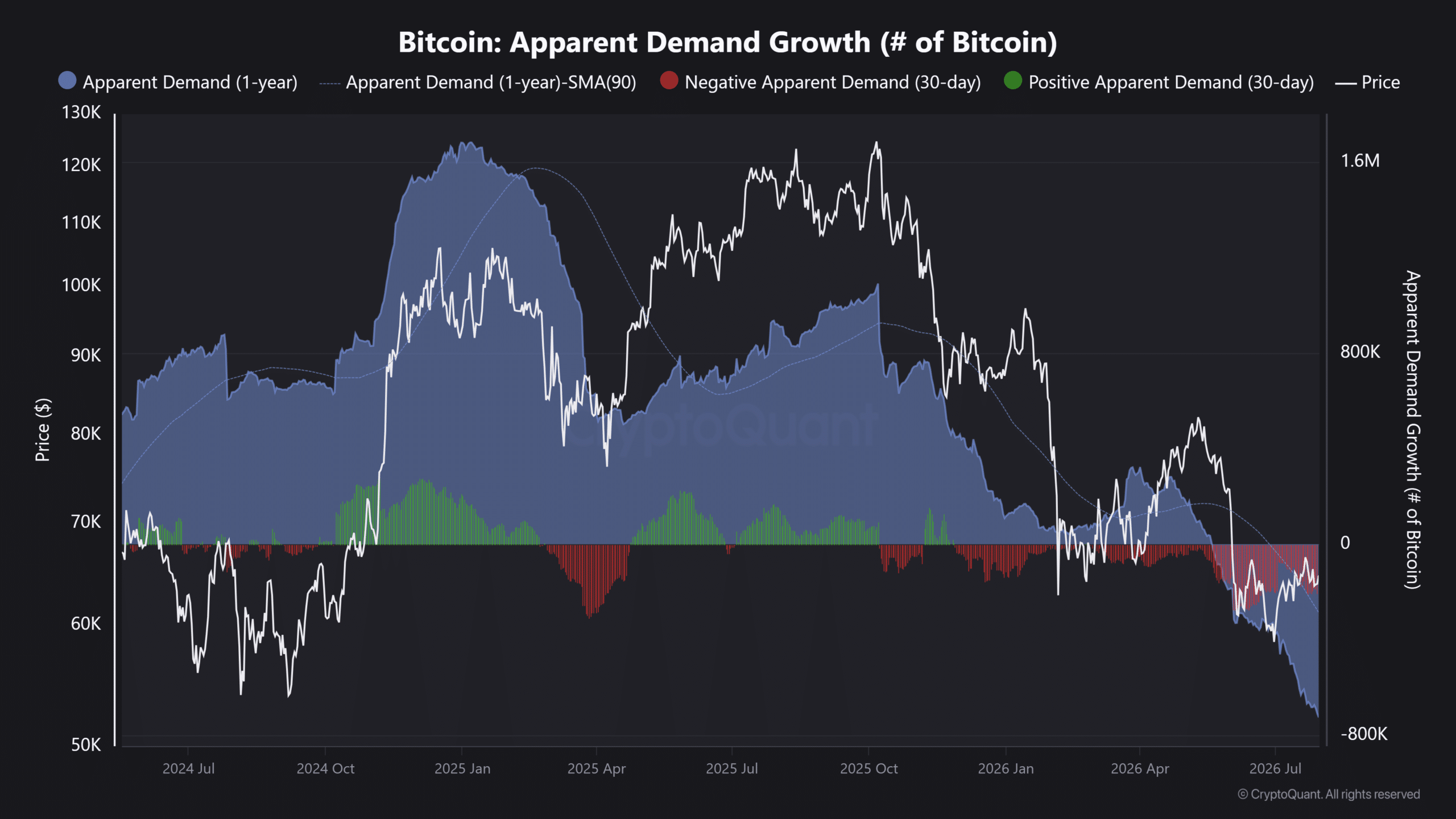
In the meantime, BTC’s overall demand improved slightly in H2 2026, but it was still negative. At the time of writing, Bitcoin was valued at $63.7K with a likely sideways structure until September’s Fed rate decision. 

Michael Saylor BitcoinMichael Saylor Bitcoin
Source: CryptoQuant

Final Summary

  • Saylor called Bitcoin’s 200-week moving average a key price signal that could allude to price recovery.
  • He believes that AI rotation, Fed rate policy, CLARITY Act, the Middle East, and trade tensions could determine when crypto winter ends. 


Source link

The $70 million Coldcard exploit prompts CZ to urge wallet diversification.

0
The $70 million Coldcard exploit prompts CZ to urge wallet diversification.

Crypto holders used to focus on diversifying their coins. Now, following a $70 million Coldcard exploit, they’re being told to diversify their wallets as well.

On Saturday, Binance founder Changpeng Zhao, known as CZ, asked crypto holders to split their funds across multiple wallets following a major security failure in popular Coldcard hardware devices.

“Even hardware wallets can have bugs. Even old wallets (with long history) can have bugs. How to mitigate? Split your funds in a few wallets maybe? This has a different set of risks. Nothing is 100%. Stay informed. Stay SAFU!,” he said.

On July 30, some bitcoin users discovered that funds from their Coldcard wallets had been stolen in a series of unexpected transactions. The attacker exploited a firmware flaw dating to March 2021 that weakened the randomness used to generate recovery seeds on certain Coldcard models. By reconstructing private keys offline, the attacker was able to drain funds without ever physically accessing the devices.

Initial reports said about 594 BTC, worth $38 million at the time, were drained from around 500 wallet in a 25-minute window. Subsequent analysis by Galaxy Research expanded the scope to 1,082.65 bitcoin, valued at approximately $70 million, drained from 1,196 addresses over about 41 minutes. Many of the affected wallets had sat dormant for years.

Coldcard maker Coinkite has acknowledged the bug, apologized, and released emergency firmware updates. The company has advised users who generated seeds on affected versions to create entirely new seeds on patched devices and carefully migrate funds, noting that simply updating firmware does not secure an already-created vulnerable seed.

The episode has renewed debate over the limits of self-custody. Hardware wallets are widely viewed as one of the strongest options for securing bitcoin offline, yet the Coldcard case shows that even long-established devices can harbor critical flaws that remain undetected for years.

CZ’s suggestion of diversification acknowledges that spreading risk comes with its own practical challenges, including more complex key management.


Source link

New York sues Kalshi, says prediction markets constitute illegal gambling

0
New York sues Kalshi, says prediction markets constitute illegal gambling


By Jonathan Stempel

NEW YORK, July 31 (Reuters) – New York’s attorney general sued Kalshi on Friday, claiming that its prediction markets platform violates state laws against illegal gambling.

In a ‌petition filed in a state court in Manhattan, Attorney General Letitia James said Kalshi ‌failed to obtain a New York State Gaming Commission license to operate its platform, where people trade based on the predicted ​outcomes of events such as sports and elections.

The attorney general said such platforms can encourage problem gambling, including by people under age 21. She filed similar petitions in April against two other prediction market operators, Coinbase Financial Markets and Gemini Titan.

“New York’s gambling laws protect children from underage betting and help ‌combat gambling addiction,” James said in ⁠a statement. “No matter what they call themselves, prediction markets like Kalshi are gambling platforms, plain and simple.”

Prediction markets such as Kalshi and Polymarket have soared in ⁠popularity since the 2024 U.S. presidential election, when they fared better than pollsters in predicting Republican Donald Trump’s victory over Democrat Kamala Harris.

Their growth has sparked a flurry of lawsuits and countersuits over the authority of ​individual ​U.S. states, rather than the federal government, to regulate ​the industry.

The U.S. Commodity Futures Trading Commission ‌has claimed exclusive oversight, and challenged regulatory activity in at least nine states.

FEDERAL JUDGE REJECTED PREEMPTIVE KALSHI LAWSUIT

James said Kalshi’s prediction markets are gambling because bettors don’t control the outcomes of events.

She also objected to Kalshi letting 18- to 20-year-olds use its platform, despite a minimum age of 21 under state law for mobile sports betting.

James sued two days after the federal appeals court in Manhattan ‌rejected Kalshi’s request to avoid being subjected to New York’s ​gambling laws, while it appeals a judge’s refusal on ​July 8 to grant a preliminary injunction ​against the state.

Kalshi had preemptively sued New York last October to block enforcement.

U.S. ‌District Judge Analisa Torres, however, found that ​the state’s interests in preventing ​gambling addiction, preserving the integrity of sports, and avoiding a proliferation of unregulated contracts “heavily” outweighed Kalshi’s interests in ensuring the primacy of federal law and avoiding “intractable” technology issues for customers.

At ​least four states — Massachusetts, Michigan, Nevada ‌and Washington — have won court orders restricting Kalshi’s activities.

New York’s lawsuit against Kalshi seeks ​the forfeiture of illegal gains, civil fines equal to triple those gains, and restitution ​to customers.

(Reporting by Jonathan Stempel in New York)


Source link

Ripple news: XRP Ledger upgrade brings back features once pulled over critical bugs

0
Ripple news: XRP Ledger upgrade brings back features once pulled over critical bugs


Validators (entities that supply their resources to run and maintain a network) were advised to reject it, and an emergency server release marked it unsupported to prevent activation. No funds were lost, because it never reached the main network.

Permission Delegation, which lets an institution grant another account narrowly scoped authority without handing over full signing power, was disclosed as vulnerable in September 2025 and disabled.

The bug allowed one account to charge transaction fees to another and potentially drain its balance. The ledger’s documentation has listed both amendments as obsolete since, to be replaced by revised versions.

The other three are new. Confidential MPT combines zero-knowledge proofs, which let someone prove a statement is true without revealing the underlying data, with elliptic-curve encryption, so that balances and transfer amounts on Multi-Purpose

Tokens stay private while auditors or regulators can still verify them when required.

Sponsored Fees and Reserves lets a bank or platform cover another account’s XRP fees and reserve requirement, removing the need for every user to acquire XRP before transacting.

Lastly, Dynamic MPT lets an issuer specify at creation which token properties can be changed later, avoiding a full migration to a new token when fees or metadata need updating.


Source link

Bitcoin and ethereum prices today, Friday, July 31, 2026: Crypto prices back off this morning

0
Bitcoin and ethereum prices today, Friday, July 3, 2026: 'Green' July off to a solid start


Bitcoin (BTC-USD) opened at $64,724.03 on Friday, July 31, 2026, 1.3% higher than Thursday’s opening price. As of 8:52 a.m. ET this morning, the price of bitcoin moved down to $63,652.09.

Ethereum (ETH-USD) opened at $1,917.16 on Friday, July 31, 2026, up 0.4% from Thursday’s opening price. The price of ethereum moved lower this morning to $1,877.52 as of 8:52 a.m. ET.

Bitcoin and ethereum trended down after a strong opening this morning following a pause in U.S. airstrikes in Iran overnight.

While opening bitcoin prices slowly gained momentum all week, including following the Wednesday Fed meeting where rates were left unchanged, the prices of both bitcoin and ethereum are backing off this morning as cryptocurrencies struggle to maintain any solid footing.

It’s unclear if the pause in U.S. airstrikes overnight will sustain over the weekend, but analysts still seem to be pricing in an interest rate hike at some point this year as the Strait of Hormuz remains closed and energy costs elevated.

The price of bitcoin this morning was 1.3% higher than Thursday’s opening price. Here’s a look at how the opening bitcoin price has changed versus last week, month, and year:

  • One week ago: -0.5%

  • One month ago: +7.6%

  • One year ago: -45.1%

The all-time high for bitcoin was $126,198.07 on Oct. 6, 2025. The all-time low value for bitcoin was $0.04865 on July 14, 2010. 

The price of ethereum this morning was 0.4% higher than Thursday’s open. Here’s a look at how the opening ethereum price has changed versus last week, month, and year:

  • One week ago: +2.1%

  • One month ago: +19.1%

  • One year ago: -49.7%

The all-time high for ethereum was $4,953.73 on Aug. 24, 2025. The all-time low value for ethereum was $0.4209 on Oct. 21, 2015. 

Bitcoin, ethereum, and other cryptocurrencies are rapidly evolving. Follow the latest developments from Yahoo Finance and others here.

So, you put a little mad money into bitcoin a few years ago. Now, your crypto-fueled profit means you have a sweet nest egg to put toward a house.

But can you buy a house with crypto rather than using cash or a traditional mortgage loan? What are the roadblocks? And what about taxes?

President Trump wants the United States to be “the crypto capital of the world.” In that spirit, in late June, Director of the Federal Housing Finance Agency (FHFA) William J. Pulte ordered Fannie Mae and Freddie Mac to “prepare their businesses to count cryptocurrency as an asset for a mortgage.”

The FHFA supervises Fannie Mae and Freddie Mac, the government-sponsored companies that fund a major portion of the mortgage industry.

Pulte said the housing system “needs a massive upgrade,” adding, “I want people who own cryptocurrency to be able to buy homes like everyone else. I believe cryptocurrency is an asset. I believe Americans should be able to use their crypto if they want to. It’s time the housing system caught up.”

This signals what could be a fundamental change to how cryptocurrency may be used to qualify for a mortgage.

Learn more: Want to buy a house with crypto? Here’s what to expect

Whether you’re brand new to tracking the value of bitcoin and ethereum or a more seasoned crypto investor, Yahoo Finance’s price-of-bitcoin chart and price-of-ethereum chart below show a visual history of how the currencies’ value continues to move and evolve.

More information on crypto from the Yahoo Finance team: 


Source link

I Lost a Client I Should Never Have Lost — and It Rewired How I Run My Firm

0
I Lost a Client I Should Never Have Lost — and It Rewired How I Run My Firm


Opinions expressed by Entrepreneur contributors are their own.

Key Takeaways

  • Before we went remote, the office was running a relationship-maintenance operation none of us noticed — and when it collapsed, we didn’t realize it until our clients started feeling like strangers.
  • I stopped pretending remote work is neutral: it has real costs that fall unevenly on client-facing firms, and until you name that honestly, you can’t actually fix it.

Running a small accounting firm in 2025 means answering a question nobody has fully solved: how do you build a business clients trust deeply when half your team is working from a spare bedroom two states away?

I have spent four years wrestling with it. The honest answer is that I got it wrong before I got it right. What I learned did not come from a management book or a productivity framework. It came from losing a client I should never have lost, in a way that had nothing to do with the quality of our work.

That experience changed how I run everything.

How I lost a client of seven years to a birthday

Not a missed deadline. Not a calculation error. A birthday. One of my remote staff members mentioned in passing that a long-term client had a milestone coming up. I nodded, said “great,” and did absolutely nothing with that information. Three weeks later, that client called, annoyed about something unrelated, and signed with another firm before the month was out. When I dug into it, the birthday was just the final straw. We had quietly become a transaction to them. They sent documents, we sent returns and somewhere along the way we stopped being people they actually knew.

That was the moment I understood what remote work actually costs an accounting firm, and it has nothing to do with productivity.

Every article you read about managing remote teams talks about communication tools, meeting cadence and tracking output. All of that matters. But none of it addresses the specific thing accounting firms sell: trust. Not software. Not efficiency. The feeling a client gets when they believe their accountant genuinely knows them and is watching out for them. That feeling is extraordinarily hard to manufacture through a screen, and most firms are not even trying.

What the office was actually doing for us

Before we went hybrid, the office was running a relationship-maintenance operation that none of us noticed or appreciated. A client would call the front desk and mention something offhand. The receptionist would relay it to the file owner. Someone would follow up. It wasn’t a system. It was proximity and human instinct doing the work automatically.

Remotely, that entire invisible operation collapsed overnight. Nobody was overhearing anything. Nobody was walking past anyone’s desk. The phone calls still came in, but they landed in a vacuum. Information stopped traveling sideways across the team the way it used to, and we didn’t notice until clients started feeling like strangers.

The fix was not what I expected

My instinct was to add more check-ins. More internal meetings. More structured communication. What I actually needed to do was much simpler and much harder. I needed every person on my team to take personal ownership of the relationships inside their files, not just the work inside them.

That sounds obvious. In practice, it means the accountant handling a business return knows that the owner’s daughter just joined the company, knows the lease renewal is coming up in spring and picks up the phone once in a while for no reason other than to check in. It means treating client files less like tasks and more like ongoing relationships that require actual attention.

We now build what I call a relationship note directly into every active file. Not tax notes. Not billing notes. Personal context — what is going on in this client’s life right now that we should know about. It takes two minutes to update, and it has changed the quality of our client conversations more than any software we have ever purchased.

The staff problem nobody wants to admit

Remote work exposed something uncomfortable about our industry. A certain type of accountant, perfectly competent technically, has no interest in the human side of the work. In an office, that person still participates in the culture whether they want to or not. They overhear conversations, they get pulled into hallway discussions, they absorb the relationship norms of the firm just by being present.

Remotely, that same person retreats completely into the technical work and becomes, from the client’s perspective, someone who processes their documents and occasionally sends a PDF. Clients sense this quickly even if they never say it directly. It shows up in the tone of emails, in the length of calls, in how often they reach out with questions — and how often they quietly start wondering if there is someone better out there.

I am not saying those staff members are bad at their jobs. I am saying that remote work removes the guardrails that used to compensate for the gaps, and as a managing partner you have to consciously rebuild them.

What I actually changed

I stopped measuring my team only by what they completed and started paying attention to how their clients talked about them. Not formal surveys. Just listening. When a client calls the front desk, what is the tone? When someone refers us to a friend, what do they say about us specifically?

I also made phone calls a non-negotiable part of the job. Not video calls, not Slack messages — actual phone calls with clients at regular intervals that have nothing to do with a deadline. Some of my staff resisted this. A few still do. But the clients who get those calls are the ones who have stayed with us through fee increases, staff changes and every other reason someone might think about switching firms.

The last thing I changed was the hardest. I stopped pretending that remote work is neutral. It isn’t. It has real costs, and they fall unevenly on client-facing professional services firms in ways a tech company or a marketing agency will never feel. Acknowledging that inside the firm made it possible to actually address it, instead of just adding another tool to the stack and hoping for the best.

That client we lost over a birthday is with a competitor now. I think about it more than I should. But it is the reason we run the firm the way we do today — and I would rather have learned it then than be learning it now.


Key Takeaways

  • Before we went remote, the office was running a relationship-maintenance operation none of us noticed — and when it collapsed, we didn’t realize it until our clients started feeling like strangers.
  • I stopped pretending remote work is neutral: it has real costs that fall unevenly on client-facing firms, and until you name that honestly, you can’t actually fix it.

Running a small accounting firm in 2025 means answering a question nobody has fully solved: how do you build a business clients trust deeply when half your team is working from a spare bedroom two states away?

I have spent four years wrestling with it. The honest answer is that I got it wrong before I got it right. What I learned did not come from a management book or a productivity framework. It came from losing a client I should never have lost, in a way that had nothing to do with the quality of our work.

That experience changed how I run everything.


Source link

How Ethereum finished July 2026 with 20.3% gains and THIS major hurdle

0
How Ethereum finished July 2026 with 20.3% gains and THIS major hurdle


Ethereum [ETH] had a strong July, recovering much of the ground it lost in June. Now, will ETH break above $2,000, or move sideways in the days ahead?

ETH jumped back up in July

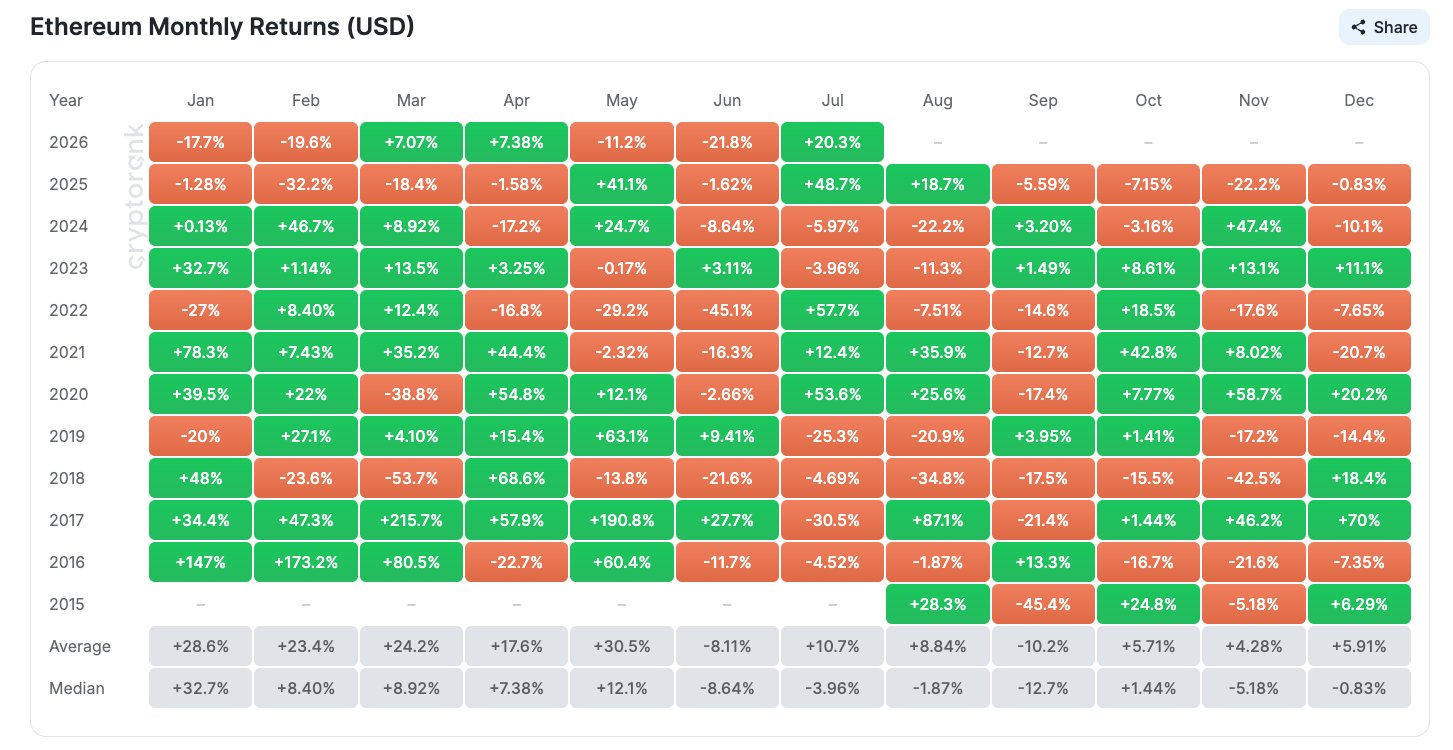
Ethereum ended July with gains of 20.3% — Its strongest monthly performance over the past year. The rebound helped ETH recover a large part of June’s 21.8% fall, and brought some confidence back to the market after a difficult H1 2026.

ethereumethereum
Source: CryptoRank

Now, what’s peculiar is how against the historic tide these gains have been. So far, ETH has delivered an average July return of 10.7%, while the median return for the month is negative. This means July 2026 performed far better than a typical July.

Still, the recovery did not completely erase June’s losses. ETH is still entering August below recent highs.

Spot ETF demand supported ETH’s July rebound


Source link