JEPQ’s Nasdaq-100 volatility fuels a 7% yield and 17% one-year gain, roughly doubling JEPI’s 8% return for income investors accepting AI concentration risk.
At 4.69%, the 10-year Treasury pressures income ETFs, but JEPI’s low-beta S&P 500 sleeve could outperform SPY if mega-cap tech leadership rotates.
Don’t wait: the analyst who called NVIDIA in 2010 just revealed his top 10 AI stocks. See the full list FREE now.
Income investors comparing JPMorgan Equity Premium Income ETF (NYSEARCA:JEPI) and JPMorgan Nasdaq Equity Premium Income ETF (NASDAQ:JEPQ) are looking at the two largest actively managed ETFs in the country. Both use the same JPMorgan playbook: hold a defensive equity sleeve, generate extra cash through equity-linked notes that mimic an out-of-the-money covered call, and pay it out monthly. The mechanics rhyme, but the underlying exposure differs.
bigjom jom / Shutterstock.com
One fund leans on the S&P 500 with a low-volatility tilt. The other rides a Nasdaq-100 sleeve where implied volatility is structurally higher, feeding fatter option premiums into the monthly distribution. That single design difference is what makes the JEPI versus JEPQ debate meaningful for the back half of 2026.
The Rate and Volatility Backdrop for H2 2026
The Federal Reserve has held the upper bound of the fed funds rate at 3.75% since December 11, 2025, a 7-month pause after cuts from 4.5% last summer. The 10-year Treasury yield has drifted the other direction, reaching 4.69% in late July, roughly 28 basis points above the prior month and near the top of its 12-month range.
For covered-call income strategies, that mix matters. Higher long-end yields raise the bar for competing cash instruments set for equity income. Stable short rates keep option premium math predictable. With Vanguard flagging that U.S. tech stocks “could well maintain their momentum given the rate of investment and anticipated earnings growth” in 2026, the volatility surface on the Nasdaq-100 remains the richer hunting ground for premium.
Don’t wait: the analyst who called NVIDIA in 2010 just revealed his top 10 AI stocks. See the full list FREE now.
JEPI: The Defensive S&P 500 Income Sleeve
An actively selected slice of the S&P 500 chosen for lower beta and quality characteristics is what JEPI runs, and then it layers ELNs that write out-of-the-money calls on the index. The result is a fund built to compress drawdowns while pulling monthly cash from option premium.
The top of the portfolio reflects that philosophy. As of May 31, 2026, the largest position is Broadcom at 1.8%, followed by Ross Stores, Amazon, Apple, and Howmet Aerospace, each near 1.7%. Alphabet, NVIDIA, Eaton, AbbVie, and EOG Resources round out the top ten, each at 1.5% to 1.6%. No holding breaches 2%, and the sector mix spans technology, consumer, industrials, healthcare, and energy.
Distributions have been steady. The July 2026 payout was $0.38716, and 2026 monthly amounts have ranged from $0.34443 to $0.44761. That is moderation from the 2025 peaks (JEPI paid $0.54001 in June 2025), consistent with a calmer S&P 500 volatility regime.
Shares are around $58, with a year-to-date total return of roughly 3.9% in price terms and a one-year gain near 7.9%. Add the distribution stream, and JEPI delivers dampened equity beta with a paycheck. The tradeoff is capped upside during strong rallies and ELN distributions taxed as ordinary income rather than qualified dividends. The expense ratio sits at 0.35%.
JEPQ: Tech Volatility Turned Into Monthly Cash
The same recipe applied to the Nasdaq-100 is what JEPQ delivers. Because implied volatility on NDX runs meaningfully hotter than on the S&P 500, the ELN sleeve harvests larger premiums. The July 2026 payout was $0.63658 per share, and 2026 monthly amounts have ranged from $0.46572 to $0.63658, running noticeably ahead of the fund’s 2024 range of $0.34167 to $0.55686. The trailing yield sits at 7.1%.
The equity sleeve diverges most sharply from JEPI. It concentrates in Nasdaq-100 mega caps, with the top 10 holdings representing about 42% of assets, including NVIDIA near 7%, Apple near 7%, and Micron near 5%. That is a portfolio with real single-name risk and a heavy tilt toward the AI capex cycle, tempered by a reported beta of 0.85 versus the broader market.
Shares are near $58, with a year-to-date price gain of about 5.1% and a one-year advance of roughly 16.8%. The last month has been softer, down about 1.8% as long yields backed up.
The expense ratio matches JEPI at 0.35%. What differs is the risk profile: heavier concentration in a handful of AI-linked names, and a distribution stream that will compress quickly if Nasdaq-100 realized volatility collapses. PineBridge frames the setup as one where “AI remains the dominant growth engine, driving heavy investment in datacenter infrastructure and cloud platforms”, which supports the underlying holdings but also raises drawdown risk if that narrative wobbles.
Head to Head: Which Fits H2 2026
The trailing scoreboard favors JEPQ. Over the last year, its total price return of roughly 17% more than doubled JEPI’s near 8%, and JEPQ’s monthly distributions have run larger in dollar terms throughout 2026. The Nasdaq-100 sleeve is doing the heavy lifting, fed by structurally higher tech volatility.
The forward setup is more nuanced. The 4.69% 10-year yield gives Treasury bills and short-duration credit a stronger claim on income allocations. Franklin Templeton’s outlook also warns that “broadening opportunities across global capital markets” and a preference for U.S. small caps and non-U.S. equities could mean mega-cap tech gives back some leadership.
The Decision Framework
The investor whose priority is the largest reliable monthly check and who accepts concentrated exposure to AI-linked mega caps will find JEPQ a strong fit. The 7.1% yield, richer option premiums, and stronger recent total return align with that mandate. Heading into the rest of 2026, the tech volatility that funds those distributions shows no sign of normalizing.
Over on the other side, someone who wants a smoother ride, broader sector representation, and a fund that behaves like a low-beta S&P 500 substitute with income attached should look at JEPI instead. The 1.8% top-position cap, diversified sector mix, and defensive stock selection matter if 2026 leadership rotates the way Vanguard, Franklin Templeton, and Goldman Sachs suggest it could.
For the rest of 2026, JEPQ offers the larger income stream for those willing to underwrite the Nasdaq-100 as their equity engine. JEPI offers the lower-volatility profile for those who are not.
Don’t wait: the analyst who called NVIDIA in 2010 just revealed his top 10 AI stocks. See the full list FREE now.
The obvious objection is that this is leveraged speculation in new language, and that traditional markets keep their frictions for good reasons. Both points have force. A funding rate is not a substitute for the price discovery that settlement enforces, and continuous leverage on volatile assets concentrates risk in ways periodic markets do not. But those are arguments for building the structure carefully, not for assuming it will not be built. The demand is already here, and it moves toward the venue that offers universal access to global assets, whether stocks, crypto or FX.
There is one place crypto’s progress this cycle has not yet reached. Over the past year, tokens acquired real economic rights, revenue shares, buybacks and votes, while projects with nothing behind them were delisted and some of the strongest teams chose IPOs over token launches. Even the IPO no longer sits outside this system: SpaceX’s shares changed hands as synthetic pre-IPO perpetuals on Hyperliquid for weeks before its June 2026 listing, trading tens of millions of dollars a day in May and swelling to roughly $1.3 billion on debut day as investors shut out of the traditional allocation turned to crypto rails. The market structure beneath perps has not fully followed. The next stage is to build that alignment in, with the transparency now expected across the rest of crypto. That consolidation is happening on centralized venues as much as onchain: the largest exchanges now run multi-asset books where equities, crypto and FX clear side by side, and a single centralized platform accounted for more than half of all real-world-asset perp volume in May 2026. The pull is structural rather than speculative, with 52% of Bitget’s users already holding both stocks and crypto.
Find out how much you could earn by locking in a high CD rate today. The Federal Reserve cut its federal funds rate three times in 2025. So far in 2026, the Fed has left interest rates alone, and so now could be your last chance to lock in a competitive CD rate before rates move further. CD rates vary widely across financial institutions, so it’s important to ensure you’re getting the best rate possible when shopping around for a CD.
The following is a breakdown of CD rates today and where to find the best offers.
CD rates today, Saturday, August 1, 2026
Generally, the best CD rates today are offered on shorter terms of around one year or less. Online banks and credit unions, in particular, offer the top CD rates.
Today, Saturday, August 1, 2026, the highest CD rate is 4.15%. This rate is offered by Synchrony Bank on its 14-month CD.
Here is a look at some of the best CD rates available today:
How much interest can I earn with a CD?
The amount of interest you can earn from a CD depends on the annual percentage rate (APY). This is a measure of your total earnings after one year, taking into account the base interest rate and how often interest compounds (CD interest typically compounds daily or monthly).
Say you invest $1,000 in a one-year CD with 1.52% APY, and interest compounds monthly. At the end of that year, your balance would grow to $1,015.20 — your initial $1,000 deposit, plus $15.20 in interest.
Now let’s say you choose a one-year CD that offers 4% APY instead. In this case, your balance would grow to $1,040.74 over the same period, which includes $40.74 in interest.
The more you deposit in a CD, the more you stand to earn. If we used the same example of a one-year CD at 4% APY but deposited $10,000, your total balance when the CD matures would be $10,407.42, meaning you’d earn $407.42 in interest.
When choosing a CD, the interest rate is usually top of mind. However, the rate isn’t the only factor you should consider. There are several types of CDs that offer different benefits, though you may need to accept a slightly lower interest rate in exchange for more flexibility. Here’s a look at some of the common types of CDs you can consider beyond traditional CDs:
Bump-up CD: This type of CD allows you to request a higher interest rate if your bank’s rates go up during the account’s term. However, you’re usually allowed to “bump up” your rate just once.
No-penalty CD: Also known as a liquid CD, this type of CD allows you to withdraw funds before maturity without penalty.
Jumbo CD: These CDs require a higher minimum deposit (usually $100,000 or more), and often offer a higher interest rate in return. In today’s CD rate environment, however, the difference between traditional and jumbo CD rates may not be much.
Brokered CD: As the name suggests, these CDs are purchased through a brokerage rather than directly from a bank. Brokered CDs can sometimes offer higher rates or more flexible terms, but they also carry more risk and might not be FDIC-insured.
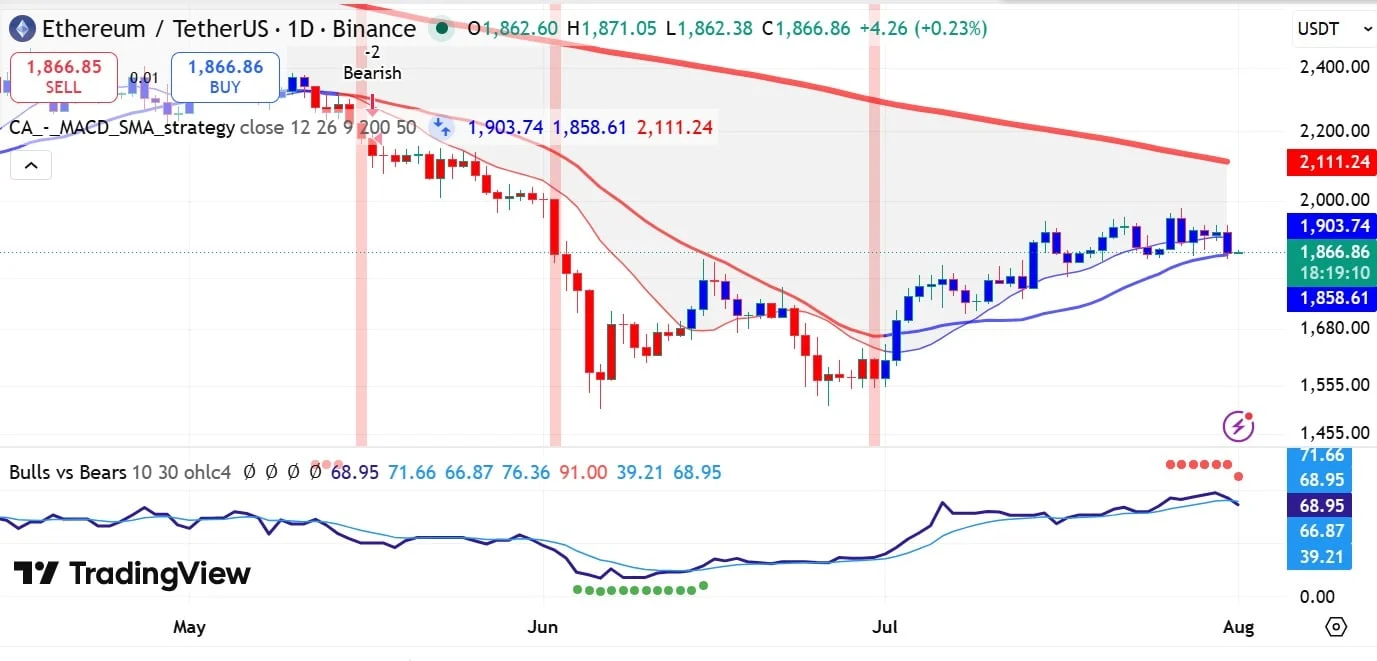
Ethereum faced renewed downside volatility after failing to hold the $1.9K support level.
The altcoin subsequently fell to $1,848, a level last seen two weeks ago. At press time, ETH traded near $1,865, down 1.9% daily.
Although Ethereum’s upside momentum remained weak, institutional activity suggested that some large investors were still optimistic.
Why did Fidelity move $499M in ETH?
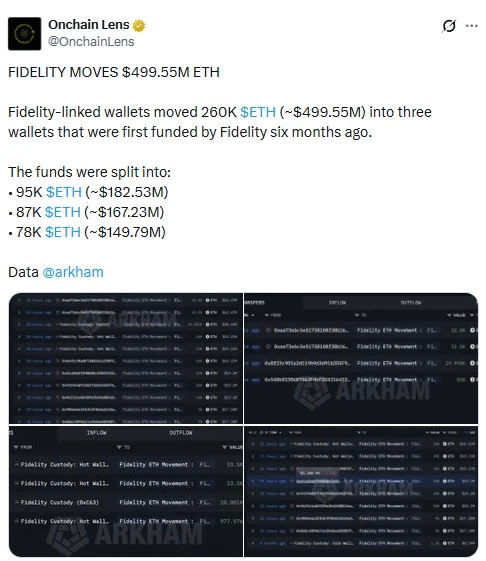
According to Onchain Lens, Fidelity-linked wallets moved 260,000 ETH, worth $499.55 million, into three wallets. These receiving wallets were funded six months ago.
Source: X
However, the transfers did not indicate an intention to sell. Instead, the movement suggested internal custody rebalancing.
Such transfers often attract market attention but generally have a neutral effect on prices.
Is Bitmine still buying Ethereum?
While Ethereum remained in a prolonged downtrend, several treasury companies halted accumulation or reduced their holdings.
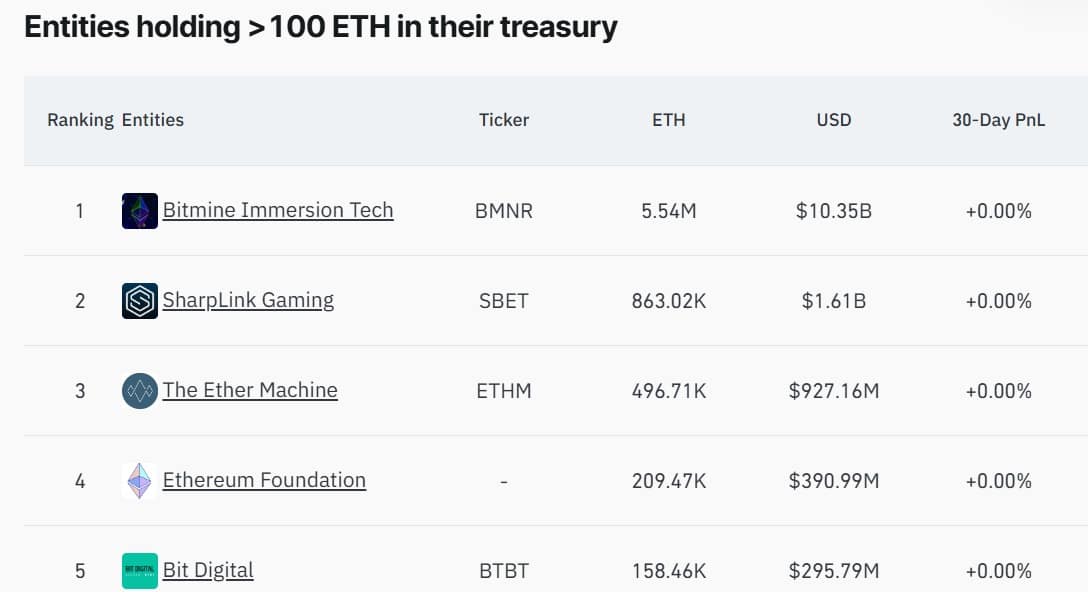
For example, SharpLink Gaming, the second-largest corporate holder, had not purchased ETH since October 2025.
The company reduced its exposure as unrealized losses exceeded $1.4 billion. By contrast, Bitmine continued accumulating.
According to Onchain Lens, a Bitmine-linked wallet purchased 10,460 ETH, worth $19.48 million, through Falcon. The entity subsequently held 5.5 million ETH, valued at approximately $10.3 billion.
Source: CoinGlass
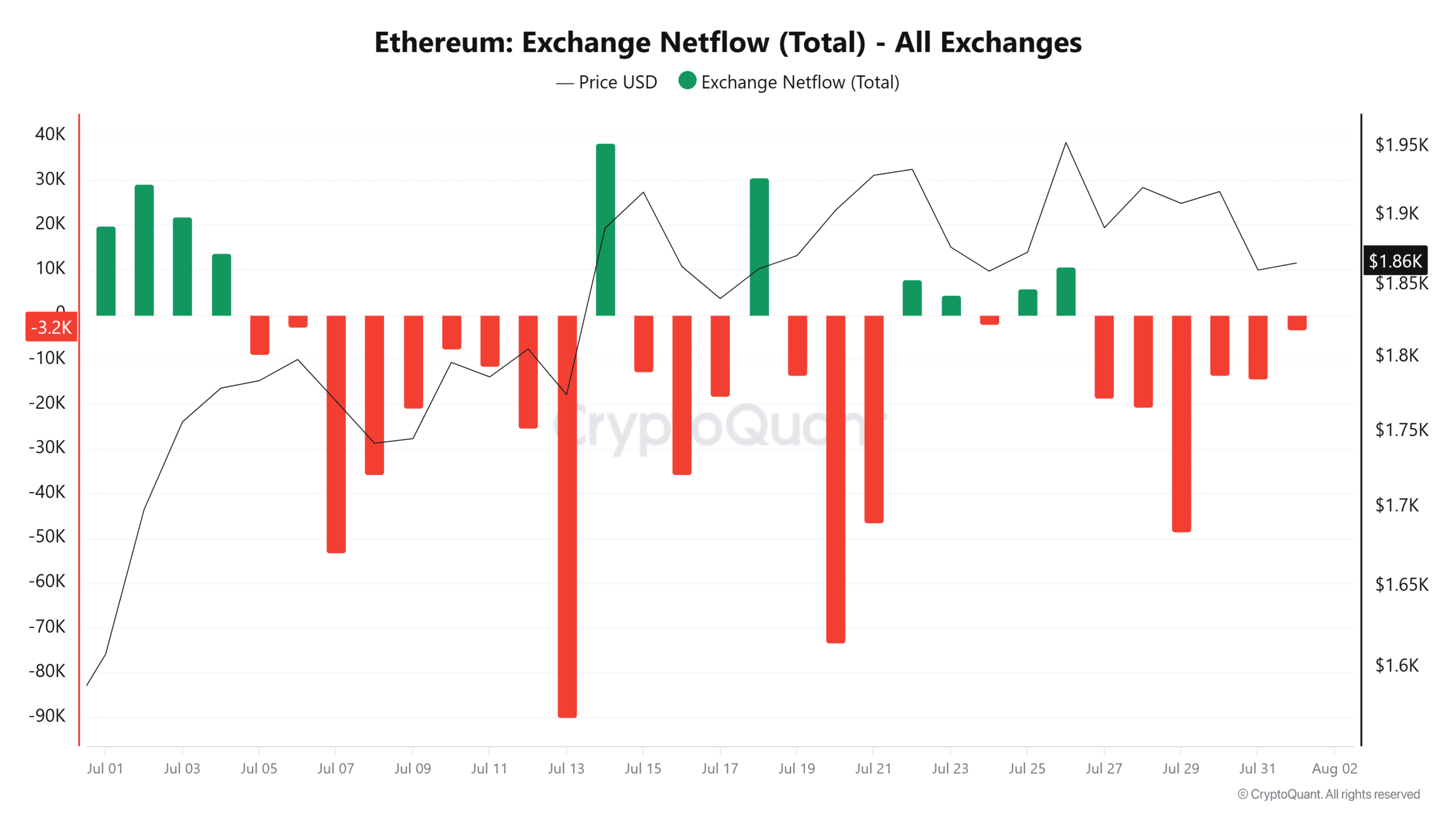
That demand coincided with persistent exchange outflows. Ethereum’s [ETH] Exchange Netflow remained negative for six consecutive days. At press time, Exchange Netflow stood near -3,200 ETH, indicating continued withdrawals from trading platforms.
Source: CryptoQuant
The last similar outflow period occurred in early July. ETH then climbed from $1.7K to $1.9K. If demand persists, Ethereum could recover from its latest decline.
Can ETH recover in August?
Despite declining exchange supply, Ethereum’s short-term momentum remained weak.
ETH traded below its 20-day Moving Average, while the MACD-SMA indicator reflected continued seller control. The Bulls v Bears indicator also formed a bearish crossover, reinforcing the possibility of further short-term pressure.
Source: TradingView
If this weakness persists, ETH could fall below $1.8K, placing the next support level near $1,750.
However, ETH remained above its 200-day Moving Average. This suggested that the broader market structure was still bullish.
Sustained demand from Bitmine could help ETH defend its 50-day Moving Average and reclaim its 20-day Moving Average. Under that scenario, Ethereum could retest $1,950 before targeting a move above $2,000.
Final Summary
Fidelity-linked wallets transferred $499.55 million in ETH, likely reflecting internal custody rebalancing.
Bitmine accumulated another $19.48 million despite Ethereum’s prolonged price decline.
BALTIMORE, MD – JULY 29: Eric Lauer #56 of the Toronto Blue Jays looks on before game two of a split doubleheader against the Baltimore Orioles at Oriole Park at Camden Yards on July 29, 2025 in Baltimore, Maryland. (Photo by Scott Taetsch/Getty Images)
Getty Images
The Toronto Blue Jays have been unable to recapture the magic that won them the American League pennant last year. Ever since they were defeated by the Los Angeles Dodgers in extra innings of Game 7 in the World Series, the team has struggled with injuries and setback performances.
And one of the Blue Jays’ key players from last season, who was enduring a rough start this season, has suddenly enjoyed a resurgence by joining Toronto’s National League foe.
Former Toronto Blue Jays Pitcher Enjoys Surge With Los Angeles Dodgers
After Eric Lauer saw his role with the Blue Jays changed to one of long relief, he publicly expressed his frustration and struggled on the mound. That led the team to designate him for assignment and then trade him to the Dodgers, who were clear that he probably wouldn’t be there for long/
“When the Dodgers acquired the 31-year-old left-hander earlier this year, plucking him off the DFA scrap heap in a trade with the Toronto Blue Jays, they told him early on that his stint might only be temporary; that he was a stopgap for a rotation that had endured a couple key early injuries,” Jack Harris wrote for the New York Post.
But, surprisingly enough, Lauer has become a successful starter for the Dodgers, who quickly moved him back to starting games after the Blue Jays’ demotion.
Toronto Blue Jays Former Pitcher Sends Los Angeles Dodgers Trade Message
But even with his newfound success, Lauer’s role could soon disappear through no fault of his own.
“And though Lauer has exceeded all expectations since then –– going 5-0 with a 2.96 ERA in nine Dodgers outings, all of which have also been Dodgers wins –– that need he was filling will soon be invalidated, with Blake Snell, Tyler Glasnow and (eventually) Shohei Ohtani all expected to rejoin the team’s rotation for the stretch run of the year,” Harris added. “That has meant, for a Dodgers team long inclined to selling excess players at the deadline in hopes of cashing on inflated midseason prices, Lauer has long looked like a potential trade candidate.”
Whether the Dodgers ultimately keep Lauer or move him before the deadline, his performance has dramatically changed the perception surrounding his career. And while he is no stranger to midseason transactions, Lauer sent a clear four-word message on how his family feels about the ongoing trade rumors.
“My wife hates it,” Lauer said, according to The Athletic’s Fabian Ardaya.
The former Blue Jays castoff has gone from organizational depth to a valuable trade asset, and his comments suggested that, while he understands both the business side of baseball and the opportunity Los Angeles has provided, he’s still hoping to stay with the team that bested his Blue Jays in the World Series.
“No, I mean, it’s something that I was aware of coming over here that it might be like a rental thing,” Lauer added, per Ardaya. “See a need, fill a need kind of thing. But I mean, I love it here. I think I’m thriving here, as far as I can tell.”
After suddenly rediscovering his form with the National League juggernaut, it’s understandable that Lauer would prefer to stay in Los Angeles. But if he is moved, he’s sure to speak his mind about his role wherever he goes next.
Every step of that runs on the attacker’s machine. The victim’s device is not involved at any point and could be powered off in a safe on another continent.
Galaxy’s breakdown shows the process running. Of the drained wallets, 1,183 used the modern native segwit address format, seven used an older standard and six an older one still. Nobody targets a specific victim across three address formats at once.
That is systematic enumeration, checking each candidate seed against every path it might have produced. The operator can widen the search, refine it and return whenever they choose.
Galaxy warned further waves are likely if owners do not move their funds.
The victims span three address formats, which is what a scanner looks like. (Shaurya Malwa/CoinDesk)
Nor can an owner determine whether they are exposed. There is no test to run against your own wallet that reveals whether your seed sits inside the reproducible range.
Attack might not be fully finished
Coinkite, Coldcard’s maker, has warned Mk3 owners and says its newer devices are unaffected, while Block’s report places the Mk2, Mk4, Q and Mk5 in scope as well. Until that is resolved, anyone who generated a seed on the affected firmware has to assume the worst rather than verify it.
The attacker did make one mistake, however.
Block’s Clay Garrett said on X that the operator used a paid account at a “well-known blockchain data provider” to query the source addresses during the sweeps, and that the provider’s internal logs matched the suspected workflow with what he called extraordinary specificity, down to the number, timing and sequence of requests.
According to average rates from the Zillow lender marketplace, mortgage rates are mostly on the rise today compared to yesterday.
The current 30-year fixed rate today, Saturday, August 1, 2026, rose by 10 basis points to 6.65%, the 15-year fixed rate fell by 2 basis points to 6.01%, and the 5/1 ARM rose by 23 basis points to 6.65%.
Here are the current mortgage rates today, Saturday, August 1, 2026, according to the latest Zillow data:
30-year fixed: 6.65%
20-year fixed: 6.33%
15-year fixed: 6.01%
5/1 ARM: 6.65%
7/1 ARM: 6.18%
30-year VA: 6.11%
15-year VA: 5.83%
5/1 VA: 5.95%
Remember, these are the national averages and are rounded to the nearest hundredth.
Today’s mortgage refinance rates
These are today’s mortgage refinance rates, Saturday, August 1, 2026, according to the latest Zillow data:
30-year fixed: 6.57%
20-year fixed: 6.22%
15-year fixed: 6.01%
5/1 ARM: 6.68%
7/1 ARM: 6.70%
30-year VA: 6.16%
15-year VA: 5.74%
5/1 VA: 5.65%
Again, the numbers provided are national averages rounded to the nearest hundredth. Mortgage refinance rates are often higher than rates when you buy a house, although that’s not always the case.
Use the mortgage calculator below to see how today’s interest rates would affect your monthly mortgage payments.
Mortgage payment calculator
You can bookmark the Yahoo Finance mortgage payment calculator and keep it handy for future use, as you shop for homes and the best mortgage lenders. You also have the option to enter costs for private mortgage insurance (PMI) and homeowners’ association dues, if applicable. These details result in a more accurate monthly payment estimate than if you simply calculated your mortgage principal and interest.
30-year fixed mortgage rates: Pros and cons
There are two main advantages to a 30-year fixed mortgage: Your payments are lower, and your monthly payments are predictable.
A 30-year fixed-rate mortgage has relatively low monthly payments because you’re spreading your repayment out over a longer period of time than with, say, a 15-year mortgage. Your payments are predictable because, unlike with an adjustable-rate mortgage (ARM), your rate isn’t going to change from year to year. Most years, the only things that might affect your monthly payment are any changes to your homeowners insurance or property taxes.
The main disadvantage of 30-year fixed mortgage rates is the mortgage interest, both in the short and long term.
A 30-year fixed term comes with a higher rate than a shorter fixed term, and it’s higher than the intro rate to a 30-year ARM. The higher your rate, the higher your monthly payment. You’ll also pay much more in interest over the life of your loan due to both the higher rate and the longer term.
15-year fixed mortgage rates: Pros and cons
The pros and cons of 15-year fixed mortgage rates are basically swapped with those of the 30-year rates. Yes, your monthly payments will still be predictable, but another advantage is that shorter terms come with lower interest rates. Not to mention, you’ll pay off your mortgage 15 years sooner. So you could save hundreds of thousands of dollars in interest over the life of your loan.
However, because you’re paying off the same amount in half the time, your monthly payments will be higher than if you choose a 30-year term.
Adjustable-rate mortgages lock in your rate for a predetermined period, then adjust it periodically. For example, with a 5/1 ARM, your rate stays the same for the first five years and then goes up or down once per year for the remaining 25 years.
The main advantage is that the introductory rate is usually lower than what you’ll get with a 30-year fixed rate, so your monthly payments will be lower. (Current average rates might not necessarily reflect this, though — in some cases, fixed rates are actually lower. Talk to your lender before deciding between a fixed or adjustable rate.)
With an ARM, you have no idea what mortgage rates will be like once the intro-rate period ends, so you risk your rate increasing later. This could ultimately end up costing more, and your monthly payments are unpredictable from year to year.
But if you plan to move before the intro-rate period is over, you could reap the benefits of a low rate without risking a rate increase down the road.
First of all, now is a good time to buy a house compared to a couple of years ago. Home prices aren’t spiking like they were during the height of the COVID-19 pandemic. So, if you want or need to buy a house soon, you should feel pretty good about the current housing market.
Plus, despite the recent uptick, mortgage rates are lower than they were this time last year.
The best time to buy is typically whenever it makes sense for your stage of life. Trying to time the real estate market can be as futile as timing the stock market — buy when it’s the right time for you.
Why do 30-year mortgage rates vary by the source reporting them?
According to Zillow, the national average 30-year mortgage rate is 6.65% right now. Why are Zillow’s rates usually different than those reported by Freddie Mac (which reported 6.49% this week) and elsewhere? Each source compiles rates by different methods, and rates are reported for different time frames. Zillow obtains rates from its lender marketplace and reports them daily, while Freddie Mac pulls information from loan applications submitted to its underwriting system and averages them for the week. However, mortgage rates vary by state and even ZIP code, by lender, loan type, and many other factors. That’s why it’s so important to shop with multiple mortgage lenders.
Are interest rates expected to go down?
According to the latest available forecasts, the MBA expects the 30-year mortgage rate to be 6.5% through 2026. Fannie Mae predicts a 30-year rate of 6.4% through the end of the year.
Are mortgage rates dropping?
For the most part, they are not, compared to yesterday. The current 30-year fixed rate today, Saturday, August 1, 2026, rose by 10 basis points to 6.65%, the 15-year fixed rate fell by 2 basis points to 6.01%, and the 5/1 ARM rose by 23 basis points to 6.65%.
How do I get the lowest refinance rate?
In many ways, securing a low mortgage refinance rate is similar to the process you used when you bought your home. Try to improve your credit score and lower your debt-to-income ratio (DTI). Refinancing into a shorter term will also land you a lower rate, though your monthly mortgage payments will be higher.