Home Blog Page 134

I Lost a Client I Should Never Have Lost — and It Rewired How I Run My Firm

0
I Lost a Client I Should Never Have Lost — and It Rewired How I Run My Firm


Opinions expressed by Entrepreneur contributors are their own.

Key Takeaways

  • Before we went remote, the office was running a relationship-maintenance operation none of us noticed — and when it collapsed, we didn’t realize it until our clients started feeling like strangers.
  • I stopped pretending remote work is neutral: it has real costs that fall unevenly on client-facing firms, and until you name that honestly, you can’t actually fix it.

Running a small accounting firm in 2025 means answering a question nobody has fully solved: how do you build a business clients trust deeply when half your team is working from a spare bedroom two states away?

I have spent four years wrestling with it. The honest answer is that I got it wrong before I got it right. What I learned did not come from a management book or a productivity framework. It came from losing a client I should never have lost, in a way that had nothing to do with the quality of our work.

That experience changed how I run everything.

How I lost a client of seven years to a birthday

Not a missed deadline. Not a calculation error. A birthday. One of my remote staff members mentioned in passing that a long-term client had a milestone coming up. I nodded, said “great,” and did absolutely nothing with that information. Three weeks later, that client called, annoyed about something unrelated, and signed with another firm before the month was out. When I dug into it, the birthday was just the final straw. We had quietly become a transaction to them. They sent documents, we sent returns and somewhere along the way we stopped being people they actually knew.

That was the moment I understood what remote work actually costs an accounting firm, and it has nothing to do with productivity.

Every article you read about managing remote teams talks about communication tools, meeting cadence and tracking output. All of that matters. But none of it addresses the specific thing accounting firms sell: trust. Not software. Not efficiency. The feeling a client gets when they believe their accountant genuinely knows them and is watching out for them. That feeling is extraordinarily hard to manufacture through a screen, and most firms are not even trying.

What the office was actually doing for us

Before we went hybrid, the office was running a relationship-maintenance operation that none of us noticed or appreciated. A client would call the front desk and mention something offhand. The receptionist would relay it to the file owner. Someone would follow up. It wasn’t a system. It was proximity and human instinct doing the work automatically.

Remotely, that entire invisible operation collapsed overnight. Nobody was overhearing anything. Nobody was walking past anyone’s desk. The phone calls still came in, but they landed in a vacuum. Information stopped traveling sideways across the team the way it used to, and we didn’t notice until clients started feeling like strangers.

The fix was not what I expected

My instinct was to add more check-ins. More internal meetings. More structured communication. What I actually needed to do was much simpler and much harder. I needed every person on my team to take personal ownership of the relationships inside their files, not just the work inside them.

That sounds obvious. In practice, it means the accountant handling a business return knows that the owner’s daughter just joined the company, knows the lease renewal is coming up in spring and picks up the phone once in a while for no reason other than to check in. It means treating client files less like tasks and more like ongoing relationships that require actual attention.

We now build what I call a relationship note directly into every active file. Not tax notes. Not billing notes. Personal context — what is going on in this client’s life right now that we should know about. It takes two minutes to update, and it has changed the quality of our client conversations more than any software we have ever purchased.

The staff problem nobody wants to admit

Remote work exposed something uncomfortable about our industry. A certain type of accountant, perfectly competent technically, has no interest in the human side of the work. In an office, that person still participates in the culture whether they want to or not. They overhear conversations, they get pulled into hallway discussions, they absorb the relationship norms of the firm just by being present.

Remotely, that same person retreats completely into the technical work and becomes, from the client’s perspective, someone who processes their documents and occasionally sends a PDF. Clients sense this quickly even if they never say it directly. It shows up in the tone of emails, in the length of calls, in how often they reach out with questions — and how often they quietly start wondering if there is someone better out there.

I am not saying those staff members are bad at their jobs. I am saying that remote work removes the guardrails that used to compensate for the gaps, and as a managing partner you have to consciously rebuild them.

What I actually changed

I stopped measuring my team only by what they completed and started paying attention to how their clients talked about them. Not formal surveys. Just listening. When a client calls the front desk, what is the tone? When someone refers us to a friend, what do they say about us specifically?

I also made phone calls a non-negotiable part of the job. Not video calls, not Slack messages — actual phone calls with clients at regular intervals that have nothing to do with a deadline. Some of my staff resisted this. A few still do. But the clients who get those calls are the ones who have stayed with us through fee increases, staff changes and every other reason someone might think about switching firms.

The last thing I changed was the hardest. I stopped pretending that remote work is neutral. It isn’t. It has real costs, and they fall unevenly on client-facing professional services firms in ways a tech company or a marketing agency will never feel. Acknowledging that inside the firm made it possible to actually address it, instead of just adding another tool to the stack and hoping for the best.

That client we lost over a birthday is with a competitor now. I think about it more than I should. But it is the reason we run the firm the way we do today — and I would rather have learned it then than be learning it now.

Key Takeaways

  • Before we went remote, the office was running a relationship-maintenance operation none of us noticed — and when it collapsed, we didn’t realize it until our clients started feeling like strangers.
  • I stopped pretending remote work is neutral: it has real costs that fall unevenly on client-facing firms, and until you name that honestly, you can’t actually fix it.

Running a small accounting firm in 2025 means answering a question nobody has fully solved: how do you build a business clients trust deeply when half your team is working from a spare bedroom two states away?

I have spent four years wrestling with it. The honest answer is that I got it wrong before I got it right. What I learned did not come from a management book or a productivity framework. It came from losing a client I should never have lost, in a way that had nothing to do with the quality of our work.

That experience changed how I run everything.


Source link

How Ethereum finished July 2026 with 20.3% gains and THIS major hurdle

0
How Ethereum finished July 2026 with 20.3% gains and THIS major hurdle


Ethereum [ETH] had a strong July, recovering much of the ground it lost in June. Now, will ETH break above $2,000, or move sideways in the days ahead?

ETH jumped back up in July

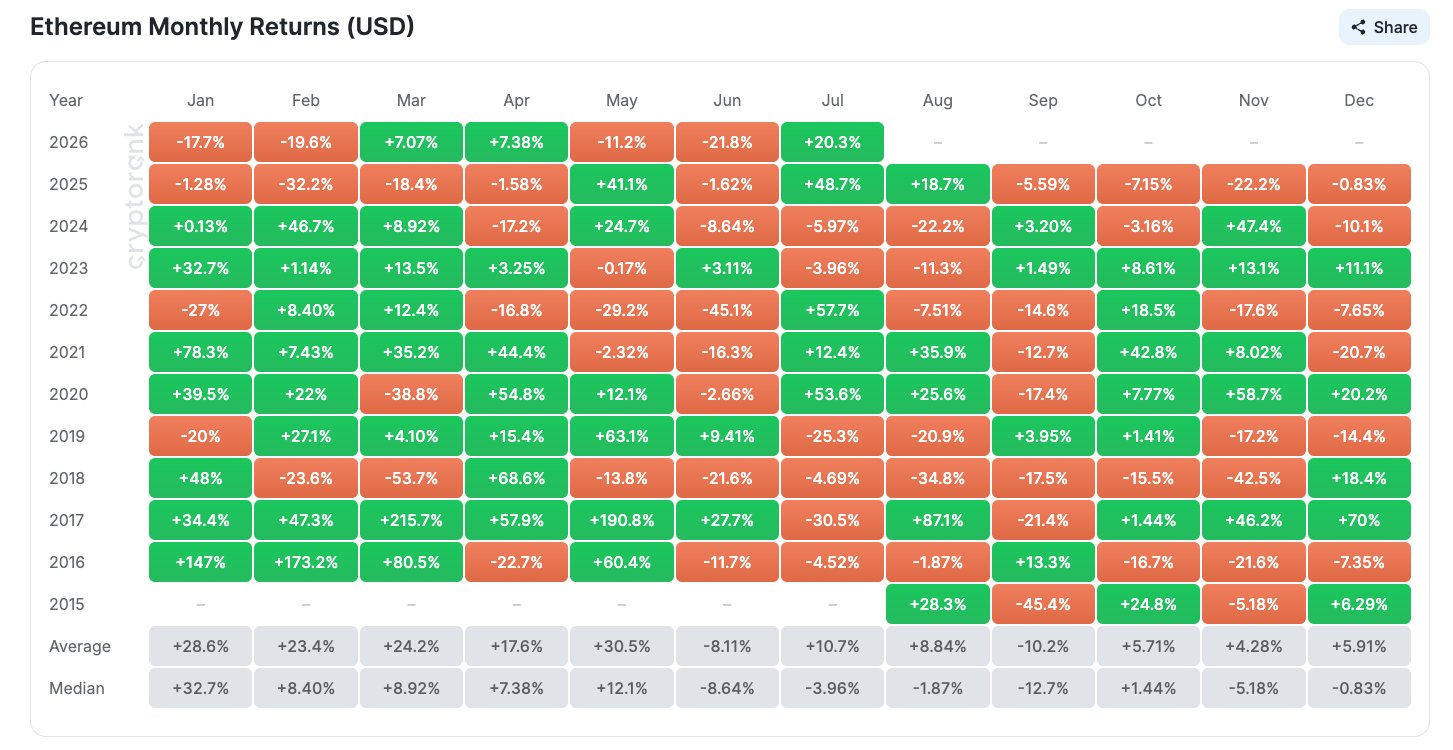
Ethereum ended July with gains of 20.3% — Its strongest monthly performance over the past year. The rebound helped ETH recover a large part of June’s 21.8% fall, and brought some confidence back to the market after a difficult H1 2026.

ethereumethereum
Source: CryptoRank

Now, what’s peculiar is how against the historic tide these gains have been. So far, ETH has delivered an average July return of 10.7%, while the median return for the month is negative. This means July 2026 performed far better than a typical July.

Still, the recovery did not completely erase June’s losses. ETH is still entering August below recent highs.

Spot ETF demand supported ETH’s July rebound


Source link

Coinbase’s (COIN) weak quarter leaves Wall Street split on timing of a recovery

0
Coinbase's (COIN) weak quarter leaves Wall Street split on timing of a recovery

Coinbase said it captured a record 10.3% share of global crypto trading volume during the quarter, its third consecutive quarterly gain. Analysts at Benchmark, Oppenheimer, Clear Street and Cantor all highlighted the figure as evidence that trading activity is consolidating onto larger regulated exchanges during periods of market stress.

Several also pointed to derivatives, where Coinbase reported flat trading volumes despite management saying the broader derivatives market declined by double digits.

Diversification shows progress, but isn’t enough

Analysts viewed Coinbase’s push beyond spot trading as encouraging, even though the newer businesses remain too small to offset weakness in core trading revenue.

The company is trying to diversify through prediction markets, derivatives, subscriptions, stablecoins and its Base blockchain. Prediction markets surpassed a $100 million annualized revenue run rate, while Coinbase One topped one million paid subscribers. Its Circle partnership for USDC also renewed on existing terms, removing a key concern for investors.

Still, there was broad agreement that diversification has not yet become large enough to replace lost trading revenue.

Clear Street noted new businesses continue gaining traction but remain “optionality” rather than meaningful earnings contributors. Barclays was more critical, arguing prediction markets and retail derivatives “did not” provide the boost they offered last quarter. Compass Point similarly said emerging businesses “barely moved the needle.”


Source link

Sonic Automotive, Inc. Q2 2026 Earnings Call Summary

0
Sonic Automotive, Inc. Q2 2026 Earnings Call Summary


Sonic Automotive, Inc. Q2 2026 Earnings Call Summary – Moby

Strategic Performance Drivers

Our analysts just identified a stock with the potential to be the next Nvidia. Tell us how you invest and we’ll show you why it’s our #1 pick. Tap here.

  • Record second quarter revenues of $3.9 billion were driven by strong execution in used vehicle throughput and record fixed operations gross profit.

  • Management attributed the year-over-year decline in new vehicle GPU to difficult comparisons against 2025’s pre-tariff consumer demand pull-forward.

  • Strategic focus on used vehicle volume throughput resulted in a 7% increase in same-store retail used volume, progressing toward a long-term goal of 100 units per dealership per month.

  • Fixed operations reached an all-time quarterly record, serving as a stable earnings foundation as affordability challenges lead consumers to repair rather than replace vehicles.

  • EchoPark’s 17% volume growth was fueled by a strategic shift toward more affordable, higher-mileage inventory and improved non-auction sourcing, which now accounts for 42% of sales.

  • Management acknowledged that the increased mix of battery electric vehicles (BEVs) and higher-mileage units at EchoPark has pressured F&I GPU due to lower warranty penetration.

  • Powersports segment growth of 53% in revenue validates the company’s diversification strategy, with recently acquired dealerships outperforming initial expectations.

Outlook and Strategic Initiatives

  • Full-year new vehicle GPU guidance was raised to $2.85 thousand to $3 thousand per unit, reflecting lower downside risk despite anticipated compression in the second half.

  • EchoPark is targeting total GPU in the $3.1 thousand to $3.3 thousand range for 2026, supported by the introduction of new F&I products specifically for BEVs.

  • Management expects to deploy $8 million to $12 million in incremental brand marketing for EchoPark in Q4 to support market expansion and organic volume growth.

  • The company plans to open one new EchoPark location in Orlando in Q4 2026, with an additional 2 to 4 locations planned for 2027.

  • Strategic focus for fixed operations involves implementing ‘value pricing’ service offerings to recapture market share from independent repair shops and drive mid-single-digit growth.

Risk Factors and Structural Dynamics

  • Affordability remains a primary headwind, with management noting that 1 in 5 customer payments now exceed $1,000 per month.

  • Tariff-driven price increases on new vehicles are creating a significant price gap, positioning used vehicles as a more attractive value proposition for the next 12-18 months.

  • Compliance with FTC guidelines remains a competitive variable, as management noted some independent dealers are not yet adhering to transparent pricing rules.

  • Inventory levels were intentionally increased to capture volume opportunities, though management expects day-supply to normalize by September and October.


Source link

Why is Unibase up? AI buzz, exchange outflows & more…

0
Why is Unibase up? AI buzz, exchange outflows & more…


Unibase returned to the spotlight after getting ranked among the top AI agent cryptocurrency on July 30, giving traders a fresh narrative to chase. 

The recognition coincided with a 15.83% daily rally that lifted UB to $0.1615, pushing its market capitalization to $403.86 million. 

Yet the move unfolded alongside a 52.26% decline in trading volume to $14.2 million, revealing that enthusiasm spread faster than participation. 

Instead of broad market inflows, sentiment largely revolved around the growing AI sector, where projects continued competing for investor attention. 

The Fear and Greed Index remained at 36, reflecting cautious positioning despite the rally. 

As a result, the ranking became the dominant catalyst behind UB’s advance, shifting attention away from protocol-specific developments and toward narrative-driven demand.

Exchange balances continue moving in bulls’ favor

Selling pressure remained restrained as more UB left exchanges than entered them. 

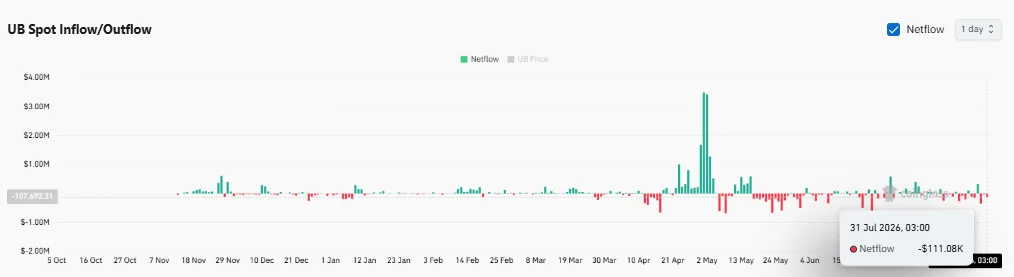
CoinGlass recorded a -$111.08K spot netflow during the latest session, extending the pattern of exchange outflows. 

Rather than signaling aggressive distribution, the data pointed to a gradual reduction in tokens readily available for immediate selling. 

Such behavior often reflects investors moving assets into private wallets instead of preparing them for liquidation. 

However, the relatively small scale of the outflow also explained why the rally lacked explosive volume confirmation. 

Fresh buying interest continued supporting price, although capital entered the market selectively rather than aggressively. 

The combination left UB with a constructive supply backdrop, where shrinking exchange availability complemented the renewed attention generated by its AI ranking.

Source: CoinGlass

Has Unibase opened the path toward $0.20?

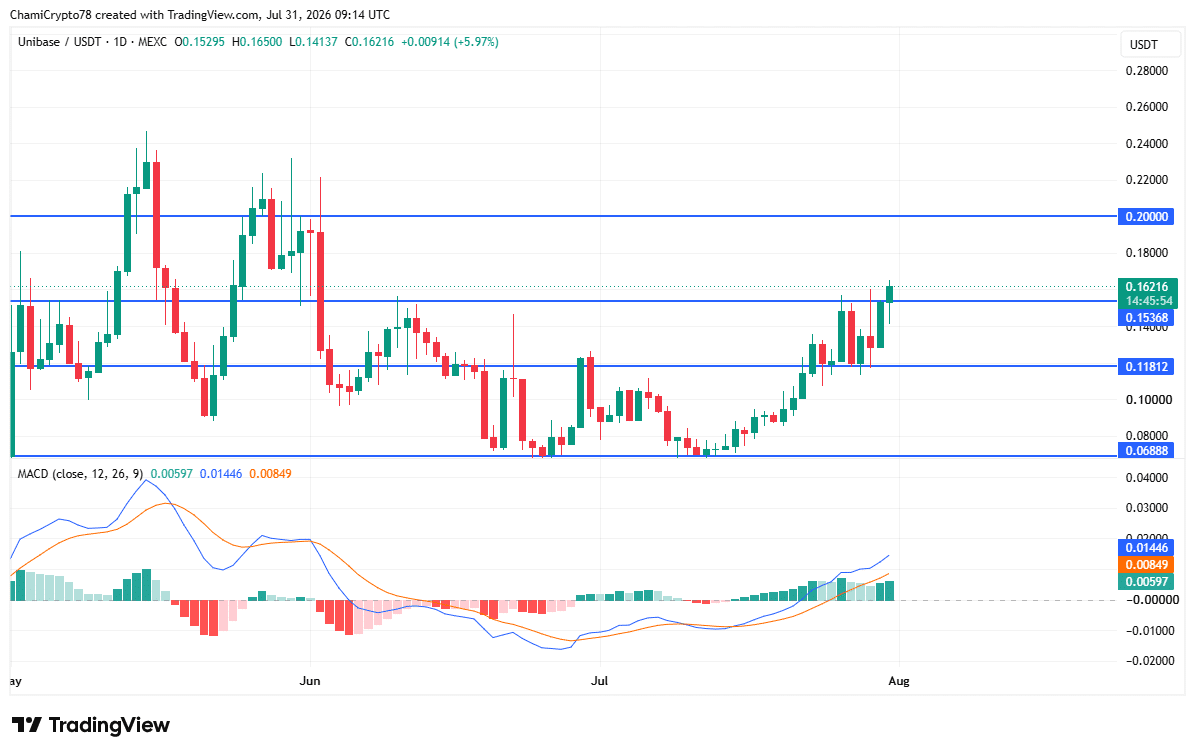
Unibase [UB] price spent weeks rebuilding from the $0.0689 July floor before reclaiming $0.1537, a level that repeatedly interrupted previous recovery attempts. 

That breakout altered the market structure by converting former resistance into an area buyers immediately defended. 

Instead of fading after crossing the level, UB extended higher and closed around $0.1615, reflecting sustained demand throughout the session. 

Buyers also preserved a sequence of higher lows, reinforcing the recovery without relying on sharp speculative spikes. 

Beneath the surface, the MACD strengthened the broader picture rather than leading it. 

The MACD line climbed to 0.01446, comfortably above the 0.00849 signal line, while the positive histogram expanded to 0.00597, reflecting improving buying strength during the advance. 

The next challenge now stand at $0.20, where previous rallies stalled. 

A successful defense of $0.1537 could encourage another attempt at that barrier, whereas losing it would likely shift attention toward $0.1181, where buyers previously regained control.

Unibase price actionUnibase price action
Source: TradingView

Liquidity map reveals the next battleground

The liquidation landscape placed the next contest directly above the current market. 

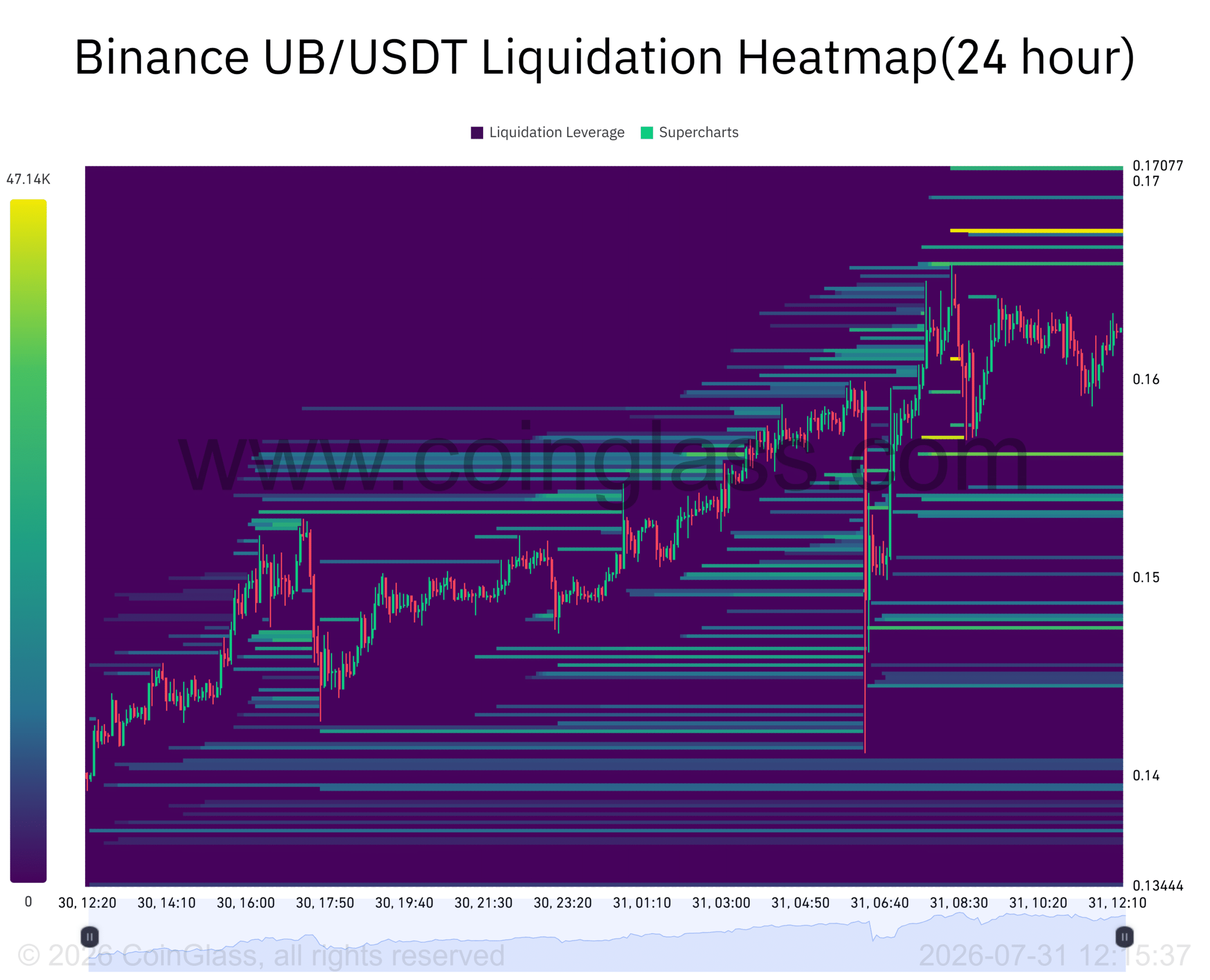
CoinGlass highlighted dense short liquidation clusters around $0.165 and $0.170, leaving a relatively narrow gap between price and leveraged resistance.

Markets often gravitate toward those zones because forced liquidations inject additional buying activity once triggered. 

Consequently, even a modest continuation could generate enough pressure to accelerate the move higher. 

Beneath the market, liquidity appeared more dispersed around the $0.150 region, reducing the probability of an immediate cascade unless support failed decisively. 

The chart therefore presented two competing scenarios: an advance into overhead liquidity or a pause while the market absorbed recent gains. 

Either outcome would likely revolve around how price reacted as it approached the concentrated liquidation pockets.

Source: CoinGlass

Final Summary

  • Unibase reclaimed a major resistance while exchange outflows continued reducing immediate selling pressure.
  • Overhead liquidation clusters now decide whether buyers can extend gains toward the $0.20 barrier.


Source link

STS Digital CEO sees three major headwinds for crypto markets

0
STS Digital CEO sees three major headwinds for crypto markets

Much of the adoption, however, benefits established financial institutions rather than token holders, Seiler said. As traditional finance integrates blockchain tech into existing workflows, less value accrues directly to crypto assets than investors expected several years ago.

Founded in 2021, STS Digital is a Bermuda-regulated crypto options market maker that provides 24/7 liquidity and pricing for institutional clients trading digital asset derivatives. The firm specializes in over-the-counter (OTC) trading.

AI, regulation add to crypto headwinds

Another barrier to growth is artificial intelligence. Investor enthusiasm for AI has diverted both attention and capital away from crypto, Seiler said.

High-profile developments around companies such as OpenAI, Anthropic and the SpaceX (SPCX) IPO have made AI the market’s dominant growth narrative, according to Seiler.

He also pointed to delays in U.S. market structure legislation, including the Clarity Act, as another factor weighing on sentiment.

Regulatory certainty would help to accelerate traditional finance’s shift toward 24/7 trading and settlement, while creating a more constructive backdrop for digital assets, he says.

Options selling caps volatility

Seiler also said the rapid growth of the institutional crypto options market is suppressing bitcoin’s price volatility.

Bitcoin’s implied volatility has remained unusually subdued in recent months, with the BVIV Index, a measure of expected 30-day volatility derived from bitcoin options, falling into the mid-30% range in recent months, among its lowest levels of the current cycle, before beginning to edge higher in July.


Source link

Trane Technologies plc Q2 2026 Earnings Call Summary

0
Trane Technologies plc Q2 2026 Earnings Call Summary


Trane Technologies plc Q2 2026 Earnings Call Summary – Moby

Strategic Performance Drivers

Our analysts just identified a stock with the potential to be the next Nvidia. Tell us how you invest and we’ll show you why it’s our #1 pick. Tap here.

  • Enterprise organic bookings surged 37%, resulting in a record $12.1 billion backlog that provides high visibility into revenue acceleration for the second half of 2026 and into 2027.

  • The Americas Commercial HVAC segment achieved exceptional bookings growth of 50%, with all 14 key verticals growing by over 20% during the quarter., with particular strength in data centers.

  • Applied bookings grew over 100% for the fourth consecutive quarter, reflecting a fourfold increase on a two-year stack as customers prioritize energy-efficient thermal management systems.

  • Management attributed margin performance to intentional, heavy reinvestment in capacity expansions, innovation, and the deployment of the business operating system into recent acquisitions like Stellar.

  • Residential performance exceeded expectations due to market fundamentals and easier year-over-year comparisons, with sell-in and sell-through remaining approximately equal.

  • EMEA performance was bifurcated; while the Middle East conflict created a revenue headwind, the underlying commercial HVAC business saw mid-20s booking growth excluding that region.

  • The services business continues to serve as a durable growth engine, maintaining a low-teens compound annual growth rate since 2020 and representing one-third of total revenue.

Outlook and Strategic Assumptions

  • Full-year organic revenue growth guidance was raised to approximately 9%, supported by the conversion of a massive backlog where $6 billion is already slated for 2027 and beyond.

  • The company expects a significant step-up in performance in the second half of 2026, with Q3 organic revenue growth projected at approximately 10%.

  • Management anticipates the Americas transport market will transition from a headwind to a growth contributor starting in late 2026, leading into a multi-year upcycle.

  • Guidance assumes a 30% revenue decline in the Middle East will persist through the second half, though cost-alignment actions taken in June are expected to improve regional profitability.

  • The company plans to deploy $2.8 billion to $3.3 billion in capital for the year, The company is prioritizing internal reinvestment followed by the deployment of excess cash through strategic M&A and share repurchases.

Operational Risks and Structural Adjustments

  • The Middle East conflict remains a primary regional risk, prompting management to rightsize infrastructure and positions to protect margins against a 30% revenue drop.

  • Capacity expansion is a critical focus to prevent turning away orders; the company has expanded applied capacity fourfold over the last three years and continues brick-and-mortar investments.

  • Price versus cost was a headwind in Q2 and is expected to remain so in the second half, though management expects sequential improvement as productivity gains take hold.

  • The Stellar acquisition is now expected to be EPS neutral for the year, rather than modestly accretive, due to pulled-forward investments in operating system integration.


Source link