Home Blog Page 136

Want to trade SpaceX for Apple? 1inch says skip the dollars

0
Want to trade SpaceX for Apple? 1inch says skip the dollars


1inch, a leading decentralized finance (DeFi) protocol, just announced the launch of it’s new shared liquidity protocol, Aqua. It promises to improve efficiency and unlock liquidity for users across networks.

Sergej Kunz, co-founder and CEO at 1inch, joined TheStreet Roundtable to talk about the launch and describe where those efficiency gains are actually being made.

Related: American crypto exchange owner warns of ‘Chinese walls’ after $19B market crash

RWAs need liquidity

Kunz frames Aqua’s efficiency as a new model of liquidity provisioning built for the tokenized-asset wave.

RWAs are coming into DeFi, and RWAs need our infrastructure to be able to have proper liquidity in our space,” he said.

A recent study, commissioned by 1inch, found that roughly 80% of liquidity on decentralized exchanges sits idle at any given time. That equates to around $1.6 billion that isn’t earning anything.

For thin and newer markets such as tokenized RWAs, that inefficiency can be fatal.

The killer use-case

Tokenized equities have exploded globally despite not being available to U.S. investors yet. For users outside the U.S., there are already 100s of tokenized stocks available for purchase through Robinhood, Kraken, Ondo, and more.

You can just buy all the top ten RWAs from Backed’s xStocks, Robinhood or whatever, and make trading positions among them,” Kunz said. “You could, theoretically, set up a trading pair for SpaceX and Apple stock. And then you have SpaceX–Tesla, and then Tesla–Apple, and then Microsoft. It’s a construct that allows you to benefit from the volume that comes from the movement of the RWAs.”

More news:

Traditional brokerages only let you trade each stock against dollars. Kunz is describing direct asset-to-asset markets, a web where one wallet’s holdings back every pair simultaneously, with the LP collecting fees on every crossing.

Why does it require Aqua?

When these RWAs are isolated in single two-token-pair pools, it’s not possible. So here we have additional efficiency,” Kunz answered.

The RWA boom keeps promising “stocks on-chain” but mostly delivers stocks-vs-dollars with extra steps. Kunz’s pitch is one of the first structurally new things tokenized equities could do: markets between assets, priced continuously, fed by one pool of reusable capital.

This story was originally published by TheStreet on Jul 31, 2026, where it first appeared in the Innovation section. Add TheStreet as a Preferred Source by clicking here.

Source link

U.S. Treasury yield hits 2007 high – What it means for Bitcoin

0
U.S. Treasury yield hits 2007 high – What it means for Bitcoin


The crypto market has struggled through much of the year amid limited capital inflows. Now, it could face tighter conditions capable of squeezing more liquidity from the space.

The outlook followed rising U.S. bond yields, which increased the appeal of lower-risk assets. This shift could leave crypto holdings such as Bitcoin [BTC] and altcoins off investors’ preferred list.

Bitcoin has already shed over $675 billion in market value since its January high.

Could rising bond yields hurt crypto?

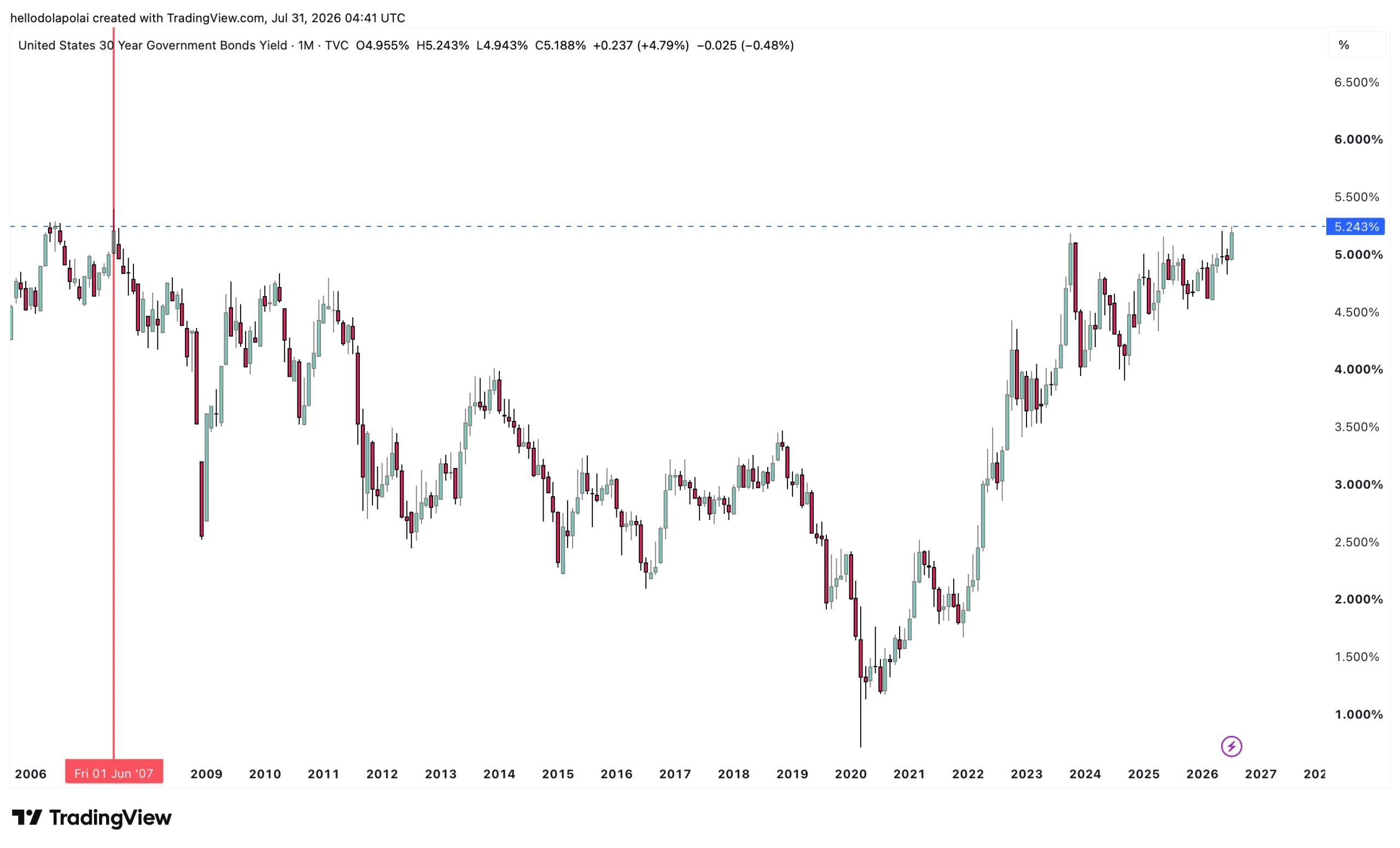
The 30-year U.S. Treasury yield climbed to 5.234% during the early hours of the 30th of July. That move marked its highest level since July 2007. The yield eased to 5.185% on the 31st of July.

Higher bond yields typically make government debt more attractive relative to risk assets. This competition for capital rarely favors crypto, especially when market liquidity is already thin.

U.S. 30 year bond yield.
Source: TradingView

The climb followed the Federal Open Market Committee’s decision to hold interest rates between 3.5% and 3.75%. The committee described the economy as strong, supported by productivity and capital investment.

However, it flagged energy-driven inflation as a lingering concern.

Inflation remains elevated relative to the Committee’s 2 percent goal, in part reflecting supply shocks that have driven price increases in certain sectors, including energy.

The energy shock followed the closure of the Strait of Hormuz during the Middle East conflict involving the U.S. The committee stressed that its priority remained price stability.

Are U.S. investors turning cautious?

U.S. investors have already adjusted their positions as yields climbed and inflation remained above the 2% target.

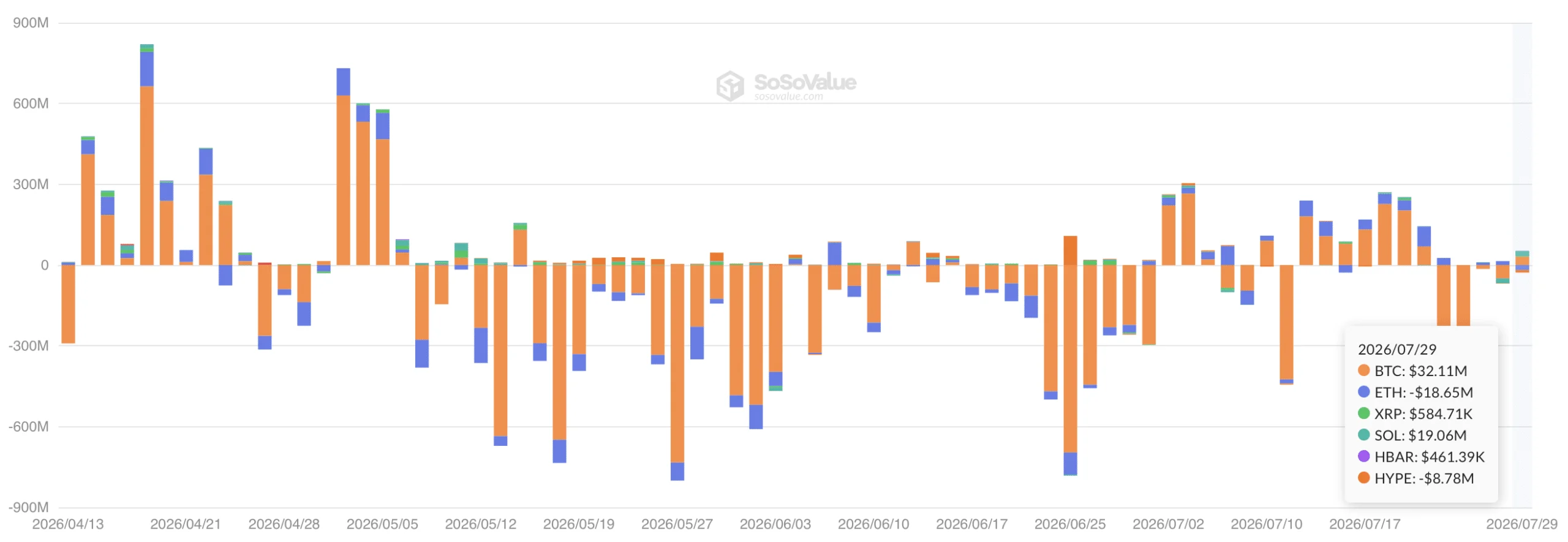
At the same time, Netflows across listed U.S. crypto products posted a sharp drop.

SoSoValue tracked a combined inflow of $24.7 million across six asset classes. These included Bitcoin [BTC], Ethereum [ETH], Hyperliquid [HYPE], and Solana [SOL].

The figure marked the lowest buy-side Netflow since the 8th of July. This suggested investors had grown broadly cautious with their trades.

U.S. Crypto ETF netflowU.S. Crypto ETF netflow
Source: SoSoValue

Bitcoin’s Coinbase Premium Index also remained negative, pointing to softer demand from U.S.-based investors. Strong U.S. demand last appeared during a brief positive spike on the 18th of May.

Could weakness last until elections?

In a recent report, AMBCrypto noted that the bearish market could drag on further.

The report found that a bull run may remain unlikely until the period surrounding the U.S. midterm elections. This view was also based on Realized Profit and Loss data.

Historically, Bitcoin has attracted renewed inflows around midterm election periods. With the next vote due in November, the market could keep ranging or slide further until then. Bitcoin may still print local highs during this period. However, those moves could fall short of a broader bull run.


Final Summary

  • The 30-year U.S. Treasury yield reached its highest level since 2007, increasing competition for crypto capital.
  • U.S. crypto Netflows fell to $24.7 million, while the Coinbase Premium Index remained negative.


Source link

Bitcoin (BTC) July price gain survives hawkish Fed, AI meltdown and Coldcard fallout

0
Bitcoin (BTC) July price gain survives hawkish Fed, AI meltdown and Coldcard fallout

Since then, average daily liquidations have remained well below this year’s typical $400 million-$500 million range, suggesting there has been little forced selling despite the macro shock, according to Bitfinex.

“Crypto fell less than levered equity themes because the forced-selling fuel was already spent,” the analysts wrote.

Security concerns linger

Separately, the market is also digesting the fallout from a major exploit involving Coldcard, which resulted in at least $38 million worth of bitcoin being stolen.

The incident hasn’t materially affected price action, but it marked another blowback as digital asset-related exploits have surged and reignited debate around risks of self-custody, one of crypto’s fundamental promises.

“The proceeds haven’t yet been liquidated, but the knock-on effect of this and the likelihood of liquidation will weigh on bitcoin pricing in the near term,” said Paul Howard, director at trading firm Wincent. More broadly, he said, the exploit highlights the operational risks that continue to accompany self-custody.

Read more: Coldcard’s $38 million (so far) exploit shakes faith in self-custody, may push investors to ETFs

Eyes on jobs data and ETF flows

Looking ahead, macro uncertainty remains the dominant theme.

Jeff Anderson, managing partner at STS Digital, said markets may be entering “a new volatility regime” as investors swing between expectations for rate cuts, pauses and hikes. That uncertainty, he said, is likely to keep pressure on high-beta assets such as bitcoin until the economic outlook becomes clearer.


Source link

Bitcoin and ethereum prices today, Thursday, July 30, 2026: Prices rise after Fed leaves rates unchanged

0
Bitcoin and ethereum prices today, Thursday, June 18, 2026: Prices sliding despite Iran peace deal


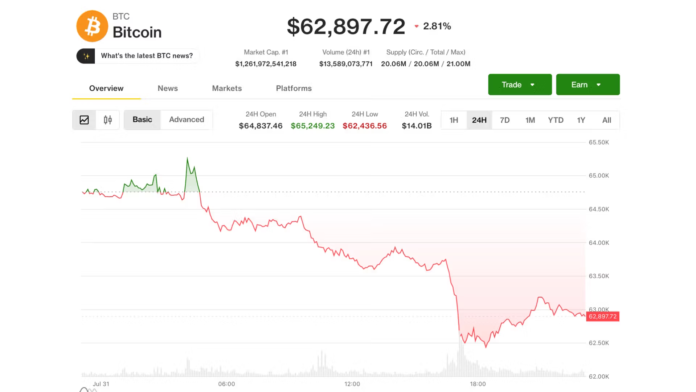
Bitcoin (BTC-USD) opened at $63,902.90 on Thursday, July 30, 2026, flat compared to Wednesday’s opening price. As of 9:00 a.m. ET this morning, the price of bitcoin moved up to $64,838.92.

Ethereum (ETH-USD) opened at $1,908.34 on Thursday, July 30, 2026, down 0.6% from Wednesday’s opening price. The price of ethereum moved higher this morning to $1,923.23 as of 9:00 a.m. ET.

Both bitcoin and ethereum prices are up significantly month over month this morning, but there’s more work to be done to get bitcoin back to the opening price levels we observed last week.

Crypto prices certainly appear to be responding positively to the Fed’s decision to keep rates steady. Any increase to borrowing costs tends to make riskier investments, such as crypto, less appealing to investors.

As the war in Iran only appears to be escalating, the threat of higher rates later this year is still very much in play. This puts crypto investors in a wait-and-see mode as they digest Fed Chair Warsh’s latest comments and assess the likelihood that an interest rate increase will actually land later this year.

The price of bitcoin this morning was unchanged compared to Wednesday’s opening price. Here’s a look at how the opening bitcoin price has changed versus last week, month, and year:

  • One week ago: -3.3%

  • One month ago: +6.3%

  • One year ago: -45.8%

The all-time high for bitcoin was $126,198.07 on Oct. 6, 2025. The all-time low value for bitcoin was $0.04865 on July 14, 2010. 

The price of ethereum this morning was 0.6% lower than Wednesday’s open. Here’s a look at how the opening ethereum price has changed versus last week, month, and year:

  • One week ago: -1.3%

  • One month ago: +18.5%

  • One year ago: -49.7%

The all-time high for ethereum was $4,953.73 on Aug. 24, 2025. The all-time low value for ethereum was $0.4209 on Oct. 21, 2015. 

Bitcoin, ethereum, and other cryptocurrencies are rapidly evolving. Follow the latest developments from Yahoo Finance and others here.

A bitcoin or crypto credit card generally works just like any other credit card. When you apply and get approved, you’ll be assigned a credit limit, and you can use your card to make purchases. If you don’t pay your total balance by your card’s monthly due date, you’ll start to accrue interest at your assigned APR.

The difference is the types of rewards you’ll earn. Instead of earning airline miles, rewards points, or cash back on your spending, you’ll earn crypto. The percentage back you earn on each purchase — such as 3% back on gas or 2% back at restaurants — is converted from U.S. dollars to bitcoin or another cryptocurrency at the current market value. You can then access your rewards through your connected crypto account.

For example, say you make a $500 purchase that earns 3% bitcoin rewards. You’ll earn $15 in U.S. dollars on that purchase. With a bitcoin credit card, your $15 may be converted at the current bitcoin value (about 0.00014 bitcoin in October 2025) and deposited in your crypto account.

The biggest benefit of crypto rewards is the potential for growth over time. Let’s say you had a total bitcoin rewards balance worth $100 USD at the end of 2024. By early October 2025, the value of those same rewards would have increased to about $114 — even if you didn’t earn any additional rewards over that time.

Learn more: Do you need a bitcoin credit card? What you can gain (and lose) by earning bitcoin rewards on spending

Whether you’re brand new to tracking the value of bitcoin and ethereum or a more seasoned crypto investor, Yahoo Finance’s price-of-bitcoin chart and price-of-ethereum chart below show a visual history of how the currency’s value continues to move and evolve. 

More on crypto from the Yahoo Finance team: 


Source link

I’m a registered dietitian. Here are 12 of my favorite budget-friendly anti-inflammatory foods at Aldi.

0
I'm a registered dietitian. Here are 12 of my favorite budget-friendly anti-inflammatory foods at Aldi.


As a registered dietitian, I think Aldi has a great selection of anti-inflammatory items at a great price.

  • I’m a registered dietitian who loves shopping at Aldi for budget-friendly, anti-inflammatory foods.
  • My trip to Aldi is never complete without grabbing some steamed edamame, Greek yogurt, or avocados.
  • I also always stock up on the store’s salmon and frozen berries.

As a registered dietitian, chef, and mom of two, I’m always looking for foods that taste great, help reduce inflammation, and support my long-term health.

Chronic inflammation has been linked to a variety of long-term health concerns, including heart disease, autoimmune conditions, Alzheimer’s disease, and certain types of cancer. That’s why I aim for meals and snacks that support overall wellness and make it easier for my family to enjoy a balanced, nutrient-rich diet every day.

My go-to place for groceries that check all those boxes is Aldi. Not only can I fill my cart with nutritious staples, but I’m also never stressing about blowing my budget.

These are my 12 favorite anti-inflammatory foods to buy at Aldi.

Prices may vary depending on location.

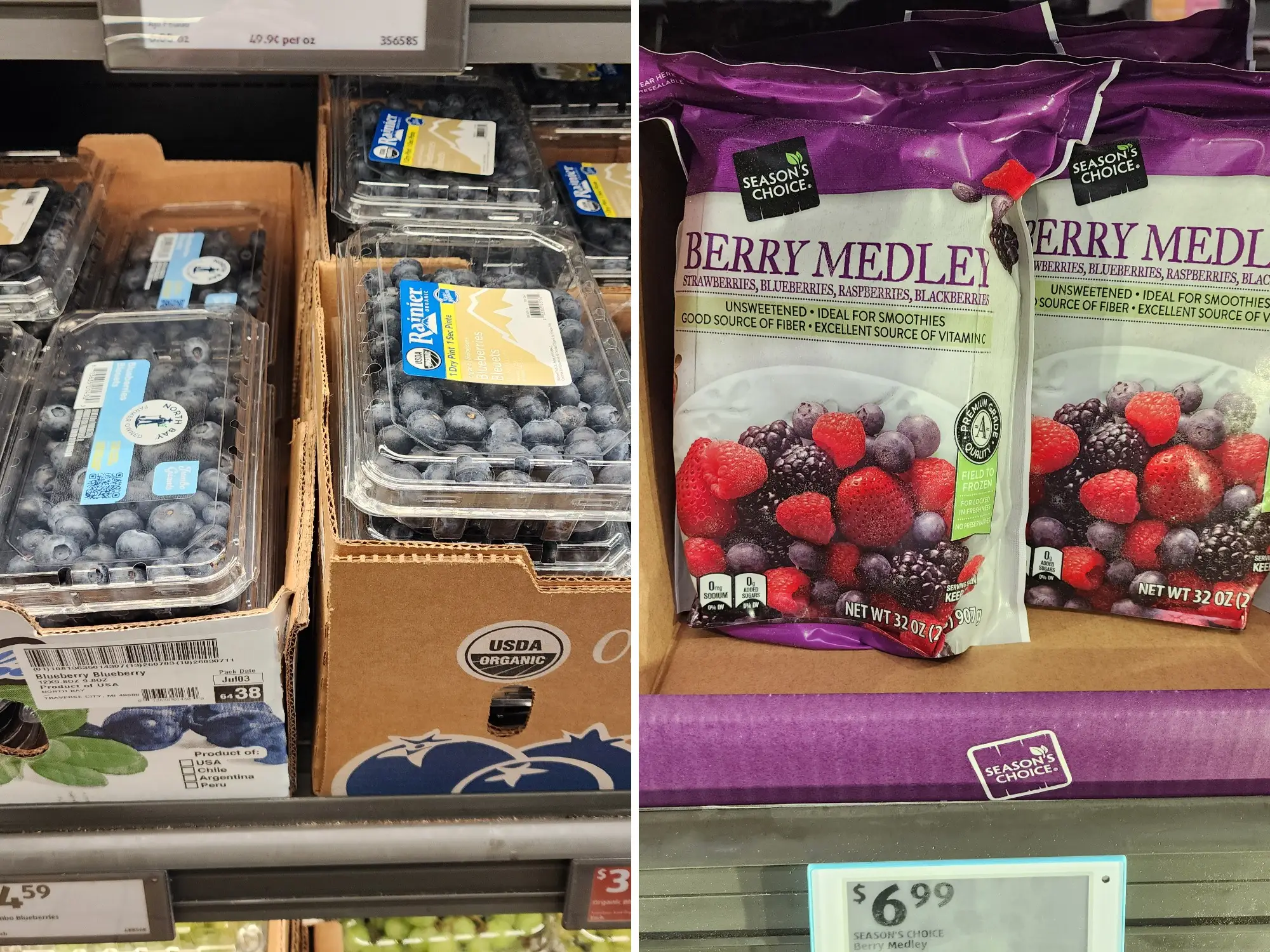
I love Aldi’s selection of berries.
A side-by-side image of blueberries and an image of the Season's Choice frozen berry medley at Aldi.

Whenever I’m at Aldi, I always make sure to pick up some fresh blueberries or a bag of frozen mixed berries, which are packed with nutrients and antioxidants that may help reduce inflammation.

I love to toss them into smoothies, stir them into oatmeal or Greek yogurt, and simply snack on the fresh ones straight from the fridge.

They’re also perfect for baking or for making a quick homemade fruit sauce to pour over pancakes or waffles.

Simply Nature organic extra-virgin olive oil is a staple in our household.
Several bottles of Simply Nature organic extra-virgin olive oil sitting on a shelf at Aldi.

Extra-virgin olive oil is one ingredient I never compromise on when I’m grocery shopping.

It’s packed with beneficial fats and antioxidants, including polyphenols, which can help support the body’s natural inflammatory response.

I use it to make homemade salad dressings, to roast vegetables, and to garnish soups and grain bowls for extra flavor.

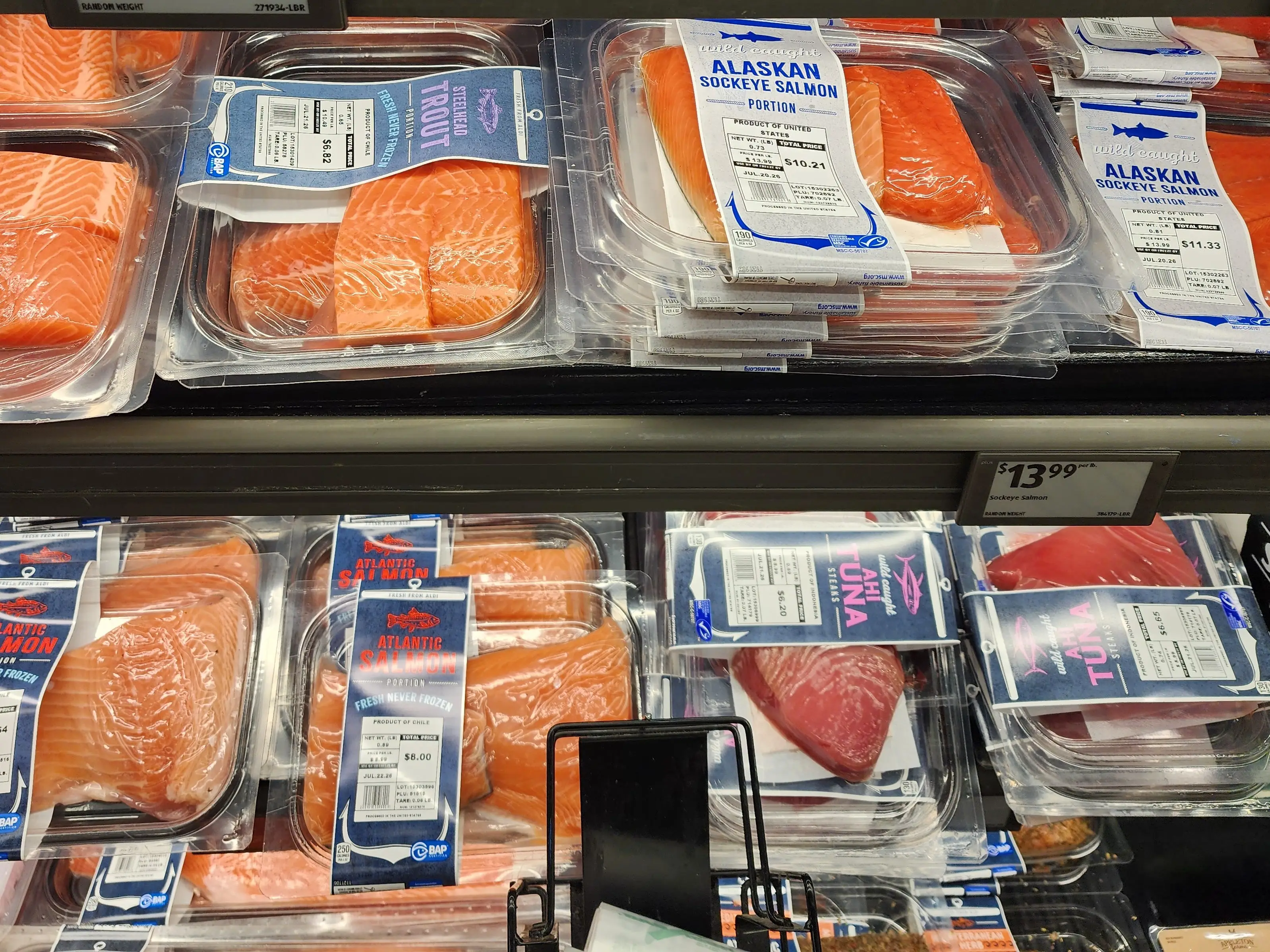
I love that Aldi offers fresh, canned, and frozen salmon.
A selection of fresh salmon sitting on multiple shelves at Aldi.

Salmon is one of my favorite sources of omega-3 fatty acids, which have been studied for their role in supporting heart health and helping regulate inflammation.

Fresh salmon is great for weeknight dinners, the canned alternative makes quick salmon cakes, and frozen fillets are perfect to keep on hand when I need an easy protein.

I always buy some leafy greens whenever I’m at Aldi.
Several boxes of leafy greens, including baby spinach, arugula, and mixed greens, sitting on a shelf at Aldi.

Leafy greens — like spinach, arugula, mixed greens, kale, Swiss chard, and collards — are some of my go-to foods for an anti-inflammatory diet. They also provide important nutrients, including vitamin K, and some varieties are good sources of iron and calcium.

I typically use greens in salads, sandwiches, wraps, and grain bowls.

I also make sure to pick up some frozen bagged greens like spinach and kale, since they can stay fresh in the freezer and can easily be mixed into whatever I’m cooking.

Simply Nature organic cage-free eggs are one of my go-to protein sources.
Several cartons of Simply Nature organic cage-free eggs sitting on a shelf at Aldi.

Simply Nature organic cage-free eggs are one of my favorite affordable proteins, priced at only $3.75 a carton.

They’re also incredibly versatile. I like to make veggie-packed omelets for breakfast, hard-boiled eggs for snacks, or add them to fried rice and bowls for extra fuel.

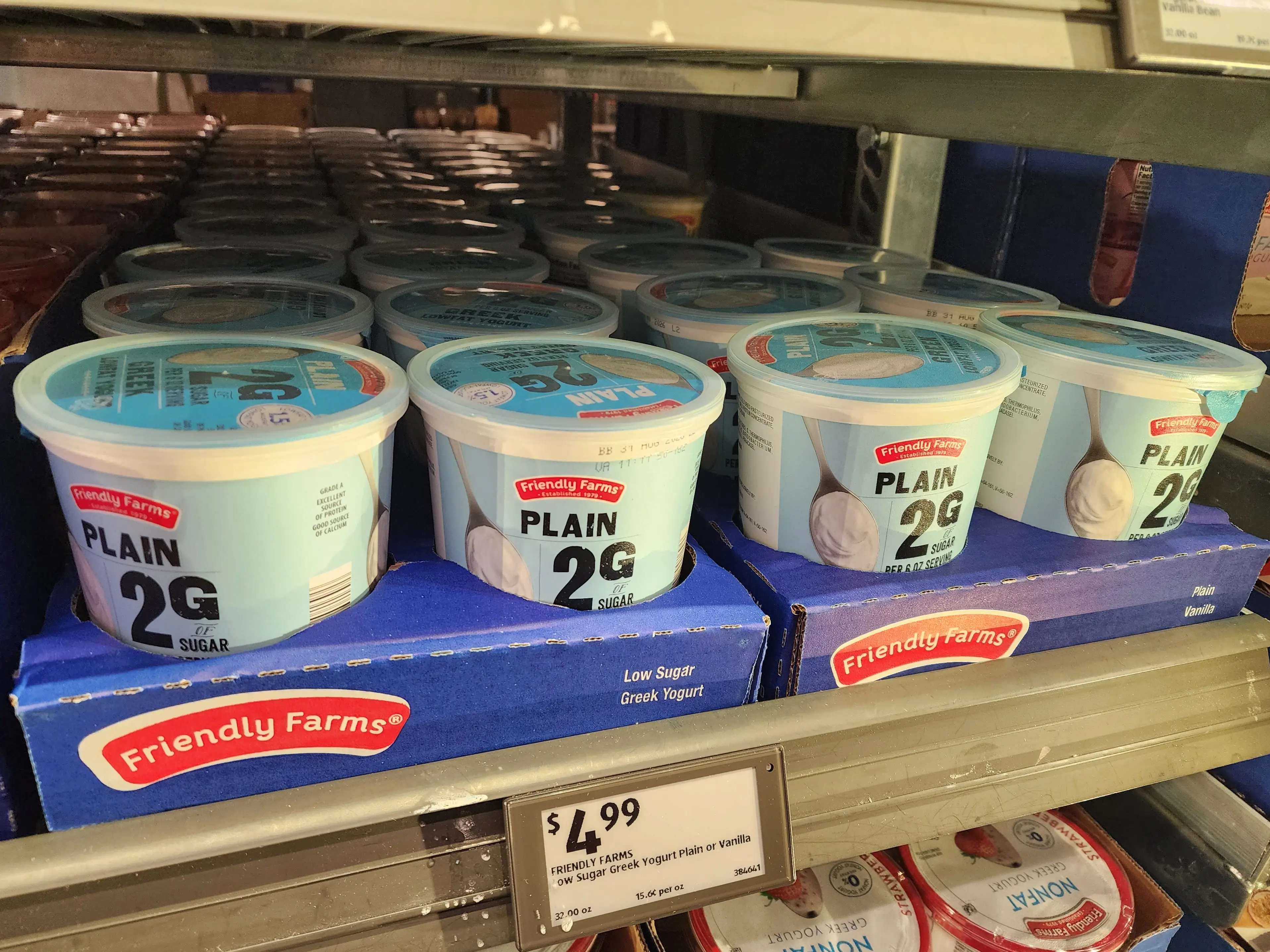
I love using Friendly Farms plain Greek yogurt to make smoothies.
Several containers of Friendly Farms plain Greek yogurt sitting on a shelf at Aldi.

Friendly Farms plain Greek yogurt is always in my refrigerator because it provides protein and probiotics that help support a healthy digestive system and immune function. A bonus: it’s only $5 at Aldi.

Since gut health is closely connected to overall health and inflammation levels, it’s a food I confidently add to my cart on almost every Aldi shopping trip.

I enjoy it with berries and nuts, blend it into smoothies, or use it as a creamy substitute for sour cream and mayonnaise.

Aldi’s avocados are a great source of protein at an affordable price.
Several cardboard boxes full of avocados sitting on a shelf at Aldi.

Avocados provide heart-healthy fats along with fiber, making them one of my favorite satisfying foods. Plus, at Aldi, they’re only $0.60 a piece.

I like to mash them onto toast, slice them into salads, blend them into smoothies for extra creaminess, or simply sprinkle them with everything-bagel seasoning for a tasty snack.

The nuts and seeds at Aldi are some of my favorite snacks.
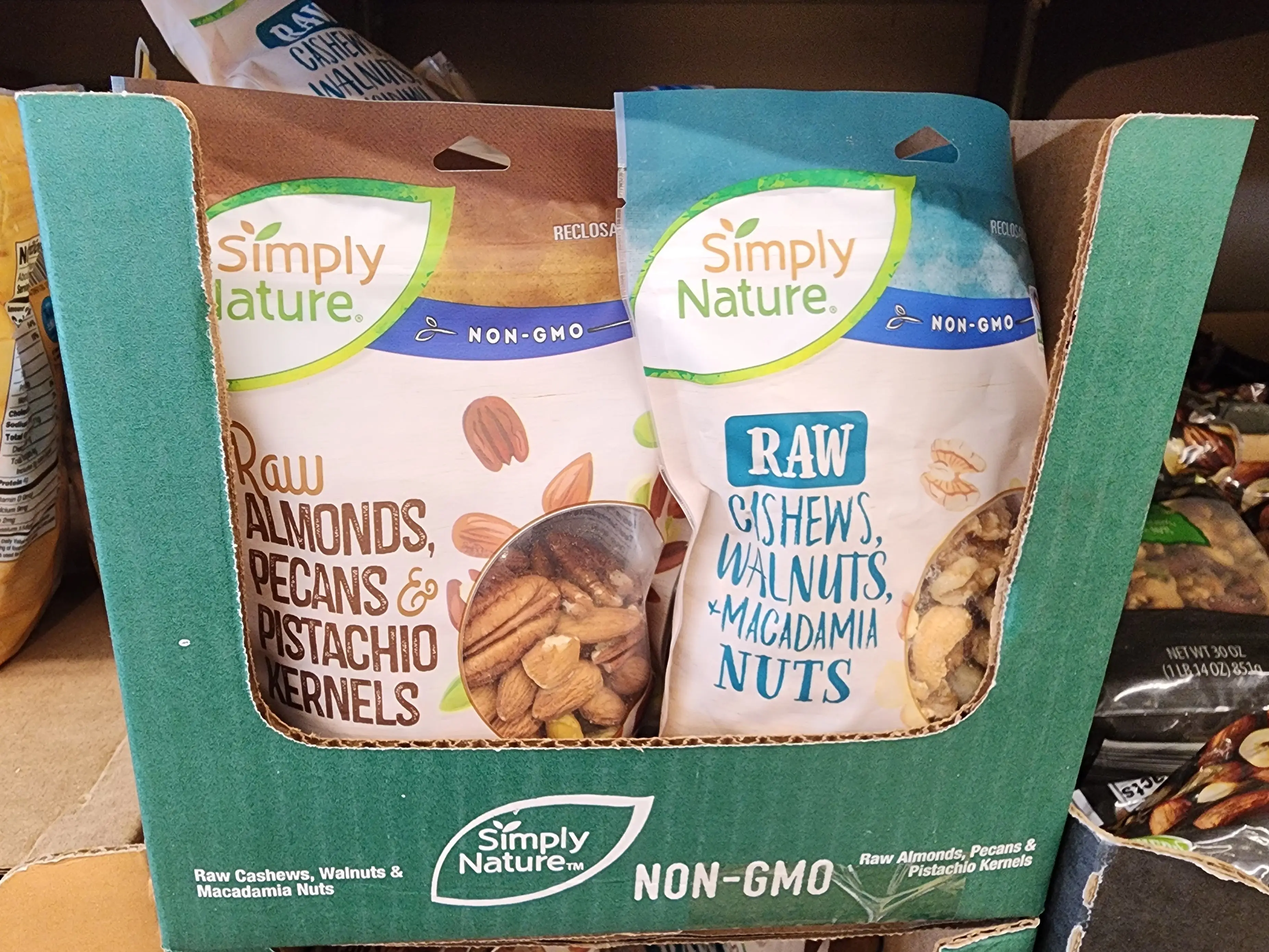
A bag of Simply Nature raw almonds, pecans, and pistachio kernels, and a bag of Simply Nature raw cashews, walnuts, and macadamia nuts sit in a cardboard box at Aldi.

I always have Simply Nature raw almonds, pecans, and pistachio kernels on hand, since they provide healthy fats and fiber.

They’re an easy snack, but I also like to sprinkle them over yogurt, oatmeal, roasted vegetables, and salads for extra crunch. And whenever I’m craving something sweet, I’ll add them to a berry-forward dessert like a crisp or a crumble.

My Aldi trip isn’t complete without the Millville rolled oats.
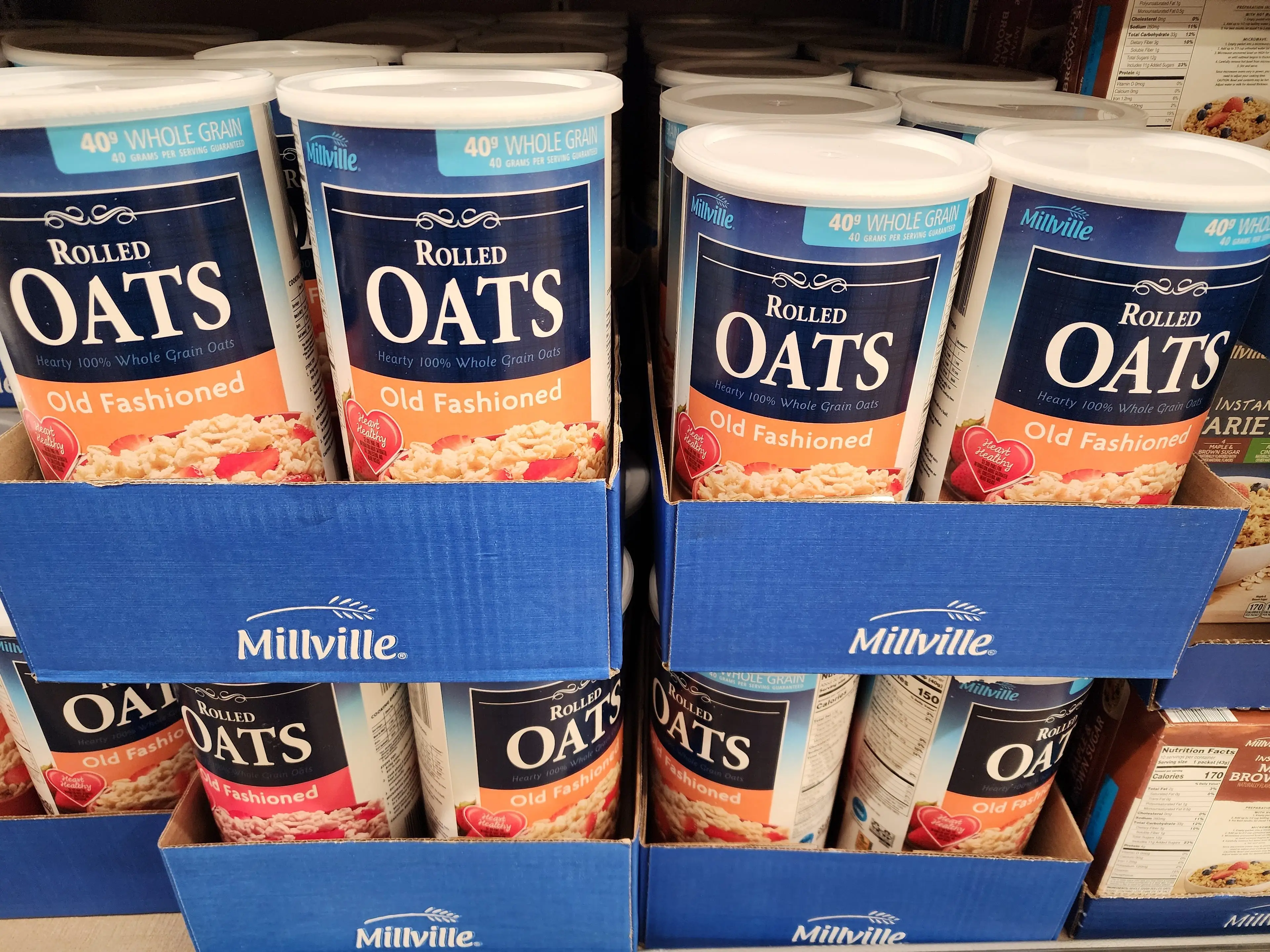
Several containers of Millville old-fashioned rolled oats sit in cardboard containers at Aldi.

Millville old-fashioned rolled oats are a pantry staple for me because they contain fiber, including beta-glucan, which can help support heart health. They also contain unique antioxidant compounds called avenanthramides, which have anti-inflammatory properties.

Beyond a warm bowl of oatmeal, I use them to make homemade energy bites, granola, and overnight oats.

They’re also great blended into smoothies for an extra boost of fiber.

Simply Nature organic ground turmeric is packed with flavor.
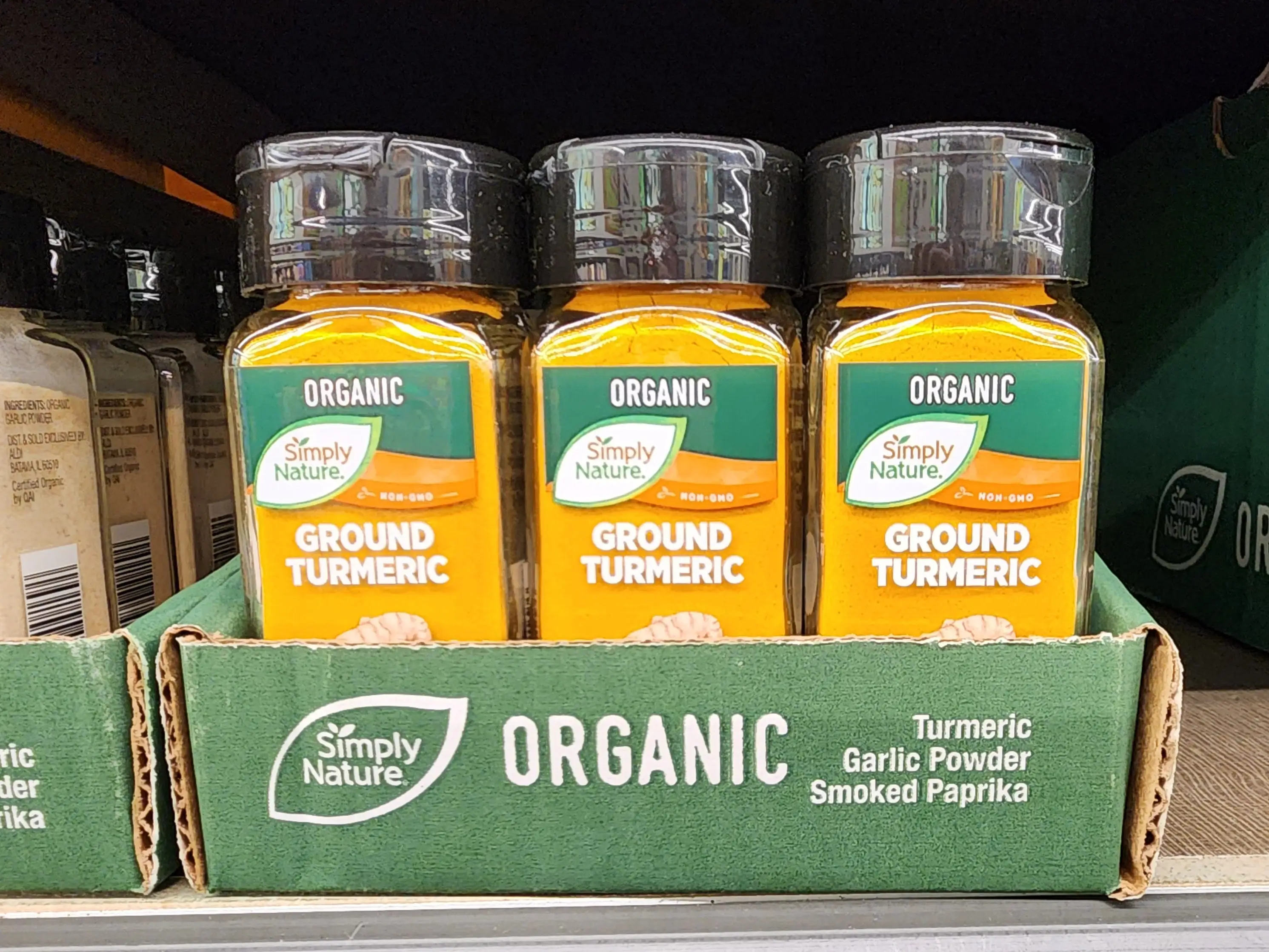
Several bottles of Simply Nature organic ground turmeric sit on a shelf at Aldi.

A little turmeric goes a long way. Its bright yellow color comes from curcumin, a compound that’s been widely studied for its anti-inflammatory benefits. And at Aldi, it costs only $2.

I love to stir the Simply Nature organic ground turmeric into soups, roasted vegetables, curries, rice, and scrambled eggs.

Aldi’s canned beans are my secret to quick weeknight meals.
Simply Nature dark red kidney beans and pinto beans are stacked in a grocery store display at Aldi.

Simply Nature dark-red kidney beans and pinto beans are some of my favorite budget-friendly meal shortcuts.

Not only are they loaded with fiber and plant protein, but eating beans regularly has also been associated with lower inflammation and improved gut health.

I rinse and drain them, then add them to soups, tacos, salads, grain bowls, or pasta dishes. Sometimes, I mash them into dips for a quick snack.

Season’s Choice steamed edamame is a great snack.
Several bags of Season's Choice steamed edamame sitting in a cardboard box at Aldi.

In my opinion, edamame is one of the most underrated foods in the freezer aisle.

It’s packed with protein, fiber, and naturally occurring isoflavones, which some research suggests may help protect against certain cancers.

I always grab Season’s Choice steamed edamame at Aldi, and like to toss it into stir-fries, fried rice, salads, noodle bowls, and soups — or simply microwave it for an easy, satisfying snack with a sprinkle of sea salt.

This article is not a substitute for professional medical advice, diagnosis, or treatment. Always consult your qualified physician or healthcare provider.

Curious to know what other shoppers put in their carts? Check out our other Aldi diaries here.

Read the original article on Business Insider


Source link

Tether clears $1.5 billion in profit as its safety cushion shrinks by half

0
Tether clears $1.5 billion in profit as its safety cushion shrinks by half

Tether reported $1.5 billion in net operating profit for the second quarter of 2026, driven by returns from its U.S. Treasury and repurchase agreement holdings.

The issuer of USDT, the world’s largest stablecoin, reported holding $187.75 billion in assets against $183.64 billion in liabilities as of June 30, leaving it with $4.11 billion in excess reserves, according to the BDO attestation released Friday. Those excess reserves are down from just over $8.23 billion three months earlier.

The second quater report shows Tether increased its physical gold holdings by 14 tons to roughly 146.2 metric tons from 132.2 tons during the quarter. The value of those holdings, however, fell to $18.84 billion from $19.84 billion because the price of gold dropped about 15% to just over $4,000 per ounce.

The company lifted bitcoin holdings by roughly 1,796 coins to 98,933 BTC. The value of those holdings fell to $5.80 billion from $6.62 billion as the bitcoin price used in the reports declined to $58,600 from $68,200, during the period.

Tether’s USDT issuance increased by about $446 million to $184.6 billion during the quarter.


Source link

Best CD rates today, Friday, July 31, 2026: Up to 4.15% APY return

0
Best CD rates today, Friday, June 19, 2026: Up to 4.20% APY return


See which banks are currently paying the highest CD rates. If you’re looking for a secure place to store your savings, a certificate of deposit (CD) may be a great choice. These accounts often provide higher interest rates than traditional checking and savings accounts. However, CD rates can vary widely. Learn more about CD rates today and where to find high-yield CDs with the best rates available.

Today’s CD rates vary quite a bit. In general, however, CD rates have been declining for quite some time due to the Fed’s decision to cut its benchmark rate three times in the latter part of 2024 and three times in 2025. Even so, with the Fed leaving rates unchanged so far in 2026, some banks are still offering competitive CD rates.

For institutions offering competitive rates, top rates reach about 4% APY. This is especially true for shorter terms of one year or less. 

Today, Friday, July 31, 2026, the highest CD rate is 4.15%. This rate is offered by Synchrony Bank on its 14-month CD.

Here is a look at some of the best CD rates available today from our verified partners:

Compare these rates to the national average as of July 2026 (the most recent data available from the FDIC):

Compared with today’s top CD rates, national averages are much lower. This highlights the importance of shopping around for the best CD rates before opening an account.

Online banks and neobanks are financial institutions that operate solely via the web. That means they have lower overhead costs than traditional brick-and-mortar banks. As a result, they’re able to pass those savings on to their customers in the form of higher interest rates on deposit accounts (including CDs) and lower fees. If you’re looking for the best CD rates available today, an online bank is a great place to start.

However, online banks aren’t the only financial institutions offering competitive CD rates. It’s also worth checking with credit unions. As not-for-profit financial cooperatives, credit unions return their profits to customers, who are also member-owners. Although many credit unions have strict membership requirements that are limited to those who belong to certain associations or work or live in certain areas, there are also several credit unions that just about anyone can join.

Whether or not you should put your money in a CD depends on your savings goals. CDs are considered a safe and stable savings vehicle — they don’t lose money (in most cases), are backed by federal insurance, and allow you to lock in today’s best rates.

However, there are some drawbacks to consider. First, you must keep your money on deposit for the full term, otherwise you’ll be subject to an early withdrawal penalty. If you want flexible access to your funds, a high-yield savings account or money market account might be a better choice.

Additionally, although today’s CD rates are high by historical standards, they don’t match the returns you could achieve by investing your money in the market. If you’re saving for a long-term goal such as retirement, a CD won’t provide the growth you need to reach your savings goal within a reasonable time frame.

Read more: Short- or long-term CD: Which is best for you?


Source link