Home Blog Page 137

Will crypto recover? Three signals that could confirm a lasting rebound

0
Will crypto recover? Three signals that could confirm a lasting rebound


The crypto market has shown signs of stabilizing after June’s sell-off. Still, the evidence for a sustained recovery remains incomplete.

Recent Bitcoin ETF inflows have improved sentiment, yet market structure, altcoin participation, and institutional demand have not fully aligned. Until those signals strengthen together, the latest rebound remains vulnerable to another pullback.

Total market value must reclaim key resistance

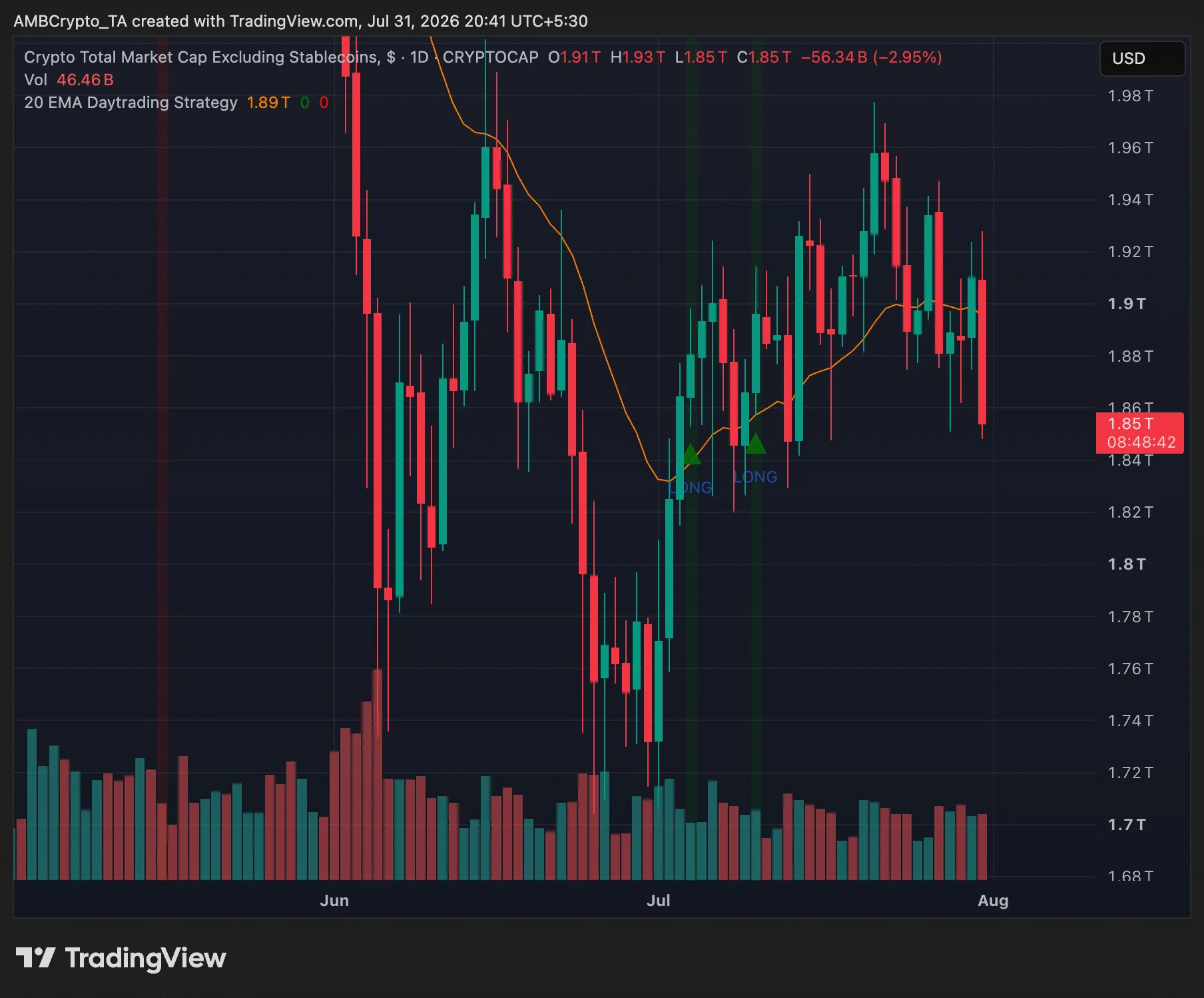
The TOTALES index, which tracks the crypto market excluding stablecoins, fell 2.95% to approximately $1.85 trillion, slipping back below its 20-day exponential moving average [EMA] at $1.89 trillion.

Reclaiming that level would improve short-term momentum, but the more important test sits between $1.94 trillion and $1.96 trillion.

That area repeatedly capped rallies throughout July. A decisive move above it would establish a higher high and provide stronger evidence that the broader market trend is turning positive.
Crypto market capitalization excluding stablecoins
Source: TradingView

On the downside, immediate support remains near $1.84 trillion. Losing that level could expose $1.80 trillion, followed by the June support region around $1.74-$1.76 trillion.

Altcoins need to join the recovery

One of the clearest signs that the current rebound remains incomplete is the weakness across smaller cryptocurrencies.

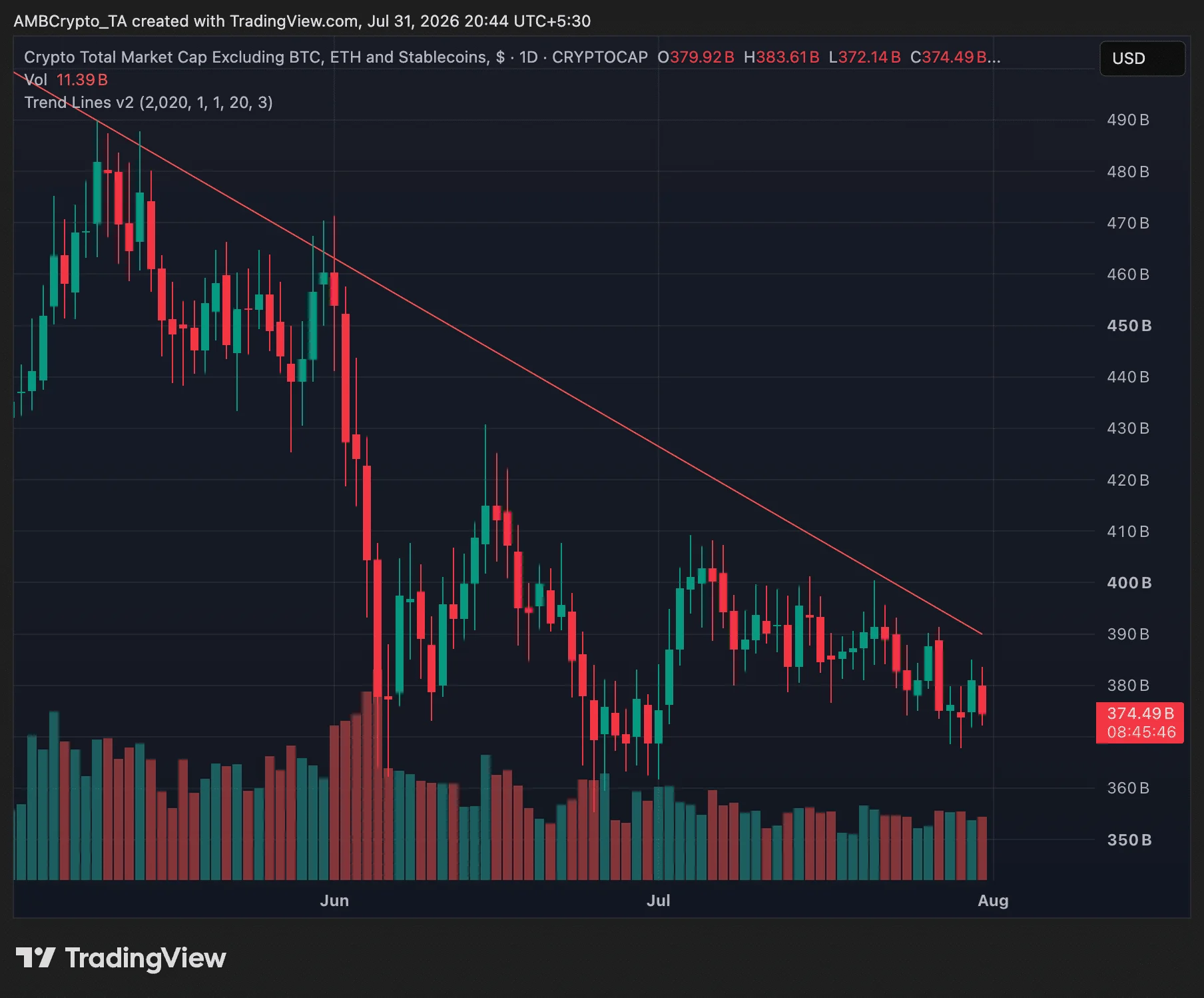
Market capitalization excluding Bitcoin, Ether, and stablecoins stood near $374.5 billion, remaining below the descending trendline that has capped rallies since May.

That trendline currently sits around $390 billion.
Crypto market capitaliztion excluding Bitcoin and EthereumCrypto market capitaliztion excluding Bitcoin and Ethereum
Source: TradingView

A breakout above it could open the way towards $400-$405 billion, signalling that buying interest is broadening beyond the largest cryptocurrencies.

Conversely, a move below $370-$372 billion would increase the risk of another decline towards June’s support near $360 billion.

The contrast between the two market-cap charts suggests Bitcoin and Ether have led most of the recent recovery. At the same time, many altcoins continue to post lower highs.

ETF demand needs to remain consistent

Institutional demand has shown tentative signs of improvement.

According to SoSoValue data, US spot Bitcoin ETFs attracted $32.1 million on July 29, followed by another $233.1 million on July 30, bringing two-day inflows to $265.2 million.

However, the products still recorded a combined $261.3 million in net outflows across the previous six completed trading sessions.

Ethereum ETFs presented an even weaker picture.

Although the funds attracted $12.8 million on July 30, they still recorded a net outflow of $43.4 million over the same six-session period.

That divergence suggests institutional appetite for Bitcoin is improving, but has yet to broaden across the wider crypto market.

Meanwhile, the Federal Reserve maintained interest rates at 3.50%-3.75%. At the same time, three policymakers voted for an immediate increase, leaving the prospect of tighter monetary policy on the table.

Will crypto recover in 2026?

For now, the market has yet to produce the combination of technical and fundamental signals that typically accompanies a sustained bull phase.

A stronger recovery would likely require:

  • The total crypto market is expected to reclaim $1.89 trillion before breaking above $1.96 trillion.
  • Altcoins to break above $390 billion, showing that buying is spreading beyond Bitcoin and Ether.
  • Bitcoin ETF inflows to remain positive while Ethereum ETFs and broader institutional demand also begin to recover.

Until those conditions align, the latest rebound should be viewed as an encouraging improvement rather than confirmation of a lasting market recovery.


Final Summary

  • Crypto’s recovery remains incomplete, with market structure, altcoin participation, and institutional demand still falling short of full confirmation.
  • A sustained rebound would require stronger price action, broader market participation, and more consistent ETF inflows across both Bitcoin and Ethereum.


Source link

Quantum computing nears commercial breakthrough, IBM CEO says

0
Quantum computing nears commercial breakthrough, IBM CEO says

Unlike AI, which has driven a surge in demand for graphics processors to train and run large language models, quantum computing targets a different class of challenges. Researchers say the technology could accelerate molecular simulations, optimize complex logistics networks, advance materials science and improve cryptography.

Krishna said IBM has already demonstrated some of that potential, using quantum computers to uncover properties of materials that conventional computers had been unable to model. Those insights could eventually contribute to longer-lasting batteries, new materials, fusion energy research and drug discovery.

Growing confidence around commercialization has been matched by rising investment. In May, IBM announced plans for a standalone quantum chip foundry backed by a $1 billion commitment from the U.S. Department of Commerce through the CHIPS incentive program, alongside a matching $1 billion investment from the company. Other developers have also expanded manufacturing capacity and research partnerships as they push toward fault-tolerant quantum computers.

The industry’s progress is also drawing attention from the digital asset sector. Several publicly traded bitcoin miners, including MARA Holdings (MARA), Riot Platforms (RIOT) and CleanSpark (CLSP), have diversified into AI and high-performance computing, leveraging their data centers and power infrastructure for new computing workloads.

Quantum computers won’t simply slot into today’s AI data centers. They require entirely different hardware and operating environments, meaning the industry will need new facilities and supply chains as the technology matures.


Source link

US Treasury informed banks that it may intervene in Japan’s yen, source says

0
US Treasury informed banks that it may intervene in Japan's yen, source says


By David Lawder

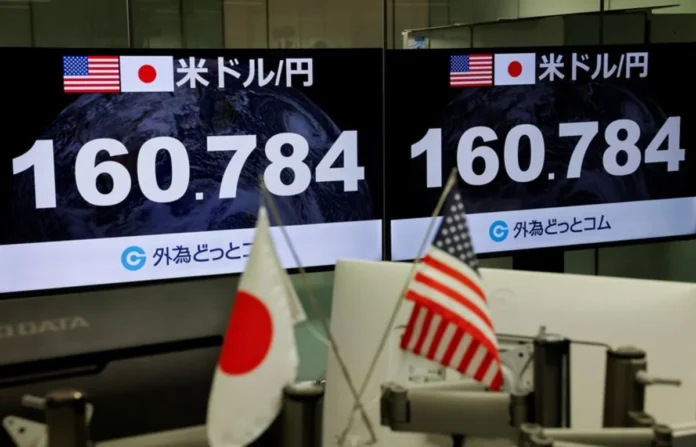
July 31 (Reuters) – The U.S. Treasury has informed a number of banks that it may intervene in the Japanese yen market on Friday and that they should “stand ready for future action,” a source familiar with ‌the matter told Reuters.

The notice to banks, channeled through the Federal Reserve Bank of New York, comes a day ‌after Japanese authorities stepped in to prop up the yen, setting the currency up for its biggest weekly rise since February, pulling it off of four-decade ​lows against the dollar.

News of the potential intervention by the U.S. Treasury helped push the yen higher against the dollar on Friday. It last traded at 159.09 to the dollar after trading as low 163.65 on Thursday.

The method of potential Treasury intervention was not immediately clear. The Federal Reserve has maintained a dollar liquidity swap line with the Bank of Japan and four other major central banks since 2013.

Japan’s ‌top currency diplomat Atsushi Mimura in Tokyo Friday ⁠declined to comment on intervention but hinted at U.S. involvement in the effort to stem the yen’s decline, including so-called “rate checks” — requests to dealers for indicative dollar/yen quotes that are considered a precursor to ⁠interventions.

Mimura added that the U.S. support “goes beyond psychological support.”

The Reuters report of Treasury’s notice to banks of potential intervention “fits in with the view in the market that the New York Fed has been carrying rate checks, so it’s adding to the nervousness of market participants that there could ​be ​further intervention,” said Lee Hardman, currency strategist at MUFG in London. “It definitely ​helps support the idea that there is intervention ‌risk on the table.”

U.S. Treasury Secretary Bessent said in an X social media post that the Treasury maintains “a strong relationship and close coordination” with Japanese authorities, but did not confirm the intervention preparations.

He said he looked forward to meeting with Bank of Japan Governor Kazuo Ueda at the U.S.-hosted G20 finance ministers and central bank governors meeting in Asheville, North Carolina, at the end of August.

“Japan’s economy continues to perform well under Prime Minister Takaichi, Governor Ueda and the Bank of Japan Board, which has demonstrated a strong ‌commitment to monetary and financial stability,”

On Thursday, U.S. Treasury Secretary Scott Bessent told ​Fox Business Network that the yen “seems very undervalued to me” and that Japanese ​Prime Minister Sanae Takaichi was enacting “strong policies” that would ​help Japan’s economic fundamentals.

Bessent added that “we think excess volatility in the yen isn’t healthy” and that the ‌yen has “substantially overshot what would be called an equilibrium ​price.”

The last time that the U.S. ​Treasury intervened directly to prop up Japan’s yen was in 2011 as part of a coordinated action by G7 countries to stabilize the currency after a devastating earthquake and tsunami rocked Japan.

The Treasury last fall intervened to prop up Argentina’s ​peso market ahead of parliamentary elections and ‌provided President Javier Milei’s government with a $20 billion currency swap line to help stabilize the currency and Argentina’s dollar ​bonds.

The aid to Argentina relied partly on the Exchange Stabilization Fund, which had total assets of about $217 billion ​as of June 30.

(Reporting by David Lawder; Editing by Chizu Nomiyama)


Source link

Novo Nordisk’s Market Value Sheds $30 Billion—Here’s Why Shares Are Down

0
Novo Nordisk’s Market Value Sheds $30 Billion—Here’s Why Shares Are Down


Topline

Novo Nordisk shares plunged on Friday, erasing more than $30 billion in market value after the Danish drugmaker said a late-stage experimental drug failed in a large study, drawing criticism from analysts who said the firm missed an opportunity to expand beyond its weight-loss offerings.

Key Facts

Shares of Novo Nordisk dropped 9.3% to around $46.70 as of Friday morning, marking the stock’s largest intraday loss since February and a 10.6% decline so far this year.

Novo Nordisk reported Friday its ziltivekimab “did not achieve” goals to reduce major adverse cardiovascular events like a heart attack or stroke in a late-stage clinical trial, and it did not disclose how much the drug reduced risks.

Jeffries analysts wrote in a note that ziltivekimab would have needed to show at least a 20% risk reduction, and the trial results were “strategically negative” as they effectively erased a growth opportunity for Novo Nordisk’s business beyond its Ozempic and Wegovy market that could have been worth more than $10 billion annually.

Goldman Sachs analysts praised the drug’s potential ahead of the trial results, writing ziltivekimab could have been the foundation for Novo Nordisk to build a franchise in cardiovascular disease care and relieve potential risks to sales, which are largely reliant on Ozempic and Wegovy.

big number

$30.7 billion. That’s how much was cut from Novo Nordisk’s market capitalization as of Friday’s share price, lowering from $229.2 billion to $198.5 billion, marking a nearly 69% decline since hitting an all-time high of $635.7 billion in June 2024.

key background

Novo Nordisk, despite the success of its Ozempic and Wegovy drugs in recent years, has worked to expand on its other businesses to bolster sales. The firm has moved to increase the GLP-1 market by expanding into pill versions of its medications, and Novo Nordisk has since launched a Wegovy pill in the United Arab Emirates and the U.K., with plans to sell in the U.S. and globally.

tangent

Novo Nordisk clashed with Eli Lilly earlier this month, accusing the rival GLP-1 manufacturer of “deceptive” advertising that Novo Nordisk said relied on outdated data to make its products look less effective. The Ozempic maker said it looked to resolve the dispute out of court, but “Lilly refused, calling its advertising ‘truthful’ and ‘transparent,’” according to court documents. The motion also asks the court to require Lilly to issue corrective advertising that indicates its ad campaigns had “planted false beliefs in consumers’ minds.”

further reading

ForbesNovo Nordisk Asks Court To Block Eli Lilly’s ‘Deceptive Advertising’


Source link

All about Coldcard’s $38M Mk3 exploit and what’s next for Bitcoin self-custody

0
All about Coldcard’s $38M Mk3 exploit and what’s next for Bitcoin self-custody


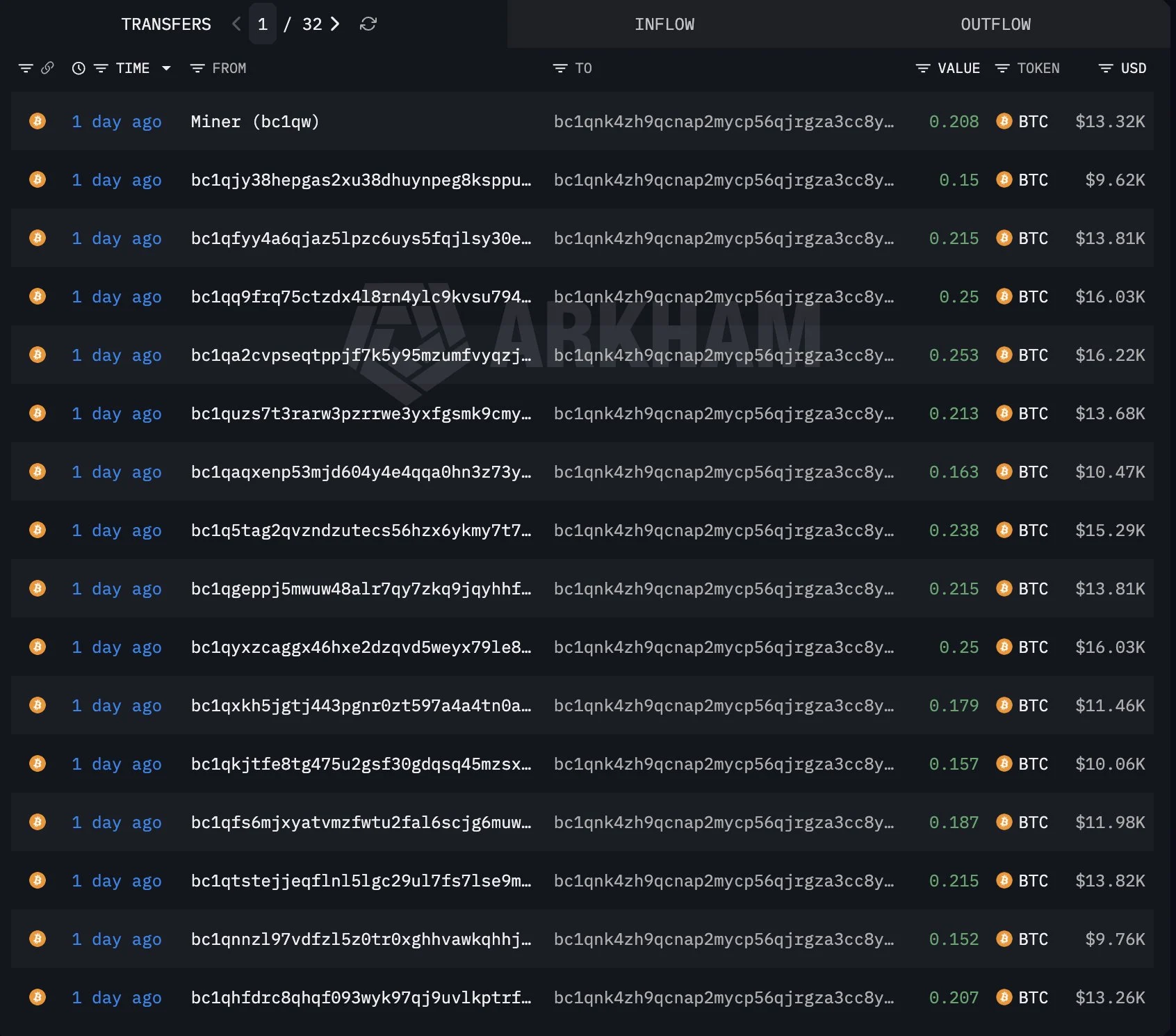
On the 30th of July, Bitcoin’s [BTC] self-custody faced a stress test. An attacker drained about 594 BTC worth over $38 million from 500 Coldcard wallets within about 15–25 minutes.

This action is a real-world examination of Bitcoin’s core ethos, as these users did everything right. They bought a reputable air-gapped device, never entered the seed on a networked computer, and left funds untouched for years, but still lost money.

Are other hardware wallets at risk?

Hacker drains 594 BTC from 500 Coldcard wallets

As per on-chain investigations, an attacker exploited a Coldcard Mk3 seed generation flaw to steal BTC in less than half an hour. The bug made some Mk3 recovery phrases predictable due to weak entropy.

Normally, a hardware wallet generates the seed phrase using true randomness. However, the flaw reduced the number of guesses a hacker needed to make by altering how the system selected the words

Instead of choosing from 340 undecillion combinations, the wallet was picking from a few billion. Despite that being a huge number, it is astronomically smaller than what Bitcoin’s security is designed to provide.

BitcoinBTC
Source: Arkham

Even so, the seed phrase looked normal, but the words came from the same word list. Hence, the search space became extremely smaller for the hacker.

Coldcard security advisory

Coldcard has faced backlash due to this incident despite warning Mk3 users that their funds were not safe. However, those who protected with a BIP-39 passphrase faced minimal risk.

Additionally, seedphrases generated on Mk4, Q, and Mk5 before the fixed firmware release were affected too. Coldcard advisory report said,

If you generated a seed on a Mk3 after firmware 4.0.1, your funds may be at risk.

Other Coinkite hardware signers, such as TAPSIGNER, OPENDIME, and SATSCARD, remained unaffected. The company advised Mk3 users to move their funds.

They recommend migrating funds to a newly generated seed on an unaffected device. Moreover, they could use a strong BIP-39 passphrase or dice-only seed.

Despite the company’s detailed technical analysis, the very act of moving funds under time pressure creates new opportunities for user error, phishing, or rushed mistakes.

Self-custody’s stress test

The attack has spread panic across the Bitcoin community, but the core ecosystem remains intact.

This is because only single-sig hardware wallets were affected, prompting the addition of extra layers of security to better them. Thus, passphrases, multisig, and dice rolls were non-negotiable.


Final Summary

  • An attacker exploited a Coldcard Mk3 flaw, draining 594 BTC worth $38 million in less than half an hour.
  • Bitcoin’s self-custody faced a stress test, but the security remains intact for wallets with extra layers like multisig. 


Source link

Circle secures New York trust charter as crypto regulatory push accelerates

0
Circle secures New York trust charter as crypto regulatory push accelerates

Circle Internet Group, Inc. (CRCL), the issuer of USDC, the world’s second-largest stablecoin, announced Friday that it secured a limited purpose trust charter from the New York Department of Financial Services (NYDFS).

The trust charter is an official state banking authorization that allows the holder to legally provide fiduciary, custody and asset-management services under the New York Banking Law.

“Earning a New York trust charter has been a longstanding objective for Circle given the regulatory clarity that comes with it,” said Jeremy Allaire, Co-Founder, Chairman, and CEO of Circle.

Circle’s stock price remains flat Friday morning at $64.24 and its stablecoin USDC has a market capitalization exceeding $71.8 billion.

Earlier this month, Circle received approval from the U.S. Office of the Comptroller of the Currency (OCC) to establish a national trust bank.

National trust banks are authorized to provide users with custody and fiduciary services but do not accept consumer deposits or make loans like traditional commercial banks.

The stablecoin issuer said the national bank would “enhance the safety and regulatory oversight of the USDC Reserve, while enabling Circle to offer fiduciary digital asset custody and related services to institutional customers.”


Source link

Study Finds That A $1.2 Million Retirement and a $4 Million Retirement Look Almost Identical In Terms Of Spending

0
Study Finds That A $1.2 Million Retirement and a $4 Million Retirement Look Almost Identical In Terms Of Spending


Quick Read

  • JPMorgan and Morningstar data show that retirees with portfolios ranging from $1.2M to $4M tend to cluster in the same annual spending band of $70K to $120K.

  • Boldin’s data reveals median retirement income climbs just $16K between the $1M and $5M-plus tiers, showing wealth barely drives higher spending.

  • Time and energy run out before money does, so wealthier retirees upgrade quality of spending rather than volume, keeping total outlays in the same range.

  • Act now: the analyst who called NVIDIA in 2010 just named his top 10 AI stocks — and JPMorgan Chase didn’t make the cut. Grab the names FREE today.

A $1.2 million retirement and a $4 million retirement do not look nearly as different as the balances suggest. Across the Federal Reserve Survey of Consumer Finances, JPMorgan (NYSE:JPM)’s 2026 Guide to Retirement, and Boldin’s planning data, households with seven-figure net worth cluster in the same annual spending band whether their portfolio sits near $1 million or well past $3 million.

Prostock-studio / Shutterstock.com

The convergence figure is $70,000 to $120,000 a year in retirement spending for $1 million-plus households. That range holds across three very different measurement approaches: the Fed’s household balance-sheet survey, JPMorgan’s actuarial spending analysis, and Boldin’s user-level planning platform. Context matters here. Roughly three out of four $1 million-plus households sit between $1 million and $3 million in net worth. Millionaire retirees, as a group, are mostly ordinary savers, with net worth well below the $10 million-plus ultra-wealthy tier.

Why Spending Refuses to Scale

Core costs stay roughly fixed. Housing, food, and healthcare cost about the same whether your portfolio is $1.5 million or $4 million. Time and energy run out before money does, and wealthier retirees typically change how they spend (better quality, more health-focused choices) before they change how much.

Act now: the analyst who called NVIDIA in 2010 just named his top 10 AI stocks — and JPMorgan Chase didn’t make the cut. Grab the names FREE today.

Consider the hypothetical couple Boldin uses to illustrate the pattern. Grant and Priya retire at 67 and 65 with $1.5 million invested and a combined $45,000 in Social Security. They arrive at about $105,000 a year in spending without ever targeting that figure. The arithmetic underneath is straightforward. Married couples in this wealth tier often collect a combined $40,000 to $70,000 in Social Security, well above the roughly $25,000 an average single retired worker collects. A $1.5 million portfolio at a 4% withdrawal rate produces about $60,000 a year, which combined with Social Security lands many households at $100,000 to $110,000 annually before any deliberate lifestyle decisions. The 2.8% Social Security COLA for 2026 reinforces that benefit as an inflation-adjusted floor.


Source link