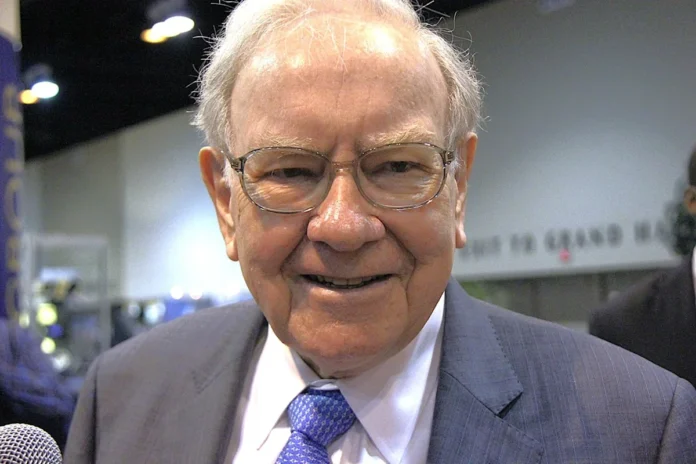
Warren Buffett is no longer the CEO of Berkshire Hathaway (NYSE: BRKA)(NYSE: BRKB). But his fingerprints are all over how the conglomerate does business. After all, Berkshire’s investment activities are now overseen by a handful of handpicked lieutenants, all of whom spent years working directly with Buffett, mastering his investment style while bringing their own strengths.
There are plenty of stocks in Berkshire’s portfolio that Buffett personally selected. One of Berkshire’s biggest positions, in fact, was a favorite of Buffett’s when he was at the helm. This under-the-radar oil stock remains relatively cheap despite Berkshire’s heavy interest.
Missed Nvidia in 2009? This Rare Signal Is Flashing Again. In 2009, a “Double Down” signal flashed for a little-known chipmaker called Nvidia. For the first time in years, that same “Total Conviction” signal is flashing for a company 1/100th the size of Nvidia. Continue »
Warren Buffett loved this oil and gas stock
Buffett first bought shares of Occidental Petroleum (NYSE: OXY) for Berkshire’s portfolio in the first quarter of 2019. He massively upped the stake in the fourth quarter of that year, only to sell the entire stake in the second quarter of 2020.
Buffett couldn’t stay away for long, however. In March 2022, he purchased massive blocks of Occidental Petroleum over several trading sessions. He purchased even more shares on several occasions in May and June. While he did trim the position slightly later that year, Berkshire has been a consistent buyer of Occidental Petroleum stock nearly every quarter since.
Image source: The Motley Fool.
What did Buffett love so much about Occidental Petroleum? Mainly, he adored the way the company was run. After reading the company’s annual report, Buffett commented, “I read every word and said this is exactly what I would be doing.” But Buffett was more than just bullish on Occidental Petroleum’s management style. He was also a long-term oil bull. He once warned:
When you buy into a huge oil production company, how it works out is going to depend on the price of oil to a great extent. It’s not going to be your geological home runs or super mistakes or anything like that. It is an investment that depends on the price of oil.
In a nutshell, Buffett thought that buying into an oil company nearly required a bullish stance on oil prices.
Fortunately, Buffett had revealed in 2011 where he thought oil prices were headed long-term. “You’ve stuck a lot of straws into the Earth, and it is a finite number,” he said. “So, the one thing I can almost promise you is that oil will sell for a lot more someday.”
Occidental Petroleum isn’t the same company that Buffett originally purchased in 2019. In 2024, Occidental Petroleum added to its debt load with a $12 billion takeover of CrownRock, L.P., a mid-tier U.S. oil and gas producer. Then, in 2025, it sold its OxyChem chemicals division directly to Berkshire Hathaway in a $9.7 billion cash deal. The company also welcomed a new CEO on June 1.
Still, Berkshire Hathaway has held onto its entire position, refusing to trim its stake even after Buffett’s departure. Trading at 17 times free cash flow, Occidental Petroleum stock isn’t as cheap as it was when Buffett first started buying. But a 6% free-cash-flow yield remains respectable in an otherwise expensive market, especially if you believe ongoing geopolitical uncertainties will keep oil prices higher for longer.
Should you buy stock in Occidental Petroleum right now?
Before you buy stock in Occidental Petroleum, consider this:
The Motley Fool Stock Advisor analyst team just identified what they believe are the 10 best stocks for investors to buy now… and Occidental Petroleum wasn’t one of them. The 10 stocks that made the cut are built for long-term growth and could produce monster returns in the coming years.
Consider when Netflix made this list on December 17, 2004… if you invested $1,000 at the time of our recommendation, you’d have $379,662!* Or when Nvidia made this list on April 15, 2005… if you invested $1,000 at the time of our recommendation, you’d have $1,206,116!*
That performance is why people listen. With a track record of beating the S&P 500 by 4x, Stock Advisor offers a distinct advantage. Don’t miss the latest top 10 list, available with Stock Advisor, and join an investing community built for the long haul.
Ryan Vanzo has no position in any of the stocks mentioned. The Motley Fool has positions in and recommends Berkshire Hathaway. The Motley Fool recommends Occidental Petroleum. The Motley Fool has a disclosure policy.
Bitcoin and other crypto has spent years being discussed as an asset, yet the more useful question is where it goes after leaving an exchange. From online entertainment to business payments, the answer now sits inside ordinary checkouts, cards and apps, where digital money is starting to behave like money people actually spend.
Crypto usually enters the conversation as something to buy, hold or trade, but that leaves out the part where people actually spend it. In 2026, digital assets are paying for travel bookings, supplier invoices and online entertainment, with stablecoins doing much of the practical work behind the scenes. The big change is happening at checkout, where crypto now moves through cards, apps and payment tools that people already know how to use.
Crypto Leaves the Wallet and Enters the Game
Online entertainment gives crypto a direct job. A player sends funds from a wallet into an account, uses the balance to play, and can later withdraw through the same payment route. The transaction is tied to a service, rather than another trade or a move between wallets.
That is the payment setup one can find at voltrush.com. The VoltRush crypto casino supports deposits and withdrawals in Bitcoin, Ethereum, Litecoin, XRP, Solana and Tron, alongside Visa, Mastercard and Apple Pay deposits. The casino carries more than 7,000 pokies, plus live blackjack, roulette and baccarat, so the payment leads straight into a large entertainment product rather than sitting in a wallet waiting for another price move.
Players can hold accounts in AUD, NZD, CAD or USD, which is useful for an audience spread across Australia and New Zealand. The minimum deposit is $20 AUD, and withdrawals can return through cryptocurrency or bank transfer. Security checks may hold a payment briefly, but pending requests usually clear within a few hours.
That setup shows where crypto spending becomes practical. The user already has the wallet, the service already runs online, and the payment never needs to leave the digital environment. There is no need to convert funds manually before using them.
Stablecoins Are Carrying the Payment Load
Volatile coins still dominate headlines, but stablecoins are doing a large share of the payment work. Their value is tied to a fiat currency, usually the US dollar, which makes them easier to use for invoices and supplier payments where the amount cannot jump around before settlement.
Stripe’s annual update, published in February 2026, said stablecoin payment volume doubled during 2025 to about US$400 billion. Stripe estimated that 60% of that volume came from business-to-business payments, while Bridge processed more than four times its previous transaction volume.
The spending pattern now reaches several parts of the economy:
Spending Channel
Payment Function
Verified Detail
Online entertainment
Deposits and withdrawals
VoltRush supports six cryptocurrencies
Business payments
Supplier and contractor settlement
Stripe attributed 60% of stablecoin payment volume to B2B use
Ecommerce
Wallet payment with fiat settlement
Shopify merchants can accept USDC while receiving local currency
Travel
Booking flights and accommodation
Travala accepts more than 100 cryptocurrencies
Card spending
Stablecoin balance converted at purchase
Visa and Bridge connect crypto balances to card payments
The important point is that much of this activity does not depend on a merchant holding crypto. A customer can pay from a digital balance, while the business receives local currency through its normal settlement process. That removes one of the biggest operational headaches from the sale.
Familiar Payment Design Is Driving Adoption
Crypto payments become easier to use when the process resembles an ordinary card or banking transaction. Wallet addresses, network choices and manual conversions create room for mistakes, so payment companies are placing those technical steps behind interfaces people already understand.
Research commissioned by Visa and conducted by Askable between February and March 2026 surveyed 703 Australian consumers and 257 Australian small businesses. It found that 60% of respondents would consider using stablecoins for international payments when the option sat inside an existing bank app or card. Another 67% said fraud protection and money-back guarantees would increase their confidence.
The business figures were even more practical. Visa and Askable found that 78% of Australian small businesses planned international payments days or weeks ahead, while 58% named cybersecurity concerns as a barrier to adopting a new stablecoin payment method.
Anthony Jones, Head of Product for Visa Oceania, put the point plainly in March 2026: “Stablecoins can help make international payments as seamless as sending a text.”
That same design logic appears in VoltRush’s payment menu. Crypto sits beside Visa, Mastercard and Apple Pay, so the player can change the payment rail without learning a new entertainment product.
Where Crypto Is Actually Being Spent
The strongest use cases in 2026 are attached to a clear product or operational need.
Travel: Travala covers more than 2.2 million properties and 600 airlines, with more than 100 cryptocurrencies accepted for bookings. Its catalogue also includes 400,000 activities and 50,000 car-rental locations.
Ecommerce: Shopify’s stablecoin rollout lets a customer pay in USDC while the merchant receives local currency. The sale can use blockchain settlement without forcing the retailer to manage a crypto treasury.
Supplier payments: Stripe’s US$400 billion stablecoin figure includes a 60% B2B share, showing that companies are using digital dollars for operating payments rather than novelty purchases.
Digital services: Stablecoin micropayments can cover API calls, subscriptions and automated services where card fees make very small transactions uneconomical.
Online entertainment: Crypto funds play across VoltRush’s pokies and live tables, then remain available as a withdrawal method. The same account also supports fiat currencies, which gives players a choice between digital assets and conventional payment routes.
The common thread is direct utility. A coin becomes useful when it pays for something the customer already wants, without adding extra work at the point of sale.
Payment Speed Still Needs the Right Friction
Fast payments still need checks. A withdrawal sent to the wrong wallet cannot be pulled back easily, and a stolen account can move funds before the owner realises what happened. Good payment design therefore removes pointless delays while keeping controls that protect the account.
VoltRush requires identity verification before withdrawal and may ask for ID with proof of address. The casino also provides two-factor authentication, deposit limits and loss controls. Players can set wager limits, take a time-out or use self-exclusion tools from the account area.
Those controls sit beside the payment process rather than replacing it. A crypto withdrawal may still need a security review, and that can delay settlement for a few hours. The delay has a purpose when it checks ownership or unusual account activity.
The wider crypto industry is dealing with the same balance. Exchanges, custodians and other intermediaries face increasing pressure to improve registration, reporting and anti-fraud controls as digital assets move into everyday payment systems.
For users, the best experience is simple to understand: fast when everything checks out, slower when there is a reason to stop and look.
Crypto Spending Is Becoming Less Visible
The clearest development in 2026 is happening behind the payment screen. Stablecoin balances now fund cards, ecommerce checkouts, and business transfers without asking the merchant to handle crypto directly.
That changes what crypto spending looks like. The customer may pay from a wallet, yet the business receives ordinary currency and records the sale through its normal systems. Online entertainment follows the same pattern, with crypto sitting beside established payment methods rather than replacing them.
Crypto is being spent in more places because the technical work is moving into the background. The payment still uses blockchain infrastructure, but the person making it sees a checkout they already understand.
Gambling is for adults and carries financial risk. It should be treated as entertainment, never as a source of income.
Author Bio
David Fox is an experienced iGaming writer with a strong understanding of online casinos, sports betting and gambling regulation. He specialises in exploring the trends shaping modern wagering markets, helping readers understand the technology, culture and industry developments behind today’s betting landscape.
Disclaimer: This is a paid post and should not be treated as news/advice.
Data center operator Core Scientific (CORZ) announced an infrastructure partnership with Advanced Micro Devices (AMD) anchored by 15-year leases for 529 megawatts of U.S. AI capacity, which the company said could generate more than $14 billion in base contracted revenue.
The capacity is expected to support AMD customer deployments beginning in 2027. The agreements give AMD, under certain conditions, the right to reserve another 1,925 MW through Dec. 28, 2028, potentially expanding the partnership to roughly 2.5 gigawatts.
AMD directly leased 377 MW across Core Scientific sites in Pecos and Hunt County, Texas, and Muskogee, Oklahoma, according to the company’s quarterly filing.
An unnamed cloud provider leased another 152 MW in Auburn, Alabama, and Dalton, Georgia, under agreements supported by AMD.
Core Scientific and AMD will collaborate on data-center design and the deployment of AMD Instinct graphics processing units, EPYC processors and ROCm software, the companies said.
AMD also received warrants to purchase up to 30 million Core Scientific shares at $23.47 per share. About 6.5 million vested when the initial leases were signed, with further warrants vesting as additional capacity is contracted.
Apple (AAPL) on Tuesday briefly became the second publicly traded company in history to hit a market capitalization of $5 trillion.
The tech giant hit the milestone less than a year after topping $4 trillion in October 2025.
Apple stock is up roughly 24% year to date and nearly 60% over the past 12 months, driven by strong iPhone sales.
Investors have criticized Cupertino, Calif.-based Apple over the past few years, concerned that the company was too far behind in the AI race. While Apple initially debuted its Apple Intelligence platform in 2024, it delayed key parts of the software, including an upgraded version of Siri.
That led to executive shakeups at the company. Apple eventually signed a deal to use Google’s (GOOG, GOOGL) Gemini AI models to power the voice assistant.
Apple is now expected to launch the overhauled Siri as a beta alongside its highly anticipated first foldable iPhone and the iPhone 18 lineup later this fall.
The company’s lack of heavy AI exposure has meant it hasn’t seen the same kind of explosive growth as some of its Big Tech peers since OpenAI (OPAI.PVT) released ChatGPT in November 2022.
Of the group, Nvidia (NVDA) stock has benefited the most, climbing about 1,125%, while Meta (META) stock rose around 386% and Google jumped 226%. Shares of Apple, meanwhile, increased 130% during that time.
But Apple was also insulated from some of the steep selloffs that its AI-focused rivals have faced. Microsoft (MSFT) stock, for instance, has struggled since hitting an all-time closing high of $542.07 in October 2025, falling roughly 28% on questions about AI spending and growth.
AI, however, has hit Apple in another way. The company, like much of the consumer tech industry, is currently contending with the AI-induced global memory and storage shortage.
That has forced Apple to raise prices on its Mac and iPad products, among others. And while the company hasn’t increased iPhone prices yet, that could change with its upcoming smartphones.
All of this comes as Apple CEO Tim Cook prepares to hand over the reins to incoming CEO John Ternus on Sept. 1, marking one of the biggest leadership transitions in the company’s history.
Jared Blikre contributed to this story.
Sign up for Yahoo Finance’s Week in Tech newsletter. ·Yahoo Finance
Email Daniel Howley at dhowley@yahoofinance.com. Follow him on X at @DanielHowley.
In the current suit, James Ramirez, claims he downloaded the app on July 25, 2025 and had 7.4 BTC “transferred to a scammer.” He reported the app and theft to Apple that day, according to the filing. Christopher Ellis allegedly lost about $840,000 after installing the app on Aug. 3.
Jalen Delgado, who had downloaded the app around May 1, 2025, lost 1.05 BTC, then worth roughly $120,000 after relying on “Apple’s representations that its App Store was safe and the apps hosted in the Apple App Store had been vetted by experts,” according to the filing.
Ramirez and Ellis said Apple never responded to their reports.
The official Sparrow Wallet is a desktop-only application available for Windows, macOS and Linux. It does not offer an iOS version.
The lawsuit alleges Apple ranked the fraudulent application and included it in curated cryptocurrency app collections alongside legitimate products. It also points to Sparrow developer Craig Raw warning in January 2024 that an impersonator remained available despite being reported to Apple weeks earlier.
The case seeks reimbursement of the alleged stolen assets, compensatory and punitive damages and potentially multiplied damages. The plaintiffs also want Apple to disclose the limitations of its review process, strengthen its controls and warn users that an App Store listing does not establish that a cryptocurrency application is authentic.
Ukraine is sending ground robots into combat in record numbers to replace its soldiers in deadly roles wherever possible, from logistics missions to front-line assaults.
And while the ground robots are helping save lives, they’re also changing how the Ukrainian military sustains the war as it nears the four-and-a-half-year mark and continues facing manpower challenges.
Ukrainian commanders told Business Insider that one of the benefits of uncrewed ground robots, or UGVs, is their ability to increase Kyiv’s “operational endurance.”
War robots don’t “fatigue in the same way humans do, allowing persistent tasks such as monitoring, transport, or reconnaissance support,” said Grek, a UGV company commander with the 21st Unmanned Systems “Kraken” Regiment. He used his call sign for security reasons.
The commander of a UGV unit in the 2nd “Khartia” Corps, who goes by his call sign Mathematician, said that the main purpose of the ground robots is to decrease the number of soldiers involved in missions.
However, he said the robots have a durability advantage: they can go on more missions than a small infantry unit can, and at any time of day, too. “Without that, the Ukrainian Army cannot exist now, really. So this is definitely about durability.”
Ukraine is pushing more robots into combat to replace soldiers on dangerous missions.
Polina Kulish/Gwara Media/Global Images Ukraine via Getty Images
Ukraine has made UGVs a priority defense investment this year. The country contracted 25,000 robots in the first half of 2026 — twice as many as in all of 2025. And Ukrainian President Volodymyr Zelenskyy wants 50,000 produced by the end of the year.
The investments in this technology underscore Ukraine’s push to replace soldiers with robots in various combat roles, especially deadly logistics missions. Officials have praised the UGVs for their ability to save lives on the battlefield.
The robots are playing a growing role in the war. Zelenskyy said in April that UGVs had logged more than 22,000 missions since the start of the year. The figure had climbed to more than 50,000 by June.
Ukrainian UGV commanders said the aim in using the robots is to reduce the number of soldiers doing dangerous missions, but not actually remove them entirely from the war.
“Keeping humans involved in decision-making remains essential,” Grek said. “UGVs are tools that support people — they can handle the most hazardous parts of a mission while humans provide judgment, control, and responsibility.”
He added that the robots increase efficiency, allowing a smaller number of soldiers to control or coordinate systems that previously required more people and resources.
UGVs have short lifetimes because they travel slowly and lack protection against drones.
Nina Liashonok/Ukrinform/NurPhoto via Getty Images
Ground robots are particularly valuable at the front lines, which have evolved into a miles-wide “kill zone” where any movement can draw a fatal drone strike. Ukrainian officials and soldiers have said this area is growing.
Equipped with advanced sensors and cameras, war robots provide troops farther back with greater situational awareness, allowing them to see closer to the front lines and “extending human capability,” Grek said.
He said operators can “observe, deliver, recover, inspect, or support operations from a safer distance.”
However, as the battlefield becomes deadlier for soldiers, it has also become riskier for robots, which move slowly and lack the same protection against drones that an armored vehicle may have.
Near the line of contact, robots may only survive five or 10 missions before they’re destroyed, said Andrii Kushnierov, a platoon leader with Ukraine’s 59th Assault Brigade.
Mathematician said that in some areas of the battlefield, the life of a robot may be as long as 20 missions. In his, though, it’s maybe three or four. For the Ukrainians, these machine losses are worth it to keep soldiers alive.
Banco Sabadell will introduce a revised organisational set-up to streamline operations, advance its transformation programme and reinforce its relationship banking approach.
The new structure takes effect on 1 September.
The lender said the membership of its management committee will stay the same, leaving its governance arrangements unchanged during the reorganisation.
A central element of the overhaul is a new corporate transformation & artificial intelligence unit within the strategy division overseen by Marc Prat.
Robert Duran will lead the new team, which is intended to support the wider use of AI across the bank.
The operations & technology division under Elena Carrera will also gain additional AI-related capabilities.
In the Spain Business area run by Carlos Ventura, the bank is setting up a business transformation unit.
It is focused on product development for high-value customers, digitalisation and customer-facing projects.
Jorge Rodríguez Maroto, currently head of retail banking, will lead that area.
His responsibilities will also extend to small businesses and the self-employed, adding to his existing remit across financing, payment methods, consumer lending, insurance, asset management and Sabadell Consumer Finance.
Ventura’s area will also include a newly formed commercial banking unit led by Albert Figueras.
Alongside his current work coordinating regional management teams, he will also take charge of remote sales and remote customer service.
A new personal banking unit will be headed by Xavi Blanquet and will report to Ventura.
Separately, the bank recently announced the forthcoming appointment of Adela Martín to lead its private banking business.
Following the changes, Sabadell’s operations in Spain will be divided into five areas: retail banking & business transformation, corporate banking, private banking, personal banking, and commercial banking.
The marketing division will also report to Ventura.
Further adjustments affect the finance division, where Sergio Palavecino will take on responsibility for cost management.
The people & sustainability division under Sonia Quibus will add procurement, while the communications division led by Virginia Zafra will assume full control of internal communications.
The bank also said it will centralise a range of functions now spread across different business areas.
These include people, legal, financial planning, organisation, technology and operations, in an effort to make decision-making more agile.
Sabadell CEO Marc Armengol said: “This new structure will enable us to concentrate more resources and capabilities in the areas that are key to our strategy, accelerate the bank’s transformation and fully harness the potential of artificial intelligence to improve our processes. We want a simpler, more agile and more collaborative organisation, equipped to deliver the best service to our customers and successfully meet the challenges of the years ahead.”
“Sabadell to expand AI focus, centralise key functions in restructure” was originally created and published by Retail Banker International, a GlobalData owned brand.