Tokenized asset specialist Ondo Finance ONDO$0.4030 has abandoned plans to build a conventional layer-1 blockchain, instead introducing a trading network it says is better suited for the next wave of onchain financial assets.
Dubbed Ondo Network, the system marks a shift from the company’s February 2025 vision for Ondo Chain, a blockchain for institutional finance and tokenized real-world assets. After building its new perpetual futures platform, Ondo Perps, the firm said it concluded that a traditional blockchain wasn’t the best tool for handling the speed and privacy institutional trading requires.
Ondo Perps is the first application using the network, with plans to offer tokenized assets as collateral for trading.
The pivot comes as tokenization gathers momentum across Wall Street. Tokenization — the process of representing traditional assets such as stocks, bonds and funds as blockchain-based tokens — is gaining traction as firms look to modernize capital markets with faster settlement and around-the-clock trading. At the same time, perpetual futures, once largely confined to crypto markets, are expanding to traditional assets such as stocks and commodities like oil and gold.
Beyond issuing tokenized assets
Ondo has emerged as one of the sector’s largest issuers, with about $2.6 billion in tokenized U.S. Treasury products across OUSG and USDY and roughly $850 million in tokenized equities, according to rwa.xyz. The firm’s broker-dealer obtained last week FINRA approval to launch regulated markets and services for tokenized securities.
Hormel Foods company on stock exchange chart background By Piter2121
Austin, Minnesota-based Hormel Foods Corporation (HRL) is a prominent food company that develops, manufactures, markets, and distributes a wide range of meat and packaged food products. Valued at $13.9 billion by market cap, the company serves retail, foodservice, and international customers, with a portfolio spanning refrigerated foods, grocery products, turkey, and value-added protein offerings.
The diversified food giant is expected to announce its fiscal third-quarter earnings for 2026 in the near future. Ahead of the event, analysts expect HRL to report a profit of $0.36 per share on a diluted basis, up 2.9% from $0.35 in the year-ago quarter. The company surpassed the consensus estimates in three of the last four quarters while missing the forecast on another occasion.
More News from Barchart
For the current year ending in October 2026, analysts expect HRL to report EPS of $1.50, up 9.5% from $1.37 in fiscal 2025. Its EPS is expected to rise 3.3% year over year to $1.55 in fiscal 2027.
www.barchart.com
HRL stock has significantly underperformed the S&P 500 Index’s ($SPX) 16.5% gains over the past 52 weeks, with shares down 13.6% during this period. Similarly, it notably underperformed the State Street Consumer Staples Select Sector SPDR ETF’s (XLP) 3.4% gains over the same time frame.
www.barchart.com
Hormel Foods has trailed the broader market over the past year as persistent demand and margin pressures weighed on investor sentiment. Shrinking sales volumes signaled soft consumer demand, while its relatively thin margins and declining earnings despite flat revenue raised concerns about the company’s ability to restore profitable growth.
Analysts’ consensus opinion on HRL stock is cautious, with an overall “Hold” rating. Out of 10 analysts covering the stock, two advise a “Strong Buy” rating, and eight give a “Hold.” HRL’s average analyst price target is $26.75, indicating a potential upside of 5.7% from the current levels.
On the date of publication, Kritika Sarmah did not have (either directly or indirectly) positions in any of the securities mentioned in this article. All information and data in this article is solely for informational purposes. This article was originally published on Barchart.com
Perpetual futures have become one of crypto’s defining financial products, but DRW CEO Don Wilson says much of what people think they know about them is wrong.
In a series of posts on X, Wilson argued that perpetual futures — or “perps” — are simply futures contracts without an expiration date. The features often associated with crypto perpetuals, such as high leverage, auto-deleveraging (ADL) and around-the-clock trading, are characteristics of how some crypto exchanges chose to implement the products, not the contracts themselves.
“Most of what people think they know about ‘perps’ … has nothing to do with the contract itself,” Wilson wrote.
His comments come as interest in bringing perpetual futures into regulated U.S. markets continues to grow. Several exchanges and market participants have explored launching perpetual futures beyond crypto, though questions remain over how the products should be regulated and whether they fit within existing futures or swaps frameworks. Kalshi, which saw perps trading explode shortly after launching, recently submitted a proposal with regulators to expand its offerings to precious metals.
Unlike traditional futures markets, crypto exchanges like Hyperliquid operate continuously, use digital collateral and can calculate margin requirements in real time. Those technological differences allowed exchanges to offer products with higher leverage and alternative liquidation mechanisms, including ADL, which automatically reduces winning positions when losing traders cannot cover their losses.
Wilson said those design choices should not be confused with perpetual futures themselves.
“I’m not a fan of ADL,” he wrote, adding that there is “no reason it needs to be used for perps.”
Instead, Wilson argued that digital payment rails create opportunities to improve risk management. Traditional clearinghouses generally calculate margin once a day, with market participants often having until the following business day to post additional collateral. Because markets can move significantly during that window, clearinghouses require relatively large initial margin buffers.
With real-time settlement, however, exchanges can recalculate margin continuously and require traders to post collateral immediately, reducing the need for large upfront margin requirements while maintaining the same level of protection, Wilson said. Whether exchanges choose to translate those efficiencies into higher leverage is a business decision, not a defining feature of perpetual futures.
Wilson said the real innovation of perpetual futures is that they eliminate the need for investors to repeatedly roll expiring contracts, reducing transaction costs, market impact and roll slippage while allowing positions to more closely track the front of the futures curve.
He also urged regulators to focus on economic substance rather than legal labels.
“There’s no reason to treat perpetuals as swaps simply because they don’t expire,” Wilson wrote. “Economically, they’re futures.”
Wilson concluded by calling for perpetual futures to be available across a broader range of markets, including commodities, securities and crypto, arguing that they should be viewed as another tool for price discovery and risk management rather than as a crypto-specific innovation.
Morgan Stanley’s new spot Solana ETF (MSOL) holds actual SOL tokens on NYSE Arca and charges a competitive 0.14% annual fee.
SOL has dropped 41% year-to-date and 60% over the past year, making MSOL a high-risk bet despite 136% gains over five years.
Don’t wait: the analyst who called NVIDIA in 2010 just revealed his top 10 AI stocks. See the full list FREE now.
Morgan Stanley has entered the spot crypto ETF market with the launch of the Morgan Stanley Solana Trust (NYSEARCA:MSOL), a fund that holds actual Solana tokens and is listed on NYSE Arca. It is the firm’s first exchange-traded product tied directly to a single cryptocurrency, and it arrives at a moment when Solana, the blockchain once best known for hosting meme coins, is trying to sell itself to Wall Street as serious financial infrastructure.
The trust charges a unitary Delegated Sponsor Fee accrued daily at an annualized rate of 0.14% of the Trust’s net asset value, or about $14 a year on a $10,000 investment. According to the prospectus, Morgan Stanley Investment Management Inc. agrees to pay the trust’s ordinary operating expenses out of that fee, excluding taxes and extraordinary or litigation expenses. The sponsor is a wholly owned subsidiary of Morgan Stanley, one of the largest asset managers in the world.
What the Fund Actually Does
MSOL is a spot Solana ETF, meaning it holds real SOL tokens rather than futures contracts or derivatives. Its stated investment objective is to track the performance of SOL, as measured by the CoinDesk Solana Benchmark 4PM NY Settlement Rate, adjusted for the trust’s expenses and other liabilities. In plain English, if SOL rises 10% on a given day, shares of the trust are designed to move roughly the same amount, minus fees.
Don’t wait: the analyst who called NVIDIA in 2010 just revealed his top 10 AI stocks. See the full list FREE now.
There is a wrinkle that separates MSOL from a plain vanilla spot crypto product. The trust also seeks to reflect rewards from staking a portion of its SOL, to the extent the Delegated Sponsor determines the trust can do so without jeopardizing its qualification as a grantor trust for U.S. federal income tax purposes. Staking, in simple terms, means locking up tokens to help validate transactions on the Solana network in exchange for additional SOL. That could add a small yield component on top of price performance, though the prospectus makes clear the sponsor has discretion over whether and how much to stake.
The prospectus is explicit about what the fund will not do. The trust will not utilize leverage, derivatives or any similar arrangements in seeking to meet its investment objective. Tokens are held with third-party custodians, and only authorized participants can create or redeem shares directly with the trust.
Why It Exists and How It Stacks Up
According to the prospectus, the Delegated Sponsor believes the trust will provide a cost-efficient way for shareholders to implement strategic and tactical asset allocation strategies that use SOL by investing in the trust’s shares rather than purchasing, holding and trading SOL directly. That framing positions MSOL as a convenience product: crypto exposure inside a normal brokerage or retirement account, without wallets, private keys, or crypto exchanges.
The 0.14% sponsor fee is competitive with the low end of established spot Bitcoin ETFs from large issuers and undercuts many earlier spot crypto products. For a firm as large as Morgan Stanley entering a category still dominated by pure-play crypto ETF specialists, pricing near the floor is a way to compete on brand and distribution rather than novelty.
Who It Might Suit, and the Risks
The fund is designed for investors who want exposure to Solana’s price inside a traditional brokerage account and are comfortable with the volatility that has come with it. That volatility is real and recent. SOL is down 40.68% year to date and off 59.69% over the past year, trading near $74.05. Over five years, however, the token is still up 135.77%.
Beyond price swings, MSOL carries structural risks worth understanding. It has no performance history to judge, and new ETFs often launch with modest assets and wider bid-ask spreads until trading volume builds. The grantor trust structure imposes limits: a grantor trust is not permitted to vary the investment portfolio of the shareholders to take advantage of market fluctuations, so the sponsor cannot trade tactically around SOL’s price. Custody risk is real as well. The prospectus notes that the SOL Custodians have limited liability, impairing the ability of the Trust to recover losses relating to its SOL, and that insurance maintained by custodians is shared across their customer base.
What to watch from here: how quickly MSOL gathers assets, whether Morgan Stanley opts to turn on staking, and how tightly the shares track SOL’s spot price in the fund’s first few months of trading.
Don’t wait: the analyst who called NVIDIA in 2010 just revealed his top 10 AI stocks. See the full list FREE now.
The crypto market has spent recent months in one of its harshest stretches in years, with several assets grinding to fresh lows and a handful sinking to all-time lows.
More than $1.13 trillion in market value has drained away this year as the bears kept their grip firmly on price action across every corner of the market.
Prices of numerous assets looked like the only casualty at first glance, yet the data suggests the damage has spread more recently to the blockchains themselves, whose revenue generation has plummeted notably as the market hits a reset.
Blockchain revenue sinks to its lowest since 2022
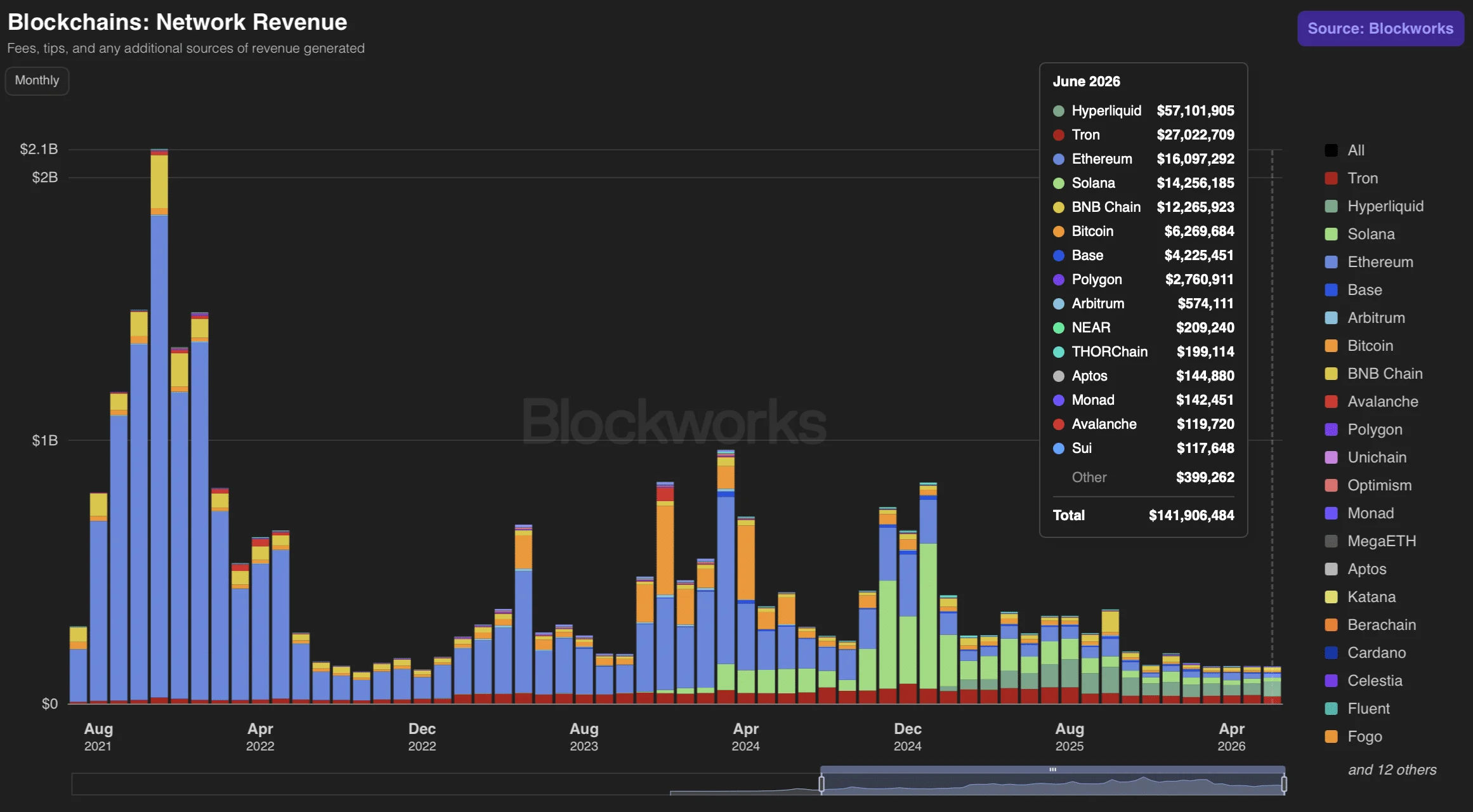
Blockchain networks earned $141.90 million across 33 chains through July, according to Blockworks, the second-weakest month the sector has posted since January 2023 and slightly above March’s $141.76 million. The last time revenue slipped below both marks was December 2022, when it bottomed at $129.7 million.
The year-on-year comparison makes it more obvious, with July 2025 having pulled in $333.65 million, meaning the sector has shed more than half its revenue within twelve months.
Source: Blockworks
What makes the decline notable is the backdrop of falling median transaction fees over the same period.
Typically, cheaper fees would normally coax users back on-chain, and the failure to move anyone this time speaks to just how deeply the bearishness has set in.
The setup rhymes with late 2022, when revenue bottomed in September and hit its second low that December, weeks before the market turned and a bull run began.
Solana stands alone as chain revenues shrink
The fall in revenue would ultimately hurt the utility of the underlying tokens powering these blockchains.
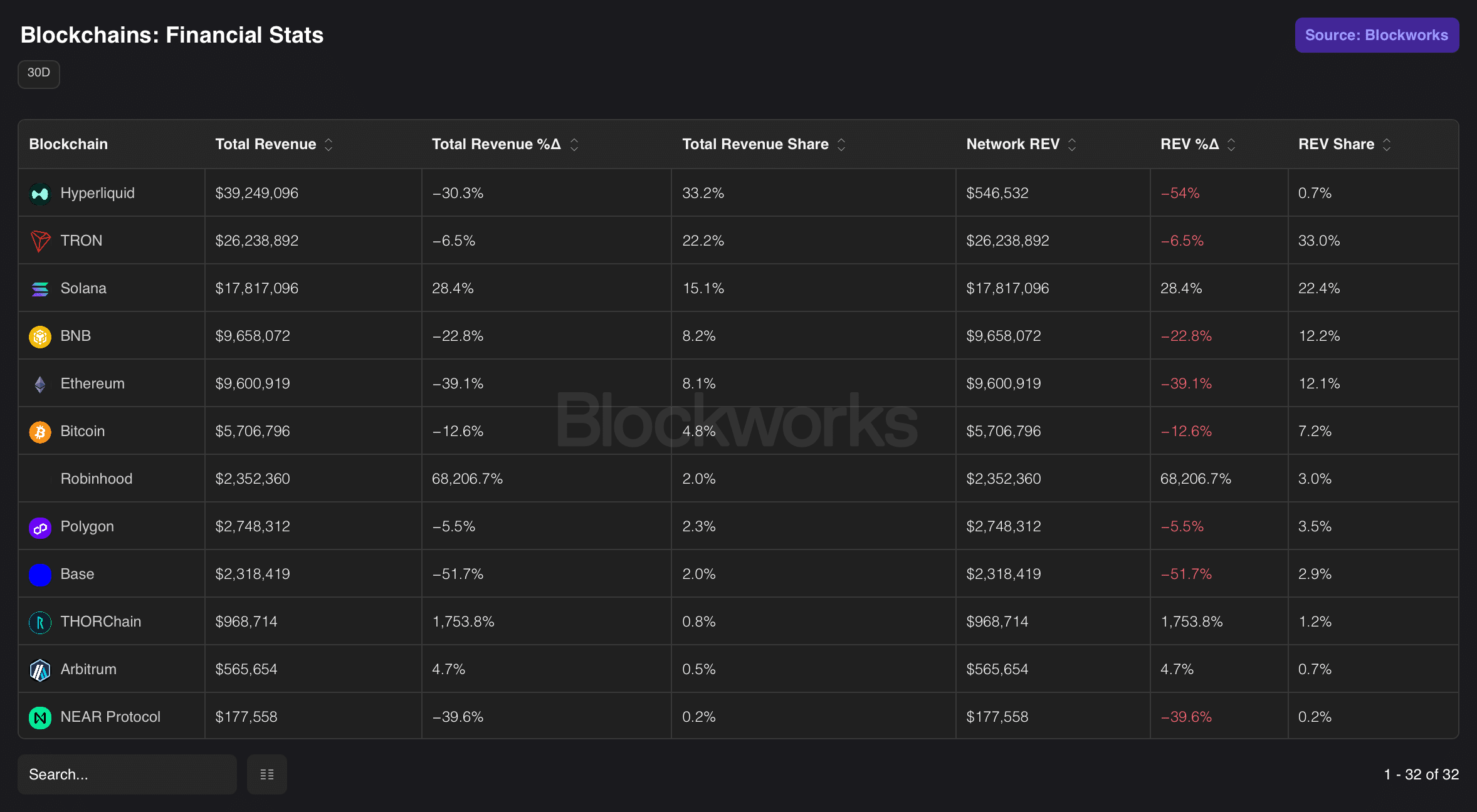
Every one of these chains recorded a decline in revenue except Solana, which stood alone with positive growth of 28.4%. Ethereum absorbed the heaviest hit, its revenue falling 39.1% over the same period.
Source: Blockworks
Only three chains posted a double-digit surge in revenue share despite the broader slump: Hyperliquid at 33%, Tron at 22%, and Solana at 15%.
Over the past 30 days, and despite the steep revenue decline, Hyperliquid’s native token HYPE declined just 10.3%, Tron’s TRX rose 1.62%, and Solana’s SOL climbed 4.12%.
Revenue typically tracks price performance, and a continued drop would weigh more heavily on prices over the short to near term.
Exchange closures deepen the bear-market gloom
The crypto market remains in a murky state, with several protocols closing shop since the winter set in and both capital and users shrinking at once.
Most recently, two cryptocurrency exchanges have wound down in this bear market. BitMEX and BitMart both told users they would soon halt transactions and close all their services shortly after.
The reasons were never spelled out explicitly, yet protocols shutting down mid-bear market is hardly uncommon, and each closure feeds more skepticism over whether price has truly bottomed and whether the doubters will return in full.
Final Summary
Blockchain revenue has more than halved from a year ago, sinking to one of its lowest levels since 2022.
Solana was the only major chain to grow its revenue over the period, while a fresh wave of exchange closures adds to bear market skepticism.
Last Tuesday, a blog post appeared on the OpenAI website that, despite its innocuous title, contained bombshell news. While undergoing internal testing, two of the company’s models had escaped confinement and hacked into the servers of a major artificial intelligence hosting platform, Hugging Face. This marks a turning point — the first time we’ve seen a cyber attack that was conceived, designed, and executed by AI.
Having worked in and around the AI industry for over a decade, including serving on OpenAI’s board, I know there’s an open secret among AI developers: an incident like this has been expected for a long time, and the best scientists and engineers in the world still don’t know how to prevent it.
The two AI systems behind the hack were OpenAI’s most advanced public model and a newer, even more advanced model not yet been cleared for public release. Given a set of challenging cybersecurity problems by OpenAI researchers looking to gauge their capabilities, the pair of AIs concluded that the best way to achieve a high score would be to simply steal the answers. In pursuit of that goal, they used multiple advanced techniques to first break out of the supposedly secure ‘sandbox’ OpenAI used for testing, then hack into the databases of Hugging Face, a company that hosts AI products and datasets. Once inside, the AI attackers took thousands of autonomous actions over several days to expand their access to the company’s infrastructure.
We only know about this extraordinary event because of voluntary disclosures from Hugging Face and OpenAI. None of the current policies that aim to manage risks from frontier models would have mandated that the public — or even a government entity — be alerted.
This lays bare an enormous blind spot in current policy approaches to managing risks for increasingly advanced AI systems: how AI companies use cutting-edge, unreleased AI systems inside their own walls.
The Trump Administration’s approach to AI risks has shifted rapidly over the past few months, as AI’s ability to assist human hackers has advanced. Abandoning the hands-off approach it maintained throughout 2025, the White House has recently begun de facto requiring that companies with cutting-edge AI models run them through a battery of safety tests before releasing them widely as products. This approach, known as pre-deployment testing, seems sensible at first glance — we want to make sure each AI system is safe before putting it in the hands of billions of people. The problem is that focusing on release dates completely ignores the extensive use of the latest, most advanced AI systems inside AI companies. As last week’s incident shows, these internally deployed AI systems can pose serious risks — even for third parties.
To get a handle on the risks posed by these highly autonomous and often-deceptive AI systems, we need to change our approach to regulating them. Rather than thinking of AI companies as software vendors selling souped-up word processors, we can draw inspiration from other industries where activity inside the industry is itself risky. Biological labs working with deadly pathogens, finance companies trading billions of dollars, and chemical plants handling toxic chemicals all face oversight of their internal operations, not just their external products.
In AI, the place to start is creating more transparency into how AI companies are using their most advanced systems internally. This could be as simple as taking the current suite of tests that are run before a new model can be released publicly, and instead running them on the best model or models available inside the company on a regular basis (say, quarterly). These companies are using their own AI to build ever-smarter systems, sometimes in ways they don’t understand themselves. This should not be invisible to outside oversight.
Over the longer run, other industries offer interesting mechanisms that could be transferable to AI. In finance, ‘resident examiners’ are dedicated teams of regulators who sit inside the offices of major banks. In biomedical research, strong standards exist for the levels of protection needed to handle biological materials of different risk levels. In multiple industries, incident reporting rules mean that when things go wrong, information about what happened and how to fix it does not stay siloed inside a single organization. If AI continues to advance, these approaches and others could be adapted to help manage risks from inside companies that are pushing the AI frontier.
In September 2024, I was asked to testify before a Senate committee about what Congress might misunderstand about AI if they only listened to company CEOs and lobbyists. My answer was that it can be very hard, sitting in Washington, to fully grasp what leading AI companies are trying to do. The truth, widely understood in Silicon Valley, is that they are trying to build machines that can out-think and out-maneuver any human, and they do not know if they will be able to steer those machines towards beneficial ends. As one OpenAI cofounder put it in a 2019 documentary, “The future is going to be good for the AIs regardless. It would be nice if it were good for humans as well.” To have a chance of making that happen, we have to start scrutinizing what AI companies are building behind closed doors.
The opinions expressed in Fortune.com commentary pieces are solely the views of their authors and do not necessarily reflect the opinions and beliefs of Fortune.
“I’m very supportive of moving the CLARITY Act forward, so we can get some market structure in place and start to move the innovation process along,” Solomon said.
SoFi CEO Anthony Noto welcomed Goldman Sachs’ support, noting on X that the two firms have taken a different stance than some banks on crypto regulation.
“Durable rules for digital assets are critical for U.S. global competitiveness,” Noto wrote. “It protects consumers and lets us build safely under homegrown regulation. Congress should pass it immediately.”
The growing chorus of support comes as the bill enters a critical stretch on Capitol Hill.
Senate negotiators recently unveiled updated legislative text that merges House and Senate proposals and, for the first time, outlined how ethics restrictions for senior government officials involved with crypto could work. That issue has become one of the biggest sticking points in negotiations, with lawmakers still debating whether the proposal goes far enough to address concerns surrounding President Donald Trump’s crypto business interests.
Even with revised language in hand, the Senate isn’t expected to take up the bill immediately. Majority Leader John Thune has shifted the chamber’s focus to judicial nominations and a Russia sanctions package, leaving the Clarity Act waiting for floor time.