Home Blog Page 170

Nvidia just locked down deal that changes AI race

0
Nvidia just locked down deal that changes AI race


South Korean President Lee Jae Myung flew to San Francisco on July 24 for a summit with the most powerful names in artificial intelligence. Jensen Huang was there. Sam Altman was there. The heads of Samsung, SK Group, Hyundai Motor and Naver flew in. By the end of the day, roughly $950 billion in new AI agreements had been signed, and South Korea had positioned itself as the country most central to the next phase of the buildout.

Nvidia (NVDA) is not slowing down its global hunt for AI infrastructure partners. The chipmaker has spent much of 2026 signing deals across Asia, the Middle East and Europe to secure the chips, memory and power it needs to keep building AI systems.

On July 24, that hunt landed squarely on South Korea, with a cluster of new agreements announced within hours of each other.

Nvidia, SK Hynix seal $500 billion memory deal

Nvidia said on July 24 that it has locked down AI memory supply from SK Hynix, South Korea’s second most valuable company, CNBC reported. The agreement, unveiled late that evening in San Francisco, could be worth $500 billion over a number of years, and it includes large-scale data centers expected to come online in 2027.

SK Hynix affiliate SK Telecom will build a cloud business using Nvidia’s Vera Rubin systems as part of the deal.

Nvidia said it is targeting enough capacity to require 2 gigawatts of power, a figure that points to a buildout involving hundreds of thousands of graphics processing units working together.

More Nvidia:

“The expansion will include a co-develop opportunity for us on the next-generation SK Hynix AI memory, and this will help us secure a stable supply of HBM memory,” Raj Mirpuri, Nvidia’s enterprise vice president, told reporters on a call. High bandwidth memory, known as HBM, sits directly next to AI chips and feeds them data fast enough to keep expensive processors from sitting idle.

SK Hynix (SKHY) has built its recent momentum on exactly that product. The company ranked first globally in HBM revenue with a 56.4% share in the first quarter of 2026. Its Nasdaq debut showed first-quarter revenue reaching 52.58 trillion won, roughly $34.5 billion, up 198% from a year earlier, with the stock now trading under the ticker SKHY, as TheStreet reported.

Samsung, Broadcom ink separate $200 billion pact

A second, unrelated deal landed the same day. Samsung Electronics said it signed a memorandum of understanding with chip designer Broadcom to expand their collaboration across memory and foundry technologies. The agreement, worth an estimated $200 billion, is meant to help support the next generation of AI infrastructure, Reuters reported.


Source link

Celestia’s $62K token unlock meets 23% OI surge: Can TIA’s rally continue?

0
Celestia's $62K token unlock meets 23% OI surge: Can TIA's rally continue?


Celestia [TIA] has been on the decline over the past couple of weeks, as the market appears to be settling into a more neutral position.

TIA has posted a 25% decline on a year-to-date basis, with the past day reflecting that neutral state through a 0.2% gain as of the time of writing.

The market appears caught in a tight spot, with uncertainty building over the price’s next direction.

TIA faces more token unlocks

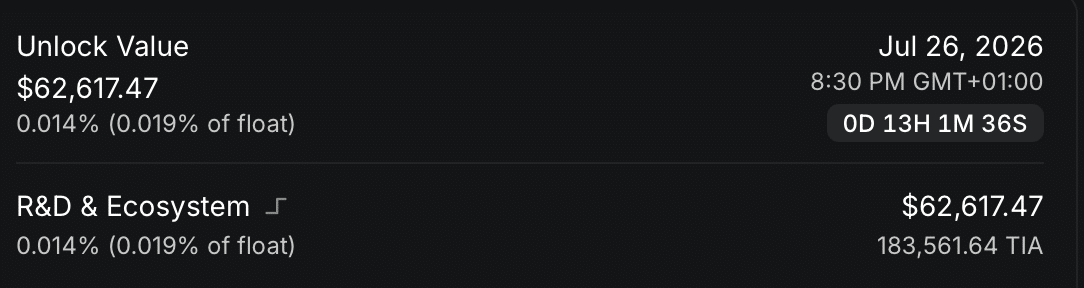
TIA will undergo a major token unlock, channeling the released tokens toward research and development for the blockchain. A token unlock distributes new tokens into the market, bumping the asset’s supply and weighing on its price.

The unlock will release roughly $62,000 into the market in less than 24 hours, with another $62,000 following in 48 hours—an amount likely to move the market significantly.

Token unlock chart.
Source: DeFiLlama

Beyond that, Celestia’s total value locked (TVL) remains at $0, reflecting how weak the blockchain’s performance has been. The chain generated just $53 in fees over the past day, underscoring the point.

This combination of weakening on-chain performance and an expected volume surge puts Celestia at major risk.

Funding and capital flows

Despite the weakening on-chain metrics and the scheduled token unlock, sentiment around TIA has turned net positive, with investors showing a growing pattern of long bets in the market.

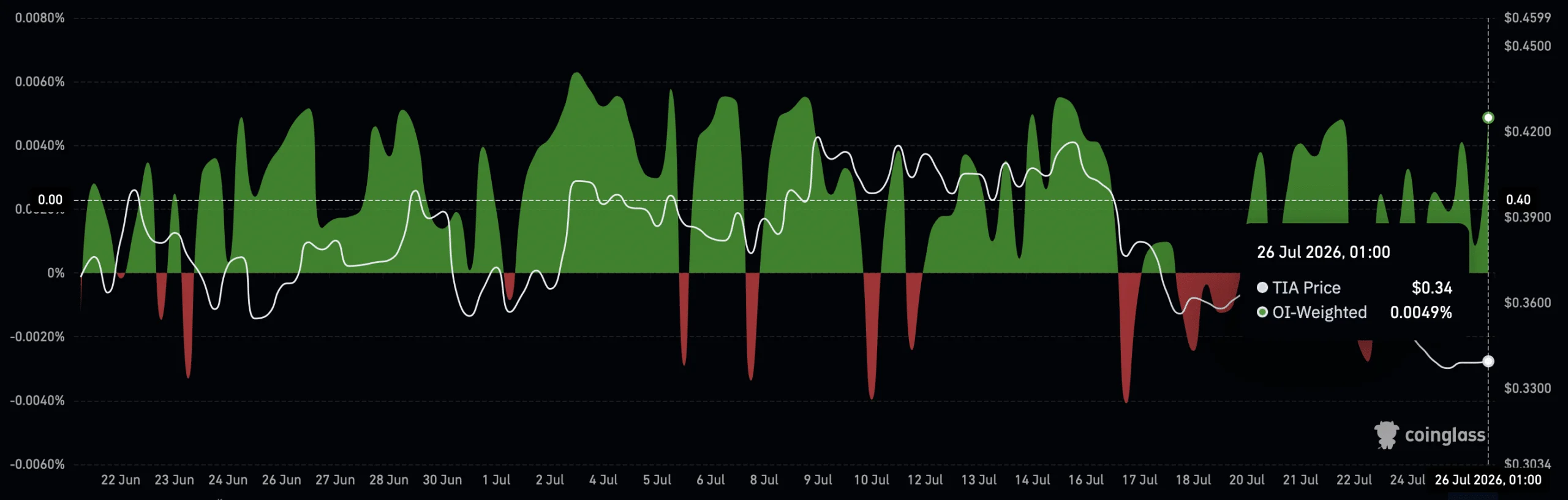
Funding Rate data over the past day has spiked significantly, reaching roughly 0.0049% on the chart, according to the latest reading. A positive Funding Rate implies more bulls than bears in the market, measured by the scale of leveraged positions open on the asset.

TIA funding rate chart. TIA funding rate chart.
Source: CoinGlass

Adding to this outlook is a massive inflow of capital into the market, reinforcing the bullish case.

To put this into perspective, Open Interest surged 23% over the past 24 hours, reaching a high of $57.52 million within that period.

The rising Funding Rate, at a time when Open Interest has also surged, signals that the new inflow of capital is being channeled toward long positioning in the market.

Liquidation levels are tight

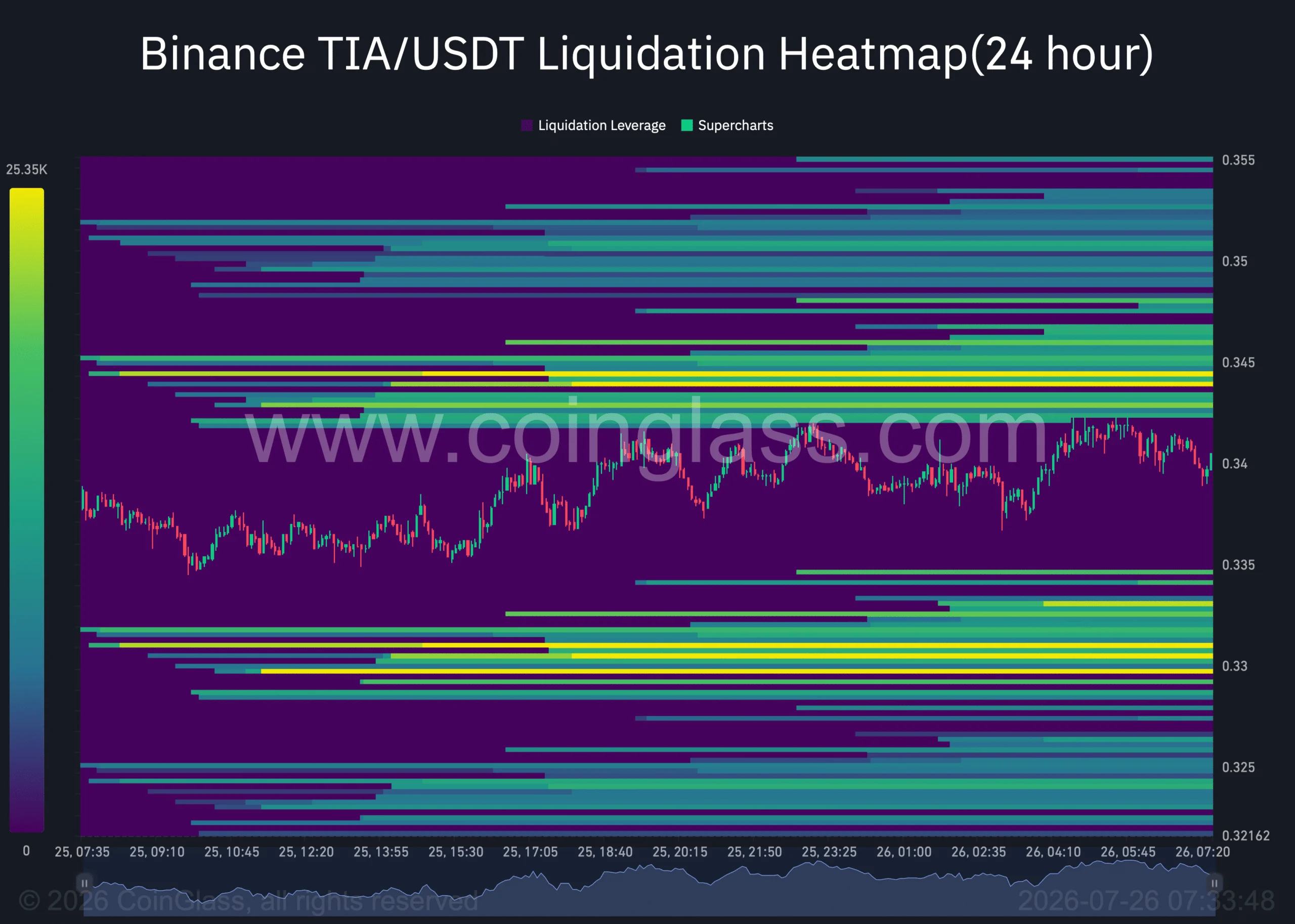
Liquidation heatmap analysis, which identifies clusters of buy and sell orders on the chart, shows TIA sitting in a tight spot from a liquidity perspective.

The asset carries distributed sell orders above price, matched by an equal depth of distributed buy orders below price.

This means price could swing either way—the asset could move up or down, since both clusters exert the same pull on price, and liquidation clusters are known to act like magnets.

TIA liquidation heatmap chart. TIA liquidation heatmap chart.
Source: CoinGlass

However, given the market’s tight positioning, momentum will be the key determinant of where price skews. With bulls currently in control, there’s a high chance of an upswing in price from current levels over the short to near term.


Final Summary

  • Celestia is releasing a large batch of new tokens into the market within the next two days, which could add selling pressure on the price.
  • Traders taking bullish bets have been growing fast, suggesting many expect the price to rise in the near term.


Source link

How Transparency Helps You Win Better Capital, Not Just More

0
How Transparency Helps You Win Better Capital, Not Just More


Opinions expressed by Entrepreneur contributors are their own.

Key Takeaways

  • The fastest way to lose support from investors is to hide the challenges you face along the startup process. Credibility is not built by perfection, but through clarity.
  • The leaders that people trust are the ones who treat disclosure like a habit and not like a negotiation tactic. They set a real plan, communicate it clearly and stay honest about where they are on that path. They understand that people are afraid of surprises, not difficulties. Fundraising is no different.

I once sold a home in Las Vegas, and the required disclosure of everything that was wrong with the house ran 52 pages. I had to put myself in the buyers’ shoes when they came to view the house. I went as far as documenting where the ants come in when it rains because I did not want them to sue me. That is what disclosure looks like when you are serious about trust. Fundraising is no different.

The fastest way to lose support is to hide obstacles. Credibility is not built by perfection, but through clarity. The leaders that people trust are the ones who treat disclosure like a habit and not like a negotiation tactic.

When you are not transparent, people find out

I cannot emphasize transparency enough, especially with early-stage investors. If they understand your obstacles and you are honest, it has been my experience that the investor is rooting for you, especially if they are interested in the mission.

But entrepreneurs do something that is completely backwards. They think the way to earn support is to make everything sound smooth. They talk like nothing is wrong. Then the first obstacle hits, and everyone realizes the story was carefully edited — either it was not true or it was incomplete. When you are not transparent, people find out.

The truth is, the people in your company are pioneers with you. If you want them to support you through the hurdles in the beginning, you must let them see the full picture — both the good and the bad.

State the obstacles plainly, without making excuses

If you have an idea whose time has come that is of tremendous interest to investors, you should tell them, “Look, if I can just overcome these three obstacles, then this is how big this can become.” They would want to know that, rather than hear that everything is fine.

So, the first discipline is simple: Do not hide the obstacles. Say them. Not in a dramatic way. Not as a plea. Just as the reality of the road ahead. I have found that clarity has a sequence.

First, communicate the potential bigness of your idea. How imaginative are you? That is what people are interested in. They are interested in the extraordinary.

Then be transparent about the barriers and what lies ahead so that the support that has been gathered can remain through the inevitable barriers and obstacles that are to come.

Define the milestones you control

People lose trust when they realize you do not have a plan or you cannot explain how their investment would be used. I have seen this in real cases. It usually shows up at the moment a founder must explain how the next stage actually gets unlocked.

In one case, the first thing we had to do was have the shareholder, who was going to become the sole owner, buy out his partner. The partner did not want the long-term plan. He was older and wanted to retire. The partner was simply an obstacle to the future plan.

Once that partner was bought out, the company was in a position to execute the next set of plans, which involved taking on new partners and investors.  That is what leaders do. They name the obstacle, and turn it into a milestone.

When talking to investors, it is important to ask:

  • What is important to them?
  • What is the plan to expand the value of the company?
  • How much value can we reasonably expect years later?
  • What is the rate of return?

If you cannot explain the milestones, why those investment dollars matter, what the estimates are and what effort is required to make those milestones, you are going to have a very difficult time raising the money at all.

And here is the part leaders avoid saying out loud — even when the plan is solid, there is often a trough.

That is why your milestones must be concrete, and your communication must be disciplined. If you do not define the milestones you control, every hard moment becomes debatable.

Put the documents there and treat ownership like manhole covers

There is investor protection in an exchange environment. All the necessary disclosures must be contained in the requisite documents, resulting in transparency, which will ultimately increase the share price.

This matters for fundraising because leaders could do something else that kills trust — they treat ownership like a casual tool. People throw their entrepreneurial shares around like feather pillows — “Oh, what’s the deal going to be, 80/20?”

We look at shares of an entrepreneurial company like manhole covers. You do not want to throw them around.

If you are sloppy with your own ownership, casual with your own disclosures or constantly revising the story because you are negotiating instead of communicating, the investing public will see right through it. 

So, the third discipline is disclosure. Put the paperwork together. Ensure the correct documents are present. Explain what you are doing and why.

The point is to avoid one person controlling your terms and the dilutive effect on your earlier investors and on you as the entrepreneur.

Set the vessel, tell the truth and stay on the path

Over the years, I have seen a consistent difference between leaders who stay supported and leaders who lose trust halfway through the journey.

The leaders who endure are the ones who take the time to set a real plan, communicate it clearly and stay honest about where they are on that path. They understand that people are afraid of surprises, not difficulties. 

Fundraising is no different. The leaders people trust do not pretend the ants do not exist. They document where the ants come in when it rains.

Key Takeaways

  • The fastest way to lose support from investors is to hide the challenges you face along the startup process. Credibility is not built by perfection, but through clarity.
  • The leaders that people trust are the ones who treat disclosure like a habit and not like a negotiation tactic. They set a real plan, communicate it clearly and stay honest about where they are on that path. They understand that people are afraid of surprises, not difficulties. Fundraising is no different.

I once sold a home in Las Vegas, and the required disclosure of everything that was wrong with the house ran 52 pages. I had to put myself in the buyers’ shoes when they came to view the house. I went as far as documenting where the ants come in when it rains because I did not want them to sue me. That is what disclosure looks like when you are serious about trust. Fundraising is no different.

The fastest way to lose support is to hide obstacles. Credibility is not built by perfection, but through clarity. The leaders that people trust are the ones who treat disclosure like a habit and not like a negotiation tactic.

When you are not transparent, people find out

I cannot emphasize transparency enough, especially with early-stage investors. If they understand your obstacles and you are honest, it has been my experience that the investor is rooting for you, especially if they are interested in the mission.


Source link

2 weeks left for Clarity: State of Crypto

0
2 weeks left for Clarity: State of Crypto

The crypto industry, naturally, is urging passage. The common refrain online is that Clarity includes some investor protection rules and creates some structure for crypto products, while not passing the bill would mean there are no investor protections.

If the bill is to pass the Senate before summer recess begins, the first thing to watch for is a motion to proceed on Monday or Tuesday. This kicks off the formal process. If the motion to proceed is filed by Wednesday, one individual following the process said, that would still give the Senate enough time to vote on the bill before August 7, the last day of the summer session.

If the motion to proceed ripens — meaning it’s been an hour into the second day after the motion is filed, according to the Congressional Institute, a not-for-profit organization — there can be a cloture vote, most likely on the amendment in the nature of a substitute (i.e. the new text of the bill). If that passes, there can be another cloture vote later on for the actual passage of the bill.

“Recess deadlines are powerful tools,” Kristin Smith, the president of the Solana Policy Institute, told CoinDesk.

On a practical note, what this most likely means is we’ll see the motion to proceed Monday or Tuesday, two industry sources told CoinDesk, with a possible vote late next week.


Source link

Teva’s Turnaround Is Working. Here’s the 1 Thing That Could Send It Soaring Another 50%.

0
Teva's Turnaround Is Working. Here's the 1 Thing That Could Send It Soaring Another 50%.


Year to date, Teva Pharmaceutical Industries (NYSE: TEVA) shares have continued to recover. Thanks to the company’s shifting focus from generic to branded drugs, this pharmaceutical stock has surged by around 85% over the past 12 months.

Although Teva may be pulling back lately, don’t assume the turnaround rally is over. In addition to success with its initial round of commercially successful branded pharmaceuticals, the company has one key candidate in the pipeline that could be on the verge of becoming a blockbuster drug.

Missed Nvidia in 2009? This Rare Signal Is Flashing Again. In 2009, a “Double Down” signal flashed for a little-known chipmaker called Nvidia. For the first time in years, that same “Total Conviction” signal is flashing for a company 1/100th the size of Nvidia. Continue »

Image source: Getty Images.

Teva’s branded drug transformation

As seen in Teva’s first-quarter 2026 financials, generic drugs now barely make up a majority of the company’s overall sales. Meanwhile, branded drugs, particularly recent hits like Austedo, Ajovy, and Uzedy, are experiencing mid-double-digit annual sales growth.

Management expects a drop in earnings per share (EPS), from $2.65 in 2025 to between $1.91 and $2.11 in 2026. However, much of this stems from the initial dilutive effect of Teva’s recent acquisition of Emalex Biosciences. Starting next year, the anticipated launch of biosimilars, along with other factors, should contribute to a 30% increase in operating profit and adjusted EBITDA.. Furthermore, another emerging catalyst for Teva could drive the next big leap for shares.

The duvakitug catalyst

Next year, key drivers for the growth rebound include biosimilars, plus incremental sales growth for Teva’s aforementioned flagship drugs. However, next year and beyond, duvakitug could be key to the company’s further turnaround. The drug, which Teva co-developed with Sanofi, is currently in clinical trials as a treatment for ulcerative colitis and Crohn’s disease.

If phase 3 clinical trial results prove as promising as recently released phase 2b findings, this drug could be on the fast track toward commercialization. Management has previously guided for duvakitug to reach between $2 billion and $5 billion in peak annual sales. Considering this, any progress with duvakitug could drive yet another massive rally, especially as the stock sells for less than 10 times estimated 2027 earnings. This strongly suggests taking advantage of near-term weakness by making this stock a long-term buy.

Should you buy stock in Teva Pharmaceutical Industries right now?

Before you buy stock in Teva Pharmaceutical Industries, consider this:

The Motley Fool Stock Advisor analyst team just identified what they believe are the 10 best stocks for investors to buy now… and Teva Pharmaceutical Industries wasn’t one of them. The 10 stocks that made the cut are built for long-term growth and could produce monster returns in the coming years.

Consider when Netflix made this list on December 17, 2004… if you invested $1,000 at the time of our recommendation, you’d have $377,990!* Or when Nvidia made this list on April 15, 2005… if you invested $1,000 at the time of our recommendation, you’d have $1,269,518!*

That performance is why people listen. With a track record of beating the S&P 500 by 4xStock Advisor offers a distinct advantage. Don’t miss the latest top 10 list, available with Stock Advisor, and join an investing community built for the long haul.

See the 10 stocks »

*Stock Advisor returns as of July 26, 2026.

Thomas Niel has no position in any of the stocks mentioned. The Motley Fool has no position in any of the stocks mentioned. The Motley Fool has a disclosure policy.

Teva’s Turnaround Is Working. Here’s the 1 Thing That Could Send It Soaring Another 50%. was originally published by The Motley Fool


Source link

Wingstop Is Down 68% From Its All-Time High. Should You Buy Before July 29?

0
Wingstop Is Down 68% From Its All-Time High. Should You Buy Before July 29?


Inflation remains uncomfortably elevated, and that’s a drag on an array of consumer discretionary stocks, including Wingstop (NASDAQ: WING).

Ahead of its July 29 earnings report, shares of the fast-casual wing chain are off 43.5% year to date (as of July 23) and would need to more than triple to reclaim the record high. Analysts expect the Texas-based eatery to post earnings per share (EPS) of $1.02 on sales of $190.2 million. Given the stock’s weak state, if those estimates are missed or the company offers guidance that’s not to investors’ satisfaction, more declines could be in store.

Missed Nvidia in 2009? This Rare Signal Is Flashing Again. In 2009, a “Double Down” signal flashed for a little-known chipmaker called Nvidia. For the first time in years, that same “Total Conviction” signal is flashing for a company 1/100th the size of Nvidia. Continue »

A lot has to go right for Wingstop to rebound. Image source: Getty Images.

This fast-food stock has no margin for error, and a lot needs to go right against a challenging consumer backdrop. That’s not lost on Wall Street. On July 23, DA Davidson cut its price target on Wingstop to $200 from $230 while keeping a buy rating.

The new target implies upside of about 48% from the stock’s close on that day, but there’s some bad news. The research firm pared its second-quarter same-store sales forecast to a decline of 6% from a drop of 4%, citing stress on Wingstop’s core lower-income and younger customer base.

For risk-tolerant investors, there may be something to see here. Looking ahead, Wingstop is expanding rapidly, adding new locations across the U.S. Additionally, the stock has some support on Wall Street. Piper Sandler says the stock’s now lengthy decline has created a potentially favorable risk/reward scenario. At the same time, Guggenheim believes the shares can nearly double if the company returns to steady same-store sales growth.

Investors willing to take a flier on earnings may want to evaluate Wingstop’s commentary around its Smart Kitchens and its Club Wingstop loyalty program. Strength in those areas could contribute to a rebound down the road.

Should you buy stock in Wingstop right now?

Before you buy stock in Wingstop, consider this:

The Motley Fool Stock Advisor analyst team just identified what they believe are the 10 best stocks for investors to buy now… and Wingstop wasn’t one of them. The 10 stocks that made the cut could produce monster returns in the coming years.

Consider when Netflix made this list on December 17, 2004… if you invested $1,000 at the time of our recommendation, you’d have $377,990!* Or when Nvidia made this list on April 15, 2005… if you invested $1,000 at the time of our recommendation, you’d have $1,269,518!*


Source link

Aptos TVL falls 43% as capital flees – Can APT price recover?

0
Aptos TVL falls 43% as capital flees - Can APT price recover?


Aptos’ [APT] price action has been trending downward for the past 18 months. Last week alone, APT’s Total Value Locked (TVL) declined by about 43% as of writing, and the decline shows no signs of slowing.

Why is Aptos’ TVL crashing?

According to DefiLlama, TVL has been falling over the past two months. In early June, it was around $280 million but lost over $100 million by the end of the month.

In the past week, Aptos’ TVL tumbled from $156 million to $100 million, equivalent to about a 43% drop. Excluding active loans, double counts, staking, and liquid staking, the TVL stands at $63 million.

AptosAPT
Source: DefiLlama

One key factor behind last week’s sharp plunge was Echo Protocol pulling a significant amount of liquidity. As a Bitcoin [BTC]-focused bridge on Move chains, including Aptos, Echo’s exit hit APT the hardest.

This drop was an indication of low user activity. It was backed by the low Daily Active Addresses of around 40.5K. Additionally, earnings have declined by 72% from $366K to $103K, as per DefiLlama.

Such a decline could cause traders to pull out staked APT, viewing it as less profitable and potentially affecting the chain’s security. Notably, the decline in RWA TVL on Aptos should not be overlooked as it dropped 70% in the past thirty days.

AptosAptos
Source: rwa.xyz

Together, these factors led to capital flight from Aptos.

Is APT’s price responsible for the TVL drop?

Moreover, weak price performance played a part when measuring the TVL in terms of USD valuation. When the price of APT drops, the USD value of the TVL also drops.

At press time, APT was falling in a trend channel following a breakdown from a sideways range. This trend was reinforced by Open Interest (OI) crashing to around $42 million.

APTAPT
Source: APT/USDT on TradingView

Notably, APT was trading above the mid-level of the channel, a potential sign that bulls may be gaining strength in bear territory.


Final Summary

  • Aptos’s TVL crashed more than 43% in a week due to Echo Protocol pulling liquidity, RWA underperformance, low usage, and earnings. 
  • APT price was declining in a trend channel, with OI reinforcing that traders were not interested in the token. 


Source link