Same allocation, different objective: This portfolio keeps Buffett’s 90/10 stock-and-cash framework while emphasizing high income instead of capital appreciation.
Tax-aware income strategies: Both SPYI and CSHI use SPX index options, Section 1256 tax treatment, tax-loss harvesting, and have historically classified a significant portion of distributions as return of capital.
Higher income comes with trade-offs: An 11.26% average distribution yield is attractive, but investors should expect higher fees and the potential to lag a traditional S&P 500 and Treasury bill portfolio during bull markets.
Don’t wait: the analyst who called NVIDIA in 2010 just revealed his top 10 AI stocks. See the full list FREE now.
Warren Buffett has been remarkably candid about his own mortality, and in doing so has offered some of the best investing advice for everyday investors. Buffett instructed that 90% of his estate be placed in a low-cost S&P 500 index fund and the remaining 10% in short-term U.S. Treasury bills after his death.
Alex Wong / Getty Images News via Getty Images
It’s an intentionally simple portfolio that combines long-term equity growth with a small allocation to highly liquid, low-risk assets. While it’s admittedly light on international diversification and heavily tilted toward U.S. equities, it’s inexpensive, easy to maintain, tax efficient, and backed by decades of evidence supporting index investing.
The trade-off is that the portfolio is designed almost entirely for capital appreciation. If you’re retired and want to generate income, you’re generally left with two choices: periodically sell shares or overlay an options strategy such as covered calls. Fortunately, there’s a third option.
By swapping Buffett’s underlying investments for a pair of ETFs from NEOS Investments, it’s possible to maintain the same 90/10 split between the S&P 500 and short-term Treasury bills while generating a weighted average distribution yield of roughly 11.26%. The trade-off is giving up some upside potential in exchange for substantially higher cash flow.
Don’t wait: the analyst who called NVIDIA in 2010 just revealed his top 10 AI stocks. See the full list FREE now.
NEOS S&P 500 High Income ETF (SPYI)
The NEOS S&P 500 High Income ETF (SPYI) serves as the portfolio’s equity allocation. Rather than simply owning the S&P 500, SPYI combines a portfolio of large-cap U.S. stocks with an actively managed options strategy that both buys and sells SPX index options. Using index options instead of options on individual ETFs creates several potential tax advantages within the fund.
Because SPX options are Section 1256 contracts, gains generally receive the favorable 60/40 tax treatment, with 60% taxed at long-term capital gains rates and 40% at short-term rates regardless of the holding period. The managers also actively harvest tax losses, allowing a large portion of distributions to be classified as return of capital. Return of capital generally isn’t immediately taxable, instead reducing an investor’s adjusted cost basis until the shares are eventually sold.
After deducting its 0.65% expense ratio, SPYI currently offers an 11.99% distribution yield based on its most recent monthly distribution. Performance has also held up reasonably well for a covered call strategy. Over the trailing three-year period, SPYI generated an annualized total return of 11.50%, compared with 12.11% for the CBOE S&P 500 BuyWrite Monthly Index. Investors should remember, however, that both significantly trailed the standard S&P 500, which returned 20.61% annually over the same period.
NEOS Enhanced Income 1-3 Month T-Bill ETF (CSHI)
Buffett’s original allocation calls for short-term Treasury bills, but there’s a way to potentially enhance that income as well. The NEOS Enhanced Income 1-3 Month T-Bill ETF (CSHI) begins with a portfolio of one- to three-month U.S. Treasury bills while adding a data-driven put spread strategy using SPX index options. After deducting its 0.30% expense ratio, the fund currently offers a 4.71% distribution rate with monthly payouts.
Investors should recognize that CSHI is not a substitute for simply owning Treasury bills. The options strategy introduces additional risk, and during sharp equity market declines the fund can experience losses that a traditional T-bill ETF would likely avoid. So far, however, the strategy has delivered encouraging results. Over the trailing three-year period, CSHI produced a 5.43% annualized net asset value total return, outperforming the Bloomberg U.S. 1-3 Month Treasury Bill Index’s 4.74%.
Putting the Portfolio Together
Allocating 90% to SPYI and 10% to CSHI produces a weighted average distribution yield of approximately 11.26% using the funds’ most recent distribution rates. As always, those yields can change over time as option premiums, interest rates, and portfolio distributions fluctuate.
Investors should also keep their expectations realistic. This version of Buffett’s famous 90/10 portfolio may very well underperform his original recommendation over the long run. SPYI’s covered call strategy naturally caps part of the market’s upside, while both ETFs carry higher expense ratios than a simple index fund and Treasury bill allocation.
But if your primary objective is generating income rather than maximizing long-term capital appreciation, I think it’s an interesting adaptation. You still maintain broad exposure to the S&P 500 and short-term Treasuries while outsourcing the income generation to professionally managed options strategies instead of having to write covered calls yourself.
Don’t wait: the analyst who called NVIDIA in 2010 just revealed his top 10 AI stocks. See the full list FREE now.
The World Foundation, the non-profit organization that governs the World network (formerly Worldcoin), has raised $52.5M to advance the network. However, the deal soon triggered a 9% WLD token price crash.
According to the organization, the deal was made possible by selling WLD tokens to strategic investors including Pantera Capital, Selini Capital, Bain Capital Crypto, and Eightco Holdings.
On-chain data showed that the non-profit transferred 217.4M WLD, with analysts estimating that the token’s sale price was $0.2415 per WLD.
That would translate to a 30% discount from the press time price level of $0.3445 or a whopping 40% discount from WLD’s price of $0.386 on Friday, before the update went public.
However, for its part, the World Foundation insisted the deal was based on the market price.
Funding was through a direct purchase of market-priced $WLD. All purchased tokens are subject to a 1-year lockup. No tokens were sold on exchanges.
Source: X
Franklin Bi, General Partner at Paradigm, billed the backing as crucial amid the rise of AI agents.
Proof-of-human is becoming the scarcest resource on the internet. Every advance in AI agents is equally an advance in bots indistinguishable from people.
Worldcoin: Is WLD recovery likely?
Interestingly, the Friday update coincided with the project’s 43% inflation plan. Back in April, the project said it would cut its daily emissions by 43% starting from 24th July. Part of the tokenomics update read,
In aggregate, this will reduce the unlock rate across all token allocations by 43%, from about 5.1M WLD per day to about 2.9M WLD per day.
The community and investor tokens were slashed to achieve the new inflation plan.
In fact, Austin Barack, Founder of crypto VC firm Relayer Capital, projected that the inflation schedule and the recent raise would ease selling pressure.
Worldcoin’s just announced $52.5m capital raise combined with today’s 43% emissions reductions should materially reduce $WLD token sell pressure. Interesting setup with the token right around support levels.
However, the token dumped by 9% immediately after the update amid broader market correction on Friday.
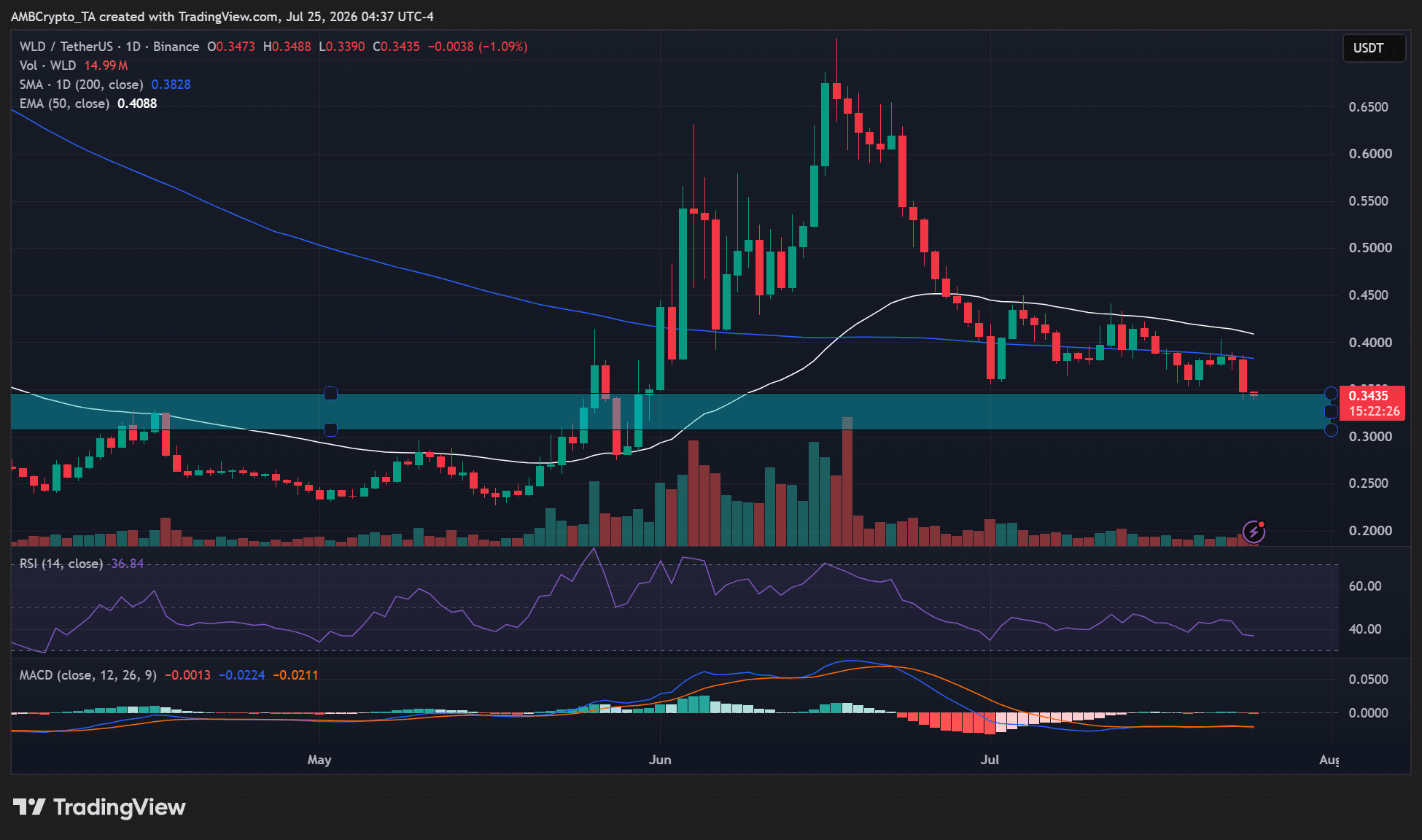
Source: WLD/USDT, TradingView
The pullback eased into a key support above $0.3000. If cracked, the next potential floor would be the 2026 low of $0.25.
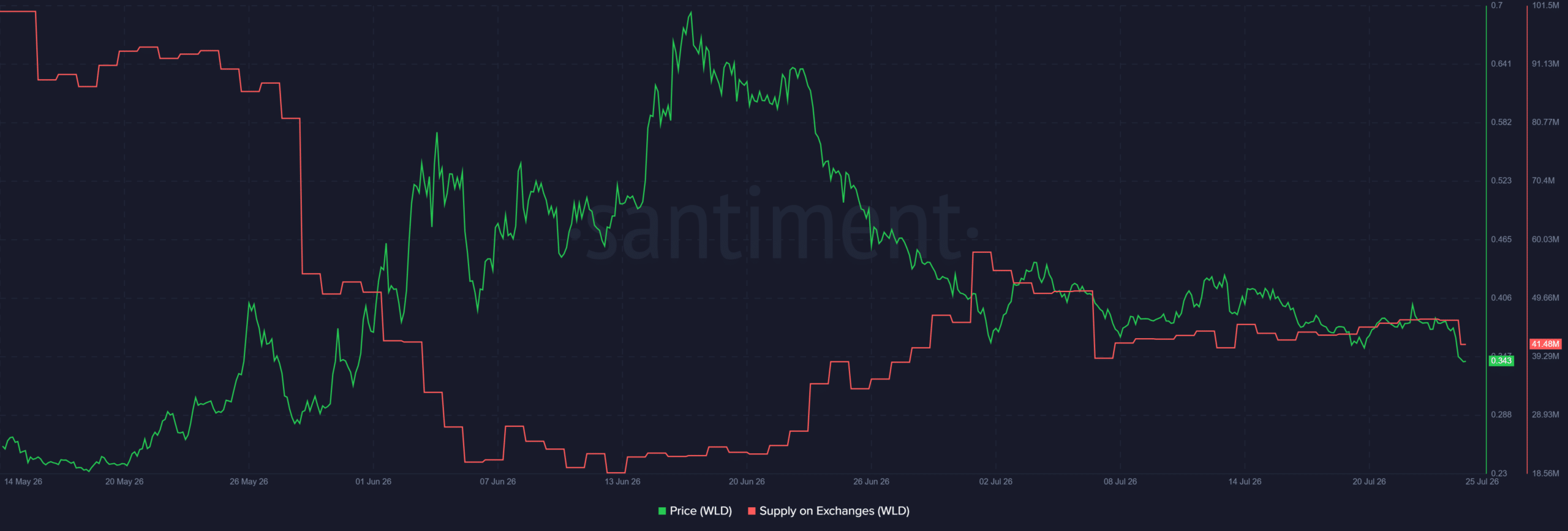
That said, while the overall WLD selling pressure stabilized, it was still elevated. Santiment data showed that exchange selling pressure, as tracked by Supply on Exchanges (red line), tripled from 18M WLD tokens to nearly 60M WLD tokens in under 2 months.
Finally, although the selling pressure dropped by 30% to 40M Worldcoin [WLD], it has remained around this level for the past few weeks.
Source: Santiment
Overall, the inflation plan and the recent deal could help the token. Elevated selling pressure across exchanges despite ETF expectations and the new deal could play spoilsport though.
Final Summary
World Foundation appeared to have sold WLD at a 40% discount for its latest $52.5M raise.
WLD’s selling pressure has been elevated after tripling since June.
BitMEX, the crypto derivatives exchange that invented the perpetual swap, faces a proposed class action suit alleging theft of bitcoin BTC$63,961.30 and insider trading filed the same day it said it would shut down in three months.
The lawsuit, filed by former tokenization project BKX Services and David Namdar in the U.S. District Court for the Southern District of New York, sees BKX claim it lost at least 305.81 BTC through forced liquidations, while Namdar alleges losses of more than 316.85 BTC — a total of 622.66 BTC ($40.7 million).
The July 23 filing came as BitMEX said it would close on Sept. 23, ending an 11-year run. Similar claims were made in a 2020 class-action case, which was closed in June 2025 without a ruling on the liquidation allegations.
The new complaint alleges BitMEX and co-founders Arthur Hayes, Ben Delo and Samuel Reed designed a system to retain customers’ collateral and transfer the remaining bitcoin to the platform’s insurance fund. It also says an internal trading desk had access to private customer information and could continue trading during server freezes that prevented other users from closing their positions.
NUKZ returned 46% since its 2024 launch owning the entire nuclear chain, while URNM concentrates half its assets in just three uranium positions.
Microsoft, Amazon, and Google power deals are shifting nuclear investment logic from uranium spot prices toward utilities signing multi-decade reactor contracts.
Don’t wait: the analyst who called NVIDIA in 2010 just revealed his top 10 AI stocks. See the full list FREE now.
Uranium spot prices drove the nuclear trade higher over the past three years. That first leg is winding down, replaced by new catalysts: reactor restarts at Palisades and Three Mile Island’s Crane Clean Energy Center, power purchase agreements from Microsoft, Amazon, and Google, and small modular reactor programs moving from press release to permit. The three funds capturing this next phase are the Range Nuclear Renaissance Index ETF (NYSE:NUKZ), the Sprott Uranium Miners ETF (NYSEARCA:URNM), and the VanEck Uranium and Nuclear ETF (NYSEARCA:NLR).
vlastas / iStock via Getty Images
Each captures a different slice of the value chain. NUKZ runs the full stack from miners to reactor developers. URNM stays upstream in mines and physical uranium. NLR tilts toward utilities and infrastructure operators that sell the electrons. Recent performance has been rough across all three, with NUKZ, URNM, and NLR each down roughly 10% to 14% over the past month, making this sorting exercise timely.
Why Phase 2 Looks Different From Phase 1
Nuclear’s share of U.S. electricity generation is forecast at 18% in both 2026 and 2027, roughly steady, but demand composition is shifting. Commercial electricity use is on track to pass residential consumption for the first time on record in 2027, driven largely by data centers in Texas and the broader West South Central region. Industrial electricity demand is forecast to grow 1% in 2026 and 4% in 2027. That load requires firm, low-carbon capacity, and existing nuclear plants plus SMR pipelines offer the shortest path.
Don’t wait: the analyst who called NVIDIA in 2010 just revealed his top 10 AI stocks. See the full list FREE now.
The investment logic changes as a result. Phase 1 was a bet on the U3O8 spot price rerating higher after a decade of underinvestment. Phase 2 is a bet on who monetizes the buildout: utilities signing multi-decade PPAs with hyperscalers, reactor operators bringing mothballed capacity online, and enrichment and fuel-service specialists between miners and reactors.
NUKZ: The Full-Stack Renaissance Bet
Launched on January 23, 2024, this fund owns the entire nuclear value chain rather than one slice. The portfolio spans 53 holdings across reactor developers, SMR companies, utilities, uranium miners, and fuel-cycle service providers. An investor avoiding the choice between a miner rally or utility rerating gets exposure to both inside one wrapper. NUKZ offers diversified exposure to the nuclear energy ecosystem without requiring sector-timing decisions.
Assets stand at $757 million, with a P/E ratio of 19 and a beta of 1.64. That beta signals the portfolio moves more than the S&P 500, even with utility exposure included. SMR and reactor-developer names push volatility toward growth.
Since inception, the fund has compounded at 46%, though the trailing month shows a 9% drawdown. The tradeoff is dilution: by owning the whole chain, investors own parts working against each other in a given month. When uranium prices weaken, miners drag the fund even as utilities benefit from lower fuel costs. The 52-week range of $56 to $77 shows price movement within a single year. Yield is thin at 0.9%, fitting a growth-oriented sleeve.
URNM: Concentrated Upstream Leverage
The purest way to own the mining side is this fund. The top three positions comprise 47% of net assets: Cameco at 21%, the Sprott Physical Uranium Trust at 14%, and NexGen Energy at 13%. The physical trust allocation is the key differentiator, giving holders direct exposure to warehoused U3O8 without operational mine risk.
The rest of the top ten includes Kazatomprom in Kazakhstan, Paladin in Australia, Yellow Cake in the UK, and CGN Mining in China alongside North American names like Denison, Uranium Energy Corp, and Energy Fuels. The fund holds 31 uranium mining holdings against $1.73 billion in assets and charges 0.75%.
Compounding at 27% annually since its December 3, 2019 inception, this ETF is off 9% year to date and swung between $43 and $85 over 52 weeks. The dividend yield of 3.4% is unusually high for a mining-focused ETF, reflecting distributions from underlying producers. The tradeoff is familiar: if U3O8 stalls, URNM stalls with it, with no utility cash flow inside the portfolio to cushion the ride.
NLR: The Utility and Reactor-Restart Angle
Dating to August 2007, this fund tilts toward utility operators and infrastructure companies that own reactors rather than miners. That composition makes it the Phase 2 vehicle. When Constellation signs a data-center PPA or Talen Energy sells power to a hyperscaler at premium pricing, revenue lands inside NLR’s largest holdings.
The fund runs 32 holdings and $3.74 billion in assets at an expense ratio of 0.52%, the cheapest of the three. A beta of 0.83 confirms the utility tilt: this ETF moves less than the market, roughly half the beta of NUKZ. The dividend yield of 2.8% reflects the regulated-utility income profile.
This utility-heavy fund is down 12% year to date, and its 52-week range of $102 to $168 shows the utility sleeve is not immune to the pullback. The five-year annualized return of 19% indicates what the composition delivered through the first phase of the trade. NLR’s longer track record and lower volatility appeal to investors seeking nuclear exposure with less mining-driven turbulence.
Choosing Between the Three
The decision depends on which part of the nuclear thesis an investor wants to underwrite. URNM is the concentrated bet on uranium prices and mine economics, with the highest beta to spot U3O8 and largest single-name concentration in Cameco. NLR is the opposite: lower volatility, higher yield, and exposure to utilities monetizing hyperscaler contracts and reactor restarts. NUKZ sits in the middle, offering one ticker covering the entire renaissance with a 53-holding structure, at the cost of some upside URNM captures in a mining-led rally.
Don’t wait: the analyst who called NVIDIA in 2010 just revealed his top 10 AI stocks. See the full list FREE now.
ETHGas [GWEI] staged a sharp recovery days after it slipped below its Coinbase listing price of $0.039. Heavy selling over the past two weeks had pushed the token down to near $0.019.
Buyers stepped back in instead of extending the decline. GWEI gained 38% to near $0.0275 over the past 24 hours, according to CoinMarketCap, making it one of the day’s strongest performers.
Why are GWEI prices rising?
Leveraged traders drove one of the clearest shifts.
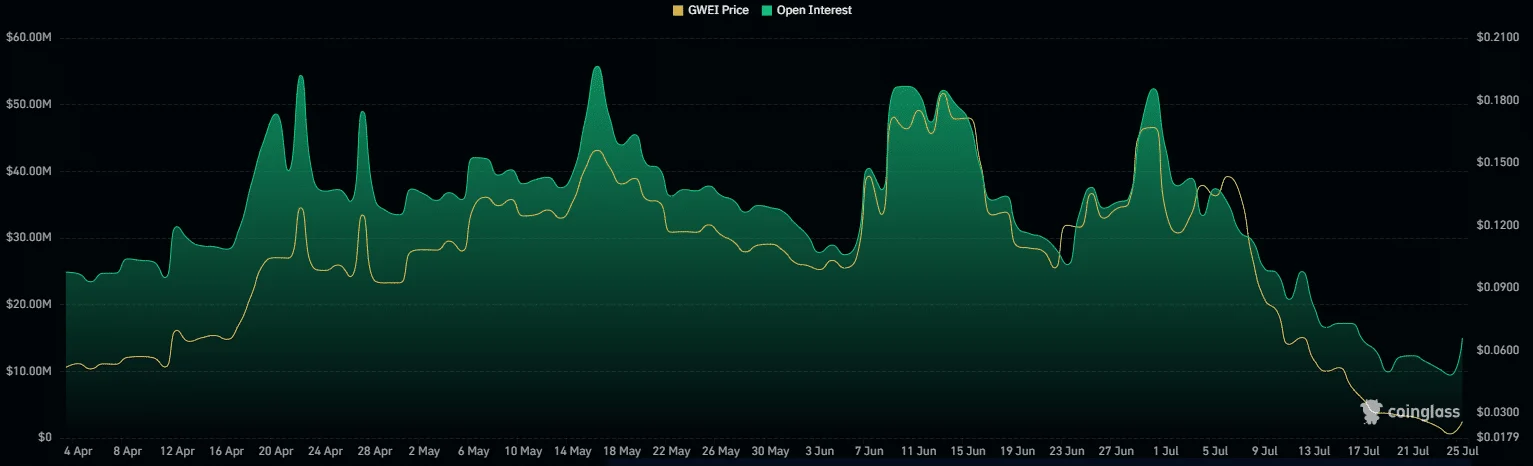
GWEI’s Open Interest nearly doubled to $14.85 million, AMBCrypto’s derivatives analysis showed. That signaled fresh capital entering GWEI futures markets, and the shift already showed up in the token’s price action.
Source: CoinGlass
On top of that, market positioning favored the bulls, too.
The Long/Short Ratio showed long positions held roughly 57% of total Open Interest, per Coinalyze data on the 1-day timeframe.
The gap was not extreme, but it pointed to improving confidence after the sell-off. Rising Open Interest alongside higher prices could support the case for new buyers driving the recovery, not short-term profit takers.
Source: Coinalyze
Are the ETHGas charts turning bullish?
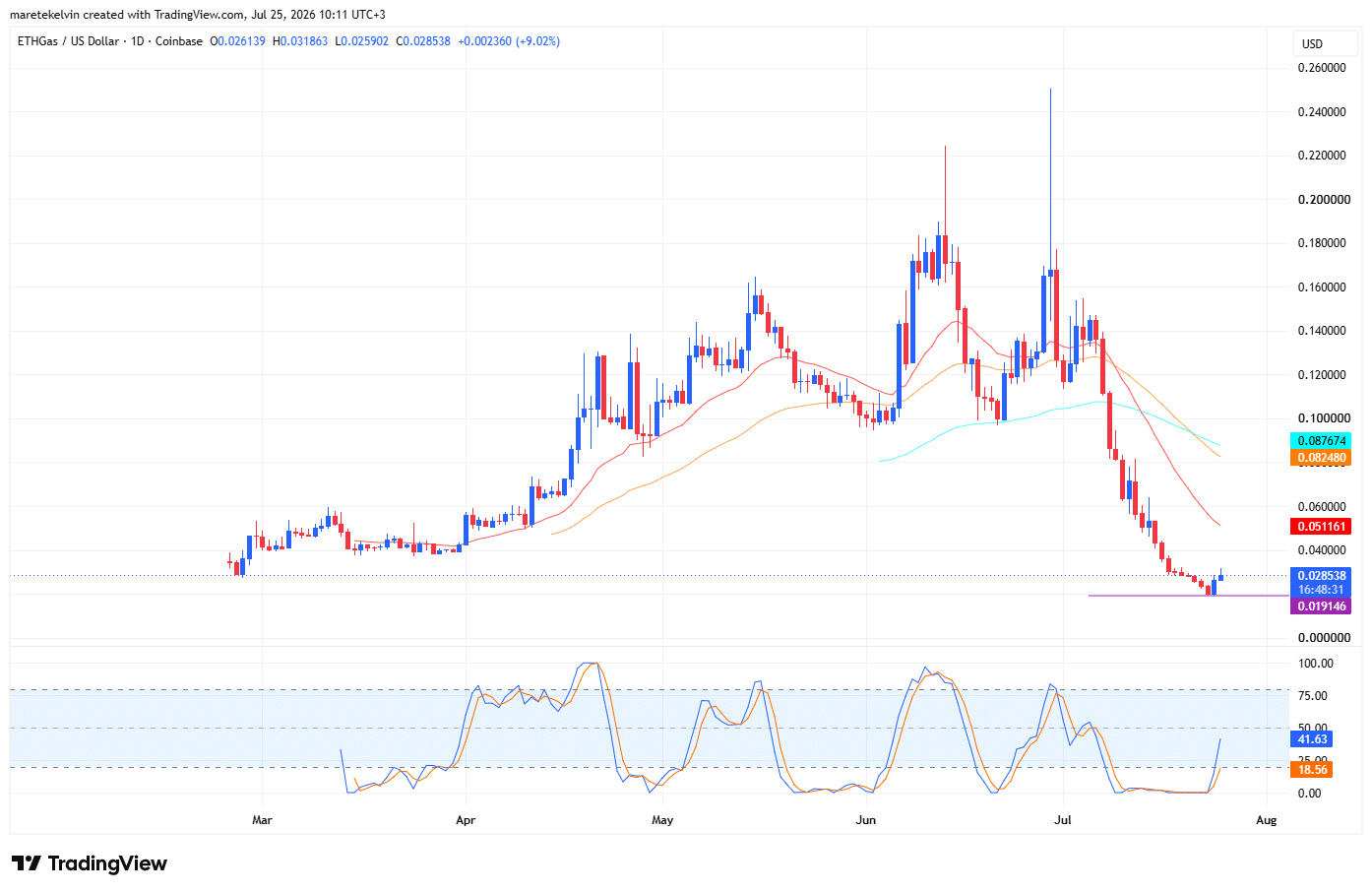
GWEI’s daily chart pointed to a recovering market structure. The token found support near $0.0191 and reclaimed much of its lost ground since then.
Momentum indicators echoed that shift. The Stochastic RSI dropped to an oversold reading near 18.56 before turning higher.
Historically, similar moves marked the end of selling pressure as buyers regained control. The same pattern could play out for GWEI now.
If the reversal holds, the rally could extend toward the next resistance level at $0.064.
Source: TradingView
Final Summary
A near-doubling of Open Interest suggests fresh money, not panic, is chasing GWEI’s rebound.
Long positions dominate GWEI futures — but can sentiment survive a retest of resistance?
North Korean authorities arrested former military hackers accused of stealing state funds from two banks and laundering the proceeds through cryptocurrency.
The group, according to a Daily NK report citing an anonymous source in Pyongyang, allegedly breached the internal systems of the Central Bank of the DPRK and Foreign Trade Bank, diverted foreign currency and state trade funds, and moved the money into overseas crypto wallets.
The report could not be independently verified.
Chinese brokers then converted the assets into U.S. dollars and yuan, Daily NK said. Contacts in the border cities of Sinuiju and Hyesan allegedly exchanged the crypto for cash in real time, with the group splitting transfers into small amounts to avoid detection and using encrypted messaging apps, unregistered phones and Chinese wireless equipment.
North Korea’s National Intelligence Agency arrested the suspects at a Pyongyang safe house on July 12 after officials detected discrepancies in foreign-currency payment approvals and suspicious overseas IP activity, according to the report.
The laundering route mirrors methods used by North Korean hacking groups to cash out stolen crypto.
Apple (NASDAQ: AAPL) spent about a decade trying to build a car and canceled the effort in February 2024. Roughly 2,000 employees were reportedly working on it, and the company is reported to have spent billions before shutting it down and moving much of the team to artificial intelligence (AI).
But Apple’s technology is still finding its way into vehicles.
Missed Nvidia in 2009? This Rare Signal Is Flashing Again. In 2009, a “Double Down” signal flashed for a little-known chipmaker called Nvidia. For the first time in years, that same “Total Conviction” signal is flashing for a company 1/100th the size of Nvidia. Continue »
Apple and Ford (NYSE: F) announced that Apple Maps will power the navigation experience in Ford’s Universal Electric Vehicle Platform beginning in 2027, delivered through a new developer kit Apple calls MapKit for Automotive. The first vehicle on that platform is a midsize electric vehicle Ford has priced around $30,000.
“Our new midsize electric vehicle will be priced around $30,000 and redefines what advanced technology can be,” said Ford CEO Jim Farley in Apple’s announcement.
Image source: Getty Images.
What Apple is actually supplying
The arrangement goes deeper than a phone-mirroring screen. CarPlay projects an iPhone onto a car’s display. This embeds Apple Maps into the vehicle itself, with Ford able to shape the look to match its own design.
Drivers get turn-by-turn directions with natural-language search, live traffic and incident data, and EV routing that preconditions the battery before a charging stop.
The more interesting piece, however, is underneath. Apple said the kit supplies road-level information automakers can use to build hands-free driving experiences, and Ford is wiring it into the next generation of BlueCruise — its hands-free highway system.
That is a different job than drawing a map. It makes Apple a supplier to someone else’s autonomy program.
“Apple Maps delivers the best map experience in the world, and we’re excited to bring the power of Maps’ navigation technology to Ford’s innovative Universal Electric Vehicle Platform,” said Eddy Cue, Apple’s senior vice president of services and health.
Why this beats the version Apple abandoned
Look at what Ford’s side of the business actually earns and the contrast is hard to miss. Ford carries a market capitalization of about $57 billion, which is a little more than 1% of Apple’s roughly $4.9 trillion. It lost money over the past twelve months. And on Friday it recalled more than 565,000 Broncos over a wiring problem that can start an engine fire.
Building cars is a capital-hungry, low-margin business. Apple would have entered it as a beginner.
Selling the software layer into it is the opposite trade. After all, Apple’s services segment produced an all-time record of about $31 billion in revenue in the fiscal second quarter (the period ended March 28, 2026), up about 16% year over year, and services carried a gross margin near 75% in fiscal 2025 against about 36% for products.
Investors should maintain perspective, though. Apple hasn’t disclosed what Ford pays, and a mapping license on one vehicle platform launching in 2027 arguably won’t show up as a line anybody can find in the services number.
The value here is reach, not a fee. Apple Maps has been an iPhone feature since 2012, useful mainly to people already inside the ecosystem. Embedded in a Ford, it becomes something a driver uses whether or not they own an iPhone — and every mile driven feeds map data back.
This comes at a time when Apple’s business already has strong momentum. Fiscal second-quarter revenue rose 17% year over year to $111.2 billion and earnings per share climbed 22% to $2.01, with iPhone setting a March-quarter record. Growth like that came after fiscal 2025 revenue grew about 6% for the full year, so the top line has accelerated sharply.
There are risks, of course. Ford could sell fewer of these vehicles than it hopes, the 2027 timeline could slip, and other automakers may prefer Android Automotive, the competing system from Google parent Alphabet, which already sits in some of Ford’s rivals.
So what do I make of it? A small deal in dollars, and a meaningful one in direction. Apple has now bought its way into vehicles through software and services, expanding its reach and increasing its optionality for future growth opportunities.
Shares trade around $333 as of this writing, near their record high, at about 40 times earnings. That is a premium price for a company this size, and I’d say the stock is a hold rather than a bargain here.
But I own it, and Thursday is a reasonable illustration of why. The car program looked like a failure in 2024. Two years later, Apple is in the dashboard of one of Ford’s most important new vehicles.
Should you buy stock in Apple right now?
Before you buy stock in Apple, consider this:
The Motley Fool Stock Advisor analyst team just identified what they believe are the 10 best stocks for investors to buy now… and Apple wasn’t one of them. The 10 stocks that made the cut are built for long-term growth and could produce monster returns in the coming years.
Consider when Netflix made this list on December 17, 2004… if you invested $1,000 at the time of our recommendation, you’d have $377,990!* Or when Nvidia made this list on April 15, 2005… if you invested $1,000 at the time of our recommendation, you’d have $1,269,518!*
That performance is why people listen. With a track record of beating the S&P 500 by 4x, Stock Advisor offers a distinct advantage. Don’t miss the latest top 10 list, available with Stock Advisor, and join an investing community built for the long haul.
Daniel Sparks and his clients have positions in Apple. The Motley Fool has positions in and recommends Alphabet and Apple. The Motley Fool has a disclosure policy.



![ETHGas [GWEI] surges 38% after Coinbase listing slump – Is $0.064 next?](https://moneyvests.com/wp-content/uploads/2026/07/ETHGas-GWEI-surges-38-after-Coinbase-listing-slump-–-Is-696x392.jpg "ETHGas-GWEI-surges-38-after-Coinbase-listing-slump-–-Is.jpg")