Home Blog Page 184

Struggling farmers unlock $20,000 in credit by putting cows on the blockchain

0
Struggling farmers unlock $20,000 in credit by putting cows on the blockchain

Farmers in Parana, Brazil, struggling to get banks to loan them cash, became the first to tokenize livestock and place 10 dairy milk cows’ tokens for trade on the country’s B3 national stock exchange. They generated nearly $20,000 in credit backed by their cattle, signaling the potential of tokenizing RWAs as a financing tool.

The dairy cow tokenization in Brazil is a world first and serves as a test in a real-world scenario in which farmers are facing increasingly stringent lending limits imposed by local banks on small agricultural businesses.

“We take the cow, which is a real and tangible asset, and transform it into a digital asset backed by a unique code monitored in real time,” Thiago Martins of Cowmed, a Brazilian Agtec company, told CNNBrasil recently.

Martins and his company did not immediately respond to a CoinDesk request for comment.

“This digitization allows for formal registration with B3 as a movable asset,” Martins added. “The process is simple and gives the producer an advantageous opportunity to finance themselves, opening a new alternative for collateral at a time of strong credit restrictions in agribusiness.”


Source link

Bitcoin and ethereum prices today, Thursday, July 23: Prices mixed as analysts debate crypto bottom

0
Bitcoin and ethereum prices today, Thursday, June 18, 2026: Prices sliding despite Iran peace deal


Bitcoin (BTC-USD) opened at $66,081.05 on Thursday, July 23, 2026, 0.6% lower than Wednesday’s opening price. As of 9:22 a.m. ET this morning, the price of bitcoin moved down to $65,054.55.

Ethereum (ETH-USD) opened at $1,933.32 on Thursday, July 23, 2026, up 0.3% from Wednesday’s opening price. The price of ethereum moved lower this morning to $1,899.38 as of 9:22 a.m. ET.

Bitcoin and ethereum have shown slight gains over the past month, fueling cautious optimism that the crypto market has hit a bottom.

In June, Coinbase CEO Brian Armstrong said that bitcoin hit its low point near $60,000. After Armstrong’s prediction, the digital currency dipped below $58,000 briefly. Bitwise CIO Matt Hougan expressed a similar sentiment in early July.

More recently, Grayscale analyst Zach Pandl suggested Bitcoin could fall further, bottoming out in September or October, with a caveat: “If the Fed forgoes rate hikes and economic growth holds up well, Bitcoin’s price may already have bottomed.”

The price of bitcoin this morning was 0.6% lower than Wednesday’s opening price. Here’s a look at how the opening bitcoin price has changed versus last week, month, and year:

  • One week ago: +2.1%

  • One month ago: +3.3%

  • One year ago: -44.9%

The all-time high for bitcoin was $126,198.07 on Oct. 6, 2025. The all-time low value for bitcoin was $0.04865 on July 14, 2010. 

The price of ethereum this morning was 0.3% higher than Wednesday’s open. Here’s a look at how the opening ethereum price has changed versus last week, month, and year:

  • One week ago: +0.9%

  • One month ago: +12%

  • One year ago: -48.4%

The all-time high for ethereum was $4,953.73 on Aug. 24, 2025. The all-time low value for ethereum was $0.4209 on Oct. 21, 2015. 

Bitcoin, ethereum, and other cryptocurrencies are rapidly evolving. Follow the latest developments from Yahoo Finance and others here.

A bitcoin or crypto credit card generally works just like any other credit card. When you apply and get approved, you’ll be assigned a credit limit, and you can use your card to make purchases. If you don’t pay your total balance by your card’s monthly due date, you’ll start to accrue interest at your assigned APR.

The difference is the types of rewards you’ll earn. Instead of earning airline miles, rewards points, or cash back on your spending, you’ll earn crypto. The percentage back you earn on each purchase — such as 3% back on gas or 2% back at restaurants — is converted from U.S. dollars to bitcoin or another cryptocurrency at the current market value. You can then access your rewards through your connected crypto account.

For example, say you make a $500 purchase that earns 3% bitcoin rewards. You’ll earn $15 in U.S. dollars on that purchase. With a bitcoin credit card, your $15 may be converted at the current bitcoin value (about 0.00014 bitcoin in October 2025) and deposited in your crypto account.

The biggest benefit of crypto rewards is the potential for growth over time. Let’s say you had a total bitcoin rewards balance worth $100 USD at the end of 2024. By early October 2025, the value of those same rewards would have increased to about $114 — even if you didn’t earn any additional rewards over that time.

Learn more: Do you need a bitcoin credit card? What you can gain (and lose) by earning bitcoin rewards on spending

Whether you’re brand new to tracking the value of bitcoin and ethereum or a more seasoned crypto investor, Yahoo Finance’s price-of-bitcoin chart and price-of-ethereum chart below show a visual history of how the currency’s value continues to move and evolve. 

More on crypto from the Yahoo Finance team: 


Source link

Ethereum is ‘cheap,’ but CryptoQuant flags $1.15K bottom risk – Why?

0
Ethereum is ‘cheap,’ but CryptoQuant flags $1.15K bottom risk – Why?


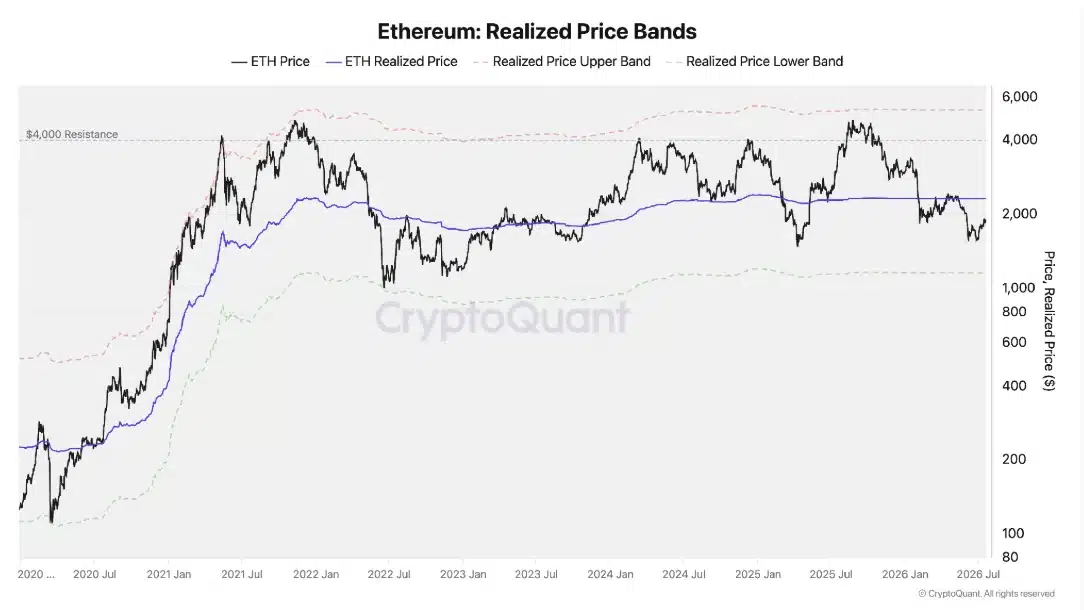
Since February, Ethereum has been ‘cheap’ after the price slipped below its overall cost basis of $2.3K. This means more holders are at a loss, which reduces selling pressure and downside risks.  

However, crypto analytic firm CryptoQuant cautioned that a durable bottom could still be elusive in the medium term. According to the firm, the final market cycle bottom could happen if ETH tags $1.15K, citing a 2022 pattern based on the Realized Price Bands metric.

Ethereum realized price
Source: CryptoQuant

During the 2022 bear market cycle, the altcoin marked a true bottom after hitting the lower band of the metric (dotted green line).

Assuming the projection turns positive, it implies the durable ETH bottom could be feasible if it drops 38% from the press time value of $1,885.  

There were three other signals relative to Bitcoin that showed ETH was still far from hitting its final floor price. 

Ethereum: 3 signals show ETH has not bottomed out

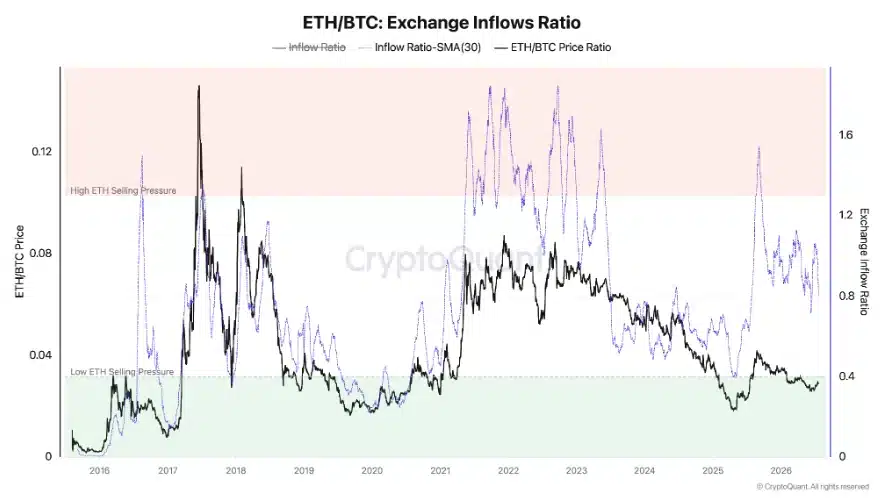
First, the relative selling pressure on ETH based on the ETH/BTC Exchange Inflows Ratio was only halfway to the level that marked the prior market bottom (green zone). 

As of writing, the metric reading was at 0.8 while it dropped to 0.4 during the 2020 and 2025 bottoms. 

Ethereum Ethereum
Source: CryptoQuant 

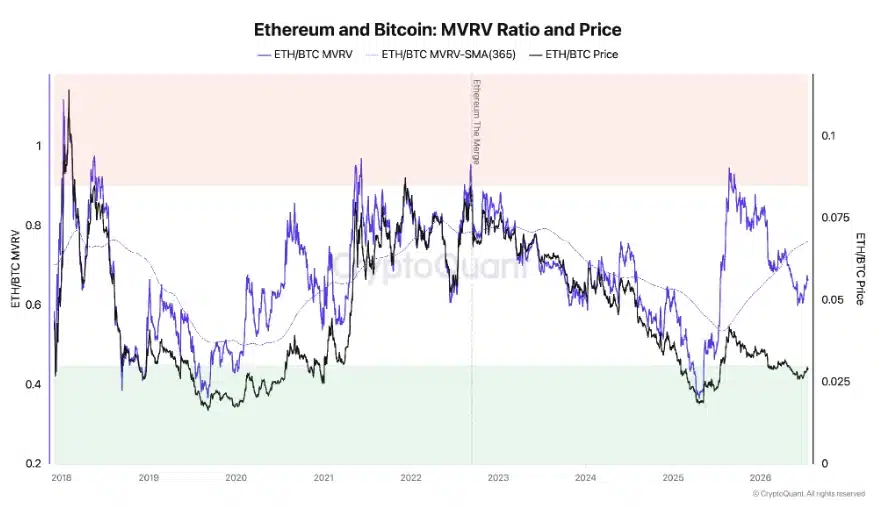
Secondly, another valuation metric, the ETH/BTC MVRV, is also halfway from hitting the bottom levels seen in the 2020 cycle and the 2025 local market bottoms. 

In the two periods, ETH reversed after slipping to 0.025 oversold territory (green). As of writing, the metric was slightly above 0.05, implying it is still far from flagging the past market bottom signal. 

Ethereum BitcoinEthereum Bitcoin
Source: CryptoQuant

Similarly, relative ETH/BTC ETF holdings turned positive in H2 for the first time since last year. Although the ETF demand was improving, it didn’t drop to the levels seen in 2025.

Overall, only spot volumes and Ethereum [ETH] realized price bands showed the altcoin was undervalued and close to past bottom territories. CryptoQuant concluded, 

But MVRV and exchange inflows are not yet at the extremes that have historically confirmed a floor. So a final bottom, and the ETH outperformance that would follow, may still take more time to form.

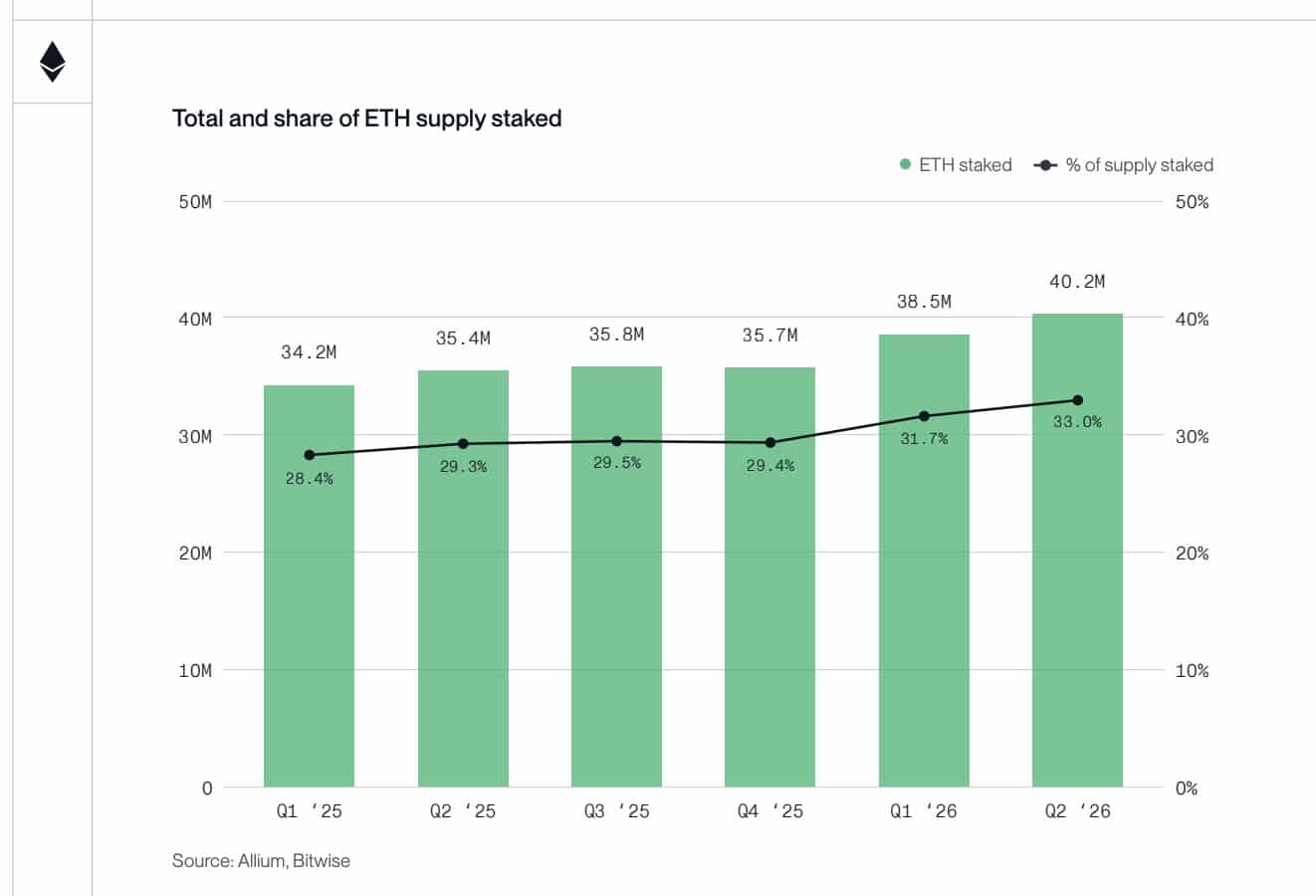
That said, with over 41 million ETH supply in loss, nearly a similar amount has been staked, marking a record 33% staking ratio. Whether the strong staking demand will further lower downside risk remains to be seen.

Ethereum Ethereum
Source: Bitwise 

Final Summary

  • Three key metrics showed that ETH may be far from a durable bottom despite being cheap below $2K. 
  • Staking demand hit a record high in 2026 with over 40M ETH currently staked and over 2.5M ETH on the waiting list. 


Source link

Institutional crypto trading platform LMAX explores strategic alternatives, including sale, IPO

0
Institutional crypto trading platform LMAX explores strategic alternatives, including sale, IPO

Institutional crypto trading platform LMAX Group is working with Morgan Stanley (MS) and investment bank KBW, part of Stifel (SF), to evaluate strategic options, according to three people familiar with the matter.

The company is exploring a sale or public listing that could value the business at up to $5 billion, the people said, speaking on condition of anonymity because the discussions are private.

While all options remain on the table, including a sale, SPAC merger and IPOs in the U.S. or Europe, a Nasdaq listing is currently the preferred route, one of the people said.

The company is in no rush to go public as crypto markets remain weak, with its core foreign-exchange business providing insulation from the downturn, another person said.

A company spokesperson said LMAX declines to comment on speculation. Morgan Stanley declined to comment. Stifel didn’t respond to a request for comment by publication time.

The London-based firm operates institutional trading venues for foreign exchange and digital assets, providing execution, liquidity and market infrastructure to banks, brokers, hedge funds and asset managers. Regulated by the U.K.’s Financial Conduct Authority, it is known for its agency execution model, transparent order books and low-latency trading infrastructure.

Connecting crypto to TradFi

Deal activity across the crypto sector has accelerated this year as exchanges, fintech companies and market infrastructure firms seek to strengthen their digital asset offerings and capture rising institutional demand.


Source link

World’s quietest metal just dropped a huge bullish signal

0
World’s quietest metal just dropped a huge bullish signal


These are good times for copper producers.

Demand for their product is decidedly robust, particularly for copper coil or copper plate or the ultra-pure copper broken up literally into atoms to make tiny, high-speed computer chips. Or all the wiring and related equipment used in data centers.

Copper is trading at $6.32 per pound in New York and $13,895 per ton in London, a bit below all-time highs reached in May. The price is up more than 700%, whether in New York or London, since the end of 1999, Macrotrends noted.

Freeport-McMoRan second-quarter results better than expected

Freeport-McMoRan (FCX), the biggest U.S.-based copper miner, reported a 28% profit gain in the second quarter on July 23, despite a 7.3% decline in revenue, Barron’s confirmed.

The Phoenix, Ariz., company’s shares were down 2.6% to $63.60 at the time of writing on July 23, but are up 24% so far in 2026.

Related: The ultimate AI proxy trade isn’t a tech stock—It’s something more humble

The company operates the giant Grasberg mine in Indonesia and has mines in Arizona and New Mexico, as well as Peru and Chile in South America. Freeport-McMoRan is the largest global producer of molybdenum (used to make high-strength steel), and the company notes that Grasberg is one of the largest single gold deposits in the world.

Copper is a uniquely ubiquitous mineral, believed to have been present on Earth since the planet’s early formation. And it has proven useful throughout the ages, starting as a decorative metal, becoming used in ancient weapons, and now being prized for its ability to transmit information and power.

Copper-alloyed coils at a tube plant in Menden, Germany.Sascha Schuermann / AFP / Getty Images

Copper: You gotta have it

The thing is that the world needs copper just about everywhere:

  • To expand the electrification of the world.

  • To provide the piping used in plumbing for new housing and commercial buildings.

  • To power all the data centers springing up around the globe. Google-parent Alphabet spent $44.9 billion in the second quarter and raised its full-year spending estimate to $195 billion to $205 billion, according to Business Insider. That’s more than double its 2025 spending.

Data centers are massive consumers of copper, at a rate of about 25 to 47 metric tons per megawatt of power. So, for a data center expected to need 100 megawatts of power, the required copper could approach 2,500 to 5,000 tons, a Standard & Poor’s report revealed.

Alphabet needs copper. So do Microsoft, Meta Platforms, Apple, Amazon, and Nvidia. The list goes on.

Alphabet shares were off more than 7% to $318 on July 23 because of investor unhappiness with the company’s projection of a huge increase in capital spending.

But Data Center will probably continue to grow, and that’s music to the ears of Freeport and competitors such as Australia’s BHP and Chile’s state-owned Codelco, Investing News Network reported.

It’s also good news for the top copper-producing countries, which include Chile, Australia, Peru, Russia, and the United States.

More natural resources

Are FCX shares overbought?

The Wall Street consensus estimate was that Freeport-McMoRan would report 62 cents per share in earnings, Barron’s indicated, compared with 54 cents a year ago. Revenue fell 7.3% to $7.03 billion from $7.6 billion a year ago, but the decline was smaller than expected.

Freeport doesn’t offer revenue and earnings guidance. The company does offer estimates for operating cash flow and the prices it expects to see.

The company trimmed its year-end cash flow projection to $8.3 billion from the $8.7 billion estimated in March. The decline was mostly due to a lower overall expected gold price: $4,000 an ounce, down from the $4,500 projected in March. Also, production from its Indonesia mine will be lower than originally expected.

Some analysts believe Freeport’s shares are overbought and will come down a bit. That assumes copper prices and demand will fall, although S&P Global is skeptical of the idea, as I reported previously.

Its estimate, released in January 2026, is that global demand will jump from 28 million metric tons to 42 million tons by 2040. That’s a 50% gain.

Related: Morgan Stanley breaks from the crowd on the U.S. economy

This story was originally published by TheStreet on Jul 23, 2026, where it first appeared in the Economy section. Add TheStreet as a Preferred Source by clicking here.


Source link

Ray Dalio Says ‘Final Battle’ For Hormuz Is Here, Warns Of American Decline

0
Ray Dalio Says 'Final Battle' For Hormuz Is Here, Warns Of American Decline


Topline

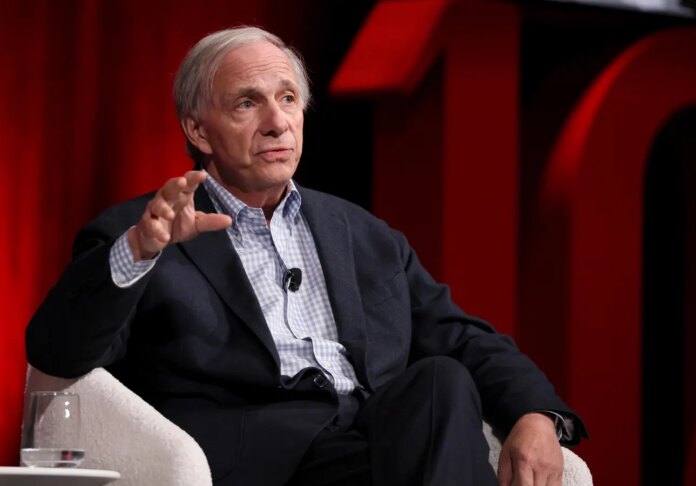
Hedge fund billionaire Ray Dalio on Friday cautioned that the U.S.-Iran war has entered a decisive phase he thinks will determine a winner and loser in the conflict—and indicate if American global power holds into the future.

Key Facts

Dalio on Friday referenced a months-old article he wrote (which has garnered over 3 million views) arguing that if Iran retains any control over the important Strait of Hormuz shipping passage—even the power to negotiate—the U.S. will be judged to have lost the war, with consequences for Gulf allies, global oil flows and the dollar’s reserve currency status.

In his most recent post, he said “it is now clear that it is happening, and we will soon have the final battle and its result.”

The post came shortly after the U.S. Central Command on Friday said American forces struck Iranian military assets, including drone storage sites, in a roughly two-hour operation beginning at 2:15 a.m. local time after Tehran reportedly rejected a U.S. cease-fire proposal delivered by Iraq’s leader..

Iran’s military command has threatened to destroy “all oil, economic, and energy facilities belonging to oil companies in the region that are partly owned by the United States or that cooperate with the United States,” Dalio quoted in his post

Dalio also drew a historical parallel to the 1956 Suez Canal Crisis, arguing that a U.S. failure to secure Hormuz could mark the beginning of American imperial decline, as similar defeats did for Britain, the Dutch Empire and the Spanish Empire.

Key background

The Strait of Hormuz, a narrow waterway between Iran and Oman, is one of the world’s most strategically important shipping lanes—roughly one-fifth of globally traded oil and a significant share of liquefied natural gas passed through it each day until Iran declared the passage “closed” following attacks from the U.S. and Israel in February. Since then, Tehran has repeatedly threatened or disrupted commercial shipping through the strait in response to U.S. and Israeli military operations, turning the waterway into the central battleground of the conflict. The United States has sought to keep the passage open for international shipping, arguing that freedom of navigation through Hormuz is critical to global commerce and energy security. The fighting has sharply reduced tanker traffic, driven up shipping insurance costs and fueled repeated spikes in global oil prices as markets fear supply disruptions.

BIG NUMBER

3. That’s how many vessels trying to pass through the Strait of Hormuz have been taken by the Iranians since the start of the war. Two container ships operated by shipping company MSC were seized in April (their ships and crews have reportedly still not been released) and a tanker belonging to Greek shipping magnate and billionaire George Prokopiou was apparently towed into Iranian waters earlier this week.

WHAT TO WATCH FOR

Whether the U.S. can assemble a multinational coalition to escort commercial ships through the Strait of Hormuz, which Dalio says would be “a big win” for the administration.

FORBES VALUATION

Dalio is the founder of the world’s biggest hedge fund firm, Bridgewater Associates, and has a net worth of about $15.4 billion, ranking him among the 200 richest people in the world.

further reading

ForbesHedge Fund Billionaire Ray Dalio Warns That Trump Could Unleash Global “Capital Wars.” Here’s What He MeansForbes‘Worse Than 2008’—Bitcoin Price Braced As Billionaire Ray Dalio Warns Of ‘Monetary Order Breakdown’ForbesBillionaire Ray Dalio Will Fund ‘Trump Accounts’ For Children In Connecticut, Bessent Says


Source link

World Foundation raises $52.5 million in new funding round lead by Pantera Capital

0
WLD plunges 20% as Hayes dumps token a day after saying he would keep holding it

Poised to become the world’s most prominent “real humans’ network”, the project previously known as Worldcoin aims to establish an identity layer to distinguish unique individuals from automated bots. The protocol relies on custom hardware, known as an Orb, to issue credentials without compromising user privacy.

“World’s technology and proof of human and variations are among the most important building blocks to secure and verify interactions in an increasingly digital driven world,” said Tom Lee, an Eightco Holdings board member who also serves as the chairman of Bitmine, in a statement.

World said the investment comes as it shifts from building the network to scaling the utility.

To date, more than 39 million people have joined the World Network, with more than 18 million humans verified by an Orb, World said in the funding announcement press release. The network has utilized more than 475 million World ID proofs since its launch, scaling its capacity alongside the rollout of its updated, enterprise-ready infrastructure, it added.

World, the Sam Altman-backed digital identity project, unveiled in April what it called its most significant upgrade yet to World ID, positioning the system as “full-stack proof of human” infrastructure aimed at consumers, enterprises and AI agents.


Source link