Poised to become the world’s most prominent “real humans’ network”, the project previously known as Worldcoin aims to establish an identity layer to distinguish unique individuals from automated bots. The protocol relies on custom hardware, known as an Orb, to issue credentials without compromising user privacy.
“World’s technology and proof of human and variations are among the most important building blocks to secure and verify interactions in an increasingly digital driven world,” said Tom Lee, an Eightco Holdings board member who also serves as the chairman of Bitmine, in a statement.
World said the investment comes as it shifts from building the network to scaling the utility.
To date, more than 39 million people have joined the World Network, with more than 18 million humans verified by an Orb, World said in the funding announcement press release. The network has utilized more than 475 million World ID proofs since its launch, scaling its capacity alongside the rollout of its updated, enterprise-ready infrastructure, it added.
World, the Sam Altman-backed digital identity project, unveiled in April what it called its most significant upgrade yet to World ID, positioning the system as “full-stack proof of human” infrastructure aimed at consumers, enterprises and AI agents.
Many treasury companies, particularly Bitcoin DATs, have long looked up to Michael Saylor’s Strategy.
Between 2020 and 2025, Strategy popularized the ‘buy-and-hold’ model. During this period, more publicly traded companies embraced Bitcoin and other cryptocurrencies as treasury reserve assets.
Recent events, however, show that countless businesses are moving away. Either from accumulation at all costs or toward active treasury management.
Instead of only lowering exposure, many businesses have entered a “Full Liquidation” or “Complete Exit” phase, entirely giving up on their crypto treasury strategies.
To begin with, Vaultz Capital abandoned its Bitcoin treasury policy to reposition itself as a cash-backed acquisition platform. Additionally, Satsuma Technology voted to liquidate all 668 BTC, return capital to shareholders, and delist from the London Stock Exchange.
Not completely giving up on Bitcoin
For others, the exit was motivated by changing business priorities and liquidity needs.
For instance, Prenetics sold about 510 BTC before enacting a rule prohibiting the purchase of digital assets in the future.
Meanwhile, Bitdeer sold its whole Bitcoin [BTC] treasury to finance the expansion of its AI data center. Whereas Genius Group liquidated its holdings to pay off debt.
AEG, MAIA Biotechnology, and Alpha Compute also halted or reduced their digital asset plans. They cited working capital needs, crypto market volatility, and restructuring.
Then there is this other group of businesses that moved away from aggressive Bitcoin accumulation, but they haven’t completely given up on the asset.
MARA Holdings, for instance, signaled a more flexible approach to capital management by formally expanding its treasury policy to allow sales from its corporate reserves and selling more than 15,000 BTC to reduce debt.
Who else is selling Bitcoin?
Finally, for operational reasons, Cango sold Bitcoin to help with its AI transformation, and Smarter Web Company liquidated 178 BTC to pay off convertible debt. Meanwhile, Nakamoto Inc. sold Bitcoin to finance operations and acquisitions.
These shifts were accelerated in line with Strategy, recently selling more than 3,600 Bitcoin and starting a $1.25 billion Bitcoin Monetization Program. This change was also observed in Saylor’s statement, in which he stated,
I never said the company wouldn’t sell its Bitcoin.
What is happening in the retail space?
This occurred while the price of Bitcoin was at $65,413.05 at press time. Now, while there is a massive shift within the institutional space, retail investors are also encountering challenges.
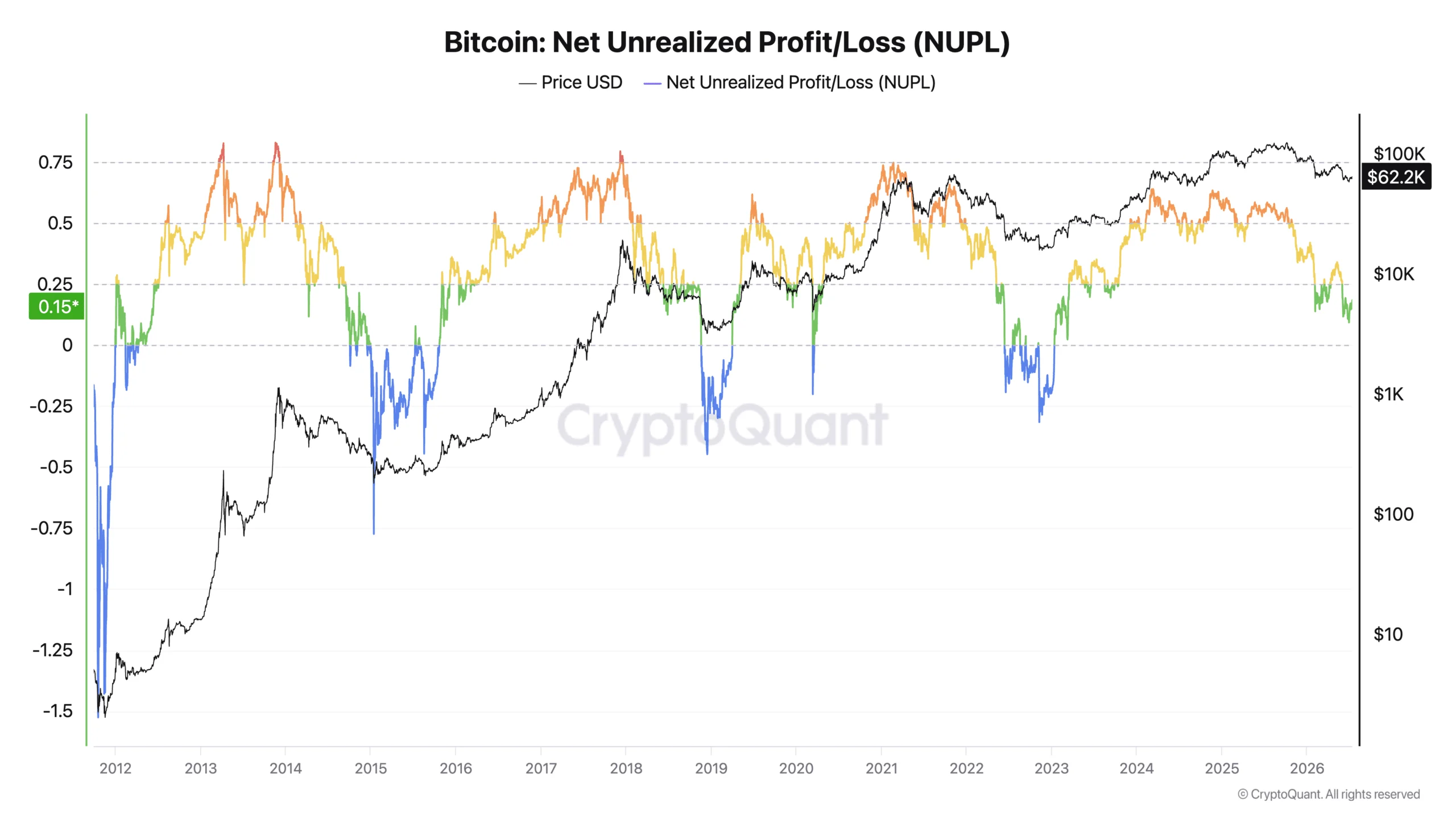
Bitcoin’s NUPL, which once soared into the euphoria zone when the market peaked in 2020 and 2021, has now shrunk hard.
Source: CryptoQuant
The graph suggests that by 2026, NUPL had decreased to about 0.15, suggesting that profits had shrunk and that market sentiment had grown more cautious—though not yet pessimistic.
This was further confirmed by a recent analysis by AMBCrypto, which stated that the bear cycle may be nearing its end sooner than most people think.
Final Summary
Once known for buying and holding, institutions are giving up on Bitcoin as a hedge against inflation.
Strategy that has long been an inspiration to hold is now acting as a playbook to sell.
There was a time when the biggest challenge facing Open Banking was awareness. Businesses needed to understand what it was, how it worked and whether there was value in investing in it. Today, Open Banking has more than proved its worth, with one in five UK consumers and businesses actively using Open Banking, and millions of payments being made through the technology every month. As adoption has grown, businesses have moved beyond asking whether Open Banking is right for them and are instead focusing on how to get the most from it. That shift is reflected in our own research at Payit by NatWest. We found that 42% of UK businesses see improved security and fraud prevention as one of the biggest benefits of Open Banking, while almost a quarter spend more than six hours every month managing and storing customer payment information. Even more recently, our latest research also found that almost all (99%) utilities and telecoms businesses continue to experience payment disruptions, showing there is still significant room for improvement when it comes to modernising payment journeys.
Businesses are no longer asking whether they should explore Open Banking. They’re asking which provider is best placed to support them as they scale. As the market matures, organisations are becoming more selective, looking beyond functionality to consider trust, resilience, long-term stability and the quality of support they’ll receive.
Open Banking has reached an important milestone. The next phase won’t be defined by who entered the market first. It will be defined by who businesses trust to grow with them.
Simplicity is driving the next wave of adoption
One of the biggest lessons we’ve learnt over the past few years is that technology alone isn’t enough.
Open Banking only succeeds if customers actually use it. That means payment journeys need to be simple, intuitive and remove as much friction as possible. If customers have to stop and think about how to pay, you’ve already introduced unnecessary complexity.
The best Open Banking experiences feel effortless. Customers can make secure payments directly from their bank account in just a few clicks, while businesses benefit from faster settlements, fewer failed payments and a smoother customer experience.
The industry’s focus is now shifting from simply onboarding merchants to increasing customer adoption. Offering Open Banking as a payment option is only the starting point.
The real opportunity lies in designing payment journeys that customers actively choose because they’re quick, secure and easy to use.
Open Banking is becoming much more than payments
While payments remain at the heart of Open Banking, the conversation has broadened considerably.
Businesses are increasingly exploring how consented financial data can improve affordability checks, onboarding, lending decisions and support for customers who may be struggling financially. Areas such as digital identity, smart data and Variable Recurring Payments (VRPs) are opening up new opportunities that go far beyond a single transaction.
Merchants are also looking beyond payment initiation. Reporting, refunds and deeper customer insights are becoming just as important in helping businesses improve operational efficiency and deliver better customer experiences.
This next phase of Open Banking is about combining payments and data to solve real business challenges.
Trust has become a competitive advantage
As Open Banking becomes more established, the conversation is naturally shifting. Businesses are no longer just asking whether Open Banking is right for them – they’re asking which provider is best placed to support them for the long term.
Innovation will always matter, but so will resilience, financial stability and long-term investment. Businesses want confidence that the provider they choose today will continue to support them tomorrow.
This is where having the backing of a trusted bank makes a real difference.
For example, Payit combines the agility and innovation of a fintech with the scale, security and resilience of NatWest. Working with a trusted, regulated financial institution also gives businesses reassurance that, throughout the payment journey, money is moving securely between regulated accounts, helping to build confidence for both businesses and their customers.
Beyond the technology itself, businesses increasingly value expert support. As Open Banking evolves, organisations want partners who can help optimise customer journeys, respond to changing market needs and maximise long-term adoption, rather than simply providing the technology.
Looking ahead
The payments landscape continues to evolve rapidly. Cards, account-to-account payments and emerging technologies are developing side by side, while innovations such as digital identity, smart data and AI financial journeys are creating new opportunities for both businesses and consumers.
After more than five years in market, we’ve seen Open Banking move from an emerging innovation to an established part of the UK’s payments ecosystem.
The next chapter isn’t about convincing businesses to adopt Open Banking. It’s about helping them choose the right long-term partner – one that combines innovation with trust, resilience and the expertise to support them as the market continues to mature.
James Hodgson, chief executive of Payit by NatWest
“Open Banking has grown up – now businesses are choosing who they trust” was originally created and published by Retail Banker International, a GlobalData owned brand.
This negotiation over the government conflict-of-interest piece had delayed progress on the Clarity Act for months — now potentially beyond the window in which it could most easily become law in 2026. This week’s release of the final working draft of Clarity included the first ethics language openly circulated, so Democrats are now responding — many of them with disdain.
“Donald Trump raked in more than $1.4 billion from cryptocurrency ventures, and this bill does nothing to prevent him from vacuuming up his next $1.4 billion in crypto profits,” said Senator Elizabeth Warren, the Massachusetts Democrat who is her party’s ranking member on the Senate Banking Committee, referring to the crypto earnings Trump disclosed for 2025. She said the president will “simply ignore the law” as it’s proposed.
So what does the language do? It temporarily bans senior government officials (including the president, vice president, members of Congress and federal judges) from issuing or sponsoring cryptocurrencies.
However, it excuses activity in the past, and there are plenty of crypto business pursuits that don’t check the boxes of issuance or sponsorship, so it’s unlikely Trump would be forced to abandon some of his most prominent ties, such as his ownership stake in World Liberty Financial. He might have to create some legal distance for himself, such as placing certain investments in trusts that he can’t access directly.
CEO Dan Schulman said Friday that Verizon has struck a deal with Google worth more than $1 billion to supply dark-fiber links for the search engine giant’s data centers.
Schulman disclosed the contract during Verizon’s post-earnings call, according to Reuters. The companies did not provide details about the agreement’s duration, geographic scope or deployment schedule.
Dark fiber is installed fiber-optic infrastructure that a customer operates using its own networking equipment. Unlike a managed network service, it gives the customer greater control over capacity and network design. For Google, the agreement will support connectivity between its data-center facilities.
Google’s AI spend
Alphabet reported negative free cash flow of approximately $5.9 billion in the second quarter, its first negative quarter since going public in 2004, as spending on AI infrastructure accelerated.
The Google parent raised its 2026 capital-expenditure guidance to between $195 billion and $205 billion, up from $180 billion to $190 billion, with most of the spending directed toward servers, data centers and networking equipment. Alphabet also plans to expand its use of third-party compute capacity as a temporary bridge while it builds additional infrastructure internally.
Data Center growth
Verizon expects to disclose additional agreements before the end of 2026, although Schulman did not identify the prospective customers or provide individual contract values.
“We have other deals that we expect to announce by year end that taken together are expected to be worth multiple billions of dollars in revenue over the next several years,” Schulman said.
The expected agreements would create a multiyear revenue opportunity beyond Verizon’s core consumer wireless and home-internet operations. The Google contract concerns data-center connectivity and is separate from the companies’ earlier work involving artificial intelligence, cloud services and 5G networks.
In 2021, Verizon and Google Cloud agreed to combine Verizon’s 5G network with Google’s computing services for factory automation. Verizon later offered Google One AI Premium to eligible wireless and home-internet customers, while Google’s Gemini models have been integrated into Verizon’s customer-service systems.
Verizon raises its 2026 outlook
Verizon disclosed the dark-fiber deal as it reported second-quarter results and raised its full-year forecasts for adjusted earnings and free cash flow.
Verizon said it added 184,000 wireless subscribers who pay monthly bills during the quarter, topping the 103,900 additions expected by analysts surveyed by FactSet. The company has rolled out simplified unlimited plans and bundled wireless and broadband billing as Schulman seeks to improve subscriber growth.
Adjusted earnings reached $1.30 per share, above the $1.27 analyst estimate, supported by cost controls and lower device-subsidy spending. Revenue of $34.3 billion missed the $35.16 billion consensus estimate as customers kept phones longer, reducing equipment sales.
Verizon now expects adjusted earnings of $4.99 to $5.04 per share for 2026, up from its previous range of $4.95 to $4.99. It forecast free-cash-flow growth of 9% to 10%, compared with its earlier projection of about 7% or more. Verizon shares rose 3% in premarket trading following the results.
Pi Network’s native cryptocurrency, Pi [PI], fell more than 10% over the past 24 hours. The decline came days after PI gained 11% following the v25 protocol upgrade.
Trading Volume rose about 35%, showing increased activity as PI declined.
By contrast, Bitcoin’s [BTC] Trading Volume fell, suggesting traders were less active across the broader market. This divergence indicated that PI faced stronger coin-specific selling pressure.
On top of a bearish market structure, profit-taking and upcoming token unlocks contributed to PI’s sell-off.
Can PI avoid its all-time low?
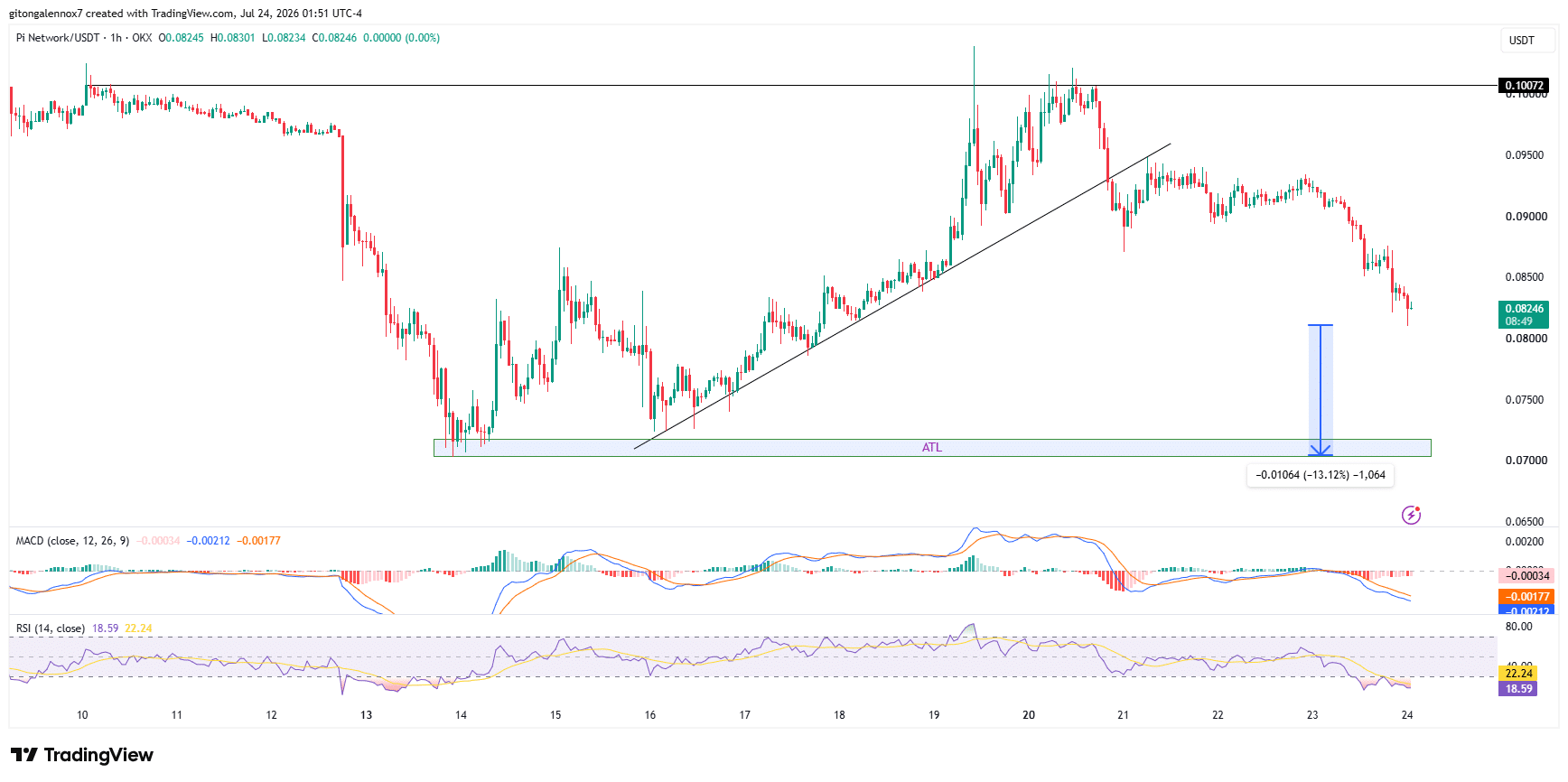
PI’s daily market structure remained bearish, while its hourly structure also turned negative. This reversal came days after PI gained short-term momentum following the v25 protocol upgrade.
Bears regained control after PI broke below the ascending trendline formed from its all-time low.
PI reached its all-time low of $0.07036 before recovering towards $0.10072. However, the latest breakdown left the token around 13% above that record low.
The Moving Average Convergence Divergence [MACD] showed strengthening bearish momentum.
Source: PI/USDT on TradingView
Meanwhile, the Relative Strength Index [RSI] fell to 18, placing PI deep inside oversold territory. A break below $0.0800 could expose the $0.07036 all-time low [ATL].
However, the oversold RSI may signal seller exhaustion and create room for a short-term reversal.
Buyers could also return around demand levels above the record low, especially after another positive catalyst. Even so, PI would need to reclaim its broken trendline before suggesting that bulls had regained control.
Why the selloff may be just the beginning
There is selling pressure from bulls taking profits from the surge that resulted from the frenzy of the v25 protocol upgrade. In total, PI made a move of over 43%, up from an ATL of $0.07036 to $0.10072.
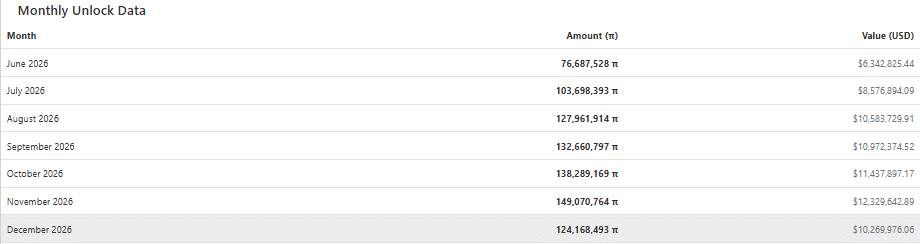
Additionally, the selling pressure is coming from the heavy unlocks that span up to December 2026. Pi Network is set to unlock 775.8 million PI tokens in the months leading up to the end of the year. This will definitely continue increasing liquid supply in the market.
Source: PiScan
On the other hand, additional supply could improve market liquidity and support greater trading activity.
Better liquidity may reduce sharp price swings, but it cannot absorb persistent selling by itself.
Therefore, the PI’s outlook depends on whether new demand can match profit-taking and unlock-related supply.
Without stronger demand, the latest decline could develop into a deeper retest of $0.07036.
Final Summary
Pi Network fell more than 10% in the past 24 hours after breaking below a key market structure.
PI price appears to be headed for further decline amid profit-taking and heavy unlocks, but meeting the liquidity deficit could cushion the sell-off.
The first metric is the new “Net Reserve”, which currently sits at $36.6 billion. That figure takes Strategy’s $55.6 billion BTC reserve (843,775 BTC), adds $3.2 billion in USD reserves, then subtracts $6.8 billion in out-of-the-money convertible debt and $15.5 billion in notional preferred, the $22.3 billion in senior claims that rank ahead of common shareholders in any liquidation scenario.
The company has also updated its multiple to net asset value (mNAV) formula. Under the old accounting method, the accretion threshold would usually keep the company’s mNAV above 1.0x, making it increasingly difficult to know whether new share issuance was actually beneficial for existing holders. The new formula anchors that threshold permanently at 1.0x — if MSTR trades above it, issuing new shares adds BTC per share for all investors.
According to the company, the formula is: MSTR Price, divided by Net Bitcoin Per Share, representing whether MSTR trades above or below Net Bitcoin Per Share after debt and preferred claims.
The BTC Floor ARR is the minimum sustained BTC growth rate over the credit structure’s duration before restructuring becomes a consideration for the company. Currently, the BTC Breakeven ARR sits at 3.22%, meaning bitcoin only needs to appreciate faster than that rate annually for Strategy to fund all interest and dividend obligations through BTC gains alone, in perpetuity.
Strategy has also introduced new bitcoin market metrics, such as the premium to the 200-week moving average and the Fear and Greed Index.